
Buying a Business? The Financial Due Diligence
Checklist Nobody Gives You
The broker package is designed to sell the business, not protect you. This is the financial due diligence checklist that surfaces what's actually there — before you sign.

If you're buying a business in Montana — or anywhere else — the standard due diligence package the broker hands you is designed to get the deal done, not to protect you. Three years of tax returns, a P&L, and a handshake isn't due diligence. It's a starting point.
We've worked on acquisitions and financial reviewswhere the stated EBITDA was off by 40% once we normalized the numbers. We've found six-figure payroll tax liabilities that weren't in any disclosure document. And we've seen buyers in Kalispell and across the Flathead Valley close on businesses that looked profitable on paper and bleed cash from day one.
This is the financial due diligence checklist nobody gives you— the one that surfaces what's actually there before you sign.
Table of Contents
- 01Why Most Buyers Get Burned
- 02What Financial Due Diligence Actually Is
- 03The CLEAR Framework: 406CG's Acquisition System
- 04Quality of Earnings: The Report That Changes Everything
- 05Working Capital: The Number That Blindsides You at Closing
- 06Hidden Tax Liabilities the P&L Won't Show You
- 07Balance Sheet Archaeology
- 08Cash Flow Forensics
- 09Operational Infrastructure: Can It Run Without the Owner?
- 10Debt, Liens & Off-Balance-Sheet Obligations
- 11Red Flags & Walk-Away Triggers
- 12Building Your Due Diligence Team in Montana
- 13How 406 Consulting Group Guides Montana Buyers
- FAQFrequently Asked Questions
Why Most Buyers Get Burned — And It's Not Their Fault
The business brokerage industry is built around getting deals closed. That's not a criticism — it's just reality. Brokers are compensated on commission at close, which means the information package you receive is curated to present the business in its best light. The broker isn't lying; they're selling.
The problem is that most buyers — especially first-time buyers — don't know what's missing from that package. They see three years of tax returns showing consistent profit and assume the numbers are real. They aren't always. Owner add-backs, one-time revenues, related-party transactions, and aggressive accounting can make a $400,000 EBITDA business look like an $800,000 one on paper.
What the broker package shows you
- ✗3 years of tax returns
- ✗Seller-prepared P&L summary
- ✗List of equipment and assets
- ✗Recast EBITDA with add-backs
- ✗Asking price and deal structure
What real due diligence uncovers
- ✓Normalized, audited Quality of Earnings
- ✓Hidden tax liabilities and liens
- ✓Real working capital requirements
- ✓Customer concentration and churn
- ✓Key-person dependency and systems gaps
Industry stat:According to M&A research, over 50% of business acquisitions fail to meet buyer expectations within three years. The leading cause isn't market conditions — it's undiscovered financial and operational problems that proper due diligence would have caught.
What Financial Due Diligence Actually Is
Financial due diligence is not an audit. An audit verifies that financial statements comply with accounting standards. Due diligence answers a different question: Is this business worth what the seller is asking, and what risks am I taking on if I buy it?
Real financial due diligence for a business acquisition covers five domains: the quality and sustainability of earnings, the accuracy of the balance sheet, the actual cash generation of the business, the tax exposure being inherited, and the operational infrastructure holding it together. Most buyers only look at the first one — and only on the surface.
| What People Call DD | What Real DD Looks Like |
|---|---|
| Review 3 years of tax returns | Normalize 3 years of P&Ls — remove owner benefits, one-time items, related-party transactions |
| Look at the P&L | Build a Quality of Earnings analysis — identify recurring vs. non-recurring revenue |
| Check for obvious debt | Pull UCC filings, run lien searches, review all lease obligations |
| Confirm assets exist | Verify asset condition, depreciation schedule accuracy, and any encumbrances |
| Ask about lawsuits | Review all legal disclosures, pending claims, and regulatory compliance status |
The depth and cost of due diligence should scale with deal size. For a $500,000 acquisition, a thorough owner-led review with a fractional CFO assisting is often sufficient. For a $5M deal, you need a formal Quality of Earnings report from a third-party accounting firm. Either way, the framework is the same.
The CLEAR Framework: 406CG's Acquisition Due Diligence System
Every acquisition we advise on at 406 Consulting Group runs through the same five-pillar system. We call it the CLEAR Framework— because by the time you're done, there should be no ambiguity about what you're buying.
Cash
What is the business actually generating in free cash flow after owner compensation is normalized? Not EBITDA. Actual cash available to service debt, invest, and pay you.
Liabilities
What obligations are you inheriting? This includes on-balance-sheet debt, off-balance-sheet leases, tax liabilities, UCC liens, personal guarantees, and pending litigation.
Earnings
Is the revenue real, recurring, and sustainable? A Quality of Earnings analysis strips out one-time items, related-party arrangements, and aggressive accounting to reveal the true earnings power of the business.
Assets
Are the assets on the balance sheet worth what they're stated at? Are they encumbered? Inventory obsolescence, aged receivables, and overstated equipment values are common traps.
Risk
Where is the business fragile? Customer concentration, key-person dependency, regulatory exposure, and systems gaps are the risks that don't show up in financial statements but destroy value on day one.
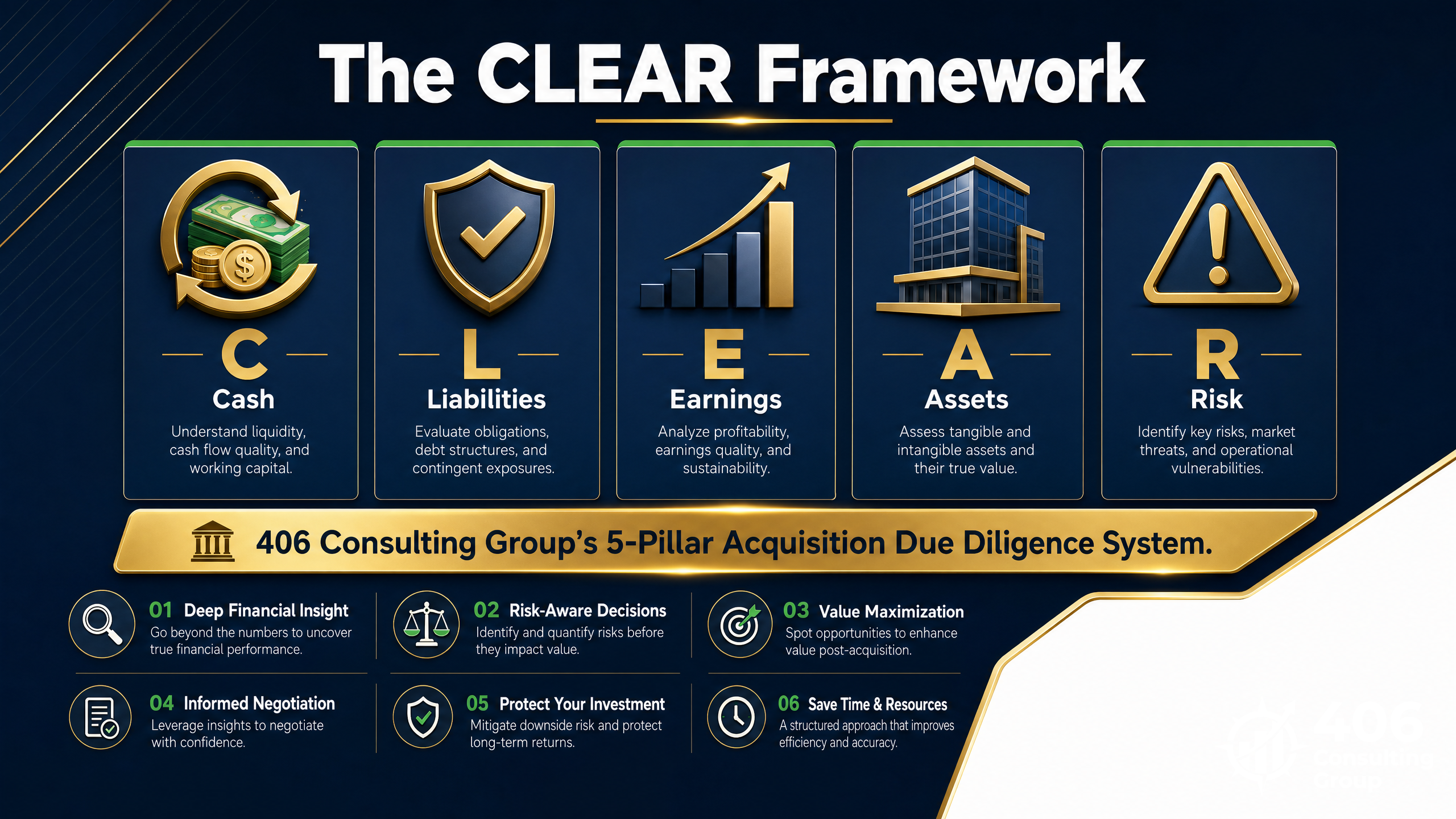
How to use this framework:Work through each pillar sequentially. Cash and Earnings tell you what you're paying for. Liabilities and Assets tell you what you're inheriting. Risk tells you how durable the business is after you own it. A deal that passes all five is worth pursuing. A deal that fails two or more needs to be repriced or walked away from.
Quality of Earnings: The Report That Changes Everything
A Quality of Earnings (QofE) analysis is the single most important financial document in a business acquisition. As the AICPA emphasizes, a QofE report goes well beyond standard financial statement review — it normalizes earnings by removing non-recurring items, owner-specific benefits, and accounting choices that inflate the apparent profitability of the business.
The seller's broker will give you a "recast" EBITDA that adds back owner salary, depreciation, and a list of "one-time" expenses. Be skeptical. A real QofE looks at those add-backs critically — because sellers have every incentive to maximize them, and many of those "one-time" items happen every year.
What a QofE Normalizes
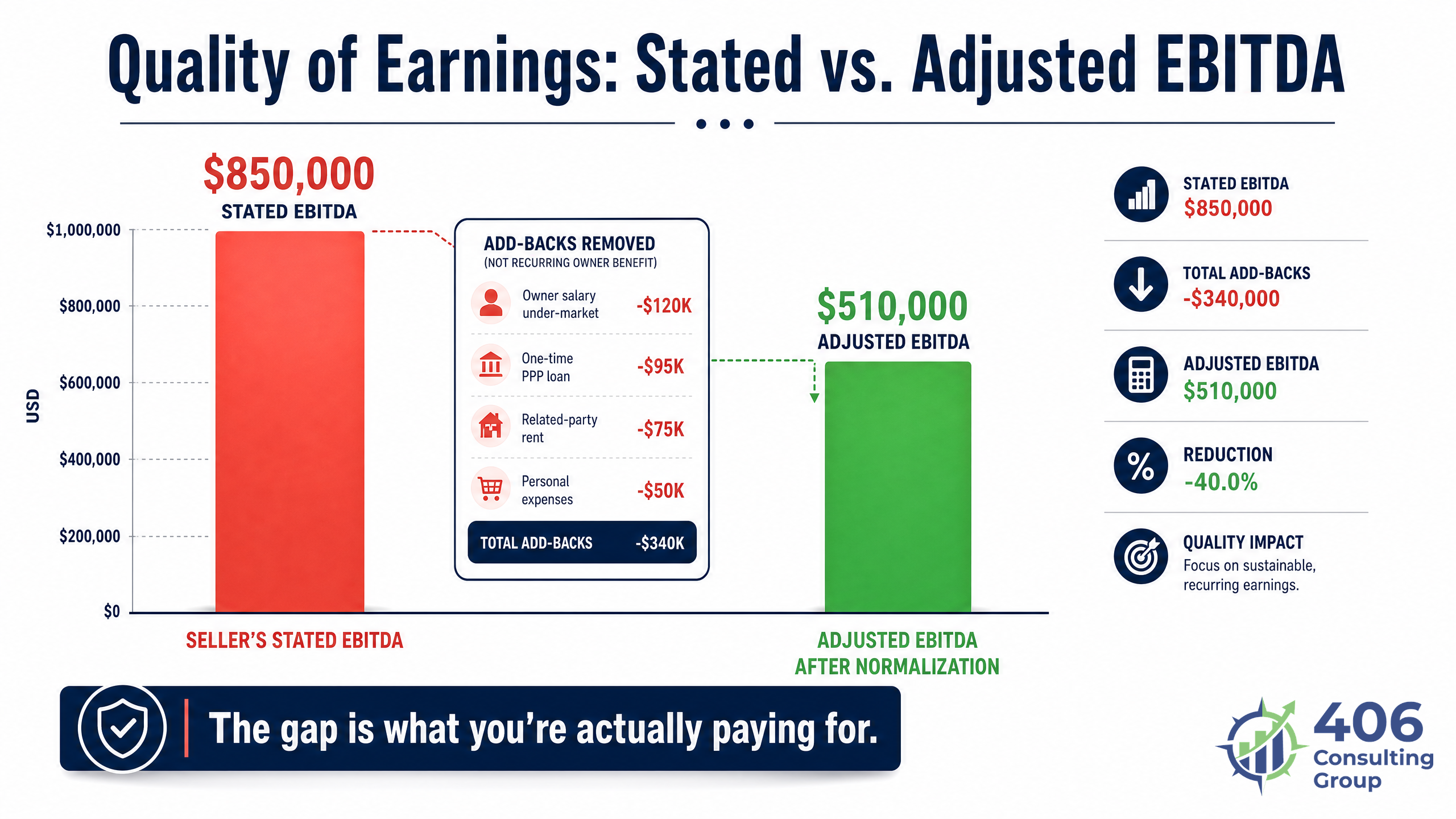
Case Study: The $340K EBITDA Overstatement
Flathead Valley construction services business — 2025
A buyer came to us after signing an LOI on a Flathead Valley contractor. The broker's recast showed $820,000 in adjusted EBITDA — a compelling number at the asking price of $2.1M.
When we ran the QofE, we found the real number was $480,000. The overstatement came from four sources: an owner salary pegged $95,000 below market rate (meaning a replacement owner would cost $95K more), $120,000 in revenue from a one-time government contract that wouldn't recur, $75,000 in rent paid to a related-party LLC at below-market rates (which would normalize higher under new ownership), and $50,000 in personal expenses buried in general and administrative costs.
Outcome: The buyer renegotiated from $2.1M to $1.45M — a $650,000 reduction — based on the corrected earnings figure. The deal closed. The seller accepted because the buyer had the documentation to support the revised valuation.
At what deal size do you need a formal QofE? For deals under $1M, a detailed buyer-led analysis with a financial advisor is usually sufficient. For deals over $1M, budget $15,000–$40,000 for a third-party QofE report. It is almost always the best money spent in an acquisition.
Working Capital: The Number That Will Blindside You at Closing
Working capital requirements in an acquisitionare one of the most commonly misunderstood — and most expensive — surprises buyers face. Working capital is the cash the business needs to operate day-to-day: to pay suppliers before customers pay you, to cover payroll while waiting on receivables, to hold inventory that isn't yet sold.
In most acquisition agreements, there's a "working capital target" — an agreed-upon level of working capital that the seller must leave in the business at close. If the actual working capital at close is below the target, the seller owes the buyer the difference (a "working capital adjustment"). If it's above, the buyer owes the seller.
The problem: most buyers don't know what the right working capital target is. They accept the seller's proposed target without running the math themselves — and then spend the first 60–90 days of ownership scrambling to fund operations that the business can't self-fund at the purchase price paid.
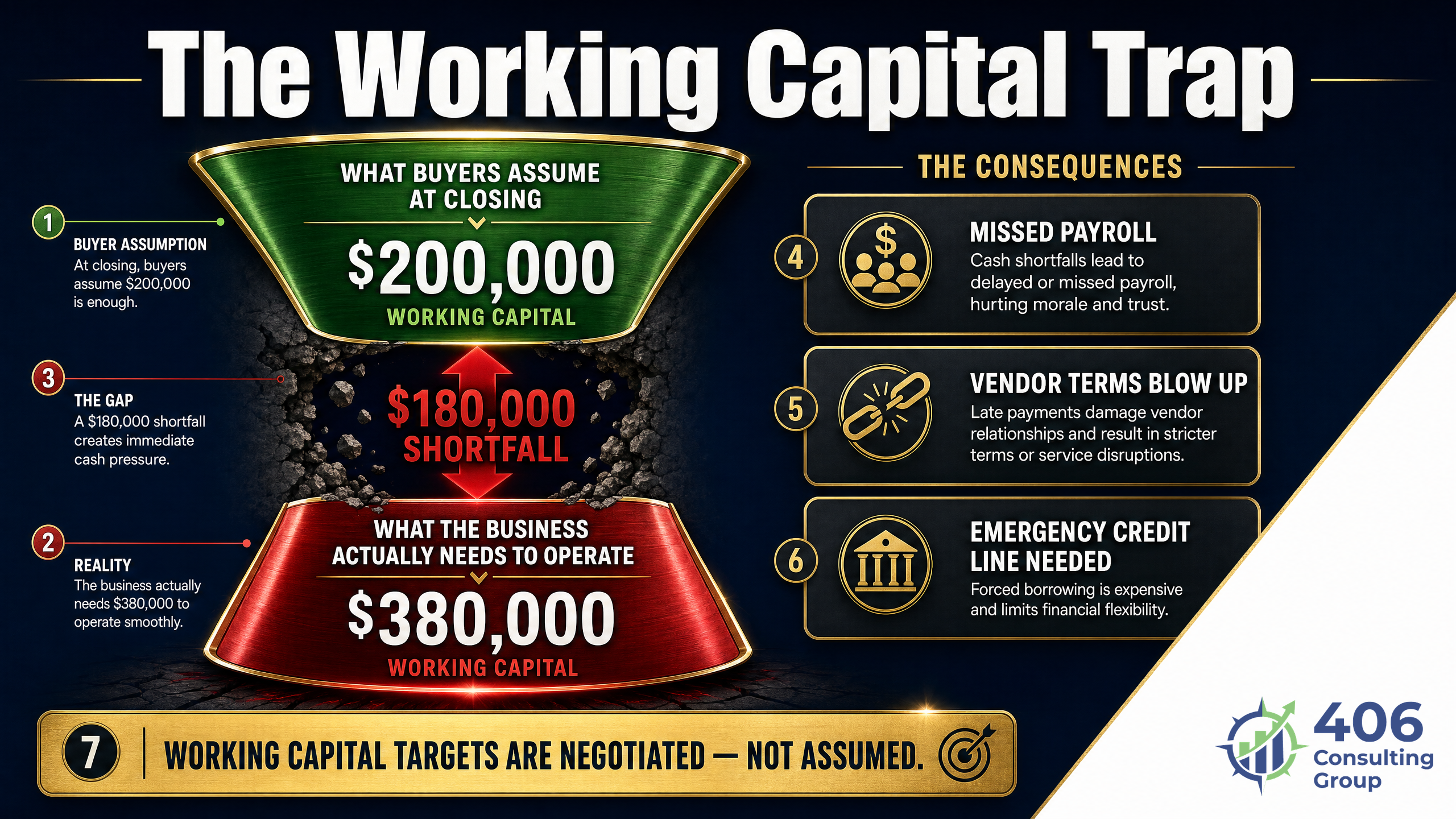
30–45
Days of operating expenses
Minimum working capital buffer for most businesses
$180K
Median working capital shortfall
Discovered post-close in underfunded acquisitions
60%
Of buyers underfund operations
In the first 90 days post-close, per M&A research
Working Capital Due Diligence Checklist
Hidden Tax Liabilities When Buying a Business
Tax liabilities are the most common category of post-close surprise — and among the most expensive. In an asset purchase (the most common structure for small business acquisitions), many tax liabilities don't transfer. In a stock purchase or entity purchase, they all do. Even in an asset deal, some liabilities follow the business regardless of deal structure.
Montana has its own state tax landscape administered by the Montana Department of Revenue, and buyers acquiring businesses with any out-of-state revenue exposure also face sales tax nexus rulesthat the Tax Foundation notes are increasingly aggressive post-Wayfair. Here's what to look for:
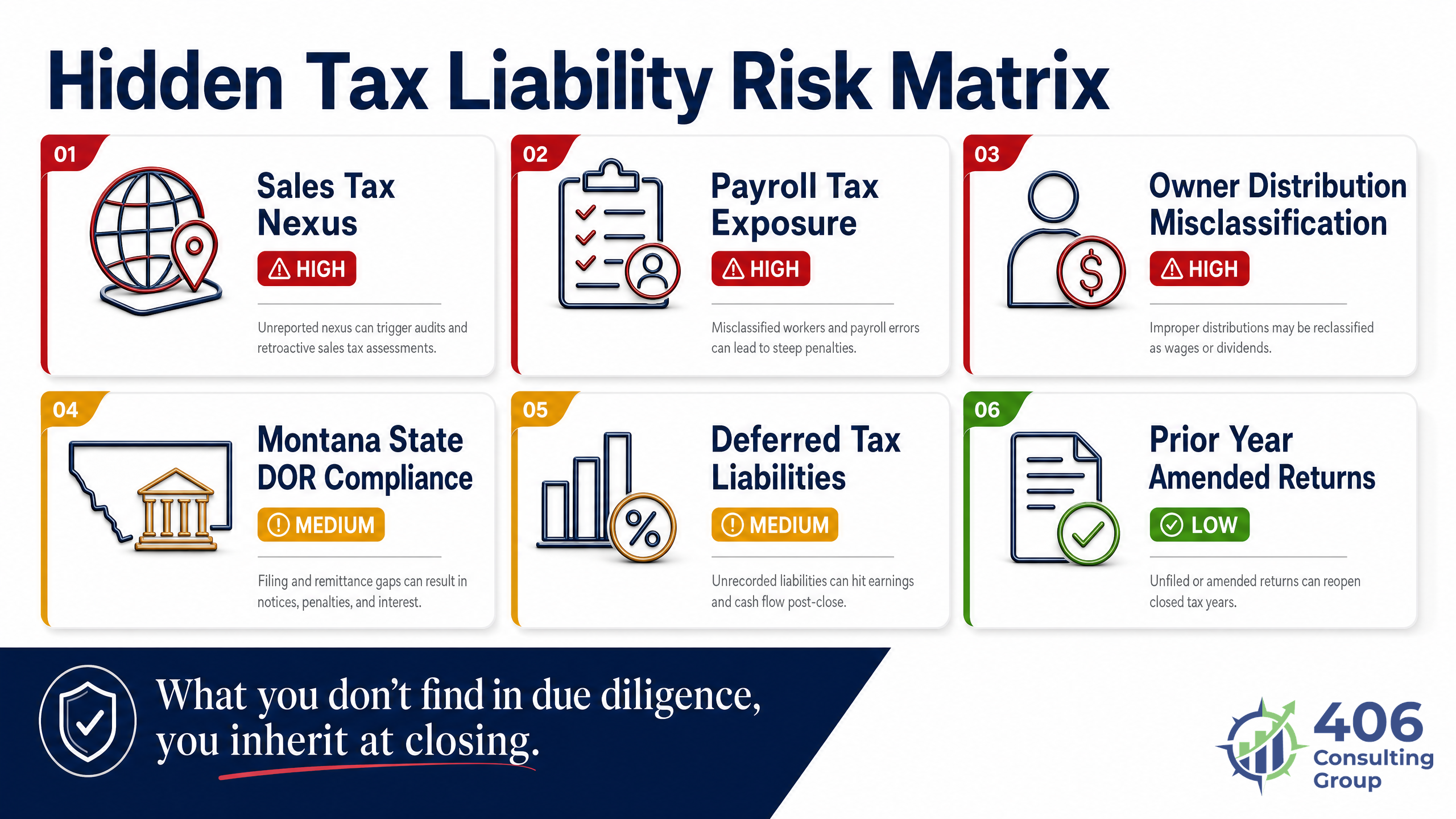
Payroll Tax Exposure
High RiskUnpaid or underpaid payroll taxes (941 deposits) are a successor liability in most states. Request IRS transcripts and verify all 941 filings are current. A $50,000 payroll tax delinquency becomes your problem the moment you close.
Sales Tax Nexus Risk
High RiskIf the business has sold into other states and hasn't been collecting sales tax, you may be buying years of exposure. Run a nexus analysis — where has the business shipped product, employed workers, or stored inventory?
Owner Distribution Misclassification
High RiskMany small business owners run personal expenses through the business. The IRS treats unreported compensation as wages subject to payroll tax. These adjustments can generate significant back-tax liability.
Montana DOR Compliance
Medium RiskMontana has no general sales tax, but does have business equipment taxes, lodging taxes (for relevant industries), and withholding requirements. Confirm all state filings are current.
Prior Year Amended Returns
Medium RiskAsk directly: have any prior years been amended, or are any under audit? An open IRS or state audit is a red flag that requires resolution before close — or a meaningful price reduction.
The 406CG rule:Request IRS tax transcripts (Form 4506-C) for the last 3 years as part of your document request list. Transcripts show what was actually filed and paid — they can't be falsified the way a seller-provided P&L can.
Balance Sheet Archaeology: Reading What's Actually There
Most buyers read the P&L. Fewer read the balance sheet. That's a mistake — because the balance sheet is where the bodies are buried. Aged receivables that will never be collected. Inventory that hasn't moved in two years. Related-party loans that the seller will want paid back at close. Equipment that's fully depreciated but still being counted as an asset at inflated book value.
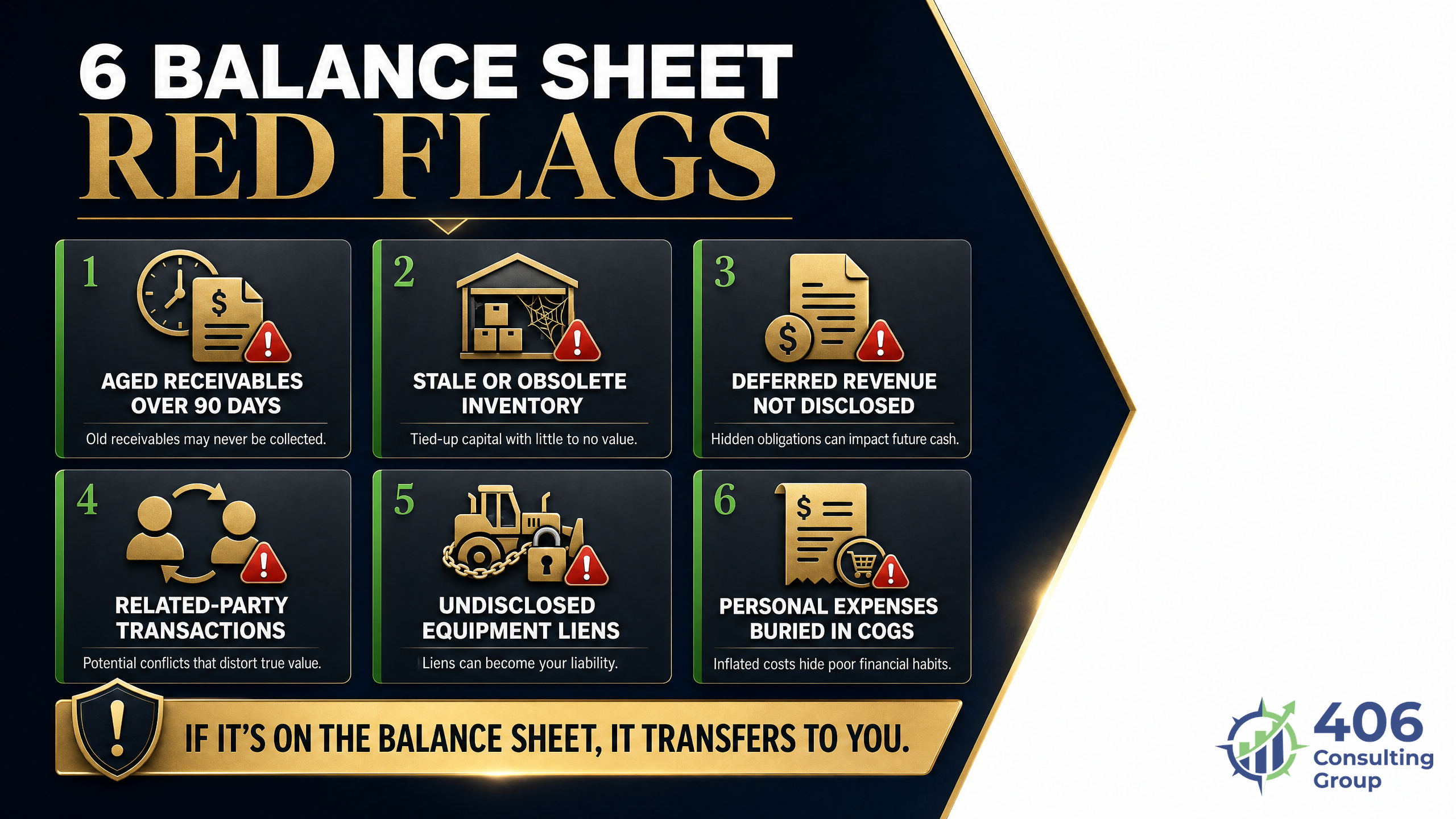
Accounts Receivable Over 90 Days
Any AR aging more than 90 days has a low probability of collection. Exclude it from your working capital calculation and negotiate accordingly. Ask to see the AR aging report — not a summary, the full aging.
Inventory Obsolescence
Inventory on the balance sheet is only worth what it can be sold for, not what was paid for it. Walk the warehouse. Look for product that hasn't moved. Montana construction businesses often carry slow-moving materials that are counted at cost but worth a fraction of that.
Deferred Revenue
If the business has taken deposits or advance payments for work not yet completed, those are liabilities — not assets. You'll have to do the work without getting paid again. Make sure deferred revenue is properly reflected in the deal structure.
Related-Party Transactions
Transactions between the business and entities the seller controls (a real estate LLC that owns the building, a vendor the seller's family member owns) are frequently at non-market terms. These normalize under new ownership — often in the wrong direction.
Undisclosed Equipment Liens
Run a UCC search in every state where the business operates. Equipment shown on the balance sheet may have outstanding lien holders who have priority claims. You don't want to buy equipment that the bank legally owns.
Shareholder Loans
If the seller has loaned money to the business (or vice versa), these typically need to be settled at close. Get clarity on all inter-company and shareholder loan balances before signing the purchase agreement.
Cash Flow Forensics: Is This Business Actually Profitable?
EBITDA is a valuation metric. It is not a measure of how much cash the business puts in your pocket. Subtract debt service, required capital expenditures, and working capital needs from EBITDA, and you get something closer to actual free cash flow — which is what pays your salary and services the acquisition loan.
The Chaos Trap
A Montana HVAC company shows $600,000 EBITDA. Buyer pays 4x = $2.4M. After SBA loan debt service ($180K/yr), capex to replace aging equipment ($120K/yr), and owner salary ($140K), free cash flow is $160K. That's a 6.7% return on a $2.4M investment — before any revenue risk.
The 406CG Approach
Run a 3-year free cash flow model before agreeing to any valuation. Start with normalized EBITDA. Subtract: debt service at the expected financing terms, maintenance capex (not growth capex), normalized owner compensation, and working capital build. What's left is your actual return.
Two specific cash flow issues to investigate thoroughly in your business acquisition due diligence:
Customer Concentration
If one customer represents more than 20% of revenue, that's a concentration risk. If they represent more than 40%, it's a deal-threatening risk. Ask for the top 10 customers by revenue for the last 3 years and look for churn.
Seasonality and Revenue Timing
Many Montana businesses have significant seasonal swings. A landscaping or construction business may do 70% of its revenue in 5 months. Model monthly cash flows — not annual averages — to understand how the business funds itself through slow periods.
Revenue Recurrence
Is revenue contract-based, repeat, or one-time? A business with 80% repeat customers from service contracts is worth significantly more than one that re-hunts every dollar of revenue each year. Ask for customer-level revenue history.
Operational Infrastructure: Can It Run Without the Owner?
This is the due diligence category that doesn't show up in financial statements — and it's often the one that destroys the most value post-close. The question isn't whether the business is profitable. It's whether it can stay profitable once the seller walks out the door.
In many small businesses — especially in Montana trades and professional services — the owner is the business. They have the key customer relationships. They hold the licenses. They do the technical work. The "business" you're buying is really just their client list and their goodwill, which has a limited shelf life once they're gone.
Operational Infrastructure Checklist
The transition period:A seller's willingness to stay on for 3–6 months post-close is a positive signal — but it's not a substitute for documented processes. Get the knowledge out of their head and into written procedures during due diligence, not after close.
Debt, Liens & Off-Balance-Sheet Obligations
Not everything the business owes is on the balance sheet. Equipment leases, software subscriptions, personal guarantees, environmental liabilities, and unfunded pension obligations are real financial obligations that don't always show up in the financials you're reviewing. A thorough buying a business checklist always includes a lien and obligation sweep.
| Obligation Type | Where to Find It | Risk Level |
|---|---|---|
| UCC Liens (equipment, inventory) | Secretary of State UCC search | High |
| Equipment operating leases | Seller disclosure + contract review | Medium |
| Real estate leases | Lease agreement + assignment clause | High |
| Personal guarantees (bank loans) | Bank documents + seller disclosure | High |
| Pending litigation | Seller disclosure + court record search | High |
| Environmental liabilities | Phase I Environmental Assessment | Medium |
| Deferred compensation / pensions | HR records + benefit plan docs | Medium |
| Software / SaaS contracts | Vendor contracts + auto-renewal terms | Low |
Red Flags & Walk-Away Triggers
Most deals have issues. The question is whether they're priceable or deal-killers. Here are the seven walk-away triggers we've seen in Montana acquisitions — problems serious enough that no price adjustment can adequately compensate for the risk.
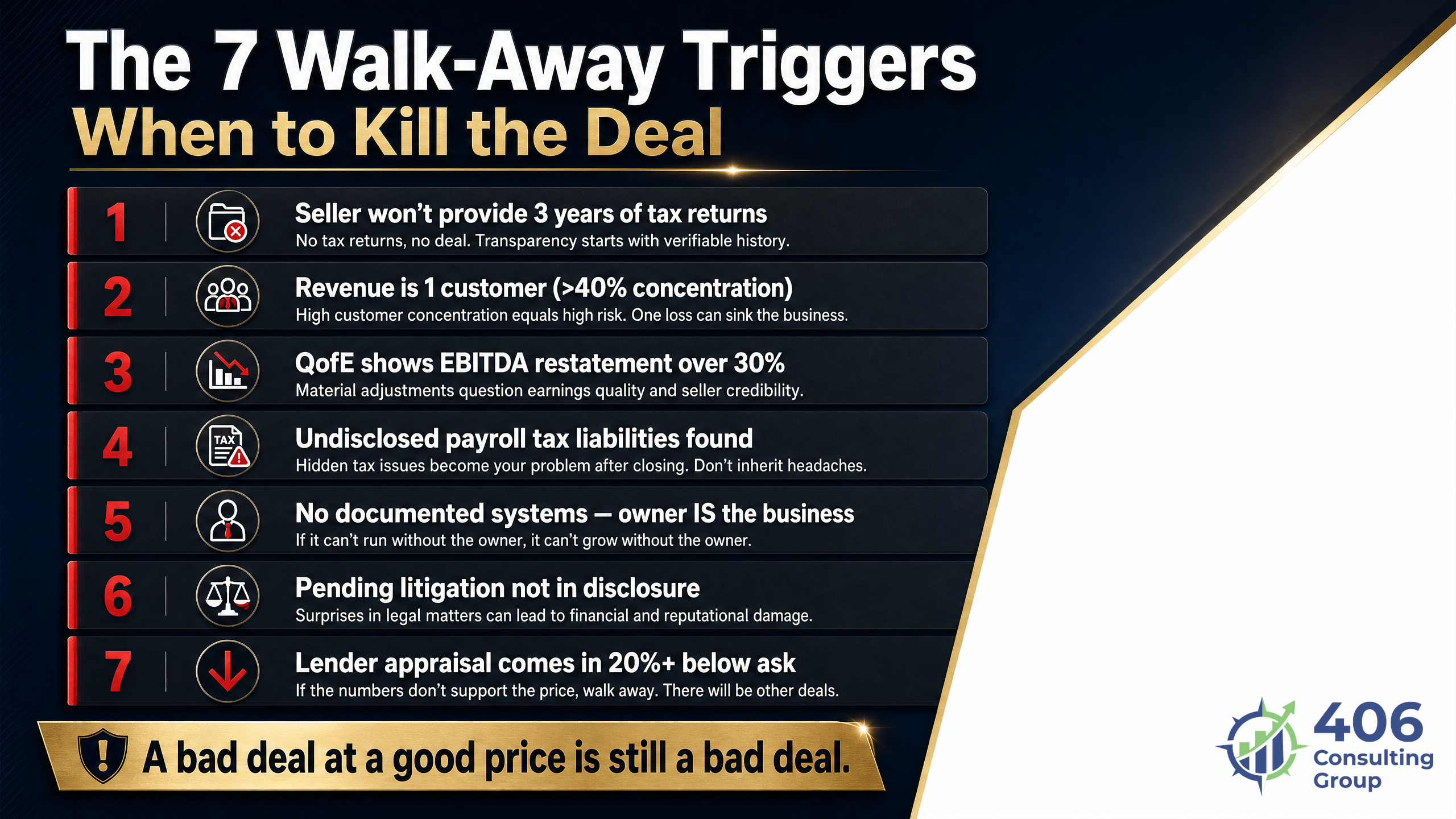
Seller won't provide 3 years of actual tax returns
If they'll only share internally prepared financials, you have no way to verify what was actually reported to the IRS. Walk away or require transcripts directly.
Revenue is more than 40% from one customer
Customer concentration at this level means the business doesn't really have a business — it has a contract. If that customer leaves, so does your investment.
QofE shows EBITDA restatement of more than 30%
A 30%+ gap between stated and normalized earnings suggests either aggressive accounting or deliberate misrepresentation. Either way, the valuation needs to reset substantially.
Undisclosed payroll tax liabilities discovered
Payroll tax delinquencies are personal liability for business owners in some structures, and they transfer in stock deals. They signal deeper compliance problems.
No documented systems — owner IS the business
If every key relationship, license, and process lives in the seller's head, you're not buying a business. You're buying goodwill that walks out the door at close.
Pending litigation not in initial disclosure
Material omissions from disclosure documents are a legal problem and a trust problem. If they omitted known litigation, what else is missing?
Lender appraisal comes in 20%+ below ask
A large appraisal gap suggests the market price is not supported by the asset values. The seller's price is built on optimism, not fundamentals.
The price adjustment rule:For issues that don't rise to walk-away level, the right response is a price reduction — not a verbal assurance from the seller. Every discovered liability should either be cured before close or reflected as a dollar-for-dollar reduction in the purchase price.
Building Your Due Diligence Team in Montana
You cannot do this alone — and you shouldn't try to. The cost of a proper due diligence team is 1–3% of the deal price. The cost of skipping it can be the entire deal. For Kalispell and Flathead Valley buyers, here's who you need and what each person does.
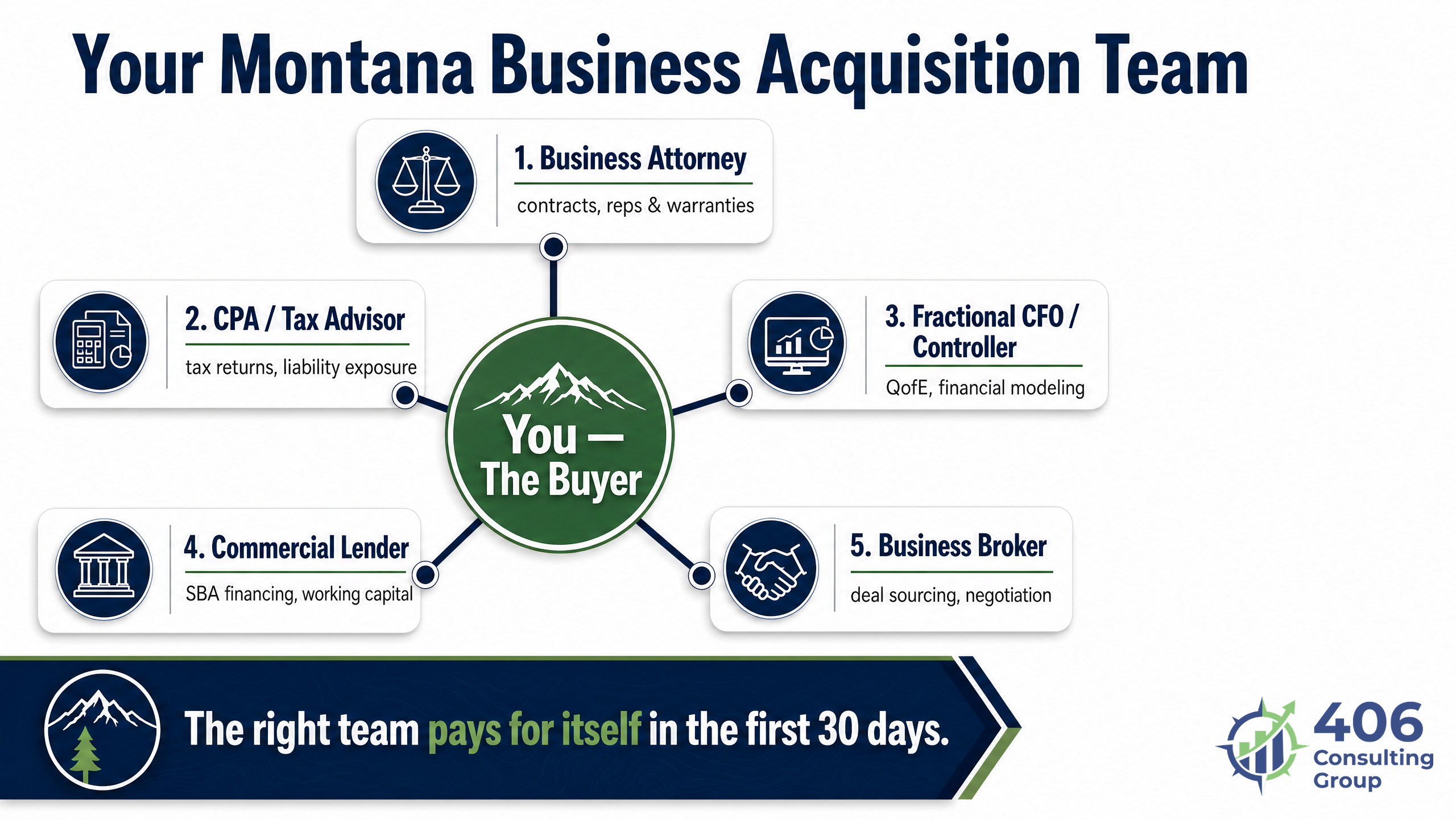
Business Attorney
From LOI through closeReviews the purchase agreement, reps and warranties, and indemnification provisions. Handles closing documents. Montana-specific legal knowledge matters — use a local attorney who does M&A work.
CPA / Tax Advisor
Before LOI through post-closeReviews tax returns, identifies hidden tax liabilities, advises on deal structure (asset vs. stock purchase tax implications), and sets up the entity structure for the new ownership.
Fractional CFO / Controller
During due diligenceRuns the QofE analysis, builds the free cash flow model, reviews the working capital target, and stress-tests the financial projections. This is where 406 Consulting Group typically engages — bringing the same financial rigor to a $1M acquisition that a Fortune 500 buyer brings to a $100M one.
Commercial Lender / SBA Specialist
Early — before LOI if possiblePre-qualifying your financing before you're deep in due diligence saves time and avoids the risk of a deal falling apart at the financing stage. SBA 7(a) loans are the most common financing vehicle for small business acquisitions — understand your terms before you negotiate the purchase price.
Industry Specialist (Optional)
Early due diligenceFor specialized industries (construction, healthcare, food service), an advisor who knows that industry's financial norms can flag problems that generalists miss — margin benchmarks, regulatory exposure, licensing requirements.
How We Help
How 406 Consulting Group Guides Montana Buyers
Our team brings controller-level financial analysis to business acquisitions of every size. Carrie's background in commercial banking and underwriting — where she reviewed 300+ business loan files — means we've seen what lenders see and what makes a deal fundable. Jason's operations background at BP means we ask questions about how a business actually runs, not just how it looks on paper.
We've helped Montana buyers recover significant purchase price reductions, uncover hidden liabilities before close, and build financial models that made their SBA applications stronger. Our CFO and advisory services and loan readiness program are built for exactly this kind of situation.
If you're considering a Kalispell business acquisition or anywhere in Montana, start a conversation before you sign anything. The best time to engage an advisor is before the LOI — not after you're already committed.
Frequently Asked Questions
What is a financial due diligence checklist for buying a business?
A financial due diligence checklist is a structured list of financial documents, analyses, and questions that a buyer works through before acquiring a business. It covers earnings quality, balance sheet accuracy, tax liabilities, cash flow sustainability, debt and liens, and operational infrastructure. The goal is to verify that the business is worth what the seller is asking and to identify any hidden liabilities before you sign.
What is a Quality of Earnings (QofE) analysis and do I need one?
A Quality of Earnings analysis is a detailed financial review that normalizes a business's reported earnings by removing non-recurring items, owner-specific benefits, and accounting choices that inflate profitability. For deals under $1M, a buyer-led analysis with an advisor is usually sufficient. For deals over $1M, a third-party QofE report ($15,000–$40,000) is strongly recommended — it's routinely the best money spent in an acquisition.
How do I find hidden tax liabilities when buying a business?
Request IRS tax transcripts (Form 4506-C) for the last 3 years — these show what was actually filed and paid, unlike seller-prepared financials. Have a CPA review all payroll tax filings (Form 941) to confirm deposits are current. Run a nexus analysis to identify any sales tax exposure in states where the business has operated. In a stock purchase, these liabilities transfer to you; in an asset purchase, many (but not all) do not.
What is a working capital target in a business acquisition?
A working capital target is the agreed-upon level of working capital (current assets minus current liabilities) that the seller must leave in the business at closing. If actual working capital at close is below the target, the seller pays the buyer the difference; if above, the buyer pays the seller. The target should be based on a trailing 12-month average of actual working capital — not a single point in time — and should account for seasonality.
How long does financial due diligence take?
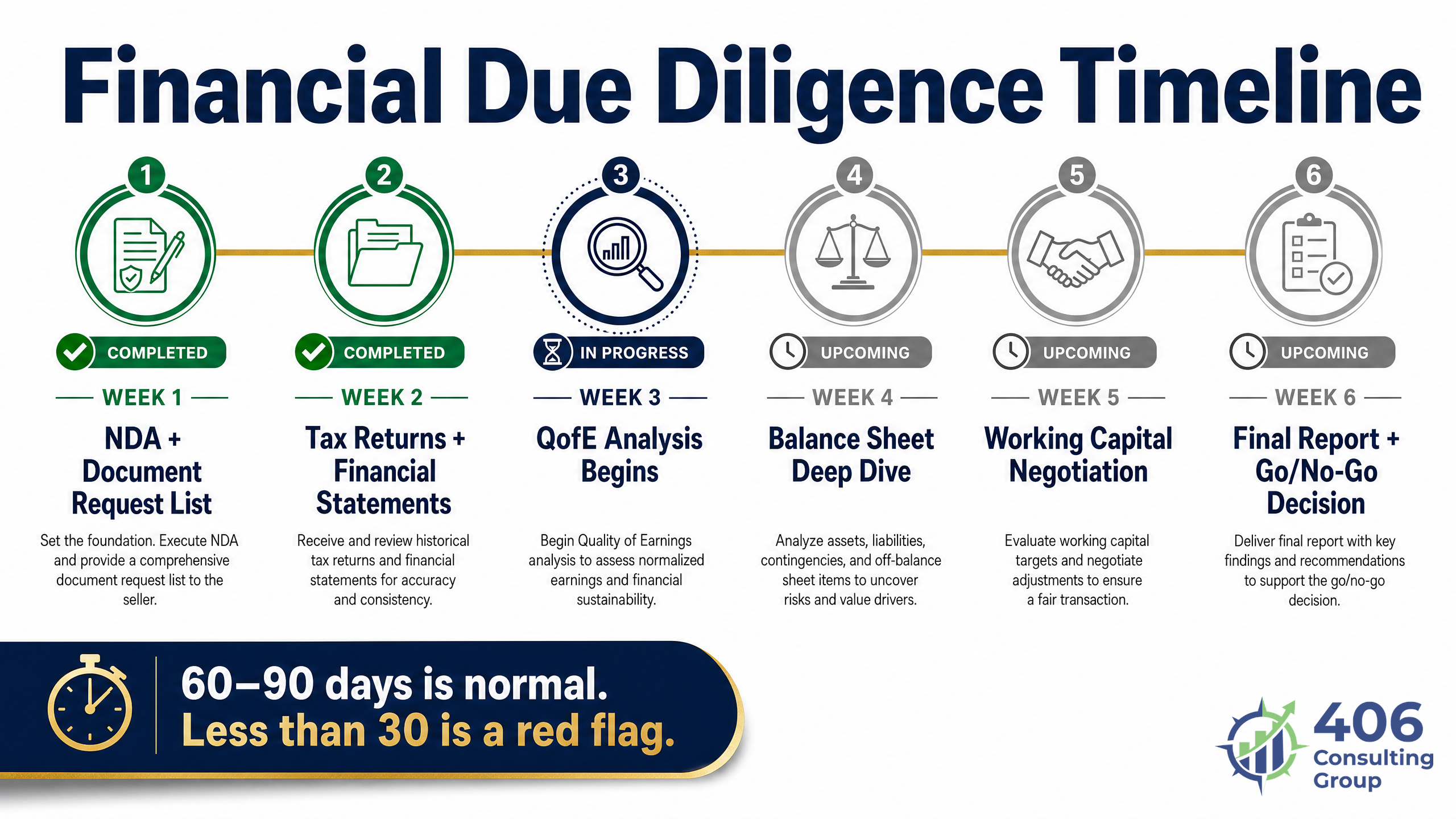
For a well-organized seller with clean books, a thorough due diligence process takes 45–60 days from when you have full access to documents. For a disorganized seller or a complex business, 60–90 days is more realistic. Less than 30 days is a red flag — either the seller is withholding information or the buyer isn't doing enough work. Rushing due diligence is one of the most expensive decisions a buyer can make.
What are the biggest red flags in a business's financials?
The seven biggest red flags are: (1) seller won't provide actual tax returns, (2) more than 40% of revenue from one customer, (3) QofE shows EBITDA restatement over 30%, (4) undisclosed payroll tax liabilities, (5) no documented systems and the owner is the business, (6) pending litigation not in initial disclosure, and (7) lender appraisal 20%+ below asking price. Any of these warrants a serious conversation about walking away.
Do I need a CFO or financial advisor to buy a business in Montana?
For any deal over $500,000, engaging a financial advisor with acquisition experience is strongly recommended. A fractional CFO or controller brings the financial modeling, QofE analysis, and working capital expertise that most buyers lack — and that pays for itself many times over in purchase price negotiation or avoided post-close surprises. 406 Consulting Group works with buyers across Montana on exactly this kind of engagement.
Free Consultation
Considering a Montana Acquisition?
We'll review your deal structure, run the financial model, and tell you exactly what you're actually buying — before you sign anything.
Book a Strategy CallThe CLEAR Framework
Related Services
Due Diligence at a Glance