
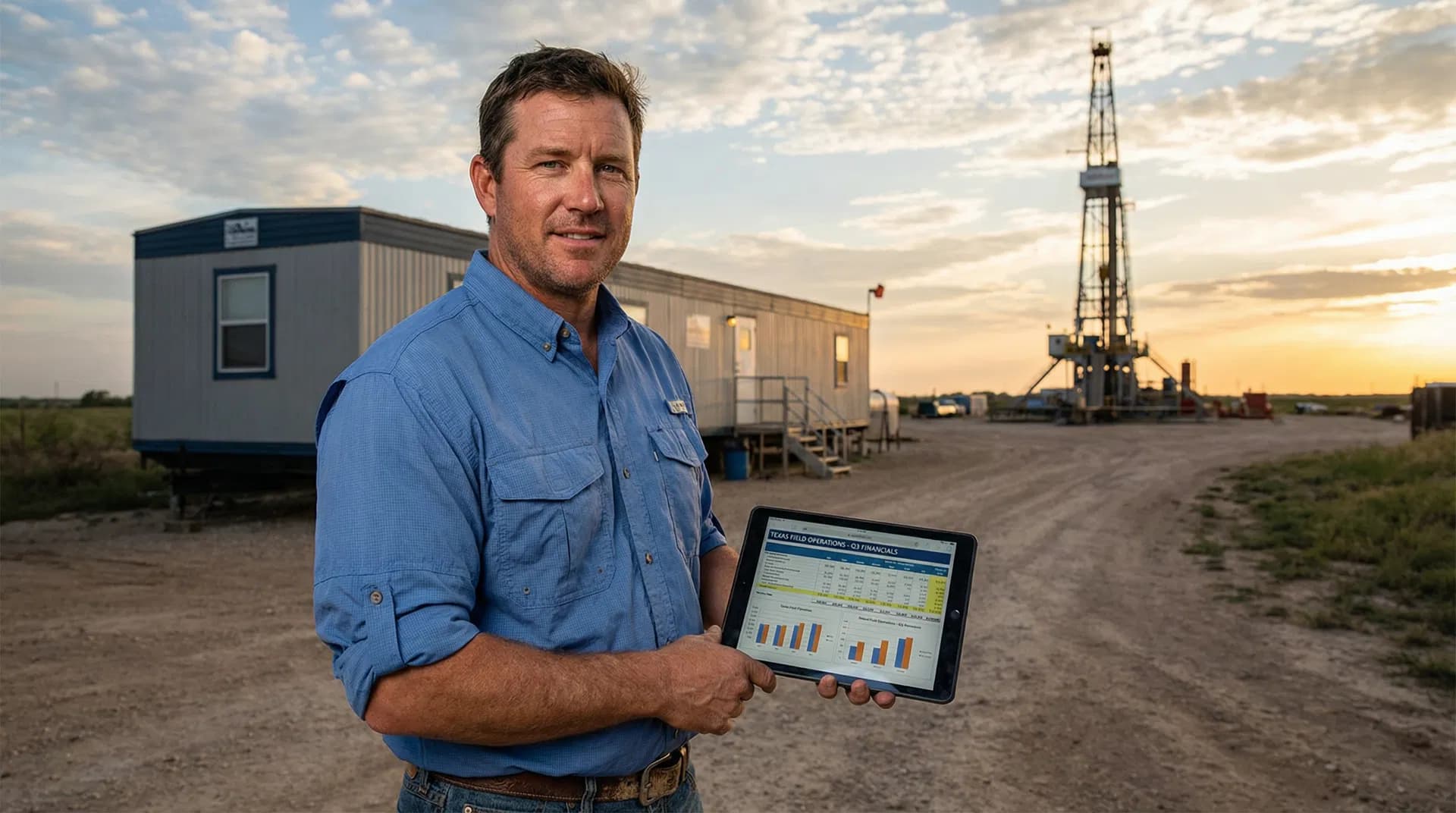
Texas Is Built for Business.
Your Finances Should Be Too.
Bookkeeping, payroll, Controller, and CFO services built for Texas businesses — construction, energy, healthcare, and professional services. We build the financial infrastructure that scales with Texas growth. Franchise Tax compliance, multi-entity payroll, and real-time cash flow visibility — all of it.
Quick answer
Do I need a local Texas accountant, or can I work with 406 remotely?
Every service below is available to Texas businesses — delivered remotely with the same depth as a local firm, and built around Texas's specific industries, compliance requirements, and growth environment.
Real Situations.
Real Outcomes.
Every service we offer is built around a problem Texas business owners actually face. Here's what that looks like in practice — and what becomes possible when the financial foundation is right.
When the Bank Says No — And the Books Are Why
Picture a Houston plumbing contractor — three service vans, about $490,000 in revenue, busy enough that the owner is running calls and managing jobs six days a week. He goes to Frost Bank for a $65,000 equipment line to buy a new service van and a pipe inspection camera. The bank says no. Not because the business isn't making money — it probably is. But the books are a mess. Business expenses are mixed with personal spending. There's no job costing. The P&L looks like a disaster even though calls are coming in every day.
Clean financials unlock things that messy books never can: a readable P&L that shows true profitability by service type, a balance sheet that supports a credit application, and a clear picture of what the business actually earns. A Houston plumbing contractor at $490K with proper job costing and clean separation between business and personal is a fundable business. The same contractor with mixed books isn't — regardless of how many calls the vans are running.
$65K
Equipment line — the difference between clean books and mixed ones
The Books Looked Fine. They Weren't.
Here's a pattern we see all the time. A business runs for years with a cheaper bookkeeping service. On the surface, the books look okay — revenue is recorded, expenses are tracked. But dig in and two problems have been compounding quietly. First: the owner makes capital contributions — putting their own money in to cover slow months — and those contributions get coded as revenue. That inflates taxable income every single year.
Second: equipment purchases get coded as owner contributions instead of fixed assets. That means the business never takes the depreciation deductions it's entitled to — thousands of dollars in write-offs, gone. Correct the coding and the picture changes significantly. An owner in this spot can be prepared to keep paying tens of thousands in taxes they don't owe — when they don't have to. A cheaper bookkeeper records what happens. A good one understands what it means.
Years
How long miscoded books can quietly inflate a tax bill before anyone reviews them
From $650K to $3.3M — Without the Owner Having to Be There Every Day
Here's what a Dallas landscaping company at $650,000 in revenue typically looks like: the owner is doing everything — estimating, managing crews, invoicing, and trying to keep up with the books on Sunday nights. He knows he's leaving money on the table but doesn't know where. He can't take a vacation. He can't hire an operations manager because he doesn't know if he can afford one. He is the bottleneck in his own business.
The path from $650K to $3.3M isn't about working harder — it's about building the financial infrastructure that lets the business run without the owner being the answer to every question. That starts with a real P&L that shows which service types and neighborhoods are actually profitable. Then a simple dashboard: revenue by crew, overhead as a percentage of revenue, a 13-week cash flow forecast. With that foundation, an owner can hire, delegate, and grow — because the numbers tell the story clearly.
$650K → $3.3M
What the maturity ladder looks like when financial systems keep pace with growth
When the Offer Comes, You Have 3 Weeks or 9 Months
Here's what acquisition readiness actually looks like in practice. An Austin tech services company — 32 employees, $6.1M in revenue, nine years of steady growth — gets contacted by a PE-backed IT services rollup. The owner wasn't actively looking to sell. But the offer was real, and the number was interesting. What happens next depends entirely on one thing: whether the books are already right.
If the financials are clean, auditable, and consistently maintained — three years of management reporting, proper revenue recognition, clean separation of service lines — due diligence takes three weeks. If they're not, it takes six to nine months to reconstruct, and half the time the deal falls apart in the process. The difference isn't luck. It's whether the financial foundation was built before the opportunity arrived.
3 Weeks
To close due diligence — versus 6-9 months if the books aren't already right
What Texas Business Owners Actually Owe
Texas has no personal income tax and no corporate income tax. But the Franchise Tax applies to most growing businesses — and it requires active planning to manage effectively.
On net revenue above $2.47M. Retail/wholesale: 0.375%. All others: 0.75%. Calculated on margin, not profit.
Texas Regions We Serve
From Houston energy to Austin tech, DFW to the Permian Basin — same depth of financial expertise.
Houston Metro
Energy capital of the world. Oilfield services, petrochemical, engineering, and logistics businesses face extreme commodity-cycle cash flow swings. We build financial infrastructure that survives the boom-bust cycle.
Dallas–Fort Worth
The DFW Metroplex is one of the fastest-growing business corridors in the country. Construction, professional services, and distribution businesses are scaling rapidly — and most are outgrowing their financial systems.
Austin–San Antonio
The I-35 corridor is a tech and manufacturing powerhouse. Austin's startup ecosystem and San Antonio's defense and healthcare base create a unique mix of high-growth and stable-revenue businesses.
West Texas & Permian Basin
The Permian Basin drives Texas energy production. Oilfield service companies, equipment suppliers, and supporting businesses need financial systems built for the specific rhythms of the energy sector.
Rio Grande Valley & South Texas
Agriculture, international trade, and cross-border commerce define South Texas. Businesses here navigate unique import/export compliance, seasonal agricultural cash flows, and bi-national workforce considerations.
What 406 Has Done for Businesses Like Yours
View all case studies$8M to $40M Without Outgrowing Financial Systems
- Owner signs checks once/month — not buried in daily ops
- Scaled 5× with financial systems that kept pace
- Acquisition-ready books and controller-level oversight
From Bank Rejection to a $7M SBA Financing Outcome
- Rebuilt books and projections across 5 entities from scratch
- Delivered SBA-grade lender package that positioned the deal
- Restructured $7M in debt — saving $20,000/month
Interim CFO Through Big 4 Diligence & Cross-Border Acquisition
- Stepped in as Interim CFO — no disruption to operations
- Navigated KPMG due diligence for a Canadian acquirer
- Deal closed on the owners' terms — clean books, clean exit
Two founders who've sat on both sides of the table
406 isn't a call center. When you work with us, you work directly with the people who own the firm — and both of them bring experience most Texas businesses never get from an accountant.
Carrie
Commercial Banking & Underwriting
Spent her career in commercial banking and underwriting — reviewing 300+ business loans. She knows exactly how a lender reads your financials, what makes a bank say yes, and how to position a business that's trying to grow or borrow.
Jason
Big-Firm Accounting & Systems
Big-firm accounting background with a passion for process and efficiency (Six Sigma, made practical). He builds the systems that keep books clean and taxes planned — not just filed. Both founders also bring hands-on oil & gas and energy-industry experience — directly relevant to the operators, oilfield service companies, and equipment suppliers across Houston, the Permian Basin, and Texas energy country.
The Foundation Has to Be Right Before Strategy Matters
Most Texas businesses have a tax preparer. Very few have clean books, compliant payroll, and real-time financial visibility. That's the foundation we build first — because without it, every other service is built on sand.
Clean Books, Every Month
Texas businesses — construction, oil and gas, technology, hospitality, and professional services — all need accurate, reconciled financials maintained monthly. We use QuickBooks Online or Xero, categorized correctly for your industry, and ready for your bank, your CPA, or your partners whenever they need it.
Texas Payroll Done Right
Texas has no state income tax withholding, which simplifies one piece of payroll — but large, fast-growing workforces, multi-location businesses, and energy sector variable compensation create real complexity. We process payroll accurately and manage Texas unemployment insurance filings, multi-entity compensation, and all federal compliance requirements.
Texas Has No Income Tax. But the Franchise Tax Catches Most Growing Businesses Off Guard.
The Texas Franchise Tax applies to most entities with Texas nexus — and the $2.47M revenue threshold catches businesses faster than they expect. Without proper financial infrastructure, the tax hits before the systems exist to manage it.
Our Controller and fractional CFO services give Texas businesses the month-end close, Franchise Tax planning, and management reporting that makes the no-income-tax advantage actually compound over time.
Our team brings direct experience working within the energy sector at the major operator level — including financial operations, cost accounting, and reporting frameworks used by large-scale oil & gas companies. That background translates directly to the oilfield service companies, equipment suppliers, and energy-adjacent businesses we serve across the Permian Basin and Houston.
Franchise Tax Planning
Revenue threshold tracking, EZ computation vs. standard method, and quarterly estimates.
Month-End Close
Accurate, timely financials every month — not just at tax time.
Multi-Entity Complexity
Consolidated reporting across multiple Texas entities — oil & gas, construction, real estate.
Lender & Investor Ready
Books at the standard banks and investors require — before you need them.
Energy Sector Depth
Financial systems built for the boom-bust cycle — operator payment cycles, commodity exposure, and the cost accounting frameworks used at the major operator level.
Franchise Tax Liability vs. Revenue
Most Texas businesses pay $0 franchise tax until they cross the $2.47M revenue threshold. Above that, the standard rate of 0.75% (or 0.375% for retail/wholesale) applies to taxable margin. The bars show how estimated liability scales with revenue for a services firm.
Services rate: 0.75% on taxable margin above the $2.47M threshold. Retail/wholesale rate: 0.375%. Source: Texas Comptroller. Illustrative example.
Remote, and better for it
You’re in Texas. We’re in Montana.Here’s why that’s an advantage.
The best accountant for your business almost certainly isn’t the one with the nearest office. Modern accounting runs on cloud books, a secure portal, screen-share, and video — so the relationship is built on expertise and responsiveness, not drive time. A great remote firm beats an okay local one every single time.
About 80%of even our own local Montana clients run the entire relationship remotely — and never come into the office. Working with Texas businesses is exactly the same.
Cloud books, always on
Your numbers live in the cloud — you can see them any time, not just at tax season.
Real conversations
Scheduled video reviews and screen-shares where we walk through the numbers together.
Secure document portal
Send and sign everything safely — no dropping off a shoebox of receipts.
Same-day responsiveness
You get faster answers from us by email and call than from most firms down the street.
How Financially Healthy Is Your Texas Business?
6 quick questions across cash visibility, financial systems, and Franchise Tax strategy. Get a score and a specific recommendation — instantly.
Not Ready to Call? See Exactly How We Work First.
Browse our service pages to understand what Controller, CFO, bookkeeping, and tax planning actually look like — scope, deliverables, and who it’s right for.
Put numbers to your Texas tax picture
Free tools to see where you stand before you ever book a call.
Financial Maturity Assessment
See exactly where your finances stand — from chaos to strategy — in about 8 minutes.
Try it freeS-Corp Tax Calculator
Find out whether an S-corp election could cut your self-employment tax this year.
Try it freeS-Corp Salary Calculator
See whether an S-Corp election could cut your self-employment tax — with real numbers.
Try it freeHow Financially Healthy Is Your Texas Business?
Take our 6-question assessment and get a personalized score across cash flow visibility, financial systems, and tax strategy — with specific recommendations for your situation.
Take the Free AssessmentTexas Business Owner Questions
Ready to Build Financial Infrastructure
That Matches Texas Ambition?
Whether you're in Houston energy, DFW construction, or Austin tech — we build the financial systems that let you scale without surprises.