
What Does a Fractional CFO Actually Cost —
And What Should You Get Back?
Fractional CFO pricing ranges from $2,000 to $10,000 per month. Here's what drives the price, what ROI to expect, and how Montana business owners know when it's worth it.

In This Article
- 01The Question Behind the Question
- 02What a Fractional CFO Actually Does
- 03How Fractional CFO Pricing Works
- 04What's the Typical Price Range?
- 05The PROFIT Framework
- 06Cash Flow & Margin: What a CFO Finds
- 07Capital Access: Loans, Bonding & Lines
- 08Tax Strategy ROI
- 09When You're Ready (and When You're Not)
- 10Red Flags When Evaluating Providers
- 11What Montana Business Owners Should Expect
- 12Case Study: $380K Recovered
- 13Frequently Asked Questions
The Question Behind the Question
A fractional CFO in Montana typically costs between $2,000 and $10,000 per month — but that number is almost the wrong thing to focus on. The real question is: what do you get back?
Most business owners asking about fractional CFO cost are actually asking something harder: is my business at the stage where this makes sense? Will someone like this find enough to justify the retainer? The answer, for most businesses between $1M and $20M in revenue, is yes — but only if you hire the right person and scope the engagement correctly.
This guide walks through both questions — what it costs and what you should get back — with specific numbers, a named framework, and a real case study from a Flathead Valley business that recovered $380K in the first 14 months of engagement.
Key Benchmark
3–8× ROI
A well-scoped fractional CFO engagement typically returns 3 to 8 times its cost in identified savings, recovered margin, or improved capital terms — within the first 12 months.
What a Fractional CFO Actually Does
The word "CFO" gets applied to everything from a $50/hr bookkeeper to a $30,000/month strategic executive. Before you can evaluate cost, you need to know what function you're actually buying.
Here's how the three financial roles actually differ — and where each one's authority ends:
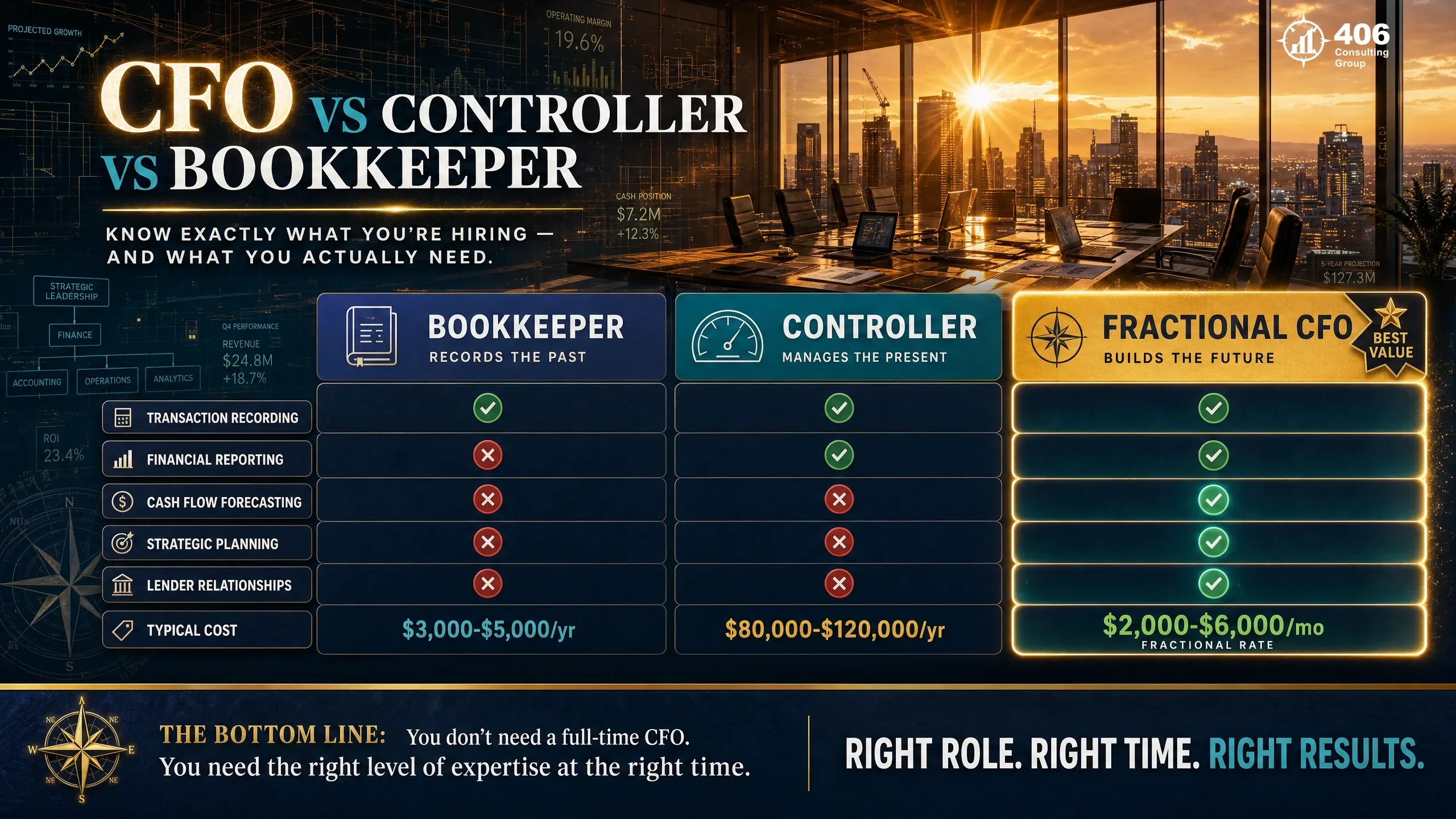
| Function | Bookkeeper | Controller | Fractional CFO |
|---|---|---|---|
| Records transactions | ✓ | ✓ | ✓ |
| Monthly financial statements | — | ✓ | ✓ |
| Cash flow forecasting | — | Sometimes | ✓ |
| Pricing & margin strategy | — | — | ✓ |
| Loan & bonding package prep | — | — | ✓ |
| Tax timing & entity strategy | — | — | ✓ |
| KPI dashboards & reporting | — | Sometimes | ✓ |
| Board / owner-level advising | — | — | ✓ |
The Core Difference
A bookkeeper tells you what happened. A controller closes the books accurately. A CFO tells you what to do next — and why it matters to your cash position, your tax bill, and your ability to borrow money.
How Fractional CFO Pricing Works
Fractional CFO engagements are priced three ways, and the model matters as much as the rate.
Monthly Retainer
$2,000 – $10,000 / monthBest for: Most businesses — predictable cost, consistent engagement
The retainer typically covers a defined set of deliverables (monthly review, forecast update, board report) plus availability for questions and decisions. Most fractional CFOs operate this way.
Hourly / On-Call
$150 – $400 / hourBest for: Businesses needing occasional strategic input
Works for one-off projects (loan package, audit prep, acquisition analysis) but creates uncertainty around cost. Not ideal for ongoing financial management.
Project-Based
$5,000 – $25,000 / projectBest for: Defined scopes: sale prep, system builds, due diligence
Appropriate when there's a specific outcome with a clear finish line. Often the entry point before transitioning to a retainer.
For most businesses in the $1M–$15M revenue range, a monthly retainer between $3,000 and $6,000 is the most common structure — and the most efficient way to get sustained strategic value.
What's the Typical Price Range?
Fractional CFO pricing varies based on the complexity of your business, the depth of engagement, and the provider's background. Here's how the market actually tiers:

Entry Level
Revenue: $500K – $2M
- Monthly financial review
- Basic cash flow tracking
- Quarterly strategy call
- Ad hoc questions
Often newer practitioners or generalists. Good starting point but limited depth.
Mid-Market
Revenue: $2M – $10M
- Monthly close review + narrative
- 13-week cash flow forecast
- KPI dashboard
- Loan / bonding support
- Tax timing coordination
The sweet spot for most growing small businesses. Substantive engagement, experienced provider.
Growth Stage
Revenue: $10M – $25M
- All mid-market deliverables
- Board-level reporting
- M&A support
- Equity / debt structuring
- Department-level budgeting
Appropriate when complexity demands deeper engagement — multiple entities, investors, or acquisition activity.
What Drives the Cost Up
Multiple entities, construction WIP accounting, investor reporting, M&A activity, or a business with poor historical records — these all increase complexity and therefore cost. A clean, single-entity service business will be at the low end of any tier.
The PROFIT Framework
Six Ways a Fractional CFO Pays for Itself
We use the PROFIT Framework to quantify CFO value across six dimensions. Each pillar represents a category of return — and most engagements generate meaningful value in at least three of them within the first 12 months.
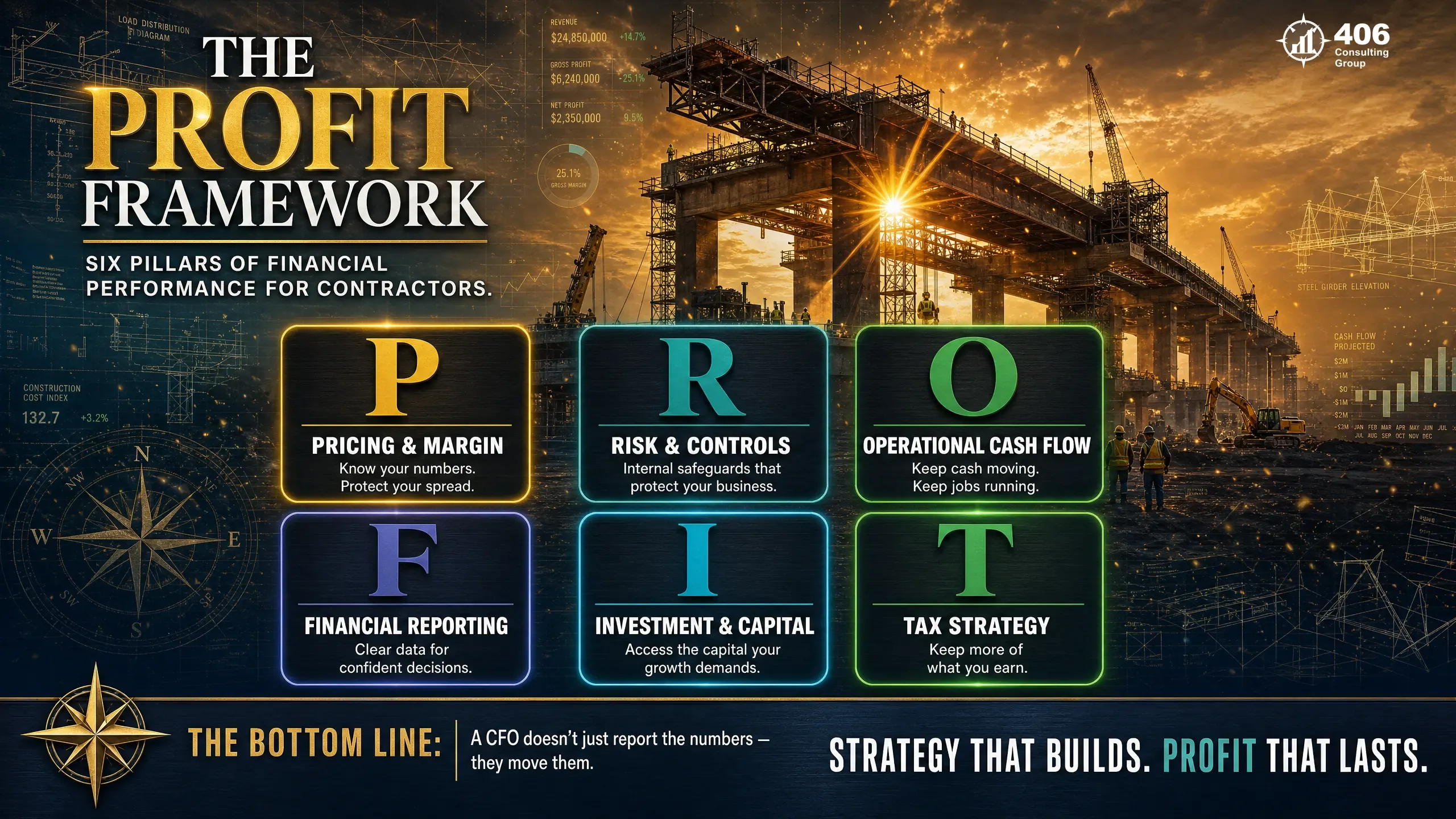
Pricing & Margin Optimization
Identifying underpriced services, unbilled costs, and margin bleed across jobs or product lines. A single pricing correction on a contractor's change order process can recover $40K–$120K annually.
Risk Identification & Controls
Surfacing fraud exposure, contract risk, concentration risk (one client = 40%+ of revenue), and compliance gaps before they become crises. Prevention value is hard to quantify but regularly exceeds the retainer.
Operational Cash Flow Management
13-week cash flow forecasting, billing cycle tightening, and A/R management. Most businesses operating without a CFO carry 15–30 extra days of receivables — converting that to cash is an immediate liquidity win.
Financial Reporting Accuracy
Clean, GAAP-aligned financials are the prerequisite for everything else — loans, bonding, investor conversations, and exit readiness. Inaccurate books cost you more than you think in denied credit and missed opportunities.
Investment & Capital Access
A CFO-authored loan package changes the lender conversation. We've seen clients go from declined to approved, or from prime+2 to prime+0.5, simply by presenting financials in a format lenders understand. On a $2M line, that's a real number.
Tax Strategy & Timing
Coordinating with your CPA on depreciation decisions, entity structure, retirement contributions, and distribution timing. Most businesses leave $15,000–$80,000 on the table annually from poor tax timing alone.
Cash Flow & Margin: What a CFO Finds That Others Miss
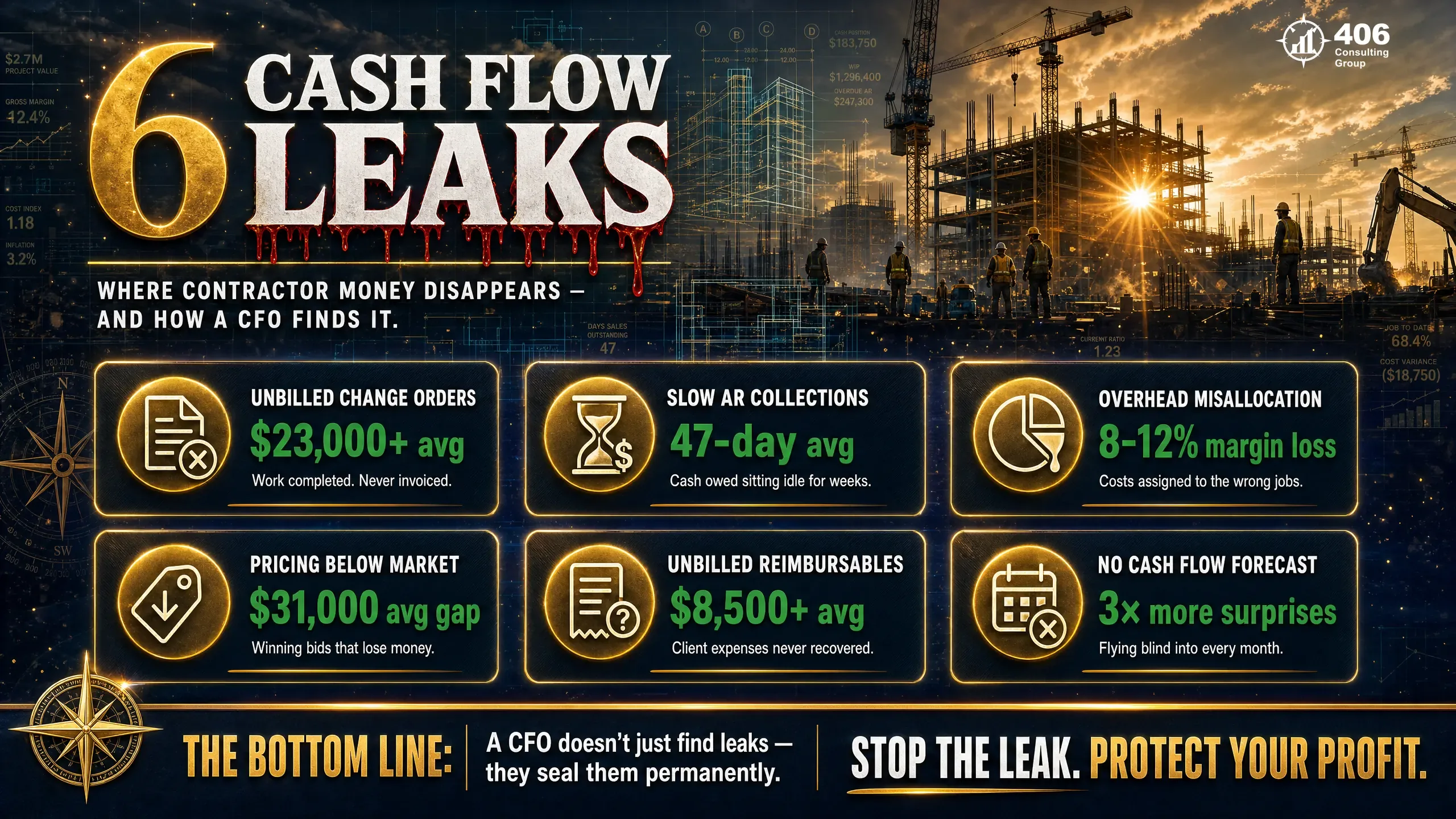
Cash flow problems are almost never caused by not having enough revenue. They're caused by the gap between when you earn money and when you collect it — and by costs that don't get captured at the job or product level.
A CFO's job is to close both gaps. Here's what that looks like in practice for a Montana construction contractor:

Scenario: Kalispell General Contractor — $4.2M Revenue
The CFO retainer in this scenario was $4,800/month — $57,600/year.The identified recovery was $468,000. That's an 8:1 return in year one, with compounding improvement in years two and three as systems are locked in.
Capital Access: How a CFO Unlocks Loans, Bonding & Lines of Credit
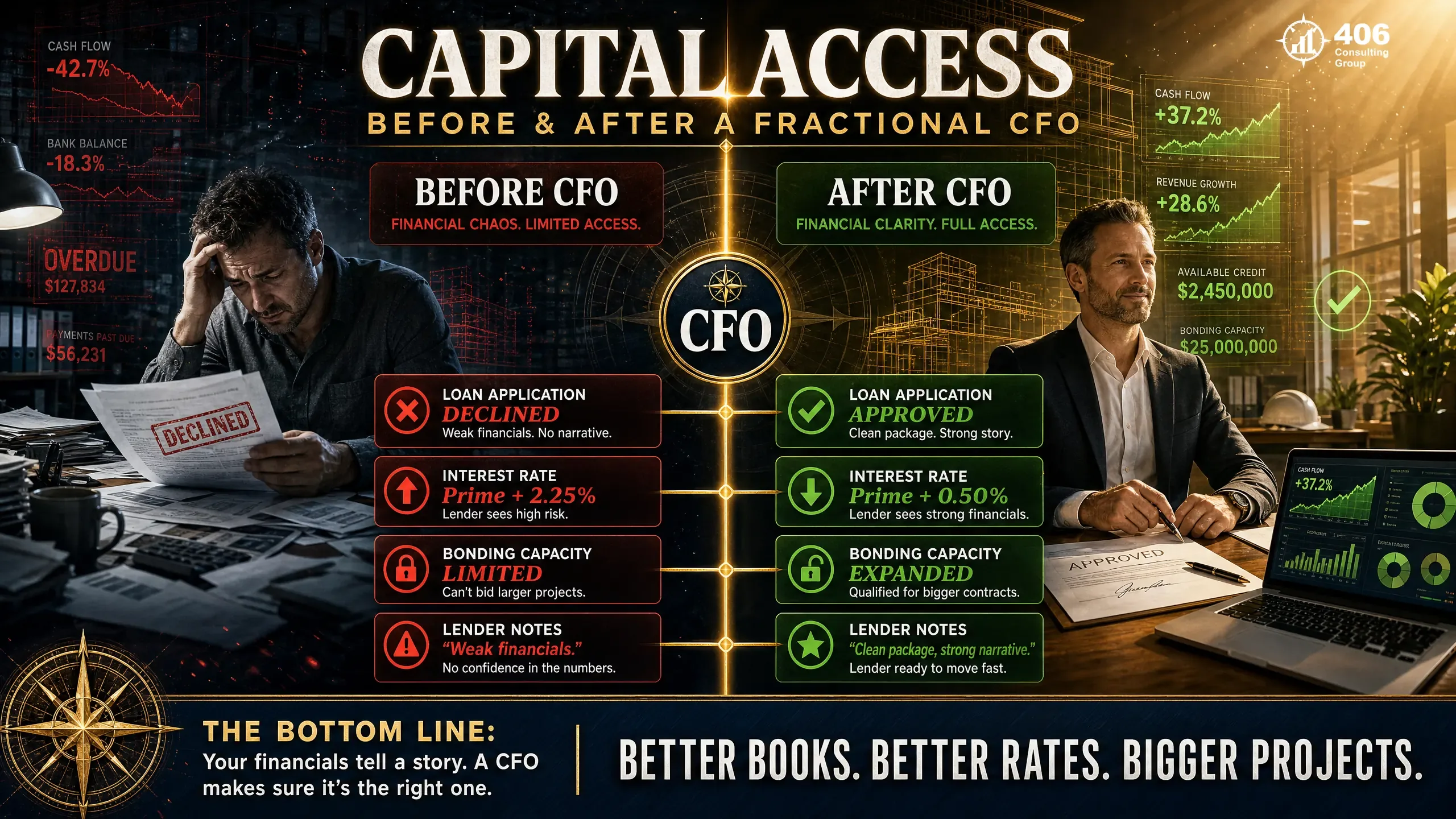
Carrie Anderson spent over a decade in commercial banking — reviewing, approving, and declining business loan applications. The number one reason clean businesses got declined or received worse terms than they deserved: the financials didn't tell the right story.
Lenders and bonding companies make decisions based on what they can read — and they read fast. A CFO's job is to make your numbers readable, defensible, and compelling. That means:
- GAAP-aligned financials with consistent methodology — not cash-basis chaos
- Debt service coverage ratio above the lender's threshold — by design
- Working capital position presented at the right moment in your cash cycle
- Add-back schedules that normalize owner compensation and one-time costs
- Narrative that explains anomalies before the underwriter asks
Real Outcome
Approved at Prime + 0.50%
A Flathead Valley equipment contractor had been quoted prime + 2.25% on a $1.8M equipment line. After six months of CFO-led financial cleanup and a resubmission package, the rate came back at prime + 0.50%. On $1.8M over five years, that's roughly $148,000 in interest savings — nearly three years of CFO retainer.
Tax Strategy ROI
A fractional CFO doesn't replace your CPA — but a good one coordinates with your CPA in ways that dramatically improve outcomes. The difference is timing and context.
Most CPAs see your books once a year, in March or April, after the tax year is closed. At that point, the options are limited. A CFO working alongside your books monthly identifies opportunities while there's still time to act.
S-Corp Distribution Timing
Save $8K–$40K/yr
Optimizing when and how much to pay yourself as salary vs. distributions reduces self-employment tax on a portion of your income.
Bonus Depreciation Planning
100% bonus (OBBBA permanent)
Equipment purchases timed before December 31 can generate immediate deductions. 100% bonus depreciation was permanently restored under the One Big Beautiful Bill Act (July 2025). A CFO tells you when to buy, not just how to depreciate.
Retirement Contribution Optimization
Shelter up to $69K/yr
SEP-IRA and Solo 401(k) contributions reduce taxable income dollar-for-dollar. Most owners undercontribute because no one runs the math.
Entity Structure Review
Often $15K–$80K/yr
Many Montana businesses are operating in the wrong entity structure for their revenue level. Correcting it is a one-time cost with annual compounding benefit.
When You're Ready for a Fractional CFO (and When You're Not)
The honest answer: not every business needs a fractional CFO right now. Here's how to read the signals.
You're NOT ready if...
- ×Revenue is under $750K
- ×You don't have a bookkeeper yet
- ×You're pre-revenue or in year one
- ×You can't name your current gross margin
Strong signals you ARE ready:
- Revenue $1M+ and growing
- Applying for credit or bonding
- Considering an acquisition
- Cash feels tight despite strong revenue
- Making decisions without real numbers
- Planning an exit in 3–7 years

Red Flags When Evaluating Fractional CFO Providers
Not all fractional CFOs are created equal. The market has no licensing requirement, which means anyone can use the title. Here's what to watch for:
No defined deliverables
If they can't tell you exactly what you'll receive each month, you're paying for access, not outcomes.
No industry experience
A CFO who's never worked with construction companies, service businesses, or businesses your size will take months to calibrate — at your expense.
Can't explain ROI concretely
Ask: 'What's the most common way you generate return for clients at my revenue level?' If the answer is vague, keep looking.
Positioned as a bookkeeper upgrade
A real CFO doesn't do data entry. If they're offering to 'take over your books' as part of the deal, clarify what role they're actually playing.
No CPA coordination process
A CFO who doesn't have a defined workflow for collaborating with your tax preparer is leaving money on the table by default.
Long lock-in with no performance benchmarks
You should be able to end the engagement on 30–60 days' notice. Multi-year contracts with no defined outcomes are a red flag.
What Montana Business Owners Should Expect
Working with a fractional CFO in the Flathead Valley — or anywhere in Montana — comes with specific context that out-of-state generalists often miss.
Seasonal Cash Flow
Construction, tourism, and agriculture businesses in Montana face dramatic seasonal swings. A CFO needs to model your cash position across the full seasonal cycle — not just average it out. A single month's snapshot in March tells you nothing about your July crunch.
Montana Tax Nuances
Montana has no sales tax but does have a Business Equipment Tax and specific rules around income apportionment for businesses operating across state lines. A CFO coordinating with your Montana CPA catches these before they become surprises.
Bonding Complexity
General contractors in Montana often need bonding capacity that outpaces their balance sheet. A CFO helps structure financials to maximize your bonding line — which directly expands how much work you can bid.
Lender Relationships
Regional lenders in Kalispell and the Flathead Valley have specific preferences. Carrie's background in Montana commercial banking means we know what Glacier Bank, Whitefish Credit Union, and First Interstate actually look for in a package.
Case Study: $380K Recovered on a $4,800/mo Engagement
Anonymized — Flathead Valley, Montana
Industry
General Contracting
Annual Revenue
$5.8M
CFO Retainer
$4,800/mo
The owner came to us because he was profitable on paper but constantly short on cash. He had a bookkeeper and a CPA — both competent — but no one was connecting the financial picture to real business decisions.
Rebuilt job costing model; identified $87K in unbilled change orders from the prior 12 months.
Cash flow forecast revealed a $220K gap in August — 5 months out. Owner negotiated a line of credit before the gap arrived instead of scrambling during it.
Billing cycle shortened from net-45 to net-28 on new contracts; AR days dropped from 61 to 34.
CFO-authored package resubmitted to lender; equipment line increased from $800K to $1.4M at improved rate.
Tax strategy session with CPA — S-Corp optimization and bonus depreciation timing saved $62K in the next filing.
14-Month CFO Cost
$67,200
Total Recovered / Saved
$381,000
Frequently Asked Questions
What does a fractional CFO cost per month?
A fractional CFO typically costs between $2,000 and $10,000 per month depending on your business size and the scope of engagement. For most businesses in the $1M–$10M revenue range, the practical range is $3,000–$6,500/month on a monthly retainer. Hourly rates run $150–$400/hour for project-based or on-call work.
Is a fractional CFO worth it for a small business?
Yes — for businesses above roughly $1M in revenue with complex finances, a fractional CFO typically returns 3–8 times its cost in the first year through margin recovery, cash flow improvement, and better capital terms. Below $750K in revenue, a strong bookkeeper and quarterly CPA review is usually more appropriate.
What's the difference between a fractional CFO and a bookkeeper?
A bookkeeper records what happened. A fractional CFO tells you what to do next. A bookkeeper processes transactions and reconciles accounts. A CFO builds forecasts, identifies margin leaks, prepares loan packages, coordinates tax strategy, and advises on decisions — using the numbers your bookkeeper produces.
How quickly can a fractional CFO show ROI?
Most engagements produce identifiable value within 60–90 days. Cash flow improvements and billing cycle corrections often show up in month two. Capital access benefits — better loan terms, higher bonding capacity — typically materialize within six months. Tax strategy savings are realized at the next filing.
Do I need a full-time CFO or will fractional work for my stage?
Most businesses under $20M in revenue don't need or can't justify a full-time CFO at $200K+/year in salary and benefits. A fractional CFO gives you the same strategic capability at 15–25% of the cost. Full-time CFOs typically make sense at $25M+ in revenue or when the business has institutional investors requiring dedicated financial leadership.
What should a fractional CFO deliver every month?
At minimum: a monthly financial review with narrative, a rolling cash flow forecast, KPI dashboard update, and availability for strategic questions. Better engagements also include tax timing check-ins with your CPA, lender and bonding coordination as needed, and quarterly strategy sessions with the owner.
Does 406 Consulting Group offer fractional CFO services in Montana?
Yes. Our team serves businesses in Kalispell, Whitefish, Missoula, and across Montana and the Intermountain West. Carrie Anderson's commercial banking background and Jason's operational finance experience make us particularly effective for construction, contracting, and service businesses. Contact us to discuss whether a fractional CFO engagement makes sense for your stage.
Work With Our Team
Find Out What a CFO Would Find in Your Business
We offer a financial maturity assessment that shows you exactly where you are — and what a fractional CFO engagement would focus on first. No commitment required.
Fractional CFO Services
See What a CFO Would Find in Your Numbers
We work with Montana businesses to identify margin leaks, improve cash flow, and unlock better capital — typically returning 3–8× the engagement cost in year one.
Schedule a ConversationFree Financial AssessmentThe PROFIT Framework
Typical ROI Ranges
External Resources