
The Benefits of Professional Accounting
in Columbia Falls, MT
Most Columbia Falls businesses are leaving $30K–$90K on the table every year through avoidable tax exposure, slow billing cycles, and financials that won't pass a lender's desk. Here's what professional accounting actually fixes.

In This Article
- 01Why Columbia Falls Businesses Leave Money on the Table
- 02What Professional Accounting Actually Means
- 03The STABLE Framework
- 04Benefit 1 — Tax Compliance & Montana Savings
- 05Benefit 2 — Financial Reporting That Drives Decisions
- 06Benefit 3 — Cash Flow Visibility & Forecasting
- 07Benefit 4 — Loan Readiness & Banking Relationships
- 08Benefit 5 — Payroll Compliance & HR Finance
- 09Benefit 6 — Exit & Growth Positioning
- 10Signs You've Outgrown DIY Bookkeeping
- 11What Columbia Falls Businesses Should Expect
- 12Case Study: $62K Saved + Loan Approved
- 13Frequently Asked Questions
Why Columbia Falls Businesses Are Leaving Money on the Table
Most small business owners in Columbia Falls, MT are managing their own books — or relying on a part-time bookkeeper who records transactions but never looks up from the spreadsheet. That gap between what's being tracked and what's being analyzed is costing real money.
We're not talking about fraud or bad intentions. We're talking about the natural blind spots that come from running a business without a professional accounting function: tax elections that never get made, billing cycles that run 30 days longer than they should, loan applications that get denied because the financials aren't presentation-ready.
Professional accounting in Columbia Falls isn't a luxury for large companies. For any business between $500K and $10M in revenue, it's the infrastructure that determines whether you grow, stall, or quietly bleed margin while the P&L looks fine on paper.
The Real Cost of DIY Books
$30K–$90K/yr
Most businesses switching from DIY or part-time bookkeeping to professional accounting identify $30,000 to $90,000 in annual improvement through tax savings, margin recovery, and cash flow tightening — in the first 12 months.
What "Professional Accounting" Actually Means
The term gets used loosely. A professional accounting function isn't just tax prep once a year — and it's more than reconciling your bank account each month. Here's how the layers actually work:
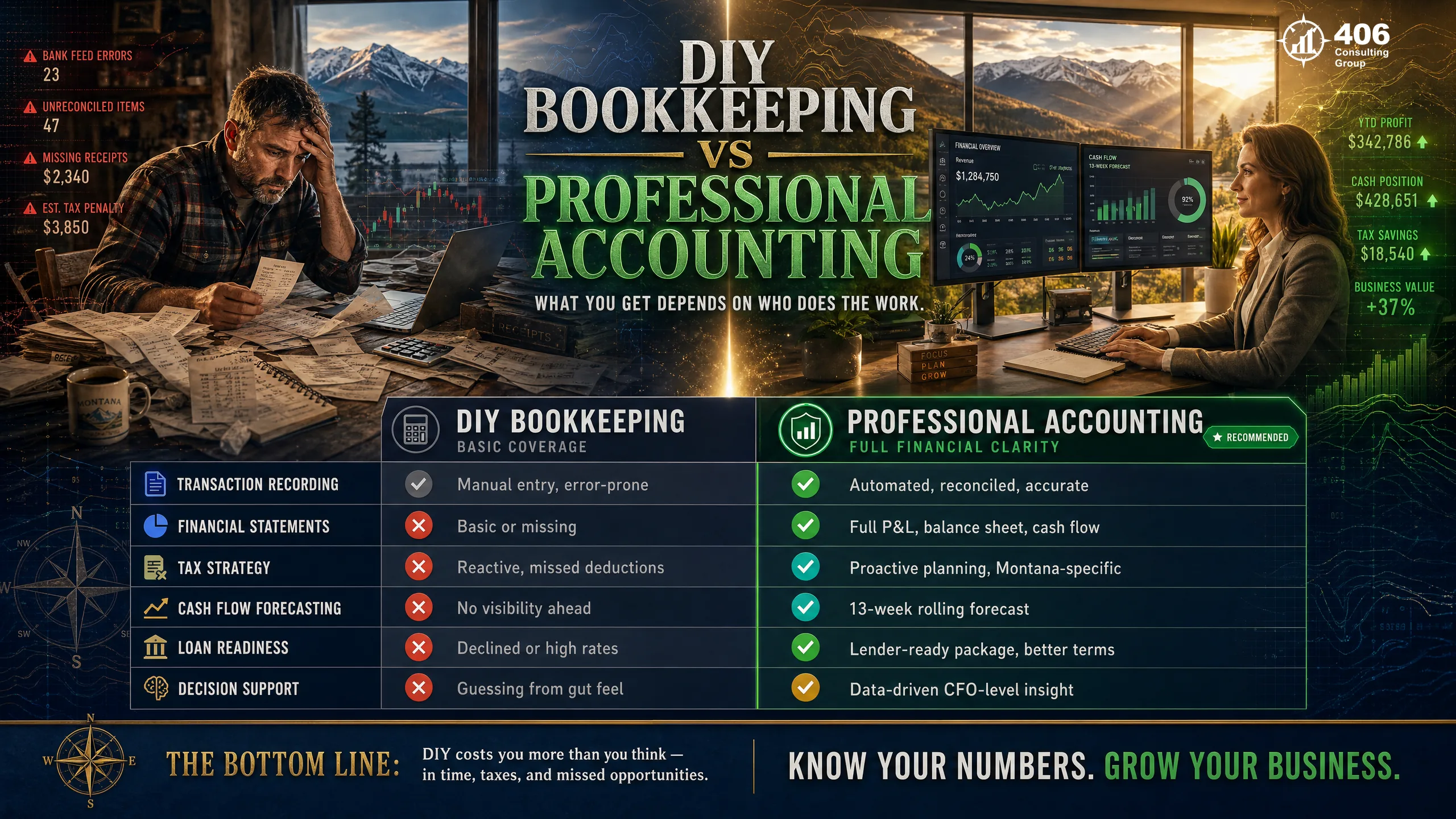
Bookkeeping
Transaction recording, bank reconciliation, accounts payable and receivable tracking. The foundation — but not the analysis.
Controller Function
Monthly close process, financial statement preparation, job costing, payroll compliance, and internal controls. This is where accuracy becomes a business asset.
CFO / Advisory Layer
Cash flow forecasting, tax timing strategy, loan packaging, KPI dashboards, and owner-level financial decision support. This is where accounting becomes a competitive advantage.
What 406 Consulting Group Provides
We work across all three layers — from bookkeeping and controller services to fractional CFO advisory — so Columbia Falls businesses get a complete financial function without hiring multiple people.
The STABLE Framework
Six Benefits of Professional Accounting for Flathead Valley Businesses
We use the STABLE Framework to explain what professional accounting actually delivers — across six dimensions that matter to a working business owner, not just an accountant.

Systems
Organized, consistent bookkeeping infrastructure that runs the same way every month — so your numbers are trustworthy when you need them.
Tax Readiness
Proactive tax compliance with no last-minute scrambles. Every election made on time, every deduction captured, every Montana-specific rule applied correctly.
Accuracy
GAAP-aligned financials and a clean monthly close. The difference between "I think we made money" and "here's exactly where the margin went."
Borrowing Power
Lender-ready numbers when you need a line of credit, equipment loan, or bonding increase. Accurate financials presented correctly change what you get approved for — and at what rate.
Labor & Payroll Compliance
Clean payroll with correct withholding, Montana-specific workers' comp tracking, and quarterly reporting done right — so a surprise audit doesn't become a penalty.
Exit & Growth Positioning
Clean financials are a business asset. Whether you're planning to sell, bring on a partner, or raise capital — buyers and investors look at three years of books before they look at anything else.
Benefit 1 — Tax Compliance and Savings Specific to Montana
Montana's tax environment is different from most states — and that difference creates both opportunities and traps for business owners who aren't working with someone who knows the landscape.

No Sales Tax
Montana is one of five states with no state sales tax — but nexus rules still matter if you sell across state lines. Many owners don't realize they may owe in other states.
Business Equipment Tax
Montana levies a property tax on business equipment, but businesses with market value under approximately $1 million may qualify for a full exemption — many Columbia Falls businesses owe nothing once this is accounted for. Professional accounting ensures the annual return is filed correctly and all exemptions are captured (verify current exemption threshold and applicable forms at MTrevenue.gov).
Income Apportionment
Businesses operating across state lines must apportion income correctly. Errors here create double-taxation risk or filing gaps that trigger audits.
Entity Structure Savings
Many Columbia Falls businesses are operating as sole props or LLCs when an S-Corp election would save $10K–$40K annually in self-employment tax.
The Montana Department of Revenue offers state-level tax credits and incentives that many small business owners never capture — simply because no one in their financial team is watching for them. A professional accountant monitors these proactively.
Benefit 2 — Financial Reporting That Actually Drives Decisions
Most small business owners review their bank balance and call it financial management. A professional accounting function replaces that gut-check with actual data — delivered in a format you can act on.
The monthly deliverable from a professional accountant isn't just a P&L. It's a narrative: here's what the numbers say, here's what changed from last month, here's what it means for your next 90 days.
Profit & Loss by Job or Service Line
Identifies which work is actually profitable — and which is burning margin
Balance Sheet (Monthly)
Shows what you own, what you owe, and what the business is actually worth on paper
AR Aging Report
Who owes you money, how long they've owed it, and when to escalate
Budget vs. Actual
Measures performance against plan — catches problems before they compound
KPI Dashboard
Gross margin %, days receivable, overhead ratio — the 5–6 numbers that actually run the business
Benefit 3 — Cash Flow Visibility and Forecasting
Columbia Falls businesses deal with the same seasonal cash flow swings that affect most of the Flathead Valley — a strong summer construction and tourism season, followed by a slower late fall and winter. Without a rolling cash flow forecast, owners either hoard cash unnecessarily or get caught short at the wrong moment.
A professional accounting function builds a 13-week rolling forecast updated monthly. It tells you, five months in advance, when a cash gap is coming — so you arrange a line of credit before you need it, not after.

What Cash Flow Management Actually Fixes
Billing lag: tighten net-45 to net-28 and recover 2–4 weeks of cash permanently
Seasonal gaps: identify August cash shortfalls in March, not July
Vendor timing: negotiate payment terms that match your receivable cycle
Owner draws: model distributions against forecast so you don't pull cash the business needs
Benefit 4 — Loan Readiness and Banking Relationships in Flathead County
Carrie Anderson spent over a decade in commercial banking — reviewing loan applications from business owners across the Flathead Valley. The most common reason a creditworthy business got declined or received worse terms than it deserved: the financials weren't presentation-ready.
Regional lenders — Glacier Bank, First Interstate, Whitefish Credit Union — make decisions based on what they can read quickly. Professional accounting puts your numbers in the format they expect, with the narrative that answers their questions before they ask them.

Without Professional Accounting
- ×Cash-basis books lenders can't use
- ×Owner compensation not normalized
- ×No add-back schedule for one-time costs
- ×Gaps and inconsistencies raise red flags
- ×Debt coverage ratio miscalculated
With Professional Accounting
- GAAP-aligned financials, clean 3-year history
- Owner comp normalized and documented
- Add-back schedule prepared in advance
- Consistent methodology, no surprises
- DSCR calculated and presented favorably
Benefit 5 — Payroll Compliance and HR Finance
Payroll is the highest-risk compliance area for most small businesses — and the one where DIY solutions most often create expensive problems. Montana has specific requirements around workers' compensation, quarterly reporting, and new hire reporting that differ from federal baseline rules.
A professional accounting function handles payroll as a system — not a monthly scramble. That means correct withholding every time, quarterly filings on deadline, and workers' comp classifications that don't create audit exposure.

What Goes Wrong Without It
A Columbia Falls contractor came to us after a Montana Department of Labor audit. Workers' comp classifications had been set up incorrectly when they hired their first employees — meaning premiums were understated and the business owed back payments plus penalties. Total exposure: $34,000. Professional accounting from day one would have cost a fraction of that.
Benefit 6 — Exit and Growth Positioning
Clean financials are a business asset — often an undervalued one. If you plan to sell your business, bring on a partner, or raise outside capital at any point in the next five to ten years, the quality of your accounting function will directly affect the outcome.
Buyers and investors look at three years of books before they look at anything else. Messy, inconsistent, or cash-basis financials create uncertainty — and uncertainty gets priced in as a discount on your valuation.
Business Sale
Clean 3-year P&L with normalized EBITDA can increase sale price by 10–30% compared to messy books requiring buyer due diligence adjustments.
Partner / Investor
Investors price risk. Clean financials reduce perceived risk — which directly improves deal terms and valuation multiples.
SBA / Bank Loan
3 years of clean financials with consistent methodology is the standard requirement for most SBA 7(a) and conventional business loans.
Signs You've Outgrown DIY Bookkeeping
There's a point where managing your own books stops being resourceful and starts costing you more than a professional would. Here's how to recognize it:

Revenue crosses $500K and you have employees
You're applying for a business loan or bonding
You hired your first W-2 employee
You have multiple revenue streams or job types
Tax prep takes more than a few days to pull together
You don't know your gross margin off the top of your head
You're making major purchases without a forecast
You're operating across state lines
What Columbia Falls and Flathead Valley Businesses Should Expect
Columbia Falls sits at the gateway to Glacier National Park — which means the local economy is shaped by construction, trades, tourism, hospitality, and light manufacturing. Each industry has different accounting needs, and a professional accountant who understands the local landscape makes a meaningful difference.

Construction & Trades
Job costing, WIP accounting, bonding compliance, seasonal cash flow modeling, workers' comp classification, equipment depreciation.
Tourism & Hospitality
Seasonal P&L modeling, tip reporting compliance, high-volume transaction reconciliation, summer cash management.
Retail & Service Businesses
Inventory valuation, multi-state nexus awareness if selling online, owner compensation optimization, S-Corp timing.
Property Management
Tenant ledger reconciliation, security deposit accounting, repair vs. capital improvement classification, depreciation schedules.
Case Study: $62K in Tax Savings + Loan Approved for a Columbia Falls Contractor
Anonymized — Columbia Falls, Montana
Industry
Excavation / Site Work
Annual Revenue
$2.1M
Prior Setup
Owner + QuickBooks
The owner had been managing his own books in QuickBooks for six years. His CPA filed the return each April — but no one was watching the numbers in between. He came to us because a bank had declined his equipment loan application.
Rebuilt chart of accounts; separated personal and business expenses that had been commingled for three years.
Recast two years of financials into GAAP-aligned format with proper job costing and owner compensation normalization.
Submitted new loan package to First Interstate. Approved for $480K equipment line at prime + 0.75% — the previous application had been declined entirely.
S-Corp election filed retroactively with IRS coordination. Estimated annual self-employment tax savings: $28,000/yr.
Workers' comp audit prep surfaced a classification error. Corrected proactively — avoided $18,000 in back premiums. Bonus depreciation timing on new equipment saved additional $16,000 at filing.
First-Year Accounting Cost
$14,400
Identified Value (Tax + Compliance + Loan)
$62,000+
Frequently Asked Questions
What does professional accounting cost for a small business in Columbia Falls?
Professional bookkeeping and accounting services for a small business in Columbia Falls typically range from $500 to $2,500 per month depending on transaction volume, number of employees, and the scope of services. Businesses needing a controller function or CFO-level advisory pay more. Most businesses recover the cost through tax savings and margin improvement within the first year.
What's the difference between a bookkeeper and a professional accountant?
A bookkeeper records transactions and reconciles accounts. A professional accountant interprets those numbers — producing financial statements, identifying tax savings opportunities, preparing lender-ready reports, and advising on business decisions. Think of the bookkeeper as the recorder and the accountant as the analyst.
Do I need an accountant or just a bookkeeper for my Columbia Falls business?
If your revenue is under $300K and you have no employees, a bookkeeper is likely sufficient. Once you cross $500K in revenue, hire employees, apply for financing, or have multiple revenue streams, you benefit from a professional accounting function — not just transaction recording.
How does professional accounting help with Montana taxes?
Montana has no sales tax but does have a Business Equipment Tax, specific income apportionment rules for multi-state businesses, and various credits and deductions that require active monitoring. A professional accountant coordinates with your CPA on timing decisions — S-Corp distributions, bonus depreciation, retirement contributions — that reduce your tax bill within legal bounds.
Can a professional accountant help me get a business loan in Flathead County?
Yes — and this is one of the highest-ROI benefits. Lenders at Glacier Bank, First Interstate, and regional credit unions make decisions based on the quality of your financials. Professional accounting produces GAAP-aligned statements, normalized owner compensation, and add-back schedules that present your business favorably — improving both approval odds and interest rate terms.
What industries in Columbia Falls benefit most from professional accounting?
Construction and trades benefit most due to job costing complexity, bonding requirements, and workers' comp compliance. Hospitality and tourism benefit from seasonal cash flow modeling. Retail and service businesses benefit from S-Corp optimization and, if selling online, multi-state nexus management. Almost every business above $500K in revenue sees meaningful ROI.
Does 406 Consulting Group serve businesses in Columbia Falls, MT?
Yes. We serve businesses across Columbia Falls, Kalispell, Whitefish, Missoula, and throughout Montana and the Intermountain West. Carrie's commercial banking background and Jason's operational finance experience are particularly relevant for construction, trades, and service businesses in the Columbia Falls area. Contact us to discuss your situation.
Serving Columbia Falls & the Flathead Valley
Ready to See What Professional Accounting Finds in Your Numbers?
Start with our free financial maturity assessment — it shows you exactly where your accounting function stands and what the highest-impact improvements would be.
Columbia Falls & Flathead Valley
Professional Accounting for Montana Businesses
We help Columbia Falls businesses build accounting systems that recover margin, reduce tax exposure, and support growth — without hiring a full-time finance team.
Schedule a ConversationFree Financial AssessmentThe STABLE Framework
What Businesses Typically Recover