
The Toxic Employee:
The Hidden Tax on Your Growth, Your Team, and Your Books
One control-driven person can cap a good company's growth and put its finances at risk — especially when they're the one closest to the money. What it is, what it costs, and what to do.

Almost every business owner we meet can picture the person before we finish the sentence. Not the loud jerk who gets walked out on a Friday — the quieter, more dangerous version. Often competent, sometimes indispensable-seeming, and absolutely certain that nothing should change unless it was their idea. They protect their turf, they control information, they roadblock anything that threatens their standing, and over time they quietly cap what the whole company is allowed to become. That's the toxic employee — and the damage runs on two fronts at once: your operations and your books.
We see this constantly. A healthy company hires us for bookkeeping, controller, or CFO help, and within weeks it's obvious that one person — often the one closest to the money — treats every outside set of eyes as a threat. That resistance is not a personality quirk to manage around. It's a signal. This article is the long version of a story we know well: what a toxic employee actually is, how they keep good companies from growing, what it costs you (in operations and in real financial risk), and — the part that matters most — what to do about it.
By Jason Anderson — Co-Founder, 406 Consulting Group. 406 builds financial infrastructure and internal controls for growing businesses, designed from a whole-company view — which means we run into the toxic-employee problem, and the financial risk it hides, more often than most.
Quick Answer: The Toxic Employee, in Five Lines
- →A toxic employee isn't just a low performer — they're often competent and entrenched, and their core drive is protecting their own control.
- →They cap growth by roadblocking any good idea that isn't theirs and by making themselves the indispensable bottleneck.
- →When they control the books, the toxicity becomes a financial-integrity and fraud risk — no segregation of duties, hidden transactions, closed doors.
- →The cost is real and stacked: turnover, lost productivity, bad decisions on bad numbers, and stalled growth.
- →The fix is controls, documentation, and outside eyes — structure that can't be intimidated.
Table of Contents
What a Toxic Employee Actually Is
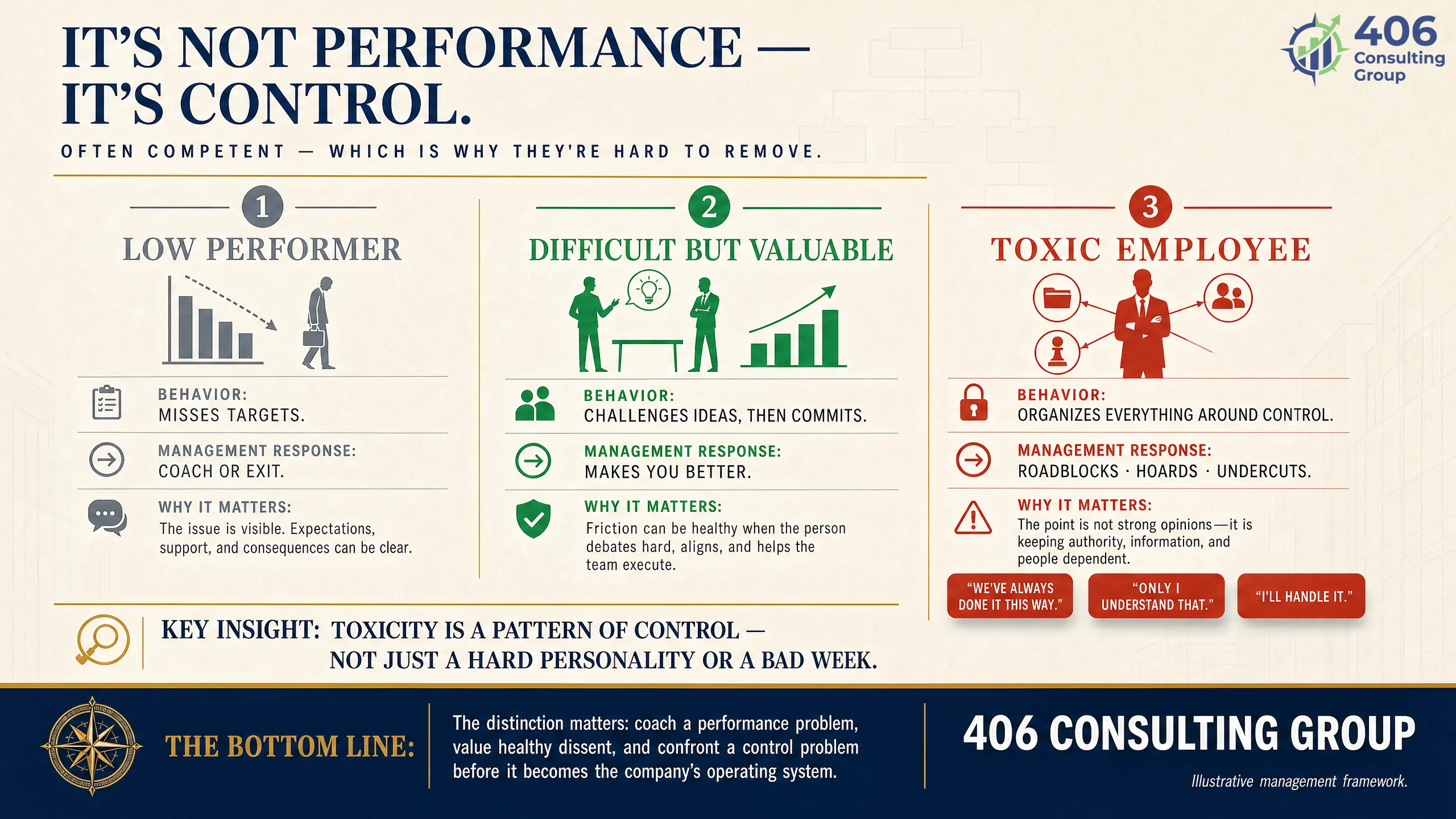
Start by clearing up a myth. A toxic employee is not the same as a low performer, and not the same as a difficult but valuable person who pushes back in meetings. A low performer misses targets; you coach them or you move on. A difficult-but-valuable person challenges ideas, then gets on board once a decision is made — friction that actually makes the company better. The toxic employee is different in kind, not degree: they are often good at the job, which is exactly what makes them hard to remove, and their defining trait isn't poor output — it's that they organize their work life around control.
You can hear it in the tells. "We've always done it this way." "I'm the only one who understands that system." "You don't want to touch that — I'll handle it." New ideas get slow-walked unless they originated with them. Information flows to them and stops. Anyone who might rival their standing gets undercut — subtly, deniably. Picture a family-owned distributor we'll call Summit Supply: the office manager knows where every body is buried, runs payroll, touches the bank, and has quietly made herself the person nobody can question. On paper she's a rock star. In reality she's a ceiling.
Hold onto that word — control. It explains everything that follows, on both fronts.
Two Fronts: Your Operations and Your Books
Most articles about toxic employees stop at culture — morale, drama, turnover. All real, and we'll cover it. But if you only look at culture, you miss the more expensive half of the problem. A toxic employee damages a company on two fronts at once: they slow and shrink your operations, and — when they're anywhere near the money — they put your books and controls at risk. The same instinct drives both. Someone whose goal is to stay in control will resist a new process that exposes their work and resist the financial transparency that would let anyone check it.
That's why this problem lands on a finance firm's desk as often as an HR consultant's. The person blocking your growth and the person guarding your ledger are frequently the same person — and the behaviors overlap: gatekeeping, "trust me," closed doors, and a strong allergy to anyone reviewing the details. Keep both fronts in view as we go, because the fix has to address both.
We'll take the operations front first, then follow the same instinct into the books.
The Growth Blocker: How They Keep a Good Company Small
Here's the part owners feel but struggle to name: a toxic employee doesn't just create bad days — they quietly cap what the company is allowed to become. Growth requires change: new systems, new hires, new ways of doing things, more people who understand how the business runs. Every one of those is a threat to someone whose power comes from being the exception. So they fight it — not with an open "no," which would get overruled, but with friction. The new software "won't work for us." The promising hire "isn't a fit." The process improvement "is more trouble than it's worth." Anything not born from them dies of a thousand small objections.
The engine underneath is manufactured indispensability. They hoard knowledge instead of documenting it, so the company can't function without them — by design. They keep processes in their head, files on their own drive, relationships routed through them. Now the owner is trapped: the person capping growth is also the person you're most afraid to lose. Meanwhile your best people — the ambitious ones who wanted to build something — read the room and leave, because they can see the ceiling has a name. Consider a fifteen-person contractor, Copper Ridge Mechanical: two strong project managers quit in a year, and the exit interviews all circled the same long-tenured operations lead nobody was allowed to challenge. The owner lost the future to protect the past.

The tragedy is that the company often looks fine from the outside. It's just never allowed to get better — and the same control instinct is usually at work in the one place it can do the most financial damage.
When the Toxic Employee Controls the Books
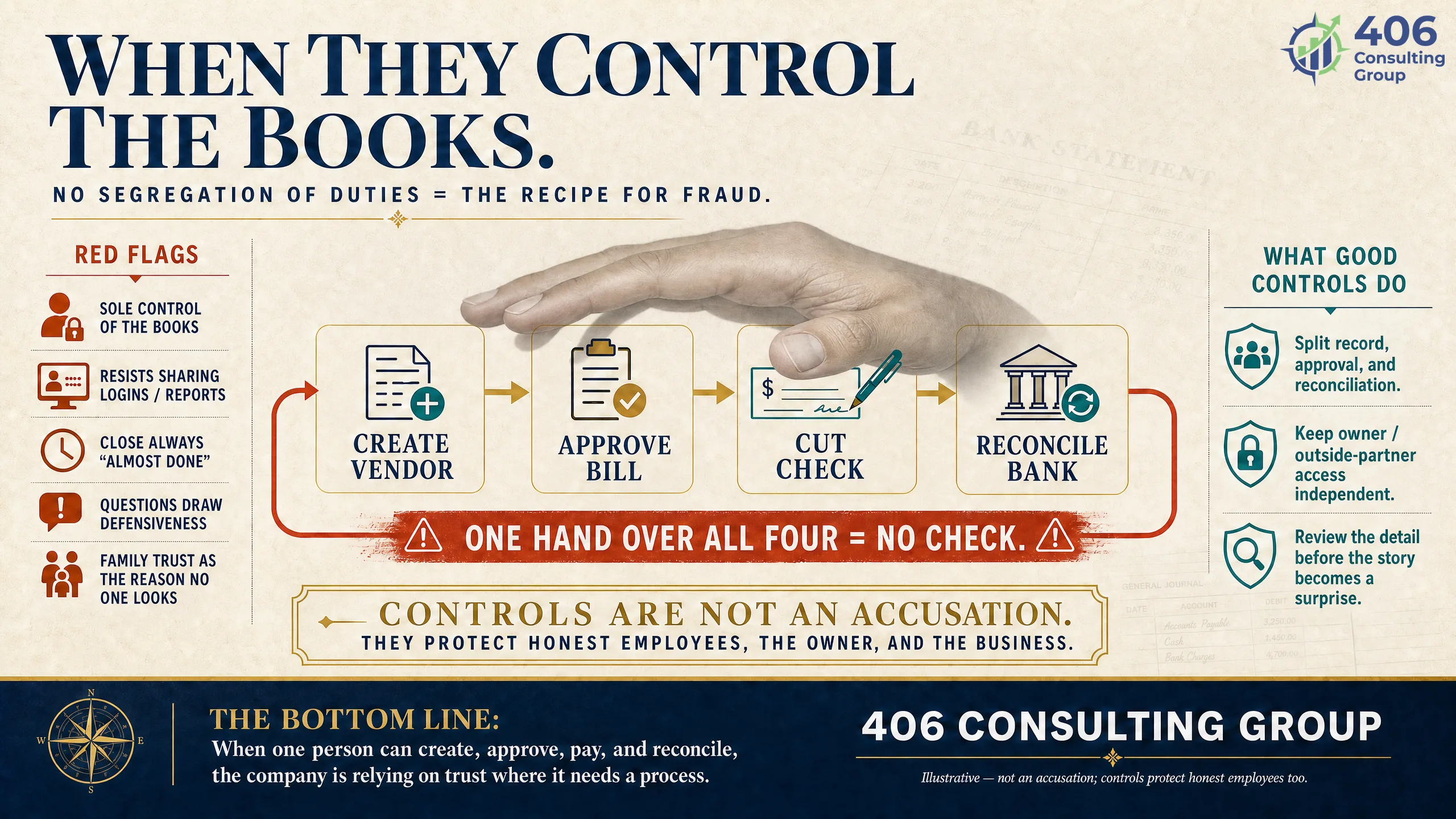
Now the stakes change. When the toxic, control-driven person is your bookkeeper, controller, office manager, or the family member "helping with the accounting," their instinct to guard their turf collides with your money — and that's where a culture problem becomes a financial-integrity and fraud problem. The warning signs rhyme with the operational ones, just aimed at the ledger: they're the only one who touches the books, they resist handing over logins or reports, the monthly close is always "almost done," and questions about specific transactions are met with irritation instead of answers.
The structural danger has a name: no segregation of duties. When one person can create a vendor, approve the bill, cut the check, and reconcile the bank account, there is no natural check on them — and opportunity plus pressure plus a rationalization is the entire recipe for fraud. It gets worse when the person is related to the owner — a niece, a nephew, a brother-in-law "we trust" — because family trust becomes the reason nobody looks, which is precisely the cover a bad actor needs. We are routinely brought in and quickly find the tells: round-dollar payments to unfamiliar vendors, personal expenses run through the company, "miscellaneous" accounts absorbing things that shouldn't be there, reconciliations that don't actually reconcile. Sometimes it's outright theft; often it's sloppiness protected by secrecy. Either way, you're making decisions — and paying taxes — on numbers you can't trust.
This is the front generic advice never covers — and it's exactly where an outside financial partner earns its keep. But first, how do you spot the problem before it costs you?
Red Flags: How to Spot One
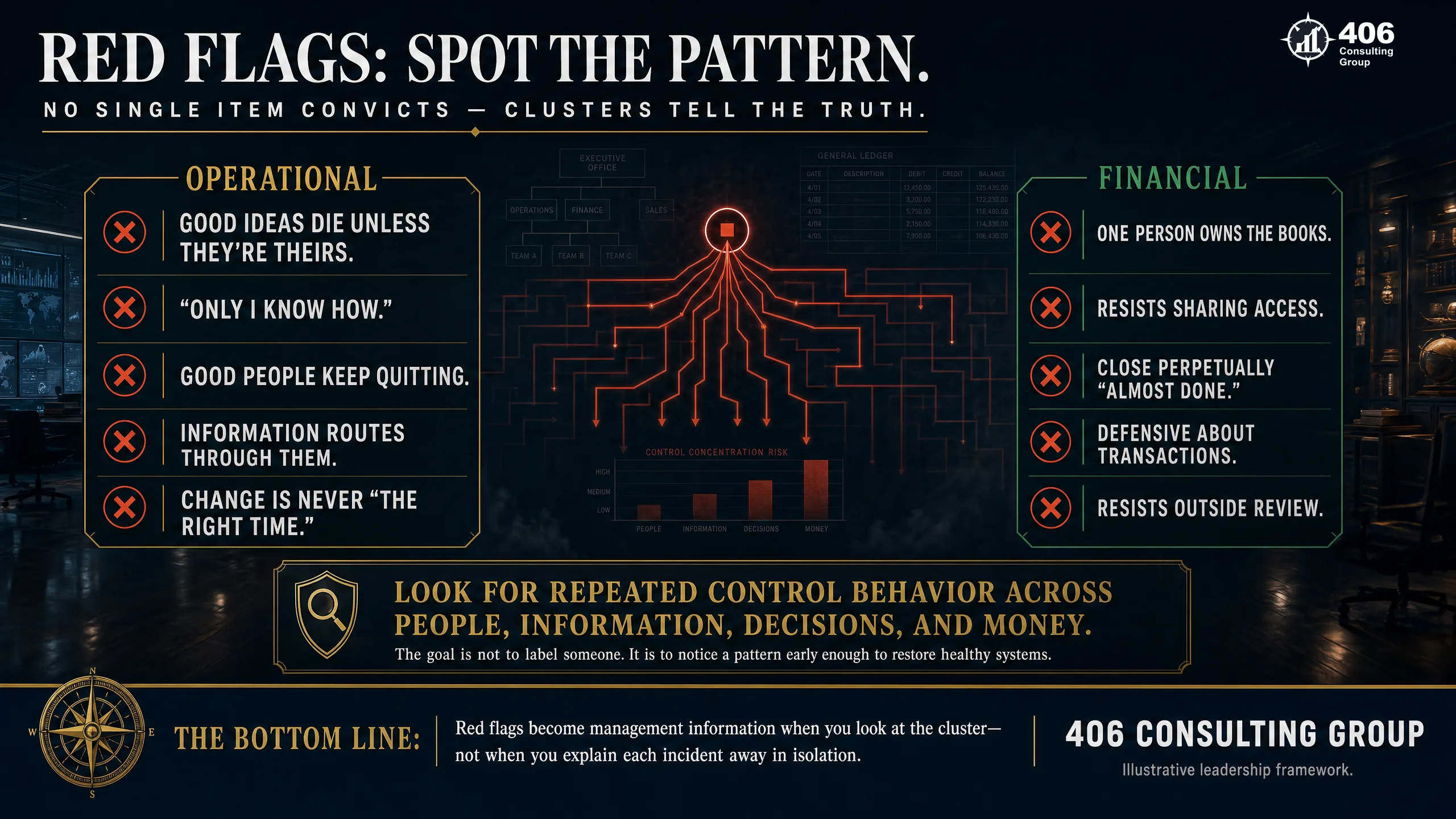
No single item below convicts anyone — good people have bad weeks, and territoriality isn't always toxicity. But patterns tell the truth. Watch for clusters, especially where operational control and financial control show up in the same person.
Operational red flags
- Good ideas die unless they were theirs
- "Only I know how to do that" — by design
- Good people keep quitting from one orbit
- Information routes through them and stops
- Change is always "not the right time"
Financial red flags
- One person owns the books end to end
- Resistance to sharing logins or reports
- The monthly close is perpetually "almost done"
- Questions about transactions draw defensiveness
- They openly resist an outside review
Not sure how exposed you are? Our Financial Maturity Assessment surfaces the control gaps a toxic employee thrives in — in about eight minutes.
What It Costs: The Real Numbers
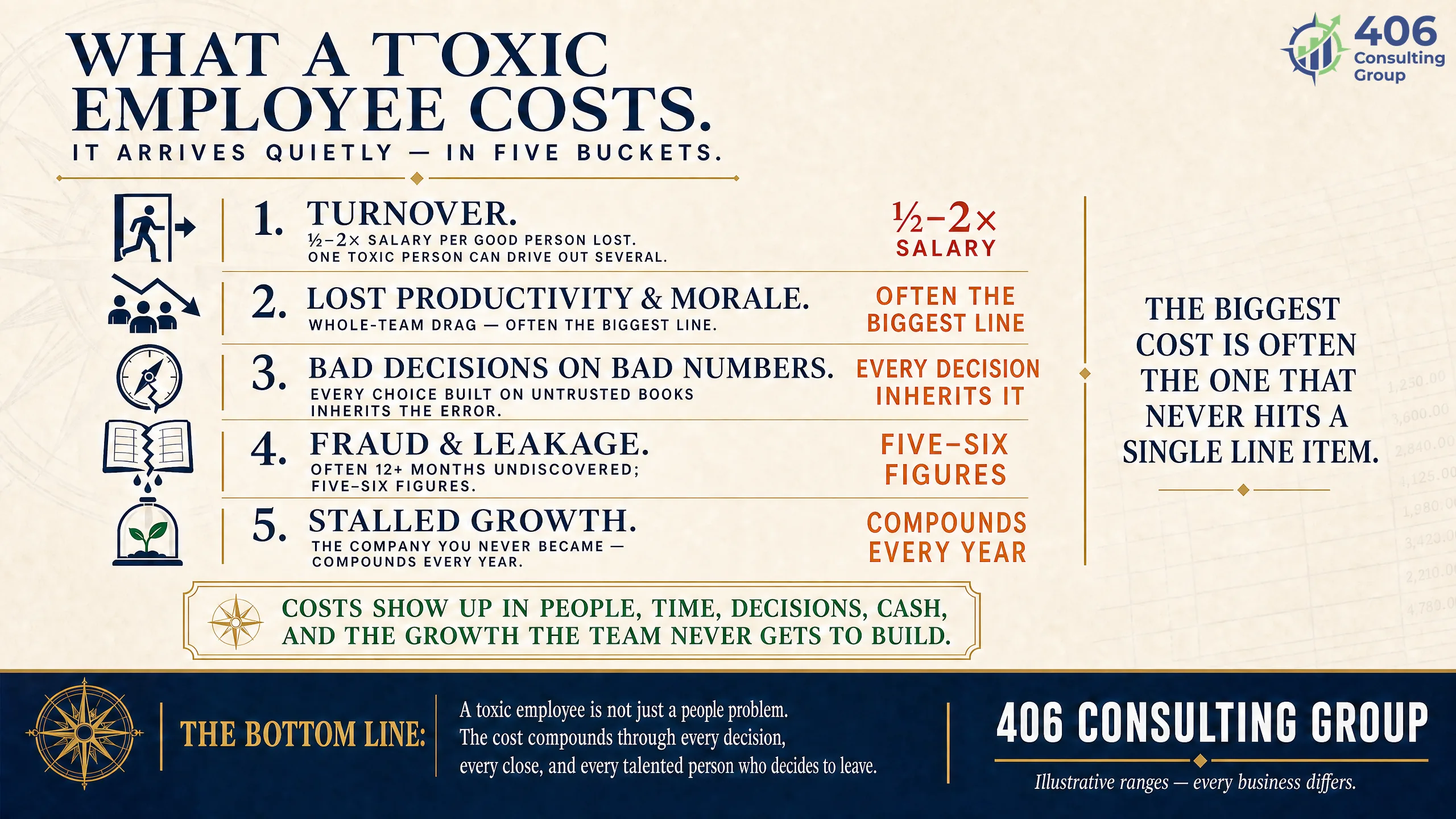
Owners tolerate a toxic employee because the cost feels abstract and the disruption of acting feels concrete. Flip that. The cost is enormous; it just arrives quietly, in five buckets:
Turnover
Losing and replacing a good employee commonly runs one-half to two times their salary once you count recruiting, ramp-up, and lost knowledge. One toxic person can drive out several — a $60K–$150K wound that repeats.
Lost productivity & morale
Teams around a toxic employee disengage, route around them, and stop bringing ideas. It rarely shows on one line, but a drag across a whole department is often the single biggest number here.
Bad decisions on bad numbers
When the books can't be trusted, every decision built on them — pricing, hiring, borrowing, a tax return — inherits the error. The cost of one wrong number can dwarf the salary of the person who hid it.
Fraud & leakage
With no segregation of duties, losses run from sloppy waste to outright theft. Small-business fraud schemes frequently run for a year or more before discovery and reach well into five or six figures.
Stalled growth (the biggest one)
The hardest cost to see is the company you never became — the market you didn't take, the systems you didn't build — because one person needed everything to stay the same. That opportunity cost compounds every year you wait.
Add those up honestly and the math almost always says the same thing: the risk of acting is far smaller than the cost of waiting.
Why They Fight Outside Help
Here's the pattern we know best, because we live it. An owner or a COO decides it's time to bring in real financial help — a bookkeeper, a controller, a fractional CFO. The moment an outside partner appears, the toxic employee's behavior escalates, because outside eyes are the one thing they can't control. Suddenly there are reasons the firm "isn't necessary," the timing is wrong, the cost is too high, the outsiders "don't understand how we do things." Requests for access slow to a crawl. Information that should take an hour takes three weeks. In the sharper cases, they work to discredit the new partner and get them removed before anyone can look too closely.
Read that resistance correctly: it is not a reason to reconsider the help — it is the diagnosis. A good employee welcomes a second set of hands and a clean set of books; only someone protecting control fights transparency. When we get pushed hardest, it's usually because we're standing closest to something. The right response isn't to back off to keep the peace. It's to make sure the owner — not the toxic employee — controls access to the company's own financial information, and to keep looking.
Which brings us to the part you came for: what to actually do.
What to Do, Part 1: Controls & Segregation of Duties
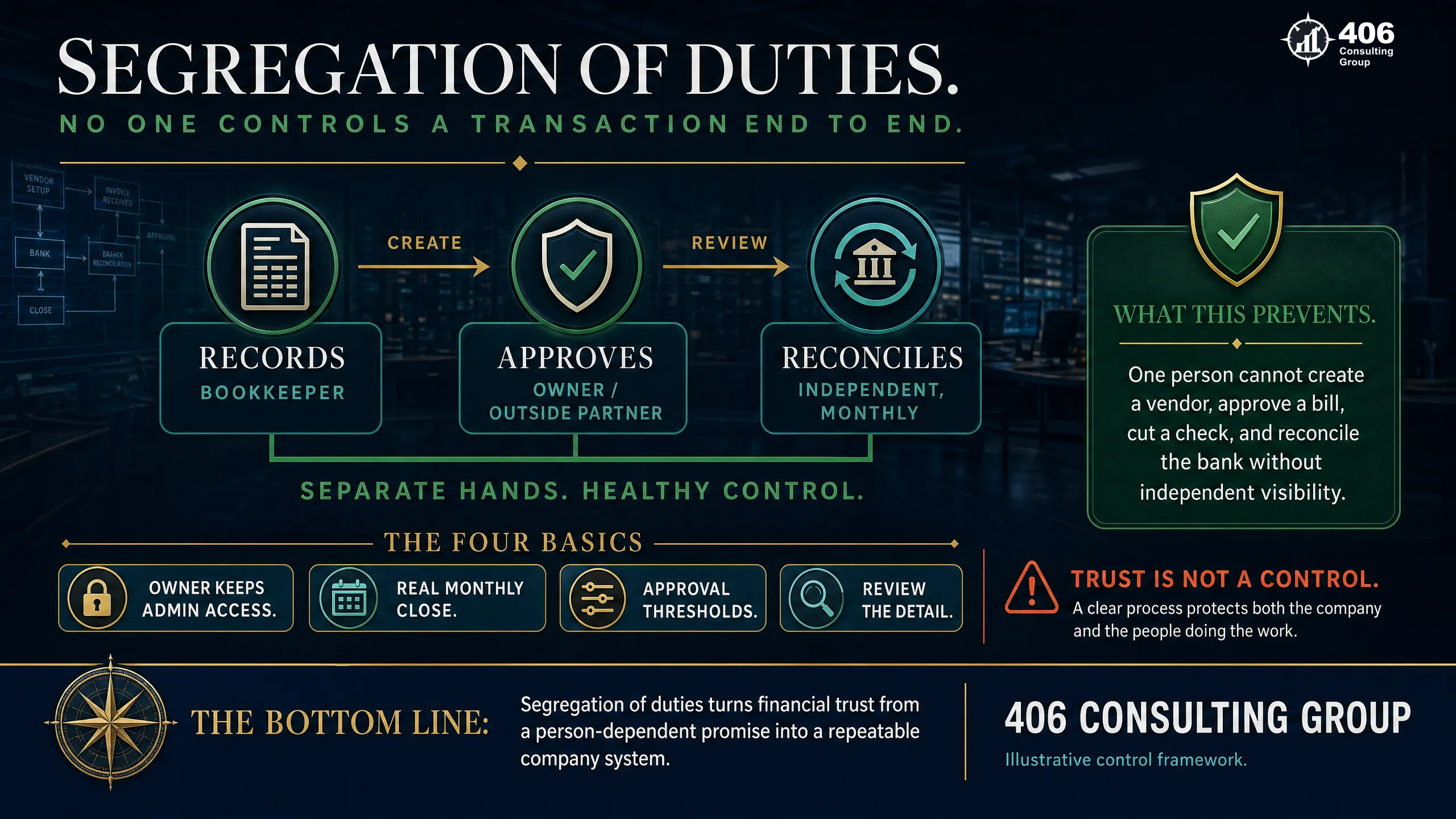
Start with the money, because that's the highest-risk front and the one you can fix with structure rather than confrontation. The single most important move is segregation of duties: make sure the person who records transactions isn't the same person who approves them, who isn't the same person who reconciles the bank. In a small company you can't hire three people for that — but you can split the chain, so that at minimum the owner (or an outside partner) reviews and approves what the bookkeeper records, and someone independent reconciles the bank and looks at the detail every month.
Around that, build the basics good businesses run on: the owner keeps their own administrator access to the bank and the accounting system — never delegated away permanently; a real monthly close produced and reviewed on a schedule; approval thresholds for new vendors and payments; and, when something looks off, a focused review of the questionable transactions before it becomes a habit. None of this requires accusing anyone of anything. It just removes the secrecy a toxic employee depends on — and clean controls protect the honest people too. This is core controller and bookkeeping work, and it's the fastest way to take back visibility.
Controls handle the financial risk. Reopening growth takes one more move.
What to Do, Part 2: Break the Dependency, Reopen Growth
A toxic employee's power comes from being irreplaceable. Take that away and most of the leverage goes with it. The tool is unglamorous and decisive: documentation. Get the processes out of one person's head and into written procedures — how payroll runs, how the close works, where the files live, which vendors matter and why. Cross-train a second person on anything only one person can do today. The goal isn't to catch anybody; it's to make sure the company can run without any single individual, which is also simply what a business needs in order to grow, be financeable, and one day be sold.
Then leadership has to do its part. Set the expectation, out loud, that good ideas are welcome from anyone and that no one owns a veto over change. Give your ambitious people room and air cover so they stop reading the ceiling and start building. And be honest with yourself about the endgame: sometimes controls and documentation are enough to neutralize the behavior and everyone moves forward; sometimes the person will not operate in a transparent company, and the kindest, most profitable decision — with legal and HR guidance — is a clean separation. Either way, you are choosing the company's future over one person's comfort. That is the whole job.
Most owners can't do this alone while running the business — which is where an outside partner changes the math.
How an Outside Financial Partner Breaks the Logjam
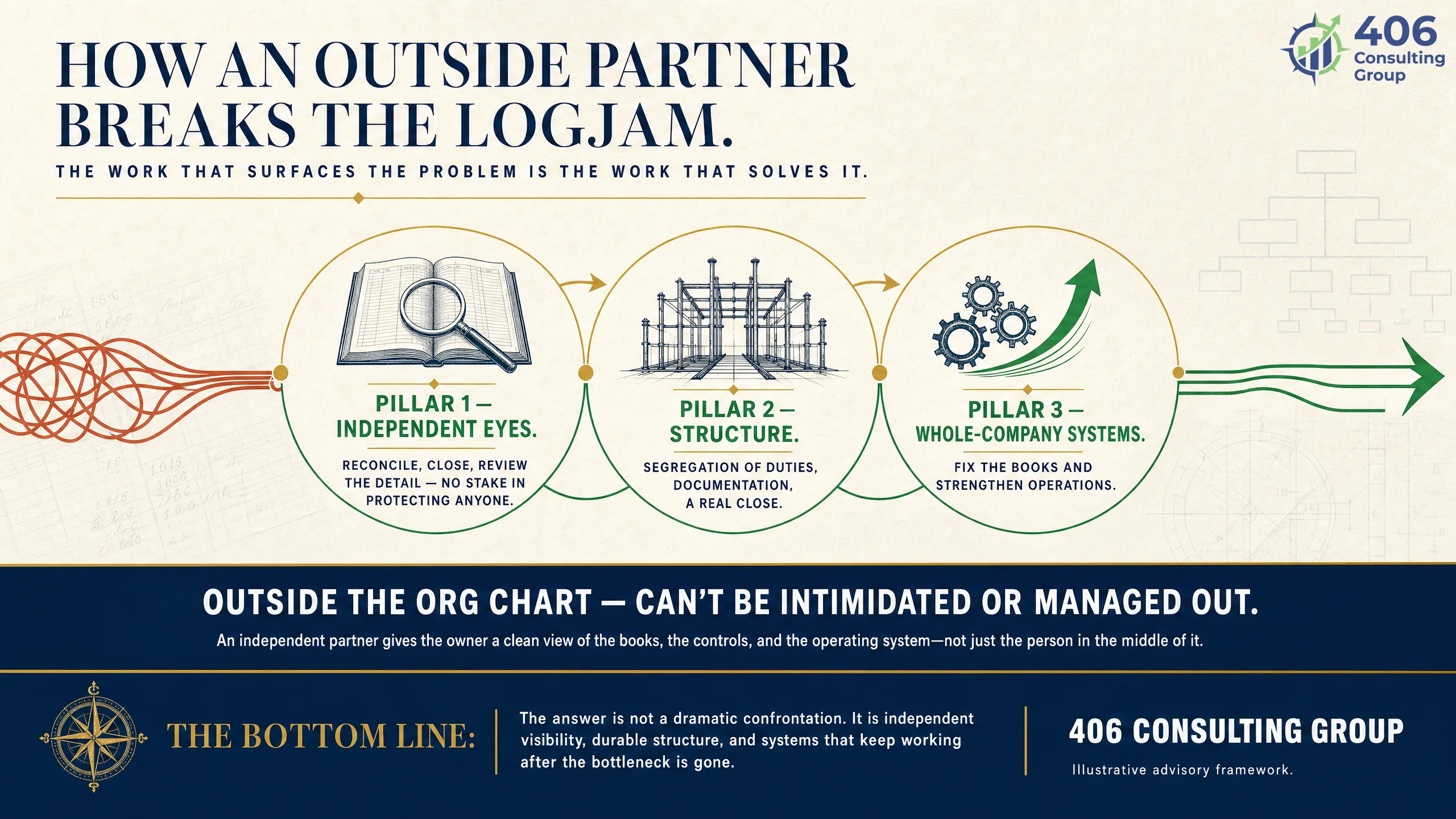
An outside financial partner does three things a toxic insider can't stop. First, independent eyes: we reconcile, we produce the monthly close, and we look at the detail — including the questionable transactions — without a stake in protecting anyone. Second, structure: we install segregation of duties, documentation, and a real close, so the company stops depending on any one person and the secrecy simply has nowhere to live. Third — and this is the part that reopens growth — we design those systems from a whole-company view, not just an accounting lens, so the fix strengthens operations at the same time it protects the books. That combination is why we run into the toxic-employee problem so often: the work that surfaces it is exactly the work that solves it.
It usually takes the shape of a bookkeeping or controller engagement to lock down the controls, a fractional CFO to give the owner numbers they can finally trust and act on, and business-systems work to document and de-risk the whole operation. And because we're outside the org chart, we can't be intimidated, undercut, or quietly managed out — which, when a toxic employee is in the building, is precisely the point.
When we're brought in and the resistance flares, we take it as confirmation we're in the right place — and we keep the owner in control of their own company's information.
How to Get Started
If any of this hit close to home, three steps move you from worried to in-control.
Take back access
Make sure you — the owner — hold administrator access to your bank and accounting system, and can pull reports without going through anyone. If you can't, that's step one, today.
Get independent eyes on the books
Bring in an outside partner to reconcile, produce a real monthly close, and review the detail — including any transactions that don't sit right. Structure, not accusation.
Build controls and documentation
Install segregation of duties, document the processes living in one person's head, and cross-train — so the company can grow and no single person can hold it hostage.
Not sure where your controls stand? Start with our Financial Maturity Assessment, or just talk to us — quietly and confidentially.
FAQ: The Toxic Employee
How is a toxic employee different from a difficult one?
A difficult-but-valuable employee challenges ideas and then commits once a decision is made — that friction usually makes the company better. A toxic employee organizes their work around control: they roadblock ideas that aren't theirs, hoard information, undercut rivals, and resist transparency. The tell isn't poor performance — toxic employees are often good at the job — it's that everything bends toward keeping them in control. When you see that pattern, especially clustered, you're likely looking at toxicity rather than ordinary friction.
Why is a toxic employee especially dangerous when they handle the books?
Because the same instinct that makes them territorial in operations makes them secretive with your money — and money plus secrecy is where fraud lives. The core structural risk is no segregation of duties: when one person can set up a vendor, approve the bill, cut the check, and reconcile the bank, nobody is checking them. Add family trust or long tenure as the reason 'we don't need to look,' and you have the exact conditions bad actors rely on. Even without theft, you end up making decisions and filing taxes on numbers you can't verify.
What is segregation of duties, and how do small businesses do it?
Segregation of duties means the person who records transactions isn't the same person who approves them or who reconciles the bank — so no one controls a transaction end to end. Small businesses can't always hire three people for it, but you can split the chain: the bookkeeper records, the owner (or an outside partner) reviews and approves, and someone independent reconciles the bank and reviews the detail monthly. Keeping the owner's own administrator access to the bank and accounting system, and running a real monthly close, covers most of the risk without a big team.
A trusted, long-time or family employee handles everything. Isn't asking for controls insulting?
Controls aren't an accusation — they're how responsible companies operate, and they protect honest employees as much as the business. Framed correctly, it's simply 'as we grow, we're putting normal financial checks in place,' which any good employee welcomes. The response tells you a lot: someone with nothing to hide is relieved to have a second set of eyes and a clean set of books; strong resistance to basic transparency is itself a signal worth heeding. Bringing in an outside partner makes the change about structure and growth rather than about any one person.
The employee resists every outside advisor we bring in. What does that mean?
Usually it means the advisor is standing close to something. A good employee welcomes help and transparency; only someone protecting control fights it. Escalating resistance when an outside bookkeeper, controller, or CFO appears — slow-walking access, questioning the cost or the need, trying to discredit the outsiders — is best read as diagnosis, not as a reason to back off. The right move is to make sure you, the owner, control access to your own financial information, keep the outside eyes in place, and keep looking.
How can 406 Consulting Group help with this?
We come in from outside the org chart, which means we can't be intimidated or quietly managed out. We install independent controls — reconciliations, a real monthly close, segregation of duties — and review the detail, including transactions that don't sit right, without a stake in protecting anyone. Then we build the documentation and systems that let the company run without depending on any single person, designed from a whole-company view so the fix strengthens operations as well as the books. In practice that's a bookkeeping or controller engagement for the controls, a fractional CFO for numbers you can trust and act on, and business-systems work to de-risk the whole operation. If this sounds familiar, reach out — quietly and confidentially.
Keep Reading
Leadership & Financial Controls
Take Back Control of Your Own Company.
If one person is capping your growth or guarding your books, 406 Consulting Group brings the independent eyes, controls, and systems to fix both — quietly, confidentially, and from a whole-company view.
The Tell in One Word
It's not performance — it's control
One Person Holding You Back?
Independent eyes, controls & systems.
About the Author
Jason Anderson
Co-Founder, 406 Consulting Group
Jason and the 406 team build financial infrastructure, internal controls, and business systems for growing companies — designed from a whole-company view. That work regularly surfaces the toxic-employee problem and the financial risk it hides, and it's exactly the work that fixes both.
Read the Full Story