
Red Flags:
Who to Steer Clear Of, Who to Exit, and Who You Can Turn Around
Every owner overrides a warning sign they later regret. The people red flags to catch in a hire, a partner, or your back office — and when to steer clear, exit, or coach them to green.

Ask any seasoned business owner about their worst hire, their worst partner, or the bookkeeper who turned into a nightmare, and you'll hear the same confession: the signs were there. There was a moment — in the interview, on the first project, in an early conversation about money — when something felt off, and they talked themselves out of it. Too busy to start over. Too impressed by the résumé. Too eager to close the deal. A red flag is that signal, and the most expensive mistakes in business almost always trace back to one an owner saw and chose to ignore.
This is the article version of a conversation we have constantly — about the people you let into your business, whether that's someone you're interviewing, a potential partner, your office manager, or the person keeping your books. The goal isn't to make you paranoid; it's to make you clear. Some red flags mean you should steer clear before you commit. Some mean it's time to exit a relationship that's already inside. And some — this is the part people miss — are ones you can actually coach from red to green. Knowing which is which is a skill, and it's one you can build.
By Amy McGehee — Senior Accountant, 406 Consulting Group. A former construction-company CFO with a master's degree and deep construction-accounting experience, Amy has spent years inside owners' books and back offices — exactly where these people-and-controls red flags show up.
Quick Answer: Reading Red Flags
- →A red flag is a signal of a pattern, not a single bad day — and owners get burned by overriding the ones they noticed.
- →They show up everywhere you let someone in: a hire, a partner, an office manager, an accountant, a key vendor.
- →Triage every one into three buckets: steer clear (don't commit), exit (it's inside and has to go), or coach to green.
- →The dividing line is character vs. competence: integrity and control problems don't coach out; skill and clarity gaps often do.
- →When the flag is near your money, treat it as a controls problem, not just a people problem.
Table of Contents
What a Red Flag Actually Is
A red flag isn't one bad moment — everybody has an off day, a nervous interview, a clumsy email. A red flag is a signal of a pattern: a small behavior that, if you're honest, points to how someone will act when the stakes are higher and no one's watching. The person who is rude to the server at the interview lunch. The candidate who badmouths every past employer. The would-be partner who wants everything on a handshake and nothing in writing. The bookkeeper who bristles the first time you ask a simple question about a transaction. None of those is a crime. Each is a preview.
A red flag isn't a bad day — it's a preview of how someone will act when the stakes are higher and no one is watching.
The reason red flags cost so much is that owners are wired to override them. You're optimistic — you have to be to run a business. You're busy, and starting a search or a hard conversation over feels like the expensive option. And the person often has something you genuinely need: a skill, capital, a relationship, or just the relief of one less thing to manage. So you explain it away. The discipline this article is really about is simple to say and hard to do: notice the signal, name it out loud, and decide on purpose — instead of drifting into a costly relationship because acting felt inconvenient in the moment.
The first step is knowing where to look.
Where They Show Up — Every Relationship You Enter
Red flags aren't just a hiring problem. They show up at every doorway where you let someone into your business, and the same override instinct works against you at each one:
- •The interview / new hire — the lowest-stakes place to walk away, and the one owners most often talk themselves out of.
- •A business partner — the highest-stakes and hardest to undo; a partnership is a marriage with your money attached.
- •Your office manager or operations lead — the person who can quietly become a bottleneck and a single point of control.
- •Your bookkeeper or accountant — anyone with their hands on the money, where a red flag is also a financial-risk flag.
- •A key vendor or subcontractor — the ones you become dependent on before you've earned the trust.
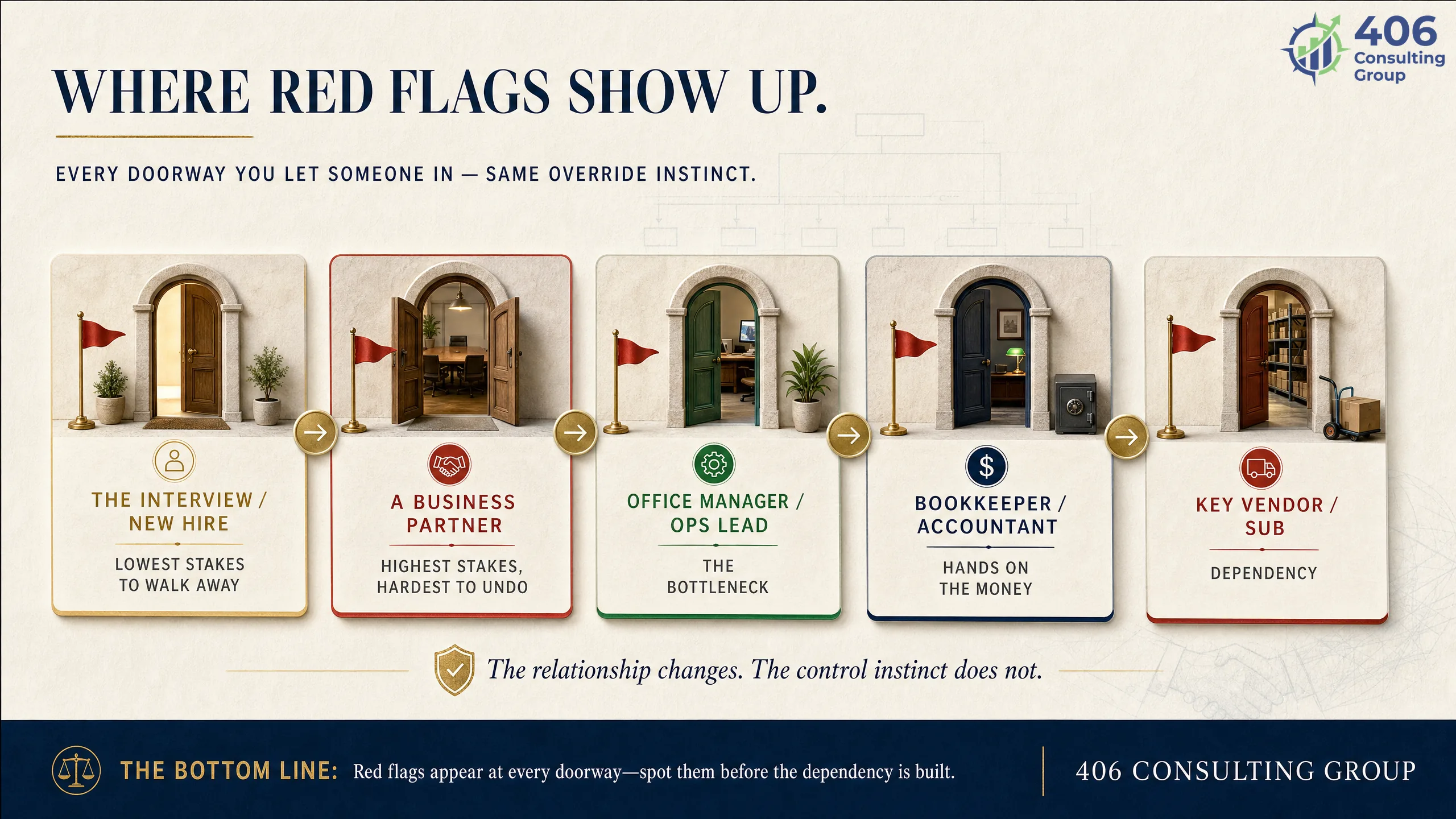
Different doorways, same job for you: read the signal and sort it. Here's the framework.
The Triage: Steer Clear, Exit, or Turn Green
Not every red flag means the same thing, and treating them all as dealbreakers is its own mistake — you'll pass on good people for nerves and coach no one. The move is to triage each flag into one of three buckets:
Steer Clear
Before you commit. Character and integrity flags that won't change — walk away while walking away is free.
Exit
It's already inside and it isn't fixable — separate deliberately, with guidance, before the cost compounds.
Turn Green
A skills or clarity gap, not a character problem — coachable with expectations, structure, and honest feedback.

The rest of this piece works through the doorways, then comes back to the rule that tells you which bucket you're in.
Red Flags in Hiring & Interviews
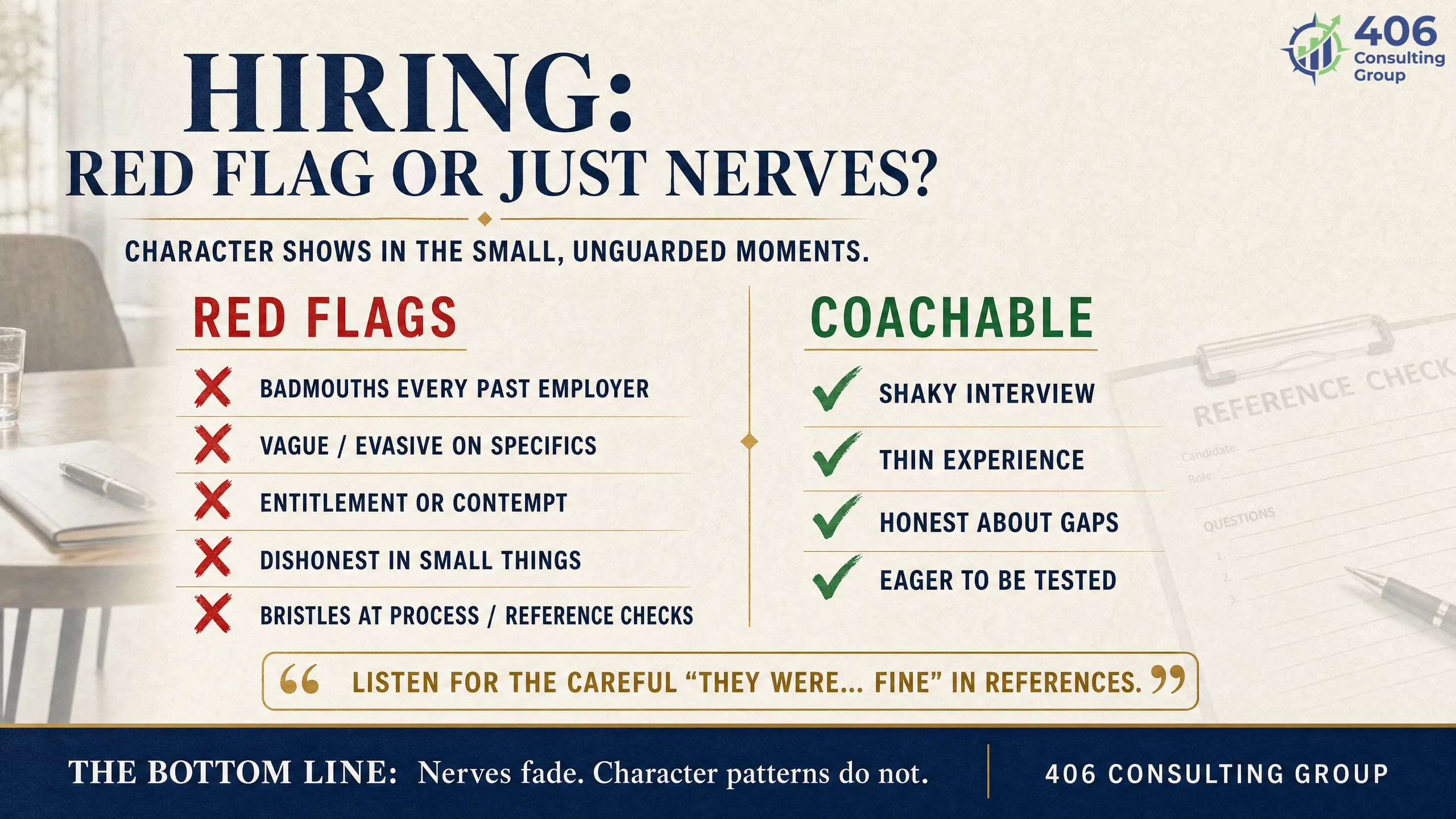
Hiring is where flags are cheapest to act on and most often ignored, because a warm body feels better than an empty seat. Watch for the patterns, not the polish: a candidate who badmouths every former employer (you'll be next); who is vague or evasive about specifics — dates, results, why they left; who shows entitlement or contempt for "beneath them" work or for the people who serve them; who is dishonest in small things on the résumé or in the story; or who bristles at process — a skills test, a reference check, a written offer. And when you check references, listen for the careful, lukewarm "they were… fine," which is often a former manager telling you the truth as loudly as they legally can.
Balance that against the flags that are usually just nerves or inexperience — a shaky interview, thin experience, an awkward answer. Those can be green-able. Consider a candidate we'll call Marcus: rough on presentation, light on years, but straight about what he didn't know and eager to be tested. Next to a polished candidate who wouldn't provide references and blamed two past firms for "not appreciating" him, Marcus was the safer hire every time. Character shows in the small, unguarded moments — and interviews are full of them if you're watching.
The stakes climb sharply when the relationship is a partnership.
Red Flags in a Business Partner
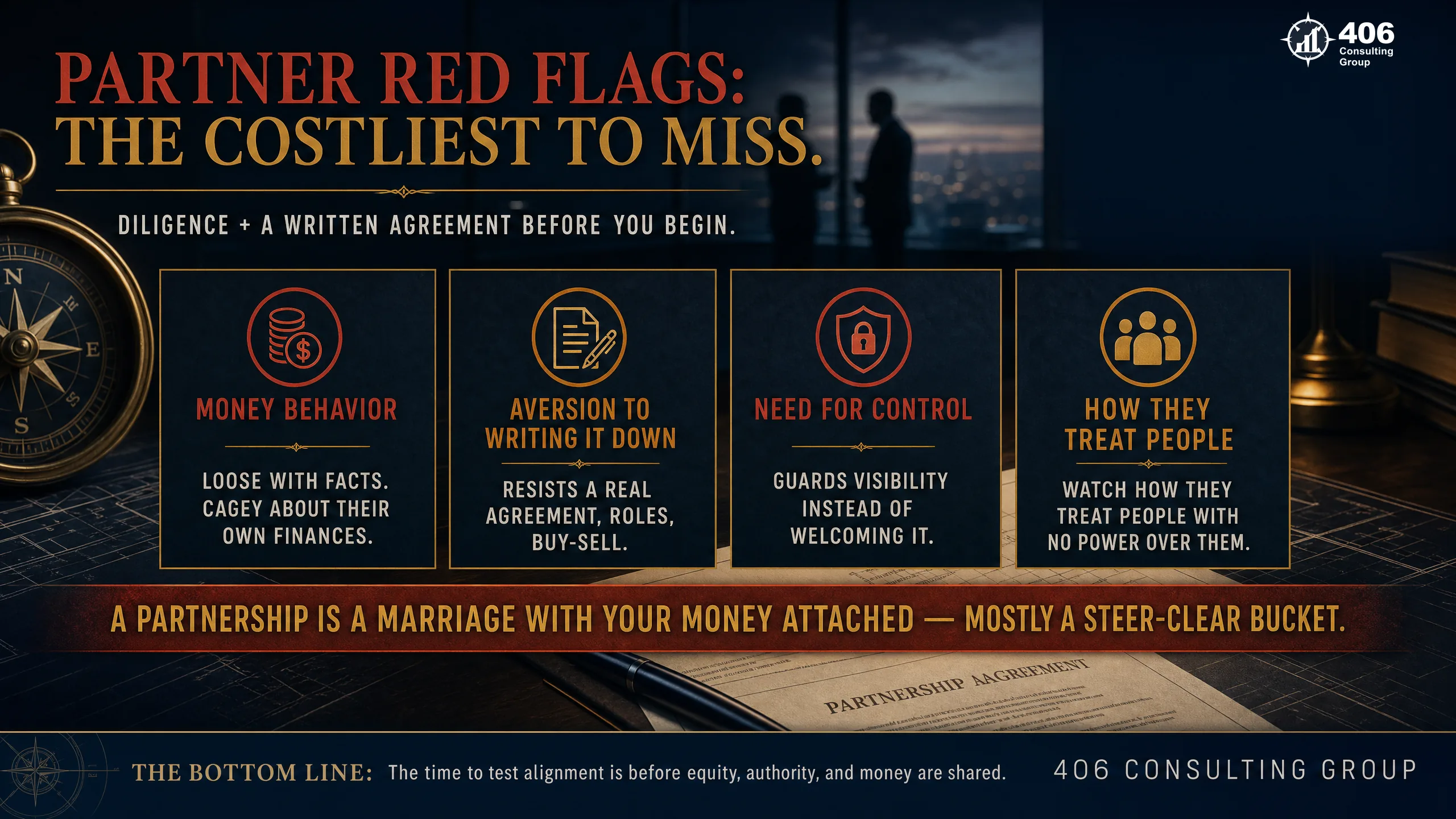
A bad hire is a setback; a bad partner can end the company. It's also the relationship people enter with the least diligence, on a wave of excitement and shared vision. Slow down for the flags that matter most: how they behave around money — loose with facts, cagey about their own finances, quick to blur personal and business spending; an aversion to putting things in writing — the partner who resists a real operating agreement, defined roles, and a buy-sell is telling you how disputes will go; a need for control — a partner should welcome shared visibility, not guard it; and how they treat people with no power over them — staff, vendors, servers — which is who they'll be when the honeymoon ends.
Because the exit is so painful, partnership red flags belong overwhelmingly in the steer-clear bucket: it is far cheaper to not marry the wrong partner than to divorce them later. The safeguard is unglamorous — do real diligence, agree on money, roles, and an exit before you start, and put it in a written agreement. A partner who fights that process on the way in has just shown you the most important red flag of all.
And then there's the highest-risk seat of all: the people with their hands on your money.
Red Flags in the People Near Your Money
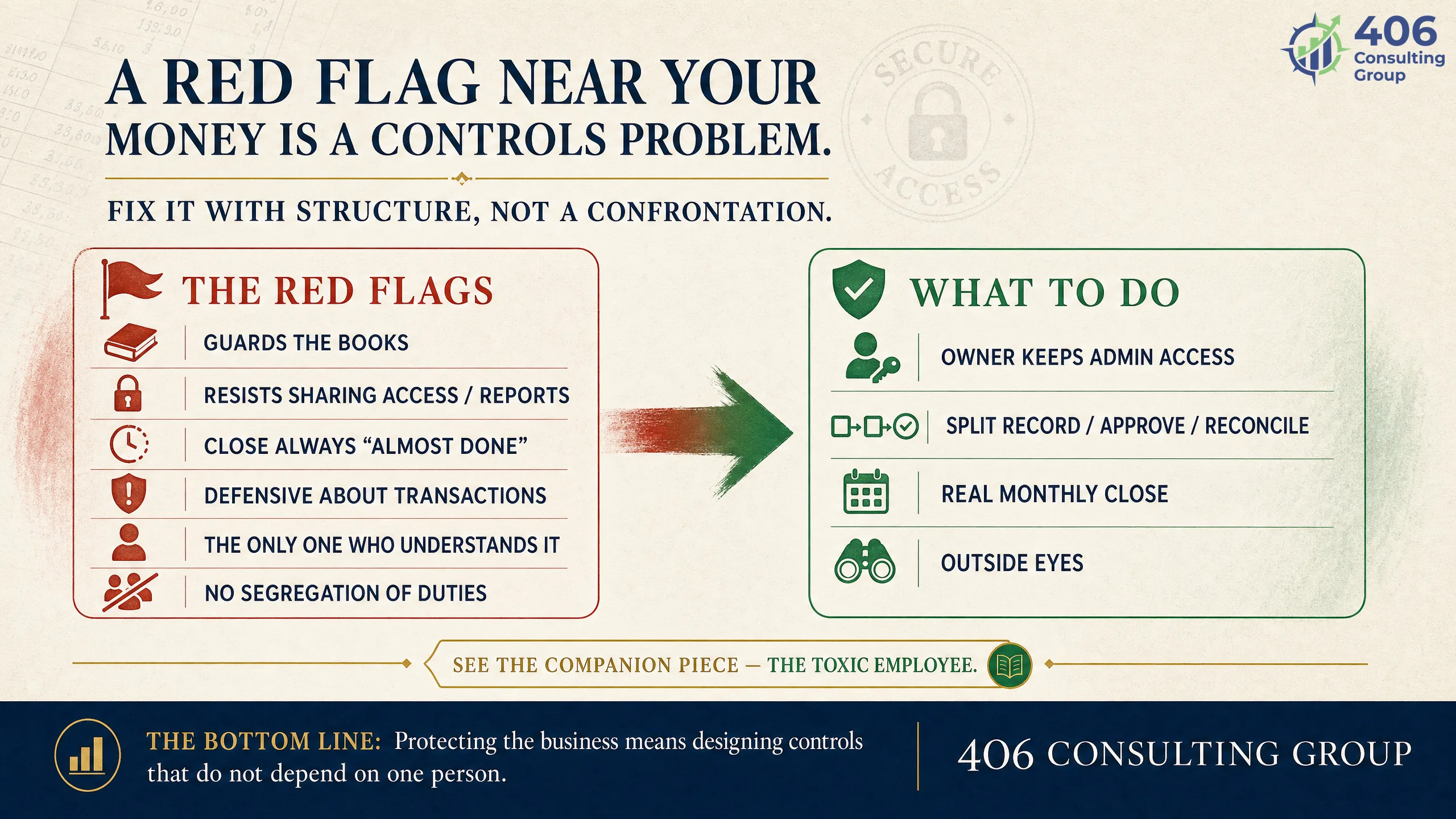
When the person raising flags is your bookkeeper, accountant, or office manager, the stakes change, because a red flag near the money is also a financial-risk flag. The tells are specific: they guard the books and resist sharing logins or reports; the monthly close is perpetually "almost done"; questions about a particular transaction draw defensiveness instead of answers; they've made themselves the only person who understands the system; and they resist any outside review. Put those together and you have the exact conditions where errors hide and, sometimes, where money walks — especially when there's no segregation of duties and one person records, approves, pays, and reconciles.
Here the fix isn't only a people decision — it's a controls decision, and that's good news, because you can improve your position without a single confrontation. Keep the owner's own administrator access to the bank and accounting system, split the chain so no one person controls a transaction end to end, run a real monthly close reviewed by someone independent, and bring in outside eyes. We wrote a whole companion piece on this exact pattern — the control-driven employee who guards the books — in The Toxic Employee. Controls protect the honest people too, which is why they're never an insult to ask for.
Now the decisions. When does a flag mean walk away, and when does it mean cut ties?
Steer Clear: The Dealbreakers
A handful of red flags should simply end it before it starts, no matter how good the rest of the package looks. These are the ones that don't coach out because they're about character: dishonesty, even in something small — if they'll shade the truth when it's cheap, they'll shade it when it's expensive; secrecy or evasiveness about money; a consistent pattern of blaming everyone else and never owning a mistake; contempt for people who can't do anything for them; and a need for control that treats transparency as a threat. When you see these clearly — not a rough day, but a pattern — the cheapest decision you will ever make is to not begin.
Dishonesty — even small
Shade the truth when it's cheap, and they'll shade it when it's expensive.
Secrecy about money
Evasiveness about finances is the flag you don't coach out.
Chronic blame
Never owns a mistake — it's always someone else's fault.
Contempt for the powerless
Disdain for the people who can't do anything for them.
A need for control
Treats transparency and oversight as a threat.
Steering clear feels like you're missing out on the skill or the deal. You're not. You're avoiding the single most expensive category of mistake an owner makes — and there is always another candidate, another partner, another vendor.
Exit: When It's Already Inside
Sometimes the flag is on someone already in the building — and the honest read is that it isn't fixable. The behavior is a character or control problem, not a skills gap; you've named it and given a fair chance to change, and nothing has; and the cost — to your other people, your customers, or your books — is compounding. That's an exit. The hardest part is that owners wait, because separation is uncomfortable and the person may hold knowledge or a key relationship. But waiting is rarely free: your best people are watching whether you'll tolerate it, and every month you delay teaches them the answer.
Exit deliberately, not in anger. Get your documentation and, where money is involved, your controls in order first, so the company can run without the person and nothing walks out the door with them. And do it with proper legal and HR guidance — the goal is a clean, professional separation that protects the business and treats the person fairly. Handled right, the relief on the other side — for you and for the team — is almost always bigger than you expected.
But plenty of red flags aren't dealbreakers at all — and treating them like they are costs you good people.
Red Flag to Green Flag: The Ones You Can Coach
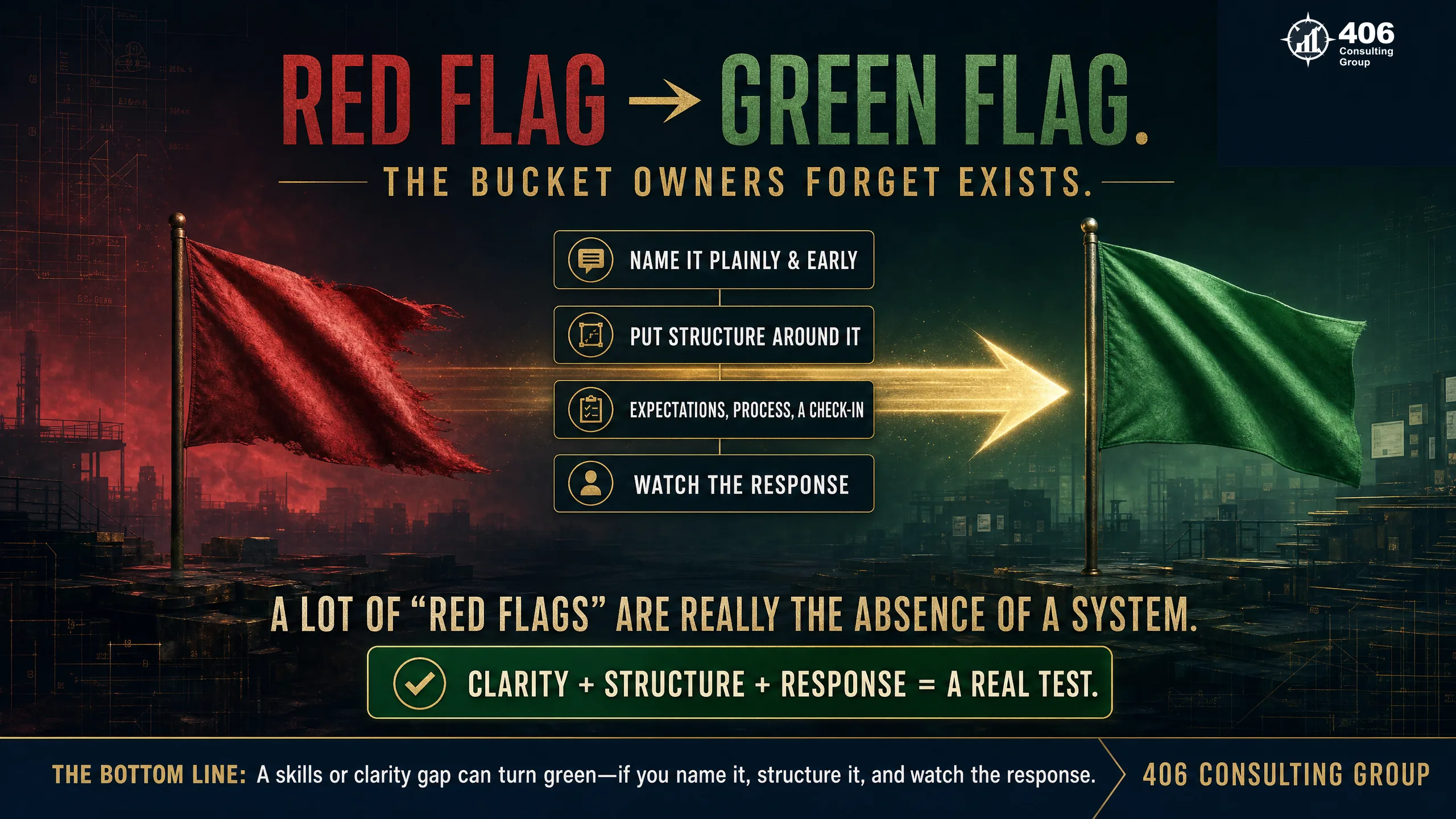
This is the bucket owners forget exists. Many red flags are really yellow — a skills gap, an off communication style, nervousness, inexperience, or a bad habit picked up in a badly run former job. Those aren't character defects; they're fixable, and often the person becomes one of your best once the flag is addressed. The employee who over-promises and misses deadlines may just have never been taught to scope work. The talented tradesperson who's prickly on site may respond immediately to clear expectations and respect. The new bookkeeper who's disorganized may simply have never had a real monthly close to follow.
A lot of "red flags" are really the absence of a system. Name it, put structure around it, and watch what the person does with it.
Coaching a red flag to green takes three things and a little courage. Name it plainly and early — most people never get honest, specific feedback, and can't fix what no one told them. Put structure around it — clear expectations, a process, a deadline, a check-in — because a lot of "red flags" are really the absence of a system. Then watch the response, which is the real test: someone who hears it, owns it, and adjusts is turning green; someone who argues, blames, or nods and changes nothing is telling you it's actually a character problem, and you've quietly learned which bucket they belong in.
Which raises the one question that decides all three buckets.
Character vs. Competence: Which Bucket Is It?
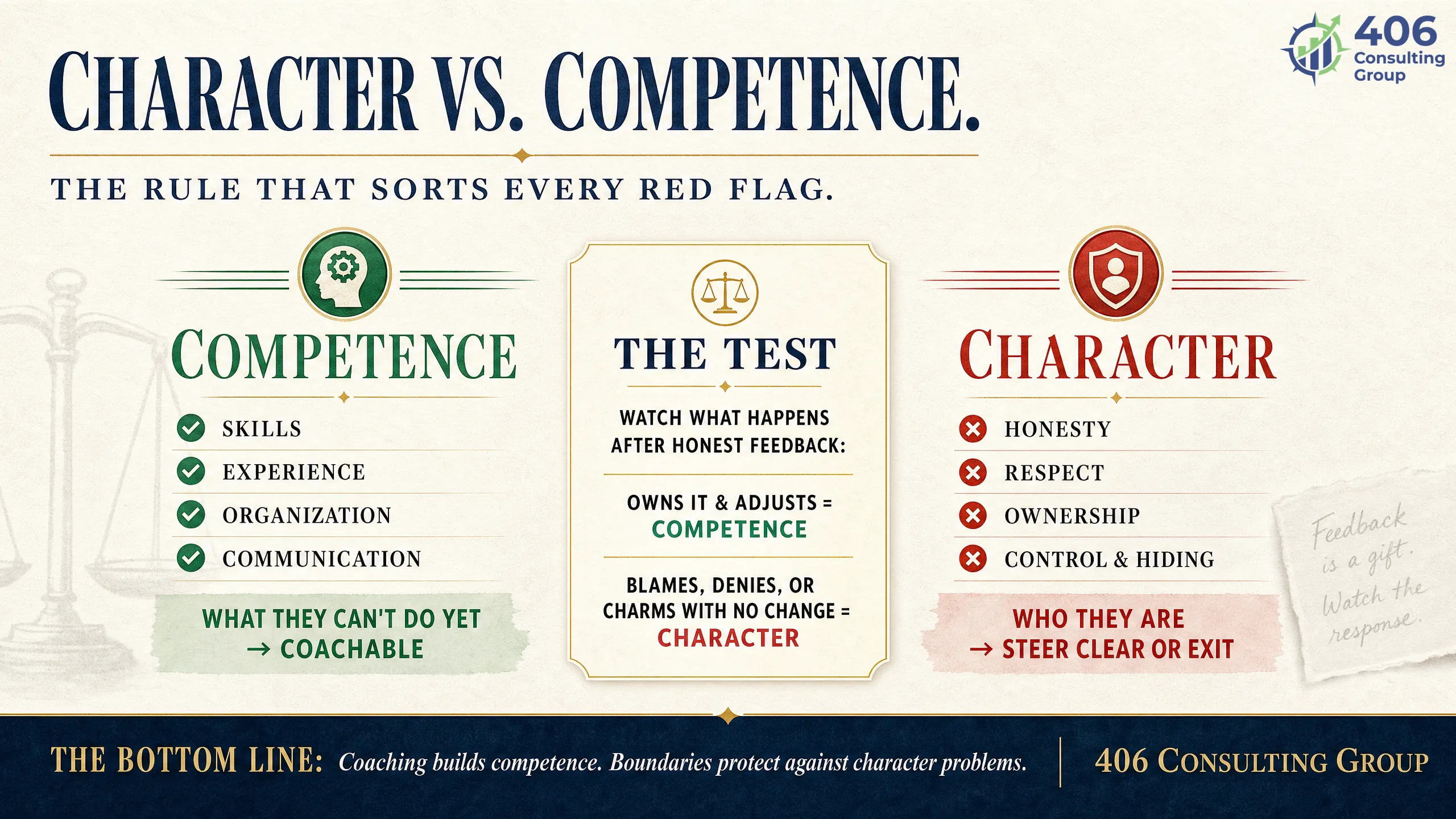
Here's the rule that sorts almost every red flag: is this a competence problem or a character problem? Competence problems — skills, experience, organization, communication — are about what someone can't do yet, and they respond to training, structure, and time. Character problems — honesty, respect, ownership, the impulse to control and hide — are about who someone is, and they do not coach out with a better process. Competence you can green. Character you steer clear of or exit. Almost every hiring and partnership disaster comes from getting this backward: coaching a character problem forever, or discarding a coachable competence gap.
A simple test cuts through it: watch what happens after honest feedback. Give the person clear, specific, fair feedback and see how they respond. Owning it and adjusting points to competence (green-able). Defensiveness, blame, dishonesty, or a charm offensive with no change points to character (steer clear or exit). Their reaction to the truth tells you more than the original flag did — and it's the same tell whether you're looking at a new hire, a partner, or the person keeping your books.
None of this requires you to become suspicious of everyone — just clear-eyed, and willing to act on what you see.
What to Do — and How 406 Helps
Turning this from insight into practice is mostly about process, so you're not deciding on gut in the moment. Build real hiring steps — structured interviews, skills tests, and reference checks you actually make. Do genuine diligence before a partnership and put money, roles, and an exit in writing up front. And around anyone near your finances, install the controls that make a red flag survivable: owner-held access, segregation of duties, a real monthly close, and outside eyes. Then, when a flag appears, run the triage — steer clear, exit, or coach — and use the response-to-feedback test to tell character from competence.
Where 406 comes in is the money side and the systems around it. We're outside your org chart, so we can't be intimidated or managed out, and we bring the controls, the independent bookkeeping, and the CFO-level visibility that turn a "trust me" back office into one you can actually verify — designed from a whole-company view, so the fix strengthens operations at the same time. If a red flag near your money has you uneasy, that's exactly the conversation to have, quietly and confidentially.
Put process before gut
Structured interviews and reference checks for hires; real diligence and a written agreement before any partnership. Decide on purpose, not in the moment.
Protect the money with controls
Owner-held access, segregation of duties, a real monthly close, and outside eyes — so a red flag near your finances is survivable, not catastrophic.
Run the triage
Steer clear, exit, or coach to green — and use the response-to-feedback test to tell a character problem from a competence gap.
Not sure how exposed your back office is? Our Financial Maturity Assessment surfaces the control gaps a red flag thrives in — in about eight minutes.
FAQ: Reading Red Flags
How do I tell a real red flag from a one-off bad day?
A red flag is a pattern, not a single moment. Nerves in an interview, one clumsy email, or a rough first week are usually just that. What you're watching for is a small behavior that repeats or that reveals character — badmouthing every past employer, evasiveness about money, contempt for people who can't help them, dishonesty in something minor. One data point is noise; a cluster is a signal. When you're unsure, name it, watch for it to repeat, and pay close attention to how the person responds to honest feedback.
When should I steer clear versus try to coach someone?
It comes down to character versus competence. Competence problems — skills, experience, organization, communication — are about what someone can't do yet, and they respond to training, structure, and clear expectations, so they're coachable. Character problems — honesty, respect, ownership, the impulse to control and hide — are about who someone is, and they don't coach out with a better process. Coach competence gaps; steer clear of, or exit, character problems. The fastest way to tell which you're dealing with is to give clear feedback and watch the response: owning it and adjusting is competence; defensiveness, blame, or dishonesty is character.
What are the biggest red flags in a business partner?
How they behave around money (loose with facts, cagey about their own finances, blurring personal and business spending), an aversion to putting things in writing (resisting a real operating agreement, defined roles, and a buy-sell), a need for control that treats shared visibility as a threat, and how they treat people who have no power over them. Because a bad partnership is so expensive and hard to unwind, most partner red flags belong in the steer-clear bucket. The best protection is real diligence and a written agreement — money, roles, and an exit — before you begin. A partner who fights that process is showing you the most important flag of all.
The red flag is my bookkeeper or accountant. What's different?
When the flag is on someone with their hands on your money, it's also a financial-risk flag, and you treat it as a controls problem, not just a people problem. Watch for guarding the books, resistance to sharing access or reports, a monthly close that's perpetually 'almost done,' defensiveness about specific transactions, and being the only person who understands the system — especially with no segregation of duties. The good news is you can improve your position without a confrontation: keep your own administrator access, split who records, approves, and reconciles, run a real monthly close reviewed by someone independent, and bring in outside eyes. Controls protect honest employees too.
How can 406 Consulting Group help with a red flag near my finances?
Start by treating the red flag as a controls question, then let outside eyes settle it. Because we sit outside your org chart, we can't be pressured, undercut, or quietly pushed aside — so we can reconcile the accounts, run a genuine monthly close, put real segregation of duties in place, and look hard at anything that doesn't add up, with no one to protect. From there we document the processes and build the systems so the business no longer hinges on a single person, and because we design them across the whole company, the books and the operations both get stronger. In practice it usually starts as a bookkeeping or controller engagement, with a fractional CFO layered on for numbers you can finally act on. If a red flag near your money is nagging at you, reach out — quietly and in confidence.
Keep Reading
Leadership & Financial Controls
Trust Your Gut — Then Verify It.
If a red flag near your money has you uneasy, 406 Consulting Group brings the independent eyes, controls, and systems to turn a "trust me" back office into one you can actually verify — quietly, confidentially, and from a whole-company view.
The Triage, in One Box
Every red flag goes in one bucket
A Red Flag Near Your Money?
Independent eyes, controls & systems.
About the Author
Amy McGehee
Senior Accountant, 406 Consulting Group
Amy is a senior accountant at 406 Consulting Group and a former CFO of a construction company, with a master's degree and deep construction-accounting experience. Years spent close to owners' books and back offices are exactly why these people-and-controls red flags are so familiar to her.
Read the Full Story