
Tax Services in Dallas-Fort Worth, TX:
No Income Tax Means Plan Federal
Texas has no state income tax — so all your tax leverage moves to the federal return: the S-corp election, depreciation, retirement, and, for relocating companies, multi-state cleanup. Plus the Texas margin tax. The planning that moves the needle, delivered remotely.

Texas has no state income tax, and that fact does something funny to business owners: it convinces them there's no tax planning to do. The opposite is true. When the state stops taxing your income, all of the leverage moves to your federal return — the entity election, depreciation timing, retirement, and, for the many companies relocating into Dallas-Fort Worth, untangling tax obligations left behind in higher-tax states. Add the Texas Franchise (Margin) Tax, and a DFW business has plenty to plan around; it just isn't where owners expect to look.
This guide walks the moves that actually cut a DFW business's tax bill — the federal levers, the margin tax, the entity math, and the relocation cleanup — delivered remotely.
By Carrie Anderson — Co-Founder, 406 Consulting Group. Former commercial banker and multi-state advisor who helps DFW owners plan proactively — federal strategy, entity choice, the margin tax, and multi-state cleanup — with the whole financial picture in view.
Quick Answer: Tax Planning for a DFW Business
- →With no state income tax, your real tax leverage is federal — entity choice, depreciation, retirement, timing.
- →The S-corp election is a purely federal play here — no state layer to complicate it, so the SE-tax math is clean.
- →The Franchise (Margin) Tax is the one Texas-specific bill — on margin, above ~$2.47M revenue.
- →Relocating in? The biggest dollars are often in cleaning up nexus and filings in the state you left.
- →Planning is remote — and about 80% of our local clients run it entirely that way.
Table of Contents
No Income Tax Doesn't Mean No Planning
Here's the mental shift a DFW owner has to make. In a state with an income tax, a lot of planning is about trimming the state bill. In Texas, that bill is zero — so every dollar of tax leverage is on the federalside. That's actually good news: the federal levers are the biggest ones anyway (entity choice, depreciation, retirement plans, timing), and none of them get muddied by a state income tax layer. The mistake is treating "no state income tax" as "nothing to plan" and coasting into April — leaving the federal savings on the table.
No state income tax doesn't remove the planning — it concentrates it. All of the leverage moves to your federal return, where the biggest levers live anyway.

There is one Texas-specific bill to handle, though — and it confuses almost everyone.
The Franchise (Margin) Tax, Handled Right
Texas's one broad business tax is the Franchise Tax, universally called the "margin tax." It applies to entities with revenue above a no-tax-due threshold (around $2.47 million) and is calculated on your margin — revenue minus certain deductions — not your profit. The rate is 0.375% for retail and wholesale and 0.75% for everyone else, and there are a few ways to compute the margin (including an EZ method for smaller filers) that can produce meaningfully different bills. The planning here is real: choosing the right computation method and managing the deductions that reduce margin can save actual money for a business over the threshold.

Confirm current rates, thresholds, and methods with the Texas Comptroller. Now to the federal move most profitable owners should run.
The S-Corp Election Is Pure Federal Here
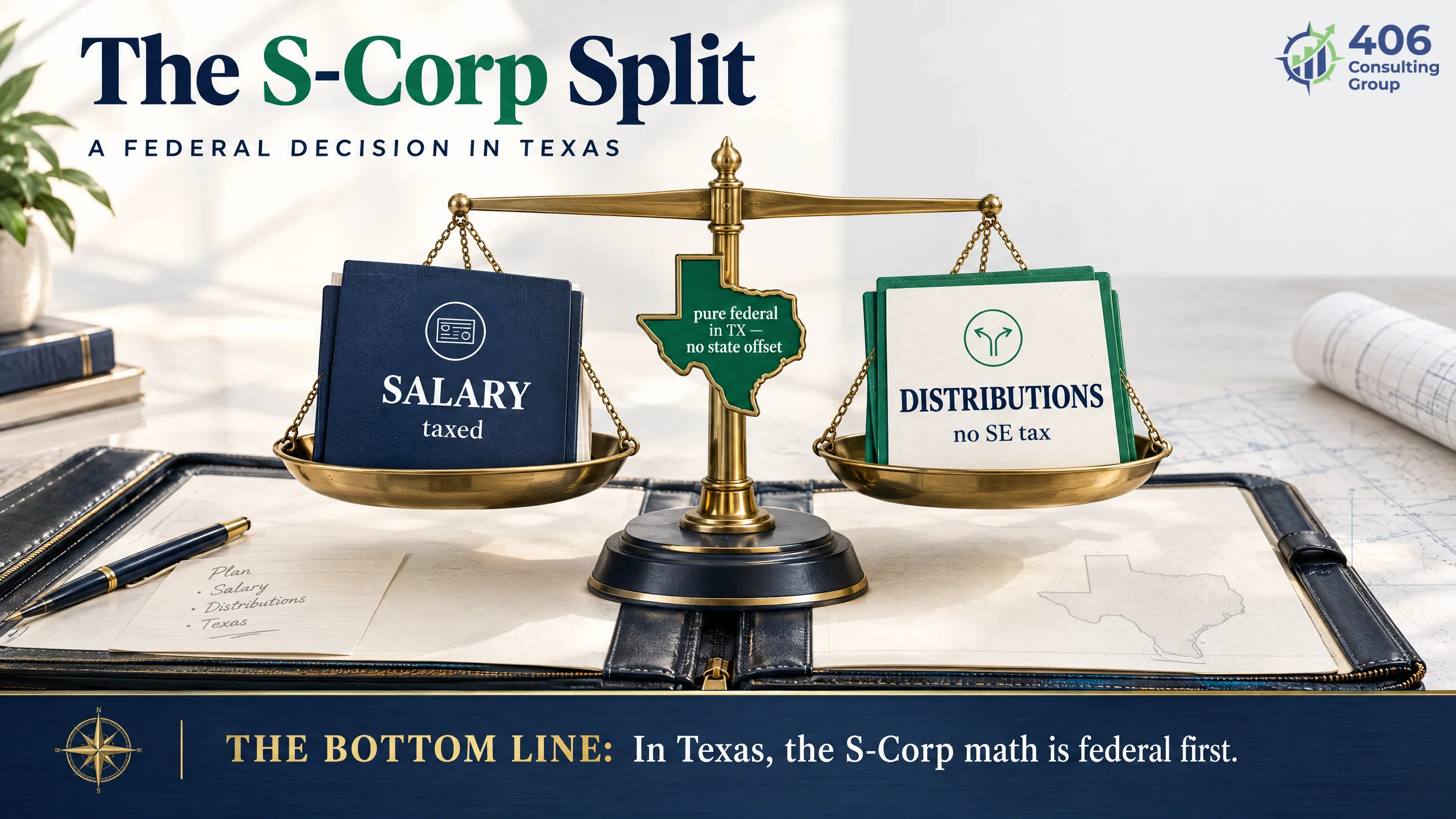
In many states, deciding whether to elect S-corp status means weighing federal savings against a state-level cost — a franchise tax, a net-worth tax, an extra state levy on the S-corp. In Texas, that complication mostly disappears: with no state income tax, the S-corp election is a clean federal play. Once profit consistently clears roughly $80,000–$100,000, electing lets you split profit into a reasonable salary and distributions, and the distributions escape the ~15.3% self-employment tax — often several thousand dollars a year, with no state offset eating into it. It's one of the simpler, cleaner wins available to a profitable DFW owner.
See what the S-corp election would save you.
Because it's purely federal in Texas, the math is clean. Run your numbers with our free calculator, then read the full decision guide.
For the many businesses that arrive in DFW from elsewhere, the biggest tax dollars are often somewhere else entirely.
Relocating to Texas? The Multi-State Cleanup
Dallas-Fort Worth is a landing pad for companies leaving higher-tax states, and the move creates a tax project most owners underestimate. Simply relocating doesn't automatically end your obligations in the state you left: if you still have employees, property, or enough sales there, you can keep nexus— and the filing duties that come with it — long after the headquarters sign changes. Done wrong, you get taxed in two states at once; done right, you cleanly de-register, apportion your final-year income correctly, and shut the door. For a relocating business, that cleanup is frequently where the biggest dollars and the biggest risks sit.

Whether you're new to Texas or long established here, the federal levers are the same — and they're where the recurring savings live.
The Federal Levers That Actually Move the Needle
With the state out of the picture, these are where a DFW owner's planning pays off:
Depreciation timing
Bonus depreciation and Section 179 let you accelerate write-offs on equipment and vehicles — powerful for capital-heavy DFW trades and logistics businesses.
Retirement plans
A solo 401(k), SEP, or defined-benefit plan can shelter large amounts of income — often the single biggest federal lever for a profitable owner.
Entity & compensation
The S-corp election and a reasonable-salary strategy, tuned to your profit — clean in Texas with no state layer.
Income & expense timing
Accelerating or deferring income and deductions across a year-end to land in the lower-tax federal year.

One more Texas tax deserves a clear head, because owners routinely confuse it with the margin tax.
The Sales & Use Tax Traps
Texas sales and use tax (around 8.25% in DFW) is a completely separate thing from the margin tax, and mixing them up is common. The traps are familiar but costly: treating collected sales tax as spendable cash when it belongs to the state, forgetting use taxon equipment and supplies bought out of state where no Texas tax was charged, and — for contractors — misapplying the special rules for construction contracts. Clean books that treat sales tax as the liability it is keep this boring, which is exactly what you want.

Tie the pieces together and one question drives the whole plan: how should you be structured?
Entity Structure in a No-Income-Tax State
Because Texas doesn't tax income, the entity decision is refreshingly focused: it's mostly about federalself-employment tax and the margin tax, not a stack of state income taxes. For most profitable owners that means the LLC-taxed-as-S-corp path, once profit justifies it, delivers clean federal savings — while keeping an eye on whether your revenue puts you over the margin-tax threshold and which computation method fits. It's simpler than the same decision in a high-income-tax state, but "simpler" still rewards running the actual numbers rather than guessing.
None of these levers — federal planning, the margin tax, entity choice, relocation cleanup — require a face-to-face meeting.
Proactive Planning, Delivered Remotely
Tax planning is analysis and conversation — secure document exchange, screen-shares, and a plan made before year-end — none of which needs a Dallas or Fort Worth address. The proof is in how our existing clients already work: roughly 80% of our local clients run the entire relationship remotelyand never set foot in the office. What matters for a Texas business is an advisor who knows the federal levers, the margin tax, and multi-state cleanup, and who is proactive all year — not one who happens to be nearby.
~80%
of our local clients are fully remote
Distance to DFW isn't the point — expertise and a year-round plan are.
No state income tax is a gift. Turning the federal side into money you keep is the work.
FAQ: DFW Tax Questions
If Texas has no income tax, is there any tax planning to do?
Yes — arguably more focused planning, not less. With no state income tax, all of your tax leverage moves to the federal return, where the biggest levers live anyway: the entity election, depreciation timing (bonus depreciation and Section 179), retirement plans, and income/expense timing. There's also the Texas Franchise (Margin) Tax to manage if your revenue is above the threshold. Treating 'no state income tax' as 'nothing to plan' is the costly mistake — it just means the savings are federal, and they still require a proactive, year-round plan rather than a April filing.
How does the S-corp election work for a Texas business?
Cleanly. In many states, electing S-corp status means weighing federal self-employment-tax savings against a state-level cost like a franchise or net-worth tax. Texas has no state income tax, so the S-corp election is essentially a pure federal play: once profit consistently clears roughly $80,000–$100,000, splitting it into a reasonable salary and distributions lets the distributions escape the ~15.3% self-employment tax, with no state offset eating into the savings. The Texas margin tax is separate and based on revenue, not the election. Run your specific numbers — our S-Corp calculator and decision guide walk through exactly how much it would save.
I'm relocating my business to DFW — what tax cleanup do I need?
More than most owners expect. Relocating to Texas doesn't automatically end your tax obligations in the state you left. If you keep employees, property, or enough sales there, you can retain nexus and its filing requirements even after moving your headquarters — and get taxed in two states at once if it's handled poorly. A proper relocation includes cleanly de-registering where appropriate, apportioning your final-year income correctly, and confirming what, if anything, still ties you to the old state. For a relocating business, this multi-state cleanup is frequently where the biggest tax dollars and risks sit, so it's worth doing deliberately with a multi-state-aware advisor.
What is the Texas margin tax and will my DFW business owe it?
The Texas Franchise Tax — the margin tax — applies to entities with revenue above a no-tax-due threshold of roughly $2.47 million and is calculated on margin (revenue minus certain deductions), not profit, at 0.375% for retail/wholesale or 0.75% for others. Below the threshold most entities owe nothing, though many still have a filing obligation. Because it's based on margin, a growing business can owe it in a year that wasn't especially profitable, and the computation method you choose can change the bill — so it rewards planning once you're near or over the threshold. Confirm current figures with the Texas Comptroller.
Can 406 Consulting Group handle my DFW taxes remotely?
Yes — we provide proactive federal and Texas tax planning and preparation for Dallas-Fort Worth and Texas businesses entirely remotely. What matters for a Texas business is expertise in the federal levers, the margin tax and its computation methods, entity strategy, and multi-state cleanup for relocating companies — not office proximity. Around 80% of our own local clients already run the entire relationship remotely, and our commercial-banking and multi-state background means we plan taxes with your whole financial picture in view.
Texas Tax Levers
Where the savings live
DFW Tax Planning
Federal-first, Texas-smart, remote.
About the Author
Carrie Anderson
Co-Founder, 406 Consulting Group
A former commercial banker and multi-state advisor, Carrie helps DFW owners plan proactively — federal strategy, entity choice, the margin tax, and the multi-state cleanup relocating companies need — with the whole financial picture in view.
Read the Full Story