
Construction & Trades Accounting in Sioux Falls, SD:
The Excise Tax Most Contractors Mis-Bid
South Dakota hits contractors twice — a 2% excise tax on gross receipts (SDCL 10-46A) plus sales/use tax on the materials you install. Here's the bid-factor math, the licensing stack, and the job costing that protects your margin.
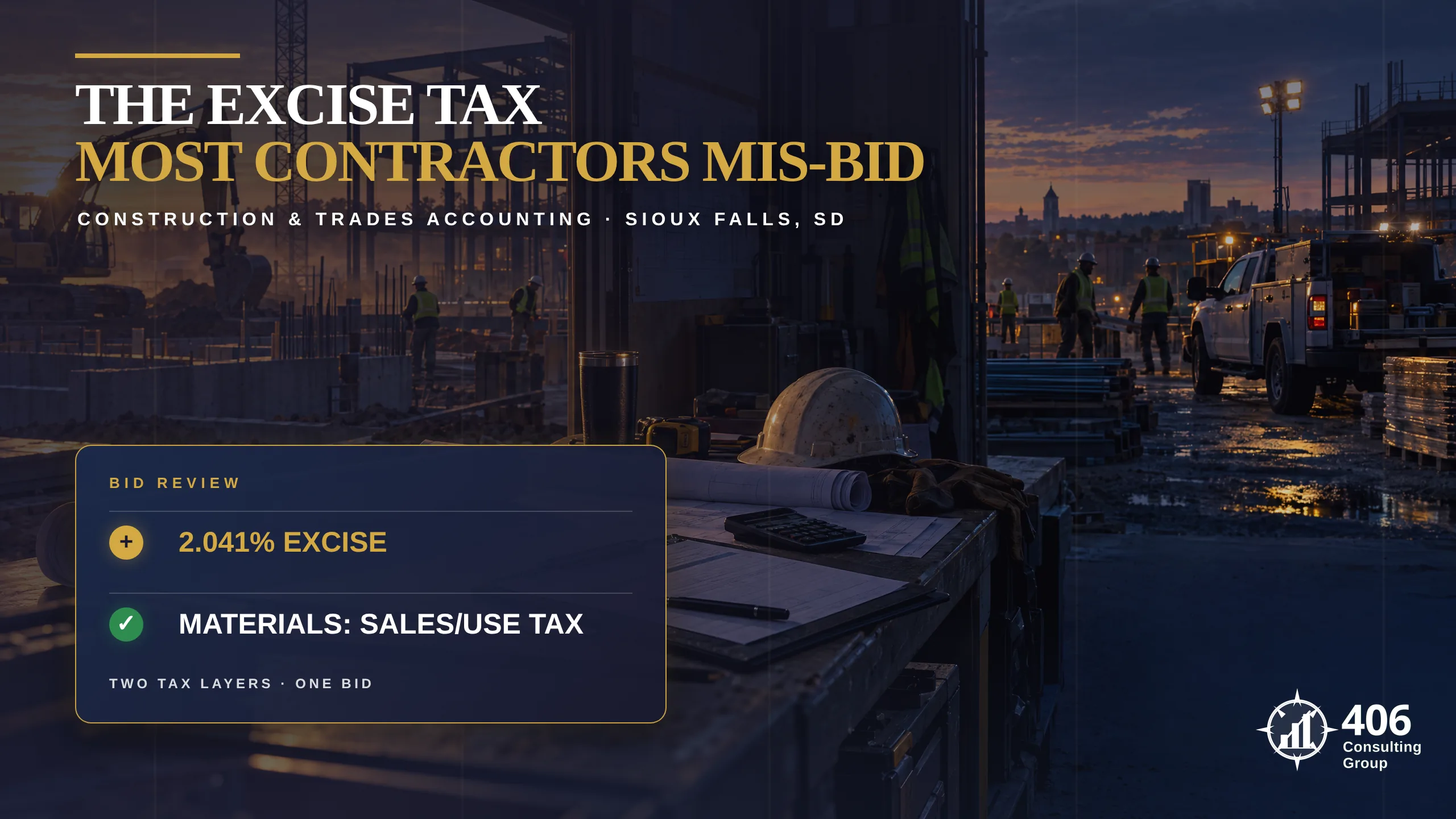
Here's a mistake we see new South Dakota contractors make exactly once: they bid a job on their costs plus margin, win it, do great work — and come up roughly 2% short, because they forgot the contractor's excise tax. South Dakota is a no-income-tax state, which lulls a lot of trades businesses into thinking taxes are simple here. For contractors, they're the opposite: SD layers a 2% excise tax on your gross receipts on top of making you pay sales or use tax on the materials you install. Two taxes, two different bases — and if you only price one, the other eats your margin.
Get this right and it's just a line in your bid. Get it wrong and it's the difference between a profitable year and a busy one. This guide walks the SD/Sioux Falls contractor tax and licensing stack, the bid math, and the job costing that keeps margin from leaking.

By Jason Anderson
Co-Founder, 406 Consulting Group
Big-firm tax background with a Six Sigma discipline for systems and job costing.
Tax and licensing rules change; verify specifics with the SD Department of Revenue, the City of Sioux Falls, and your advisor. SDCL 10-46A governs the contractor's excise tax.
Quick Answer: SD Contractor Taxes
- →2% contractor's excise tax on gross receipts for realty-improvement work (SDCL 10-46A).
- →Use the 2.041% bid factor — because the taxable base includes the tax you collect, a flat 2% under-recovers.
- →You're a consumer of materials — you pay sales/use tax on what you install; you can't buy it tax-free for resale.
- →No state GC license, but a DOR excise license, state electrical/plumbing licenses, and a Sioux Falls city license + bond apply.
- →Workers' comp is optional in SD — with a real catch (below).
What We'll Cover
The Bid That Lost Money
Picture Dakota Drywall, a growing Harrisburg sub that just landed its biggest job. The owner prices labor, materials, overhead, and margin — clean bid, signed contract. What he didn't add was the 2% excise tax on the whole contract. On a $200,000 job that's about $4,000 that comes straight out of his profit, because the tax applies whether or not he remembered to price it. One line in the bid would have covered it. That's the entire story of contractor accounting in South Dakota: the tax is predictable, so missing it is purely an avoidable margin leak.
South Dakota's 2% Contractor's Excise Tax
Under SDCL 10-46A, prime contractors owe a 2% excise tax on their gross receipts from construction and realty-improvement projects. “Gross receipts” means the full contract — there's no deduction for subcontractor payments, materials, or labor. And the taxable base includes the excise tax you pass through to the customer, which is why the effective recovery rate isn't a flat 2% (next section). This isn't a license-competency tax; it's a tax on the work itself, and it's the single biggest thing that makes SD contractor accounting different from a typical no-income-tax state.
The 2.041% Bid Factor
Because the taxable base includes the tax itself, adding a flat 2% to your bid leaves you short. The fix is the bid factor: to fully recover a 2% tax whose base includes the tax, you gross up by 2 ÷ (100 − 2) = ~2.041%. SD DOR guidance and standard industry practice use this factor on bids.
Worked example — Dakota Drywall, $200,000 job
- Bid add-on at 2.041%: ~$4,082 collected from the customer
- Excise tax owed (2% of gross receipts incl. the tax): ~$4,082
- Net margin impact: $0 — the factor makes the customer carry it
- Bidding a flat 2% instead would have left ~$80 uncovered — small here, real at volume
You're a Consumer of Materials, Too
This is the part that creates the double layer. In South Dakota, a contractor doing realty-improvement work is the consumer of the materials and supplies they install — which means you pay sales or use tax on those purchases and cannot buy them tax-free for resale. So a single job can carry two taxes on two different bases: sales/use tax on the materials you buy, and the 2% excise tax on the gross receipts of the job. Owners who assume construction is “just the excise tax” underprice; owners who assume they can buy materials tax-free get a use-tax bill later. Your books have to track both.
Layer 1 — Materials
Sales/use tax on everything you buy and install. You're the end consumer.
Layer 2 — The job
2% excise tax on the full gross receipts of the contract (SDCL 10-46A).
Prime vs. Sub: Who Owes
Generally the prime contractor owes the 2% excise tax on the full job, and a subcontractor with a prime contractor's exemption certificate on file owes nothing on that work — the prime has already covered the gross receipts. Get the certificates right and you avoid double-paying. The exception: on qualified utility projects, both prime and sub can owe tax under the separate alternative regime (SDCL 10-46B). If you sub out work or work as a sub, documenting who owes what is a real part of keeping your margin.
The Sioux Falls Licensing Stack
South Dakota has no statewide general-contractor license — but that doesn't mean no paperwork. A Sioux Falls contractor typically juggles several layers:
- A Contractor's Excise Tax license from the SD DOR — required before you start work.
- State licenses for the trades that have them — electrical (SD Electrical Commission) and plumbing (SD Plumbing Commission).
- A City of Sioux Falls Residential Building Contractor's License (with an exam) for building work.
- A bond made out to the City of Sioux Falls (surety vendors list the residential building bond around $20,000 — confirm the current amount) plus ~$300,000 liability insurance.
That's a DOR tax license, state trade licenses, a city building license, a city bond, and insurance — a lot of moving compliance parts that clean books and a controller keep straight. Requirements vary by the exact city/county you work in, so confirm locally.
Job Costing & WIP
The excise tax is the headline, but margin usually leaks somewhere quieter: jobs you think made money but didn't. Real job costing — labor, materials (with the tax), equipment, and overhead tracked by job — plus a work-in-progress schedule that shows over/underbilling, is how you catch it. A correct bid only protects you if your costing confirms you actually hit it. This is controller-level work, and it's where we turn “we're busy” into “we're busy on the jobs that pay.”
Workers' Comp Is Optional in SD — With a Catch
Unlike a lot of states (Florida construction, for example, requires it at one employee), South Dakota does not legally require any employer to carry workers' comp. But there's a real catch: an uninsured employer loses tort immunity, meaning an injured worker can sue you directly for uncapped damages. On a job site, that's a bet most contractors shouldn't take — which is why nearly all carry it anyway. “Optional” on paper isn't “skip it” in practice.
No State Prevailing Wage
South Dakota has no state prevailing-wage law (no “little Davis-Bacon”). Federal Davis-Bacon wage rates still apply to federally funded or assisted public works above the federal threshold, and SDDOT voluntarily applies federal wage decisions to some larger state-funded highway contracts as a policy. For most private Sioux Falls construction, there's no prevailing-wage layer — but if you chase public or federally funded work, that changes, and your payroll has to be ready for it.
Remote & Why 406
Construction accounting is specialized, and most generalist bookkeepers miss the excise tax, the bid factor, and the consumer-of-materials rule entirely. We don't. We've built the numbers for construction and trucking businesses — including helping pull a construction and trucking company out of bankruptcy and back to health — and we deliver it remotely across South Dakota: Sioux Falls, Harrisburg, Tea, Brandon, Hartford, Dell Rapids. Jason brings big-firm accounting and job-costing discipline; Carrie brings the banker's eye for when you need bonding or a line of credit. You get contractor-literate books, not generic ones.
Bidding SD jobs without the excise tax dialed in?
Let's set up contractor-literate books, job costing, and bids that actually hold their margin.
Frequently Asked Questions
What is South Dakota's contractor's excise tax?
Under SDCL 10-46A, prime contractors owe a 2% excise tax on gross receipts from construction and realty-improvement projects. There's no deduction for subcontractors, materials, or labor, and the taxable base includes the tax you pass through to the customer — which is why contractors bid using a ~2.041% factor rather than a flat 2% to fully recover it.
Do contractors pay sales tax on materials in South Dakota too?
Yes. A contractor doing realty-improvement work is treated as the consumer of the materials they install, so you pay sales or use tax on those purchases and can't buy them tax-free for resale. That means a job can carry two taxes on two different bases: sales/use tax on materials plus the 2% excise tax on gross receipts. Your books need to track both.
Does South Dakota require a general contractor license?
There's no statewide general-contractor license. But you do need a Contractor's Excise Tax license from the SD DOR, state licenses for electrical and plumbing trades, and — in Sioux Falls — a city Residential Building Contractor's License (with an exam), a bond made out to the city (around $20,000 for residential building; confirm the current amount), and liability insurance. Requirements vary by locality.
Is workers' comp required for South Dakota contractors?
No — South Dakota doesn't legally require any employer to carry workers' comp. But an uninsured employer loses tort immunity and can be sued directly by an injured worker for uncapped damages, so on a construction site nearly everyone carries it anyway. It's optional on paper, not in practice.
General information for South Dakota contractors, not tax or legal advice. The excise tax is governed by SDCL 10-46A; confirm current rates, bid factors, bond amounts, and licensing with the SD DOR and the City of Sioux Falls.
The bottom line
SD contractors face a double layer: 2% excise tax on gross receipts (bid at ~2.041%) plus sales/use tax on materials you install. Price both, or your margin pays it.
Sioux Falls Series