
The Accidental Bookkeeper:
Why “My Office Manager Does the Books” Costs More Than a Pro
It feels like the frugal move — let a capable employee handle the books instead of paying a professional. We've seen where it leads hundreds of times: five-figure tax overpayments, decisions made on wrong numbers, and a business that can't scale. Here's the real cost, and the fix that's a win for everyone.

Here's a decision we watch small business owners make over and over, almost always with total confidence that it's the frugal, sensible choice: "I'm not going to pay for a real bookkeeper. My office manager says she knows QuickBooks — she'll handle the books." Sometimes it's the office manager. Sometimes it's a spouse, a front-desk person, or a loyal long-time employee who "is good with numbers." The logic feels airtight: why pay a professional when someone already on payroll can do it?
We have seen the results of this decision hundreds of times, and we'll be blunt because someone has to be: it is one of the most expensive mistakes a small business owner can make. Not a little expensive — five and six figures expensive, quietly, year after year. The person doing the books usually isn't bad at their real job. They're just badly miscast in this one, and the cost of that miscasting hides in places the owner never thinks to look: the tax return, the decisions made on bad numbers, and the ceiling the business keeps hitting and can't explain.
This article is the conversation we wish we could have with every owner before they make this call. What it actually costs, the gaps you literally cannot see from where you sit, why hiring more of these people never fixes it — and the reframe that turns this from a loss into a win for everyone, including the person currently stuck doing the books.
By Jason Anderson — Co-Founder, 406 Consulting Group. Background in large-scale operational finance at BP before building financial infrastructure for Montana and Northwest small businesses. This one comes straight from what we see in the field.
Quick Answer: The Accidental-Bookkeeper Trap
- →It feels frugal — but "someone who knows QuickBooks" is not a bookkeeper, and the gap costs far more than the salary you saved.
- →The biggest cost is invisible: overpaid taxes (we've seen $60K+), decisions made on wrong numbers, and a business that can't scale.
- →They get the owner's ear — and steer real decisions with numbers that aren't right.
- →You can't hire your way out — a dozen amateurs still leave gaps only a professional closes.
- →The fix is a win-win: a real accountant builds the processes, and that employee gets redeployed to work they're actually great at.
Table of Contents
The Scene We See Every Week
A Bozeman contractor is doing $2.5M a year. Good work, steady phone, more jobs than he can take. His office manager — sharp, dependable, been with him six years — also "does the books" in QuickBooks. She pays the bills, runs payroll, and hands the file to a tax preparer once a year. The owner is proud of how lean he runs. He tells us, without a hint of doubt, that he doesn't need a bookkeeper because he already has one.
Then we look under the hood. The books haven't truly reconciled in a year. Job costing doesn't exist, so he genuinely does not know which jobs make money. Owner draws, loan payments, and equipment purchases are all miscategorized, which means the profit number on his return is fiction. He's an LLC paying tax as a sole proprietor, overpaying self-employment tax on every dollar. And his office manager — who is not to blame for any of this — has been quietly advising him for years on pricing and hiring using numbers that were never right.
That is not an unusual case. That is the typicalcase. And the owner has no idea, because everything "looks fine" from where he sits — the bills get paid, payroll runs, the return gets filed. The damage is real, ongoing, and completely invisible to the one person paying for it.
Why It Feels Like the Smart Move
The short answer: because the cost of a bookkeeper is a visible line item, and the cost of not having one is invisible. Owners optimize against the number they can see. A real bookkeeper or accountant is a bill that shows up every month; the taxes you overpaid and the bad decisions you made never arrive with an invoice, so they don't feel like costs at all.
The reasoning usually goes: "She already knows the business. She's already on payroll. QuickBooks basically does it for you now. Why would I pay someone $1,500 a month to do what she can do in a few hours a week?" Every sentence in that logic is understandable, and every sentence is wrong in a way that won't show up until tax time — or until the business tries to grow and can't figure out why the cash never matches the profit.

The frugal instinct is the right instinct pointed at the wrong target. You're saving a few hundred dollars a month and losing multiples of it where you can't see. That's not frugal — it's the most expensive kind of cheap.
Meet the Accidental Bookkeeper
The short answer: the accidental bookkeeper is a capable person who ended up owning the books because they were nearby and willing, not because they were trained for it. "Knowing QuickBooks" — being able to enter transactions and print a report — is not the same as knowing accounting, any more than owning a scalpel makes someone a surgeon.
Real bookkeeping and accounting is judgment: how to categorize a transaction so the financials mean something, how to reconcile so the numbers are trustworthy, how to structure the books so they answer questions, how the whole thing feeds a tax strategy. The accidental bookkeeper was never taught any of that, and — crucially — doesn't know what they don't know. They can make the software produce a number. They can't tell you whether the number is right, and they can't tell you it's wrong, because it all looks the same from inside the spreadsheet.
This is not a knock on them. It's a knock on the casting. You've taken a good employee and handed them a specialized profession as a side task, then assumed the software would cover the training gap. It doesn't.
The Gaps You Can't See
The short answer: the damage from amateur bookkeeping lives below the waterline. The visible part — bills paid, payroll run — is the small part. Underneath sits everything that decides whether your numbers are true, and it's usually a mess.
Reconciliations that never truly happen
If the books don't tie to the bank and statements every month, every number downstream is a guess. This is the silent one — nobody notices until it's a year deep.
Miscategorized transactions
Owner draws booked as expenses, loan principal as cost, equipment as supplies — each one distorts profit and the tax return built on it.
No job costing or margin tracking
The business can't tell which jobs, products, or clients actually make money — so it keeps saying yes to the ones that lose.
Payroll and liabilities handled loosely
Withholding, sales/use tax, and payroll liabilities tracked by feel instead of as the obligations they are — until a notice arrives.
Books that can't answer a question
When the bank, or you, need a real financial statement or a forecast, it isn't there — because the foundation was never built to produce one.
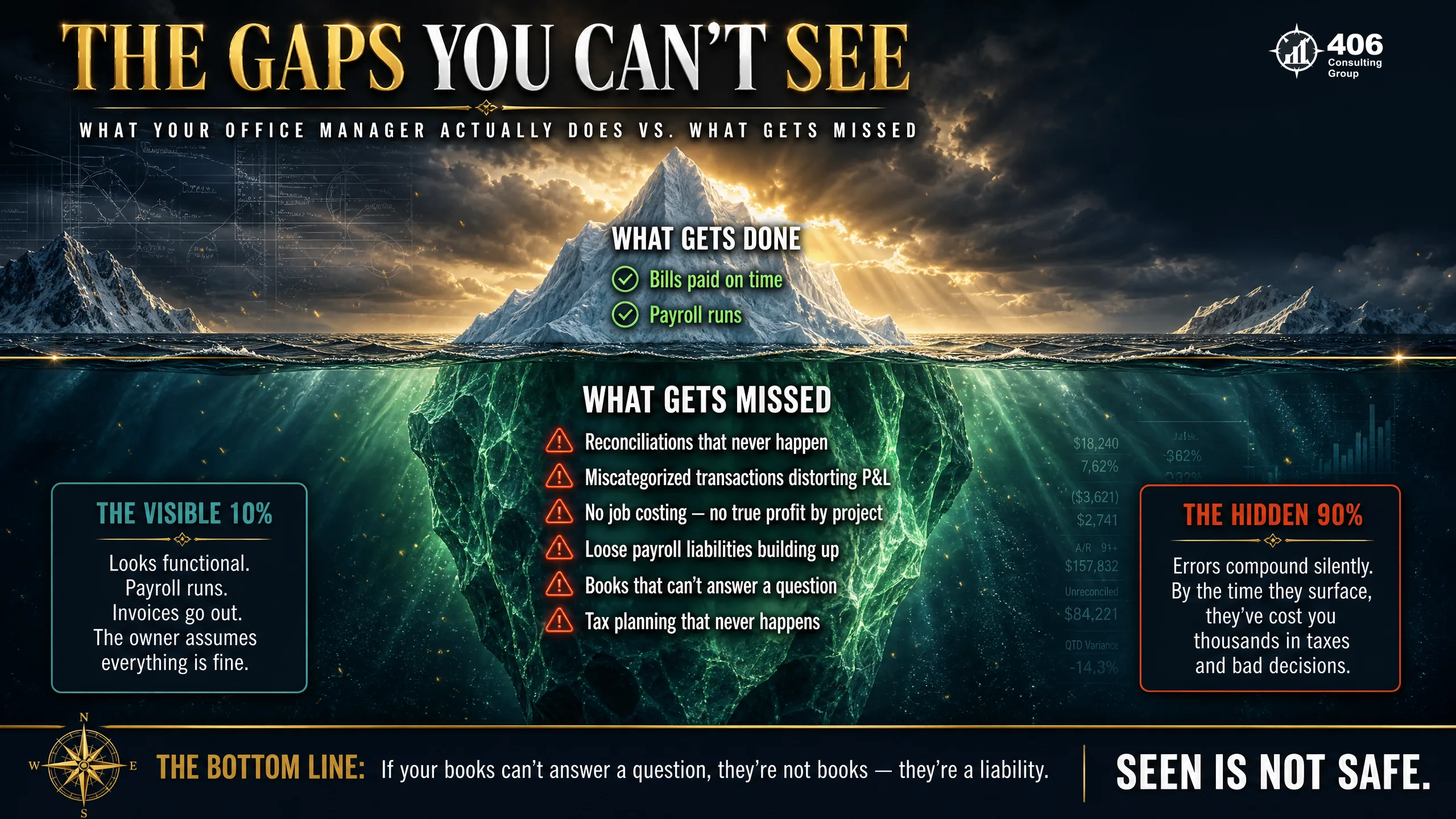
None of these throw an error message. The software runs perfectly while producing numbers that are quietly wrong — which is exactly why the owner never sees it coming.
The Tax Cost: Overpaying by Five Figures
The short answer: this is where the invisible cost becomes real money. An accidental bookkeeper doesn't do tax planning — they don't know it exists — so the business defaults to the highest tax it could possibly pay, every single year. We have seen owners overpay by $60,000 and more before anyone caught it.
How does it get that big? Stack the misses: a profitable LLC that never elected S-corp status, overpaying self-employment tax by five figures a year. Equipment bought at the wrong time, so a huge deduction lands in a low-income year instead of a high one. No retirement plan, so tens of thousands that could have been sheltered get taxed instead. Deductions missed because the books never captured them cleanly. Estimated payments guessed at, triggering penalties. Each one alone is painful; together, over a few years, they're a down payment on a building — gone.

And here's the part that stings: none of it shows up as a loss. There's no line on the P&L that says "overpaid taxes." The money simply never came home. A real accountant plans against every one of these — we walk through the moves in our work on proactive tax planning — but the accidental bookkeeper can't plan against problems they can't see.
The Bad-Advice Problem
The short answer: this is the most dangerous part, and the least discussed. The person doing your books has the owner's ear — and they use it. They're in the numbers daily, so the owner naturally turns to them: "Can we afford this hire? Should we take this job? Are we having a good year?" And they answer, confidently, from numbers that are wrong.
Think about how much rides on that. Pricing decisions, hiring decisions, whether to buy the truck or the building, whether this is the year to expand — all steered by someone who means well and is working from a distorted picture. An owner who'd never take medical advice from a receptionist will take financial strategy from an office manager, because the office manager is right there and speaks with certainty. Wrong numbers delivered confidently are more dangerous than no numbers at all, because the owner acts on them.
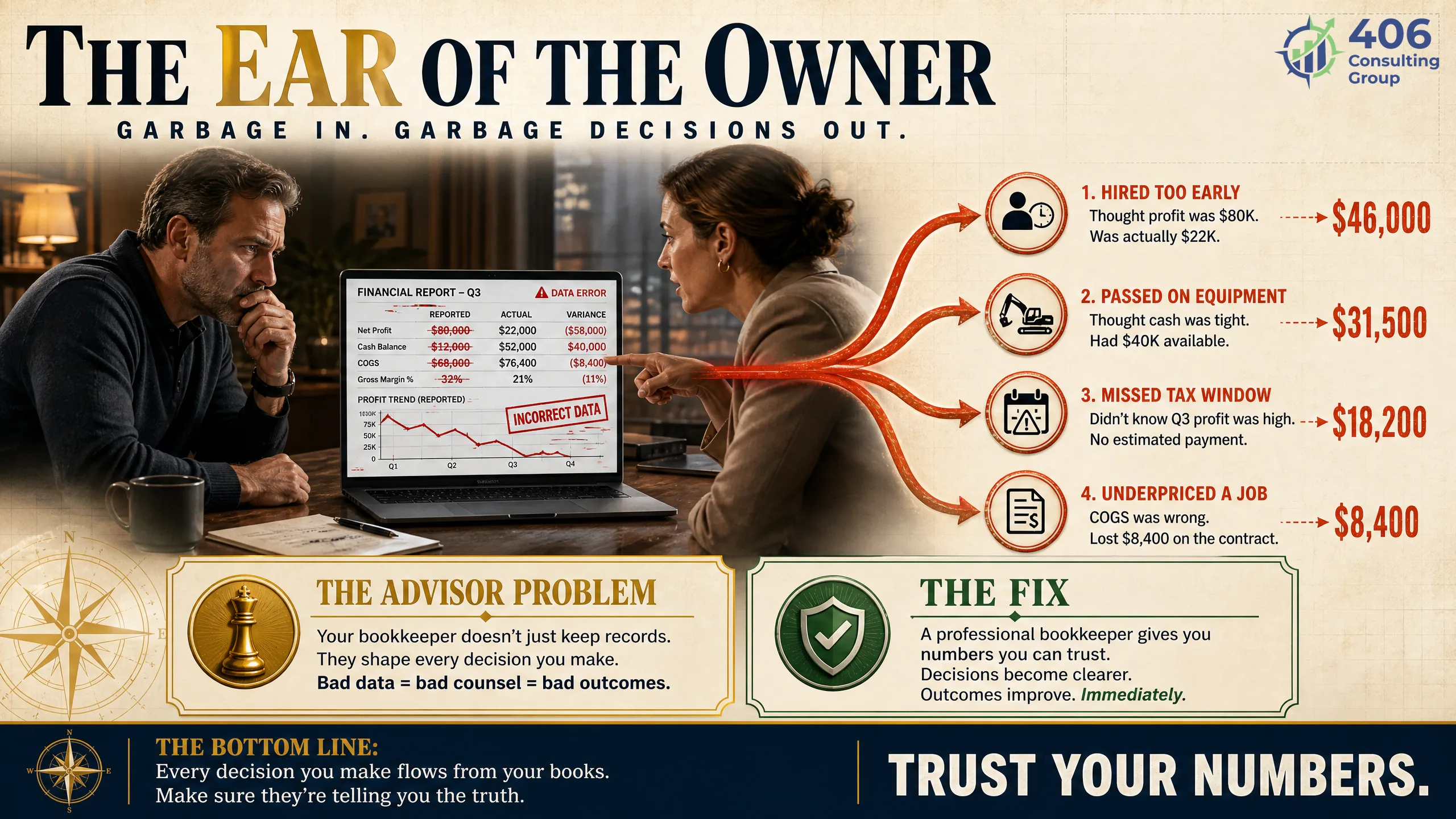
We've watched businesses turn down good work, overpay for the wrong equipment, and stall growth for years — every decision traceable back to advice given in good faith from books that didn't reconcile. The accidental bookkeeper didn't just record the numbers wrong; they quietly became the de facto CFO, and nobody decided that on purpose.
Why You Can't Hire Your Way Out of It
The short answer: owners often try to fix an overwhelmed accidental bookkeeper by adding another one — a second office person, a part-time helper. It never works, because the problem was never capacity. It's expertise. You can hire a dozen people who "know QuickBooks" and still have gaps not one of them can close, because none of them were ever trained to.
Bookkeeping and accounting is a stack of skill levels — clean data entry at the bottom, then reconciliation and reliable financials, then analysis and strategy on top. Amateurs live on the bottom rung. Adding more of them just widens the bottom rung; it never builds the levels above it. The business ends up with more hours and more payroll poured into the function and the same fundamental blindness — reconciliations still off, still no job costing, still no tax strategy, still no forecast. More people, same ceiling.
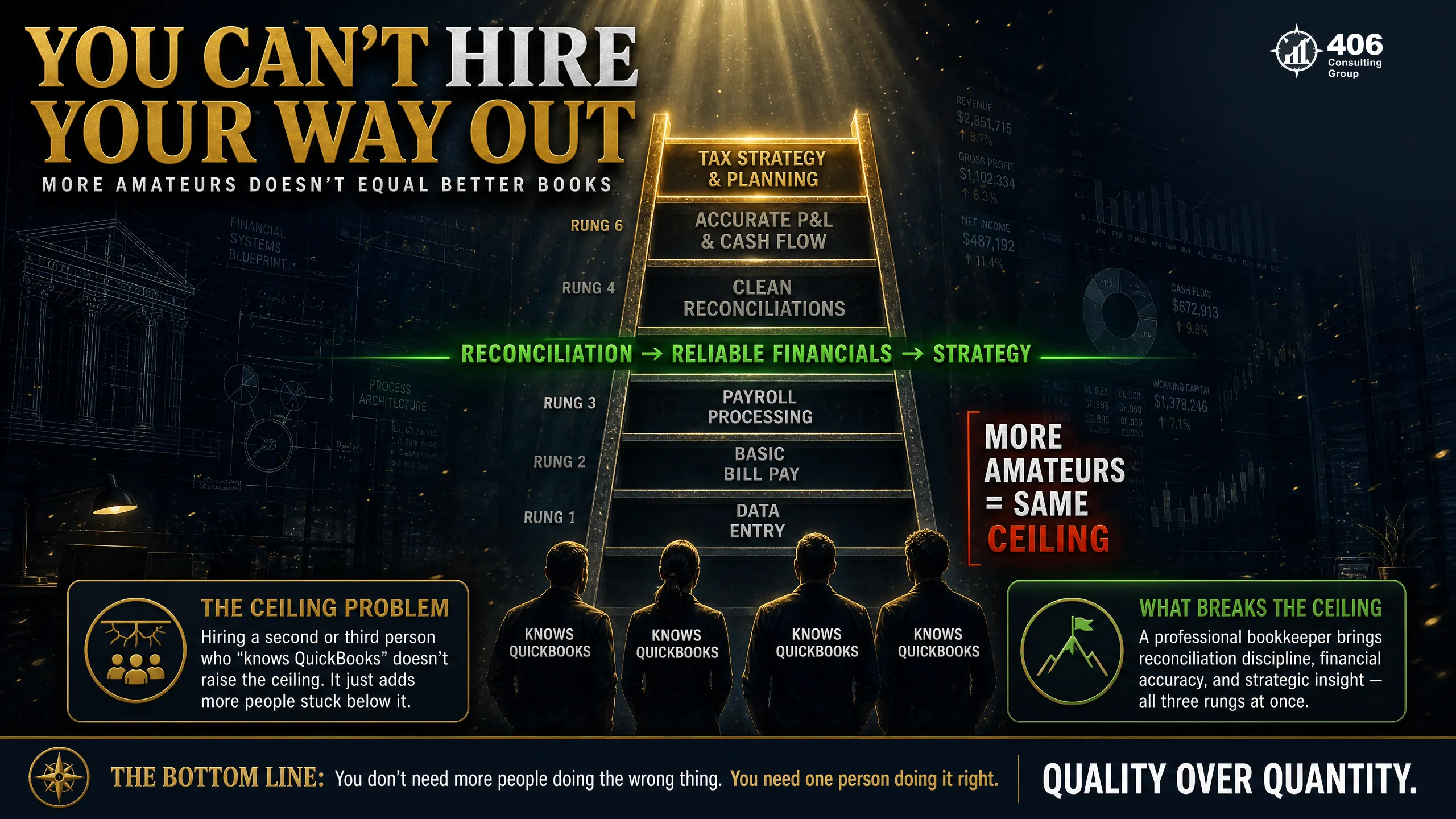
This is the moment many businesses actually need to move up a level — from bookkeeping to a controller who makes the numbers reliable and reporting real. We cover that step in when to upgrade from bookkeeping to a controller. You don't get there by stacking amateurs.
This Person Is Valuable — Just Not Here
The short answer: the goal isn't to get rid of the office manager. It's to stop wasting them. The person stuck doing your books is usually a genuinely valuable employee being spent on the one task they're worst at — and pulled away from the things they'd be great at. Fixing this is a win for them, not a loss.
Take that Bozeman contractor. His office manager is organized, trusted, and great with people and vendors. Put her back where those strengths pay off: chasing down material pricing and lead times with suppliers, managing the schedule, keeping subs and permits on track, handling customer follow-up, running the day-to-day that actually keeps jobs moving. That work drives revenue and margin directly — and she's good at it. Instead she's been buried in a QuickBooks file, doing a job she was never trained for and doesn't enjoy, while the real operational gaps go unmanaged.

When you free that person from the books, you usually discover you didn't just fix your accounting — you unlocked a strong operations person you already had and were wasting. That's the reframe: this isn't a cost you're adding, it's a person you're finally using right.
What Good Actually Looks Like
The short answer: a real accountant doesn't just take the books off the office manager's plate — they build the processes, then define a clear lane where that employee can help without owning the accounting. Done right, your office manager still touches the financial workflow; they just do the parts they're suited for, inside a system a professional designed.
In practice, a good accountant sets up the chart of accounts, the reconciliation rhythm, the categorization rules, and the reporting — the judgment layer — and then hands the office manager a defined, safe role: collecting receipts and coding them to the rules provided, submitting payroll hours, chasing down a vendor statement, flagging anything unusual. They assist the process without steering it, and the professional keeps the accounting, the reconciliations, and the tax strategy firmly in their own lane. The owner gets reliable numbers and keeps a useful pair of hands in the workflow — without the amateur being responsible for judgment they were never trained to make.
This is the part we care most about, because our background isn't just accounting — it's running whole businesses. When we design a client's financial processes, we design them around how the whole company operates: who touches what, how it flows into operations, purchasing, and payroll, and where a capable employee fits without being over their head. That's the difference between a bookkeeper who records the past and a partner who builds a system the business runs on.
The Real Math
The short answer: when you actually total it, the "free" office-manager bookkeeper is one of the most expensive things in the business. Put the real numbers side by side and the decision stops being close.
| What it really costs | Accidental bookkeeper | A real professional |
|---|---|---|
| Direct cost | "Free" (buried in a salary) | ~$1,000–$3,000/mo |
| Overpaid taxes | Often $10K–$60K+/yr | Planned down, legally |
| Decision quality | Confident advice, wrong numbers | Reliable numbers to decide from |
| Ability to scale | Hits a ceiling, can't explain it | Books built to grow on |
| Your best employee | Wasted on the books | Freed for real work |
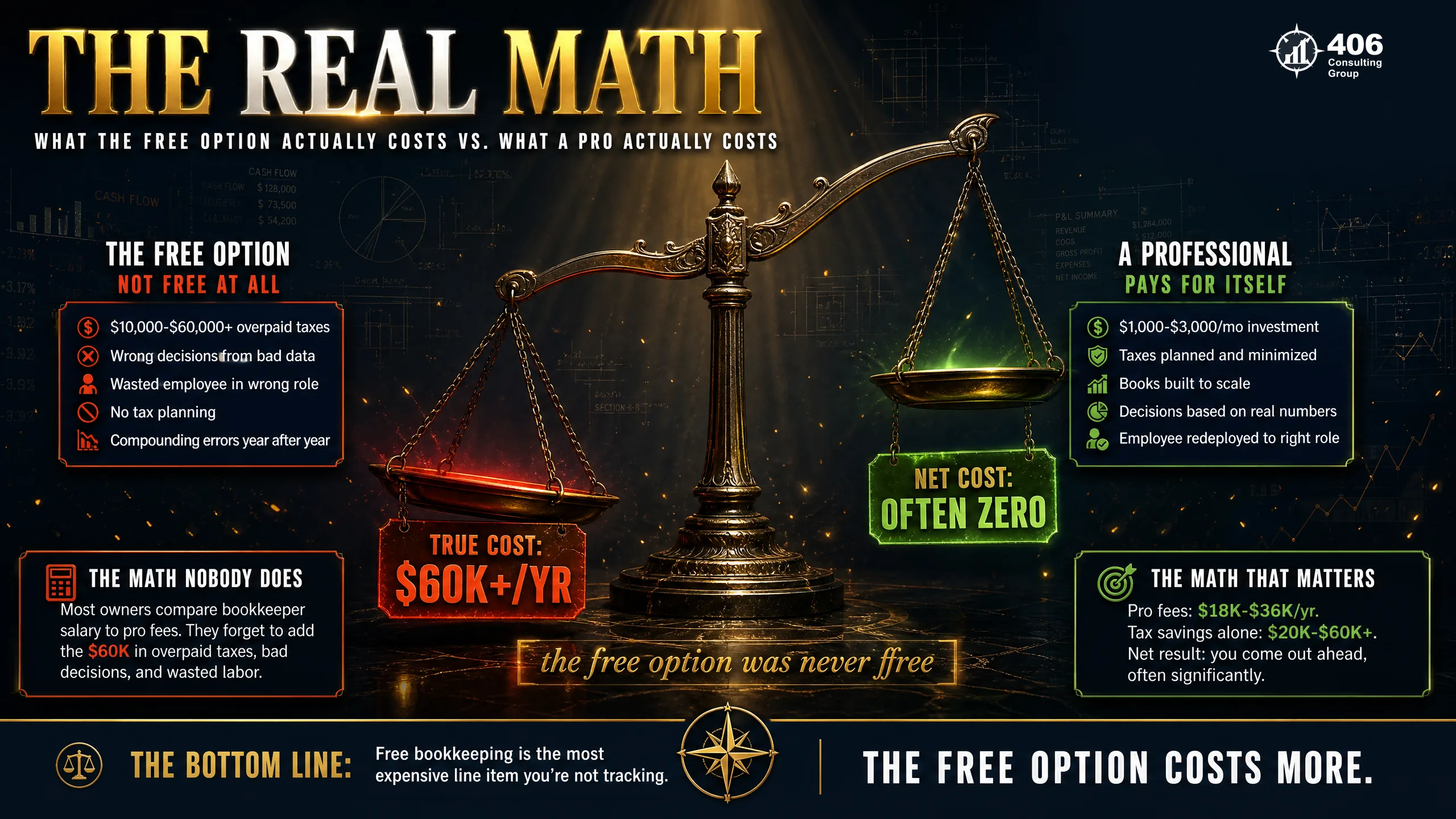
A professional who costs $2,000 a month and saves you $40,000 in taxes, closes the gaps, and hands back a great employee isn't an expense. They're the highest-return hire in the business — and the "free" option was never free.
What to Do Instead
If this article is describing your business — and for most owners reading it, it is — here's the honest path forward. None of it requires firing anyone.
Get an honest look at the books
Have a professional review the current state — reconciliations, categorization, entity, and last year's return. You'll usually find the overpayment fast.
Put a real foundation in place
Clean books, correct entity and tax plan, and processes designed by someone who does this for a living.
Redeploy your employee on purpose
Give the office manager a defined role that assists the process and put their real strengths back to work in operations.
Not sure how deep the problem goes? Our Financial Maturity Assessment gives you an honest read in about eight minutes — and if "profitable but somehow always broke" sounds familiar, that's a related symptom we break down in Profitable But No Cash.
FAQ
My office manager has done our books for years and nothing has gone wrong. Isn't that proof it's fine?
Not really — because the damage from amateur bookkeeping doesn't announce itself. Bills still get paid and payroll still runs, so it 'looks fine,' while the real costs (overpaid taxes, decisions made on wrong numbers, an inability to scale) accumulate silently. 'Nothing has gone wrong' usually means 'nothing has forced the issue yet.' A one-time professional review of your books and last return is the only way to actually know — and it typically surfaces thousands in overpayment quickly.
But QuickBooks basically does the bookkeeping now, right?
Software records transactions; it doesn't supply judgment. It won't tell you a transaction is miscategorized, that your books haven't truly reconciled, that you should have elected S-corp status, or that you're not tracking job costs. Knowing how to enter data into QuickBooks is not the same as knowing accounting, any more than owning a scalpel makes someone a surgeon. The tool is only as good as the professional judgment directing it.
Isn't paying a real bookkeeper or accountant just an added expense I can avoid?
It's the opposite — it's usually the highest-return money you spend. A professional running roughly $1,000–$3,000 a month routinely saves far more than that in taxes alone, closes the gaps that distort your decisions, and frees a valuable employee for work that actually drives revenue. The 'free' office-manager option was never free; its cost was just hidden in your tax return and your stalled growth.
Do I have to let my office manager go?
No — and that's the best part. This isn't about removing a good employee; it's about stopping the waste of one. A professional takes over the accounting and builds the processes, then gives your office manager a defined role that assists the workflow (collecting and coding receipts to set rules, submitting payroll, chasing vendor statements) while staying out of the judgment calls. Their real strengths — operations, vendors, customers, scheduling — go back to driving the business.
How would I even know if my books are actually a problem?
A few tells: your books haven't reconciled to the bank in months; you can't say which jobs, products, or clients make money; your 'profit' never matches your cash; you only think about taxes in April; and your financial advice comes from whoever does data entry. If any of those land, the foundation likely needs work. Our Financial Maturity Assessment gives you an honest read in about eight minutes.
Does 406 Consulting Group help businesses fix this?
Yes — it's a lot of what we do. We review the current state of your books and taxes, build a real foundation (clean books, correct entity and tax plan, professional processes), and design the financial workflow around how your whole company actually operates, including where an employee like your office manager fits without being over their head. We provide bookkeeping, payroll, tax planning, and fractional controller and CFO services remotely across Montana and the Northwest. The first step is an honest look — contact us and we'll tell you straight what we find.
Keep Reading
Stop Paying for "Free" Bookkeeping
Find Out What the "Free" Option Is Really Costing You.
406 Consulting Group will give your books and last tax return an honest look, tell you straight what we find, build the real foundation — and give your best employee back to the work they're great at. Delivered remotely across Montana and the Northwest.
The True Cost, At a Glance
Think This Is You?
Get an honest look — we'll tell you straight.
About the Author
Jason Anderson
Co-Founder, 406 Consulting Group
Background in large-scale operational finance at BP before building financial infrastructure for Montana and Northwest small businesses. Jason and Carrie have seen the accidental-bookkeeper trap hundreds of times — and helped owners dig out of it and put their people to better use.
Read the Full Story