
Why Your Business Feels Profitable
But Your Bank Account Disagrees
Your P&L says you made $180,000. Your bank account says otherwise — and both are telling the truth. Here's the profit-vs-cash gap explained, the six leaks quietly draining your account, and how to take control of the number that actually matters.

Your accountant says you made $180,000 last year. Your bank account says you have less money than you started with. Both are telling the truth — and if that sentence made your stomach drop a little, this article was written about your business.
It's one of the most common and most stressful experiences in small business — being "profitable but no cash." The profit and loss statement looks great, but there's never any money in the bank. You feel profitable. Your account balance disagrees. You start to wonder if the books are wrong, or if you're doing something wrong, or where on earth the money actually went.
Here's the reassuring part: the books probably aren't wrong, and neither are you. Profit and cash are two different things, measured two different ways, and the gap between them is caused by a handful of specific, findable culprits. Once you can see them, the mystery disappears — and so does a lot of the stress. This guide walks through exactly why a profitable business can be cash-poor, the six leaks that drain the account, and how to get control of the number that actually matters: cash.
By Jason Anderson — Co-Founder, 406 Consulting Group. Operational finance background at BP, and a lot of time spent helping Montana owners find the cash hiding inside their own businesses.
Quick Answer: Where Did the Money Go?
- →Profit is not cash. Profit is revenue minus expenses on paper. Cash is what's actually in the bank. They move differently.
- →Six things drain cash without showing on your P&L: receivables, inventory/WIP, debt principal, owner draws & taxes, equipment purchases, and growth itself.
- →You can be profitable and still run out of cash — it's one of the most common ways healthy-looking businesses get into trouble.
- →The fix is managing cash directly — a forecast, faster collections, money set aside for taxes, and a reserve — not just watching profit.
Table of Contents
The Short Answer: Profit Is an Opinion, Cash Is a Fact
The short answer: your business feels profitable but your bank account disagrees because profit and cash are measured differently — profit is recorded when you earn it, cash moves when money actually changes hands, and several big cash outflows never appear on your profit and loss statement at all. Profit is an accounting opinion about a period of time. Cash is a hard fact about a moment in time.
There's an old finance saying: "Revenue is vanity, profit is sanity, but cash is king." It survives because it's true. A business can show a profit for years and still fail if it runs out of cash — and a business can look unprofitable on paper while sitting on plenty of it. Profit tells you whether the business model works over time. Cash tells you whether you can make payroll on Friday. You need both, but only one of them can bounce a check.
The one idea to hold onto
Your profit and loss statement was never designed to tell you how much cash you have. That's not its job — it measures earnings, not the bank balance. Expecting your P&L to explain your cash is like expecting the speedometer to tell you how much gas is in the tank. You need to look at a different gauge.
Profit vs. Cash: What's Actually Different
The short answer: profit is what you've earned on paper (revenue minus expenses), while cash is what's physically in your bank account — and the difference comes mostly from timing and from money that moves without touching the P&L. Let's define the terms plainly.
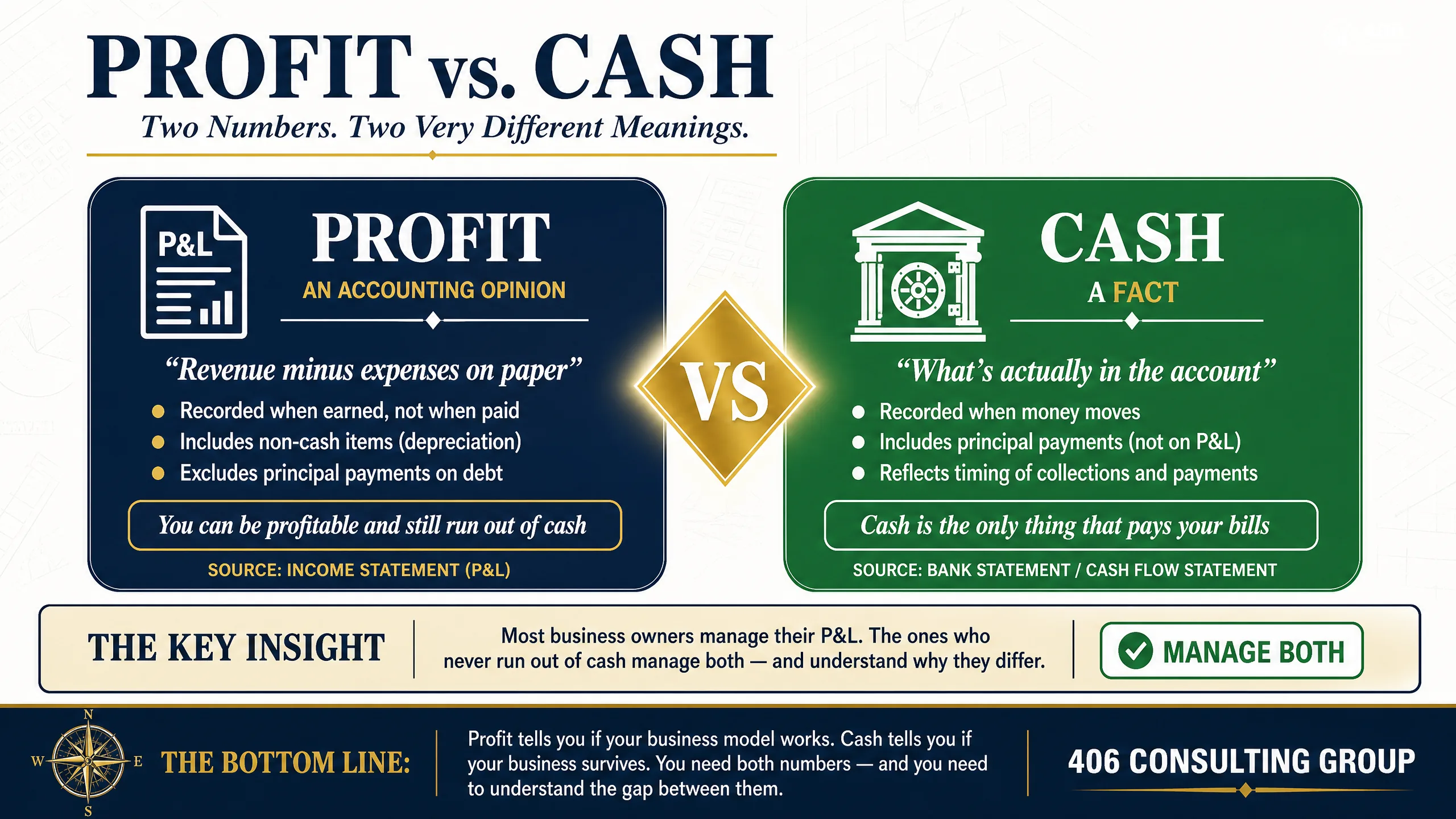
Profit (the P&L)
Revenue you've earned minus the expenses you've incurred over a period — a month, a quarter, a year. Most businesses run on accrual accounting, which records revenue when you do the work and expenses when you incur them, regardless of when cash moves.
Answers: "Is the business model working?"
Cash (the bank account)
The actual money available right now. It goes up only when money lands in the account and down when it leaves — no matter what the P&L says you earned. This is what pays employees, suppliers, and you.
Answers: "Can I cover what's due this week?"
Define accrual accounting once, because it's the root of the confusion: under accrual, when you finish a $50,000 job and send the invoice, you record $50,000 of revenue — and therefore profit — that day, even though the customer won't pay for 45 days. Your P&L shows the win immediately. Your bank account won't see a dime for a month and a half. Multiply that across every open invoice and you start to see where the gap comes from.
Cash-basis accounting (recording income and expenses only when money actually moves) tracks cash more closely, but most growing businesses use accrual because it more accurately reflects performance — and because it's often required. The takeaway isn't "switch methods." It's "stop reading your bank balance off your profit."
The Profit-to-Cash Bridge
The short answer: the Profit-to-Cash Bridge is a simple walk from the net profit on your P&L down to the actual change in your bank balance — subtracting each thing that consumed cash and adding back anything that reduced profit without using cash. It turns "where did the money go?" into a line-by-line answer.

Let's build it with a realistic example: a Montana specialty-trade contractor doing about $1.8M in revenue, whose P&L shows a healthy $180,000 net profit for the year. Here's what actually happened to the cash.
The Bridge — $180K profit, but the cash tells another story
$180,000 in profit. $105,000 less cash in the bank. Nothing here is fraud, error, or bad luck — it's six ordinary things a growing business does, none of which your P&L was built to show you. (Illustrative figures.)
Every line below the profit number is a "cash leak" — not because it's wrong, but because it moves cash in a way the profit figure hides. The next six sections take them one at a time.
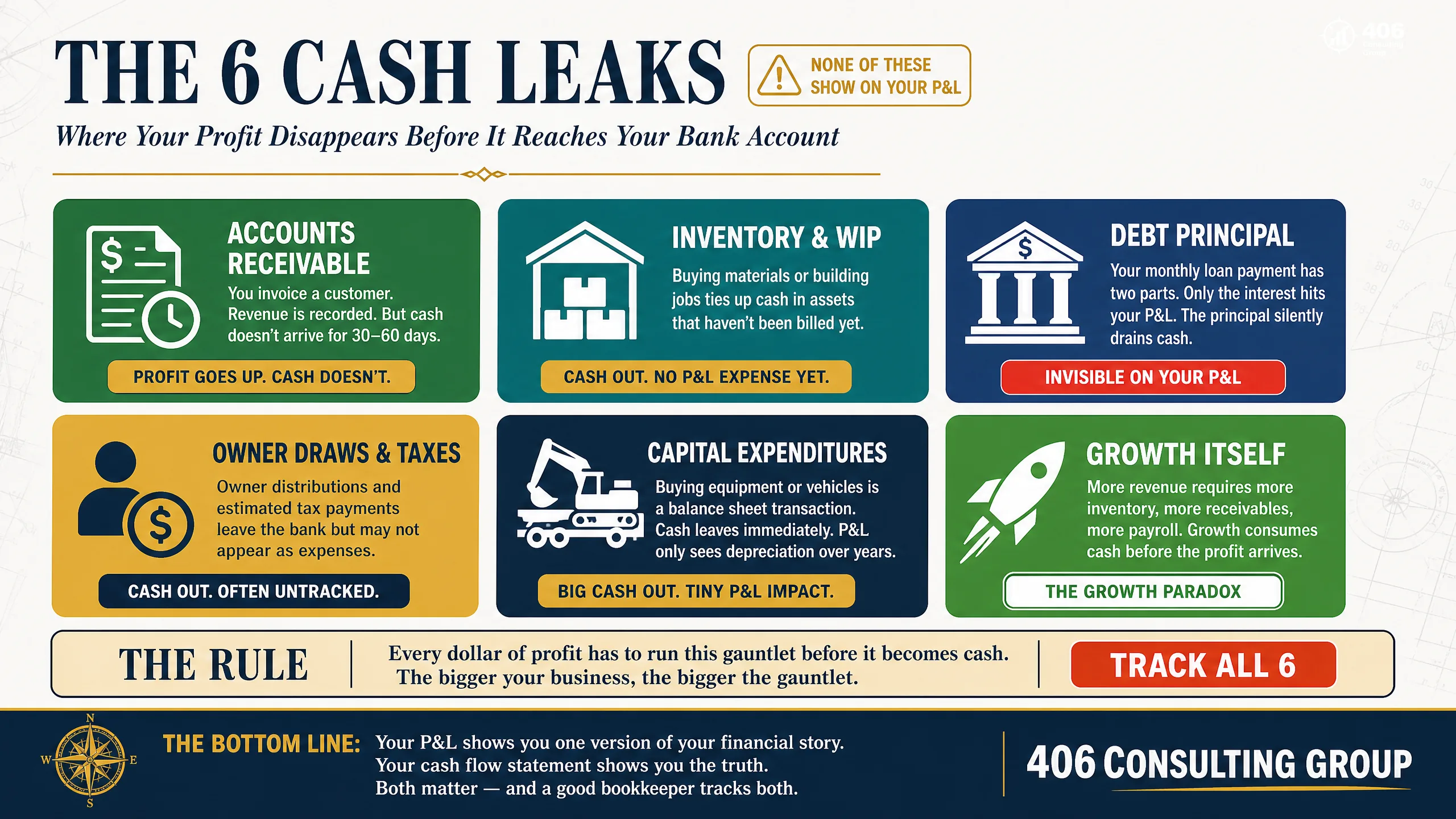
Leak #1: Accounts Receivable — You Earned It, They Haven't Paid
The short answer: when you invoice a customer, your P&L records the revenue and profit immediately, but the cash doesn't arrive until they actually pay — so every dollar sitting in unpaid invoices is profit you've booked but can't spend. This is usually the single biggest reason a profitable business is cash-poor.

Define accounts receivable (AR): it's money owed to you by customers for work you've already done and billed. It counts as revenue on your P&L the moment you invoice — but it's not cash until it's collected. A business that's growing is usually growing its receivables too, which means more and more of its "profit" is tied up in invoices instead of sitting in the bank.
The December trap
Our contractor finishes a strong December — $150,000 of work invoiced in the last three weeks of the year. The P&L closes the year looking fantastic; profit is up. But those customers pay on 30-to-45-day terms, so that $150,000 doesn't hit the bank until February and March. In January — flush with "profit" — the owner is scrambling to make payroll. The money is real. It's just not here yet.
What to watch
Track your days sales outstanding (DSO) — the average number of days it takes to collect. If it's creeping up, your cash is quietly moving out of the bank and into your customers' hands as an interest-free loan. Faster invoicing, deposits up front, clear terms, and disciplined follow-up are the highest-leverage cash fixes most businesses have.
Leak #2: Inventory & Work in Progress — Cash on the Shelf
The short answer: cash you spend on inventory or unbilled work in progress leaves your bank account now, but it doesn't hit your P&L as an expense until the product sells or the job is billed — so your profit looks unaffected while your cash quietly drains.
When you buy $35,000 of materials and stock, that cash is gone the day you pay for it. But on the P&L, it sits as an asset (inventory) and only becomes an expense — cost of goods sold — when the item actually sells. The same is true for work in progress (WIP): labor and materials you've poured into a job that hasn't been billed yet. You've spent the cash; the profit statement hasn't caught up.
This is why a business can be busiest — buying materials, staffing up jobs, filling the warehouse — right when cash feels tightest. The activity that will become next quarter's profit is consuming this quarter's cash. For contractors, disciplined WIP tracking is the difference between seeing this coming and being blindsided; see our guide to WIP and job costing.
Leak #3: Debt Principal — The Payment That Isn't an Expense
The short answer: when you make a loan payment, only the interest portion shows up as an expense on your P&L — the principal portion leaves your bank account but never touches your profit. On equipment-heavy businesses, this invisible outflow is enormous.

Here's the mechanics. A loan payment is split into two parts — interest (the cost of borrowing) and principal (paying back what you borrowed). Only the interest is an expense on your P&L. The principal is just returning the lender's money, so accounting doesn't treat it as a cost — but it absolutely leaves your bank account.
Our contractor's equipment loans
Say the contractor pays about $6,500 a month across truck and equipment loans. Only around $1,000 of that is interest — the part the P&L sees. The other ~$5,500 is principal: it leaves the bank every month, invisibly, as far as the profit statement is concerned. Over a year, that's roughly $66,000 of cash out the door that never once reduced reported profit.
This is why heavily financed businesses — construction, trucking, anything equipment-intensive — so often feel the profit-vs-cash gap most sharply. (Illustrative figures.)
Leak #4: Owner Draws & Taxes — Money That Leaves After the P&L
The short answer: owner draws (or distributions) and income taxes are paid out of profit, not counted as expenses before it — so they leave your bank account without ever reducing the profit number you're looking at. That's often a big chunk of the gap.
If you're an owner taking draws or distributions — money out of the business beyond a salary — that cash isn't a business expense. It comes out of the profit and the equity of the company, so the P&L never shows it as a cost. The business "made" $180,000; you took $60,000 of it home; the profit statement still proudly says $180,000.
Then there are income taxes. For most small businesses (sole props, partnerships, S-corps), the business's profit flows through to the owner's personal return and the tax gets paid personally — often through quarterly estimates. That money leaves to the IRS and the state, but it isn't a line on the business P&L. Profit says $180,000; the tax bill on that profit is very real and very much in cash.
The dangerous mindset
"The business made $180K, so I can take $180K." No — because receivables, inventory, principal, equipment, and taxes all have claims on that profit first. Treating reported profit as spendable cash is how owners accidentally pull the business into a hole. Set aside taxes as you go, and size draws off available cash, not off the P&L.
Leak #5: Capital Expenditures — Big Buys, Slow Deductions
The short answer: when you buy a big-ticket asset like a machine or a vehicle, the full cash cost leaves immediately, but the P&L only expenses it slowly over years as depreciation — so a large purchase can gut your cash while barely denting your profit.
Define capital expenditure (capex): money spent to buy or improve a long-lived asset — equipment, vehicles, buildings. Accounting says an asset you'll use for years shouldn't be expensed all at once, so instead of hitting the P&L in full, it's depreciated — expensed a piece at a time over its useful life. Buy a $60,000 machine and the P&L might show only $12,000 of depreciation this year. But all $60,000 left your bank the day you bought it.
There's a wrinkle worth knowing: tax rules like Section 179 and bonus depreciation can let you deduct the whole purchase in year one for tax purposes. That helps your tax bill — but the cash still left all at once, and accelerating the deduction doesn't put the cash back. Depreciation is also why the Bridge in Section 3 adds it back: it's an expense that reduced profit without using any cash this year.
The planning lesson: time big purchases around your cash position, not just your tax strategy. A machine that saves you $12,000 in taxes can still create a cash crisis if you buy it in your tightest month.
Leak #6: Growth Itself — Why Growing Fast Drains Cash
The short answer: growth consumes cash. The faster you grow, the more you have to spend on payroll, materials, and receivables before the new revenue collects — so a fast-growing, profitable business can be the most cash-starved of all. It's the cruelest version of this whole problem, because it punishes success.
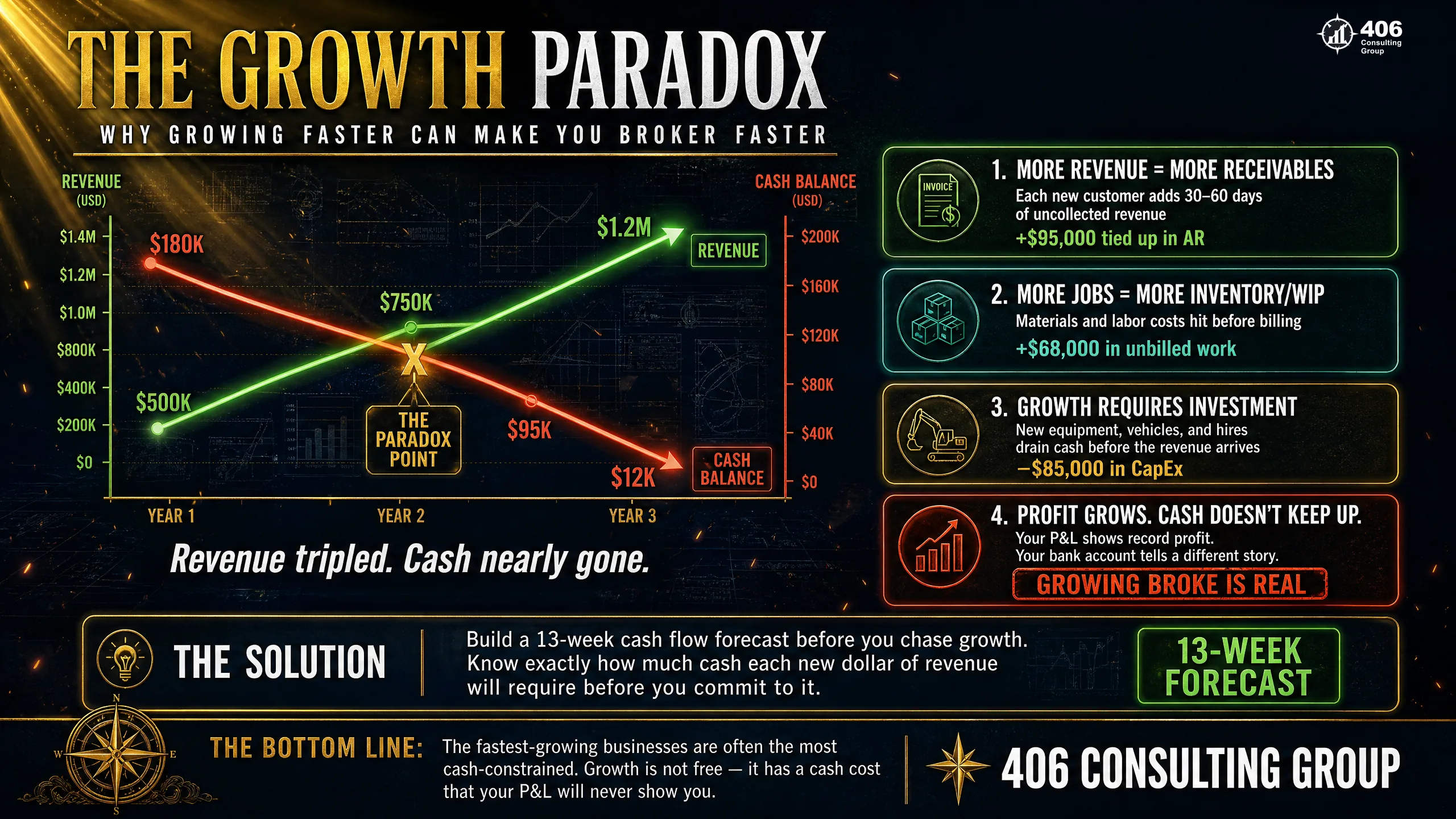
Think about what growth actually requires. To do more work, you hire and pay people now. You buy more materials now. You carry more work in progress. You send out bigger invoices — and wait to collect them. Every one of those is cash out the door in advance of the cash coming in. A business growing 40% a year is funding a 40% bigger receivables balance and a 40% bigger payroll before the growth pays for itself.
"Growing broke"
This is why businesses sometimes fail because they grew too fast — landing more work than their cash could carry. Profit was never the problem; cash was. Growth is a cash investment, and it has to be planned and funded like one — with a forecast and often a line of credit — not just celebrated when the sales come in.
How to Diagnose Your Own Gap
The short answer: run your own Profit-to-Cash Bridge. Start with your net profit, subtract each of the six leaks using your real numbers, and the result should roughly explain the change in your bank balance. When it does, the mystery is solved — and you know exactly which lever to pull.
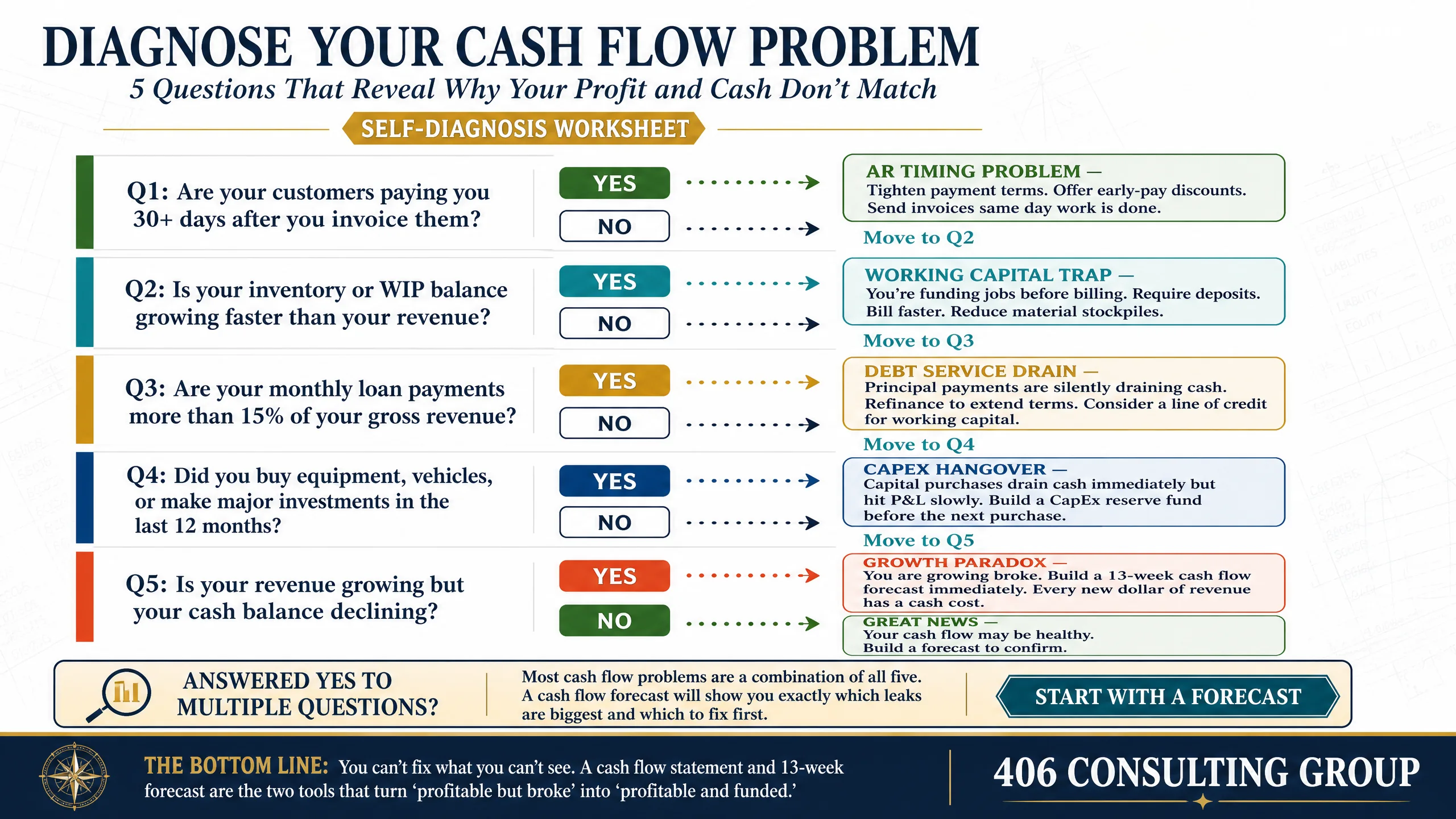
The five-minute diagnosis
Start with net profit
Pull it straight off your P&L for the period.
Subtract the change in receivables & inventory/WIP
Did AR and inventory grow over the period? That growth is cash you spent or didn't collect.
Add back depreciation
It reduced profit but used no cash this period.
Subtract debt principal, capex, draws, and taxes paid
The cash outflows that never showed as expenses on the P&L.
Compare to your actual bank-balance change
If the two roughly match, you've found where the money went. The biggest subtraction is your biggest opportunity.
Want a faster read? Our profit leak tool and cash flow runway calculator help you spot the biggest drains and see how many months of cushion you actually have.
How to Fix It: Manage Cash, Not Just Profit
The short answer: you fix the gap by managing cash directly — forecasting it, collecting it faster, setting aside what you owe, and keeping a reserve — instead of assuming a good P&L means a healthy bank account. Here's the toolkit.
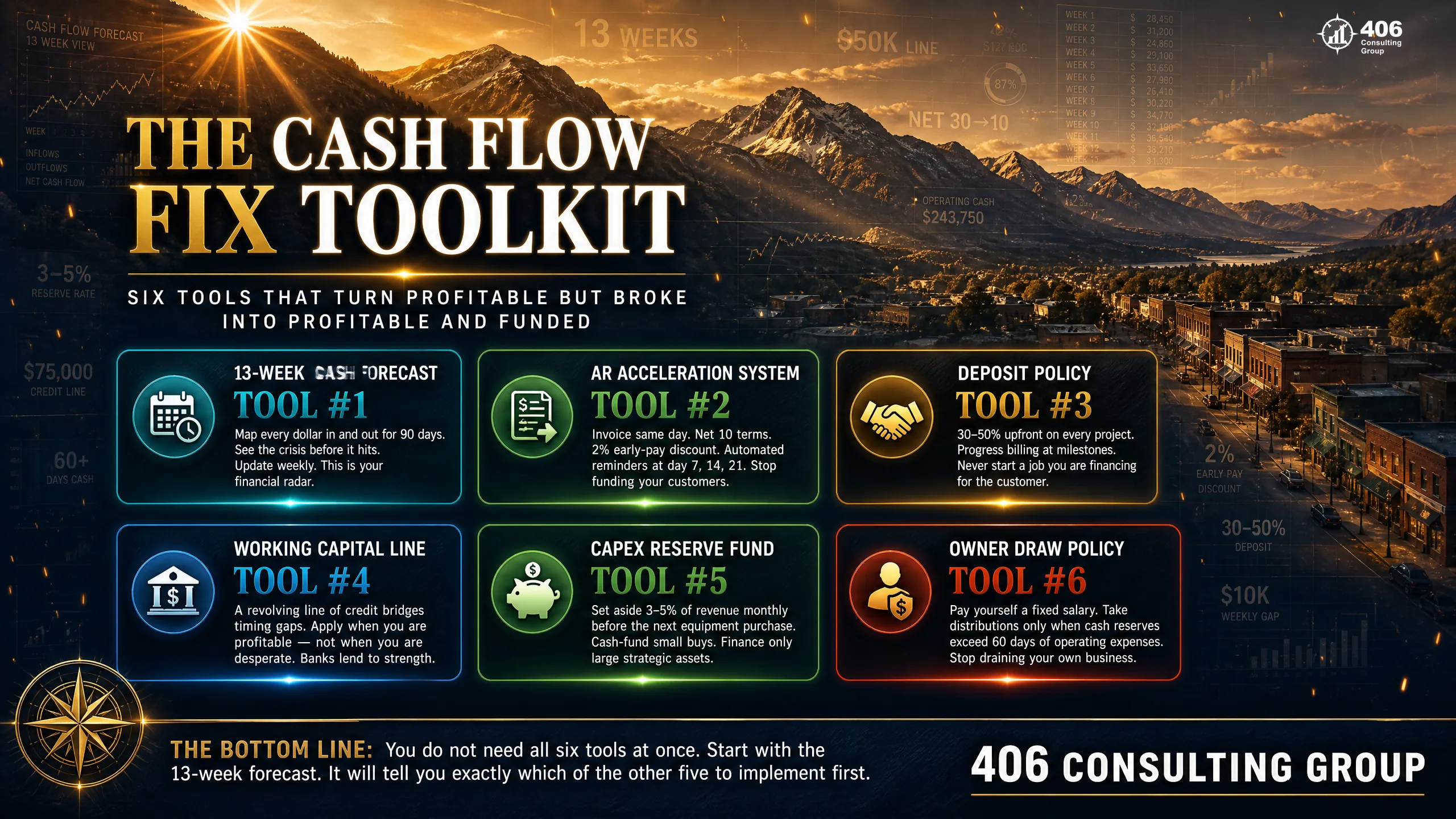
Build a 13-week cash flow forecast
The single most valuable cash tool there is. A rolling week-by-week projection of money in and money out shows you the crunch before it arrives — while you still have time to do something about it.
Invoice and collect faster
Bill the day work is done, not at month-end. Take deposits up front. Set clear terms and follow up the moment an invoice is late. Every day you shave off collections is cash back in your account.
Set aside taxes as you earn
Move a percentage of every deposit into a separate tax account. Then a quarterly estimate is a transfer, not a crisis — and you stop spending money that was never yours.
Build a cash reserve
Aim for a buffer of operating expenses — a few weeks to a few months — so timing gaps and slow seasons don't threaten payroll. The reserve is what turns a cash scare into a non-event.
Use a line of credit for timing, not survival
A line of credit is the right tool to bridge the gap between spending on a job and collecting on it — especially while growing. Set it up before you need it, when your financials are strong.
This is exactly the work a controller and a fractional CFO do: a controller keeps the books clean enough to see the truth, and a CFO builds the forecast and manages the cash. If your business feels profitable but your bank account keeps disagreeing, that's the gap we close — see our CFO services and controller services.
Frequently Asked Questions: Profit vs. Cash Flow
Why is my business profitable but I have no money in the bank?
Because profit and cash are different things. Profit is revenue minus expenses on your P&L, recorded when you earn it. Cash is what's actually in your bank account. Several big cash outflows never show up as expenses on your P&L — money tied up in unpaid customer invoices (accounts receivable) and inventory, loan principal payments, owner draws, income taxes, and equipment purchases. A growing, profitable business can pour cash into all of these at once, which is why the account can shrink even in a profitable year. The fix is to track cash directly, not to read it off your profit statement.
What's the difference between profit and cash flow?
Profit is an accounting measure of performance over a period: revenue earned minus expenses incurred, regardless of when money actually moves (under accrual accounting). Cash flow is the actual movement of money in and out of your bank account. The two differ because of timing (you book revenue when you invoice, but collect the cash later) and because some cash movements — loan principal, owner draws, taxes, equipment purchases — don't appear on the profit and loss statement at all. Profit tells you if the business model works; cash flow tells you if you can pay the bills this week.
Can a profitable business go bankrupt?
Yes — and it happens regularly. A business that's profitable on paper can run out of cash if too much of its profit is tied up in receivables and inventory, or drained by debt principal, taxes, owner draws, and equipment purchases faster than cash comes in. If it can't pay employees, suppliers, or lenders when those bills are due, it can fail regardless of what the P&L says. This is often called being 'profitable but insolvent,' and rapid growth is a common trigger because growth consumes cash up front.
Why doesn't my bank balance match my profit?
Because your profit and loss statement was never designed to track your bank balance. Profit is recorded on an accrual basis (when earned), while your bank balance only reflects cash that has actually moved. The difference comes from timing — unpaid invoices and inventory — and from cash outflows that skip the P&L entirely: loan principal, owner distributions, income taxes, and capital purchases. Running a 'Profit-to-Cash Bridge' — starting from net profit and adjusting for each of these — will reconcile the two and show you exactly where the money went.
How do I fix a cash flow problem?
Start by managing cash directly instead of assuming profit equals cash. The highest-impact steps: build a rolling 13-week cash flow forecast so you see crunches coming; invoice immediately and collect faster (deposits, clear terms, prompt follow-up); set aside taxes as you earn rather than scrambling quarterly; build a cash reserve to cover timing gaps and slow seasons; and use a line of credit to bridge the gap between spending on work and collecting on it. Cleaning up the books so you can actually see your cash position is the necessary first step.
What is a cash flow forecast and do I need one?
A cash flow forecast is a projection of the money coming into and going out of your business over a future period — a 13-week rolling forecast is the most useful version for small businesses. It shows your expected bank balance week by week, so you can spot a shortfall before it happens and act while you still have options. If your business has ever felt profitable but cash-tight, or if you're growing, the answer is almost certainly yes — a forecast turns cash from a source of monthly anxiety into something you manage on purpose.
Does 406 Consulting Group help with cash flow?
Yes. 406 Consulting Group helps businesses close the gap between profit and cash — clean, reliable books through our bookkeeping and controller services so you can see your real position, and cash flow forecasting, collections strategy, tax planning, and lender readiness through our fractional CFO services so you can manage it. We serve businesses across Montana and the greater Northwest and work virtually. If your business feels profitable but your bank account disagrees, that's precisely the problem we solve. Contact us to talk it through.
Helpful Resources
Related Tools & Resources
Cash Flow & CFO Advisory
Stop Guessing Where the Money Went.
406 Consulting Group closes the gap between profit and cash — clean books that show your real position, and a cash flow forecast that tells you what's coming. If your business feels profitable but your bank account keeps disagreeing, let's find the leaks and fix them.
The 6 Cash Leaks
Where profit hides your cash
Profit vs. Cash
Profitable But Cash-Tight?
Find the leaks and fix the flow.
About the Author
Jason Anderson
Co-Founder, 406 Consulting Group
Operational finance background at BP, where cash, capital, and profit were managed as three separate disciplines. Jason helps Montana business owners see past the P&L to the cash underneath — and build the forecasting that keeps the bank account and the profit statement on speaking terms.
Read the Full Story