
Accounting for Bend Small Businesses:
The Oregon Playbook
Oregon runs opposite to most states — no sales tax, but one of the highest income taxes anywhere, plus unique payroll and a tourism lodging tax. Here's the whole playbook for a Bend business, from a firm that knows Oregon and works remotely.
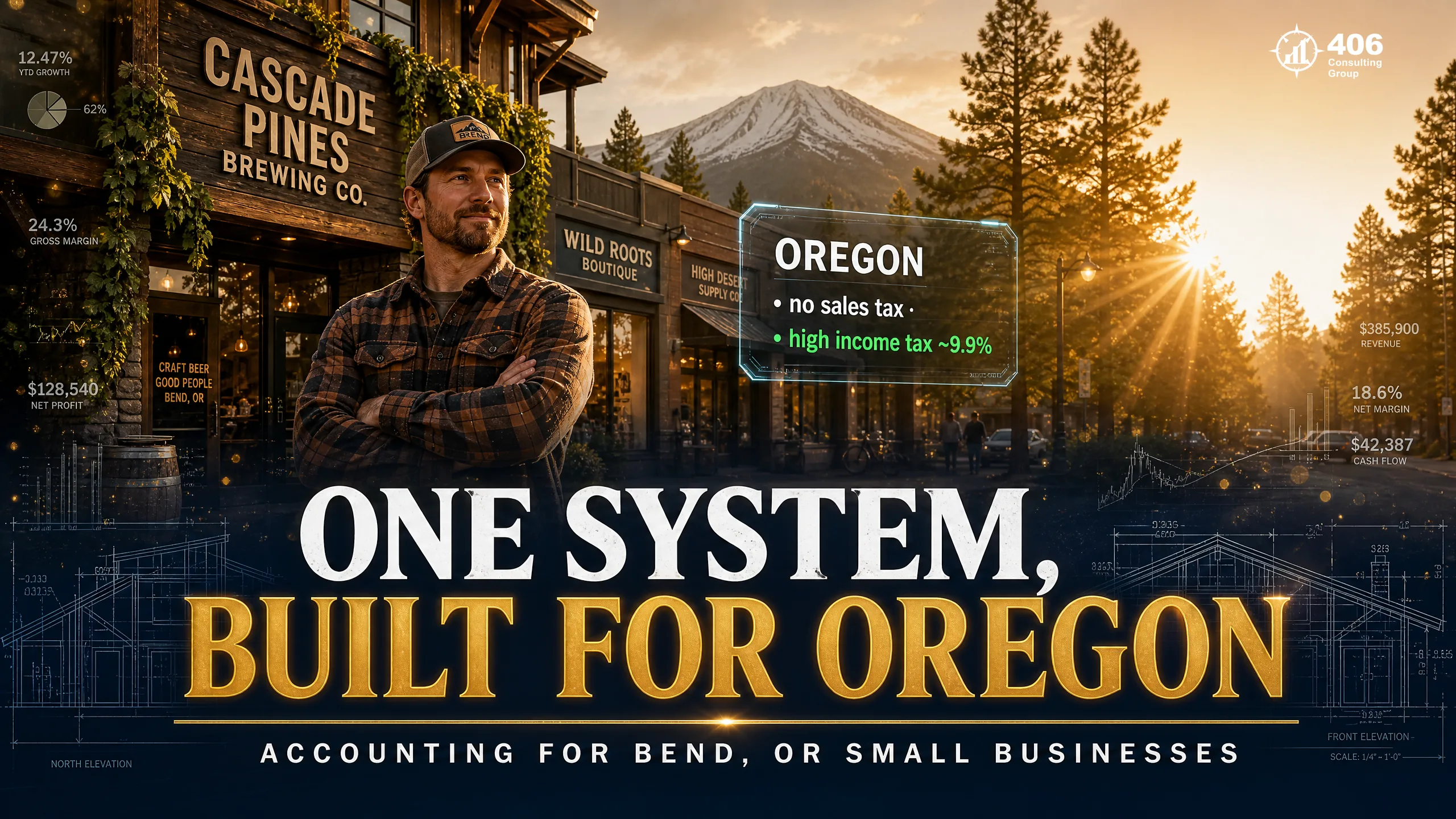
Running a small business in Bend means living with an Oregon setup that runs opposite to most of the country: no sales tax to collect, but one of the highest state income taxes anywhere. That single flip changes where your financial effort goes — away from the register and toward what you set aside, how you plan, and how you handle Oregon's distinctive payroll and Bend's tourism lodging tax. A financial system built for a sales-tax state, or run by someone who learned accounting elsewhere, gets Oregon backwards.
The good news is that once your books are built for Oregon, it's clean — no gross-receipts tax like Washington's B&O for most businesses, no sales-tax scaffolding, one main state agency. Whether you run a brewery or food maker, a tourism or lodging business, a contractor, a tech company, or a professional practice, the same playbook applies: keep profit readable so a steep income-tax bill is planned for, handle Oregon payroll and any lodging tax cleanly, and use the planning levers that a high-rate state rewards most. This guide is the overview that ties it together, with links to the deeper pieces. It's the hub of our Bend work.
Below: the Oregon tax picture, the no-sales-tax reality (and the CAT), income-tax set-asides, Oregon payroll, Bend's lodging tax, why planning works twice here, how the books-tax-CFO stack fits together, and a segment-by-segment look at your kind of business.
By Jason Anderson — Co-Founder, 406 Consulting Group. Background in large-scale operational finance at BP before building financial infrastructure for Northwest small businesses. Jason helps Bend and Central Oregon owners build financial systems that keep compliance clean and fund growth.
Quick Answer: The Bend Small-Business Playbook
- →No sales tax — nothing to collect at the register, one fewer compliance layer than most states.
- →But a high income tax (up to ~9.9%) — so income-tax set-asides and planning matter more here than almost anywhere.
- →Oregon payroll is unique — statewide transit tax, Paid Leave Oregon, and the Workers' Benefit Fund.
- →Bend tourism adds a lodging tax on short stays; larger firms watch the CAT above $1M.
- →Books → tax → CFO is a stack, delivered remotely — even most of our local clients never visit the office.
Table of Contents
Why a Bend Business Is Different
The short answer: Oregon funds itself with a steep income tax instead of a sales tax, so a Bend business's financial effort flips — there's nothing to collect and remit at the register, but a big income-tax bill that has to be tracked toward and planned for all year. Get that backwards and you either over-engineer for a tax you don't have or under-plan for the one that takes the biggest bite.
It's a genuinely different setup from the region: Montana also has no sales tax but a lower income tax; Washington has sales tax and the B&O but no income tax; Idaho has both a sales and an income tax. Oregon stands alone — no sales tax and one of the highest income taxes anywhere — plus payroll rules other states don't share and, for Bend's visitor economy, a lodging tax. Build the books for that specific shape and Oregon is refreshingly clean.
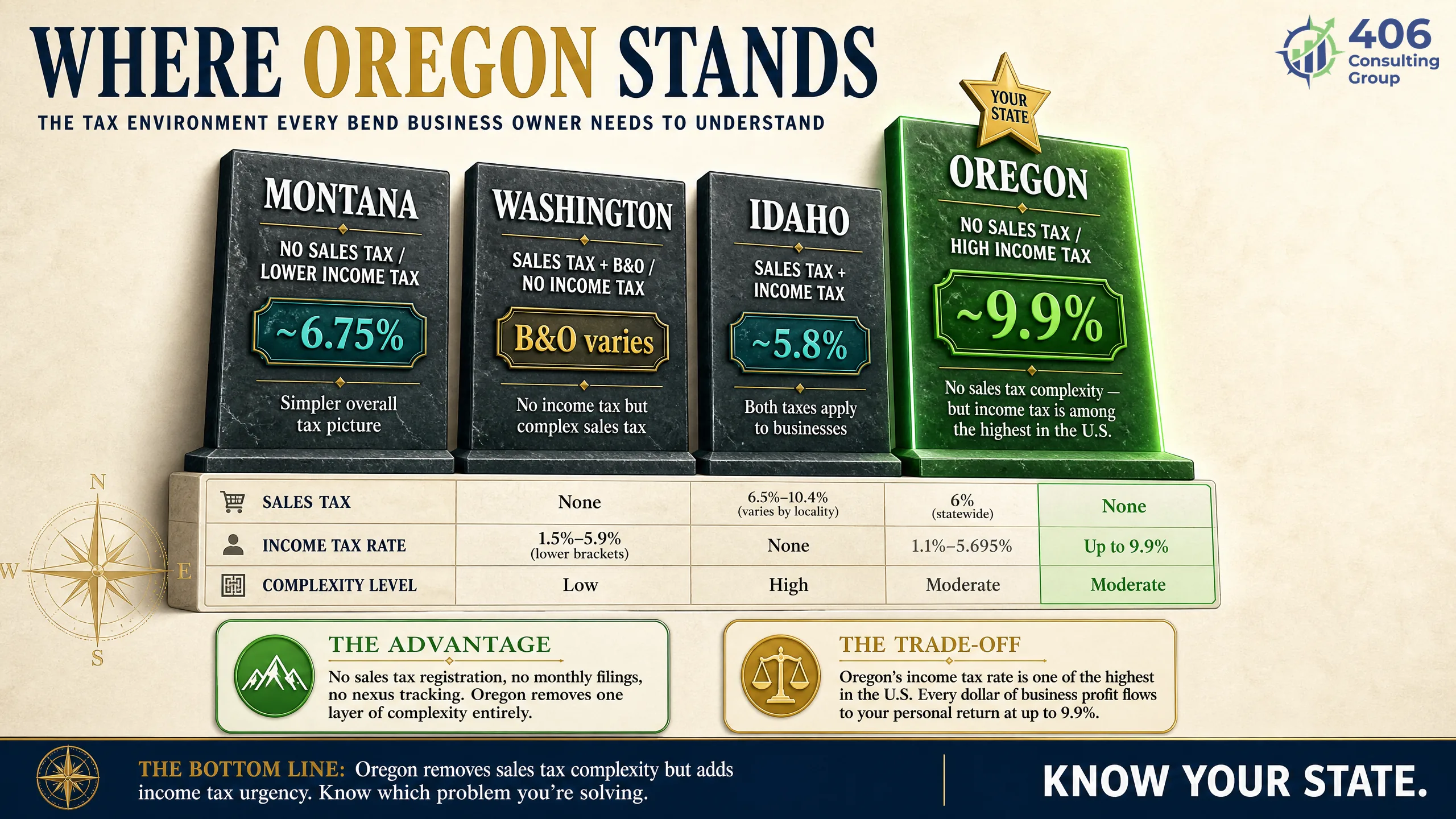
The rest of this playbook is the how. It builds on clean books, so if yours have fallen behind, the Bend bookkeeping guide is the place to start.
The Oregon Tax Picture
The short answer: a Bend business deals with a distinctive set of taxes, and the biggest mistake is treating them like a sales-tax state's. Here's the whole picture in one place.
| Tax | What it is | Your job |
|---|---|---|
| Sales tax | None in Oregon | Nothing to collect — one fewer layer entirely |
| Income tax | Bracketed, up to ~9.9%, usually personal return | Set aside as you earn; plan deductions to cut it |
| Federal income tax | IRS, on your profit — your largest bill | Plan proactively — the four levers live here |
| The CAT | Gross-receipts tax, only above $1M activity | Most small businesses exempt — monitor if you grow |
| Payroll & lodging | OR payroll (transit, Paid Leave, WBF); lodging tax on stays | Set up correctly; track lodging tax if you host |

The next sections take the no-sales-tax reality, the income side, payroll, lodging tax, and the planning that ties them together.
No Sales Tax — and the CAT
The short answer: not collecting sales tax removes a whole layer other states force on you — no taxable-vs-exempt calls, no jurisdiction rates, no sales-tax return, no liability to reconcile, and no sales/use tax loaded onto the equipment and supplies you buy. For most Bend small businesses, that's pure simplicity.
Two caveats keep it honest. If you sell into other states — online or across the Idaho, Washington, or California line — those states' economic nexus rules can still reach you. And larger businesses should know about Oregon's Corporate Activity Tax (CAT), a gross-receipts-based tax that generally applies only above $1 million of Oregon commercial activity — most small businesses are under the threshold, but it's worth planning for before you cross it. Clean books make both easy to watch.
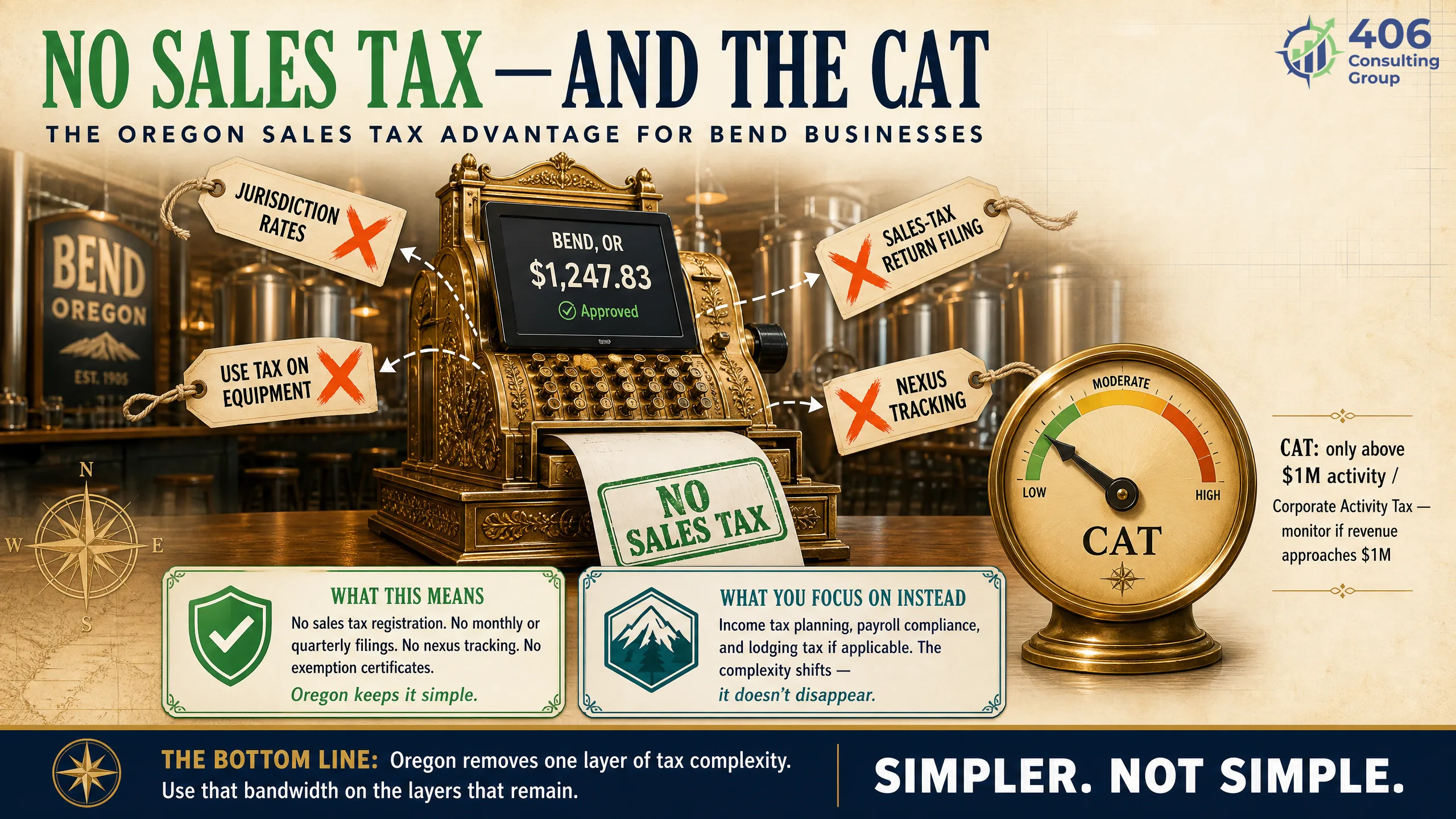
Enjoy the simplicity where it's real — and put the effort you'd have spent on sales tax into the income side, which is where Oregon asks the most.
Income Tax & Set-Asides
The short answer: Oregon's income tax is bracketed and high — the top marginal rate approaches 10% — and for most small businesses that profit flows through to the owner's personal return, on top of federal tax. With a rate that steep, setting aside for it as you earn is the single most important cash habit a Bend owner has.
For a pass-through business, the money to cover the bill comes out of the cash you're tempted to spend, and Oregon expects estimated payments along the way (with interest if you underpay). The only way to size the set-aside correctly is books that show real profit through the year, not a number reconstructed in spring. Set aside a realistic percentage as you go and a big year stays funded; guess, and Oregon's steep rate turns a strong year painful.

Because the rate is so high, Oregon is also where proactive planning pays off most — the subject of the "works twice" section below, and of the Bend tax guide.
Oregon Payroll: The Quirks
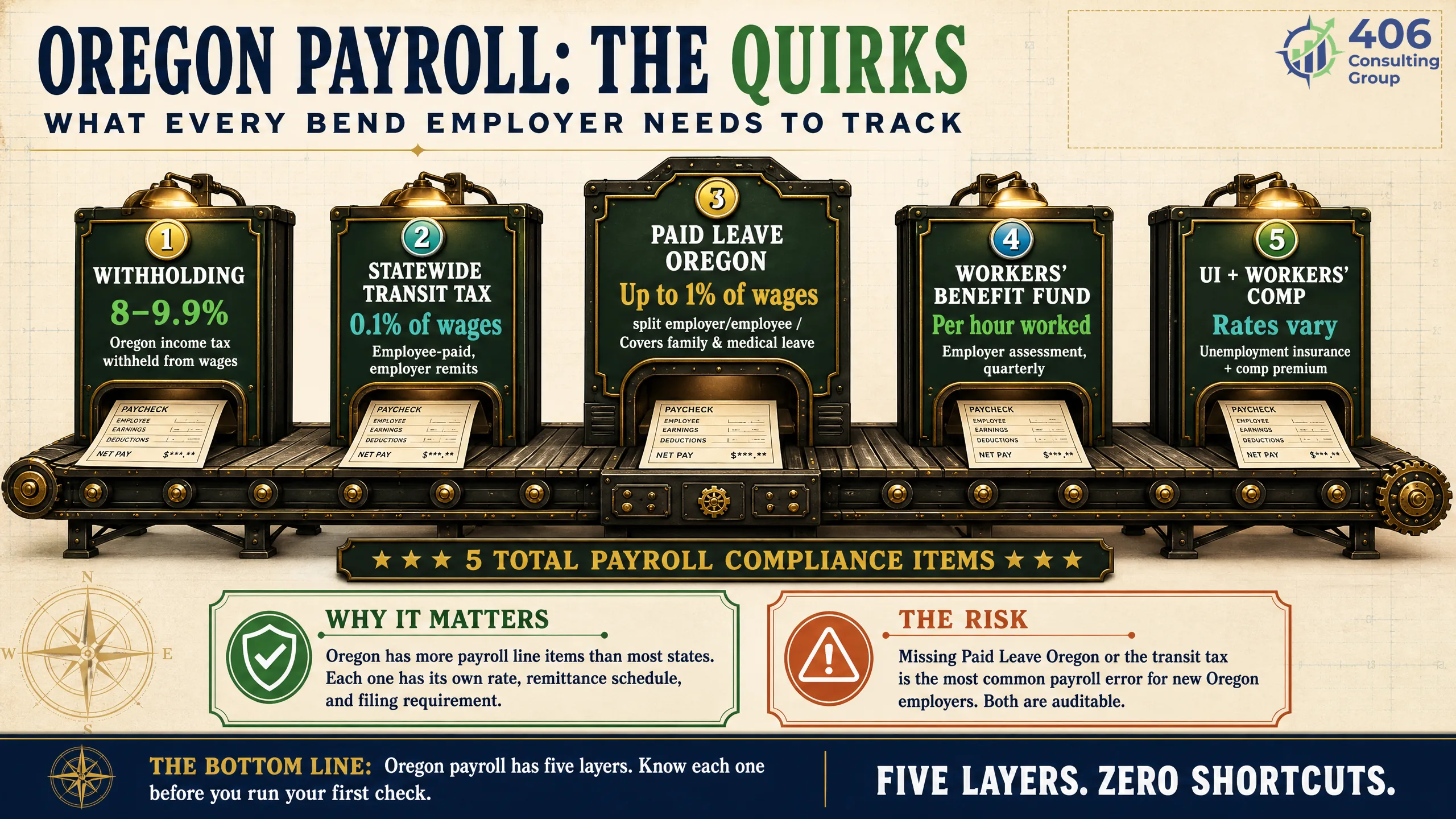
The short answer: Oregon has some of the more distinctive payroll requirements in the country, and a Bend employer has to handle several the neighboring states don't. On top of federal payroll and standard state withholding and unemployment, Oregon adds a statewide transit tax (a small tax on employee wages), Paid Leave Oregon (a shared employer/employee paid family and medical leave contribution), and the Workers' Benefit Fund (a cents-per-hour-worked assessment split between employer and employee); workers' comp is carried through a private insurer.
None of it is exotic, but it's easy to set up wrong — the statewide transit tax and the Workers' Benefit Fund in particular trip up businesses used to other states — and fixing payroll retroactively is painful. Getting it right from the first paycheck turns payroll into a routine you run rather than a liability you discover, which is what our payroll work handles for Oregon employers.
Lodging Tax & Short-Term Rentals
The short answer: Bend is a tourism town, and while Oregon has no sales tax, it does impose a transient lodging tax on short-term stays — a state portion plus a local Bend/Deschutes County portion. If you run a hotel, vacation rental, or short-term rental, this is the one "sales-tax-like" obligation you carry, and it needs to be tracked cleanly.
Platforms like Airbnb and VRBO often collect and remit certain lodging taxes on the bookings they facilitate, but coverage varies by tax and locality and may not cover direct bookings or every layer (state vs. local). Track lodging revenue and tax separately, know which portion each platform handles, and confirm what remains yours with the City of Bend, Deschutes County, and the Oregon Department of Revenue. Handled cleanly it's a simple monthly remittance; ignored, it's a surprise you already spent.
We cover the lodging-tax bookkeeping mechanics in the Bend bookkeeping guide.
Planning That Works Twice
The short answer: because Oregon taxes income at a high rate, the deductions you create through planning cut both your federal bill and a big Oregon one. That "works twice" effect — with an unusually large state half — makes proactive tax planning worth more in Bend than almost anywhere.
The four levers: an S-corp election to cut federal self-employment tax; timing equipment purchases for Section 179 deductions (and there's no Oregon sales tax on the purchase); managing income and expenses across the year; and funding a retirement plan. Three create deductions that lower taxable income — and because Oregon connects to your federal taxable income, they reduce both bills, with the state half amplified by the high rate. Oregon also offers a pass-through entity elective tax (a SALT-cap workaround) that can be genuinely valuable for a profitable Bend business. For a profitable owner, these can save well into five figures a year.

We walk through all four levers and the pass-through election in the Bend tax guide — and you can estimate S-corp savings with our S-Corp calculator.
The Books → Tax → CFO Stack
The short answer: small-business accounting isn't one service, it's a stack — clean books at the base, proactive tax planning on top, and financial leadership steering the whole thing. Each layer depends on the one beneath it, and the biggest wins come from having them work together instead of buying them piecemeal.
Bookkeeping & payroll
Oregon-ready books and correctly handled OR payroll and any lodging tax — the foundation everything reads from.
Bend bookkeeping guide →Tax planning
The four levers plus the pass-through election — so a good year isn't given back to a high-rate state in April.
Bend tax guide →Controller & CFO
Reliable reporting, cash forecasting that sizes the Oregon reserve, margin analysis, and financing readiness.
Bend CFO & controller guide →Here's our real differentiator: because our background is in running whole businesses — not just accounting — we design your financial system around how it affects operations, pricing, hiring, and cash across the whole company, not just the ledger. And we've seen how the "free" version goes wrong — we wrote about it in The Accidental Bookkeeper. Not sure which layer you need first? Our Financial Maturity Assessment maps it in about eight minutes.
The Segment-by-Segment View
The playbook is shared, but each corner of Bend's distinctive economy asks something a little different of the books.
| Segment | What to watch |
|---|---|
| Tourism & hospitality | Lodging tax, occupancy, seasonal swings, tips and seasonal payroll |
| Breweries & food/beverage | Inventory & COGS, federal/state excise, production costs, distribution |
| Construction & trades | Job costing, materials, equipment (no sales tax on the purchase), receivables |
| Tech & professional services | Multi-state nexus, revenue recognition, payroll-heavy costs, receivables |
| Healthcare & retail | Insurance or POS receivables, inventory, payroll, income-tax set-asides |

Different details, same backbone: keep profit readable for a big income-tax set-aside, handle Oregon payroll and any lodging tax cleanly, and — for makers — track inventory and COGS. Because our background is in running whole businesses, we set the system up around the entire operation, not just tax-time tidiness.
Remote & How to Get Started
The short answer: what a Bend business needs is a partner who knows Oregon — the no-sales-tax/high-income-tax flip, the payroll quirks, lodging tax, the pass-through election — not one who happens to be down the street. An Oregon-savvy remote firm beats a local generalist, and the work is a natural fit for remote delivery.
And it's genuinely how modern accounting works — even for clients nearby. Roughly 70–80% of our own local clients never come into the office; the whole relationship runs on secure cloud accounting, connected bank feeds, shared screens, and a steady rhythm. Distance simply isn't the variable it used to be, so a Bend business gets the same responsive, Oregon-savvy service our in-town clients do — with the multi-state experience that matters if you sell across the region.
Get the books Oregon-ready & current
Everything reads from here — profit readable for set-asides, OR payroll and any lodging tax handled, no sales-tax scaffolding.
Layer in tax & cash planning
The four levers plus the pass-through election, a right-sized income-tax reserve, and estimates planned federal + Oregon.
Steer with the numbers
Use reliable reporting to manage margin, get financing-ready, and grow on facts instead of gut.
Wherever you are in that path, we can meet you there — and build the financial system around how your whole operation actually runs.
FAQ: Bend Small-Business Accounting
What taxes does a Bend small business actually pay?
Oregon runs opposite to most states: no sales tax to collect, but a high bracketed income tax (top rate near 10%) that most small businesses pay through the owner's personal return, on top of federal income tax. Larger businesses may hit the Corporate Activity Tax (CAT) above $1 million of Oregon activity. Employers handle Oregon payroll (statewide transit tax, Paid Leave Oregon, the Workers' Benefit Fund, plus withholding and unemployment), and tourism/lodging businesses collect a transient lodging tax on short-term stays.
How is Oregon different from Montana, Washington, or Idaho?
Oregon stands alone in the region: no sales tax (like Montana) but one of the highest income taxes anywhere. Montana has a lower income tax; Washington has sales tax and the B&O gross-receipts tax but no income tax; Idaho has both a sales and an income tax. The practical upshot for a Bend business: skip sales-tax compliance entirely, but plan hard for a steep income tax — and because Oregon taxes income, the deductions you create cut both your federal and a big Oregon bill.
If there's no sales tax, is Oregon accounting easier?
On the sales side, genuinely yes — no taxable-vs-exempt calls, no jurisdiction rates, no sales-tax return, and no sales/use tax on the equipment you buy. But Oregon shifts the effort to the income side, where a high rate means your books must produce reliable profit numbers for a large set-aside, plus handle distinctive payroll (transit tax, Paid Leave, Workers' Benefit Fund) and, for hospitality, lodging tax. Different work than a sales-tax state — not necessarily less.
Do I need a bookkeeper, an accountant, or a CFO?
Often all three over time, in that order — it's a stack. Clean, Oregon-ready bookkeeping is the foundation. Proactive tax planning (the four levers plus the pass-through election) sits on top. Financial leadership — a controller for reliable reporting, a fractional CFO for cash forecasting, margin analysis, and financing — comes as the business grows. The layers work best together; our Financial Maturity Assessment can point you to which you need first.
Can 406 Consulting Group work with my Bend business remotely?
Yes. We work with tourism and hospitality, breweries and food/beverage makers, construction, tech, and professional and healthcare businesses across Bend, Central Oregon, and the state through secure cloud accounting — bookkeeping and payroll, tax planning, and fractional controller and CFO services. What matters is Oregon expertise (the no-sales-tax/high-income-tax setup, OR payroll, lodging tax, the pass-through election), not office proximity — in fact, roughly 70–80% of our own local clients never come into the office. Because our background is in running whole businesses, we design the financial system around your entire operation.
Keep Reading — The Bend Series
Small-Business Accounting — Bend, OR
One Financial System, Built for Oregon.
406 Consulting Group gives Bend businesses Oregon-ready books, tax planning that cuts both your federal and steep state bill, and the controller and CFO leadership to grow — payroll, lodging tax, and set-asides handled, delivered remotely across Oregon. Let's build the system your business needs.
Bend Small-Business Quick Reference
Bend, OR — Deschutes County
The Bend Playbook
Running a Business in Bend?
Books to CFO strategy, built for Oregon.
About the Author
Jason Anderson
Co-Founder, 406 Consulting Group
Background in large-scale operational finance at BP before building financial infrastructure for Northwest small businesses. Jason helps Bend and Central Oregon owners build financial systems that keep Oregon compliance clean and fund growth.
Read the Full Story