
Bookkeeping Services in Bend, OR:
No Sales Tax, But High Stakes on Income
Oregon flips the usual setup — no sales tax to collect, but one of the highest state income taxes in the country. Here's what a Bend business needs from its books: income-tax set-asides, Oregon's distinctive payroll, and the lodging tax — from a firm that knows Oregon and works remotely.

Oregon runs its taxes backwards from almost everywhere else, and Bend business owners feel it in a specific way: there's no sales tax to collect — nothing to charge at the register, no returns to file — but the state income tax is one of the highest in the country, a bracketed rate that climbs to nearly 10%. So the layer that eats most small businesses elsewhere simply doesn't exist here, while the layer that's easy to ignore is the one that quietly takes the biggest bite. Books built for a sales-tax state, or run by someone who learned accounting somewhere else, miss that flip entirely.
That flip is good news and a warning at once. Good news: your bookkeeping is genuinely simpler on the sales side — one fewer tax to track, collect, and remit. The warning: with a state income tax that steep, what you set aside and how you plan matters more in Oregon than in Idaho, Washington, or Montana, and clean books are the only way to get either right. Add Oregon's distinctive payroll rules and Bend's tourism lodging tax, and there's a specific playbook here worth getting right.
This guide covers how Oregon's no-sales-tax, high-income-tax setup shapes your books, the payroll quirks unique to the state, Bend's lodging tax, what a growing business needs, and how a remote firm delivers all of it. If you're weighing whether you've outgrown DIY books, start here.
By Carrie Anderson — Co-Founder, 406 Consulting Group. Commercial banking and underwriting background — 300+ loan reviews — plus advisory work with small businesses across the Northwest, where multi-state payroll, income-tax set-asides, and clean books are everyday work.
Quick Answer: Bookkeeping for a Bend Business
- →No sales tax in Oregon — nothing to collect or remit at the register, one fewer compliance layer.
- →But a high state income tax (bracketed, up to ~9.9%) — so income-tax set-asides matter more here than almost anywhere.
- →Oregon payroll is its own animal — statewide transit tax, Paid Leave Oregon, and the Workers' Benefit Fund.
- →Bend tourism adds a lodging tax on short-term stays — state plus local, for lodging and short-term rentals.
- →Delivered remotely — even most of our local clients never come to the office.
Table of Contents
Why Oregon Bookkeeping Is Different
The short answer: Oregon is one of a handful of states with no general sales tax, but it funds itself with a steep, bracketed income tax instead. That single fact flips where your bookkeeping effort goes — away from collecting and remitting sales tax, and toward tracking profit cleanly so a high income-tax bill is planned for, not a spring surprise.
It's a genuinely different setup from the region: Montana also has no sales tax but a much lower income tax; Washington has sales tax and the B&O gross-receipts tax but no income tax; Idaho has both a sales and an income tax. Oregon stands alone with no sales tax and one of the highest income taxes anywhere. For a Bend business, that means the books don't have to wrangle sales-tax jurisdictions — but they absolutely have to produce reliable profit numbers, handle Oregon's particular payroll rules, and, for the tourism trade, track a lodging tax. Build for that and Oregon is refreshingly clean.
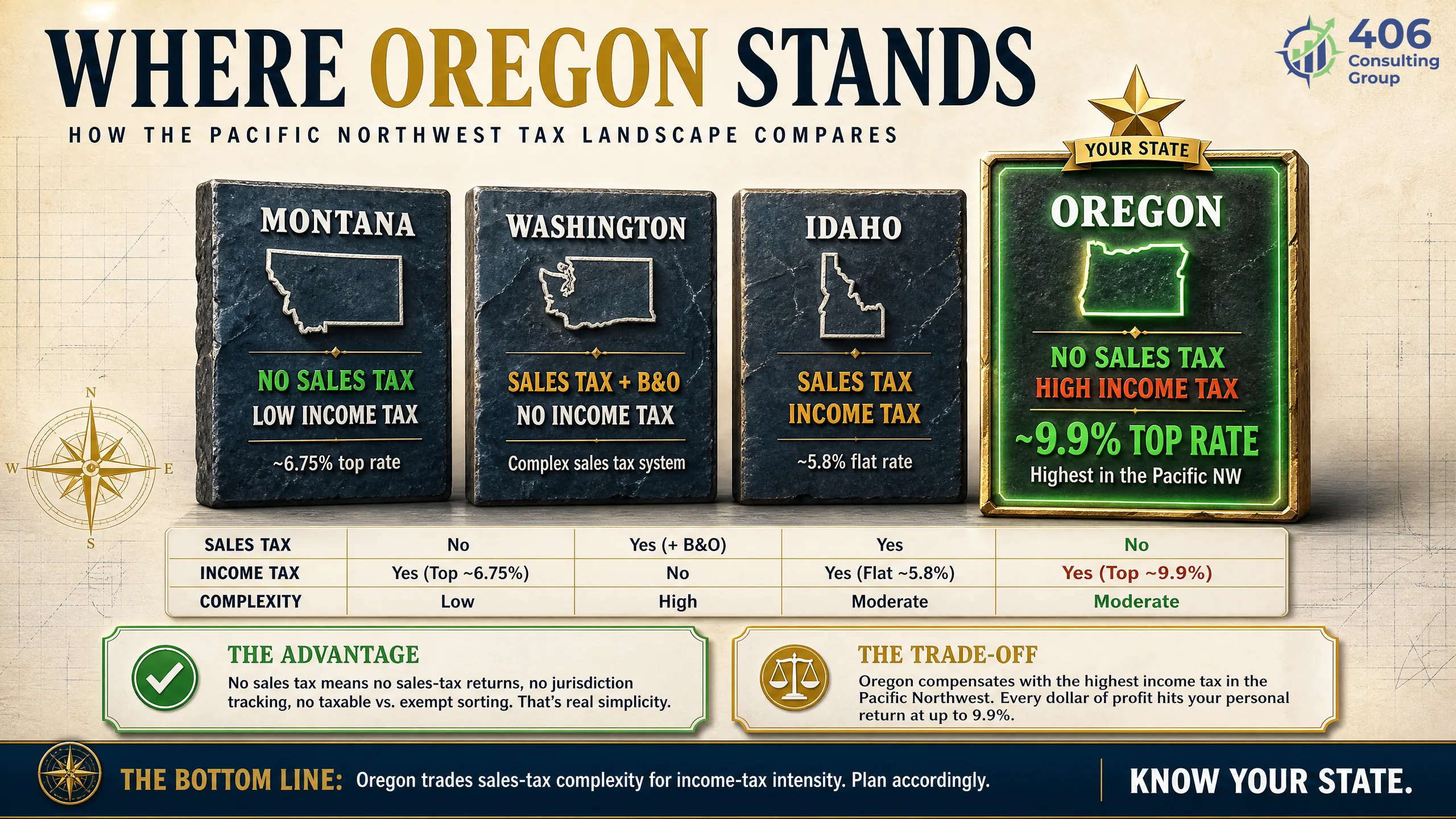
The rest of this guide walks through each piece. Get your books built around Oregon's flip and running a Bend business gets a lot calmer at tax time.
The No-Sales-Tax Upside
The short answer: not collecting sales tax removes a whole layer of bookkeeping most businesses in other states wrestle with — no taxable-vs-exempt decisions on every sale, no jurisdiction rates, no monthly or quarterly sales-tax return, no liability account to reconcile, and no risk of spending money that was never yours. For a Bend retailer or restaurant, that's real simplicity a Boise or Spokane counterpart doesn't get.
Two caveats keep it honest. First, if you sell into other states — online, or to customers across the Idaho or Washington line — those states' economic nexus and sales-tax rules can still reach you, so "no Oregon sales tax" isn't always "no sales tax anywhere." Second, larger businesses may encounter Oregon's Corporate Activity Tax (CAT), a gross-receipts-based tax that generally applies only above $1 million of Oregon commercial activity — most small businesses are under the threshold, but it's worth knowing exists. Clean books make both easy to monitor.

Enjoy the simplicity where it's real — and put the effort you'd have spent on sales tax into the income side, which is where Oregon actually asks the most of you.
Income Tax & Set-Asides
The short answer: Oregon's income tax is bracketed and high — the top marginal rate reaches nearly 10% — and for most small businesses that profit flows through to the owner's personal return, on top of federal tax. With a rate that steep, setting aside for it as you earn isn't optional bookkeeping hygiene; it's survival.
For a pass-through business — sole proprietorship, partnership, LLC, or S-corp — the business itself generally doesn't pay Oregon income tax; you do, on your personal return, on the flow-through profit, usually with quarterly estimated payments to both the IRS and Oregon. Because the Oregon bite is large, a good year can create a genuinely big combined bill, and the only way to size it correctly is books that show real profit through the year — not a number reconstructed in March. Set aside a realistic percentage of profit as you go and the bill is funded; guess, and a strong year turns painful.

Because the state rate is so high, Oregon is also where proactive tax planning pays off most — the deductions you create cut a big state bill on top of the federal one. We cover that in the Bend tax guide (part of this series); the bookkeeping job is to keep the numbers clean enough to plan from. Verify current brackets with the Oregon Department of Revenue.
Oregon Payroll: The Quirks
The short answer: Oregon has some of the more distinctive payroll requirements in the country, and a Bend employer has to handle several the neighboring states don't have. Getting them set up correctly from the first paycheck is what keeps payroll a routine instead of a mess of missed filings.
| Item | What it is | Bookkeeping note |
|---|---|---|
| Oregon withholding | State income tax withheld from wages | Remitted on a schedule; reconciled annually |
| Statewide transit tax | A small payroll tax on employee wages (0.1%) | Withheld and reported separately — easy to miss |
| Paid Leave Oregon | Paid family & medical leave contributions | Shared employer/employee; quarterly reporting |
| Workers' Benefit Fund | Cents-per-hour-worked assessment | Split employer/employee; based on hours, not wages |
| Unemployment (SUI) & workers' comp | Employer-paid UI; workers' comp via a private carrier | Quarterly filing; comp audited on payroll |
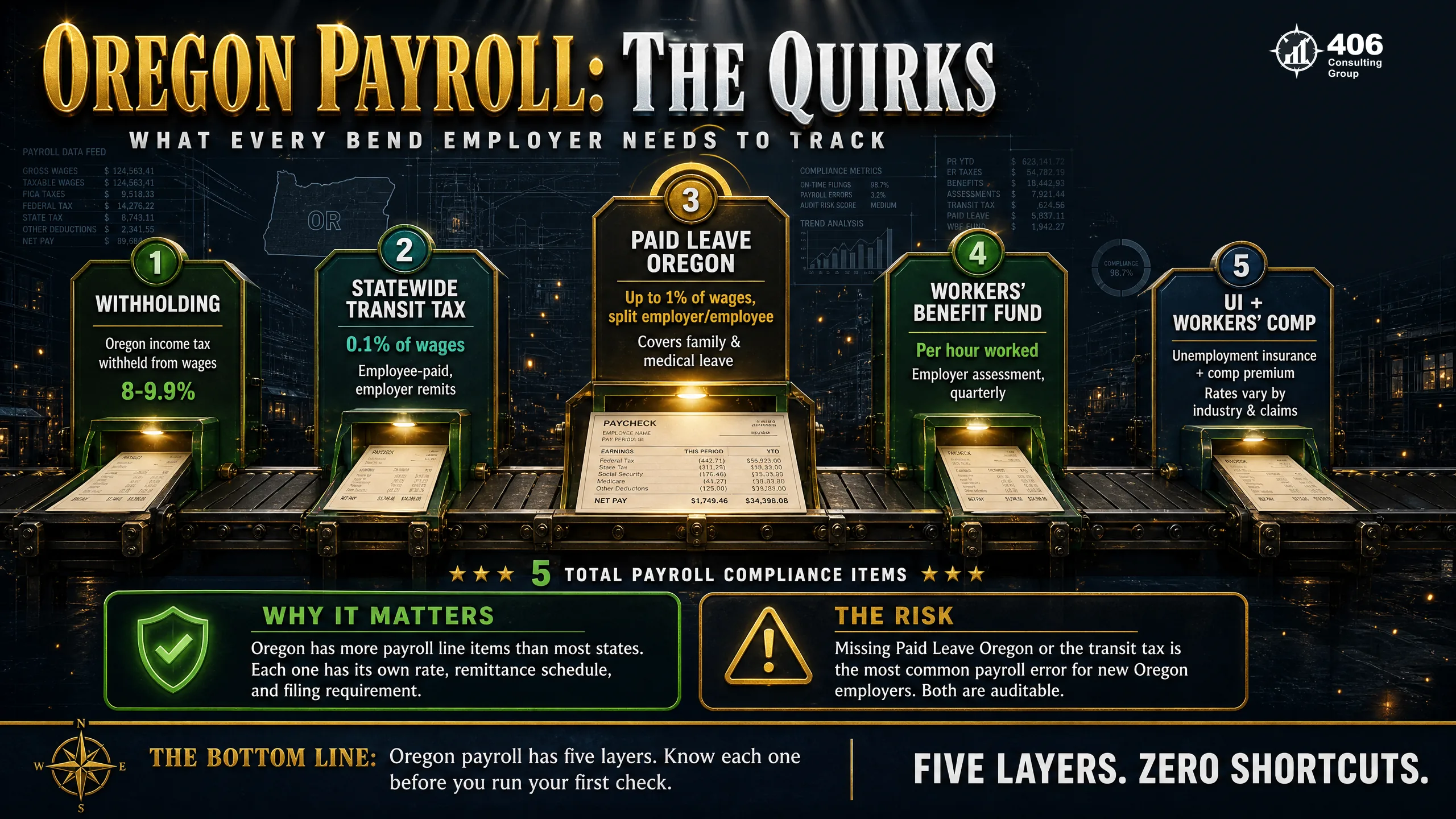
The statewide transit tax and the Workers' Benefit Fund in particular trip up businesses used to other states. Verify current rates with the Oregon Department of Revenue and Paid Leave Oregon — or hand it off. Our payroll work keeps all of it clean.
Lodging Tax & Short-Term Rentals
The short answer: Bend is a tourism town, and while Oregon has no sales tax, it does impose a transient lodging tax on short-term stays — a state portion plus a local Bend/Deschutes County portion. If you run a hotel, vacation rental, or short-term rental in the Bend area, this applies, and it's the one "sales-tax-like" obligation an Oregon hospitality business does carry.
The usual trip-up is the platform question: Airbnb and VRBO often collect and remit certain lodging taxes on the bookings they facilitate, but coverage varies by tax and by locality, and it doesn't necessarily cover direct bookings or every layer (state vs. local). You still need to account for lodging revenue and tax separately, know which portion each platform is handling, and confirm what remains yours. Track it cleanly and it's a simple monthly remittance; ignore it and it becomes a surprise you already spent.

Rates and platform behavior change, so confirm current lodging-tax specifics with the City of Bend, Deschutes County, and the Oregon Department of Revenue — and make sure your books reflect what you (versus the platform) are actually remitting.
A Chart of Accounts Built for Oregon
The short answer: your chart of accounts is the skeleton of your books, and an Oregon-ready one looks different from a sales-tax state's — there's no sales-tax liability to carve out, but you do need the income-tax set-aside, Oregon's payroll liabilities, and (for hospitality) lodging tax cleanly separated.
Set up right, an Oregon chart of accounts makes profit easy to read so income-tax estimates are accurate; breaks out payroll liabilities for withholding, the statewide transit tax, Paid Leave Oregon, and the Workers' Benefit Fund; and, if you host guests, keeps lodging tax collected as its own liability. You skip the sales-tax scaffolding entirely. The result: your Oregon and federal estimates, your payroll filings, and any lodging-tax remittance all come straight from numbers the books already track.
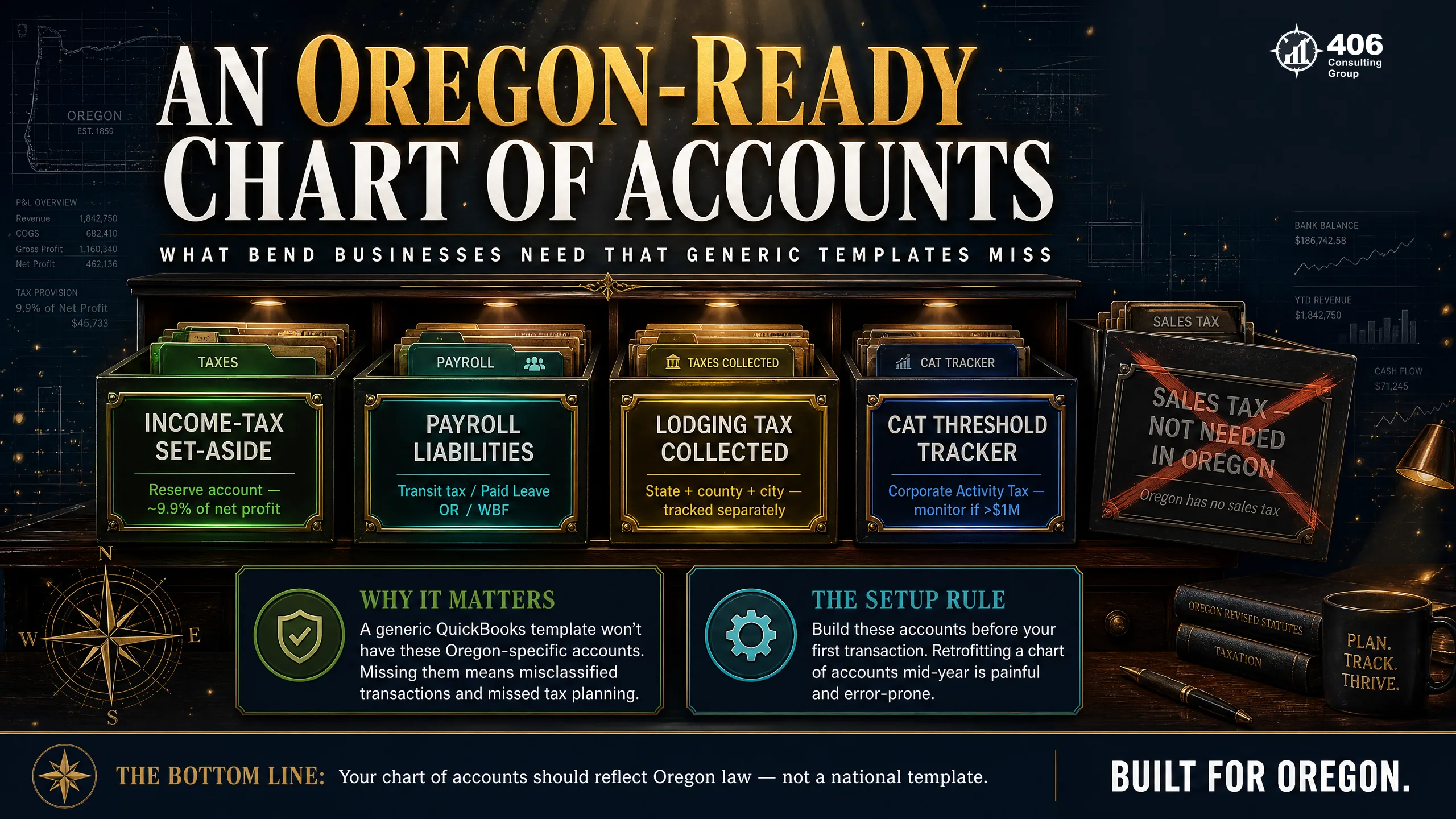
It's the kind of setup work that pays off every month — and the first thing we fix when we take on a Bend business whose books were built on a generic, sales-tax-state template.
What a Growing Bend Business Needs
The short answer: beyond compliance, a growing Bend business needs books that inform decisions — accurate monthly financials, a read on what actually makes money, and a cash-flow picture that accounts for a big income-tax set-aside and payroll.
Bend is one of the fastest-growing towns in the region, and businesses here scale quickly against a high cost base. Clean monthly books are the baseline; from there, the value climbs — margin visibility so you know what to lean into, payroll handled correctly as you hire, and a cash-flow forecast so growth and that steep Oregon income tax don't drain you. Good books turn Oregon's high-income-tax reality from an annual gut-punch into a planned, funded line, and give you the numbers to make hiring, pricing, and expansion calls on facts.
When reliable numbers become the basis for real decisions, many businesses step up from bookkeeping to controller-level support — a path we cover in upgrading from bookkeeping to a controller.
Bookkeeping by Bend Industry
Bend's economy is a distinctive mix of tourism, craft production, construction, and a growing tech and healthcare base — and each corner asks something a little different of the books.
| Industry | What the books need to track |
|---|---|
| Tourism & hospitality | Lodging tax, occupancy, seasonal swings, tips and seasonal payroll |
| Breweries & food/beverage | Inventory & COGS, federal/state excise, production costs, distribution |
| Construction & trades | Job costing, materials, equipment, receivables (no sales tax to track) |
| Tech & professional services | Multi-state nexus, revenue recognition, payroll-heavy costs, receivables |
| Healthcare & retail | Insurance or POS receivables, inventory, payroll, income-tax set-asides |

Different details, same backbone: keep profit readable for a big income-tax set-aside, handle Oregon payroll and any lodging tax cleanly, and — for makers — track inventory and COGS. Because our background is in running whole businesses, we set books up around the entire operation, not just tax-time tidiness.
Common Oregon Bookkeeping Mistakes
Most Oregon bookkeeping trouble comes from the same avoidable mistakes — several of them specific to the state's unusual setup. Here's what we see most.
Under-reserving for income tax
With a top rate near 10%, a light set-aside leaves a brutal April bill; Oregon punishes guessing more than lower-rate states.
Missing Oregon payroll pieces
The statewide transit tax, Paid Leave Oregon, and the Workers' Benefit Fund get skipped by anyone used to other states.
Ignoring lodging tax
Hospitality and short-term-rental owners assume 'no sales tax' means nothing to collect — the lodging tax says otherwise.
Assuming no out-of-state sales tax obligations
Selling online or across the ID/WA line can trigger other states' economic nexus rules despite Oregon having none.
Only thinking about taxes in April
In a high-income-tax state, reactive filing is the most expensive habit; planning saves the most here.
Every one is a setup-and-habit problem, not a character flaw — and every one disappears once the books are built for Oregon and maintained on a monthly rhythm.
Local vs. a Great Remote Partner
The short answer: what matters in a bookkeeper is whether they know Oregon's unusual tax and payroll setup — no sales tax, a high income tax, the transit tax, Paid Leave Oregon, the Workers' Benefit Fund, lodging tax — not whether their office is in Bend. A great remote partner who understands Oregon beats an okay local generalist, and the work is a natural fit for remote delivery.
And honestly, remote is how modern bookkeeping already works — even for the clients right down the road. Roughly 70–80% of our own local clients never set foot in our office; the whole relationship runs on secure cloud accounting, connected bank feeds, shared screens, and a steady monthly rhythm. Distance simply isn't the variable it used to be. So whether you're in Bend, elsewhere in Central Oregon, or across the state, you get the same responsive, Oregon-savvy service our in-town clients do.
And if you sell or operate across state lines — common for Bend businesses near the Idaho and Washington markets — that multi-state experience matters more than a local address, and it's exactly what a specialized remote firm brings.
How to Get Started
Getting your Oregon books in order is three steps.
Clean up and set the baseline
Reconcile the accounts and build an Oregon-ready chart of accounts — income-tax set-aside, OR payroll liabilities, and lodging tax if you host.
Get the income & payroll rhythm right
Set a profit-based income-tax set-aside for a high-rate state, and stand up Oregon payroll (transit tax, Paid Leave, WBF) correctly.
Run it monthly
Monthly reconciliation and clean financials keep compliance routine and give you numbers you can run the business on.
Not sure whether you need bookkeeping, tax help, or something more? Our Financial Maturity Assessment maps it out in about eight minutes.
FAQ: Bend Bookkeeping Questions
Does Bend or Oregon have a sales tax?
No — Oregon is one of the few states with no general sales tax, so a Bend business doesn't collect or remit sales tax on goods and services. That removes a whole layer of bookkeeping. The trade-off is a high state income tax (a bracketed rate reaching close to 10%), which most small businesses pay through the owner's personal return. Bend's tourism businesses do deal with a transient lodging tax on short-term stays, and businesses selling into other states can still face those states' sales-tax rules.
If there's no sales tax, is Oregon bookkeeping easier?
On the sales side, genuinely yes — no taxable-vs-exempt calls, no jurisdiction rates, no sales-tax return, no liability to reconcile. But Oregon shifts the effort to the income side, where a high, bracketed income tax means your books have to produce reliable profit numbers so you can set aside enough as you go. Add Oregon's distinctive payroll rules (statewide transit tax, Paid Leave Oregon, Workers' Benefit Fund) and, for hospitality, lodging tax, and there's plenty to get right — just different things than a sales-tax state.
What payroll taxes are unique to Oregon?
On top of federal payroll and standard state withholding and unemployment, Oregon adds a statewide transit tax (a small tax on employee wages), Paid Leave Oregon (a shared employer/employee paid family and medical leave contribution), and the Workers' Benefit Fund (a cents-per-hour-worked assessment split between employer and employee). Workers' comp is carried through a private insurer. These trip up businesses used to other states, so they're worth setting up correctly from the first paycheck.
Do I owe lodging tax on my Bend short-term rental?
Generally yes. Even though Oregon has no sales tax, it imposes a transient lodging tax on short-term stays, and the Bend area adds a local portion on top of the state's. Platforms like Airbnb and VRBO often collect and remit certain lodging taxes on facilitated bookings, but coverage varies by tax and locality and may not include direct bookings or every layer — so track lodging revenue and tax separately and confirm what remains yours with the City of Bend, Deschutes County, and the Oregon Department of Revenue.
How much should I set aside for Oregon income tax?
More than you'd think, because Oregon's rate is high — the top bracket approaches 10%, on top of federal tax. The method matters most: set aside a realistic percentage of profit as you earn it, and plan federal and Oregon estimated payments together. Because the Oregon bite is large, under-reserving is the single most common and painful Oregon mistake. Clean, current books make the set-aside and the estimates accurate instead of a guess — which is the whole point of good bookkeeping for a profitable business.
Can 406 Consulting Group do my Bend bookkeeping remotely?
Yes. We work with Bend and Central Oregon businesses through secure cloud accounting — connected bank feeds, shared screens, and a steady monthly rhythm. What matters for an Oregon business is expertise in the state's setup (no sales tax, high income tax, the transit tax, Paid Leave Oregon, the Workers' Benefit Fund, lodging tax), not office proximity. In fact, roughly 70–80% of our own local clients never come into the office either, so the relationship is effectively remote for them too. An Oregon-savvy remote partner serves you better than a local generalist, and multi-state experience is a real plus if you operate across the region.
Keep Reading
Bookkeeping — Bend, OR
No Sales Tax. High Stakes on Income. Clean Books.
406 Consulting Group keeps Bend businesses clean and compliant — income-tax set-asides for a high-rate state, Oregon payroll and lodging tax handled, and financials you can run the business on. Delivered remotely, by a firm that knows Oregon.
Bend Bookkeeping Quick Reference
Bend, OR — Deschutes County
Behind on Oregon Compliance?
Income set-asides, OR payroll & lodging, handled.
About the Author
Carrie Anderson
Co-Founder, 406 Consulting Group
Commercial banking and underwriting background — 300+ loan reviews — plus advisory work with small businesses across the Northwest. Carrie helps Bend and Central Oregon owners keep the books clean, set aside for a high-rate state, and handle Oregon's distinctive payroll.
Read the Full Story