
Accounting for Meridian Small Businesses:
The Idaho Playbook
Idaho taxes both income and sales — a sales tax you collect, a state income tax you plan for, and a federal bill on top. Here's the whole playbook for a Meridian business, from a firm that knows Idaho and works remotely.

Running a small business in Meridian means living with an Idaho money setup that sits right between its neighbors: a sales tax you collect and remit, a state income tax you plan for, and a federal bill that's still your largest. Montana has no sales tax; Washington has no income tax; Idaho has both. Add the state's payroll layers and the cash-flow reality that some of the money in your account is already spoken for, and there's a lot to keep straight — especially while you're actually running the business.
The good news: Idaho is refreshingly clean once your financial system is built for it — no gross-receipts tax to untangle, a single flat income rate, and one main state agency. Whether you run a professional practice, a healthcare or dental office, a shop, a contractor, or a growing tech or service business, the same playbook applies: track sales tax as the liability it is, set aside for income tax as you earn, plan the deductions that cut both federal and state, and keep payroll clean. This guide is the overview that ties it all together, with links to the deeper pieces. It's the hub of our Meridian work.
Below: the Idaho tax picture explained simply, how to keep sales and income taxes clean, why planning works twice here, how the books-tax-CFO stack fits together, and a segment-by-segment look at what matters for your kind of business.
By Carrie Anderson — Co-Founder, 406 Consulting Group. Commercial banking and underwriting background — 300+ loan reviews — plus advisory work with small businesses across the Northwest. Carrie helps Meridian and Idaho owners build financial systems that keep compliance clean and fund growth.
Quick Answer: The Idaho Small-Business Playbook
- →Idaho taxes both: a 6% sales tax you collect, and a flat state income tax you plan for — plus the federal bill.
- →Sales & use tax is compliance you keep clean; the income taxes are where planning saves money.
- →Deductions work twice: because Idaho taxes income, a deduction cuts both your federal and state bill.
- →Cash flow carries two set-asides — the sales tax you hold and the income tax you'll owe.
- →Books → tax → CFO is a stack, delivered remotely — even most of our local clients never visit the office.
Table of Contents
Why an Idaho Small Business Is Different
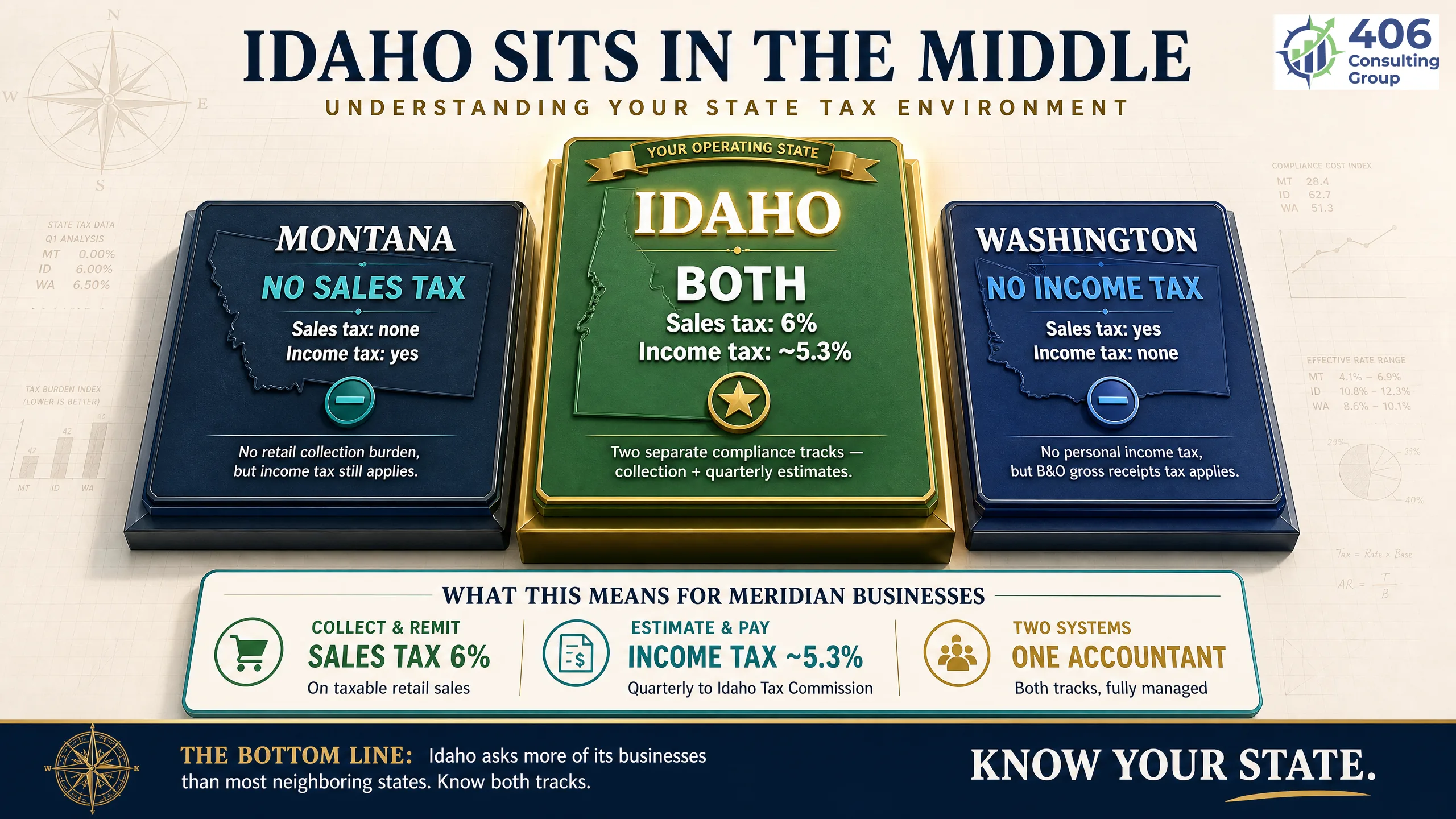
The short answer: Idaho taxes both activity and income, so your financial system has to do two jobs at once — track the sales tax you collect and plan for the income tax you owe. An owner who moved a business here, or an accountant who learned in a single-tax state, can get half of it wrong.
It cuts both ways. Idaho is simpler than Washington in one sense — no business & occupation or gross-receipts tax — and the income tax is a single flat rate rather than a bracket puzzle. But you can't ignore the income side the way a Washington business does, and you can't ignore sales tax the way a Montana business does. The businesses that stay calm and compliant are the ones whose books were built for both from the start.
The rest of this playbook is the how. It builds on clean books, so if yours have fallen behind, the Meridian bookkeeping guide is the place to start.
The Idaho Tax Picture
The short answer: a Meridian business deals with three tax realities, and the biggest mistake is treating them as one blur. Here's the whole picture in one place.
| Tax | What it is | Your job |
|---|---|---|
| Sales & use tax | 6% — collected from customers / on untaxed purchases | Collect, hold as a liability, remit — don't spend it |
| Idaho income tax | Flat ~5.3%, usually on your personal return | Set aside as you earn; plan deductions to cut it |
| Federal income tax | IRS, on your profit — your largest bill | Plan proactively — the four levers live here |
| Gross-receipts tax | None in Idaho | Nothing — simpler than Washington's B&O |
| Payroll taxes | Federal + Idaho withholding, SUI, workers' comp | Set up correctly, process cleanly |

The next sections take the sales side, the income side, and the planning that ties them together.
Sales & Use Tax
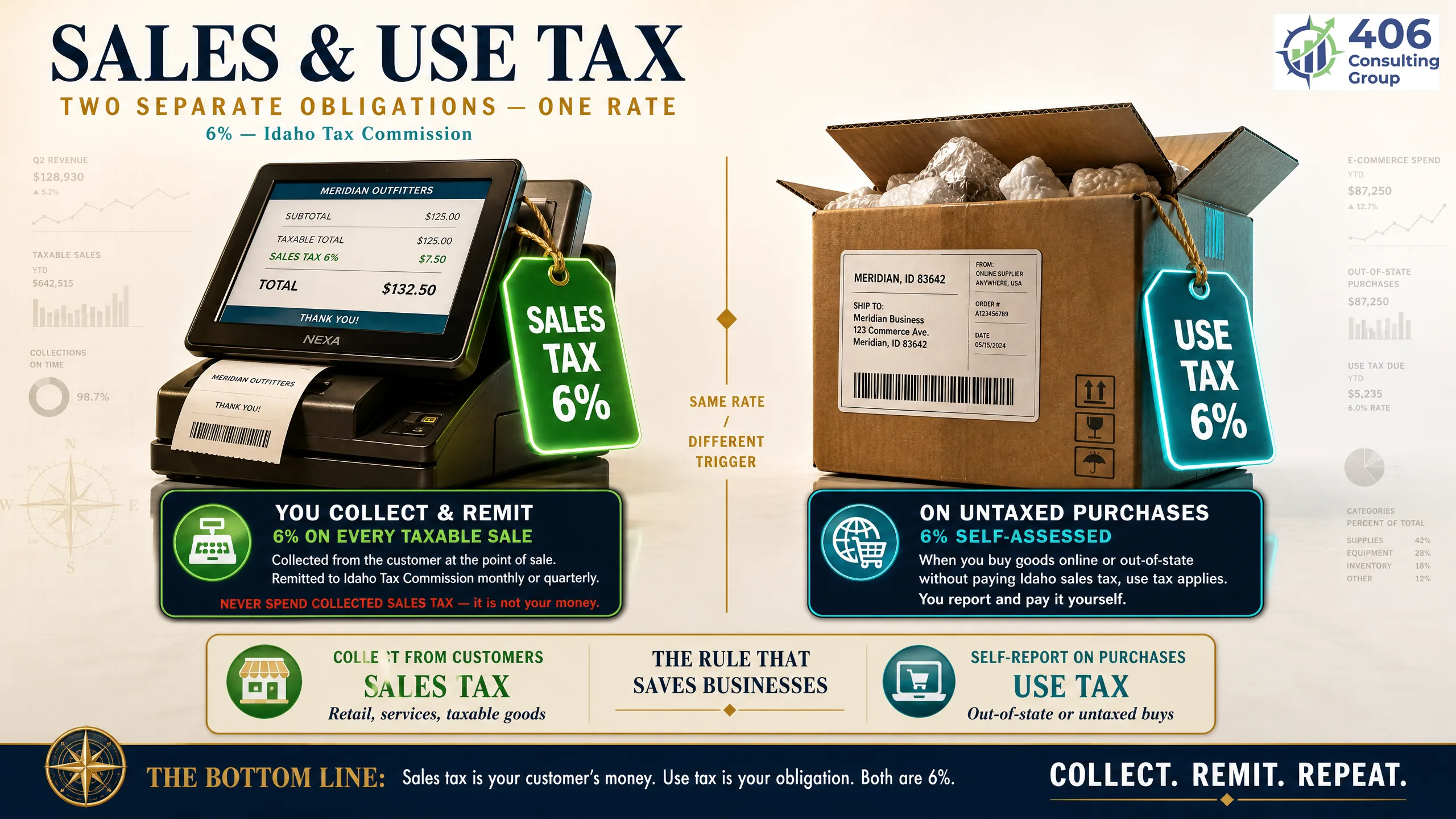
The short answer: you collect Idaho's 6% sales tax on taxable sales and remit it — it was never your money — and you owe use tax on business purchases you didn't pay sales tax on, commonly from out-of-state or online sellers. Before you collect, you need a seller's permit from the Idaho State Tax Commission.
The cardinal rule: never treat collected sales tax as cash flow. It sits in your account but belongs to the state, and spending it is the fastest way to a shortfall when the return comes due. Use tax is the commonly missed companion — a piece of equipment bought online "tax-free" usually still owes 6%. Clean books keep sales tax visible as a liability and flag use-tax situations so nothing sneaks up on you.
We go deep on sales tax, use tax, and the seller's permit in the Meridian bookkeeping guide.
Income Tax & Set-Asides
The short answer: Idaho's income tax is a single flat rate (around 5.3% as of 2025, after several recent cuts), and for most small businesses that profit flows through to the owner's personal return, on top of federal tax. The practical job is to set aside for it as you earn rather than facing it all at once.
Because Idaho profit is a pass-through for most owners, the money to cover it has to come out of the cash you're already tempted to spend. Unlike the federal side, Idaho doesn't impose a federal-style mandatory quarterly-estimate regime with underpayment penalties on most individuals — but interest accrues on tax left unpaid after the April deadline, so the discipline is the same: reserve a share of profit as you go. Clean books make that set-aside a calculation instead of a guess.

The income side is also where proactive planning saves real money — which is the next section. We go deeper in the Meridian tax guide.
Payroll in Idaho
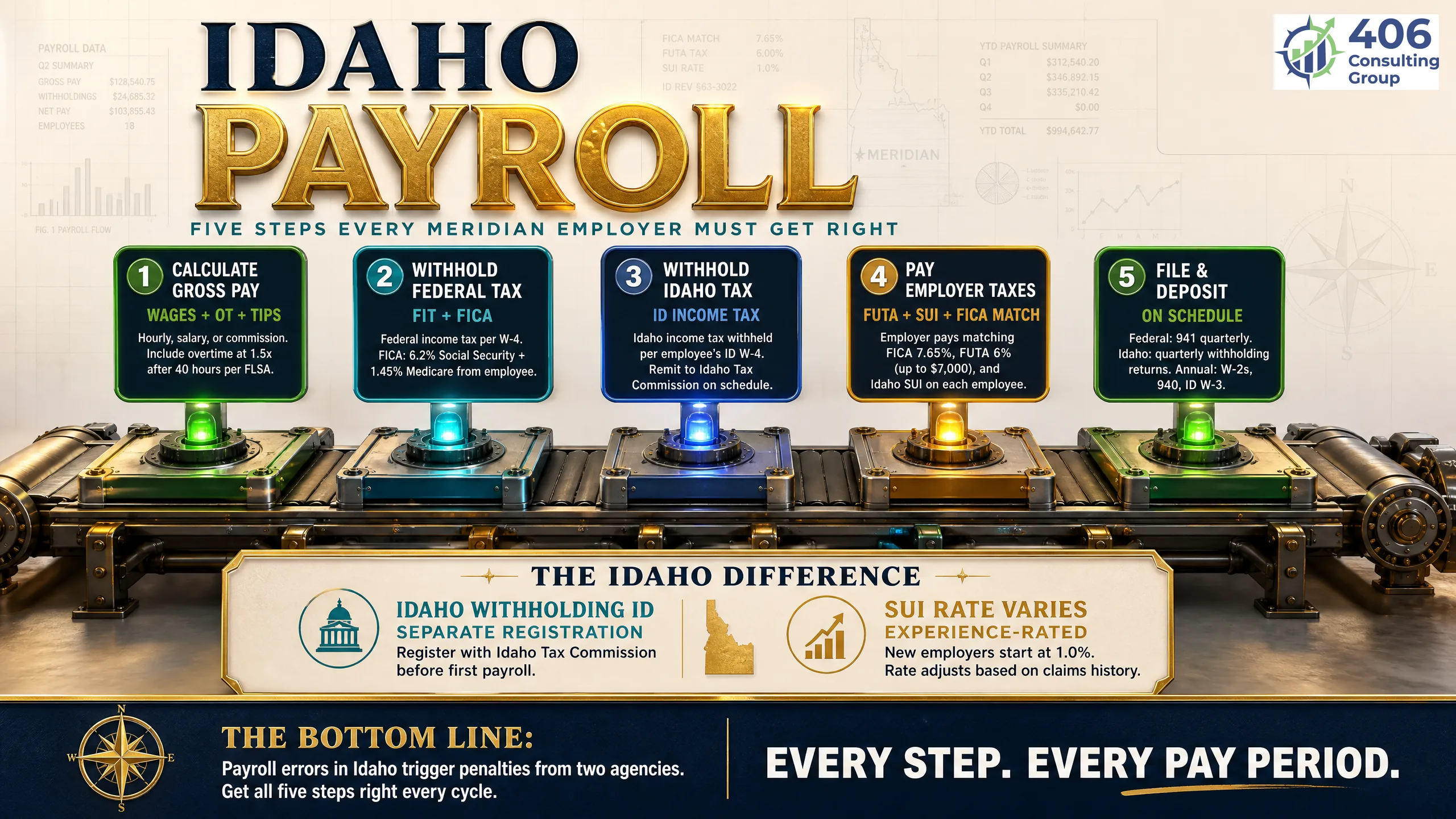
The short answer: once you hire, Idaho adds its own payroll layers on top of the federal ones — state income tax withholding, state unemployment insurance through the Idaho Department of Labor, and workers' compensation coverage from a private carrier or the Idaho State Insurance Fund. Each has its own rates and filings.
None of it is exotic, but it's easy to set up wrong, and fixing payroll retroactively is painful and expensive. Getting it right from the first paycheck — correct withholding, the right unemployment setup, and workers' comp in force — turns payroll into a routine you run rather than a liability you discover. That's what our payroll work handles for Idaho employers.
Planning That Works Twice
The short answer: because Idaho taxes income, the deductions you create through planning cut both your federal bill and your Idaho bill. That "works twice" effect makes proactive tax planning worth more in Idaho than in a no-income-tax state — even though the state rate is modest.
The four levers: an S-corp election to cut federal self-employment tax on a profitable business; timing equipment purchases for Section 179 deductions; managing income and expenses across the year; and funding a retirement plan. Three of those create deductions that lower taxable income — and since Idaho starts from your federal taxable income, they reduce both bills at once. The S-corp is the exception, a federal self-employment-tax play. For a profitable Meridian owner, these can save five figures a year.

We walk through all four levers, with real numbers, in the Meridian tax guide — and you can estimate S-corp savings on your own numbers with our S-Corp calculator.
Cash Flow: Two Set-Asides
The short answer: the balance in your account overstates what you can actually spend, because two claims sit inside it — the sales tax you're holding for the state and the income tax you'll owe on profit. An Idaho business that manages cash off the raw bank balance is setting itself up to come up short.
The fix is a simple discipline: treat collected sales tax as a liability the moment it's collected, and set aside a share of profit for income tax as you earn it. This matters more as you grow — bigger revenue means bigger obligations siphoning off cash that feels available but isn't. Get it right and you avoid the "we were up all year and still ran tight" trap that catches so many otherwise-healthy businesses.
It's the classic "profitable but broke" problem with an Idaho twist — we break down the general version in Profitable But No Cash, and the forecasting side in the Meridian CFO & controller guide.
The Books → Tax → CFO Stack
The short answer: small-business accounting isn't one service, it's a stack — clean books at the base, proactive tax planning on top, and financial leadership steering the whole thing. Each layer depends on the one beneath it, and the biggest wins come from having them work together instead of buying them piecemeal from three disconnected people.
Bookkeeping & payroll
Idaho-ready, current books and correctly handled payroll — the foundation everything reads from.
Meridian bookkeeping guide →Tax planning
The four levers plus Idaho set-asides — so a good year isn't given back to the IRS and the state at tax time.
Meridian tax guide →Controller & CFO
Reliable reporting, cash forecasting, margin analysis, and financing readiness — numbers turned into decisions.
Meridian CFO & controller guide →Here's our real differentiator: because our background is in running whole businesses — not just accounting — we design your financial system around how it affects operations, pricing, hiring, and cash across the whole company, not just the ledger. Not sure which layer you need first? Our Financial Maturity Assessment maps it in about eight minutes.
The Segment-by-Segment View
The playbook is shared, but each corner of Meridian's economy asks something a little different of the books.
| Segment | What to watch |
|---|---|
| Professional services | Time and billing, receivables, project profitability, income-tax set-asides |
| Healthcare & dental | Insurance receivables, payroll-heavy costs, equipment, use tax on supplies |
| Retail & restaurants | Sales tax, daily sales reconciliation, inventory, seasonal swings |
| Construction & trades | Sales tax on materials, job costing, receivables, equipment |
| Tech & service startups | Multi-state sales tax/nexus, revenue recognition, burn and runway |
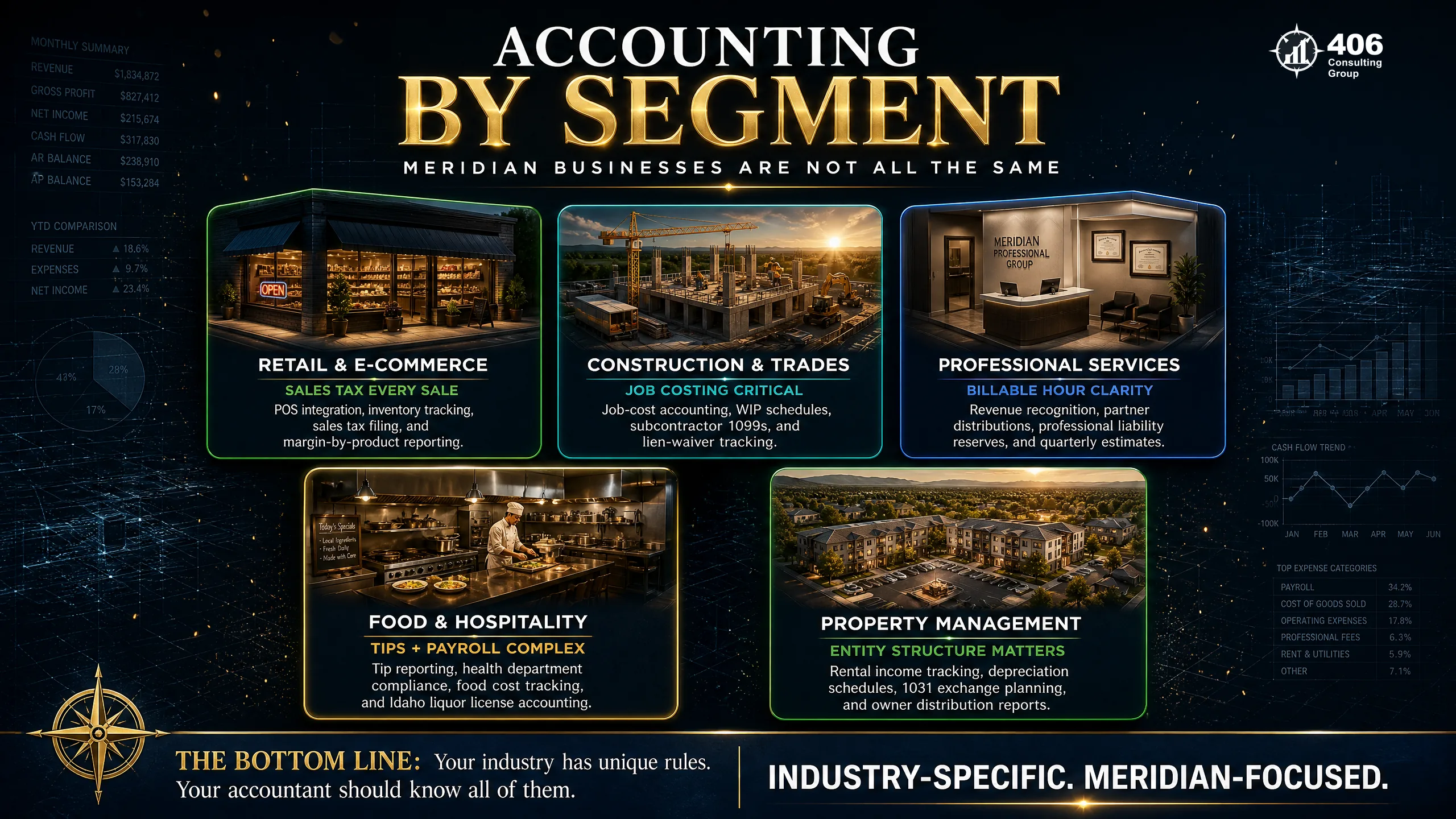
Different details, same backbone: track sales tax cleanly, keep profit readable for income-tax set-asides, and manage cash off what's actually yours. We tailor the system to your segment while keeping the whole-company view.
Remote & How to Get Started
The short answer: what a Meridian business needs is a partner who knows Idaho — sales and use tax, income-tax set-asides, state payroll, and federal planning — not one who happens to be down the street. An Idaho-savvy remote firm beats a local generalist, and the work is a natural fit for remote delivery.
And it's genuinely how modern accounting works — even for clients nearby. Roughly 70–80% of our own local clients never come into the office; the whole relationship runs on secure cloud accounting, connected bank feeds, shared screens, and a steady rhythm. Distance simply isn't the variable it used to be, so a Meridian business gets the same responsive, Idaho-savvy service our in-town clients do — with the multi-state experience that matters if you sell across the region.
Get the books Idaho-ready & current
Everything reads from here — sales tax as a liability, profit readable for set-asides, clean payroll.
Layer in tax & cash planning
The four levers, correct set-asides, and a cash discipline that respects the sales- and income-tax claims on your account.
Steer with the numbers
Use reliable reporting to manage margin, get financing-ready, and grow on facts instead of gut.
Wherever you are in that path, we can meet you there — and build the financial system around how your whole business actually runs.
FAQ: Meridian Small-Business Accounting
What taxes does a Meridian small business actually pay?
Three realities at once: Idaho sales tax (6%) that you collect from customers and remit (plus use tax on untaxed business purchases); Idaho income tax (a flat rate around 5.3%) that most owners pay through their personal return; and federal income tax on your profit — your largest bill. There's no gross-receipts or B&O tax like Washington's. Employers also handle Idaho payroll items (state withholding, unemployment insurance, and workers' compensation) on top of federal payroll taxes.
How is Idaho different from Montana or Washington for taxes?
It sits in the middle. Montana has no general sales tax; Washington has no income tax; Idaho has both a 6% sales tax and a flat state income tax (around 5.3%). What Idaho spares you is Washington's B&O gross-receipts tax and a bracket system — the flat rate keeps planning clean. The practical upshot: a Meridian business has to handle a sales-tax liability and plan for an income-tax bill, and because it taxes income, the deductions you create cut both your federal and Idaho bills.
What's the most common Idaho small-business money mistake?
Treating collected sales tax as spendable cash. It sits in your account but belongs to the state, and spending it is the fastest route to a shortfall at filing. Close behind: not setting aside for income tax as you earn, and missing use tax on equipment or supplies bought without sales tax. All three are prevented by books that track sales tax as a liability and keep profit readable, plus a cash discipline that manages off what's genuinely yours.
Do I need a bookkeeper, an accountant, or a CFO?
Often all three over time, in that order — it's a stack. Clean, Idaho-ready bookkeeping is the foundation. Proactive tax planning (the four levers plus set-asides) sits on top. Financial leadership — a controller for reliable reporting, a fractional CFO for cash forecasting, margin analysis, and financing — comes as the business grows and decisions get bigger. The layers work best together; our Financial Maturity Assessment can point you to which you need first.
Can 406 Consulting Group work with my Meridian business remotely?
Yes. We work with professional services, healthcare, retail, construction, and tech businesses across Meridian, the Treasure Valley, and Idaho through secure cloud accounting — bookkeeping and payroll, tax planning, and fractional controller and CFO services. What matters is Idaho expertise (sales and use tax, income-tax set-asides, state payroll, federal planning) and multi-state experience if you sell across the region, not office proximity — in fact, roughly 70–80% of our own local clients never come into the office. Because our background is in running whole businesses, we design the financial system around your entire operation.
Keep Reading — The Meridian Series
Small-Business Accounting — Meridian, ID
One Financial System, Built for Idaho.
406 Consulting Group gives Meridian businesses Idaho-ready books, tax planning that cuts both your federal and state bill, and the controller and CFO leadership to grow — sales tax, income tax, and payroll handled, delivered remotely across Idaho. Let's build the system your business needs.
Idaho Small-Business Quick Reference
Meridian, ID — Ada County
The Idaho Playbook
Running a Business in Meridian?
Books to CFO strategy, built for Idaho.
About the Author
Carrie Anderson
Co-Founder, 406 Consulting Group
Commercial banking and underwriting background — 300+ loan reviews — plus advisory work with small businesses across the Northwest. Carrie helps Meridian owners build financial systems that keep Idaho compliance clean and fund growth.
Read the Full Story