
The Complete Guide to Bookkeeping
Services in Boise, ID
Most Boise businesses know their revenue but not their margin. Here's what professional bookkeeping delivers — clean books, Idaho compliance, and the financial foundation your business runs on.
In This Guide
- 1.Why Boise Bookkeeping Is Different
- 2.The Hidden Cost of Bad Books in Boise
- 3.The Boise Clean Books System
- 4.Idaho Compliance Your Books Must Support
- 5.Bookkeeping Software for Boise Businesses
- 6.Clean Books and Boise Lending
- 7.Industry-Specific Bookkeeping in Boise
- 8.What Professional Bookkeeping Costs — and Returns
- 9.Signs You've Outgrown Your Current Bookkeeper
- 10.How to Choose a Bookkeeper in Boise, ID
- 11.Case Study: Year-One Results
- 12.Frequently Asked Questions
Most Boise business owners who contact us have the same problem: they know their revenue, but not their margin. They have QuickBooks — or an Excel spreadsheet, or a shoe box — but the numbers don't tell them anything useful. Books are months behind. Tax prep is a scramble. The bank loan they need requires two years of financials they don't have.
This guide covers what professional bookkeeping actually delivers for Boise businesses — and how to know whether what you have now is working.
Why Bookkeeping Services in Boise Are Different
Boise is not a static market. Ada County grew 35% between 2010 and 2020 — the fastest-growing metro in the Northwest — and that growth has continued into the mid-2020s. What that means for bookkeeping: the average Boise business today is managing more complexity than it was five years ago, at the same time the owner's capacity to manage it has been consumed by day-to-day operations.
Idaho's tax structure is not simple
Idaho has a 5.3% flat income tax, a 6% sales and use tax, withholding requirements on all W-2 employees, and quarterly unemployment insurance contributions to the Department of Labor. Each has its own form, frequency, and deadline. Missing one creates a penalty from the due date — no grace period.
Boise's growth creates classification risk
The Treasure Valley tech and service sector relies heavily on independent contractors. Idaho follows federal classification rules — but misclassification risk is real, and the penalty structure is identical to IRS penalties. A professional bookkeeper tracks contractor relationships and flags classification risk before it becomes a problem.
Remote workers and multi-state nexus
Boise has attracted thousands of remote-first businesses from California, Washington, and Oregon. If your business has employees or revenue in multiple states, you have multi-state withholding and potentially sales tax nexus in those states — complexity that requires bookkeeping built to account for it.
Construction and trades drive the local economy
Ada and Canyon County construction represents a disproportionate share of Boise economic activity. Construction bookkeeping requires job costing, WIP schedule management, subcontractor 1099 tracking, prevailing wage compliance on public jobs, and bonding-ready financial statements. Generic bookkeeping delivers none of these.
The implication:Boise businesses need bookkeeping calibrated to Idaho's specific compliance environment, Boise's industry mix, and the complexity growth brings. A generic national service or a DIY setup that worked at $300K rarely works at $1M.
The Boise Clean Books System
The Boise Clean Books System is the four-stage bookkeeping framework we use for every Treasure Valley engagement. Each stage produces a specific output. The stages build on each other — you cannot produce reliable financial reports (Stage 4) without accurate categorization (Stage 2), which depends on complete transaction capture (Stage 1). When any stage is broken, everything downstream is unreliable.
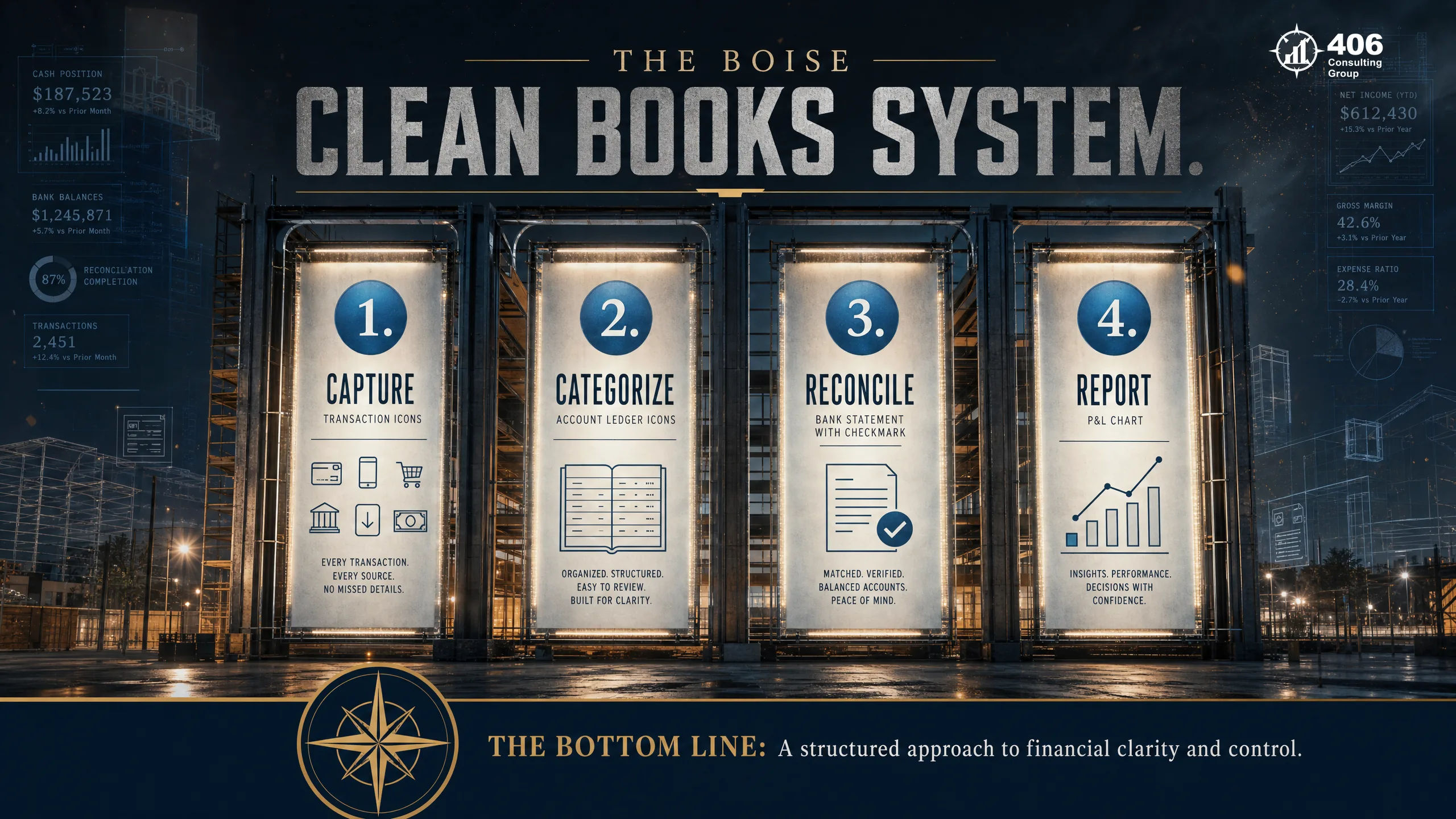
Capture
What it is
Every income and expense transaction enters the bookkeeping system within 24–48 hours of occurrence. Bank feeds are connected and reviewed daily. Receipts for cash and card transactions are documented at point of purchase. Payroll data flows from the payroll processor without manual re-entry. Vendor invoices are entered upon receipt, not when paid.
Why it matters
Missing transactions are the root cause of almost every bookkeeping failure. A bank feed that runs unreviewed for 30 days accumulates uncategorized transactions requiring reconstruction — and reconstruction introduces error. Capture in real time eliminates the reconstruction problem.
Categorize
What it is
Every transaction is assigned to the correct account in a chart of accounts designed for your specific business and industry. Boise businesses with Idaho-specific deductions — sales tax collected, Idaho withholding remittances, Idaho Investment Tax Credit qualifying purchases — are categorized explicitly so nothing is lost at year-end. Contractor payments are tracked separately from W-2 payroll and flagged for 1099 filing.
Why it matters
Categorization errors are the most common source of overpaid taxes. A meal that should be 50% deductible but miscategorized as entertainment becomes non-deductible. Equipment that qualifies for Section 179 expensed under a general account misses the deduction. Professional categorization runs through a quality review before the month closes.
Reconcile
What it is
Every bank account, credit card, and line of credit is matched against the institution's statement by the 10th of each month. Unexplained variances are investigated and resolved before the month closes. No month closes with an unreconciled account — meaning financial statements reflect exactly what happened, not an approximation.
Why it matters
Bank reconciliation is the integrity check on everything upstream. A reconciliation that balances confirms the Capture and Categorize stages worked. One that does not balance identifies exactly where the problem is. Without monthly reconciliation, errors compound — a $200 discrepancy in January becomes a $1,800 variance by August that takes days to trace.
Report
What it is
Profit and loss, balance sheet, and cash flow statement are delivered by the 12th of each month — not just generated, but reviewed. The accountant reviews reports before delivery, flags anomalies, and notes trends worth discussing. A monthly meeting of 30–45 minutes walks through the numbers, what changed, and what requires action.
Why it matters
Financial statements delivered without review and discussion are record-keeping, not financial management. The value of clean books is not the books themselves — it is the decisions they enable. The monthly review is where that value is realized.
Idaho Compliance Your Books Must Support
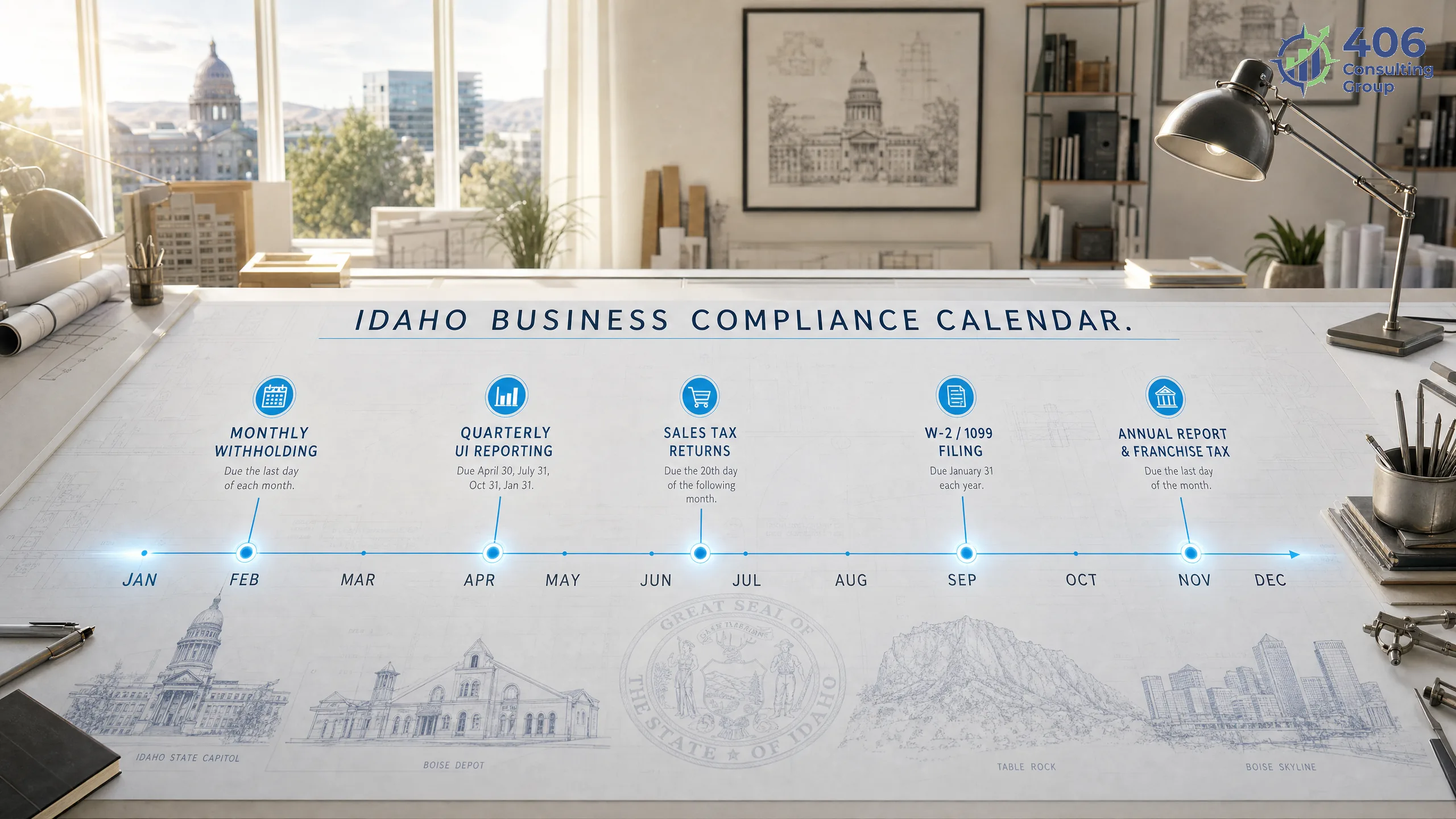
Every Boise business with employees, taxable sales, or Idaho income owes compliance to at least three different Idaho agencies on different schedules. Professional bookkeeping manages this calendar proactively — so filings happen before the deadline, not after the penalty notice. Here is what your books must track and file.
Idaho Income Tax Withholding
Idaho State Tax Commission — Form 910
Every Boise business with W-2 employees must withhold Idaho state income tax from wages and remit to the Idaho State Tax Commission. Frequency is determined by average monthly withholding — businesses withholding more than $400/month file monthly; others file quarterly. Late filing triggers a 5% penalty per month plus interest from the due date.
Idaho Sales & Use Tax
Idaho State Tax Commission — Form 850 / 850-U
Boise businesses with taxable sales must collect Idaho's 6% sales tax and remit it to the State Tax Commission. Filing frequency depends on volume: monthly for businesses collecting more than $6,000/month, quarterly for others. Remote sellers and businesses with online sales need to track Idaho economic nexus carefully — thresholds changed in 2021.
Idaho Unemployment Insurance
Idaho Department of Labor — Quarterly UI Report
Every Boise employer must report wages and pay UI contributions to the Idaho Department of Labor quarterly. New employers are assigned a standard rate; rates adjust based on claims history. The filing includes a wage report listing every covered employee and their wages for the quarter.
Business Entity Annual Report
Idaho Secretary of State — Annual Report
Every Idaho corporation and LLC must file an annual report confirming the business is active and updating officer and registered agent information. Filing is due in the entity's formation anniversary month — not December 31. Missing it results in a $25 late fee and, eventually, administrative dissolution — which creates significant problems for any business demonstrating good standing for a loan or contract.
Annual Wage & Contractor Reporting
IRS / Idaho State Tax Commission — W-2 / 1099 Series
W-2s must be issued to all employees and filed with SSA and the Idaho State Tax Commission by January 31. 1099-NEC must be issued to any contractor paid $600 or more in the calendar year and filed with the IRS by January 31. Bookkeeping that tracks contractor payments separately all year makes 1099 preparation a simple report, not a February scramble.
The Idaho Investment Tax Credit is a 3% credit for businesses that purchase qualifying depreciable property placed in service in Idaho — equipment, machinery, and certain other assets. The credit applies dollar-for-dollar against Idaho income tax, up to 50% of the liability, with carryforward up to 14 years. It is routinely missed by businesses whose bookkeeper is not tracking qualifying purchases throughout the year. The Idaho State Tax Commission at tax.idaho.gov is the primary authority for all of the above.
Bookkeeping Software for Boise Businesses
Most Boise businesses use QuickBooks. That is not a problem — QuickBooks Online and QuickBooks Desktop are both capable platforms when configured correctly and maintained by someone who knows what they are doing. The problem is when the software becomes a data warehouse rather than a management tool. Here is how the major platforms compare for Treasure Valley businesses.
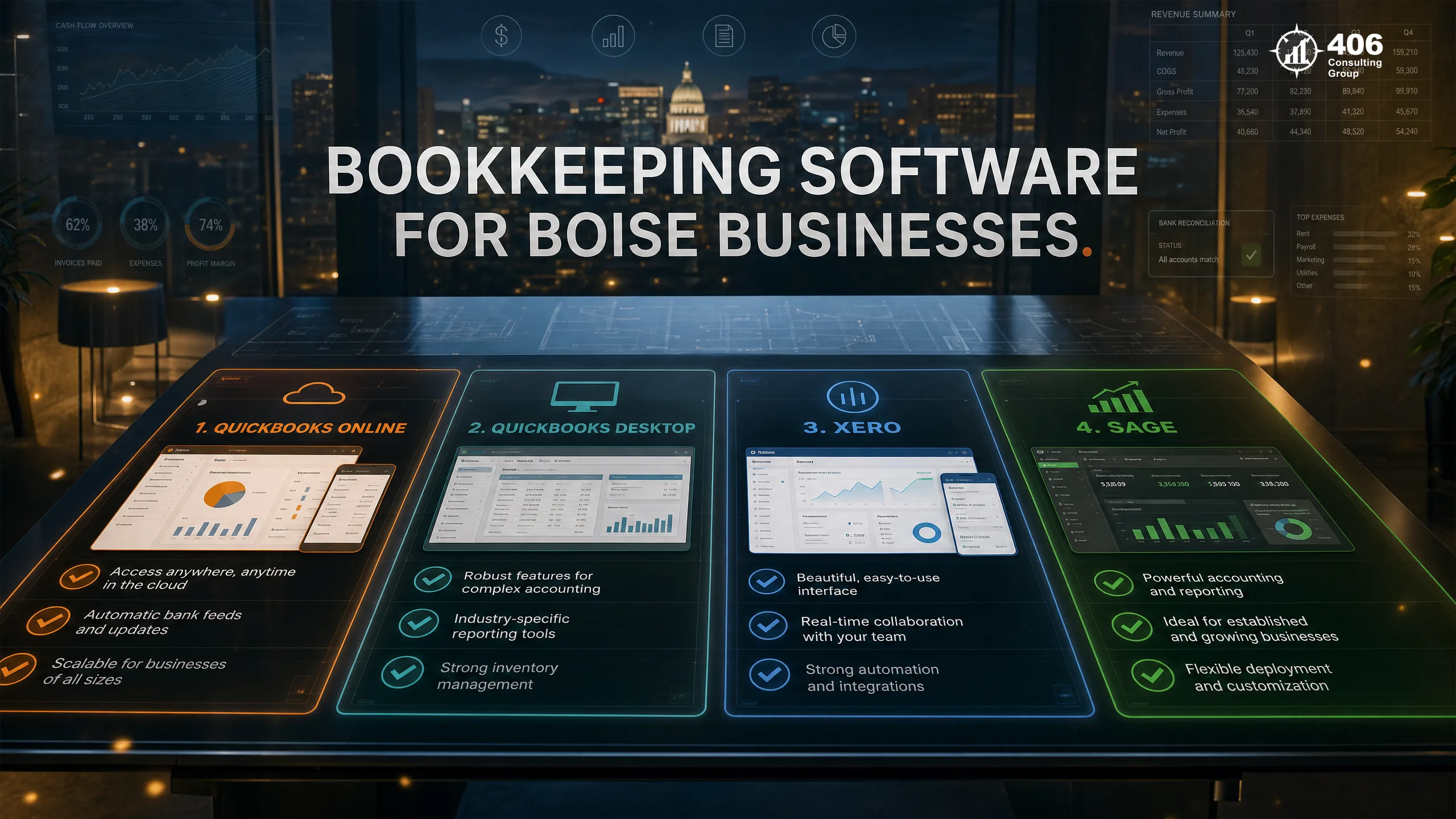
QuickBooks Online
Most Boise service businesses under $3M
Strengths
- Bank feed integration with most Idaho financial institutions
- Idaho payroll add-on or integrates with Gusto/ADP
- Simple 1099 contractor tracking built in
- Cloud access — bookkeeper works remotely without interruption
Limitations
- Job costing is limited compared to Desktop Contractor
- Inventory management is basic for complex stock
- Reports are less customizable than Desktop
QuickBooks Desktop Contractor
Boise construction and trades under $5M
Strengths
- Job costing by project, phase, and cost code
- WIP schedule management built in
- Progress billing and retainage tracking
- Subcontractor certificate of insurance tracking
Limitations
- Not cloud-native — requires remote desktop or shared server for bookkeeper access
- No longer sold with subscription updates to new users after 2023
- Payroll integration less seamless than QBO
Xero
Boise tech companies with international vendors
Strengths
- True multi-currency support
- Clean API integrations for software companies
- Unlimited users at the base plan level
- Strong bank reconciliation workflow
Limitations
- Less common in Idaho — some CPAs are not Xero-proficient
- Payroll requires a Gusto integration (additional cost)
- 1099 functionality is less developed than QuickBooks
Sage 50 / Sage 100
Boise manufacturing and distribution over $3M
Strengths
- Advanced job costing and project accounting
- Multi-entity and multi-location capable
- Strong audit trail for bonding and lending compliance
- Manufacturing module with inventory at cost
Limitations
- Complexity requires trained bookkeeper — DIY setup is high-risk
- Higher cost — not justified under $1.5M revenue
- Less common in the Boise market than QuickBooks
The gap most Boise businesses miss: Idaho withholding and sales tax filings are not automated by QuickBooks or Xero. The software produces the reports — but someone has to take the numbers, log into the Idaho State Tax Commission portal, and file the return. A professional bookkeeper builds this into the monthly calendar so it never falls through the gap between accounting software and compliance deadline.
Clean Books and Boise Lending
Boise's growth economy creates significant appetite for business capital — equipment financing, working capital lines, SBA 7(a) and 504 loans, commercial real estate. The Treasure Valley banking market is active: Banner Bank, Idaho Central Credit Union, D.L. Evans Bank, Washington Federal, and SBA-approved lenders operate throughout the area. Every one of them evaluates your financial statements before approving a dollar.
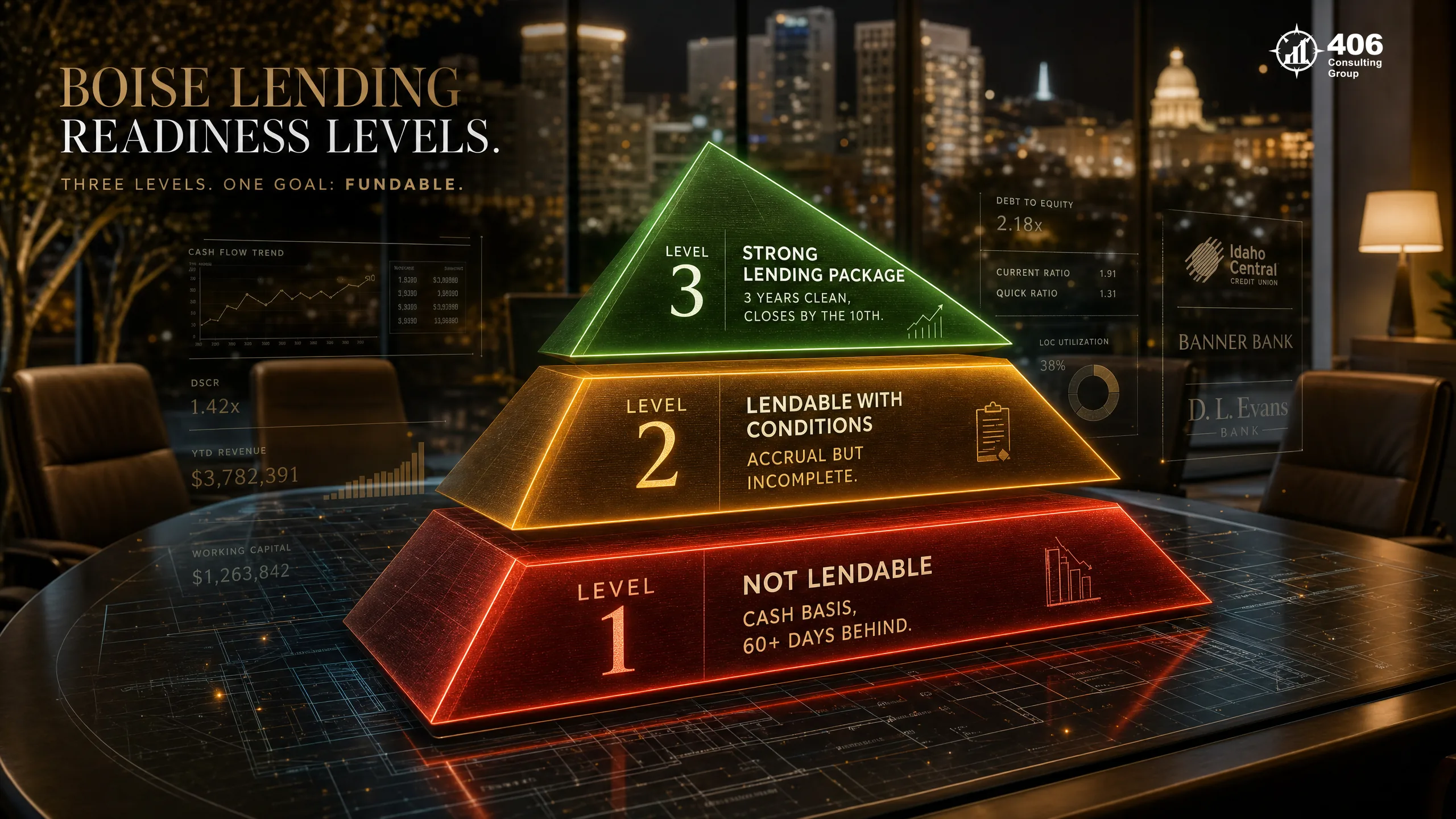
Level 1: Not Lendable
- Books are cash basis only — no accrual statements available
- Financials are more than 60 days behind at time of application
- Revenue and expenses are co-mingled with personal accounts
- No formal chart of accounts — everything lumped in general expense
- Year-end books prepared by the CPA from bank statements, not monthly reconciliations
Level 2: Lendable with Conditions
- Books are on accrual basis but missing supporting schedules (AR aging, AP aging)
- Financials close within 30 days of month-end — not on-demand
- Revenue appears consistent but receivables quality is unverifiable
- No debt schedule showing existing obligations and terms
- Owner compensation is inconsistent or appears commingled
Level 3: Strong Lending Package
- Three years of clean, accrual-basis statements reconciling to tax returns
- Books close by the 10th of each month — current statements available on request
- AR aging, AP aging, debt schedule, and owner compensation documented
- DSCR calculation prepared and clearly supported by financial data
- Cash flow statements showing operating, investing, and financing activities
The SBA factor: SBA 7(a) and 504 loans in the Treasure Valley offer some of the most competitive small business financing available — but they require the most complete financial documentation. A business at Level 3 can complete an SBA application in 3–4 weeks. A business at Level 1 typically takes 3–5 months to assemble the documentation — and still faces a higher denial rate. See what commercial lenders actually evaluate for a full breakdown of what goes into underwriting.
Industry-Specific Bookkeeping in Boise
Boise's economy is diverse. Construction, technology, healthcare, food and beverage, and retail all operate in the same Treasure Valley geography — but they have completely different bookkeeping requirements. A chart of accounts that works for a software company does not work for a concrete contractor. Here is what each major Boise industry needs from its bookkeeping setup.
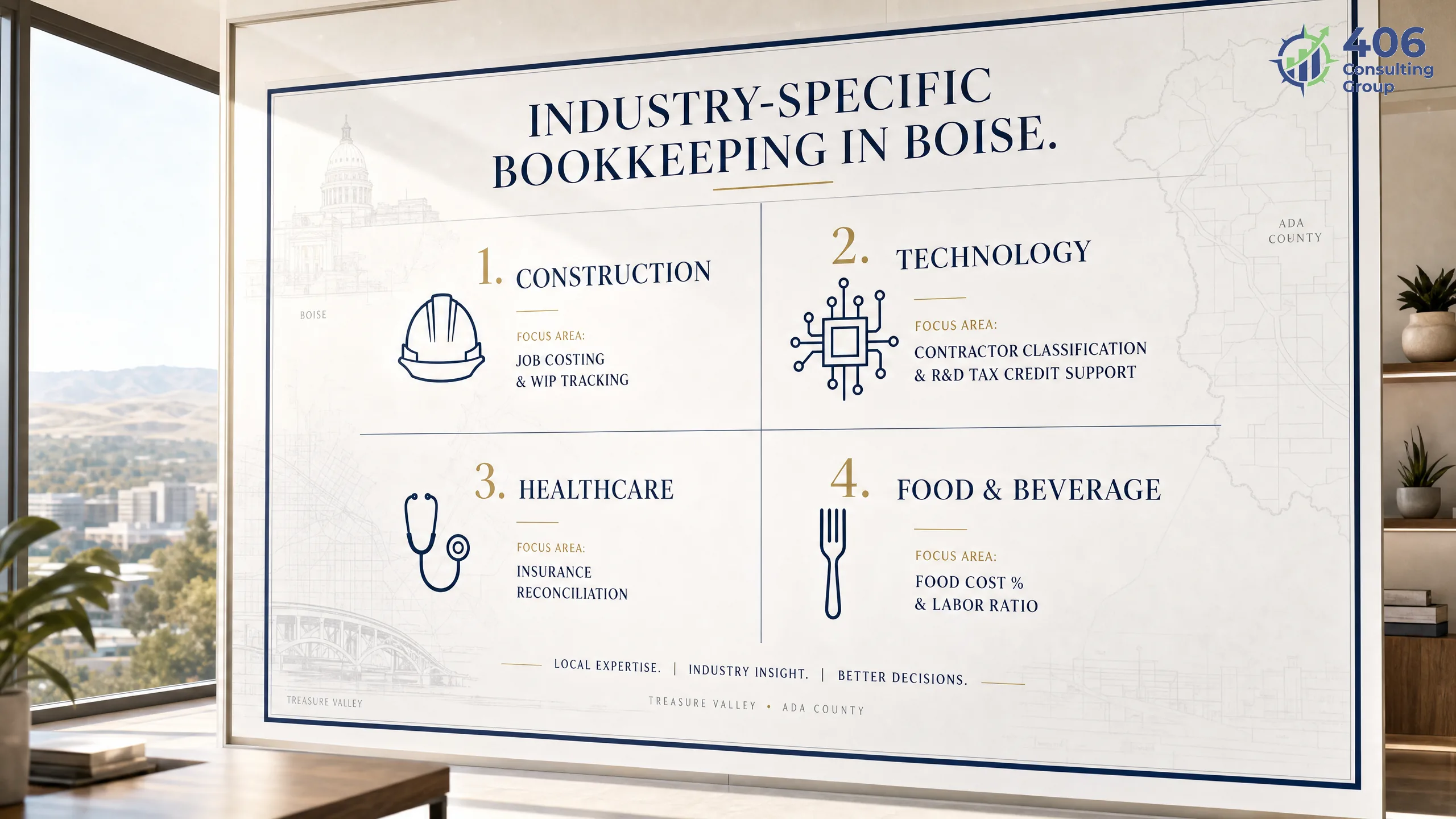
Construction & Residential Contractors
Job costing
Every labor hour, material purchase, and subcontractor payment allocated to a specific project and cost code. Without it, you know company-wide margin but not which jobs made money — and you cannot price next year's work correctly.
WIP schedule
Work-in-progress schedule tracking costs incurred, billings to date, and projected final margin across all active jobs. Required by bonding companies and most commercial lenders in the Treasure Valley.
1099 subcontractor tracking
Every unincorporated subcontractor paid $600 or more in the calendar year must receive a 1099-NEC. Professional bookkeeping tracks these throughout the year — not as a January scramble.
Retainage management
Retainage held by owners or GCs (typically 5–10%) is receivable, not lost revenue. It must be tracked separately and followed up on — a Boise contractor at $2M annually may carry $80,000–$120,000 in outstanding retainage.
Technology & Professional Services
Contractor classification
Boise tech companies frequently use independent contractors. Idaho follows federal classification rules — but misclassification triggers back payroll taxes, interest, and penalties. Professional bookkeeping flags workers approaching employee status.
SaaS revenue recognition
Subscription revenue paid in advance is deferred — not earned until the service is delivered. Recognizing subscription payments as revenue in the month received overstates income and creates a tax liability mismatch.
R&D tax credit tracking
Idaho conforms to the federal R&D credit (Section 41). Qualifying research activities — software development, product engineering — generate a dollar-for-dollar federal tax credit. This requires tracking qualifying wages and contract research costs in dedicated accounts throughout the year.
Healthcare & Professional Practices
Insurance reimbursement reconciliation
A dental or medical practice bills insurance at one amount and collects another — plus a write-off, plus a patient copay. Bookkeeping must track gross charge, contractual adjustment, insurance payment, and patient balance separately to produce accurate revenue figures.
Overhead ratio benchmarking
Healthcare practices have industry-standard overhead benchmarks. A dental practice at 68% overhead against a specialty norm of 56–60% has a structural profitability problem — one that only appears if books are prepared to industry standards and reviewed against benchmarks monthly.
Equipment depreciation schedules
Medical and dental equipment depreciates over 5–7 years. Section 179 and bonus depreciation elections can accelerate deductions significantly — but only if the asset is tracked correctly at acquisition.
Food, Beverage & Hospitality
Food cost percentage
Food cost as a percentage of food revenue is the most critical KPI in restaurant operations. A Boise restaurant running 38% food cost against a 30% target loses $80,000/year on $1M in food revenue — but only if someone is tracking the metric monthly and flagging variance.
Labor cost by category
BOH labor, FOH labor, and management labor tracked as separate percentages of revenue. The Boise labor market is competitive — knowing labor cost by category tells you where you have leverage before making a staffing decision.
Idaho food sales tax distinction
Idaho exempts most grocery food from sales tax — but prepared food and restaurant meals are taxable at 6%. The distinction matters for Boise businesses with both a retail grocery and a prepared food component (café, deli, etc.).
What Professional Bookkeeping Costs — and Returns
Boise businesses consistently underestimate the cost of bad bookkeeping and overestimate the cost of professional bookkeeping. Here is what professional bookkeeping actually costs — and what it typically returns in year one for a Treasure Valley business that has been running on DIY or part-time books.
Foundation
$400–$800/mo
Under $500K revenue
Includes
- Monthly bank & credit card reconciliation
- Income and expense categorization
- Monthly P&L and balance sheet
- Annual 1099 preparation
- Year-end close for CPA
Not Included
- Idaho compliance calendar management
- Cash flow forecasting
- Monthly review meeting
Professional
$800–$1,500/mo
$500K – $2M revenue
Includes
- Everything in Foundation
- Idaho compliance calendar — withholding, sales tax, UI filings managed proactively
- Monthly financial review meeting (30–45 min)
- AR aging and AP aging reports
- 4–8 week rolling cash flow view
- CPA coordination for estimated payments
Not Included
- Controller-level analysis
- CFO-level strategic modeling
Advanced
$1,500–$2,500/mo
$2M – $5M revenue
Includes
- Everything in Professional
- Job costing or department-level P&L
- 13-week rolling cash flow forecast
- Budget vs. actual variance analysis monthly
- KPI dashboard built to your industry
- Lender-ready financial package maintenance
Not Included
- Full fractional CFO services
Year-One Return: What Boise Businesses Typically Recover
Missed deductions recovered (meals, mileage, home office, depreciation elections)
$4,000 – $18,000Idaho compliance penalties avoided in the first 12 months
$1,500 – $6,000Owner time recovered from financial management (at $100/hr, 5 hrs/month)
$6,000/yearLoan approved or improved terms vs. denied without professional books
$10,000 – $40,000+Tax savings from entity structure correction (S-Corp election, etc.)
$8,000 – $28,000The breakeven math: A Professional engagement at $1,000/month costs $12,000/year. A Boise business that has been on DIY or part-time books for 2+ years typically recovers $15,000–$25,000 in year one from deductions, penalty avoidance, and entity structure corrections alone — before counting owner time recovered and improved lending outcomes. The engagement pays for itself in the first two to four months for most businesses.
Signs You've Outgrown Your Current Bookkeeper
The bookkeeper who served you at $200K in revenue may not serve you at $1M. Growth adds employees, vendors, multi-state complexity, and lender scrutiny. Here are the seven most reliable indicators that your current setup is no longer adequate.
Books close more than 30 days after month-end
You are managing a business with 6-week-old financial data. Every decision — hiring, pricing, capital investment — is made on stale information. By the time August books close in October, the problem has already compounded.
Your CPA makes journal entries at tax time, not just adjustments
When a CPA has to reconstruct significant portions of the year at tax time, it means monthly bookkeeping did not produce clean records. The CPA charges more, the records are less reliable, and the opportunity for proactive tax planning is gone.
You cannot answer "What is my current cash position?" without digging
If answering that question requires opening QuickBooks, running a report, and cross-referencing three accounts — the books are not working as a management tool. You should be able to see your cash position in less than 60 seconds.
Bank reconciliation shows unexplained variances
An unexplained variance on a bank reconciliation means either transactions are missing from the books or a transaction was entered with the wrong amount. Either way, your financial statements are not reliable. A $500 variance is not a small problem — it is a sign the reconciliation process is broken.
An Idaho withholding or sales tax filing was missed
Missing an Idaho tax filing is almost always a bookkeeping failure, not a knowledge failure. A professional bookkeeper has a compliance calendar and files ahead of the deadline. If a filing was missed, the calendar does not exist — and other filings are at risk.
A loan application required reconstructing 2+ years of records
Reconstruction for a loan application takes 60–120 days and costs $5,000–$15,000 in CPA fees. More importantly, it signals to the lender that financial management is not a priority — which affects approval odds and terms even after the reconstruction is complete.
You are spending more than 10% of your time managing your bookkeeper
A professional bookkeeper should require minimal management. If you are answering questions, chasing receipts, explaining recurring transactions, or reviewing work before it is submitted — you are doing the bookkeeping. That is not a bookkeeping service.
The threshold: If two or more of the above are true, the cost of your current bookkeeping — including overpaid taxes, compliance risk, and owner time — almost certainly exceeds the cost of a professional engagement. The question is not whether you can afford professional bookkeeping. It is whether you can afford to continue without it.
How to Choose a Bookkeeper in Boise, ID
Not all bookkeeping services in Boise deliver the same result. The difference between a part-time bookkeeper, a national virtual service, and a professional bookkeeping firm is scope, Idaho compliance coverage, and accountability for outcomes. Here is how to evaluate your options.
Questions to ask any bookkeeper
- Do you have clients in Boise or the Treasure Valley at a similar revenue level and in my industry?
- How do you manage Idaho withholding, sales tax, and UI deadlines — do you file them or just prepare the report?
- What is the close cycle? When do I receive monthly financials after month-end?
- What does the monthly meeting look like — do we review numbers together or just receive a report?
- How do you handle transition from my current bookkeeper? How long before books are fully current?
- Can you provide two references from Boise businesses in a similar situation?
Red flags that signal a poor fit
- They quote a monthly fee before asking about your transaction volume, industry, or complexity
- No structured onboarding process — they just take your QuickBooks login and start
- Idaho compliance is not mentioned until you ask — you are expected to manage the deadlines yourself
- No monthly meeting cadence — reports are delivered but never discussed or reviewed with you
- They cannot name 2–3 Boise businesses in your industry they have served
- The bookkeeper is the only person who touches your books — no quality review layer
What a professional bookkeeping engagement delivers
- Books closed by the 10th of each month — not the 30th, or whenever they get to it
- Idaho compliance calendar managed proactively — you do not track the deadlines
- Monthly review meeting — P&L, cash position, anything unusual discussed before it becomes a problem
- A quality review layer — the person who does the books is not the only one who reviews them
- CPA coordination — estimated payments reviewed quarterly, deduction opportunities flagged
- Response within one business day to questions between monthly meetings
Case Study: Boise Dental Practice Recovered $22K in Year One
Anonymized — Boise, ID
Pediatric Dental Practice — Year-One Professional Bookkeeping Engagement
When We Started
- $1.2M in collections — profitable but growing without financial visibility
- Books closing 45–60 days after month-end, reviewed only at tax time
- Insurance reimbursements tracked as gross revenue — write-offs not captured separately
- Idaho withholding deposits missed in Q1 and Q3 — two penalty notices outstanding
- Equipment financing application stalled — lender requested 2 years of accrual-basis statements the practice did not have
- Practice manager spending 8–10 hours per month on bookkeeping questions and bank reconciliation
After 12 Months
- Books closing by the 8th of each month — monthly review meeting on the 15th
- Insurance reimbursement reconciliation built in — accurate net collections and write-off tracking monthly
- $22,000 in missed deductions identified across 2 prior years — amended return filed
- Idaho compliance current — withholding and sales tax filed proactively, both penalties abated
- $180,000 equipment loan approved in 22 days after clean financial package submitted to D.L. Evans Bank
- Practice manager fully out of bookkeeping — zero hours per month on financial management
$22K
Missed deductions recovered via amended returns
$180K
Equipment loan approved — 22 days from submission
8 hrs
Monthly management time recovered per month
The key finding:Insurance reimbursement write-offs had never been tracked separately — they were recorded as revenue at the gross billed amount, then adjusted at year-end. This created a recurring mismatch between QuickBooks revenue and the practice management software's collections report that the CPA corrected each year. Fixing the categorization at the source eliminated the year-end adjustment and revealed $22,000 in deductions that had been obscured by the recording methodology. The equipment loan approval followed directly from having clean, accrual-basis financials available within 10 days of the lender's request.
Frequently Asked Questions: Bookkeeping Services in Boise, ID
What does a bookkeeper do for a small business in Boise?
A bookkeeper records, categorizes, and reconciles every financial transaction — monthly bank reconciliation, income and expense categorization, accounts receivable and payable tracking, and preparation of basic financial statements. In Boise, a professional bookkeeper also manages Idaho's compliance calendar: withholding deposits to the State Tax Commission, sales tax remittances, quarterly unemployment insurance contributions, and W-2/1099 preparation. Bookkeeping is the foundation — everything from tax strategy to lending to business decisions depends on the quality of the underlying records.
How much does professional bookkeeping cost for a Boise small business?
Professional bookkeeping for Boise businesses typically ranges from $400 to $2,500 per month depending on revenue, transaction volume, industry complexity, and scope. Under $500K in revenue: $400–$800/month. $500K–$2M with employees and Idaho compliance: $800–$1,500/month. Construction or multi-location with job costing: $1,200–$2,500/month. The ROI comparison: if professional bookkeeping recovers $12,000 in missed deductions and eliminates $3,000 in compliance penalties in year one, a $1,000/month engagement pays for itself in the first quarter.
Do I need both a bookkeeper and a CPA in Boise?
Yes — they serve different purposes. A bookkeeper manages monthly financial records: transaction categorization, bank reconciliation, financial statements, and Idaho compliance filings. A CPA prepares your annual tax return, handles IRS representation, and provides CPA-quality financial statements for lending. The most effective setup is a bookkeeper who coordinates actively with your CPA — sending clean, reconciled books by January 31 so the CPA can focus on tax strategy rather than reconstruction. Businesses that combine both functions in one person typically get neither done well.
What Idaho taxes does my Boise business need to track?
Most Boise businesses with employees and taxable sales manage five Idaho tax obligations: Idaho income tax withholding (Form 910, monthly or quarterly to the State Tax Commission); Idaho sales and use tax (Form 850, monthly or quarterly); Idaho unemployment insurance (quarterly to the Department of Labor); Idaho Secretary of State annual report (filed in the entity's formation anniversary month); and W-2s and 1099s (issued by January 31). Missing any of these triggers penalties from the due date with no grace period. The Idaho Investment Tax Credit — 3% on qualifying equipment — is also frequently missed.
How does professional bookkeeping help my Boise business get a bank loan?
Lenders in the Treasure Valley — Banner Bank, Idaho Central Credit Union, D.L. Evans Bank, and SBA lenders — evaluate three years of financial statements for every loan application. Professional bookkeeping produces clean, accrual-basis records: P&L, balance sheet, cash flow statement, AR aging, and a balance sheet that reconciles to the tax return. A business with professionally maintained books can provide a complete financial package within days of a lender's request. A business reconstructing records adds 60–90 days to the timeline — and still faces higher denial risk because the lender sees the reconstruction process, not just the results.
When should a Boise business switch from DIY to professional bookkeeping?
The most reliable trigger points: revenue has crossed $500K and complexity has outpaced DIY; a bank loan has been requested or denied; an Idaho compliance filing was missed; you are spending more than 8–10 hours per month on financial management; your CPA is making significant year-end corrections instead of reviewing clean records; or you cannot answer basic questions — current cash position, margin by job — without significant research. Two or more of these together means the cost of DIY almost certainly exceeds the cost of professional bookkeeping.
Does 406 Consulting Group provide bookkeeping services in Boise, ID?
Yes. 406 Consulting Group provides professional bookkeeping, controller services, and fractional CFO engagements for businesses in Boise, the Treasure Valley, and across Idaho, Montana, and the Intermountain West. Jason Anderson's background in operational finance and strategic planning and Carrie Anderson's experience in commercial banking and underwriting are particularly relevant for Boise businesses that need financial management connecting clean books to lending readiness and growth strategy. Contact us to discuss what a bookkeeping engagement looks like for your business.
External Resources
One last thing worth saying plainly: you don't have to be down the street from your bookkeeper for any of this to work. Roughly 70 to 80 percent of the clients we'd call local never actually visit our office — their books run entirely through cloud accounting, a secure document portal, and a regular video review. Remote isn't a compromise for far-away clients; it's how modern bookkeeping operates, so a Boise business gets the same clean books and Idaho-savvy service whether it's in the Treasure Valley or three states over.
Boise, ID
Professional Bookkeeping Services for Boise Businesses
406 Consulting Group provides professional bookkeeping, controller services, and fractional CFO engagements for Boise and Treasure Valley businesses. Whether you're starting from DIY or scaling through growth, we build the financial foundation your business runs on.
The Boise Clean Books System
Four stages of professional bookkeeping
Capture
Every transaction recorded in real time
Categorize
Idaho-specific chart of accounts
Reconcile
Monthly bank match — zero unexplained variance
Report
Financial statements delivered by the 12th
Idaho Compliance Quick Reference
Related Reading
Ready for books you can run your business on?
Talk to 406 Consulting Group about professional bookkeeping for your Boise business.
Schedule a Consultation