
Accounts Receivable Financing:
What Lenders Want to See
A receivables line advances 70–90% of your unpaid invoices now. The catch most owners miss: the lender underwrites your customers' credit and the quality of your AR as much as your own. Here's exactly what they require.
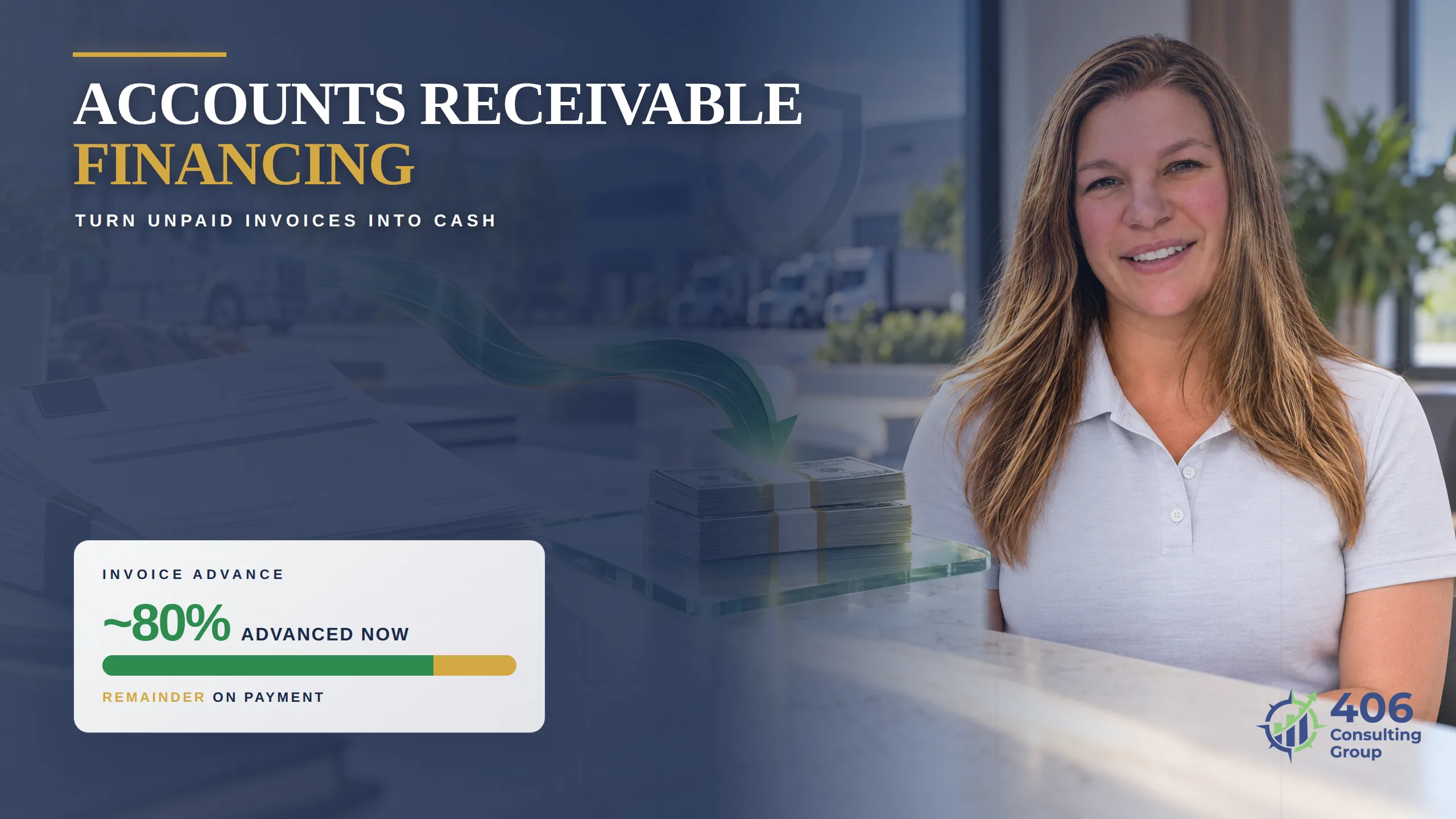
Accounts receivable financing (also called invoice financing) advances you cash — typically 70% to 90% of an invoice's value — against money your customers already owe you. Instead of waiting 30, 60, or 90 days to get paid, you get most of it now and the rest (minus a fee) when the customer pays. The twist most owners miss: the lender underwrites your customers' creditworthiness as much as your own, plus the quality of your receivables.

By Carrie Anderson
Co-Founder, 406 Consulting Group
Commercial banker and underwriter — 300+ loan files reviewed firsthand.
Advance rates, fees, and requirements vary by provider and change over time; the figures below are typical, not quotes. Confirm specifics with your lender.
What it is — and how it differs from factoring
Both turn unpaid invoices into cash now, but they're structured differently, and the biggest difference is who chases the payment.
Who collects from your customer
Invoice financing: You do — your customer may not even know
Factoring: The factoring company takes over collections
Advance rate
Invoice financing: Typically ~70–90% of invoice value
Factoring: Typically ~70–90%, remainder on payment
Customer relationship
Invoice financing: Stays entirely with you
Factoring: The factor interacts with your customers
Best when
Invoice financing: You want cash and control
Factoring: You also want to offload collections
What lenders actually require to approve a line
This is where owners get surprised. A receivables line isn't secured by your building or your credit score — it's secured by invoices owed by other companies. So the lender scrutinizes those invoices and the people who owe them:
Your customers' creditworthiness — strong, reputable payers are the real collateral.
A clean, current AR aging report — they need to see who owes what, and for how long.
Invoice age — most lenders only advance against invoices under 90 days old.
Customer concentration — if one customer is most of your receivables, that's a risk they price for or cap.
Dilution history — how often invoices get reduced by disputes, returns, or credits.
Verifiable, legitimate invoices — for work actually delivered, not progress or pre-billing.
When AR financing makes sense
When you sell to other businesses on terms and the wait is choking your cash flow. If you've done the work, sent the invoice, and now you're floating payroll for 60 days until a solid customer pays, a receivables line turns that wait into working cash — without taking on long-term debt for a short-term timing problem.
Where it fits
A Flathead trucking outfit hauls for a large, creditworthy shipper on net-45 terms. The loads are booked and delivered, but the cash is a month and a half out while fuel and driver pay are due now. Advancing ~85% of those invoices bridges the gap — and because the shipper is a strong payer, the line is straightforward to approve. The receivable the owner was waiting on becomes the collateral that funds the next haul.
What it costs — and the catch
You don't get 100% up front: the advance is typically 70–90%, and the fee comes out of the rest when the invoice is paid. Pricing depends on how long your customers take to pay, your invoice sizes, and their credit. Watch the structure, too: recourse financing means you're on the hook if your customer doesn't pay; non-recourse shifts some of that risk to the lender for a higher cost. And none of it works without a clean receivables ledger — which is the part we make sure is airtight before you ever apply.
Cash stuck in unpaid invoices?
We'll get your AR aging lender-ready, show you what a receivables line would actually cost, and tell you honestly whether it's the right fix — from someone who used to underwrite these lines.
FAQ
What do lenders require to approve an accounts receivable financing line?
They focus on the invoices and the customers behind them, not just your business. Expect them to require a clean, current AR aging report, invoices generally under 90 days old, and verification that the invoices are for work actually delivered. They'll weigh your customers' creditworthiness (strong payers are the collateral), your customer concentration (one customer dominating your receivables is a risk), and your dilution history (how often invoices shrink from disputes or credits). A tidy, trustworthy receivables ledger is what gets the line approved.
What's the difference between invoice financing and factoring?
The main difference is who collects. With invoice financing (AR financing), you borrow against your invoices but keep control and collect from your customers yourself — they may never know. With factoring, the factoring company buys the invoices and collects directly from your customers. Both typically advance 70–90% of invoice value up front; factoring also comes in recourse and non-recourse forms. Choose invoice financing when you want cash and control; consider factoring when you also want to hand off collections.
How much of my invoice can I get up front?
Typically 70% to 90% of the invoice value as an advance, with the remainder (minus the lender's fee) paid when your customer pays. The exact advance rate depends on your industry, your customers' credit, and the terms of the agreement — higher-risk situations sit at the lower end. Because you never get the full 100% immediately, AR financing is a cash-flow timing tool, not free money; the fee is the price of getting paid sooner.
This article is general financial education, not lending, legal, or financial advice for your specific situation. Advance rates, fees, and approval criteria vary by provider.
In one line
AR financing advances ~70–90% of unpaid invoices now. The lender underwrites your customers' credit and your AR quality — so a clean aging report is everything.