
Business Line of Credit vs. Term Loan:
Which Fits Your Cash-Flow Gap?
A line of credit covers short-term gaps you'll close soon; a term loan funds a specific, long-lived purchase. A Montana underwriter explains which one lenders approve — and when each is the wrong tool.
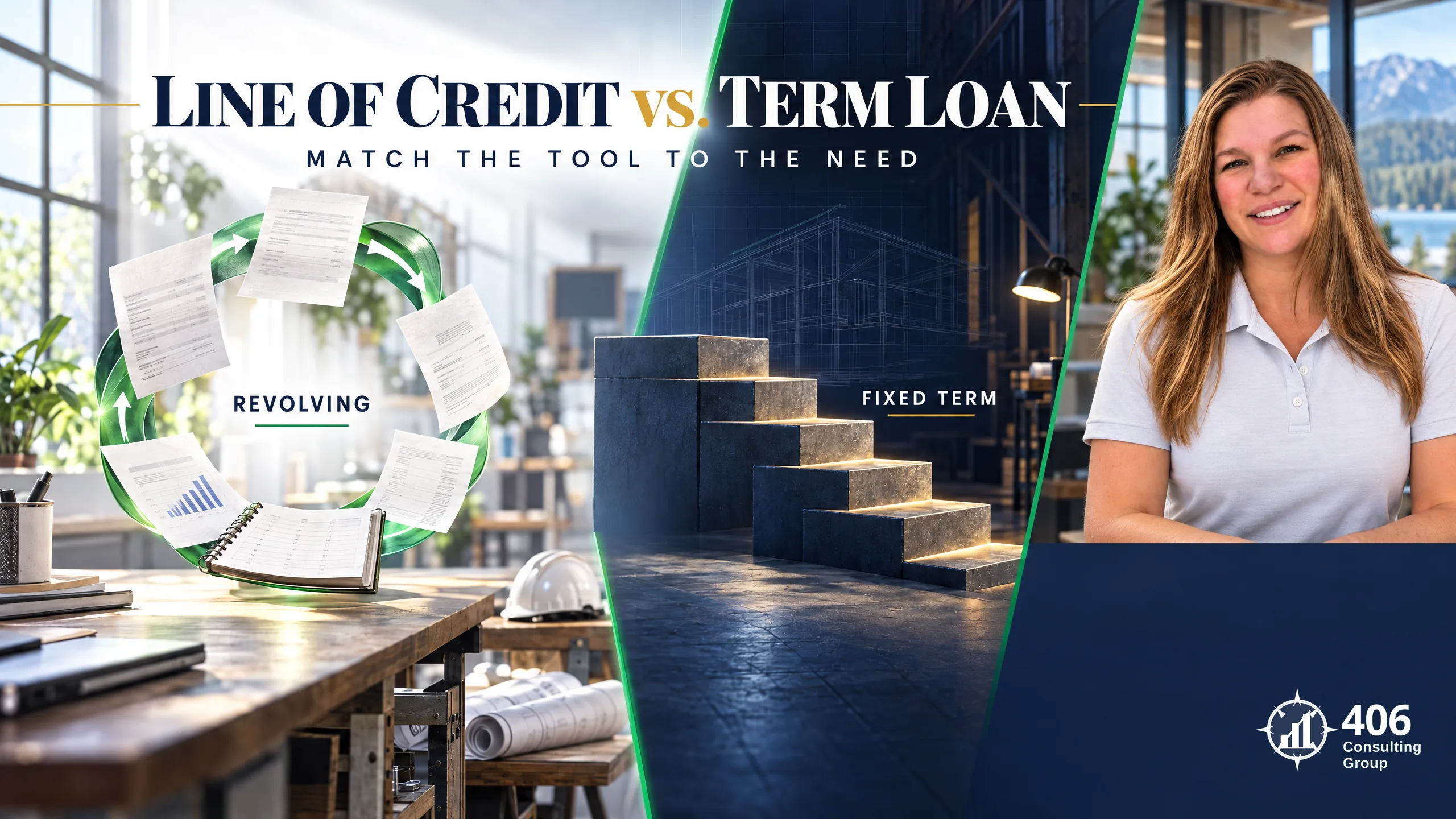
A business line of credit is revolving money for short-term, recurring cash-flow gaps — you draw what you need, pay interest only on what you use, and pay it back down. A term loan is a lump sum with a fixed repayment schedule, for a specific, longer-lived purchase. The rule underwriters use to decide which one you should get is simple: match the tool to the life of the need. A short-term gap wants a line of credit; a long-lived asset wants a term loan.

By Carrie Anderson
Co-Founder, 406 Consulting Group
Commercial banker and underwriter — 300+ loan files reviewed firsthand.
Rates, terms, and approval criteria vary by lender and change over time; the ranges and norms below are typical, not quotes. Confirm specifics with your banker.
What's the actual difference?
They feel interchangeable when you're staring at a cash crunch, but they're built for opposite jobs. One is a reusable safety valve; the other is a one-time purchase on an installment plan.
Shape of the money
Line of credit: Revolving — draw, repay, draw again up to a limit
Term loan: Lump sum, paid out once
You pay interest on
Line of credit: Only the balance you've actually drawn
Term loan: The full loan from day one
Best for
Line of credit: Short-term, recurring gaps (payroll, inventory, AR waits, seasonality)
Term loan: Specific long-lived purchases (equipment, buildout, acquisition)
Repayment
Line of credit: Flexible; often interest-only on the draw, revisited annually
Term loan: Fixed schedule over a set term (often 3–10 years)
Rate
Line of credit: Usually variable
Term loan: Often fixed
When is a line of credit the right tool?
When the need is temporary and it comes back. A line of credit is a bridge over a gap you expect to close — not a way to fund something you'll still be paying for in five years.
Where it earns its keep
Dave's Plumbing in Kalispell finishes a big job in November and won't be paid by the GC for 60 days — but payroll is due every two weeks through the winter slow season. Dave draws $30,000 on his line to cover payroll, and pays it back the week the GC's check clears. He paid interest on $30,000 for a few weeks, not on a loan he's carrying all year. That's exactly the job a line of credit is built for: covering the gap between work done and money collected.
When is a term loan the right tool?
When you're buying something specific that will earn for years — a piece of equipment, a tenant buildout, a second location, another company. The purchase has a long life, so the financing should too. A term loan spreads a big one-time cost over the time the asset is actually producing, so the thing you bought helps pay for itself instead of draining this month's cash.
The mistake that gets owners in trouble
Using the wrong tool for the job — and the most common version is quietly turning a line of credit into a term loan by never paying it back to zero. The balance creeps up, the draw becomes permanent, and now you're financing a long-term need with short-term, variable-rate money the bank can re-evaluate every year.
From the underwriter's chair, an “evergreen” line that never rests at zero is a red flag — it tells the lender the business is using a bridge to patch a hole that real cash flow should be covering. That's often the moment a bank tightens or pulls the line, usually right when you can least afford it. If your line never gets paid down, the real problem isn't the line — it's a cash-flow gap that needs a different fix.
What lenders check before approving either one
For both, it comes down to whether your cash flow can carry the payments — measured by your debt-service-coverage ratio — plus time in business and the quality of your financials. For a line, they'll look hard at your receivables (the thing the line is bridging). For a term loan, they'll weigh the asset you're buying and whether its useful life matches the term. Clean, current books make all of it faster: a lender who can read your numbers in ten minutes approves faster and larger than one who has to guess.
Not sure which one you actually need?
We'll look at the gap you're trying to close, run the numbers a lender will run, and help you walk in asking for the right tool — from someone who used to sit on the bank's side of the table.
FAQ
Is it easier to get a line of credit or a term loan?
Neither is automatically easier — it depends on your cash flow and what you're financing. Lenders judge both mainly on your debt-service-coverage ratio (cash flow versus payments), time in business, and the quality of your financials. A line of credit also leans heavily on your receivables, since that's what it bridges; a term loan leans on the asset you're buying and whether its useful life matches the loan term. Clean, current books speed up approval on either one.
Can I use a line of credit to buy equipment?
You can, but it's usually the wrong tool. A line of credit is short-term, revolving, often variable-rate money meant for gaps you'll close soon. Equipment lasts years, so financing it on a line ties up your safety valve and exposes a long-term purchase to a rate the bank can reset. Equipment financing or a term loan — where the payoff period matches the equipment's life — is almost always the better fit.
Why does my bank want my line of credit paid down to zero each year?
Because a line of credit is meant to rest at zero between uses. A line that never gets paid down — an 'evergreen' balance — tells the lender you're using a short-term bridge to cover a long-term need, which is a credit risk. Banks often want to see the line return to zero (a 'clean-up' or annual rest) to confirm it's funding temporary gaps, not permanent losses. If yours never gets there, that's a signal to look at the underlying cash-flow gap.
This article is general financial education, not lending, legal, or financial advice for your specific situation. Loan terms and approval criteria vary by lender.
In one line
A line of credit bridges short-term gaps you'll close soon; a term loan funds a specific, long-lived purchase. Match the tool to the life of the need.