
Working Capital Loan vs. Equipment Financing:
Which to Use When
Working capital bridges short-term operating gaps; equipment financing buys a long-life asset, secured by the asset itself. The rule that keeps owners out of trouble: match the loan's length to the life of what it buys.
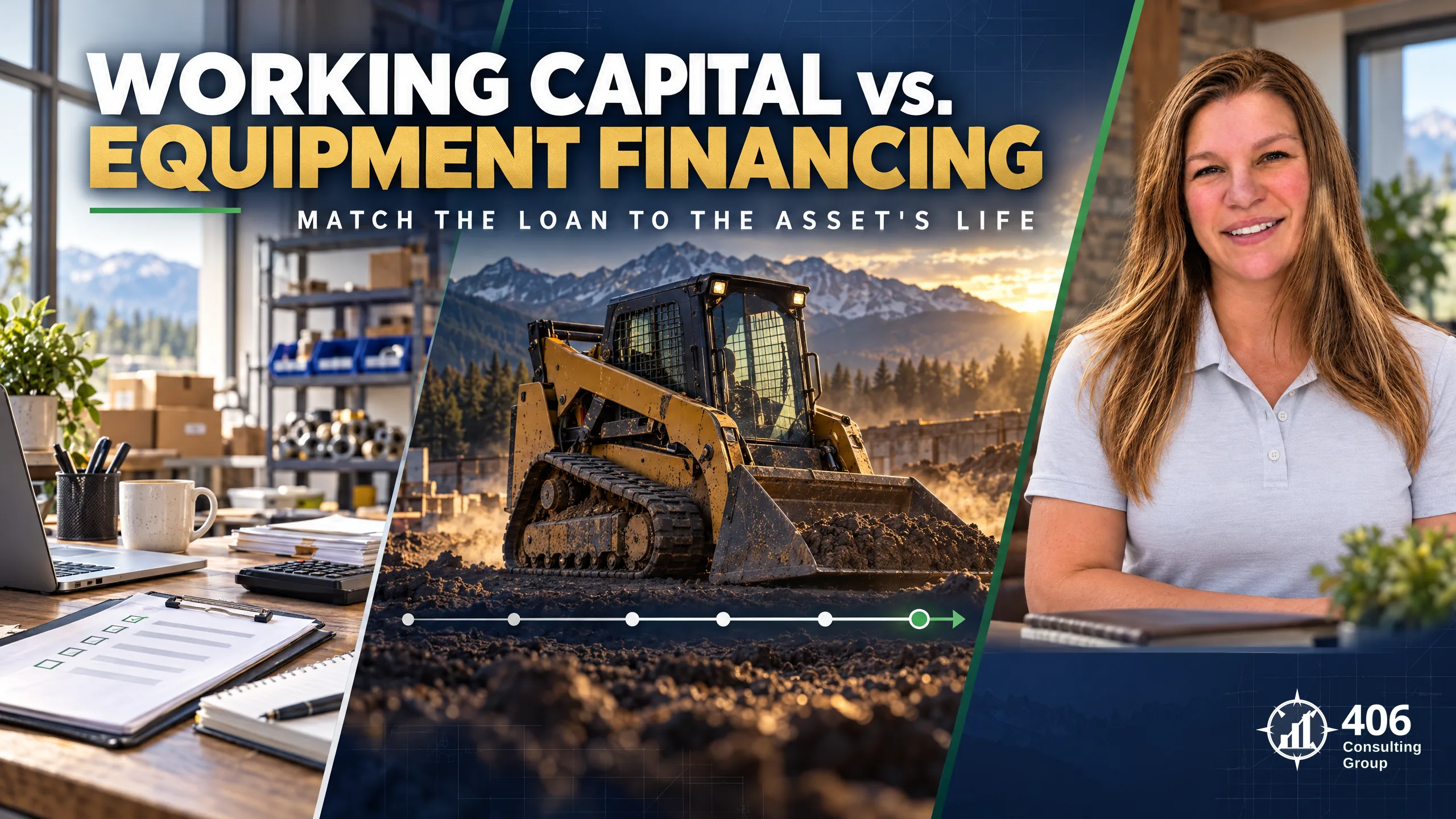
Use a working-capital loan to cover short-term operating needs — payroll, inventory, a cash-flow gap. Use equipment financing to buy a specific machine, truck, or tool, where the equipment itself is the collateral.The golden rule underwriters live by: never finance a short-term need with long-term debt, and never buy a long-life asset with short-term money. Match the length of the loan to the life of what it's paying for.

By Carrie Anderson
Co-Founder, 406 Consulting Group
Commercial banker and underwriter — 300+ loan files reviewed firsthand.
Rates, advance percentages, and terms vary by lender and change over time; the figures below are typical, not quotes. Confirm specifics with your banker.
What each one is for
They solve different problems. A working-capital loan keeps the lights on through a gap. Equipment financing buys a thing that earns for years. Confusing them is how owners end up paying for payroll long after that pay period is forgotten.
What it funds
Working capital: Day-to-day operations — payroll, inventory, supplies, cash-flow gaps
Equipment financing: A specific machine, vehicle, or piece of equipment
Collateral
Working capital: Usually your cash flow and receivables
Equipment financing: The equipment itself (self-collateralizing)
Term
Working capital: Short — months to a couple of years
Equipment financing: Matched to the equipment's useful life (often 3–7 years)
How much
Working capital: Based on cash flow and the size of the gap
Equipment financing: Often up to ~80–100% of the equipment's cost
The point
Working capital: Bridge a temporary shortfall
Equipment financing: Buy a productive asset without draining cash
When a working-capital loan is the right call
When you need to bridge a gap in operations, not buy an asset. A sudden growth surge that ties up cash in inventory and payroll before the invoices come in. A slow season you'll come out of. Waiting 60 days on a big customer while the bills keep arriving. These are temporary by nature, so the financing should be short by design — in and out, not a multi-year weight on the business.
When equipment financing is the right call
When you're buying a specific, durable asset. Because the equipment secures the loan, approval is often easier and the rate better than unsecured borrowing — and you keep your cash and your line of credit free for everything else. Just as important, the loan term is set to match how long the equipment will earn, so the asset effectively pays for itself as it works.
Term matching in practice
A Bozeman excavation outfit doing about $200,000 a year wants a $90,000 skid steer it'll run for the better part of a decade. Financing it over five years means the payment lines up with the years the machine is billing jobs. Putting that same $90,000 on the line of credit — or on a 12-month working-capital loan — would crush a year's cash flow to pay for something earning for eight. Same purchase, very different survival math, decided entirely by matching the term to the asset's life.
What lenders look at for each
For working capital, it's your cash flow and receivables — can the business generate enough to repay a short-term loan quickly, measured by your debt-service-coverage ratio. For equipment financing, it's the asset plus your cash flow: what the equipment is worth, how long it lasts, and whether your numbers can carry the payment. In both cases, clean and current books are what let a lender say yes faster and for more — because they can see the cash flow instead of guessing at it.
Buying equipment or bridging a gap?
We'll help you match the financing to the need, run the cash-flow math a lender will run, and keep you from paying for a short-term gap over five long years.
FAQ
What's the difference between a working-capital loan and equipment financing?
A working-capital loan funds day-to-day operations — payroll, inventory, cash-flow gaps — and is typically short-term, repaid in months to a couple of years. Equipment financing buys a specific machine or vehicle, is secured by that equipment, and runs for a term matched to the equipment's useful life (often three to seven years). The rule of thumb: short-term needs get short-term money; long-life assets get longer financing.
Should I finance equipment or pay cash?
It depends on your cash position and what else that cash could do. Equipment financing lets you keep cash and your line of credit free for operations and opportunities, and because the equipment secures the loan, rates are often reasonable. Paying cash avoids interest but can leave you thin right when you need a buffer. The right answer comes from your cash-flow forecast — which is exactly the kind of math worth running before you decide, not after.
Can I use a working-capital loan to buy equipment?
You can, but it usually backfires. A working-capital loan is short-term money meant to be repaid quickly, so using it for equipment that lasts years forces a big purchase into a tiny repayment window and strains your cash flow. Equipment financing spreads the cost over the asset's working life and is secured by the asset itself, which is why it's almost always the cheaper, safer tool for the job.
This article is general financial education, not lending, legal, or financial advice for your specific situation. Loan terms and approval criteria vary by lender.
In one line
Working capital bridges short-term operating gaps; equipment financing buys long-life assets, secured by the asset. Match the loan's length to the life of what it buys.