
Bookkeeping Services in St. Charles, IL:
Books Built for Illinois's Three-Tax Reality
Illinois taxes a business on three fronts — sales tax, a 4.95% flat income tax, and the Personal Property Replacement Tax — plus PTET and Secure Choice. The bookkeeping a St. Charles business really needs.
St. Charles sits on the Fox River in the heart of Kane County's Tri-Cities, an affluent, established corner of the Chicago suburbs with a busy downtown, a deep bench of professional and trade businesses, and none of the Chicago and Cook County tax machinery that makes headlines. That last part matters: a St. Charles owner doesn't deal with Chicago's minimum-wage tiers, Cook County's sick-leave ordinance, or the city lease taxes — but they do face the full weight of Illinois, and Illinois asks more of a small business's books than most states in the country.
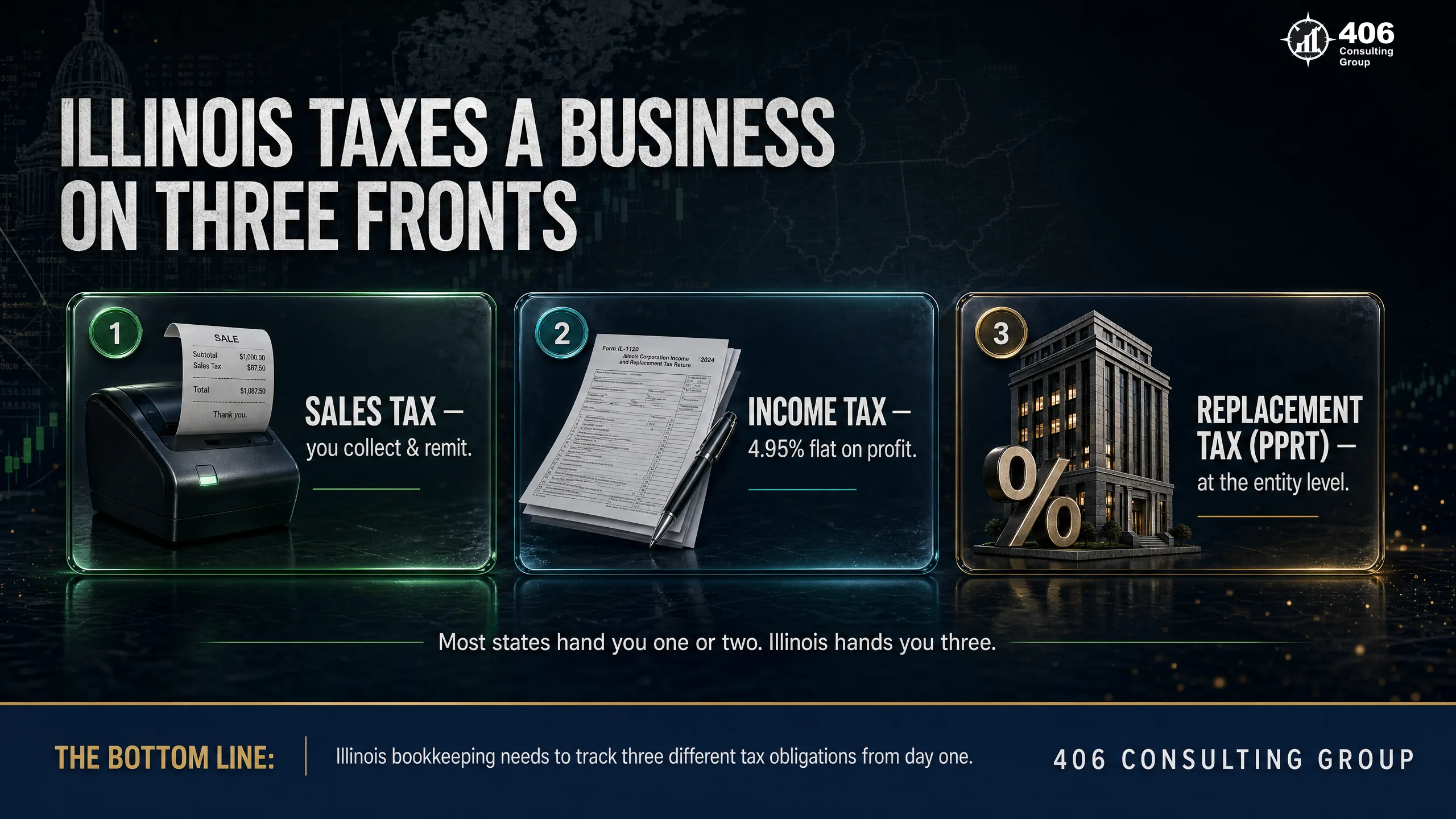
The reason is that Illinois taxes a business on three fronts, not one or two. There's a sales tax you collect and remit, a flat income tax on your profit, and — the one out-of-state owners never see coming — the Personal Property Replacement Tax, a separate state tax that most businesses pay at the entity level on top of everything else. Books built for a one-tax or two-tax state will quietly get an Illinois business wrong, and the errors compound at exactly the times cash is tight.
This guide walks through how Illinois sales tax, income tax, the Replacement Tax, and payroll actually work for a St. Charles business, plus the PTET election that can save real money, what a growing company needs from its books, the mistakes to avoid, and how a remote firm delivers all of it. If you're wondering whether you've outgrown DIY books, start here.
By Jason Anderson — Co-Founder, 406 Consulting Group and a St. Charles native who grew up in the Fox Valley. After a career in large-scale operational finance, he builds financial infrastructure for small businesses — the kind that keeps Illinois's three-tax stack, PTET planning, and payroll straight, for owners back home and across the country.
Quick Answer: Bookkeeping for a St. Charles Business
- →Illinois taxes on three fronts: sales tax you collect, a 4.95% flat income tax on profit, and the Personal Property Replacement Tax at the entity level.
- →St. Charles sales tax runs ~8% once local add-ons join the 6.25% state rate — higher than the state base, so track it precisely.
- →The Replacement Tax (PPRT) — 1.5% of pass-through net income for partnerships and S-corps — is the layer transplants miss (sole proprietors are exempt).
- →Payroll adds Illinois withholding, IDES unemployment, workers' comp, and the Secure Choice retirement mandate.
- →Delivered remotely — Illinois expertise matters far more than a Kane County address.
Table of Contents
Why Illinois Bookkeeping Is Different
Most states hand a small business one or two tax jobs. Illinois hands you three. You collect and remit sales tax; you owe a flat state income tax on profit; and, unless you're a sole proprietor, you also owe the Personal Property Replacement Tax — a state income tax on the business itself that partnerships, S-corps, and C-corps pay at the entity level. Books set up for an Idaho or a Texas business simply don't have a place to put that third piece, which is how it turns into a surprise.
The good news for St. Charles: you carry the Illinois stack without the Chicago one. No Cook County sick-leave accruals, no Chicago lease tax, no tiered city minimum wage — just the state's rules, done cleanly.
What Illinois does offer in return for the complexity is predictability: a single flat income rate rather than a bracket puzzle, and a well-defined set of state agencies — the Department of Revenue for sales, income, and Replacement Tax, and IDES for unemployment. The job isn't hard once the books are built for it. It's specific. Separate the sales tax you're holding from real revenue, keep profit readable so income and Replacement Tax estimates are accurate, and run payroll clean.
The rest of this guide walks each piece. Build your books around them and running a St. Charles business gets a great deal calmer when the returns come due.
Illinois Sales Tax & the St. Charles Rate
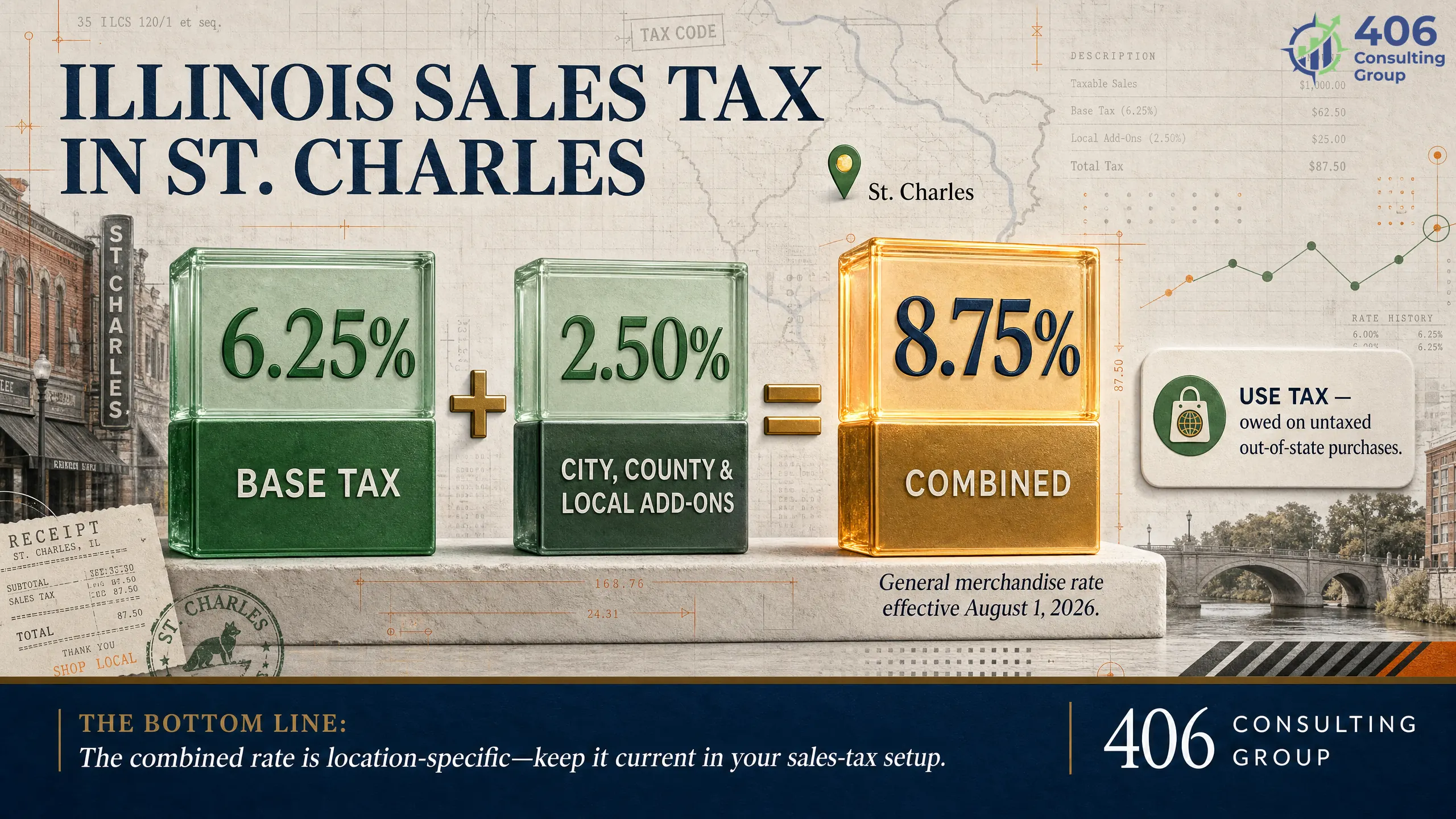
Illinois's state sales tax is 6.25%, but almost nobody in St. Charles pays only that. Once Kane County and municipal add-ons stack on top, the combined rate on a typical retail sale lands around 8% (verify your exact rate and address, since St. Charles straddles Kane and DuPage counties and rates shift by location). If you sell taxable goods or certain services, you collect that tax from the customer and remit it to the Illinois Department of Revenue — it was never your money.
Two Illinois specifics matter for the books. First, the tax is technically a Retailers' Occupation Tax with a companion use tax: buy equipment or supplies without paying Illinois tax — often from an out-of-state or online seller — and you generally owe use tax on them, a commonly missed liability. Second, rate accuracy is a real bookkeeping task in Illinois, because combined rates vary street by street across the collar counties. Clean books record collected sales tax as a liability, not revenue, and flag use-tax situations before they become audit findings.
The trap: spending sales tax you collected
Collected sales tax sitting in your account isn't revenue — it belongs to the state. At an ~8% St. Charles rate, that's real money accumulating, and treating it as cash flow is one of the fastest ways a small business digs a hole. Clean books keep it visible as a liability so you always know what's yours and what's the state's. Confirm current rates and rules with the Illinois Department of Revenue.
Income Tax + the Replacement Tax (PPRT)
Illinois's income tax is a flat 4.95% with no standard deduction, and for most small businesses that profit flows through to the owner's personal return. So far, that's familiar. What isn't familiar is the second layer: the Personal Property Replacement Tax, a separate Illinois tax on business income that partnerships and S-corps pay at 1.5% of net income at the entity level, and C-corps pay at 2.5%. Sole proprietors are exempt — but the moment a St. Charles business becomes an LLC taxed as a partnership or an S-corp, the Replacement Tax shows up.
That means a St. Charles S-corp is effectively paying Illinois twice on the same profit: 1.5% Replacement Tax at the entity, and 4.95% personal income tax as it flows to the owner. Neither is optional, and both have to be set aside for as you earn — not scrambled for at filing. Your books are what make those estimates accurate: track profit cleanly through the year and both numbers become calculations instead of guesses. Miss the Replacement Tax entirely, as transplant owners often do, and a good year ends with an unbudgeted bill.

The Replacement Tax and income-tax planning is where a St. Charles owner saves real money — and it leads straight into an Illinois advantage most owners never claim. Verify current rates with the Illinois Department of Revenue, and we go deeper in the St. Charles tax guide.
The PTET Election: An Illinois Edge
One Illinois quirk actually works in your favor, and it lives right at the seam between bookkeeping and tax. The Pass-Through Entity Tax (PTET) election lets an S-corp or partnership pay its Illinois income tax from the business itself instead of routing all of it through the owners' personal returns. That flip matters because a business-level tax stays federally deductible without the $10,000 SALT cap that limits the personal deduction — so the same Illinois tax dollars do more work on the federal side.
For a profitable St. Charles pass-through the payoff can run into thousands of federal dollars a year — but only when the entity actually makes the payments, the election is filed on time, and the owners' credits are tracked, which is squarely a books-and-records job. Consider this the high-level flag; the full mechanics, deadlines, and math live in the tax guide.
It's the rare Illinois rule that hands money back — but only to owners whose books and tax planning are actually talking to each other.
Payroll in Illinois
Once you hire, Illinois layers its own payroll rules on top of the federal ones — and for a St. Charles employer, they're the state's rules without Chicago's overlay. You withhold Illinois income tax at the flat rate, pay state unemployment through IDES, carry workers' compensation, and — a step many owners miss — either offer a retirement plan or enroll staff in Illinois Secure Choice. Illinois's Wage Payment and Collection Act also sets strict rules on final pay and deductions, so mistakes carry real liability.
| Item | What it is | Bookkeeping note |
|---|---|---|
| Illinois withholding | State income tax withheld from wages (4.95%) | Remitted to IDOR on your assigned schedule; annual reconciliation |
| State unemployment (IDES) | Employer-paid unemployment insurance | Experience-rated; quarterly filing — Illinois rates run high, so track it |
| Workers' comp | Required coverage via a private carrier | Premiums by class code, audited on payroll; Illinois rates are notably steep |
| Secure Choice | State retirement mandate if you don't offer a plan | Facilitate enrollment for eligible staff or sponsor your own plan |
| Federal payroll | Social Security, Medicare, federal withholding, FUTA | Deposits and quarterly 941s as usual |
None of it is exotic, but Illinois is unforgiving about payroll done wrong, and retroactive fixes are painful. Set up properly it's a clean routine — which is what our payroll work gives a St. Charles business.
A Chart of Accounts Built for Illinois
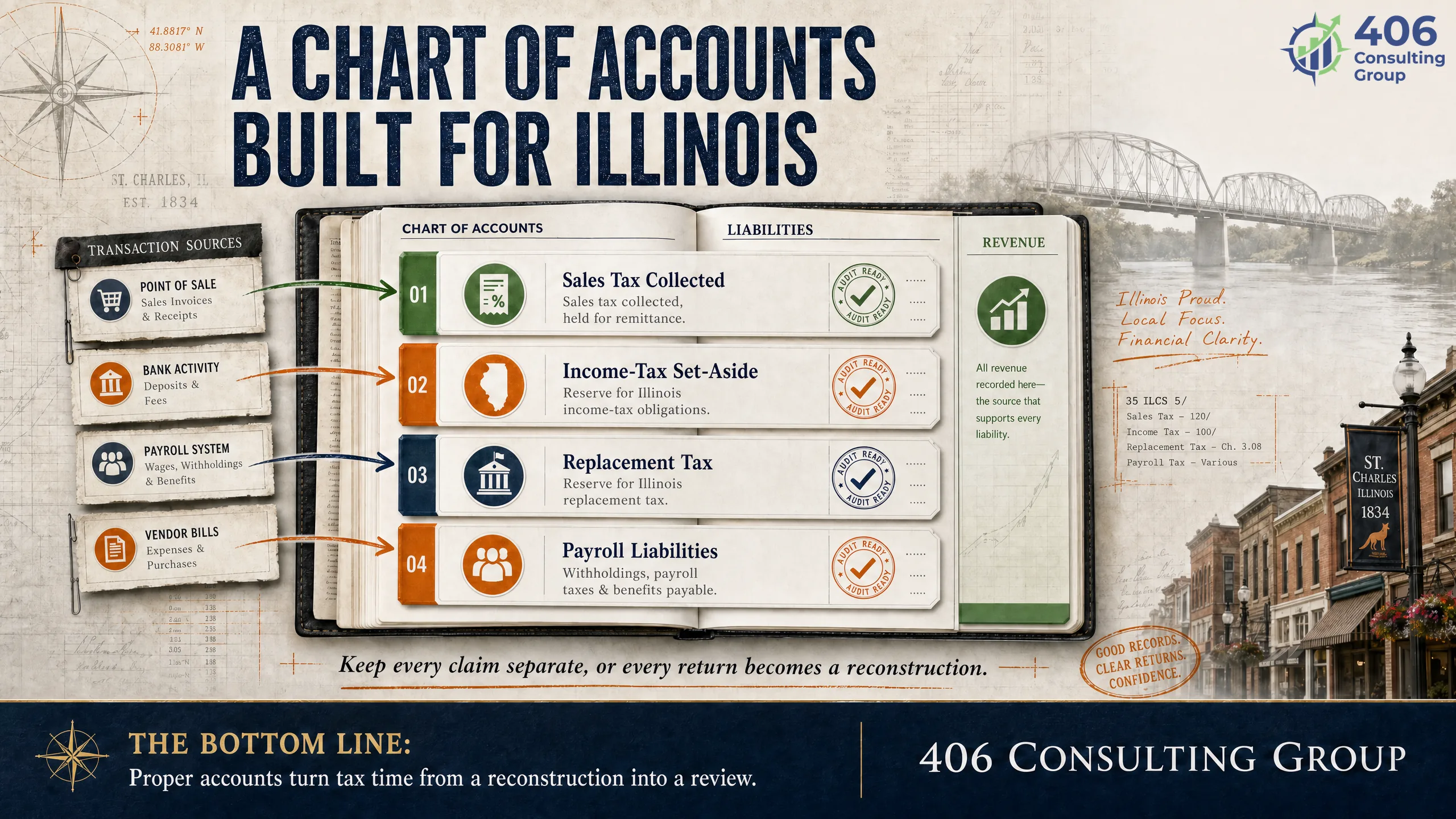
Your chart of accounts is the skeleton of your books, and for an Illinois business it has to keep several liabilities cleanly separated — the sales tax you're holding, the income-tax set-aside, the Replacement Tax, and payroll liabilities — or every return becomes a reconstruction project instead of a report you run.
An Illinois-ready chart keeps sales tax collected as a liability, never mixed into revenue; makes profit easy to read so both the income-tax and Replacement-Tax estimates are accurate; and breaks out payroll liabilities for withholding, unemployment, workers' comp, and Secure Choice. Set up that way, your sales-tax return, your quarterly estimates, and your entity's Replacement-Tax filing all come straight from numbers the books already track.
It's setup work that pays off every month afterward — and it's the first thing we fix when we take on an Illinois business whose books grew up without it.
Cash Flow: Setting Aside for Several Claims
Because Illinois taxes on three fronts, a St. Charles business has several standing claims on its cash at once — the sales tax it's holding for the state, the income tax it'll owe on profit, and the Replacement Tax on the entity. A bank balance that ignores all three overstates what you can actually spend, sometimes badly.
The discipline is simple but has to actually happen: treat collected sales tax as a liability the instant it lands, and set aside a percentage of profit for income and Replacement Tax as you earn it rather than facing it all at once. Done consistently, the remittances and quarterly estimates are funded and boring. Skipped, they become the cash surprises that make a profitable Illinois business feel broke. This is the everyday version of the "profitable but no cash" problem — we break down the general case in Profitable But No Cash.

What a Growing St. Charles Business Needs
Beyond compliance, a growing St. Charles business needs books that inform decisions — accurate monthly financials, a clear read on what actually makes money, and a cash-flow picture that accounts for all three Illinois taxes coming due.
The Fox Valley rewards established, well-run businesses, and the ones that scale do it on clean monthly books. From that baseline the value climbs: margin visibility so you know what to sell more of, payroll handled correctly as you add staff, and a cash-flow forecast so growth doesn't outrun the account. Good books turn Illinois's three-tax setup from a recurring source of anxiety into a managed routine — and give you the numbers to make hiring, pricing, and expansion calls on facts instead of feel.
When reliable numbers become the basis for real decisions, many businesses step up from bookkeeping to controller-level support — a path we cover in upgrading from bookkeeping to a controller.
Bookkeeping by St. Charles Industry
St. Charles leans toward downtown retail and dining, professional services, healthcare, construction and the trades, and Kane County's light manufacturing — and each asks something a little different of the books.
| Industry | What the books need to track |
|---|---|
| Retail & restaurants | ~8% sales tax, daily sales reconciliation, inventory, downtown-event seasonality |
| Professional services | Time and billing, receivables, project profitability, income and Replacement-Tax set-asides |
| Healthcare & dental | Insurance receivables, payroll-heavy costs, equipment, use tax on supplies |
| Construction & trades | Use tax on materials, job costing, prevailing-wage certified payroll, receivables |
| Light manufacturing | Inventory and COGS, the manufacturing machinery exemption, R&D activity, Replacement Tax |
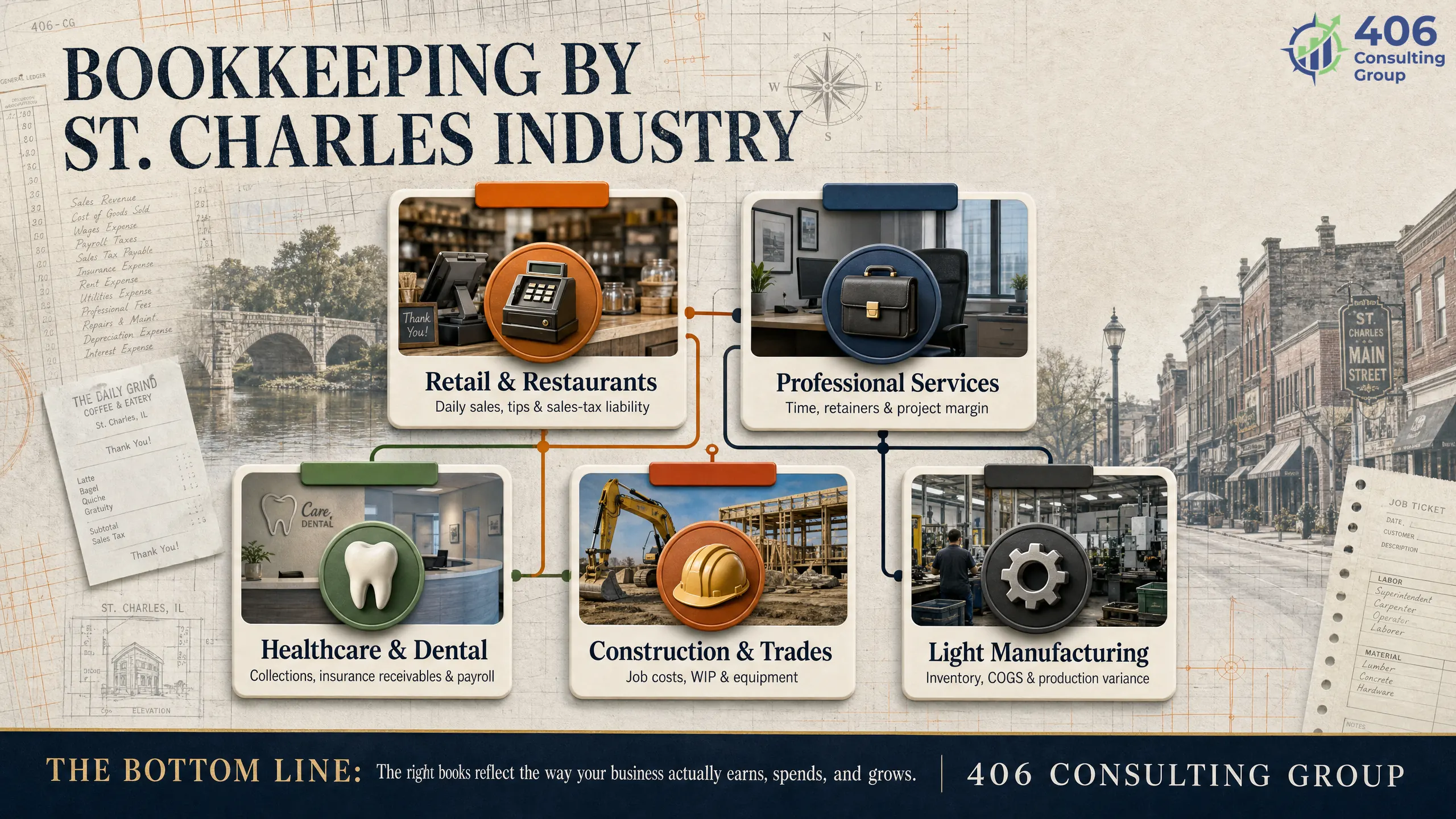
Different details, same backbone: track sales tax cleanly, keep profit readable for income and Replacement-Tax estimates, and stay ahead of payroll. Because our background is in running whole businesses, we set books up around how they affect the entire operation — not just tidiness at tax time.
Common Illinois Bookkeeping Mistakes
Most Illinois bookkeeping trouble traces back to the same avoidable errors. Here's what we see most — and what clean books prevent.
Missing the Replacement Tax entirely
Transplant owners set up an S-corp or partnership and never budget the 1.5% PPRT — then get a bill they didn't see coming.
Spending collected sales tax
At ~8%, the sales tax in your account adds up fast. It's the state's money — treat it as cash flow and you're short at remittance.
Leaving the PTET election on the table
A profitable pass-through that skips PTET can overpay federal tax by thousands a year for no reason.
Wrong sales-tax rate by location
Combined rates vary across Kane and DuPage; charging the wrong rate creates under- or over-collection headaches.
Setting up Illinois payroll wrong
Withholding, IDES, workers' comp, and Secure Choice each have rules; Illinois is unforgiving and retroactive fixes are costly.
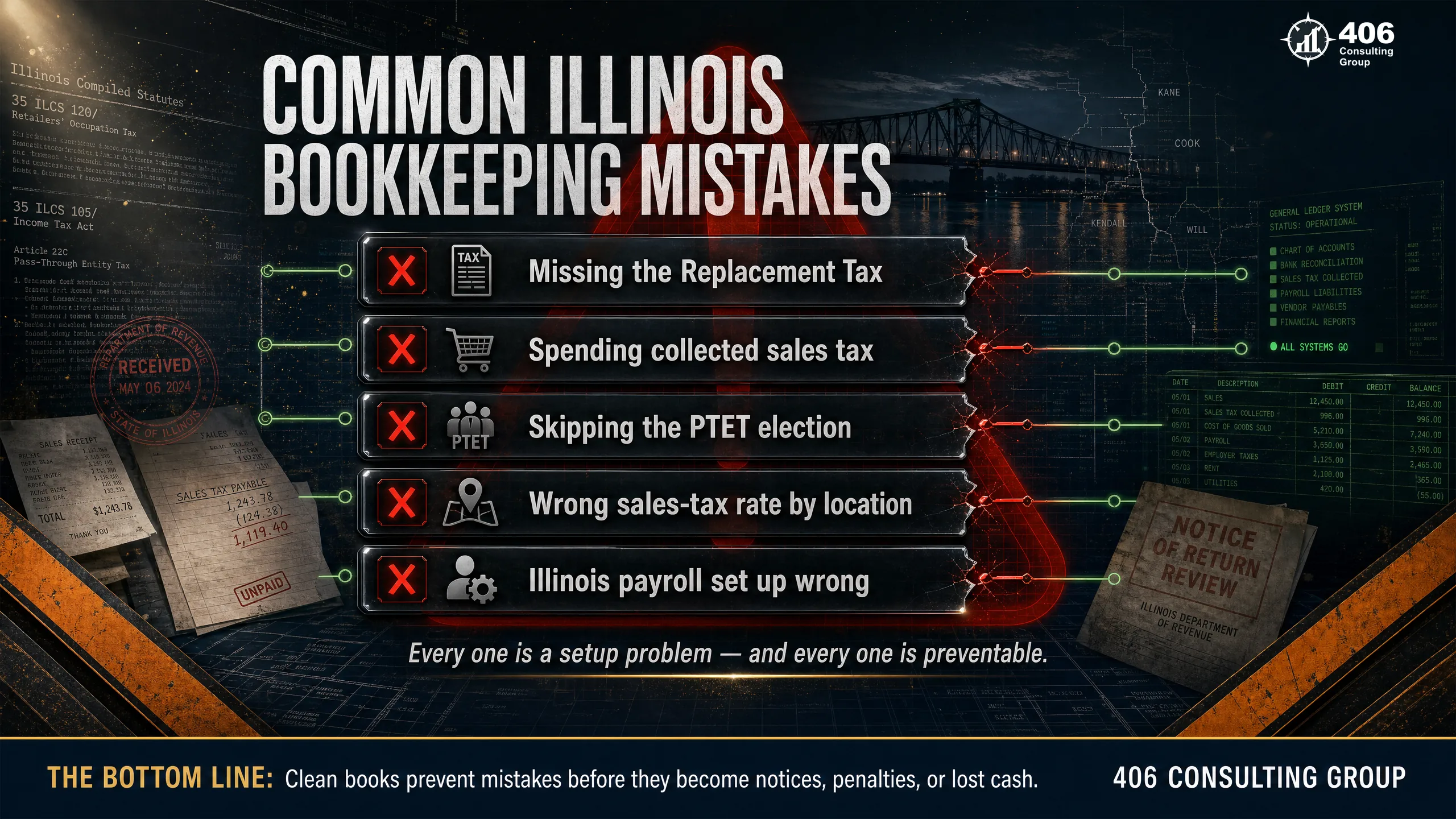
Every one is a setup-and-habit problem, not a character flaw — and every one disappears once the books are built for Illinois and maintained on a monthly rhythm.
Local vs. a Great Remote Partner
What matters in a bookkeeper is whether they know Illinois's tax setup — sales and use tax, the income and Replacement Tax, PTET, and state payroll — not whether their office is on Main Street in St. Charles. A great remote partner who understands Illinois compliance beats an okay local generalist, and the work is a natural fit for remote delivery.
Remote is simply how modern bookkeeping works now, even for clients down the road: secure cloud accounting, connected bank feeds, shared screens, and a steady monthly rhythm. Distance stopped being the variable it used to be. So whether you're in St. Charles, elsewhere in the Tri-Cities and Kane County, or anywhere in Illinois, you get service that's fluent in the state's three-tax reality — which is worth far more than proximity.
And there's a hometown bonus here: we know the Fox Valley, and we know Illinois cold — so a St. Charles owner gets a partner who understands both the place and the compliance stack it sits inside.
How to Get Started
Getting your Illinois books in order is three steps.
Clean up and set the baseline
Reconcile the accounts and build a chart of accounts that separates sales tax collected, the income and Replacement-Tax set-asides, and payroll liabilities.
Get the tax rhythm right
Set up sales-tax tracking at your exact St. Charles rate, profit-based set-asides for income and Replacement Tax, PTET where it fits, and compliant payroll.
Run it monthly
Monthly reconciliation and clean financials keep Illinois compliance routine and give you numbers you can actually run the business on.
Not sure whether you need bookkeeping, tax help, or something more? Our Financial Maturity Assessment maps it out in about eight minutes.
FAQ: St. Charles Bookkeeping Questions
What taxes does a St. Charles, Illinois business have to deal with?
Illinois taxes a business on three fronts. You collect Illinois sales tax — around 8% in St. Charles once local add-ons join the 6.25% state rate — and remit it to the Illinois Department of Revenue. You pay a flat 4.95% state income tax on profit, which for most small businesses flows through to the owner's personal return. And unless you're a sole proprietor, you also owe the Personal Property Replacement Tax at the entity level (1.5% of net income for partnerships and S-corps, 2.5% for C-corps). Employers add Illinois withholding, IDES unemployment, workers' comp, and the Secure Choice retirement mandate. Notably, St. Charles is in Kane County, so the Chicago and Cook County taxes don't apply.
What is the Personal Property Replacement Tax and do I owe it?
The Replacement Tax (PPRT) is a separate Illinois income tax on businesses, created to replace revenue when the state abolished the local personal-property tax. Partnerships and S-corps pay 1.5% of net income, C-corps pay 2.5%, and it's paid at the entity level — on top of the income tax owners pay personally on the same profit. Sole proprietors are exempt. It's the single most commonly missed Illinois tax among owners who moved a business in from another state, because most states have nothing like it. Clean books set aside for it as you earn so it isn't a surprise at filing.
What is the PTET election and can it save me money?
It can, and it's one of the few Illinois rules that works in an owner's favor. The Pass-Through Entity Tax election lets an S-corp or partnership pay its Illinois income tax at the entity level; because a business-level tax stays federally deductible without the $10,000 SALT cap, a profitable St. Charles pass-through can keep thousands of federal dollars it would otherwise lose. It only pays off when the entity makes the payments, the election is filed on time, and the owners' credits are tracked — a books-and-tax handoff we detail in the St. Charles tax guide.
How much should I set aside for Illinois taxes?
It depends on your profit and entity, but the method is what matters: set aside a percentage of profit as you earn it rather than facing the bill at filing. For a typical St. Charles pass-through that means covering federal income tax, the 4.95% Illinois income tax, and the 1.5% Replacement Tax — plus keeping collected sales tax fully separate as a liability. Clean, current books make those set-asides and quarterly estimates accurate instead of a guess, which is the whole point of good bookkeeping for a profitable business.
Can 406 Consulting Group do my St. Charles bookkeeping remotely?
Yes. We work with St. Charles and Fox Valley businesses through secure cloud accounting — connected bank feeds, shared screens, and a steady monthly rhythm. What matters for an Illinois business is genuine expertise in sales and use tax, the income and Replacement Tax, the PTET election, and Illinois payroll — not office proximity. As it happens, our co-founder is a St. Charles native, so you get a partner who knows both the Fox Valley and the Illinois compliance stack it sits inside. An Illinois-savvy remote firm serves you better than a local generalist.
Keep Reading
Bookkeeping — St. Charles, IL
Illinois Books, Done Right.
406 Consulting Group keeps St. Charles businesses clean and compliant — sales tax, income and Replacement-Tax set-asides, PTET, and Illinois payroll handled, with financials you can actually run the business on. Delivered remotely, by a firm that knows Illinois — and the Fox Valley.
St. Charles Bookkeeping Quick Reference
St. Charles, IL — Kane County
Behind on Illinois Compliance?
Sales tax, income & Replacement Tax, payroll.
About the Author
Jason Anderson
Co-Founder, 406 Consulting Group
A St. Charles native who grew up in the Fox Valley before a career in large-scale operational finance and building financial infrastructure for small businesses. Jason helps St. Charles owners keep Illinois's sales tax, income and Replacement Tax, PTET, and payroll straight — with books they can actually run the business on.
Read the Full Story