
Strategic Financial Leadership:
CFO Services in Bozeman, MT
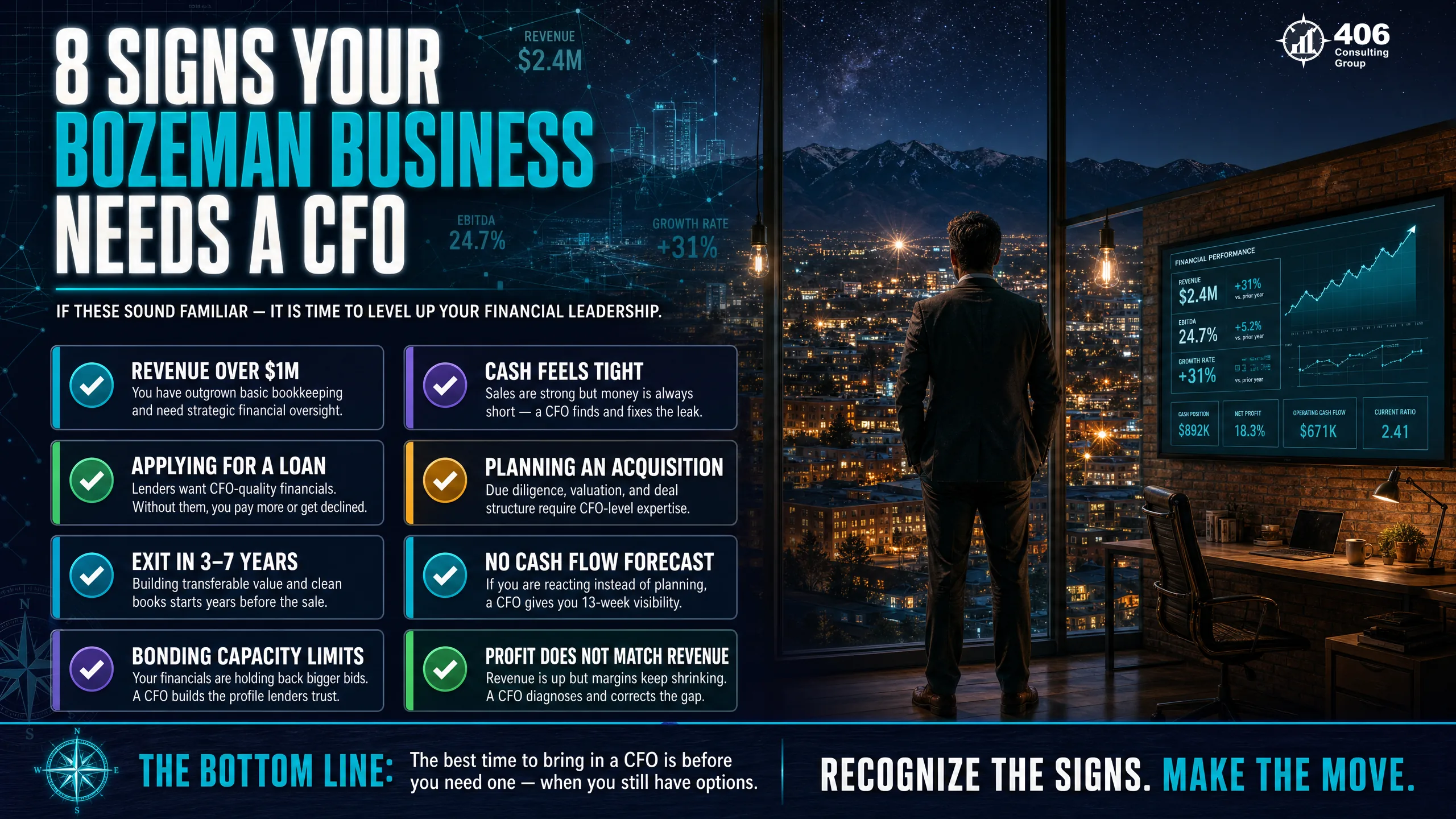
Bozeman is growing fast — and most businesses here are scaling faster than their financial infrastructure can support. Here's what CFO-level financial leadership actually looks like for Montana companies navigating that growth.

Bozeman is no longer a sleepy college town. It's one of the fastest-growing cities in the United States — population up over 30% since 2015, a booming tech sector drawing talent from Seattle and San Francisco, and a real estate market that's reshaped the entire Gallatin Valley economy. That growth is good news for Montana entrepreneurs. But it creates a specific financial leadership problem: businesses scaling faster than their financial systems can support.
When you're adding headcount, winning larger contracts, and managing more operational complexity every quarter, a bookkeeper keeping score isn't enough. You need someone who can tell you what the numbers mean, where the business is heading, and what decisions to make before the problems show up on the P&L.
That's what CFO-level financial leadership actually delivers. This article breaks down what it looks like in practice for Bozeman companies — and how to know when it's time to bring it in.
Table of Contents
Why Bozeman Businesses Need CFO-Level Thinking Right Now
Bozeman's growth isn't a trend anymore — it's a permanent structural shift. The city has attracted technology companies, remote workers with coastal salaries, and institutional capital that's reshaped what businesses here compete against. Gallatin County is consistently ranked among the fastest-growing counties in the Mountain West.
30%+
Population growth since 2015
One of the fastest-growing cities in the US
$700K+
Median home price
Driven by tech migration and remote work influx
Top 5
Mountain West tech hubs
Bozeman ranks among fastest-growing startup ecosystems
That growth creates a specific trap for Montana business owners. Revenue climbs. Headcount grows. New clients come on. And then — often suddenly — cash gets tight, margins compress, and the owner can't explain why the business is busier than ever but feels harder to run than it did at half the revenue.
The problem isn't the growth. The problem is that the financial infrastructure didn't scale with it. The business outgrew its bookkeeper and didn't replace that function with anything more sophisticated. The result is a company making major decisions — hiring, pricing, capital, contracts — with lagging, incomplete financial information.
The Bozeman growth trap in one sentence:Businesses here are landing bigger deals and hiring faster than their financial systems can track — and the gap between what they think they're earning and what they're actually keeping is widening every quarter.
What a CFO Actually Does (vs. What Most Business Owners Think)
Most business owners think a CFO is a bookkeeper with a fancier title. That misunderstanding is why so many businesses go too long without CFO-level support — and why they often don't realize what they've been missing until something breaks.
The distinction isn't about seniority. It's about time orientation and scope. A bookkeeper records what happened. A controller ensures the records are accurate and controls are in place. A CFO uses those records to drive decisions about what happens next.
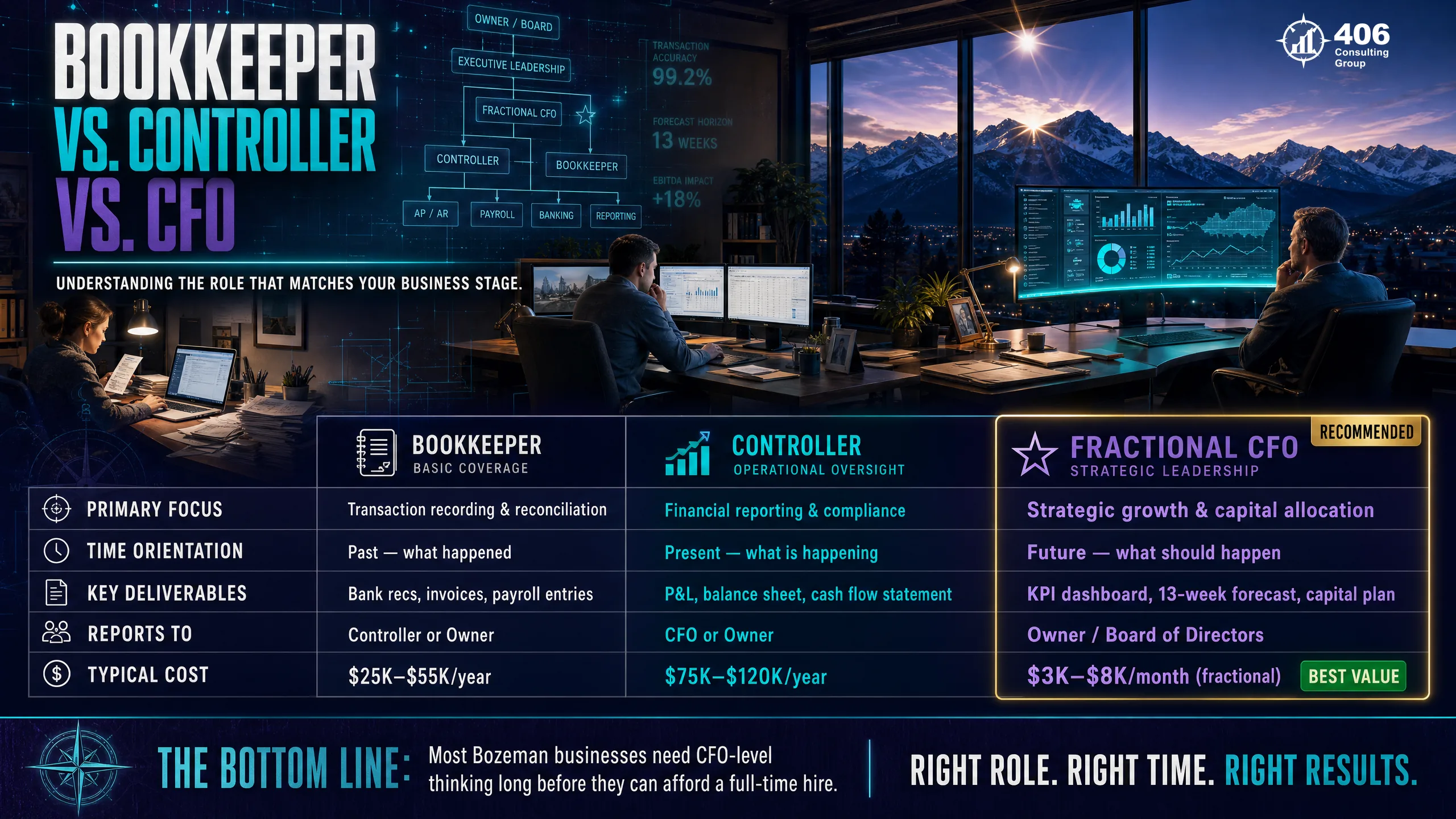
| Role | Time Orientation | Primary Deliverable |
|---|---|---|
| Bookkeeper | Past — what happened | Accurate transaction records, reconciled accounts |
| Controller | Present — what is happening | Clean financial statements, controls, compliance |
| CFO | Future — what should happen | Strategic decisions, forecasts, capital strategy, ROI analysis |
At the CFO level, the deliverables include things like: a rolling 13-week cash flow forecast that tells you exactly when cash gets tight before it does; a margin analysis by service line or client that shows which work is actually profitable; a capital plan that tells you whether to use cash, bank debt, or equity to fund the next growth phase; and board-level reporting that gives investors or lenders confidence in the business's trajectory.
The gap most Bozeman businesses are living in:They have a bookkeeper (or basic accounting software) but no controller and no CFO. They get a P&L once a month, 30 days after the period ends, with no forward-looking data. They're flying blind on a growth trajectory that requires precise navigation.
The GROWTH Framework: 6 Dimensions of Strategic Financial Leadership
CFO-level financial leadership isn't a single service — it's a set of six distinct capabilities that most scaling Bozeman businesses are missing at least partially. We call it the GROWTH Framework. Each dimension represents a specific gap — and a specific set of CFO deliverables to close it.
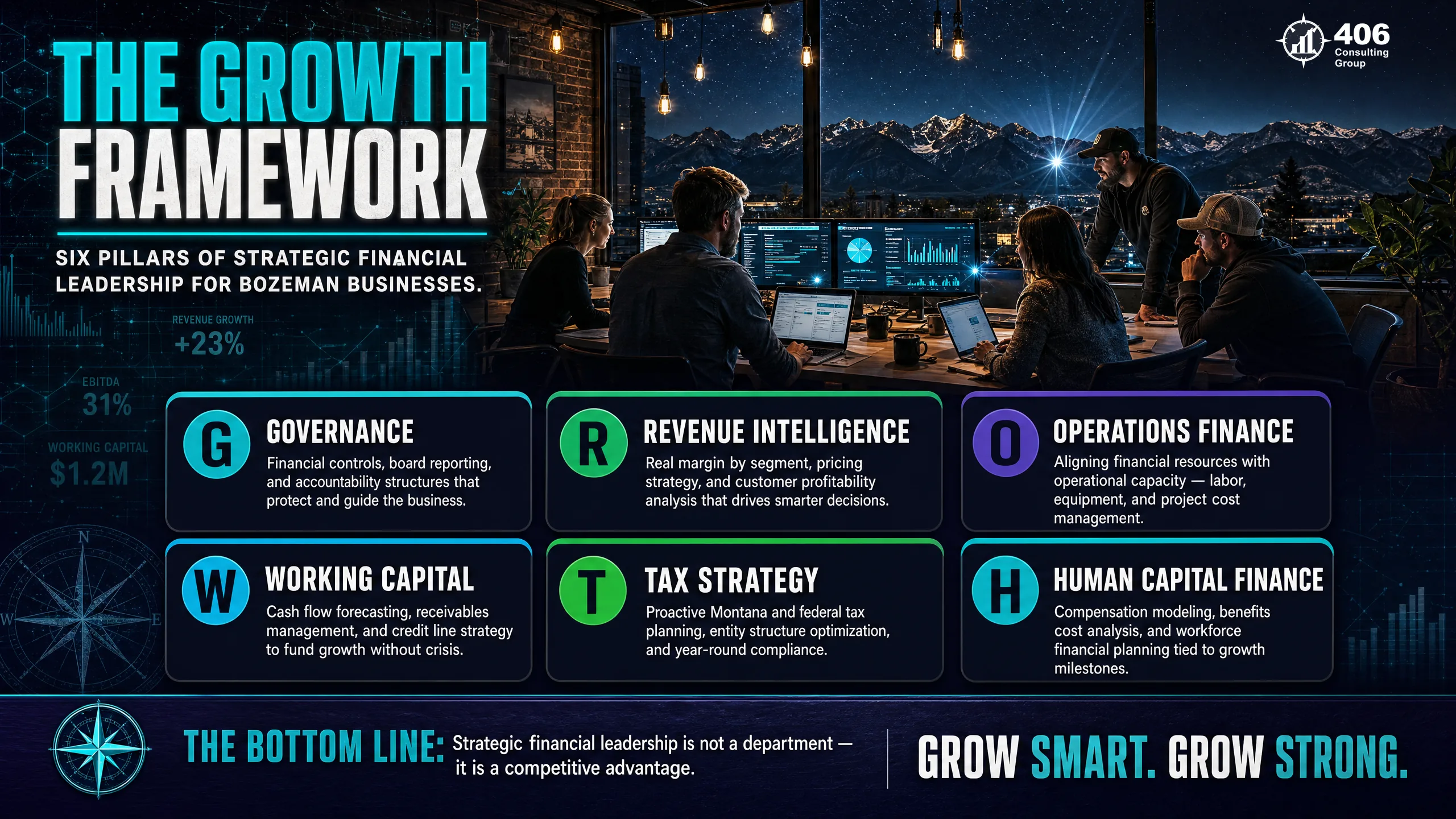
| Letter | Dimension | What a CFO Delivers |
|---|---|---|
| G | Governance | Financial controls, reporting infrastructure, audit-ready systems |
| R | Revenue Intelligence | Margin by product/job/client, pricing strategy, revenue mix analysis |
| O | Operations Finance | Cost structure, overhead allocation, efficiency metrics by department |
| W | Working Capital | Cash flow forecasting, receivables management, burn rate modeling |
| T | Tax Strategy | Entity optimization, proactive planning, coordination with personal tax |
| H | Human Capital Finance | Headcount modeling, payroll burden analysis, equity compensation structure |
Most scaling Bozeman businesses have partial coverage of one or two of these dimensions — and none of the rest. The sections below break down each dimension with specific examples from Bozeman industries and concrete outcomes.
G — Governance: Financial Controls That Can Scale
Financial governance isn't about bureaucracy. It's about building the infrastructure that lets a business scale without losing control of its money. For most companies, governance gaps don't become visible until the business is large enough that the owner can't personally touch every transaction — and then they become very visible, very fast.
Month-End Close Process
A defined, repeatable process for closing the books each month — reconciling accounts, reviewing accruals, and producing financial statements within 5–10 business days. Without this, management decisions are based on data that may be 45–60 days old.
Approval Workflows
Who can authorize what spend, at what dollar threshold, requires what documentation. In a fast-growing company, informal approval processes create fraud exposure and budget overruns that are discovered long after the damage is done.
Financial Reporting Cadence
Monthly P&L, balance sheet, and cash flow statement delivered on a consistent schedule. KPI dashboard that compares actuals to budget. Quarterly board or stakeholder reporting package.
Audit Readiness
If your business ever seeks bank financing, outside investment, or an acquisition, your financials will be reviewed by someone who didn't build them. Audit-ready systems mean that review produces confidence, not red flags.
Bozeman Case Study: Tech Company, 8 to 35 Employees
A Bozeman SaaS company grew from 8 to 35 employees in 18 months. Books were maintained by a part-time bookkeeper. When they sought a $1.2M growth loan, the bank's review uncovered $340K in unreconciled receivables, three years of financial statements that didn't agree with bank deposits, and no documentation of $210K in owner draws categorized as business expenses.
CFO engagement: 90 days to rebuild financial infrastructure, reconcile three years of records, and produce a clean loan package. Loan closed at $1.1M. Total CFO cost for the engagement: $22,500. Cost of not having engaged earlier: close to $340K in unrecognized receivable risk.
R — Revenue Intelligence: Knowing Your Real Margins
Most Bozeman business owners know their gross revenue. Far fewer know their margin by service line, project type, or client. That gap is expensive — because in most businesses, 20–30% of revenue is generated at margins that barely cover overhead, or at a loss. The business grows its top line while its net margin quietly erodes.
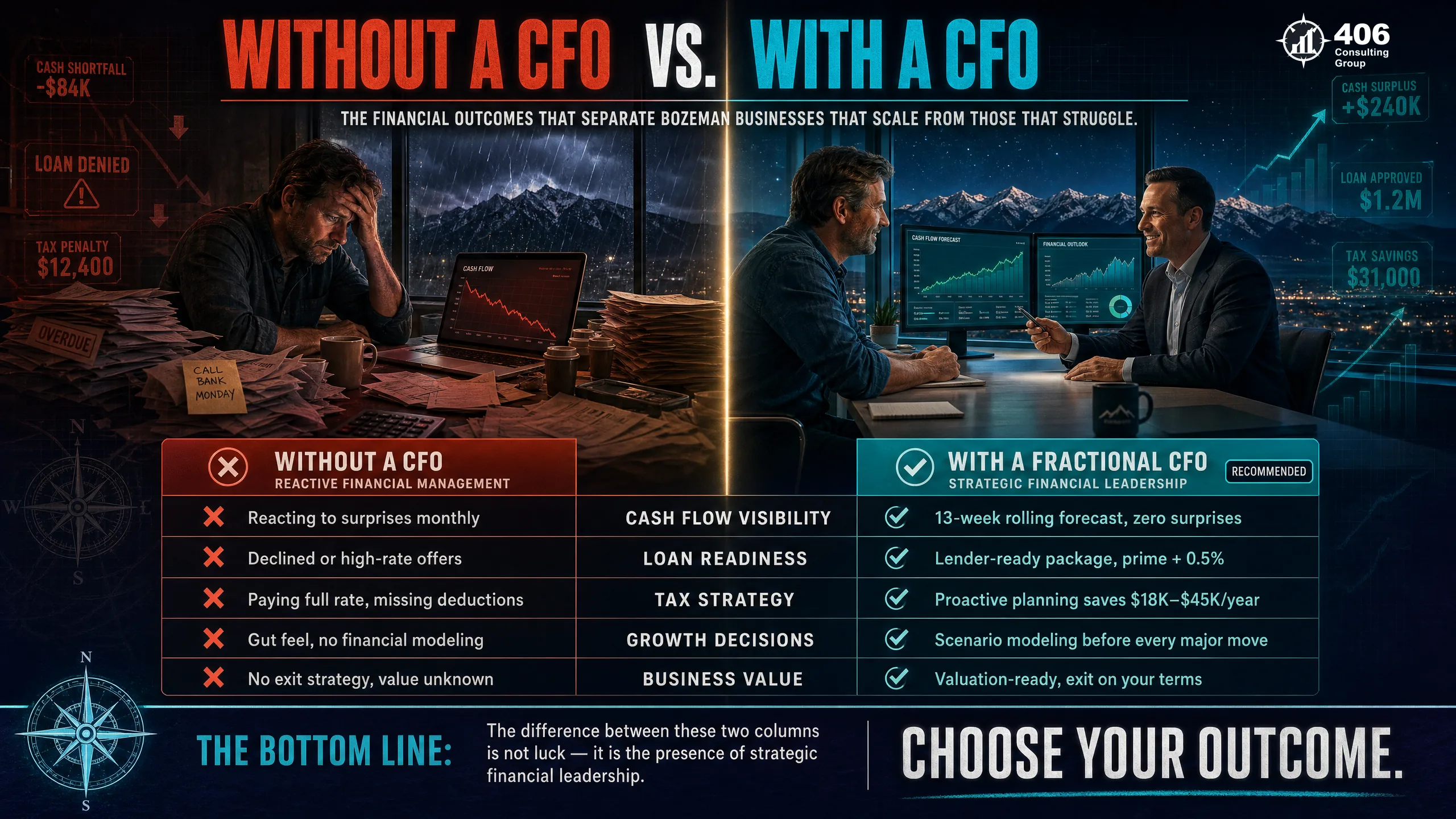
A CFO builds revenue intelligence into the business: a structured analysis of margin by product, service line, client, or project — and a system that keeps that data current. The output isn't just a chart. It's a set of decisions: which clients to grow, which service lines to sunset, where pricing needs to change.
Without Revenue Intelligence
- ✗Pricing based on what competitors charge
- ✗All clients treated as equally profitable
- ✗Growing revenue that masks shrinking margin
- ✗Saying yes to every job without knowing which ones make money
With CFO-Level Revenue Intelligence
- ✓Pricing based on actual job cost and target margin
- ✓Top 20% of clients identified and prioritized
- ✓Revenue mix managed for margin improvement
- ✓Unprofitable service lines repriced or eliminated
A real estate development company in Bozeman generating $4.2M in project revenue discovered through a CFO engagement that one of its three project types — commercial tenant improvements — was generating an average margin of 4.1%, well below their 18% target. That single finding, and the decision to reprice or exit that segment, recovered $580K in annual margin within 12 months.
O — Operations Finance: Where the Money Actually Goes
Revenue intelligence tells you which revenue is worth keeping. Operations finance tells you what it costs to deliver it. Most scaling companies have overhead that has grown faster than revenue — and no visibility into which departments, functions, or cost centers are driving that growth.
Overhead Allocation
Assigning shared costs (rent, admin, insurance, software) to the revenue-generating activities that consume them — so the true cost of each service line is visible, not buried in a single overhead bucket.
Cost-Per-Unit Analysis
For product businesses: cost per unit produced or delivered. For service businesses: cost per billable hour, per project, or per engagement. This is the foundation of rational pricing and capacity planning.
Departmental P&Ls
Separate profit-and-loss views for each department or revenue unit. A $6M business with three divisions may have one profitable division carrying two that lose money — and the combined P&L hides all of that.
Efficiency Benchmarking
Comparing your cost structure to industry benchmarks: revenue per employee, gross margin %, SG&A as a percent of revenue. These benchmarks tell you whether you're running lean or whether you have structural cost problems that need addressing.
An outdoor recreation brand based in Bozeman with $3.8M in annual revenue had a wholesale channel, a direct-to-consumer website, and a retail store. Their combined P&L showed healthy gross margins. Departmental P&Ls built by a CFO revealed the retail store was operating at negative EBITDA — and had been for two years. Closing it redirected $190K annually into the profitable DTC channel.
W — Working Capital: Managing Growth Without Running Out of Cash
The most common financial crisis in a fast-growing business isn't a bad year — it's a good year that outpaces working capital. Bozeman companies are landing bigger contracts, hiring ahead of revenue, and paying vendors before clients pay them. The result is a profitable business that perpetually feels cash-strapped.
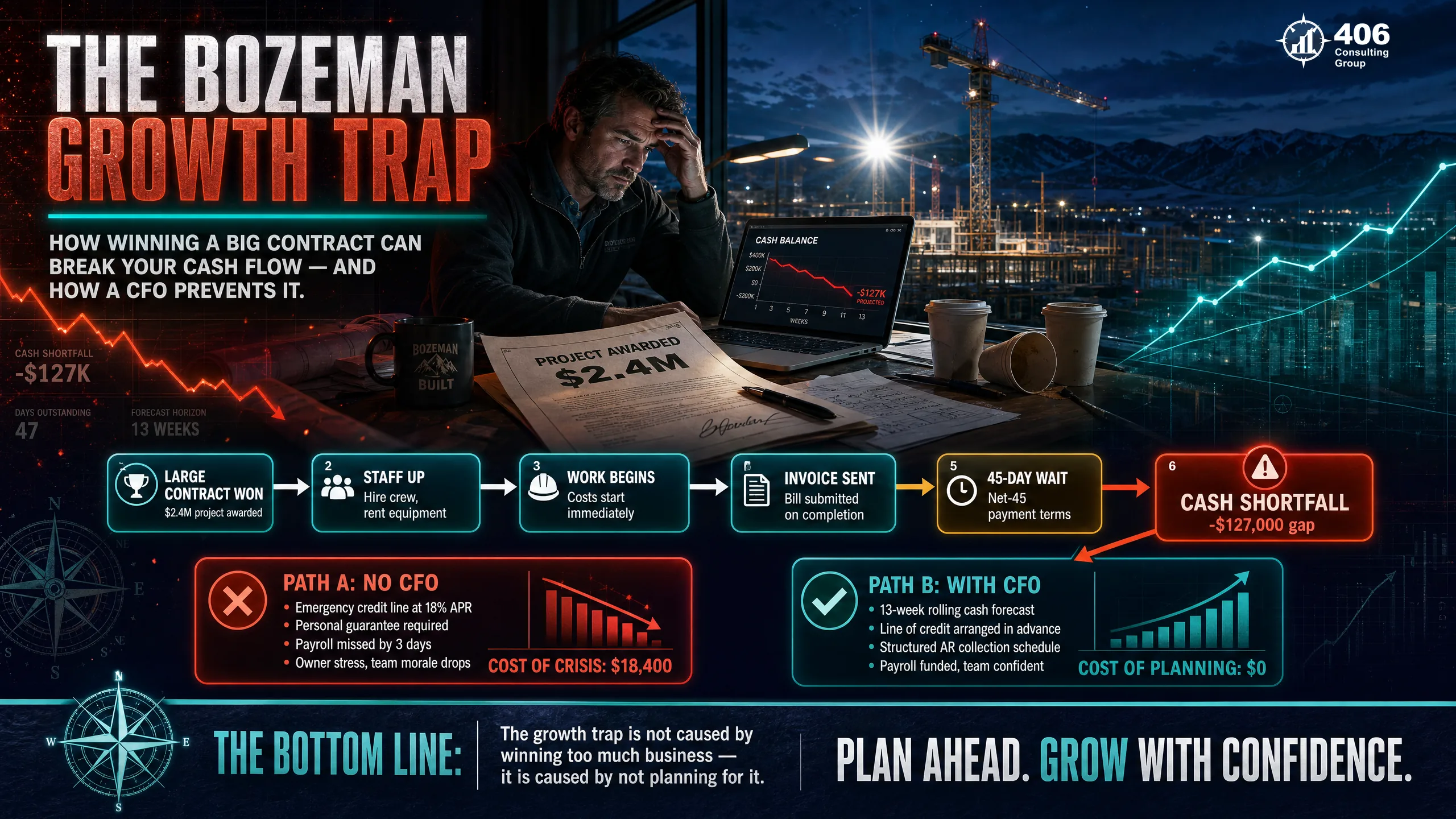
The Bozeman Growth Trap: How It Happens
CFO solution: A rolling 13-week cash forecast built before the contract was signed would have identified the cash gap in week 8 — and structured a progress billing schedule and a pre-approved operating line to bridge it. The crisis never happens because it was modeled in advance.
Working capital management at the CFO level involves three tools: a rolling 13-week cash flow forecast (updated weekly), a receivables acceleration strategy (faster invoicing, shorter terms, early pay incentives), and a capital structure that matches funding to the duration of the need — short-term line of credit for working capital gaps, term debt for long-lived assets.
For Bozeman businesses dealing with Montana's seasonal patterns — construction slows in winter, tourism peaks in summer, agricultural clients pay seasonally — working capital planning isn't optional. It's the difference between a business that survives its slow season and one that enters spring already in a hole.
T — Tax Strategy: Proactive Planning at the CFO Level
Tax planning at the bookkeeper level means recording transactions correctly so the return is accurate. Tax strategy at the CFO level means structuring the business and its financials to minimize what you legally owe — year-round, not in April.
Entity Structure Optimization
For many Bozeman businesses generating $80K–$400K in net income, an S-Corp election can save $12,000–$40,000 annually in self-employment taxes. A CFO evaluates entity structure as part of overall financial strategy — not as a one-time decision.
Owner Compensation Structure
The split between W-2 salary and distribution in an S-Corp has significant tax implications. A CFO models the optimal salary level — reasonable compensation for IRS purposes, optimized for SE tax savings — and coordinates with your CPA to implement it.
Timing of Income and Deductions
Accelerating deductions into high-income years and deferring income when possible. Section 179 and bonus depreciation timing. Retirement contribution maximization — SEP-IRA, Solo 401(k), defined benefit plans for higher-income owners.
Coordination Between Business and Personal Tax
For owner-operators, business and personal tax are inseparable. A CFO coordinates the overall picture — ensuring that business decisions are evaluated for their personal tax impact, and that the combined tax liability is minimized across both entities.
For Bozeman's growing technology and professional services companies, proactive tax planning at the CFO level — not just tax preparation after the fact — is one of the highest-ROI engagements available. A business owner paying $85K in annual taxes with no proactive planning is almost certainly overpaying by $15K–$30K.
H — Human Capital Finance: Payroll, Equity, and People Costs
In most Bozeman knowledge businesses — tech, professional services, consulting, creative agencies — payroll is 50–70% of total expenses. Which means headcount decisions are financial decisions, and they need to be made with financial data, not intuition.
Fully-Loaded Employee Cost
- • Base salary
- • Payroll taxes (employer portion: ~8%)
- • Health insurance ($500–$900/month/employee)
- • Workers' comp
- • Retirement match (if any)
- • Equipment and tools
- • Training and onboarding
- A $65,000 salary hire typically costs $82,000–$90,000 fully loaded.
Revenue Per Employee
- • Professional services benchmark: $150K–$250K/employee
- • Tech/SaaS benchmark: $200K–$400K/employee
- • Construction benchmark: $120K–$180K/employee
- • Below benchmark = overstaffed or under-priced
- • Above benchmark = at risk of burnout/churn
- A CFO tracks this metric monthly and flags when it moves outside the target range.
For Bozeman's technology companies competing for talent against remote-work opportunities at Bay Area salaries, equity compensation has become a recruiting necessity. A CFO structures equity plans — profits interests for LLCs, phantom equity, or stock option plans for C-Corps — that align employee incentives with business outcomes without creating unintended tax or governance consequences.
Headcount modeling — knowing precisely when to hire, what role to add, and what revenue growth assumption justifies the spend — is one of the highest-value CFO deliverables for a scaling Bozeman business. Hiring 60 days too early costs more than most owners realize.
Fractional CFO vs. Full-Time CFO: What Makes Sense for Bozeman Companies
This is the first question most business owners ask. The honest answer: for the vast majority of Bozeman businesses under $20M in revenue, a fractional CFO delivers more financial leadership per dollar than a full-time hire — because a fractional CFO brings strategic-level experience without the full-time cost, and scales engagement hours up or down as the business needs change.
| Fractional CFO | Full-Time CFO | |
|---|---|---|
| Monthly cost | $3,000–$8,000/month | $18,000–$30,000/month (salary + benefits + equity) |
| Annual fully-loaded cost | $36,000–$96,000 | $250,000–$400,000+ |
| Availability | Part-time, dedicated hours | Full-time, on-site presence |
| Experience level | Senior — often former Big 4 or Fortune 500 CFOs | Varies widely by candidate quality |
| Scales with growth | Yes — adjust hours as needed | No — fixed cost regardless of workload |
| Best for revenue range | $1M–$20M | $20M–$100M+ |
The crossover point — where a full-time CFO starts to make economic sense — is typically $15M–$25M in revenue, when the complexity and volume of financial decisions justify a daily strategic finance presence. Below that threshold, a well-matched fractional CFO provides the same strategic capability at a fraction of the cost.
For a deeper breakdown of fractional CFO pricing and ROI, see our article: What Does a Fractional CFO Actually Cost — And What Should You Get Back?
What to Expect in Your First 90 Days with a Fractional CFO
One of the most common questions Bozeman business owners ask: "How long before I see results?" The answer depends on what shape the financial infrastructure is in when the engagement starts. For most companies, the first 90 days follow a predictable three-phase pattern.
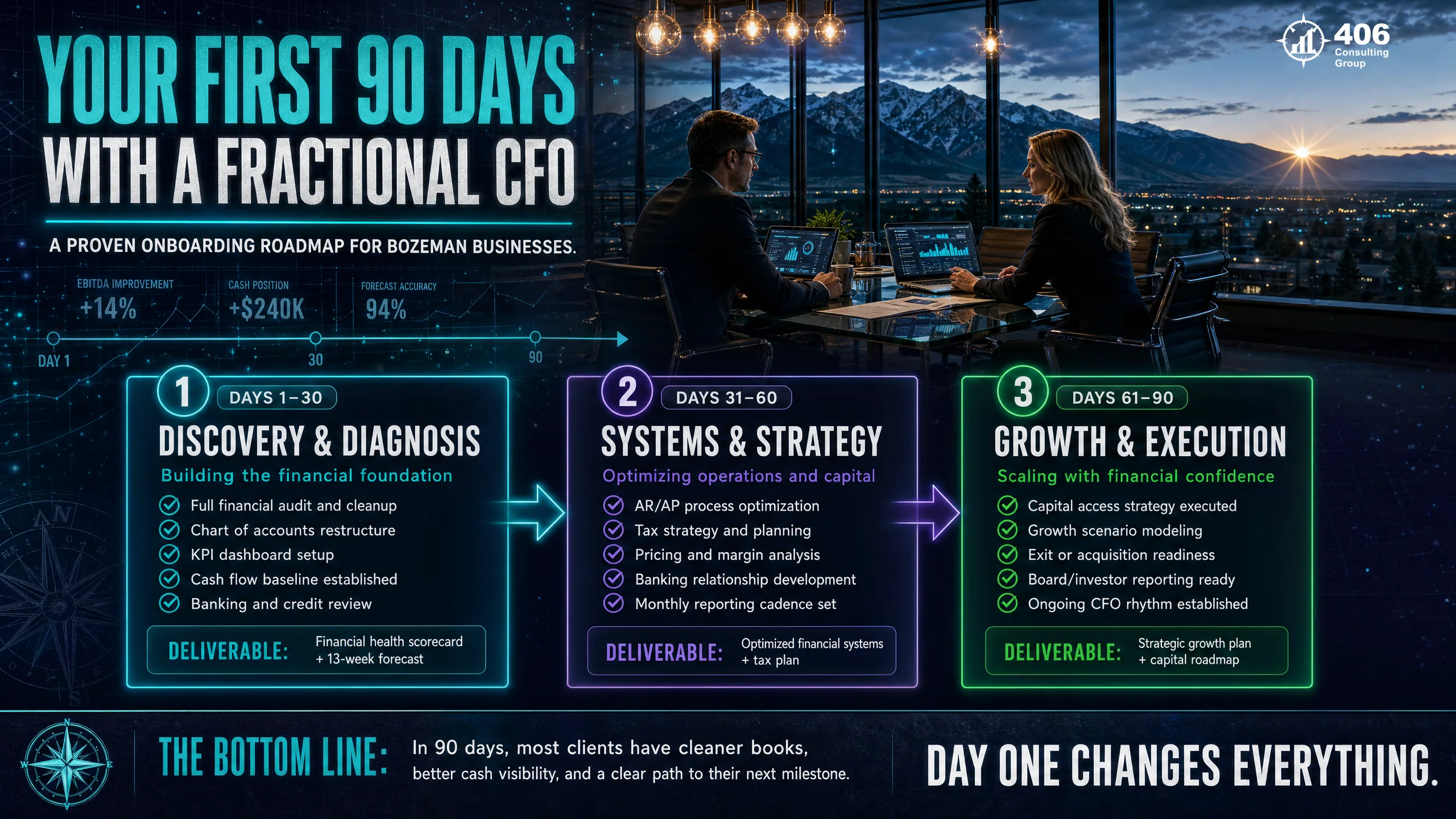
Days 1–30
Discovery & Quick Wins
- →Financial audit — review 24 months of actuals
- →System assessment — accounting software, processes, controls
- →Identify top 3–5 quick wins (pricing, cost cuts, billing)
- →Map existing reporting gaps
- →Initial DSCR and cash flow baseline
Days 31–60
Infrastructure Build
- →Month-end close process designed and documented
- →Rolling 13-week cash flow forecast built and live
- →Margin analysis by service line or client completed
- →KPI dashboard delivered
- →Budget vs. actual reporting initiated
Days 61–90
Strategic Output
- →Strategic recommendations presented to owner
- →Capital plan drafted (debt, equity, or internal funding)
- →Headcount model built for next 12 months
- →Tax strategy coordination with CPA initiated
- →Board or lender reporting package delivered
Most clients see their first measurable outcome — a recovered margin, an avoided cash gap, a realized tax saving — within the first 30–45 days. The system-level returns accumulate over the following 6–12 months as the infrastructure compounds. The question isn't whether a fractional CFO pays for itself — it almost always does. The question is how fast.
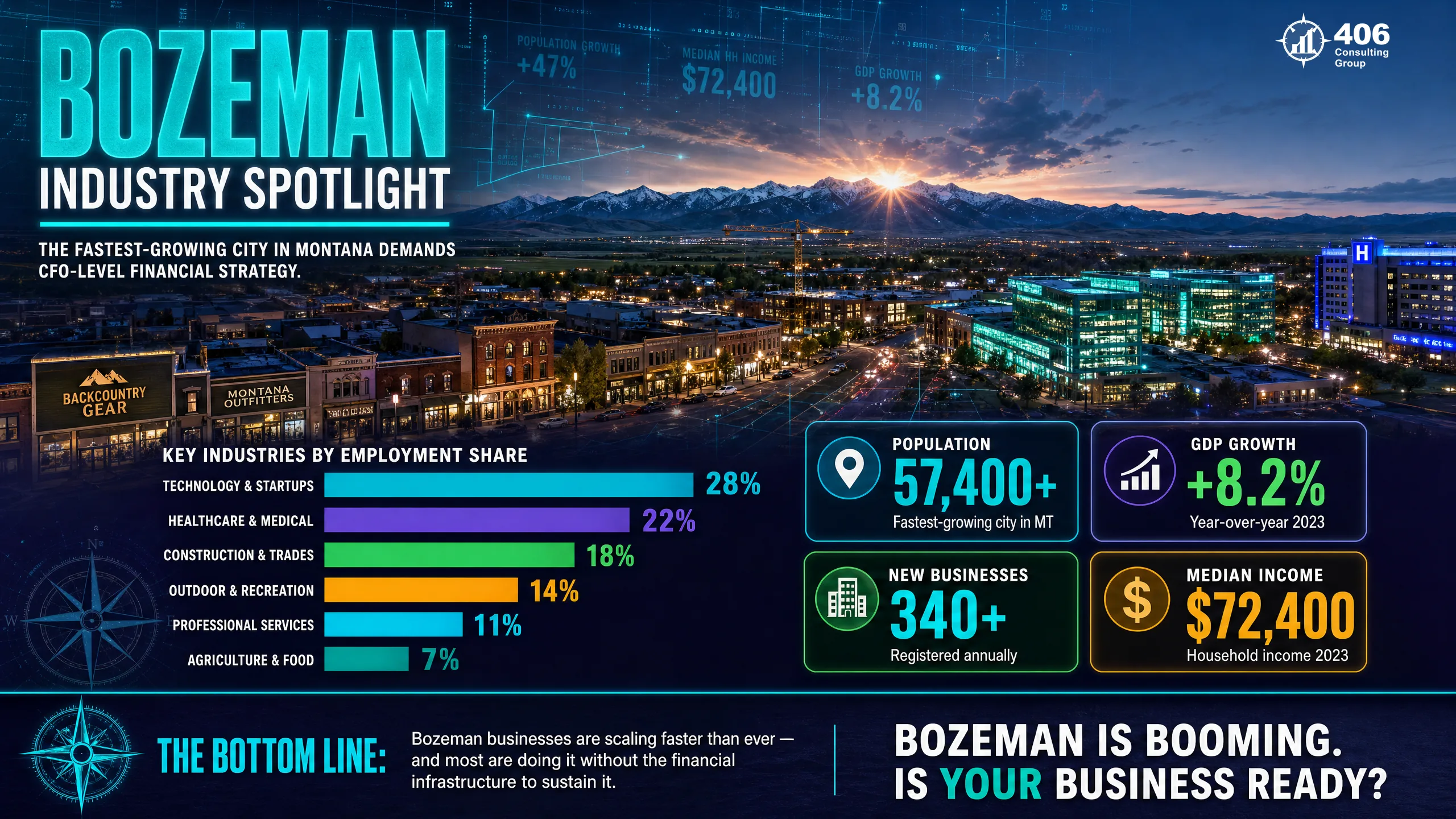
Bozeman Industry Spotlight: Who Needs CFO Services Most
CFO-level financial leadership applies across industries — but certain Bozeman business types have the highest ROI on a fractional CFO engagement due to their specific growth patterns, cost structures, and capital needs.
Technology Startups & SaaS Companies
Key Pain Point
Burn rate management, investor reporting, fundraising preparation
CFO Value
A CFO builds the financial model for fundraising, manages runway projections, and produces investor-grade reporting that accelerates Series A and Series B closes. Bozeman's tech ecosystem is growing faster than its financial talent pool — a fractional CFO closes that gap without a full-time hire.
Real Estate Development & Property Management
Key Pain Point
Project finance complexity, lender reporting, cash flow across multiple projects simultaneously
CFO Value
Each development project is its own P&L. A CFO builds consolidated reporting across projects, manages lender draw schedules, and models the portfolio-level cash flow — so the developer always knows exactly where the business stands, not just where each project stands.
Construction & General Contracting
Key Pain Point
WIP accounting, bonding capacity, job costing, seasonal cash management
CFO Value
Construction is one of the highest-risk industries for financial mismanagement. A CFO builds WIP schedules, tracks job-level profitability in real time, and manages the bonding relationship — maximizing bonding capacity for larger commercial bids. We work extensively with Flathead Valley and Gallatin County contractors on exactly this.
Outdoor & Recreation Brands
Key Pain Point
Seasonal inventory, DTC vs. wholesale margin management, product line profitability
CFO Value
Bozeman's outdoor economy is one of its most distinctive assets — and most outdoor brands are managing three channels (retail, wholesale, DTC) with wildly different margin profiles. A CFO builds channel-level P&Ls and manages the inventory capital cycle through seasonal demand swings.
Professional Services & Consulting Firms
Key Pain Point
Utilization rates, revenue per FTE, pricing discipline, partnership equity structure
CFO Value
Professional services firms live and die on utilization and billing rates. A CFO tracks revenue per billable FTE, models the impact of rate changes, and structures equity for partners in a way that aligns incentives without creating tax or governance nightmares.
Frequently Asked Questions
What does a fractional CFO cost for a Bozeman business?
Fractional CFO engagements for Montana businesses typically range from $3,000 to $8,000 per month depending on the size and complexity of the business and the scope of services. A startup at $1.5M revenue needs different CFO support than a $12M construction company. Most Bozeman businesses in the $2M–$10M range find their engagement falls in the $3,500–$6,000/month range. For a full breakdown of pricing and ROI, see our article on fractional CFO cost.
When do I actually need a CFO instead of a bookkeeper?
The clearest signals: your books are accurate but you still can't tell which parts of your business are profitable, you're making major hiring or investment decisions without financial models, cash flow feels unpredictable despite growing revenue, or you're approaching a bank or investor with financials that aren't telling your full story. Any one of these is a CFO signal.
How long until I see results from a fractional CFO engagement?
Most businesses see the first measurable outcome — a recovered margin, a billing process improvement, a quick-win tax saving — within the first 30–45 days. System-level results (better cash flow management, strategic decision support, lender-ready reporting) accumulate over 3–6 months. The engagement typically pays for itself within the first quarter.
Does 406 Consulting Group serve Bozeman-based companies?
Yes. We serve businesses across Montana including Bozeman, Kalispell, Whitefish, Missoula, Helena, and the broader Flathead and Gallatin Valley regions. Fractional CFO and controller services are delivered remotely with structured check-ins, and we travel to client sites for quarterly strategic sessions when needed.
What's the difference between a CFO and a controller?
A controller ensures your financial records are accurate, your month-end close is clean, and your internal controls prevent errors and fraud — they're the foundation. A CFO uses those clean records to make forward-looking decisions: forecasting, capital strategy, margin optimization, investor relations. Many businesses need both. Some need to build the controller function first before layering in CFO strategy.
Can a fractional CFO help me prepare for a commercial loan?
Yes — and this is one of the highest-value fractional CFO use cases. A CFO builds your loan package, calculates DSCR, prepares the addback schedule, reconciles your financials, and frames your business narrative for the underwriter. Because 406 Consulting Group actively underwrites loans for a local Montana bank, we know exactly what the lender on the other side of the table is evaluating.
What industries does 406 Consulting Group work with in Bozeman?
We work across construction, real estate development, technology and SaaS, outdoor and recreation brands, professional services, property management, and trucking/logistics. Our deepest expertise is in capital-intensive businesses — construction, real estate, and equipment-heavy operations — where the financial stakes of poor CFO-level management are highest.
One note on delivery, since Bozeman owners often assume CFO work has to be in person: it doesn't. Roughly 70 to 80 percent of our own local clients never come into the office — forecasting, KPI reviews, and strategy sessions all run over shared screens and a steady call rhythm on live cloud data. Fractional CFO leadership is simply delivered this way now, so whether your company is in Bozeman, elsewhere in the Gallatin Valley, or across Montana, distance has no bearing on the strategy you get.
Bozeman, MT
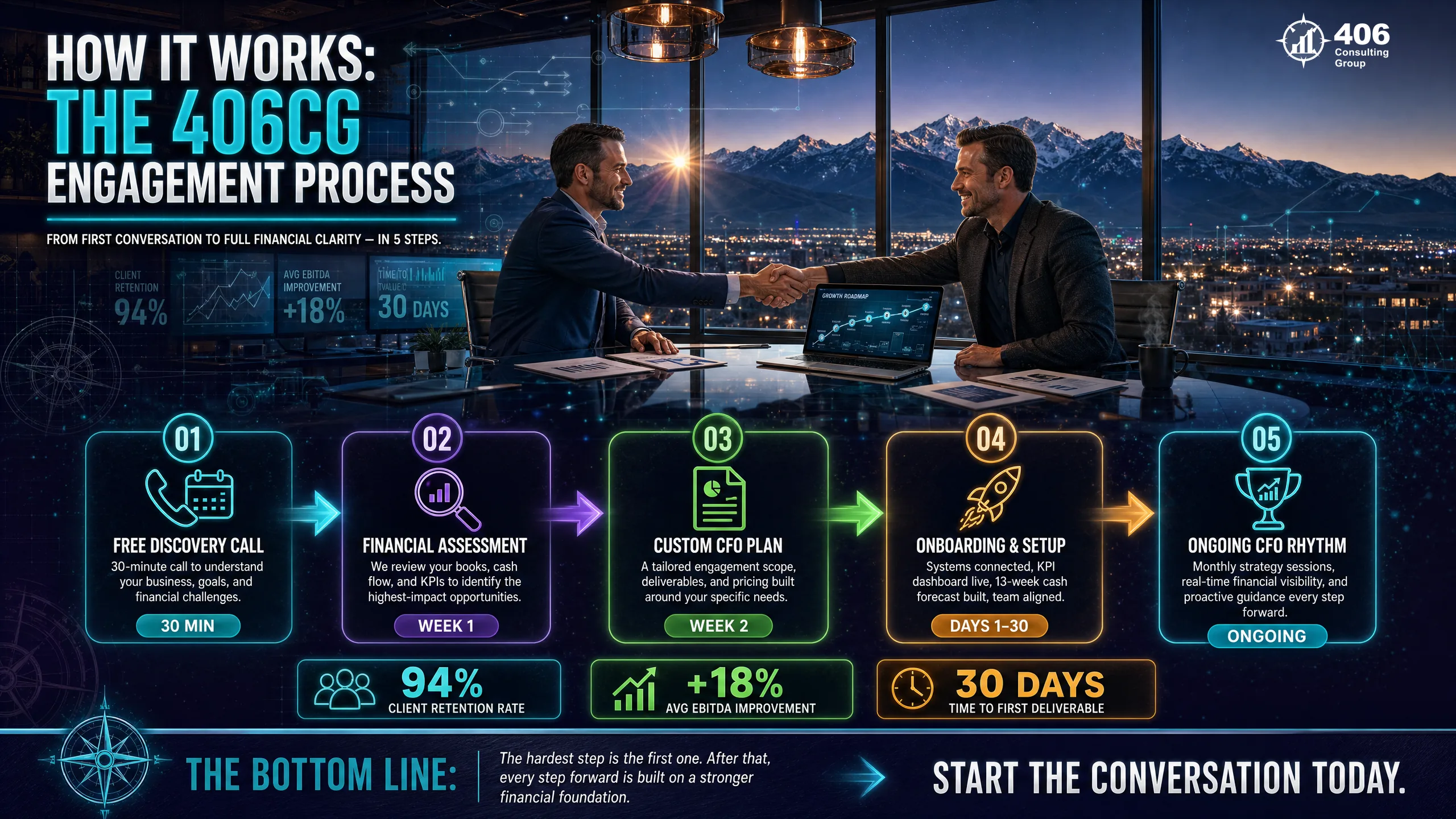
Ready to Bring CFO-Level Thinking to Your Business?
406 Consulting Group provides fractional CFO, controller, and strategic financial advisory services to growing Montana businesses. We know what Bozeman businesses are navigating — and we know what it takes to build financial infrastructure that scales with that growth.
The GROWTH Framework
6 dimensions of strategic financial leadership
Governance
Controls, reporting, audit readiness
Revenue Intelligence
Margin by client, job, and segment
Operations Finance
Cost structure and efficiency metrics
Working Capital
Cash flow forecasting, receivables
Tax Strategy
Proactive planning, entity optimization
Human Capital Finance
Headcount modeling, equity comp
Financial Leadership Maturity
Where does your business sit on the maturity curve? Take our free assessment to find out.
Our Services
Signs You Need a CFO