
Choosing a Tax Preparer in the Flathead Valley:
Why the Right One Pays for Itself
Most owners judge a tax preparer on the fee. The bigger number is the tax they overpay when nobody plans. What separates a filer from a planner, what's changing for the upcoming tax year, and the Montana levers most owners never use.

Here in the Flathead Valley, most people pick a tax preparer the same way they'd pick a place to renew their tabs: find someone who'll do the paperwork, pay the fee, and get out the door. And if all you want is a return filed, that's fine. But it quietly wastes the single highest-return relationship a business owner can have — because a good tax preparer doesn't just report what already happened, they change what happens next. The difference between those two kinds of preparers, especially heading into a tax year with real changes on the way, can be worth far more than the fee either one charges.
This is a guide to choosing the right one — what separates a filer from a planner, what's changing for the upcoming tax year, the Montana-specific levers most owners never use, and why the returns for your business and your household should be handled together.
By Jason Anderson — Co-Founder, 406 Consulting Group. Big-firm-trained accountant serving the Flathead Valley and all of Montana — personal, partnership, and S-corp returns, planned proactively so a good year isn't given back at tax time. Tax rules change; confirm specifics with a professional and the relevant agencies.
Quick Answer: Choosing a Tax Preparer
- →The real choice isn't who files cheapest — it's a filer who bills you vs. a planner who saves you more than the fee.
- →Pick one who handles personal, partnership, and S-corp returns together — your business and household are one tax picture.
- →Montana rewards planning: no sales tax, a two-bracket income tax, a preferential capital-gains rate (as low as 3%), and the PTET election most owners never use.
- →The upcoming tax year brings real federal changes — opportunity for the prepared, a trap for everyone else.
- →The savings are won before December 31. April is for filing, not fixing.
Table of Contents
The One Bill That Should Pay for Itself
Most business expenses cost you money. Good tax work is one of the rare ones that should makeyou money — or at least keep more of what you earned. The problem is that most owners judge a tax preparer purely on the fee, because the fee is the only number they can see. What they can't see is the far bigger number: the taxes they overpaid because nobody planned. A preparer who charges a little less but never has a single proactive conversation can be the most expensive choice you make, by thousands, every single year — you just never get the invoice for it.
The cheapest preparer is rarely the least expensive. The fee you see is small next to the tax you overpay when no one is planning ahead.
The two numbers — only one you ever see
Illustrative
That gap comes down to a single difference in how a preparer works.
Filed-and-Billed vs. Planned-Ahead
There are really two kinds of tax preparers, and they feel completely different to work with. One takes your documents in the spring, produces an accurate return, and sends you a bill — a historian, recording what already happened. The other treats the return as the endof a year-round conversation: they know your business, they've talked with you before year-end about moves that lower the bill, and by the time they file, the savings are already locked in. Both are "tax preparers." Only one of them is on your side of the ledger.
Filed & billed
- •Sees you once a year, in the spring
- •Records what already happened
- •"Here's your return and your bill"
- •Savings already off the table by April
Planned ahead
- ✓Talks with you year-round, before year-end
- ✓Changes what the return will say
- ✓"Here's how we lower next year's bill"
- ✓Savings captured while there's still time

That difference matters in any year. It matters more when the rules themselves are moving.
What the Upcoming Tax Year Is Changing
Federal tax law just went through one of its bigger shake-ups in years, and the effects carry into the upcoming tax year. A few of the changes that matter most to a Montana business owner: the SALT deduction cap was raised (from $10,000 toward $40,000, with a phase-down for higher earners), 100% bonus depreciation is back for qualifying equipment, and the 20% qualified business income (QBI) deductionfor pass-throughs was made permanent. Each is a genuine opportunity — but only if someone is watching for it and planning around it. Rule changes reward the prepared and quietly penalize everyone still filing on last year's assumptions.
A year of rule changes is a fork in the road: an opportunity for owners whose preparer is paying attention, and an expensive surprise for those whose isn't.
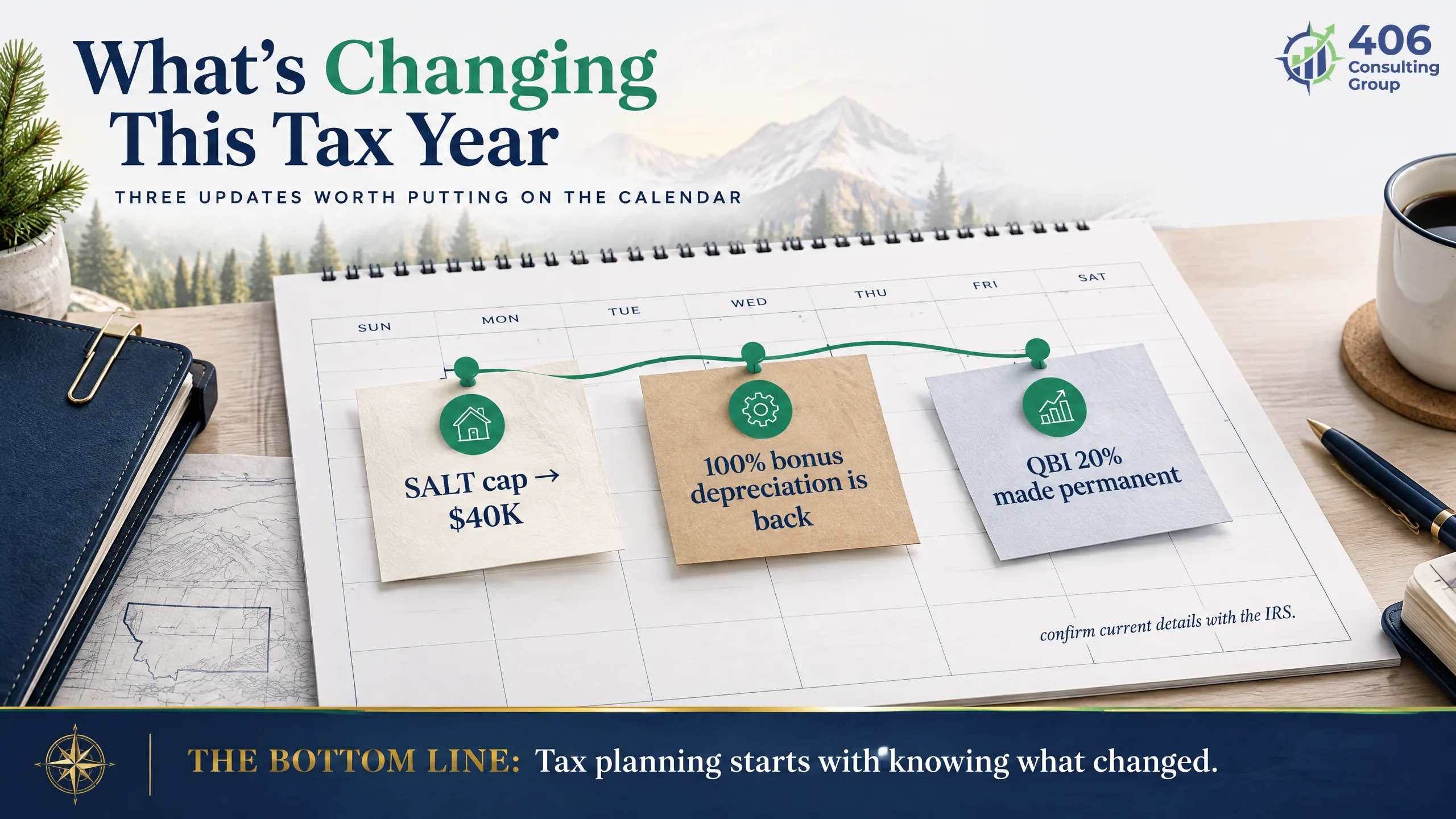
Confirm the current details with the IRS, because specifics evolve. And the federal picture is only half the story in Montana.
Montana's Own Tax Landscape
Montana's tax environment is genuinely different from most states, and the differences reward planning. Here's the picture:
No general sales tax
One of only five states with none. Simpler operations — but the state leans harder on income tax, so entity and owner-comp decisions matter more.
Two-bracket income tax (4.7% / 5.9%)
The 5.9% top rate hits most profitable owners. On real income, that's real money that rewards a strategy, not just a filing.
Preferential capital-gains rate
Montana taxes long-term capital gains at a preferential rate (as low as 3%, with a higher preferential tier above a threshold) — a meaningful lever when timing an asset sale or a business exit.
The PTET election
A pass-through entity tax election that most owners have never used — and one of the best federal-savings tools available in the state (next section).

Confirm current rates and thresholds with the Montana Department of Revenue. One of those levers is worth its own section, because so few owners use it.
The Election Most Montana Owners Miss
If you own an S-corp or partnership in Montana, this is the one to ask your preparer about. Montana's pass-through entity tax (PTET) electionlets the business pay the Montana income tax at the entity level, which makes it a fully deductible business expense on the federal return — effectively working around the federal SALT cap that otherwise limits what owners can deduct. Even with that cap recently raised, owners whose state taxes run above it can still come out ahead — and for a profitable pass-through, the election can save real federal dollars each year, usually for only modest added complexity. And yet most Montana owners have never heard of it, because their preparer files the return the way it's always been filed and never raises the option. A planner brings it up; a filer never does.

It has timing and mechanics that must be handled correctly, so confirm your situation with a professional and the Montana Department of Revenue. Catching a lever like this is far easier when one firm sees your whole picture.
One Firm for Every Return
For a business owner, your personal and business taxes aren't two separate problems — they're one picture. Your salary and distributions, the PTET election, retirement contributions, how the business is structured: every one of those decisions moves both returns at once. When a preparer handles only your 1040 and someone else does the partnership or S-corp return — or worse, when nobody connects them — the coordination that produces the biggest savings simply doesn't happen. A preparer who does personal, partnership, and S-corp returns together can optimize across all of them, so a move on the business side and a move on the personal side add up instead of working against each other.

That coordination starts at the very first meeting — and what happens in that meeting tells you everything about which kind of preparer you've found.
The New-Client Conversation
When a new business owner comes to us, the first real conversation isn't a document drop-off — it's a planning session. Before we ever file anything, we're asking the questions that surface savings: Is your entity structure still the right one? Are you taking a reasonable salary versus distributions in the most efficient split? Have you looked at the PTET election? Are you timing equipment purchases and retirement contributions to your advantage? What's changing in your business next year that we should plan around now? Those questions are the whole point — and they're exactly the conversation a file-and-bill preparer never starts.
Questions a planning-minded preparer asks up front
- 1.Is your entity structure (LLC, S-corp, partnership) still the right fit for your profit?
- 2.Is your owner salary-versus-distribution split as efficient as it could be?
- 3.Have you evaluated the Montana PTET election?
- 4.Are equipment purchases and depreciation timed to your advantage?
- 5.Are you using retirement plans to shelter income?
- 6.What's changing next year that we should plan for now?

Those questions get sharper when a preparer actually understands the place you do business.
Flathead Valley Realities
Doing business in the Flathead isn't the same as doing business in a generic metro, and a good preparer plans around what makes it different. Seasonality is huge: Glacier Country packs a large share of the year's revenue into a roughly 90-day summer window, which changes how income, estimated payments, and equipment purchases should be timed. The construction and trades boom brings job-costing, equipment, and entity questions. And the steady wave of new residents and business transplantscreates part-year and multi-state issues — income earned in another state, a business relocated mid-year, a home sold somewhere else. Add ranching and real estate, and you have a tax picture that a plug-and-play, out-of-the-box preparer routinely gets wrong.

We work with businesses and families across the whole valley — a tax preparer for the Flathead Valley should know it as more than a dot on a map. We serve Kalispell, Whitefish, Columbia Falls, Bigfork, Lakeside, Somers, Evergreen, and the communities around Flathead Lake down to Polson— and, remotely, businesses across the rest of Montana.
So how do you actually tell a planner from a filer before you hire them? A short checklist does it.
What to Look For in a Tax Preparer
Before you hand anyone your return, run them through this. The right preparer clears all of it:
Handles every return you need
Personal, partnership, and S-corp — under one roof, coordinated, not farmed out or disconnected.
Plans year-round, not just in April
They talk to you before year-end about moves that lower the bill, while there's still time to make them.
Asks questions about savings
The first meeting surfaces opportunities — entity, comp, PTET, timing — instead of just collecting your documents.
Knows Montana's specifics
No sales tax, the two-bracket income tax, the capital-gains rate, and the PTET election — not a generic, any-state playbook.
Is available after tax season
You can reach them in July with a question, because the relationship is year-round, not seasonal.

And the last thing to know is when to make the call.
Don't Wait for April
Here's the timing that trips everyone up: by the time you're gathering documents in the spring, the tax year is already closed and almost every lever has been pulled or missed. Real tax savings are won before December 31— the entity move, the PTET election, the equipment purchase, the retirement contribution, the income timing. That's why the best time to find a planning-minded preparer isn't at filing; it's now, with a full quarter still on the clock and the upcoming year's changes still ahead of you. April is for filing. Fall is for planning.
When tax savings are actually won
The timingLet's make next year's return the easy part.
We handle personal, partnership, and S-corp returns for the Flathead Valley and all of Montana — and we plan ahead so you pay the least the law allows, not whatever the filing happens to add up to. Start with a conversation before year-end.
Weighing your entity, too? See Should You Elect S-Corp? The Real Math, and for the timing side, our Q4 tax-planning guide.
FAQ: Tax Preparation in Montana
What should I look for in a tax preparer in the Flathead Valley?
Look past the fee to how they work. The right preparer handles every return you need — personal, partnership, and S-corp — under one roof so your business and household are coordinated as one tax picture; plans year-round rather than only appearing in April; asks questions about savings opportunities at the first meeting instead of just collecting documents; knows Montana's specifics (no sales tax, the two-bracket income tax, the preferential capital-gains rate, and the PTET election); and is reachable after tax season. A preparer who only files a return and sends a bill is usually the most expensive choice once you count the taxes that go unplanned.
What's the difference between tax preparation and tax planning?
Tax preparation is producing an accurate return for a year that has already ended — necessary, but backward-looking. Tax planning is the year-round work that changes what the return will say: choosing the right entity, setting an efficient salary-versus-distribution split, evaluating the Montana PTET election, timing equipment purchases and retirement contributions, and adjusting for law changes before the year closes. Preparation reports the score; planning changes it. The savings almost always come from the planning, which is why the two should be done by the same firm — and why the conversation should start well before filing season.
What tax changes should Montana business owners know about for the upcoming year?
On the federal side, recent law carried several changes into the upcoming tax year: the SALT deduction cap was raised from $10,000 toward $40,000 (with a phase-down for higher earners), 100% bonus depreciation returned for qualifying equipment, and the 20% qualified business income deduction for pass-throughs was made permanent. On the Montana side, the state uses a two-bracket income tax (top rate 5.9%), has no general sales tax, taxes long-term capital gains at a preferential rate, and offers the PTET election. Each is an opportunity only if your preparer is planning around it — confirm current details with the IRS and the Montana Department of Revenue.
What is the Montana PTET election and should my business use it?
Montana's pass-through entity tax (PTET) election lets an S-corp or partnership pay the Montana income tax at the entity level, making it a deductible business expense on the federal return and effectively working around the federal SALT cap. For a profitable pass-through, it can save real federal dollars each year, yet most Montana owners have never been told about it because their preparer never raised it. Whether it's right depends on your income, owners, and situation, and the election has timing and mechanics that must be handled correctly — so it's worth evaluating with a professional and confirming with the Montana Department of Revenue. We look at it for every eligible client.
Does 406 Consulting Group prepare personal and business tax returns?
Yes — we prepare personal (1040), partnership, and S-corp returns, and we handle them together so the business and household are optimized as one picture rather than by disconnected preparers. More than that, we plan proactively: for business clients especially, we use the tax review as a chance to find savings and prepare for the next year — how to capture every deduction and pay the least the law allows — rather than simply preparing the return and sending a bill. We serve the Flathead Valley and all of Montana, and much of the work is done remotely for clients across the state.
Montana Tax Snapshot
Why planning pays here
Plan, Don't Just File
Flathead Valley & all of Montana.
About the Author
Jason Anderson
Co-Founder, 406 Consulting Group
Big-firm-trained accountant serving the Flathead Valley and all of Montana — personal, partnership, and S-corp returns, planned proactively so a good year isn't given back at tax time.
Read the Full Story