
Profitable, and Still Going Under:
The Contractor & Trucking Turnaround Playbook
A busy, profitable contractor or trucking company can still run out of cash and end up at the bank's mercy. Here's why it happens — and the turnaround playbook, in order — from someone who sat in the banker's chair and helped pull a company out of bankruptcy.

Here is the moment almost no owner sees coming: the work is good, the jobs are profitable, the crews are busy — and you still can't make payroll. The line of credit is maxed, a supplier just put you on credit hold, and the bank that used to take your calls suddenly wants a meeting. From the outside you look successful. From the inside you're one slow-paying customer away from the end. A profitable company can go under, and in construction and trucking it happens all the time, because profit is on paper and payroll is in cash.
I've sat on both sides of that table. As a commercial lender and underwriter I reviewed hundreds of loans and had to decide which struggling businesses to stand behind and which to walk away from. And one of the very first companies we ever worked with was a construction and trucking company we helped pull out of bankruptcy and back to health. This is the playbook from that seat: why it happens, what a real turnaround actually does, in what order — and how to steer out of the ditch before the bank decides for you.

By Carrie Anderson
Co-Founder, 406 Consulting Group
Commercial banker and underwriter — 300+ loan files reviewed firsthand.
General guidance, not advice for your specific situation. Examples are for illustration; confirm specifics with your advisor.
The Short Version
- Profitable contractors and truckers go broke on cash timing, not profit — retainage, slow pay, over-fronting growth, and one unprofitable division or route quietly draining the rest.
- A turnaround starts by finding the bleeder — the job, route, or division losing money — then fixing WIP, billing, and collections so cash comes in faster than it goes out.
- The thing that decides whether you survive is often the lender relationship — and that goes better when the person building your numbers has sat in the banker's chair.
- It can be done. We've helped pull a construction and trucking company out of bankruptcy and back to health.
Prefer to watch? Back from the brink, in 75 seconds
What We'll Cover
The Call No Owner Expects
It rarely arrives as a single disaster. It's a slow squeeze: payroll gets tighter each cycle, you start floating vendors, you draw the line of credit to the limit and leave it there, and you tell yourself the next big payment fixes everything. Then a customer pays late, or a job goes sideways, or the bank reviews your file — and the slow squeeze becomes a crisis. If you've ever made payroll by moving money around at the last minute and hoped nobody noticed, this playbook is for you.
Why Profitable Contractors and Truckers Go Broke
Field businesses have a cash structure that quietly works against them. You pay for labor, fuel, and materials now; you collect weeks or months later. Add the industry-specific traps and the gap widens fast:
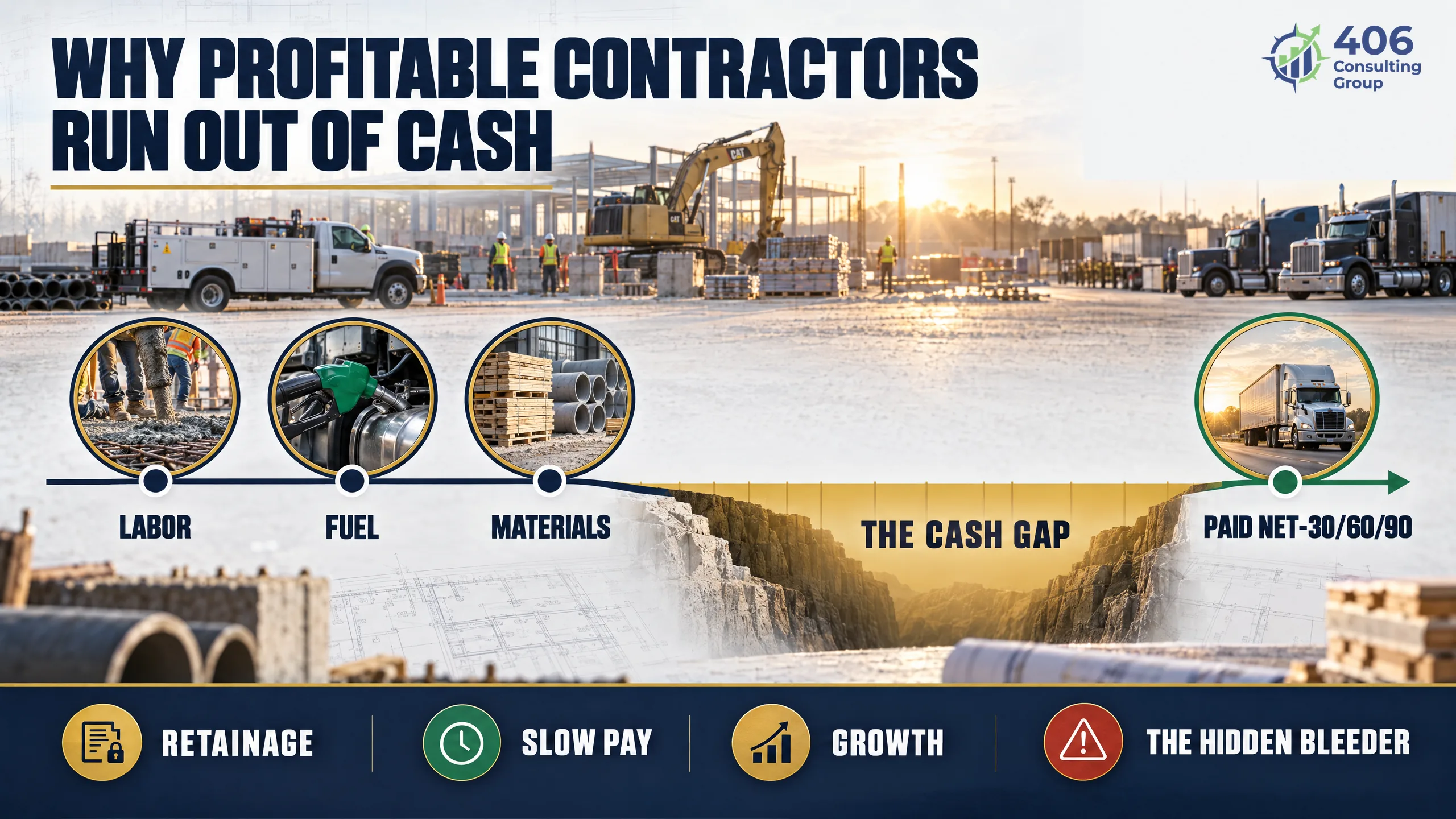
- Retainage. On construction jobs, 5–10% of every invoice is held back until the end. You did the work and paid for it, but a slice of your profit sits on someone else's balance sheet for months.
- Slow pay and the billing drag. Every day between finishing work and sending an accurate invoice is a day you finance the customer for free. In the trades and trucking, sloppy billing is a silent lender.
- Growth eats cash. More jobs and more trucks mean more payroll, fuel, and materials fronted before any of it gets paid. Growth feels like success and spends like a crisis.
- The hidden bleeder. One unprofitable division, lane, truck, or customer can quietly consume the cash the profitable work generates — and the blended P&L hides it.
First Move: Find the Bleeder
The instinct in a cash crisis is to chase revenue — take more work, run more trucks. That's often exactly wrong, because if some of that work loses money, growth accelerates the bleed. The first move in a real turnaround is the opposite: stop, and find where the cash is actually going.

This is the first thing we did on that bankruptcy turnaround: before touching sales, we broke the business down to find the piece draining the cash — and once it was clear, the owner could cut it and stop the bleeding in weeks, not quarters. You can't fix what the blended numbers hide.
WIP: The Number That Tells the Truth
For a contractor, the single most important — and most ignored — report is the work-in-progress (WIP) schedule. It compares how much of each job you've actually completed against how much you've billed. Bill ahead of the work (overbilled) and you're borrowing from the customer — that cash isn't really yours yet. Bill behind the work (underbilled) and you're the one lending money, often without realizing it. A clean WIP schedule tells you which, by job, and it's the first thing a sharp banker or surety turns to.
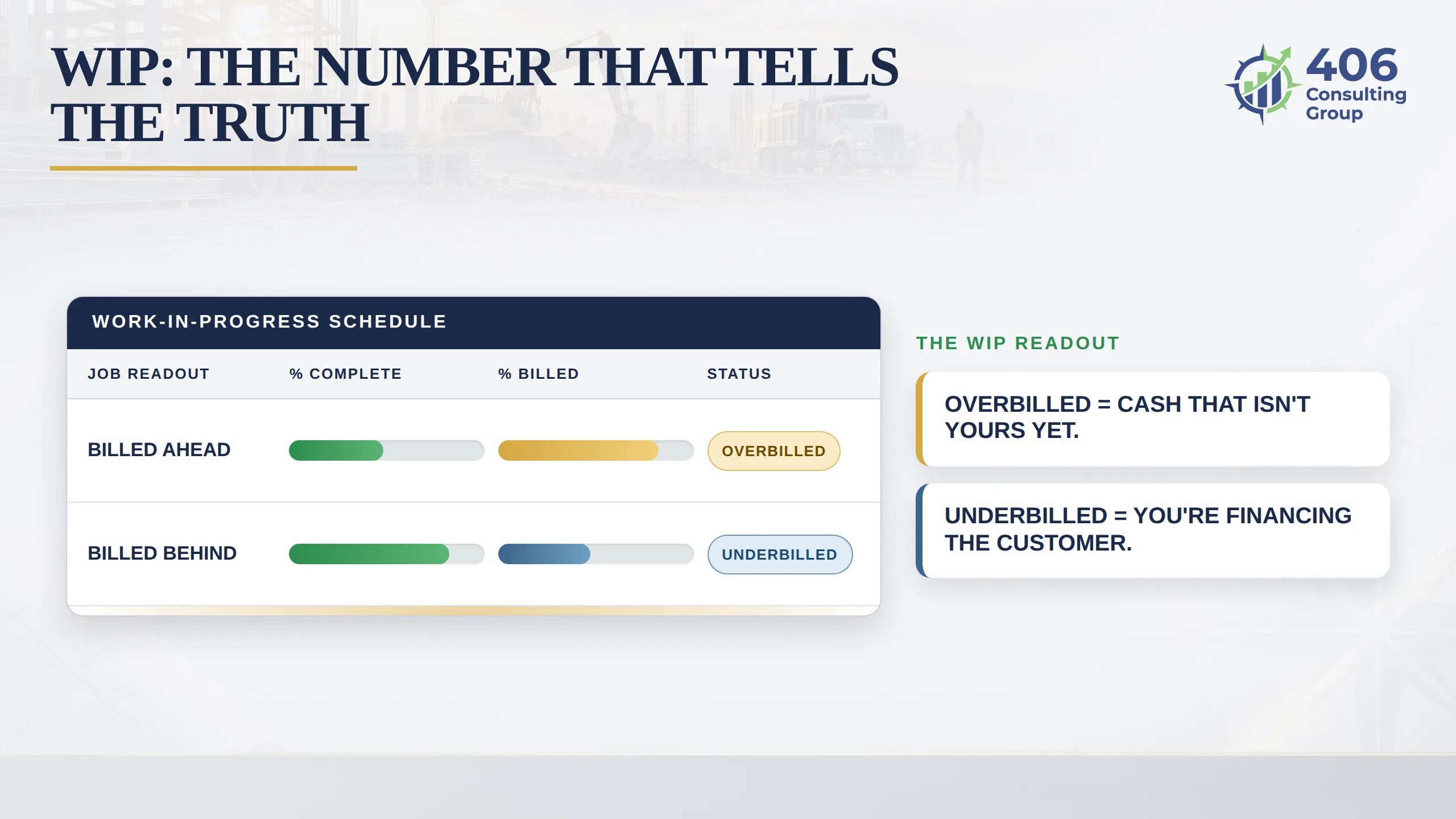
We go deeper on this in What Is a WIP Schedule (and Why Your Banker Wants One)? — if you bid and bill jobs over time, it's the report that keeps you honest with yourself.
Which Jobs (and Trucks) Actually Pay
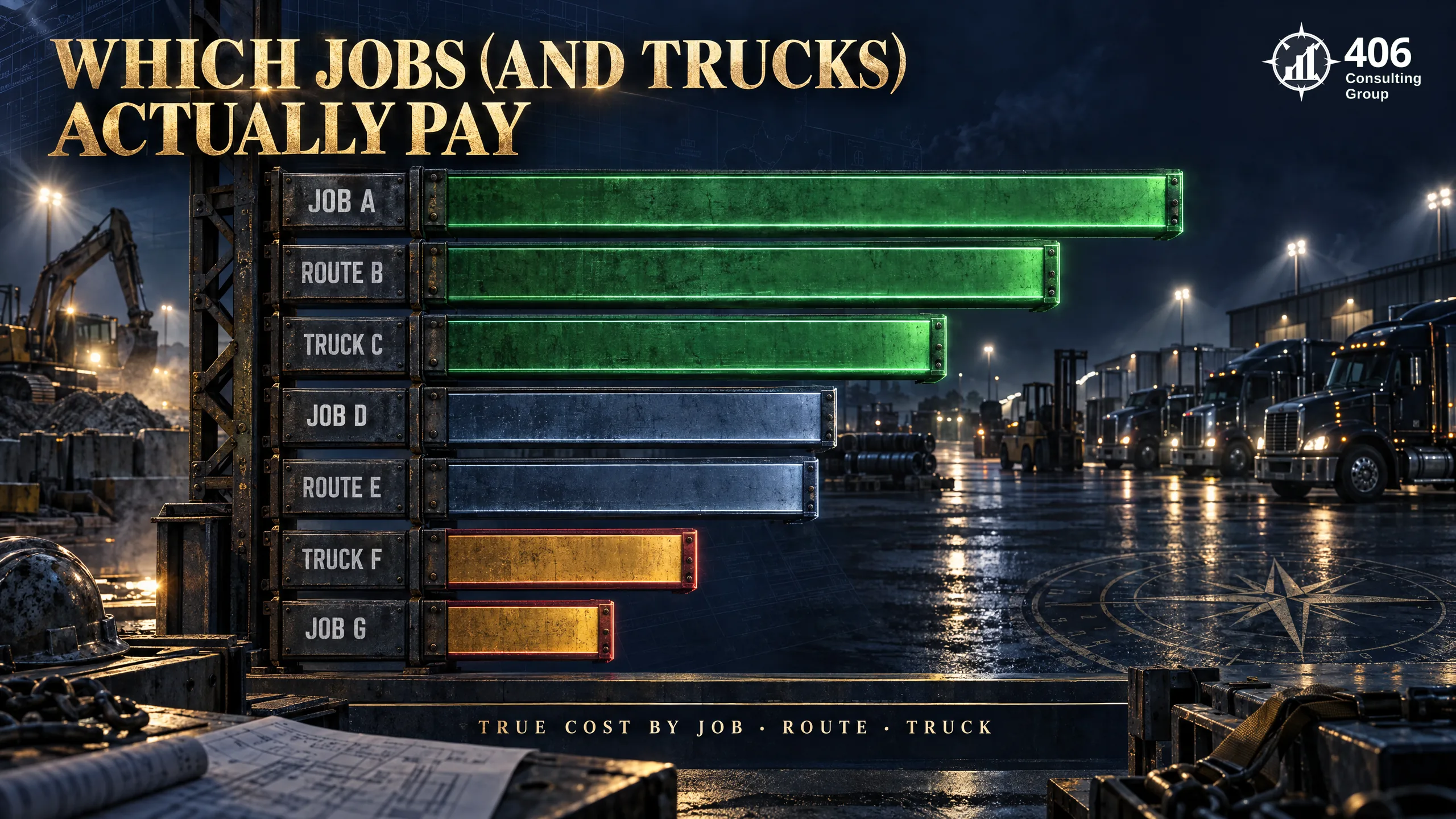
Ask most owners which work makes money and you get a feeling, not a number. In a turnaround, feelings are expensive. You need true cost by job, by route, by truck — labor, materials, fuel, equipment, subs, and the overhead that actually belongs to each. Do that and the picture usually surprises everyone: a few jobs or lanes carry the company, a few quietly lose money every time, and the “busy” ones in the middle barely break even. Once you can see it, you can price it, fix it, or walk away from it.
Turn the Cash Cycle Around
Once the bleeding stops and you know your real margins, the fastest cash comes from the cycle you already control: bill accurately the moment work is done, not weeks later; invoice progress on schedule instead of waiting for the end; chase retainage like it's money you're owed, because it is; and tighten collections so the average days-to-pay comes down. None of this requires more sales. It just stops you from financing everyone else for free.
- Bill the day work is complete — not at month-end
- Progress-bill long jobs on a schedule
- Track and collect retainage deliberately
- Shorten days-to-pay with real collections follow-up
Keep the Bank From Pulling the Plug
In a turnaround, your lender is either your lifeline or your executioner, and which one often comes down to whether they trust your numbers. Here's the part most owners never hear: a banker rarely pulls a loan because a business hit a rough patch. They pull it when they lose confidence — when the financials are late, the story keeps changing, and the owner can't explain what's happening or what the plan is. Walk in early with clean statements, a WIP schedule, a cash forecast, and a credible plan, and you're a borrower worth standing behind.
This is exactly my old seat. I spent years underwriting and reviewing commercial loans — I know what makes a lender nervous and what makes them say yes, because I was the one deciding. When we build your package, we build it the way the bank actually reads it. You're not guessing what the lender wants; you're working with someone who used to be the lender.
The Turnaround Sequence
Order matters. Do these out of sequence and you burn cash you don't have chasing the wrong fix.

- 1Stabilize cash. Build a 13-week cash forecast so you can see the squeeze coming and triage payments.
- 2Find and stop the bleeder. Isolate the unprofitable division, route, or customer and cut or fix it.
- 3Fix WIP, billing, and collections. Get accurate, on-time billing and clean WIP so cash comes in faster.
- 4Rebuild the lender relationship. Clean financials + forecast + plan, delivered before the bank asks.
- 5Grow on real margin. Only once you know which work pays — scale the winners, not the whole thing.
Why 406 for a Turnaround
A turnaround isn't a bookkeeping job — it's a whole-business problem that happens to show up in the numbers. That's the seat we sit in. Between us we've run operations, built the job-costing and systems that show where the money really goes, and spent years in commercial banking and underwriting on the other side of the lending desk — and we've taken a construction and trucking company from bankruptcy back to health. We've been the operator, and we've been the bank. When your business is in the ditch, that combination is exactly who you want in the truck with you — and we do it remotely, so help isn't limited to who happens to be down the road.
Frequently Asked Questions
How can a construction or trucking company be profitable and still run out of cash?
Because profit and cash are different things. You pay for labor, materials, and fuel up front but collect weeks or months later; construction adds retainage (a slice of every invoice held back until the end); growth fronts even more cash before any of it is paid; and one unprofitable division, route, or customer can drain the cash the profitable work generates. The P&L can look fine while the bank account empties — which is why a cash forecast and job-level margin matter more than the bottom line in a squeeze.
What's the first step in turning around a struggling contractor?
Stabilize cash, then find the bleeder. Build a 13-week cash forecast so you can see and triage the squeeze, then break the business down to find the specific division, route, or customer losing money. The instinct is to chase more revenue, but if some of that work loses money, growth makes it worse. You fix the bleed first, then fix billing and WIP, then rebuild the lender relationship, and only then grow — on the work you've proven makes money.
What is a WIP schedule and why does it matter in a turnaround?
A work-in-progress (WIP) schedule compares how much of each job you've actually completed against how much you've billed. Overbilled means you've billed ahead of the work and that cash isn't truly earned yet; underbilled means you're financing the customer. It reveals the real profit on jobs in progress and is one of the first reports a banker or surety reviews. In a turnaround it keeps you from mistaking borrowed cash for profit. We cover it in detail in 'What Is a WIP Schedule.'
Will my bank pull my loan if my business is struggling?
Not usually because of a rough patch alone — lenders pull loans when they lose confidence. Late or messy financials, a story that keeps changing, and an owner who can't explain the plan are what trigger it. If you come to the bank early with clean statements, a WIP schedule, a cash forecast, and a credible turnaround plan, you're far more likely to keep their support. Having someone who has underwritten loans build that package is a real advantage.
Does 406 Consulting Group help with business turnarounds?
Yes. 406 Consulting Group helps construction, trucking, and other field-operations businesses stabilize cash, find and fix unprofitable work, clean up WIP and billing, and rebuild the financials and lender relationship needed to recover — delivered remotely. Our founders bring operations experience, job-costing and systems depth, and years in commercial banking and underwriting, and we've helped take a construction and trucking company from bankruptcy back to health. We work from both the operator's seat and the banker's seat.
The bottom line
Profitable contractors and truckers go broke on cash timing, not profit. Find the bleeder, fix WIP and billing, and keep the bank's confidence — in that order. It's survivable; we've done it.
Keep Reading
External Resources