
Profitable On Paper, Broke in the Bank:
Where Your Money Actually Went
Your P&L says you made money. Your bank account says you didn't. Both are telling the truth — here's exactly where the cash went, why growing the business makes it worse, and how to see the crunch coming before Friday's payroll.

It's Friday, and payroll clears tonight. Maria — she owns a growing landscaping company in Missoula — is shuffling money between accounts for the third month running, refreshing the balance, doing the math on whether it'll go through. Two weeks ago her accountant sat across from her and said the business earned $90,000 last year. The number on her screen this morning is $4,000. And sitting there with her stomach in a knot, she's thinking the thought that quietly haunts more successful owners than any of them will admit out loud: If we made all that money, where is it — and what is wrong with me that I can't find it?
Read this next part slowly, because it will take some weight off your chest: nothing is wrong with you, and — despite how it feels — the business probably isn't broken either. Both numbers are true at the very same time. Your money wasn't stolen and it didn't evaporate — it went somewhere specific, and by the time you finish this article you'll be able to put your finger on every missing dollar. "We're profitable but I never have any money" is the most common and most quietly frightening feeling in small business, and it is not a mystery, a mistake, or a personal failing. It's mechanics — and the moment you understand the mechanics, that fear starts turning into the thing you actually want: control.
By Jason Anderson — Co-Founder, 406 Consulting Group. Big-firm-trained accountant who builds the cash-flow forecasting and financial systems that turn "where did it go?" into "here's what's coming."
Quick Answer: Profitable but Broke
- →Profit and cash are different things. Your P&L measures earnings; your bank account measures cash. Both can be true at once.
- →The money hides in receivables, inventory, debt principal, owner draws, equipment, and taxes — real cash out that your P&L doesn't show as expense.
- →Growth makes it worse before better — more sales tie up more cash in receivables and stock.
- →The fix is a cash-flow forecast — seeing cash 13 weeks out instead of reacting on Friday.
- →Profit is an opinion; cash is a fact. Run the business on the one that makes payroll.
Table of Contents
The Gut-Punch: Profitable on Paper, Broke in the Bank
If you've ever hunted for a profit number you simply could not find in your bank account, you already know the exact dread I mean — the kind that shows up at 2 a.m., or on the quiet drive home. Everyone tells you the business is "doing great." The tax bill agrees. And yet you're privately bracing for the month it all comes apart, moving money around to make payroll and wondering if you're secretly no good at this — or if the whole thing is a house of cards waiting for one bad week. So let me lift that off you right now: you are not bad at this, and it is nota house of cards. Your profit and your cash are simply two different measurements, and a perfectly healthy P&L can sit right next to a terrifying bank balance without either one lying to you.
Your P&L says
$90,000
Profit — a great year
Your bank says
$4,000
Cash — and payroll's Friday
Both are true. The gap between them is the whole story — so let's take it apart.
Two Statements, Two Truths
Your profit & loss statement is built on accrual accounting: it records a sale when you earn it and an expense when you incur it, whether or not the cash has actually moved. Your bank account is pure cash: money in, money out, right now. Those are two honest ways of looking at the same business, and they answer different questions. The P&L answers "is the business making money over time?" Your bank balance answers "can I pay what's due this week?" You need both — but only one of them makes payroll.
The P&L (accrual)
Records the sale when earned and the cost when incurred. Answers: "Am I making money?" Great for measuring performance — blind to timing.
The bank account (cash)
Records money only when it actually moves. Answers: "Can I pay what's due?" The truth about survival — blind to what you've earned but not collected.
Same month, two very different numbers
IllustrativeThe gap is real money — tied up in receivables and inventory. Both numbers are true at once.

When the two diverge, the cash didn't vanish — it moved somewhere the P&L doesn't call an expense. Here's where.
Where the Money Actually Went
Start at your profit number and walk it down to your bank balance, and the "missing" money reappears — every dollar of it. It didn't disappear; it changed shape into things the P&L doesn't treat as expenses. Here's Maria's $90,000 profit walking down to $4,000 in cash:
From profit to cash — where the $86,000 went

None of those lines is a loss. Each is cash that's still in your business — just not in your bank account. Let's look at the biggest culprits one at a time.
The Sale That Isn't Cash Yet
The moment you invoice a customer, your P&L counts the sale as revenue — and your profit goes up. But if that customer has 30, 60, or 90 days to pay, no cash has arrived. You've booked the profit and funded the work (materials, labor, your time) entirely out of your own pocket while you wait. Every unpaid invoice is a chunk of your profit sitting in someone else's bank account. For a growing business, that pile of accounts receivablecan be enormous — and it's the number-one reason profitable companies feel broke.
A sale isn't money until it's collected. Until then, you're the one financing your customer — and the bigger you grow, the more of your cash is out on loan to them.
This is fixable, and it's mostly about systems: invoice the day the work is done, not the end of the month; set and enforce clear terms; take deposits and progress payments; and actually follow up on what's overdue. Tightening collections by even a couple of weeks can transform your bank balance without adding a single sale.

Receivables are cash parked in your customers' hands. The next culprit is cash parked on your own shelves.
The Cash Sitting on Your Shelves
If you carry inventory, every unit on the shelf is cash you've already spent that hasn't sold yet. When you buy stock, cash leaves — but your P&L doesn't record an expense until the item actually sells (that's "cost of goods sold"). So you can have a profitable month while your cash quietly drains into a stockroom full of product. Over-ordering, slow-moving items, and "stocking up to be safe" all convert spendable cash into shelves you can't use to make payroll.
Cash out now
You pay for inventory the day it arrives.
Expense later
The P&L only records it when the item sells — sometimes months later.
The gap
That timing difference is cash sitting on your shelves, not in your bank.
Leaner inventory, better purchasing timing, and clearing dead stock all pull real cash back out of the shelves — money that was yours the whole time.
The Growth Trap: Why Getting Bigger Made It Worse
This is the cruelest twist of all, and it ambushes good businesses at their proudest moment: growth eats cash. Land the big contract, double your sales, and every single thing that devours cash swells right alongside it — bigger unpaid invoices, more inventory, payroll for the people you hired to handle the work, jobs you have to bankroll for months before anyone pays you. Your P&L has never looked better while your bank account has never felt tighter. It feels like a punishment for winning — and it is precisely why the fastest-growing companies are so often the ones that suddenly, shockingly run out of money. The sales aren't the problem. The problem is that growth has to be funded, and nobody warned you.
Last year
- $600K revenue, steady
- Receivables and stock manageable
- Cash comfortable
This year — revenue doubled
- $1.2M revenue, record profit
- Receivables & inventory doubled too
- Cash gone — funding the growth

Good growth and bad growth look identical on the P&L. The difference shows up only in cash — which is why you have to be able to see it coming.
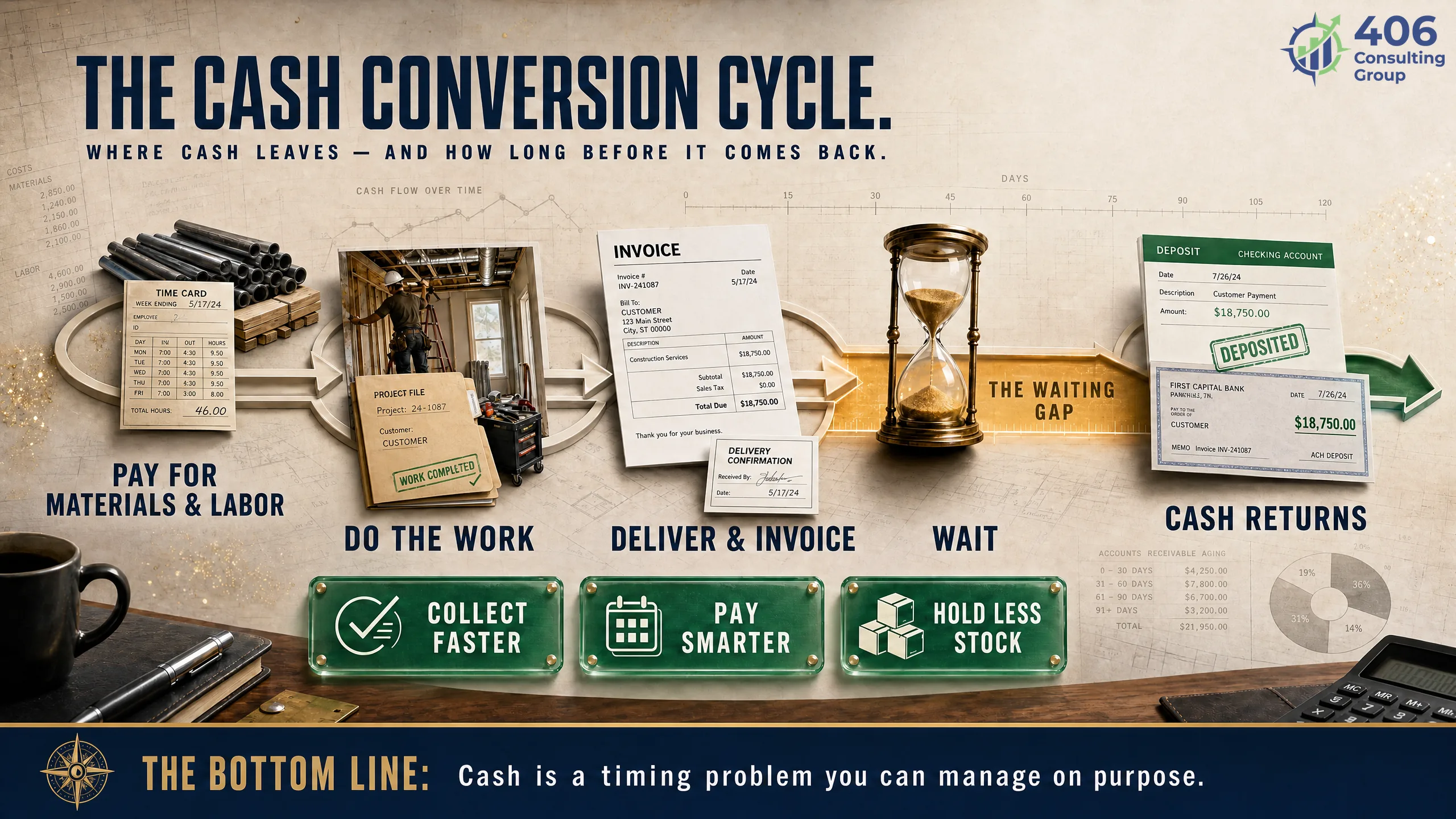
The Cash Conversion Cycle
There's one number that explains your bank balance better than almost any other: how many days pass between when cash leaves your business and when it comes back. You pay for materials and labor, do the work, deliver, invoice, and finally get paid — and every day in that gap is a day you're funding out of your own pocket. Shorten the gap and cash appears; lengthen it and cash disappears, no matter how profitable you are.
Every day in this cycle is a day you're financing the business yourself.
You have three levers, and you don't have to pull them hard to feel it: collect faster (tighter terms, deposits, prompt invoicing), pay smarter (use the terms your suppliers give you), and hold less inventory(buy closer to when you need it). Move the cycle from 60 days to 45 and you've funded a chunk of your own growth without a loan.
Managing the cycle is powerful — but it works best when you can see what's coming instead of reacting to what already happened.
From Reactive to Planned: The 13-Week Forecast
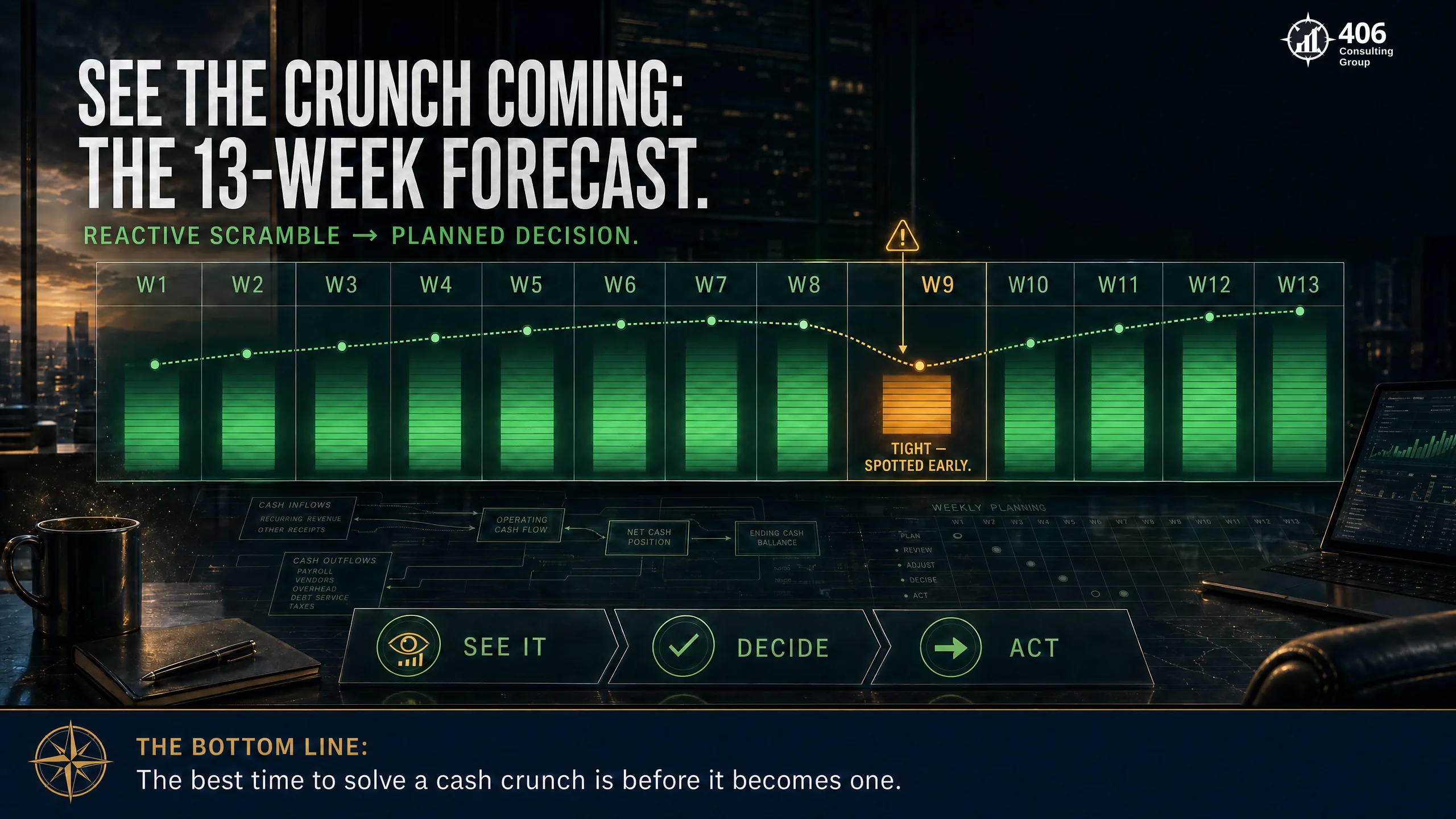
Here is where the fear turns into something better. Picture walking in on Monday already knowing which weeks over the next three months are going to be tight — and knowing, for each one, exactly what you'll do about it. That is what a cash-flow forecast gives you: a rolling 13-week view of the cash coming in and going out, week by week, so the crunch appears on your screen weeks before it appears in your account. No more discovering on Thursday that Friday is short. You saw it coming, you leaned on collections or timed a purchase or drew on your line on purpose, and payroll got met with a plan instead of a prayer. It turns cash from the thing that wakes you at 2 a.m. into a decision you make calmly, in daylight, from a position of strength.
Reactive
You find out about a cash crunch when the account is already low. Every fix is an emergency, made from a position of weakness.
Planned
You see the tight week coming weeks out and handle it calmly — collections, timing, or a deliberate draw. Decisions, not scrambles.
This is the single highest-leverage habit a cash-strapped-but-profitable business can build — and it's where a controller or CFO function starts earning its keep.
Profit Is an Opinion, Cash Is a Fact
There's an old saying in finance worth tattooing on the wall: profit is an opinion, cash is a fact. Profit depends on judgment calls — how you time revenue, how you value inventory, how you depreciate. Cash doesn't care about any of that; the money is either in the account or it isn't. The P&L is essential for understanding whether your business model works, and you should absolutely watch it. But you cannot run a company on it alone, because a business doesn't fail when it stops being profitable — it fails when it runs out of cash.
A business doesn't die when it stops being profitable. It dies when it runs out of cash — sometimes in its best year ever.
Watch both numbers, respect the difference, and make cash a number you manage on purpose rather than one you check with your stomach in knots.
What to Do — and How 406 Helps
The way out of "profitable but broke" is not more hustle — it's finally being able to see the cash you already have. Build a rolling 13-week forecast so a crunch is a heads-up instead of an ambush. Put a dead-simple cash dashboard in front of yourself — receivables, payables, bank balance, one glance. Attack the conversion cycle: invoice faster, hold firm on terms, stop over-buying stock. And price in the cash cost of growth, debt, equipment, and taxes before they land on you. Do this and the 2 a.m. math stops. You stop bracing for the business to blow up, and you start running it like someone who can finally see the road ahead.
This is exactly the work a fractional controller or CFO does — and it's a core rung on our Financial Maturity Ladder: moving from books that only look backward to a financial view that sees around corners. We build the forecast, set up the dashboard, and help you manage cash on purpose — with the whole-company view that connects your operations to your bank balance. The same clean, forward-looking numbers also make you the borrower a bank wants to back, which is a story in itself in whose side your banker is really on.
Tired of the Friday-payroll knot in your stomach?
Imagine knowing your cash three months out — every tight week spotted early, every one handled on purpose. That's the forecast we build with you, and it's the difference between bracing for the crunch and running the business from a position of strength. Start with where you stand today.

Your profit tells you the model works. Your cash tells you the business survives. Now you know how to read — and manage — both.
FAQ: Profit vs. Cash Flow
Why is my business profitable but I have no money?
Because profit and cash are two different things, and the gap between them is real cash that's tied up somewhere your P&L doesn't call an expense. The usual culprits: money owed to you in unpaid invoices (accounts receivable), cash spent on inventory sitting on the shelf, loan principal you repay (only the interest is a P&L expense), owner draws and distributions, equipment you bought for cash, and the tax bill. Add those up and the 'missing' money reappears — every dollar of it. You didn't do anything wrong and nothing was stolen; the cash simply changed shape into things that keep the business running. Seeing exactly where it went is the first step to getting control of it.
What's the difference between profit and cash flow?
Profit is an accounting measure from your P&L: it records a sale when you earn it and a cost when you incur it, whether or not money has actually moved. Cash flow is the real movement of money in and out of your bank account. The P&L answers 'is the business making money over time?' Your cash answers 'can I pay what's due this week?' You need both, but only cash makes payroll — which is why there's a saying worth remembering: profit is an opinion, cash is a fact. A business doesn't fail when it stops being profitable; it fails when it runs out of cash, sometimes in its best year ever.
Why does fast growth make my cash worse, not better?
Because growth has to be funded before it pays off. When sales jump, everything that ties up cash grows with them: you carry bigger unpaid invoices, buy more inventory, hire ahead of the revenue, and bankroll more jobs for months before customers pay. Your P&L looks better than ever while your bank account gets tighter — it feels like a punishment for succeeding. This is called over-trading, and it's exactly why some of the fastest-growing companies are the ones that suddenly run out of money. The sales aren't the problem; the problem is that nobody planned for the cash the growth would consume. A forecast is how you fund growth on purpose instead of getting blindsided by it.
What is a 13-week cash-flow forecast?
It's a rolling, week-by-week projection of the cash you expect to come in and go out over the next 13 weeks — about a quarter. Thirteen weeks is long enough to see trouble coming and short enough to forecast with real accuracy. Instead of finding out on Thursday that Friday's payroll is short, you see the tight week weeks ahead and handle it calmly — lean on collections, time a purchase, or draw on your line deliberately. It's the single highest-leverage habit a profitable-but-cash-strapped business can build, because it turns cash from a monthly gut-check into a decision you make on purpose, from a position of strength.
When should I get controller or CFO help for cash flow?
When the cash side of the business has outgrown what you can hold in your head — the classic signs are being profitable but constantly short, getting surprised by tax or payroll, or growing fast without knowing whether the growth is funded. A fractional controller or CFO builds the forecast, sets up a simple cash dashboard, tightens your cash conversion cycle, and helps you plan for the cash cost of growth, debt, and equipment before it hits. It's a core rung on our Financial Maturity Ladder — moving from books that only look backward to a financial view that sees around corners — and you can get it fractionally, long before a full-time hire makes sense.
Where the Cash Hides
Profit that isn't in your bank
See Your Cash Coming
Find your rung in about eight minutes.
About the Author
Jason Anderson
Co-Founder, 406 Consulting Group
Jason is a big-firm-trained accountant who builds the cash-flow forecasting, dashboards, and financial systems that let owners manage cash on purpose — with a whole-company view that connects operations to the bank balance.
Read the Full Story