
Whose Side Is Your Banker Really On?
How to Read the Incentives of Everyone You Pay for Advice
You pay your banker, lawyer, broker, and accountant — but paying someone isn't the same as them being on your side. A former commercial underwriter on reading the incentives and building a team that actually backs you.

Here's something I learned on the other side of the desk that most business owners never get to see: the banker who shakes your hand, the lawyer who sends the engagement letter, the advisor who takes you to lunch — they all send you an invoice and a smile, and not one of those things tells you whose interests they actually serve. I spent years in commercial banking and underwriting, sitting inside the credit decision on hundreds of loans. And the single most useful thing I can hand a small business owner isn't a tax tip. It's this: every professional you pay runs on incentives, and "I pay them, so they work for me" is the most expensive assumption you can make.
This isn't a case for cynicism. Most bankers, lawyers, and accountants are decent people doing their jobs. It's a case for literacy — learning to read whose interests line up with yours and whose quietly don't, so you can build a team that actually has your back. I'm going to start with the world I know best, the bank, and show you how a loan decision really gets made. Then I'll give you a test you can run on any advisor you'll ever hire — including us.
By Carrie Anderson — Co-Founder, 406 Consulting Group. Commercial banking and underwriting background with 300+ loan reviews — years spent inside the credit decision, seeing exactly how banks decide who they'll back and who they won't.
Quick Answer: Whose Side Are They On?
- →Every advisor runs on incentives — paying someone doesn't mean they answer to you.
- →Your banker often works for the bank first: protecting its capital, hitting targets, and winning your deposits.
- →The reason you're given for a "no" isn't always the real one — sometimes the bank just didn't want the relationship.
- →Run one test on anyone you hire: how are they paid, and what happens to them if they tell you no?
- →Build a team whose incentives line up with yours — and hold your accountant to the same test.
Table of Contents
The Comfortable Lie: "I Pay Them, So They Work for Me"
Picture Joe, who runs a plumbing company in Bozeman. Joe's banker takes him golfing, remembers his kids' names, and calls him by his first name at the branch. So when Joe needs a $250,000 line to buy trucks and stock inventory for a big commercial job, he walks in relaxed. Of course they'll do it — he's been a customer for nine years. Then the answer comes back a slow, hedged no, and Joe is blindsided. What he never understood is that his friendly banker doesn't decide his loan, and doesn't work for Joe. He works for the bank.
That's the comfortable lie almost every owner believes about the professionals around them: I'm the one paying, so they're on my side. But being paid by you and being aligned with you are two different things. The person's real loyalty runs to whoever signs their paycheck, sets their targets, and decides whether they keep their job — and that's rarely you. Until you know who that actually is for each advisor, you're negotiating blind.

To see how far apart "paid by you" and "on your side" can drift, it helps to sit where I sat — inside the bank.
From the Other Side of the Table
For years, my job was to look at businesses the way a bank looks at them — not as the owner sees his life's work, but as a file, a risk, and a return. I reviewed hundreds of loan requests. And once you've sat in that seat, you understand that a bank is optimizing for a handful of things, and your success is only one of them. A bank wants to protect its capital (get its money back, with interest), manage risk (avoid the loan that goes bad and lands on a report), hit its targets (loan officers carry goals like anyone in sales), and win your whole relationship — your deposits, your payroll accounts, your merchant services, because that's often where the real money is.
None of that makes a bank the villain. But notice that "help this specific owner grow" isn't on the list by itself — it only matters to the bank insofar as it serves those four goals. Your friendly relationship manager is the front door; behind him sits an underwriter and a credit committee who never golfed with you and who see only the file. That's who I was. And the gap between what the owner thinks is happening in the lobby and what's actually happening in the credit meeting is where most of the surprises live.

And here's the part almost nobody on the outside sees: the reason written on your decline letter is not always the reason you were declined.
The Reason They Give You Isn't Always the Real Reason
This is the thing I most want owners to understand, because it's invisible from the outside. Sometimes a file lands on the desk and the numbers are fine — the cash flow covers the debt, the collateral is there, the credit score is solid — and the bank still doesn't want to do the deal. Maybe the industry is out of favor that quarter. Maybe the bank is already heavy in that sector and doesn't want more. Maybe the relationship just doesn't fit what they're chasing right now. And when that happens, the applicant rarely hears "we just don't want your business." They get a tidy, defensible, credit-sounding reason instead.
I've watched applications get declined "on the credit" when the credit was never really the problem. The bank had simply decided it didn't want the relationship — and handed the owner a face-saving reason to explain the no.
Take that as an illustration, not a courtroom exhibit — the specifics vary and every bank is different. But the pattern is real, and it changes how you should operate. If a "no" can be about appetite rather than about you, then a decline is not a verdict on your business. It means you may be at the wrong bank, or telling your story to the wrong one. Owners who understand this don't crawl away ashamed after one rejection; they ask better questions, they shop the relationship, and they find the lender whose appetite actually matches their business. The ones who believe the letter at face value often stop trying — and that's the real cost.

So when does a banker's interest actually line up with yours, and when does it pull away? Both happen — and knowing the difference is everything.
When Your Banker Is On Your Side — and When They're Not
Start with the good news, because it's real: a great deal of the time your bank genuinely wants you to win. They lent you money and they want it back with interest, which means they need your business to thrive. A banker who understands your company can be a true asset — a source of capital as you grow, a sounding board, a connector. When your interests and the bank's point the same direction, that relationship is worth cultivating.
The trouble is the moments when they diverge, because those are exactly the moments you're most exposed. The personal guarantee that quietly puts your personal assets — potentially even your home — on the line for the business loan. The covenantburied in the agreement that lets the bank call the loan or freeze the line if a ratio slips — often right when a downturn means you need that cash the most. The line of credit that gets pulled or reduced in a soft quarter because the bank is de-risking its book, not because you did anything wrong. This is the "they hand you an umbrella and take it back when it rains" problem, and it's not personal — it's the incentive structure doing exactly what it's built to do.
On your side when…
You're healthy and growing, repayment looks solid, and lending to you helps them hit targets and win your deposits. They want you to succeed.
Not on your side when…
A covenant trips, a quarter softens, or the sector falls out of favor — and protecting the bank's capital suddenly outranks funding your growth.

You can't change the incentive structure. But you can change how well you understand it — starting with what the bank actually sees when it looks at you.
What the Underwriter Sees That You Don't
When your loan request hit my desk, I wasn't reading your dreams. I was reading your financial statements— and they told a story long before you said a word. Could your cash flow cover the new payment with room to spare? Was your balance sheet strong enough to absorb a bad month? Were your books clean and consistent, or did the numbers wander from one year to the next in a way that made me wonder what else was loose? A messy, inconsistent set of financials doesn't just look bad — it makes an underwriter nervous, and a nervous underwriter finds reasons to say no.
What I read first — before you say a word
Cash flow
Does it cover the new payment with room to spare?
Balance sheet
Strong enough to absorb a bad month?
Consistency
Do the numbers hold their story year to year — or wander?
Most owners never see their business through this lens, and it costs them. Two companies with the same real performance can get completely different answers because one presented clean, credible, lender-ready financials and the other handed over a shoebox. The numbers are the same; the storyis not. Knowing how the file gets read is exactly why we prepare our clients' financials the way a bank wants to see them — because we know how a bank reads them.
Two identical businesses can get opposite answers on the same numbers. The difference isn't the performance — it's the story the financials tell.
Understanding what strengthens a file is what lets you flip the whole dynamic — and become the borrower the bank actually competes to keep.
How to Be the Borrower a Bank Fights to Keep
Here's the empowering flip side of everything above: when you understand what the bank wants, you can give it to them and shift the leverage to your side of the table. The strongest borrowers aren't necessarily the biggest — they're the ones who are easy to underwrite and easy to trust. Clean monthly financials that don't change their story. A cash-flow forecast that shows you've thought past next week. No surprises. When a file is a clear, confident yes, the whole relationship changes — you get better rates, more flexibility, and a bank that calls youwhen it's trying to grow its loan book.
Take Sarah, who runs a small manufacturing shop in Kalispell. The first time she applied for expansion financing, her books were six months behind and she couldn't answer basic questions about her margins; she got a lukewarm offer with a personal guarantee and a tight covenant. A year later — clean books, a rolling forecast, and a one-page summary of exactly how the loan would be repaid — she walked into two banks and had them competing. Same business. Completely different power. That's not luck; that's preparation aimed at how banks actually decide.
Sarah, Year 1
- Books six months behind
- Couldn't explain her own margins
- Lukewarm offer — personal guarantee, tight covenant
Sarah, Year 2
- Clean books, current every month
- A rolling cash-flow forecast
- Two banks competing for the deal
This is squarely where a strong financial partner earns their keep — and it's the through-line of our Financial Maturity Ladder: moving from books that just barely comply to financials that open doors. But the bank is only one of the professionals in your life. The same lens applies to all of them.
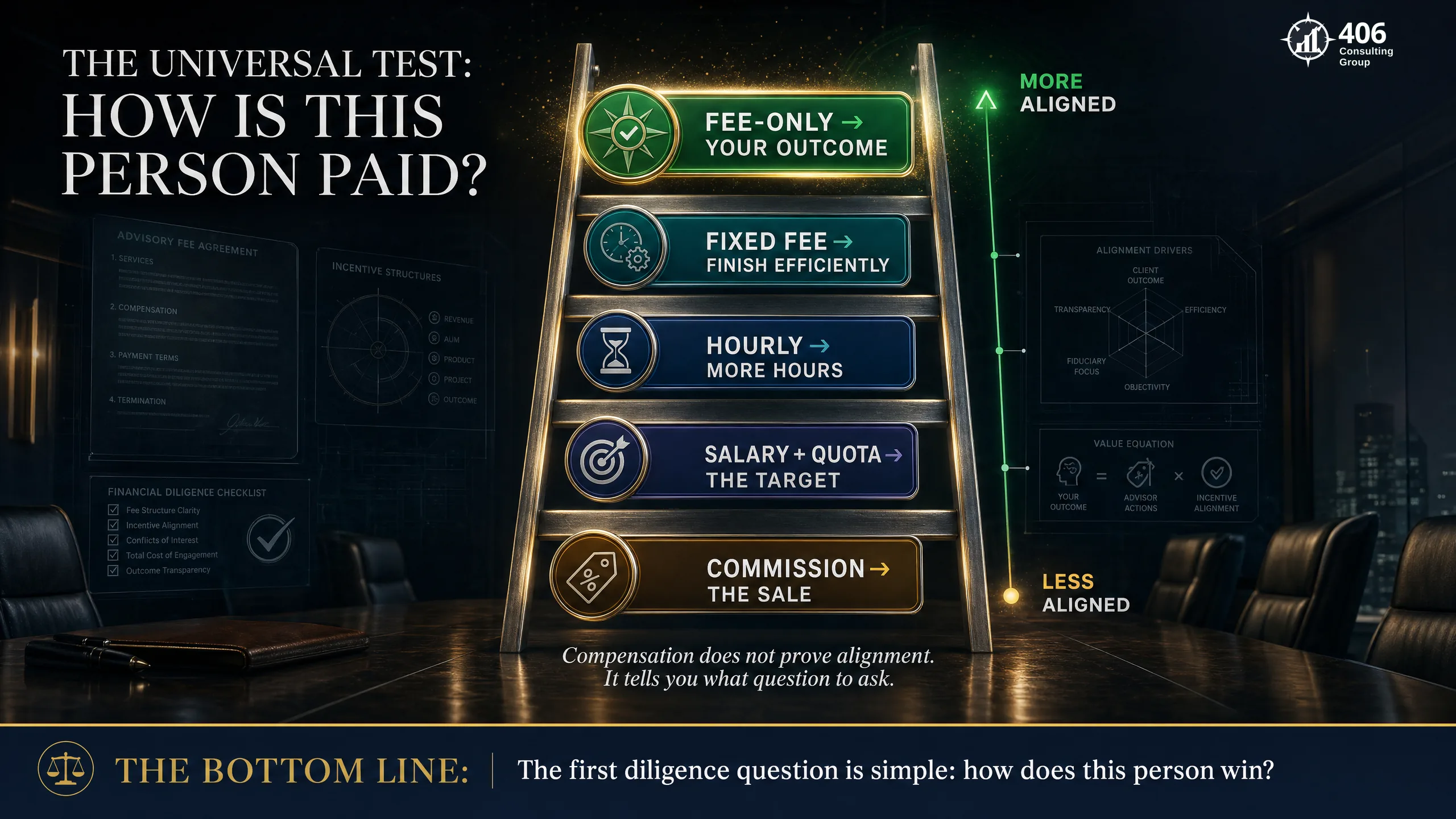
The Universal Test: How Is This Person Paid?
Everything I learned inside the bank rolls up into one question you can ask about anyone you pay for advice: how do they make their money, and what happens to them if they tell you no?Follow the incentive and you'll almost always find whose side someone is really on. It's not about assuming bad faith — it's about seeing the pull that's acting on every recommendation you get.
| How they're paid | Which way the incentive pulls |
|---|---|
| Commission on what they sell | Toward the sale — the product that pays them best may not be the one that fits you best |
| Salary + a sales target | Toward the target — friendly, but the quarter's goals sit behind the smile |
| Hourly / by the billable | Toward more hours — complexity and time can quietly serve the biller |
| Flat or fixed fee for a scope | Toward finishing efficiently — closer to aligned, if the scope is right |
| Fee-only, paid solely by you | Toward your outcome — no third party paying them to steer you |
Now let's run that test on the other professionals you lean on most.
Your Lawyer, Your Broker, Your Advisor
Your attorney, billing by the hour, has a subtle pull toward thoroughness that can tip into over-lawyering a simple deal — and if your lawyer is also the bank's preferred counsel or the other party's friend, ask plainly who they represent here. A good lawyer is worth every dollar; just know the meter is running and match the firepower to the job. (I'm speaking from the finance seat, not giving legal advice — for the document itself, that's your attorney's call.)
Your insurance broker and many financial advisors earn commissions on the products they place, which is why the "perfect" policy or investment sometimes happens to be the one that pays them most. The fix isn't suspicion — it's a single question: "How are you compensated on this?" A fee-only advisor, paid solely by you, has no product-maker paying them to steer you; a commissioned one might be excellent, but you deserve to know the pull before you weigh the advice. Anyone worth hiring will answer that question without flinching. (This is general education from the finance seat, not investment advice — how any specific product fits you is a conversation for a fiduciary who knows your full situation.)
Attorney
Billed hourly — a pull toward more hours
“Who do you represent here?”
Insurance broker
Commission — a pull toward the sale
“How are you paid on this?”
Financial advisor
Fee-only or commission — know which
“Are you a fiduciary?”
Ask it every time, and the picture gets clear fast — which brings us to the tells that reveal misalignment even when nobody says it out loud.
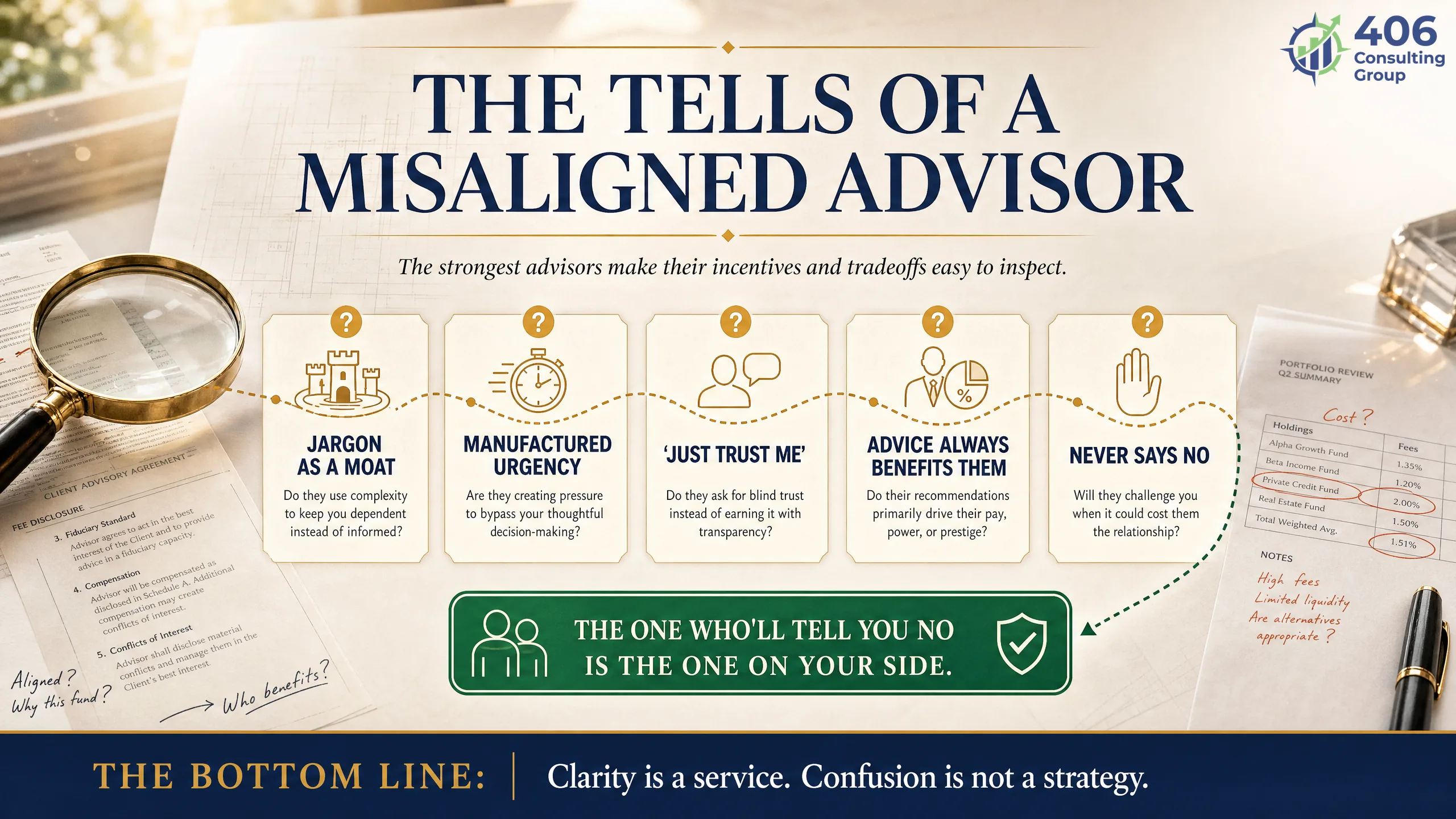
The Tells: How to Spot Misalignment
You don't need to read minds. Misaligned advisors leave the same fingerprints again and again, and once you know them you'll see them everywhere.
Jargon as a moat
They keep it complicated so you can't evaluate it yourself. A pro on your side makes things simpler, not murkier.
Manufactured urgency
"This rate/offer is only good today." Real advice can survive you sleeping on it.
"Just trust me"
Reluctance to explain the why — or how they're paid — is the loudest tell there is.
The recommendation always benefits them
If every answer points back to the product they sell, the advice is really a sales pitch.
They never tell you no
An advisor who only ever agrees isn't advising. The valuable ones will talk you out of things.
If I'm going to hold every other professional to this standard, honesty requires that I turn the lens on my own profession too.
Even Your Accountant
Run the same test on accountants, because we're not exempt. A firm billing purely by the hour has a quiet incentive toward inefficiency — the longer it takes, the more they bill. A compliance-onlyfirm makes its money filing your return and reconciling your books, and has little reason to tell you about the tax planning or the strategic moves that would actually change your bottom line, because that's not what they sell. And some firms lean on upsells that serve the firm more than the client. None of this makes accountants crooks — it just means our incentives deserve the same scrutiny as anyone's.
Misaligned
- Bills by the hour — slower is more revenue
- Compliance-only — files, never advises
- Upsells that serve the firm
Aligned
- Paid for your growth, not your hours
- In the room before the decision
- Prepares lender-ready financials; tells you the hard truth
So what does alignedlook like? An accountant whose incentive is your growth, not your hours — who's in the room before the decision, not just after the year closes; who prepares your financials the way a lender or investor reads them; and who will tell you the hard truth even when it's not what you hoped to hear. That's the standard we hold ourselves to, and you should hold us to it. Ask us how we're paid. Ask us to explain our advice in plain English. Ask us to tell you no when no is the right answer. If any advisor — us included — won't pass that test, that's your answer.
Once you're asking the incentive question out loud, you can assemble something most owners never have: a team that's genuinely on your side.
Building a Team That's Actually On Your Side
Put it all together and it's simple to practice. Ask the incentive question openly — "How do you make money on this?" is a fair question, and how someone answers tells you almost everything. Get important advice in writing, so recommendations have to stand on their reasoning. Cross-check the big decisions — your accountant and your attorney looking at the same deal from their own angles will catch what one alone would miss. And above all, prize the advisor who'll tell you no. The professional willing to lose a sale or an hour of billing to steer you right is the one whose incentives truly point at your success.
This is the seat we try to fill for the businesses we work with. Because of the years I spent inside the bank, we prepare your financials the way lenders and investors actually read them, we bring a whole-company view instead of a narrow accounting one, and we'll give you the straight answer — including when the answer is "not yet" or "don't." We help you become the borrower banks fight to keep, and the owner who can finally see whose side everyone is on.
Want an advisor whose incentives line up with yours?
We'll show you exactly how we're paid, prepare your numbers the way a bank reads them, and tell you the truth — even when it costs us the sale. Start with where your business stands today.

You pay a lot of people for advice. Now you know how to tell which of them are worth listening to.
FAQ: Reading Whose Side They're On
Does my banker work for me or the bank?
For the bank, first. Your relationship manager may genuinely like you and want you to succeed, but they answer to the bank — its capital, its risk limits, its sales targets, and its appetite for your deposits. Behind the friendly front person sits an underwriter and a credit committee who never met you and who see only your file. That doesn't make the bank an enemy; when you're healthy and growing, the bank's interest in getting repaid lines up nicely with your interest in growing. It's the moments they diverge — a tripped covenant, a soft quarter, a personal guarantee — where it pays to remember whose side they're structurally on.
Why do banks decline loans that look approvable?
Because the number on the page isn't the only thing being decided. Sometimes the cash flow, collateral, and credit all look fine and the bank still passes — the sector is out of favor, the bank is already heavy in that industry, or the relationship just doesn't fit what they're chasing that quarter. When that happens, applicants rarely hear "we don't want your business"; they get a tidy, credit-sounding reason instead. The practical takeaway: a decline isn't always a verdict on your business. It can mean you're at the wrong bank for your profile right now — so ask better questions, shop the relationship, and find the lender whose appetite matches your business.
How do I know if a financial advisor or broker is on my side?
Ask one question: "How are you compensated on this?" Advisors and insurance brokers who earn commissions on the products they place have a pull toward the product that pays them best, which isn't always the one that fits you best. A fee-only advisor, paid solely by you, has no third party paying them to steer you. A commissioned advisor can still be excellent — but you deserve to know the incentive before you weigh the advice. Anyone worth hiring will answer that question plainly and without flinching; reluctance to explain how they're paid is itself the answer.
What should I ask before hiring any advisor?
Run the universal test: how do they make their money, and what happens to them if they tell you no? Then watch for the tells of misalignment — jargon that keeps you from evaluating the advice yourself, manufactured urgency ("only good today"), "just trust me" instead of a clear why, recommendations that always happen to benefit them, and an advisor who never tells you no. Get important advice in writing so it has to stand on its reasoning, and cross-check big decisions across your accountant and attorney. The professional willing to lose a sale to steer you right is the one whose incentives actually point at your success.
How is 406 Consulting Group different from a compliance-only accountant?
A compliance-only firm makes its money filing your return and reconciling your books — so it has little reason to raise the tax planning or strategic moves that would actually change your bottom line, because that's not what it sells. We hold ourselves to the opposite standard: aligned with your growth, in the room before the decision rather than just after the year closes, and — because of Carrie's years inside commercial underwriting — preparing your financials the way lenders and investors actually read them. We'll also tell you the hard truth, including "not yet" or "don't." Ask us how we're paid and ask us to explain our advice in plain English; we should pass the same test we're telling you to run on everyone else.
The One Question
Ask it of anyone you pay for advice
"How do you make money on this — and what happens to you if you tell me no?" How they answer tells you whose side they're really on.
Want a Lender-Ready Business?
See where you stand in about eight minutes.
About the Author
Carrie Anderson
Co-Founder, 406 Consulting Group
Carrie spent years in commercial banking and underwriting — 300+ loan reviews — inside the credit decision most owners never get to see. She now helps businesses prepare their financials the way lenders and investors actually read them, and build a team of advisors whose incentives line up with the owner's.
Read the Full Story