
The Financial Maturity Ladder:
Why the Shiny Playbook Fails — and What Actually Moves a Business Forward
Most consulting sells a playbook for a summit you're not built to reach yet. The Ladder meets your business where it actually stands — Chaos, Compliance, Control, Strategy — and climbs it one rung at a time.

A while back we sat across from a business owner who was writing a national consulting firm a check for five figures every month. Good company, real revenue, a genuinely ambitious operator. He wanted us to look at what he was getting for it. So we did — the decks, the frameworks, the "operating system," the growth playbook. And here's the uncomfortable truth we had to tell him: there was almost nothing in it he wasn't already getting from us, and in a few places our own models were sharper. What he was really paying for was a shiny playbook and a very confident story about the riches on the other side of it.
That meeting crystallized something we'd watched for years: consulting engagements fail not because the playbook is wrong, but because it's aimed at a business that isn't built to run it yet. You can't bolt a Strategy-level growth plan onto Chaos-level books and expect it to hold. The plan has to start from where the business actually is — function by function — and move it up deliberately. That idea is the reason we built the Financial Maturity Ladder, and it's the spine of this whole piece.
By Jason Anderson — Co-Founder, 406 Consulting Group. We build financial infrastructure, controls, and business systems for growing companies from a whole-company view — which is exactly the work the Ladder is designed to sequence.
The Short Version
- →Most consulting fails because it sells a playbook, not a plan built for where your business actually stands.
- →Financial maturity isn't revenue or ambition — it's consistency and repeatable systems you can set a watch by.
- →The Ladder has four rungs — Chaos, Compliance, Control, Strategy — and you climb them one at a time.
- →Different parts of your business sit on different rungs; the real work is aligning them before you climb.
- →Our Financial Maturity Assessment tells you your rung in about eight minutes.
Table of Contents
The Five-Figure-a-Month Wake-Up Call
The national-consultancy model is seductive, and it's everywhere now: a polished brand, a stage, a testimonial reel, and a promise that a proven "operating system" will unlock the growth you know is in there. Owners sign up because the story is good and the fear is real — everyone else seems to have a system, and you're running the business out of your head. So the check goes out, month after month, often well into five figures.
What you tend to get back is a binder. Frameworks, scorecards, a cadence of meetings, a vocabulary. Some of it is genuinely useful. But when we've been asked to look under the hood of these engagements — and we've been asked more than once — the pattern repeats: the material is generic, the models are ones we already run (sometimes in a thinner form than ours), and almost none of it is anchored to the specific, unglamorous condition of the client's actual books and operations. The owner is being sold the summit without anyone checking which rung they're standing on.
A brilliant growth playbook run on books you don't trust isn't a strategy — it's an expensive way to make bad decisions faster.

We're not against playbooks. We build them. What we're against is selling the playbook first — before anyone has honestly assessed whether the business can execute it. That inversion is the single most common reason these engagements quietly fail, and it's worth understanding exactly why.
Why So Many Consulting Engagements Fail
A growth plan is a set of instructions that assumes certain things are already true: that your numbers are accurate, that you can see margin by job or product line, that cash is forecast rather than felt, that the team executes a process the same way twice. When those assumptions hold, a good playbook is rocket fuel. When they don't, the same playbook is a list of things your business physically cannot do yet — and every unmet instruction becomes another reason the owner feels like a failure while the invoices keep coming.
Picture a construction company that's genuinely excellent in the field — crews plan and sequence jobs beautifully, quality is high, clients are loyal — but whose accounting is a month behind, whose job costing lives in the owner's head, and whose invoicing goes out whenever someone gets to it. Now hand that company a Strategy-level plan built around real-time dashboards, capital allocation, and acquisition math. It won't fail because the plan is bad. It'll fail because the plan is standing on a floor that isn't there.
The Shiny Playbook
- • Starts with the destination
- • Generic, sold at scale
- • Assumes infrastructure you may not have
- • Measures you against the summit
- • Priced on aspiration
A Plan Built for Your Rung
- • Starts with where you actually are
- • Specific to your books and operations
- • Builds the infrastructure first
- • Measures you against the next rung
- • Priced on the work in front of you
The fix isn't a better playbook. It's a way to measure where a business really stands before you prescribe anything — and to be honest that "where it stands" isn't one number.
What Financial Maturity Actually Means
Here's the part that surprises people: financial maturity has very little to do with how much money you make, and everything to do with consistency. It's not ambition, it's not revenue, it's not the size of your crew. It's whether the core financial rhythms of your business happen the same way, on the same schedule, every single time — whether or not the owner is paying attention that week.
Take something as ordinary as invoicing in a construction company. A mature operation runs on hard dates, not good intentions: subcontractors know the cutoff to get their invoices in; client invoices go out on a fixed day of the month, every month; checks to subs are cut on a set schedule tied to that cycle. Those dates don't move because someone got busy. That discipline is worth more than it looks — it's what makes cash predictable, what keeps job costs current enough to trust, and what lets you actually close the books on time. A company that invoices "when we get to it" can be very profitable and still be immature, because the profit is riding on luck and heroics instead of a system.
Maturity is the stuff you can set a watch by. If a process only happens when the owner chases it, it isn't a process yet — it's a favor.

That's why maturity is something you can measure, not just aspire to. Consistency leaves fingerprints — reconciled accounts, on-time closes, segmented reporting, a budget you actually compare against. Line those markers up and a business sorts naturally onto one of four rungs.
The Financial Maturity Ladder: Four Rungs
We named the four rungs — Chaos Survivor, Compliance Achiever, Control Commander, and Strategy Master — so they'd be impossible to fudge (we'll use the short form for each below, and it's the same label the assessment gives you). Every business we work with can find itself here, and the honesty of that placement is the whole point — you can't build the right plan until you've admitted which rung you're on.
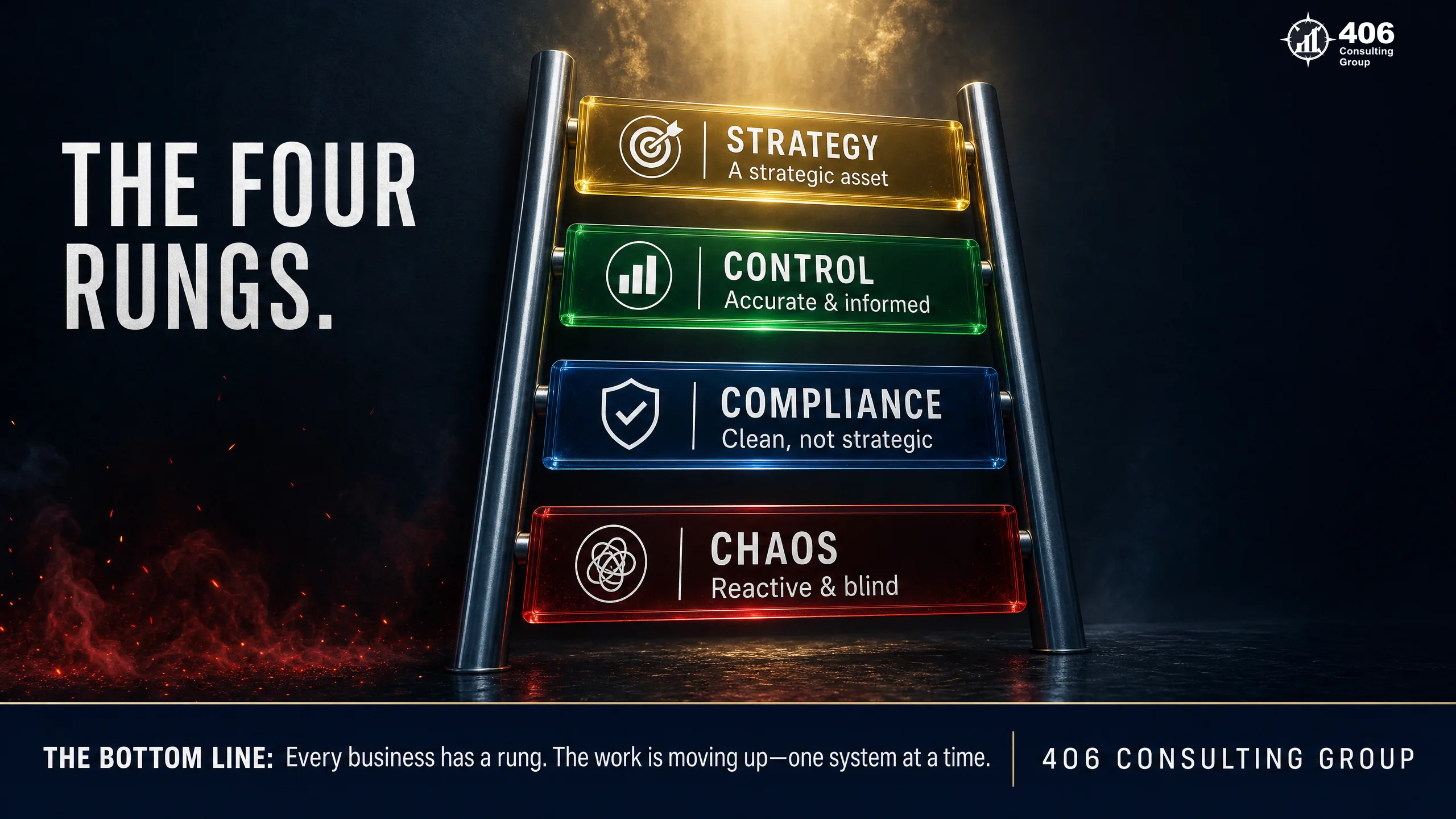
Chaos Survivor — Reactive & blind
The foundation is unstable. Books you don't trust, no real visibility, decisions made on gut and bank balance. Every month is a scramble.
Compliance Achiever — Clean, not strategic
The basics work — books get done, taxes get filed — but the financials aren't driving decisions. You're meeting requirements, not leveraging them.
Control Commander — Accurate & informed
Solid controls and real visibility. You make informed decisions from accurate data. The shift now is from managing what happened to planning what's next.
Strategy Master — A strategic asset
Your financial infrastructure is a weapon, not a burden. You forecast accurately, plan proactively, and use the numbers to drive growth, capital, and exit.
The rungs aren't judgments about how smart or hardworking you are — plenty of brilliant operators run Chaos-level books. They're a map. And like any ladder, the only way up is one rung at a time.
Walking the Rungs: Chaos to Strategy
It's worth sitting with each rung, because most owners recognize themselves the moment they read the honest description — and recognizing the rung is what makes the next move obvious.
Chaos feels like flying blind. The books are behind or untrusted, nobody could produce a clean P&L on short notice, and cash is a feeling rather than a forecast. It's not a character flaw — it's simply the absence of a foundation, and it's costing real money in missed opportunities and avoidable risk. The first job here isn't strategy; it's a clean, reconciled set of books and a monthly close that actually happens.
Compliance is where a lot of decent businesses plateau. The books get done and the taxes get filed, so it feels handled — but the numbers are a rear-view mirror, not a dashboard. There's no segmented reporting, no forecast driving decisions, and the accountant is reactive. It's stable, and stability is a real achievement, but the financials aren't yet earning their keep.
Most businesses that feel "stuck" are stuck at Compliance — clean books, no leverage. The problem isn't effort; it's that nobody has turned the numbers into decisions.
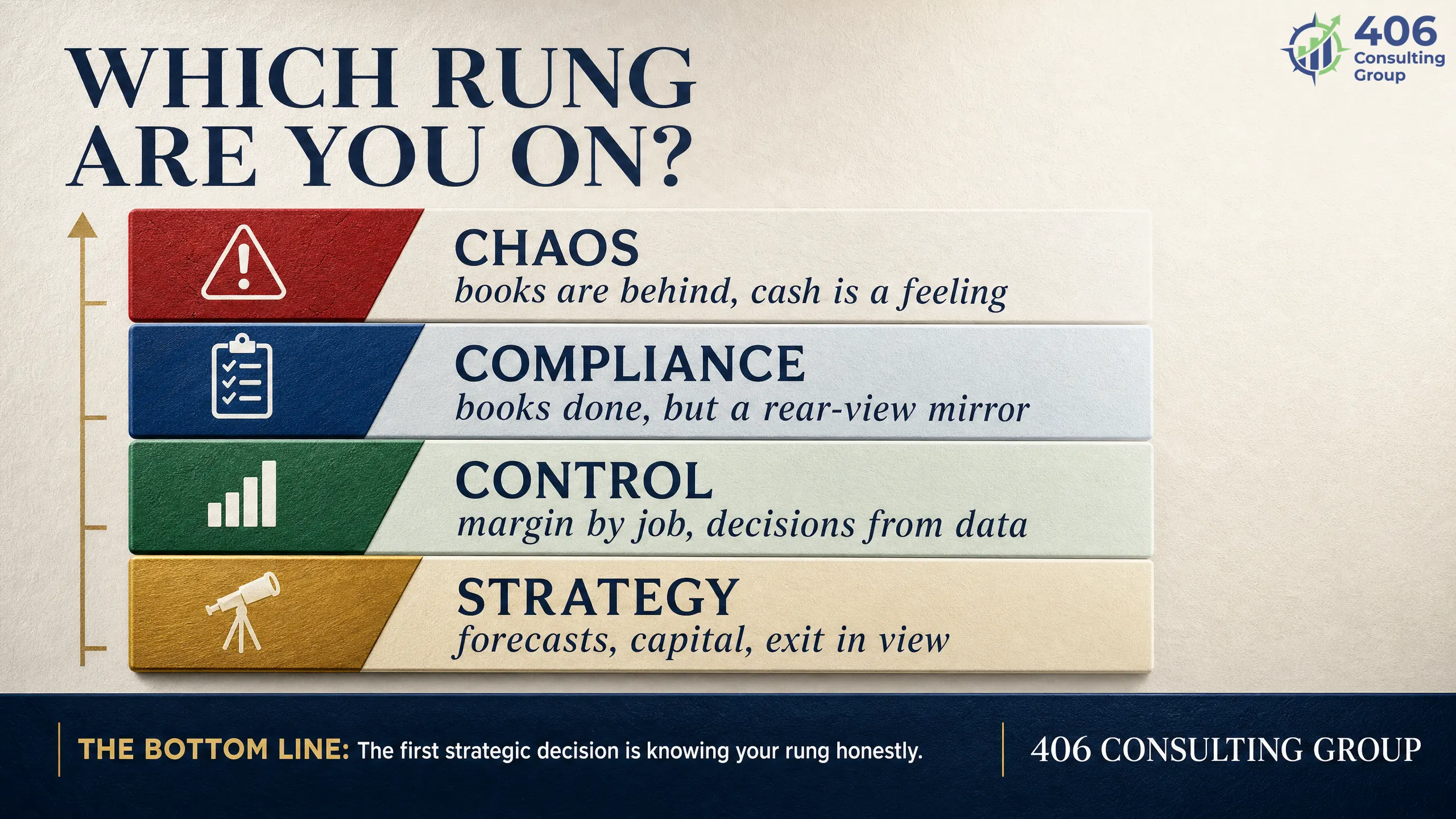
Control is where the numbers start working for you. Reporting is accurate and timely, you can pull margin by job, department, or client, and you make decisions from data instead of instinct. This is the rung where a controller-level function earns its cost many times over. The next frontier is looking forward — turning that clean data into forecasts and plans.
Strategy is the summit the playbooks promise. Here, your financial infrastructure is a genuine asset: rolling forecasts, scenario planning, disciplined capital allocation, and a real view toward growth, acquisition, or exit. The irony is that the businesses actually operating here got there by climbing the lower rungs first — not by buying the summit up front.
The Part Playbooks Miss: Alignment
Here's where a single maturity score falls apart — and where most off-the-shelf consulting goes wrong. A business isn't on one rung. Different functions sit on different rungs at the same time. That construction company might be Strategy-level at planning and sequencing jobs — genuinely world-class in the field — while its accounting is stuck in Chaos and its cash management barely reaches Compliance. Average those together and you get a meaningless number that hides the exact gap that's holding the company back.
Growth stalls at the lowest rung, not the highest. You can be the best builder in the valley, but if your finance function can't tell you which jobs made money, you'll keep taking work that quietly loses it — and no amount of field excellence fixes that. The functions have to be aligned: brought up to a common rung so they can actually support each other, instead of one department sprinting while another drags.
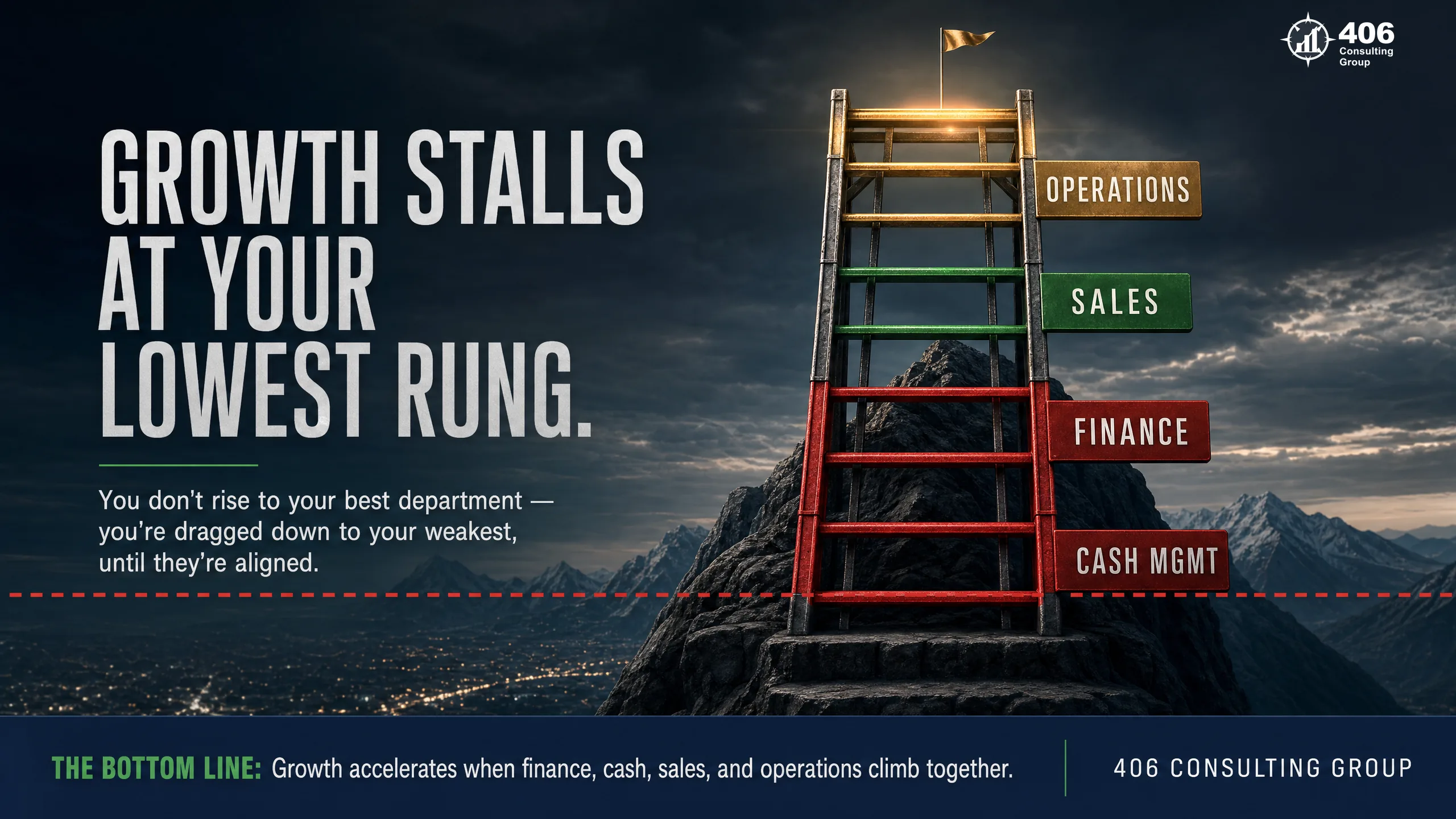
This is why we assess a business the way we do — and why we design systems from a whole-company, cross-departmental view rather than through a narrow accounting lens. Operations, sales, finance, and admin all have to move up together, because a change in one ripples into the others. That perspective is the thing the national playbook can't sell you off a shelf: it only comes from actually looking at your business, function by function.
You don't rise to the level of your best department. You get dragged down to the level of your weakest one — until they're aligned.
How You Actually Climb — One Rung at a Time
You don't skip rungs. Each one builds the foundation the next one stands on, and the work that moves you up is different at every level. That's the sequence a real plan follows — and, not by accident, it maps directly onto the work a business needs at each stage.
From Chaos to Compliance
Build the foundation: a clean chart of accounts, every account reconciled, a monthly close that actually closes, and financial statements you can trust. This is bookkeeping done right — the floor everything else stands on. Typically 3–6 months of focused work.
From Compliance to Control
Add oversight and insight: controller-level review, segmented reporting and KPIs, proactive tax planning, and the first real forecasting and variance analysis. The numbers start driving decisions. Usually a 6–9 month build.
From Control to Strategy
Bring in the forward view: multi-year financial strategy, cash and capital optimization, scenario planning, and advisory on growth, acquisition, and exit. A CFO-level function turns clean data into direction.
Staying at Strategy
Maintain and sharpen the infrastructure, advise on complex decisions, optimize tax at an advanced level, and plan for succession or exit. The summit is a discipline, not a finish line.
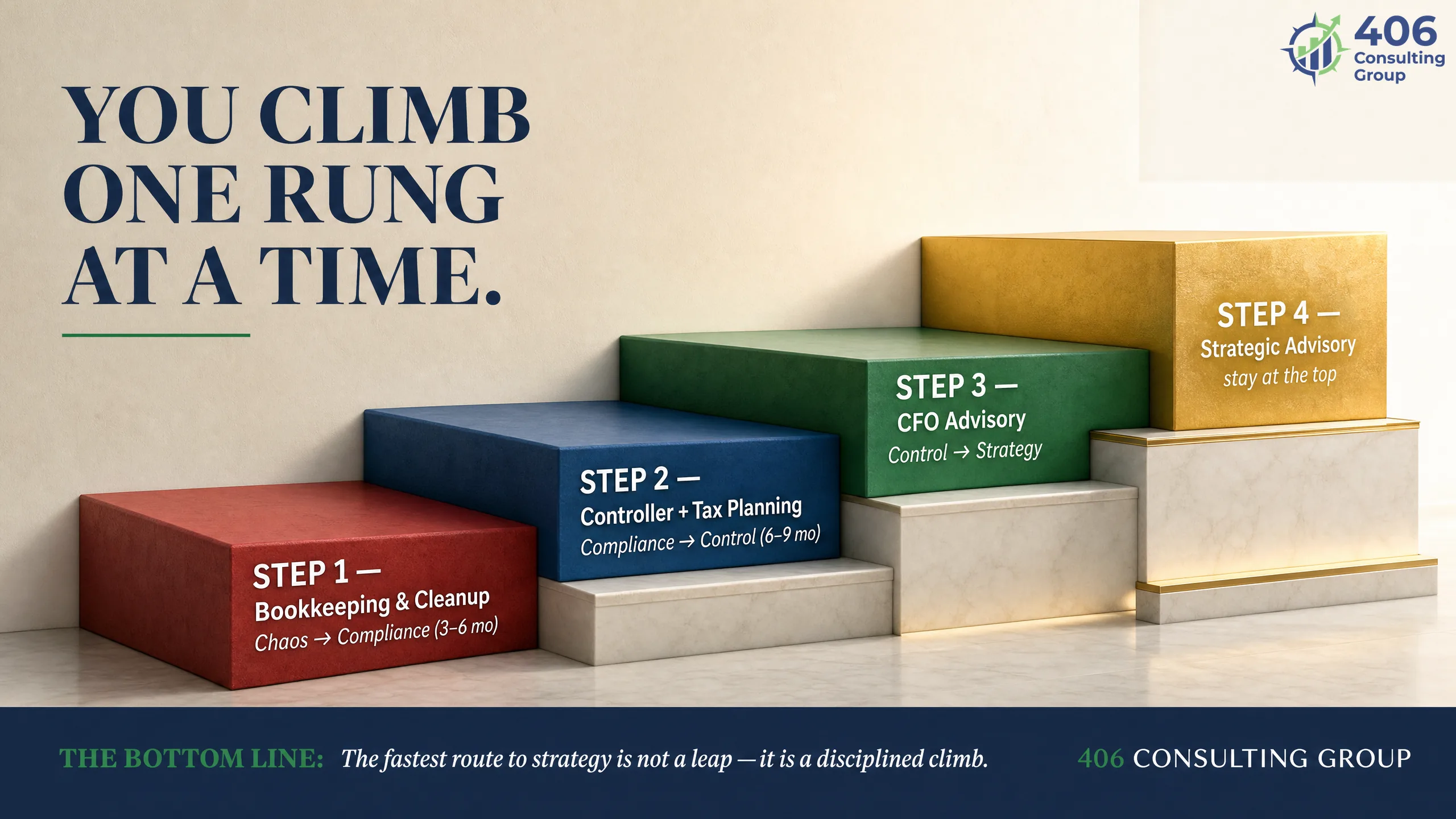
Notice what this is: not a motivational summit, but a staircase with a real next step at every level — bookkeeping to controller to CFO to strategic advisory. You buy the rung you need, when you need it.
A Plan Built for Your Rung, Not a Playbook
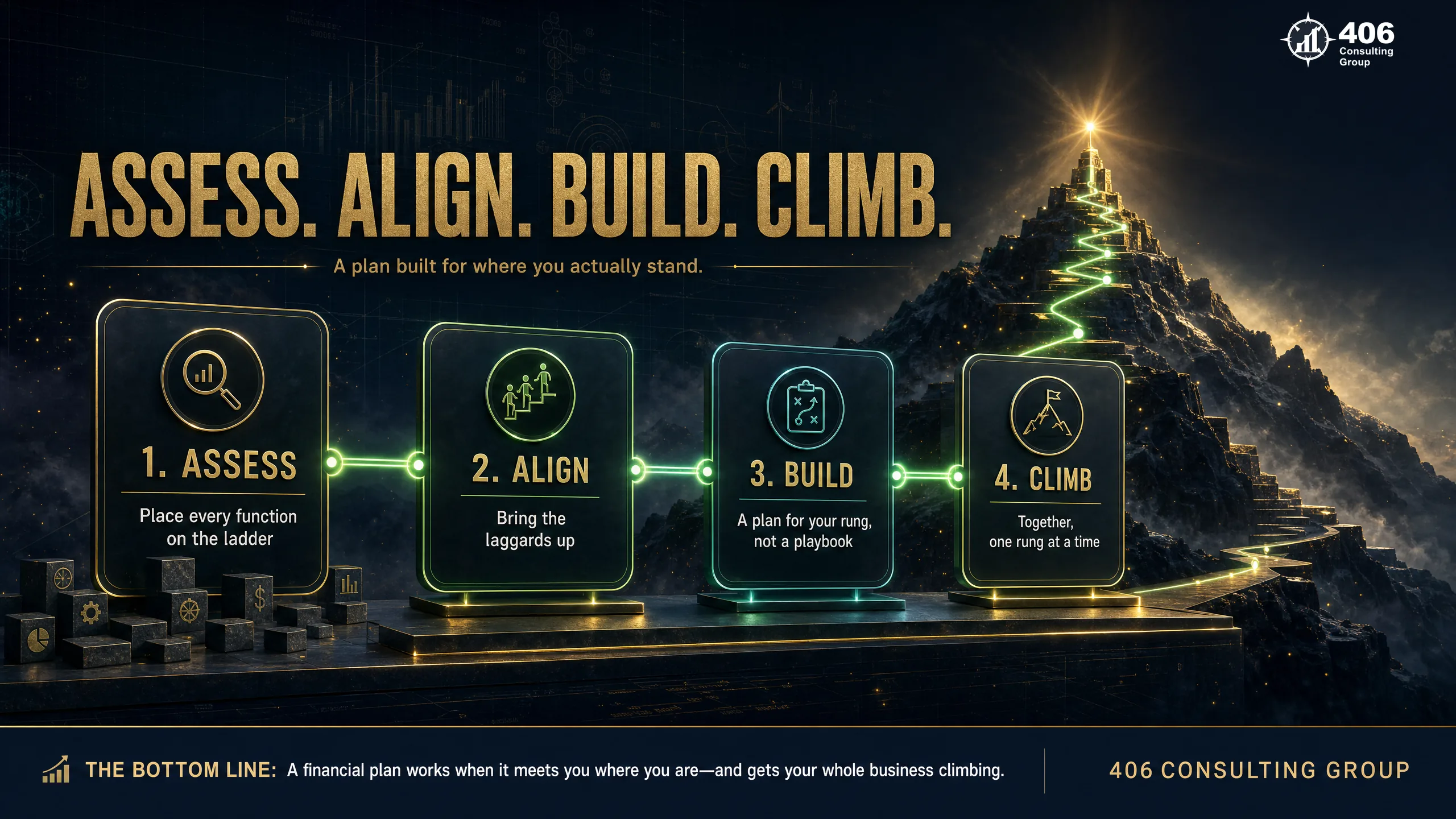
This is the whole difference between what we do and what the five-figure-a-month firm was selling. We start by finding out where you actually stand — every function, honestly placed on the ladder. We align the ones that have drifted apart. Then we build the plan for the rung you're on and the one right above it, and we do the work with you until you're standing on it. Only then does the next rung's plan make any sense.
It's less glamorous than a stage and a growth-riches promise. There's no binder that fixes a business that can't yet trust its own numbers. But it's the version that actually compounds — because every rung you climb makes the next plan executable instead of aspirational. That's not a knock on ambition; it's how ambition finally gets traction. Every time we've been asked to look inside one of these engagements, this is the part that was missing.
The 406 approach, in one line
Assess where every function stands → align them to a common rung → build the plan for that rung → climb, together, one rung at a time.
If your books are the thing holding the plan back, the honest first move is to see the whole cost of that gap — which is the exact territory of the hidden cost of no systems.
Find Your Rung
You can't build the right plan until you know which rung you're on — so start there. Our Financial Maturity Assessment is eight honest questions and about eight minutes, and it places you on the ladder and shows you the specific next step to the rung above.
Locate yourself honestly
Take the assessment — and resist the urge to grade on a curve. The value is in the honest placement of each function, not a flattering score.
Find your lowest rung
Identify the function dragging the rest down. Growth stalls there, so that's where the first real work is — no matter how strong everything else looks.
Climb deliberately
Build the foundation for the next rung and move up before you reach for the one after. A plan you can execute today beats a playbook you can't.
Wherever you land, there's a real next step — and it's a lot cheaper than a playbook you're not built to run yet.
FAQ: The Financial Maturity Ladder
What is the Financial Maturity Ladder?
It's our framework for describing where a business actually stands financially, across four rungs — Chaos, Compliance, Control, and Strategy. Chaos is a reactive, low-visibility foundation; Compliance means the books get done but aren't used strategically; Control means accurate data and informed decisions; Strategy means your financial infrastructure is a proactive asset driving growth. We built it because a plan is only useful if it starts from where you are, and 'where you are' needs an honest, shared vocabulary. Our Financial Maturity Assessment places you on the ladder in about eight minutes.
Why do so many consulting engagements fail?
Because they sell a playbook before checking whether the business can run it. A growth plan quietly assumes your numbers are accurate, your margins are visible, your cash is forecast, and your team executes a repeatable process — the markers of a higher rung. When those aren't in place, the same plan becomes a list of things the business can't do yet, and it fails not because the ideas are wrong but because the foundation isn't there. Meeting a business where it actually stands, function by function, is what prevents that.
How is financial maturity different from just being profitable?
You can be very profitable and still be immature. Maturity is about consistency and repeatable systems, not the size of your revenue. A company that invoices 'when we get to it' might be making good money, but the profit is riding on luck and heroics rather than a process you can trust and repeat. Maturity shows up as hard cutoffs and cadences — invoices out on a fixed day, reconciliations current, the monthly close actually closing — the disciplines you can set a watch by. That consistency is what makes profit durable and the numbers trustworthy enough to plan from.
Can different parts of my business be on different rungs?
Almost always, and that's the key insight most one-number assessments miss. A construction company can be Strategy-level at planning and running jobs while its accounting sits in Chaos and its cash management barely reaches Compliance. Growth stalls at your lowest rung, not your highest — so the job is to align the functions, bringing the laggards up to a common level so they support each other instead of one sprinting while another drags. That's why we design systems from a whole-company, cross-departmental view rather than a narrow accounting one.
How does 406 Consulting Group use the ladder with clients?
We start by placing every function honestly on the ladder, then align the ones that have drifted apart, then build a plan for the rung you're on and the one directly above — and we do the work with you until you're standing on it. The work maps to the rung: bookkeeping and cleanup to move out of Chaos, controller-level oversight and tax planning to reach Control, and CFO-level strategy and advisory to operate at Strategy. It's deliberate rather than glamorous, but it compounds — each rung makes the next plan executable instead of aspirational. Start with the Financial Maturity Assessment to find your rung.
Keep Reading
The Financial Maturity Ladder
Stop Buying the Summit. Find Your Rung.
406 Consulting Group builds a plan for where your business actually stands — assess, align, and climb from Chaos to Strategy, one rung at a time. Start with the assessment, or talk it through with us.
The Four Rungs
Where does your business stand?
Not Sure Which Rung You're On?
Eight questions, about eight minutes.
About the Author
Jason Anderson
Co-Founder, 406 Consulting Group
Jason and the 406 team build financial infrastructure, internal controls, and business systems for growing companies — designed from a whole-company view. The Financial Maturity Ladder is how they meet a business where it actually stands and climb it deliberately, instead of selling a playbook it isn't built to run.
Read the Full Story