
You're Paying Your Best Employee to Quit:
The Hidden Cost of No Systems
Your top performer is doing three jobs, burning out, and you can't even see which one makes money. That's not hustle — it's operational chaos you're paying for invisibly. Here's the real cost, and the fix.

Every growing business has one: the person who holds the place together. The one who knows where everything is, catches every dropped ball, and stays late without being asked. The owner brags about them — "I don't know what we'd do without her." Here's the uncomfortable part: that sentence is usually literal. You don't know what you'd do without her, because she's quietly doing three or four jobs at once — and she's closer to quitting than you think.
This isn't a story about a loyal employee. It's a story about what her overload is really costing you — a cost you can't see because you've never measured it. The owner who says "I can't afford to hire" is almost always already paying for that hire, and then some, through inefficiency, errors, and risk that never show up on the P&L as a line item called "chaos." You're not saving money by running lean and heroic. You're bleeding it. Let's find the leak.
By Jason Anderson — Co-Founder, 406 Consulting Group. Big-firm-trained accountant who spends most of his time helping owners see the money hiding inside their own operations.
The Short Version
- →Your best person is doing three or four jobs — and burning out doing them.
- →"Hustle" is often just chaos with good PR — heroics filling the gap where a system should be.
- →You're already paying for the hire — through errors, rework, key-person risk, and your own firefighting.
- →You can't see it because you don't measure it — nobody knows which of those jobs makes money.
- →The fix: separate the jobs, measure each, then decide — hire, redeploy, automate, or cut.
Table of Contents
The Employee Who Does Everything
Let's make it concrete. Meet Kalispell Cabinetry, a fifteen-person shop doing about $3M a year, and meet Jenna. Her title is "office manager." What she actually does is run four jobs: she handles scheduling and dispatch for the install crews, she does all the purchasing and vendor management, she owns customer quotes and follow-up, and she quietly took over onboarding new hires and prepping payroll because nobody else would. The owner, Ryan, will tell you Jenna is the best hire he ever made. He's right, and that's exactly the problem.
Jenna hasn't taken a real vacation in two years — the one time she tried, her phone didn't stop. She's the first one in and the last to leave. She's also, as of about three weeks ago, quietly updating her résumé, because being indispensable stopped feeling like a compliment and started feeling like a trap. Ryan has no idea. From where he sits, everything's running fine. That's the thing about this kind of problem: it looks perfectly healthy right up until the day it doesn't.

You almost certainly have a Jenna. Maybe it's an employee. Maybe — be honest — it's you. Either way, the question isn't whether she's valuable. It's what that four-jobs-in-one arrangement is actually costing you, and why you can't see it.
"Hustle" Is Just Chaos With Good PR
We've built a whole mythology around the scrappy team that does whatever it takes. And there's something real in it — early on, hustle isthe system, because there's no room for anything else. But somewhere between the garage and fifteen employees, "everyone wears every hat" stops being a virtue and becomes a liability wearing a virtue's clothes. The heroics that felt like grit at $500K feel like barely-controlled chaos at $3M, and the only reason it doesn't collapse is that one or two people are absorbing the shocks personally.
A system is just the opposite of a hero. A hero is a person who holds knowledge and process in their head and makes it work through sheer effort. A system is that same knowledge and process written down, assigned, and measured, so it works whether that person is there or not. When you don't have systems, you don't actually have a business yet — you have a group of people heroically re-solving the same problems every week. That's not hustle. That's an unbuilt company held up by exhausted individuals.

The tell is simple: if a key person taking a two-week vacation would genuinely frighten you, you don't have a system there. You have a Jenna. And a Jenna is expensive in ways your accountant never shows you — until now.
The Four Hidden Costs of No Systems
None of these show up on your income statement, which is exactly why they're dangerous. Here's what the four-hats arrangement is quietly costing Kalispell Cabinetry — and you.
Key-person risk: it all walks out the door
The day Jenna leaves, four jobs and everything she knows leave with her — the vendor relationships, the quirks of the scheduling, the informal fixes nobody wrote down. You won't find one person to replace her, and the knowledge isn't recoverable.
Opportunity cost: your best people on your lowest-value work
Jenna is sharp enough to be improving your quoting or your margins. Instead she's chasing a purchase order. Every hour a capable person spends on work a $22/hour coordinator could do is an hour not spent on the work only they can do.
Errors and rework: the tax on context-switching
A person juggling four jobs makes more mistakes — a double-ordered material, a quote that goes out two days late and loses the job, a missed vendor discount. Each one is small. Together, across a year, they add up to a number that would make you wince.
The invisible growth ceiling
You can't take on more work, because the system that runs the current work is a person who's already at 110%. Growth doesn't stall because of demand — it stalls because the operation can't absorb it without Jenna breaking.

Add those up and the "lean" operation isn't lean at all. It's carrying a heavy, invisible cost — and paying it every single month.
The False Economy of "I Can't Afford to Hire"
Here's Ryan's mental math: hiring a purchasing-and-scheduling coordinator would cost him, say, $48,000 a year, and he "can't afford it." So he doesn't. What he misses is that he's already paying for it — he just can't see the invoice. Let's make the invisible visible with rough, illustrative numbers for a shop like his:
| What the chaos costs (illustrative) | Rough annual figure |
|---|---|
| Owner firefighting ~8 hrs/week that a system would prevent | $60,000+ of owner time |
| Jobs lost to slow or late quote follow-up | a few deals — tens of thousands |
| Errors & rework — double orders, missed discounts, redo's | $15,000–$30,000 |
| The eventual cost of replacing Jenna when she quits | often 50–200% of her salary |
| The coordinator you "can't afford" | $48,000 |

The exact figures vary by business, but the shape almost never does: the cost of the chaos dwarfs the cost of the fix. "I can't afford to hire" is usually the most expensive sentence a growing owner says — because the alternative isn't "spend nothing." It's "keep spending more, invisibly, forever."
You Can't See It Because You Don't Measure It
Ask Ryan which of Jenna's four jobs makes the most money and he can't answer — not because he's careless, but because nothing about her work is measured. The quoting function might be the single highest-leverage activity in the whole company, or the purchasing might be quietly leaking margin, and he has no way to know. It's all blended into "Jenna," the same way a company-wide P&L blends a profitable job with a losing one. You can't manage what you refuse to measure, and you can't measure what you've never separated.
This is the same disease we diagnosed in unit economics, where the busiest truck turns out to be the least profitable — just pointed at people and roles instead of trucks. And it's the cousin of the problem in the accidental bookkeeper, where a capable person doing a job they were never built for costs far more than the specialist would. The through-line is always the same: the money hides in the things you don't measure, and inefficiency is invisible until you put a number on it.
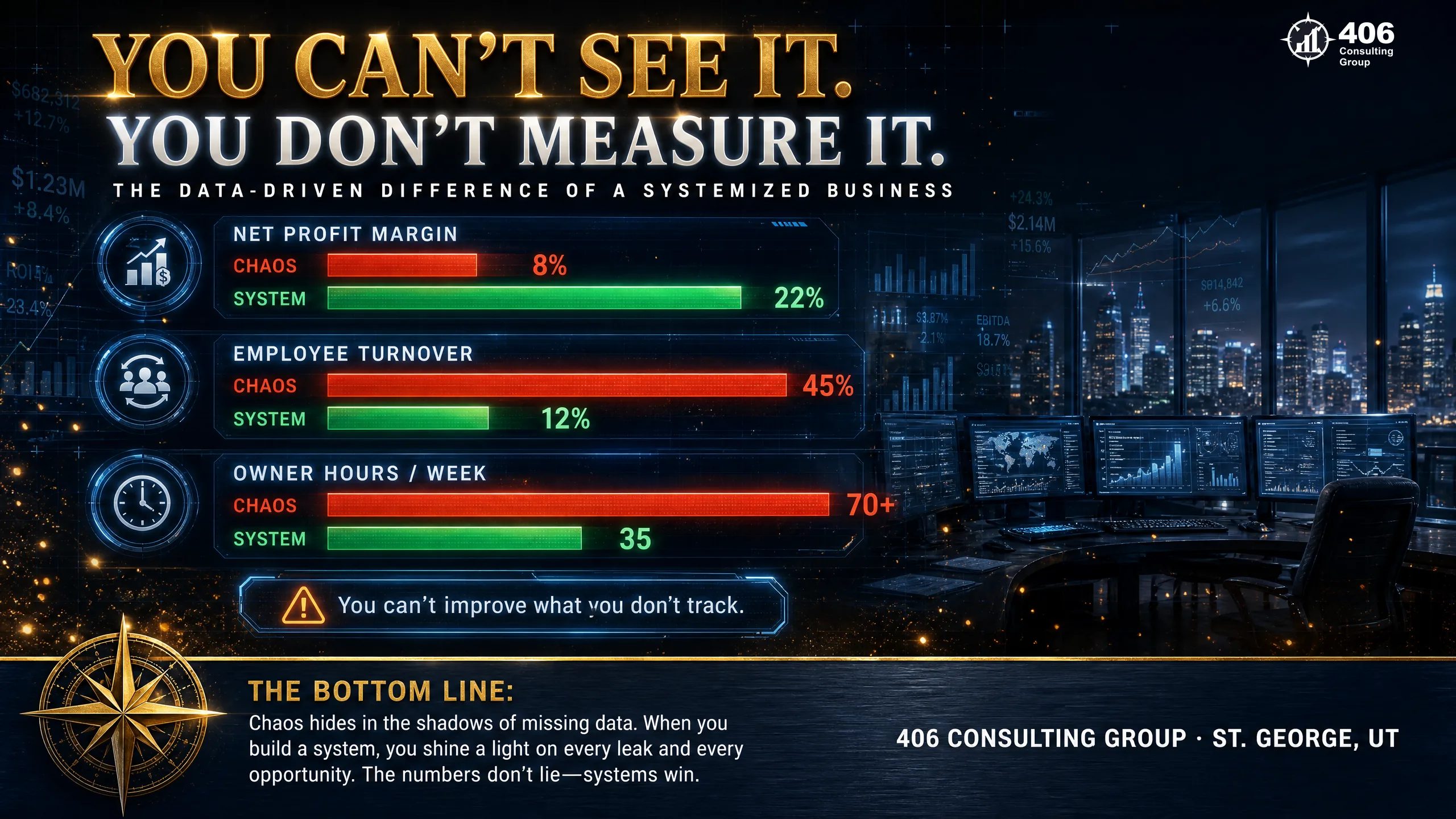
Measurement is the flashlight. Until you shine it, the leak just keeps running in the dark.
What Happens When She Quits
Play it forward. One Tuesday, Jenna gives two weeks' notice. Now Ryan discovers, all at once, exactly how much she was holding. The install schedule falls apart because nobody else knows how she sequenced it. Purchase orders get missed; a job stalls waiting on materials. Quotes stop going out. Ryan himself steps in to plug the biggest holes, which means he stops selling and stops leading, which means the whole company slows down. He tries to hire a replacement and learns the hard way that there is no single person who does all four of Jenna's jobs — because those four jobs were never supposed to be one role.
Three to six months later, having spent a fortune in recruiting, overtime, lost jobs, and his own sanity, Ryan finally builds the systems and hires the roles he "couldn't afford" — except now he's doing it in crisis instead of on purpose, and it costs him several times more. The bitter joke is that the quit didn't create the cost. The cost was there the whole time. The quit just sent him the bill all at once.

The good news: none of this is inevitable. It's just what happens when you wait for the crisis instead of getting ahead of it.
Systems Aren't Bureaucracy
Here's where a lot of owners flinch, because "systems" sounds like binders, red tape, and the soul-crushing process of a big company. It's the opposite. A system, in a fifteen-person shop, is just three simple things: a documented way the work gets done, a clear owner for each piece, and a measured outcomeso you know it's working. That's it. It's not a manual nobody reads; it's the difference between "ask Jenna" and "here's how we do this, and here's the number that tells us it's working."
Done right, systems don't cage your people — they free them. A documented, owned, measured process means Jenna can take a vacation, a new hire can get productive in a week instead of a quarter, and your best people can spend their talent on the work that actually needs it instead of re-solving the same logistics every day. Systems are how a business stops depending on heroics and starts running on design.
And critically, systems are what make the invisible visible — because a measured process produces numbers, and numbers are what let you finally see where the money and the waste actually are.
Separate, Measure, Decide
The fix is a sequence, and it starts with pulling the four jobs apart. Once you can see them as distinct functions instead of one blurry "Jenna," you can put a rough number on the time and value of each — and then make a deliberate decision about every one, instead of defaulting them all onto your best person.
| For each job, decide: | When it's the right call |
|---|---|
| Hire for it | It's a real, ongoing role that doesn't need your star — a coordinator, a bookkeeper, an admin. Cheaper than the chaos, every time. |
| Redeploy your star to it | It's high-leverage work only your best person can do — pricing, key accounts, quality. Free them from the low-value stuff to do it. |
| Automate or systematize it | It's repetitive and rules-based — scheduling, reminders, reordering. Software and a documented process do it without a person. |
| Cut it | It turns out nobody actually needs it, or it loses money once you can finally see its economics. Stop doing it. |
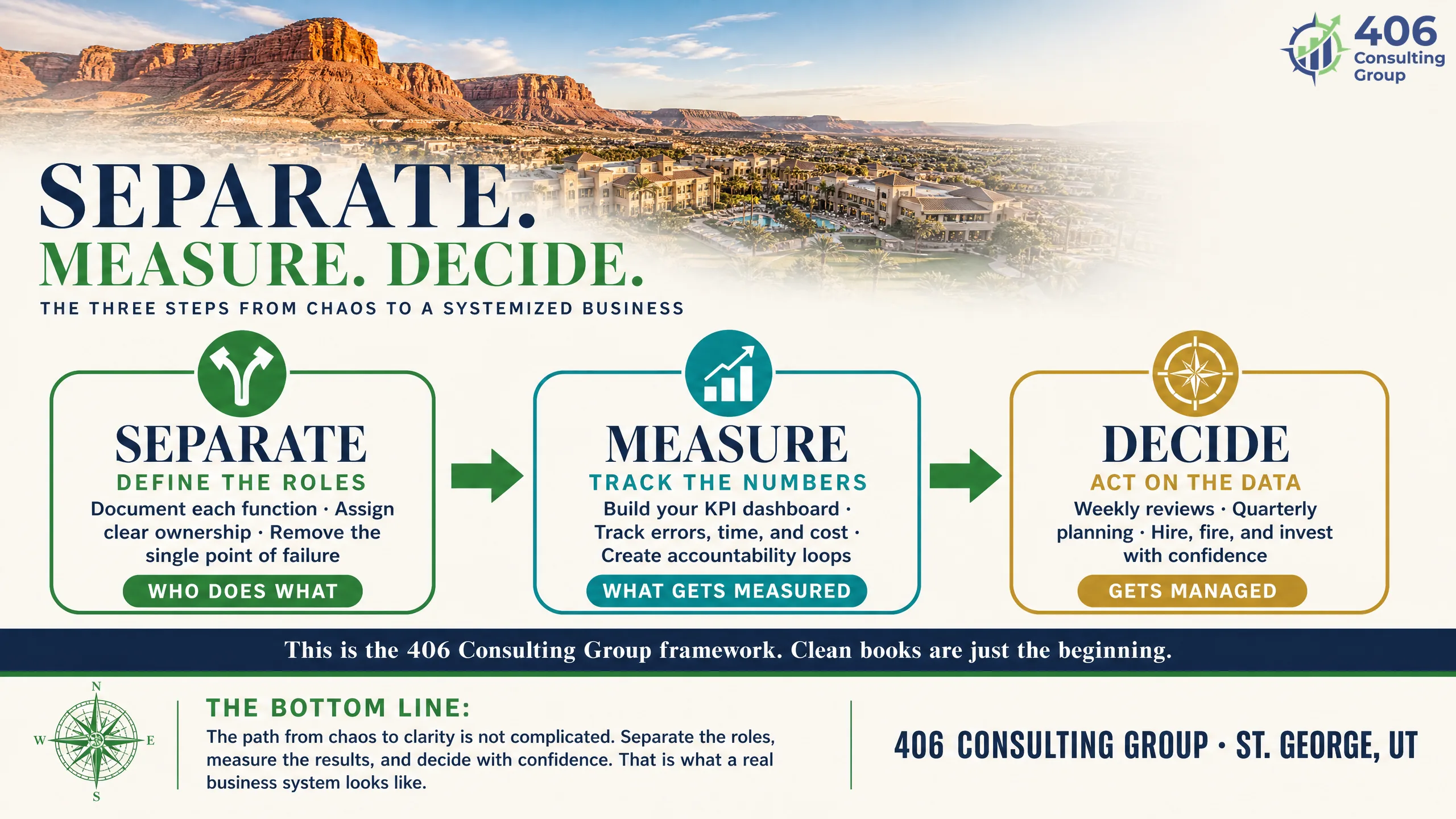
For Ryan, it went like this: hire a $48K coordinator for scheduling and purchasing, systematize the onboarding so any manager could run it, and redeploy Jenna to own quoting and margin — the one job where her judgment was worth a fortune. Same payroll dollars, aimed on purpose. A year later the shop was bigger, calmer, and more profitable — and Jenna took her résumé back down.
Where the Money's Actually Hiding
Here's the part that changes the whole conversation about affording the hire. When you separate and measure the work, you don't just find costs — you find the money to fix it, sitting in plain sight. The missed vendor discounts you can now capture. The higher-margin quotes your freed-up star can now win. The jobs you were losing to slow follow-up. The owner's time redirected from firefighting to selling. In almost every case we've seen, the efficiency you unlock by building the system more than pays for the role you add.
That's the reframe: you're not spending money you don't have to hire. You're redirecting money you're already losing. The hire feels like a cost because it's a visible number on the P&L; the chaos feels free because it isn't. Measurement flips that — it makes the real cost visible and the fix obvious.
Want to put a number on what your own inefficiency is costing? Our Cost of Ignorance tool is a fast way to start, and our Financial Maturity Assessment shows where your business is flying blind.
The Financial and Operational Chaos Are One Problem
Most accountants would stop at "your books are clean." We don't, because the mess in Jenna's four-hat job and the mess in your numbers are the same mess wearing two outfits. You can't build a clean financial picture on top of a chaotic operation, and you can't fix an operation you can't measure. The reason we design systems from a whole-company view — how work is quoted, scheduled, delivered, billed, staffed, and reported, not just how it's booked — is that the money leaks at the seams between those functions, and only someone looking at the whole thing can see them.
That's the difference between an accountant who records what happened and a partner who helps you change what happens next. Clean books tell you the business lost margin last quarter. A whole-company view tells you it leaked out of the gap between purchasing and quoting because one exhausted person owned both and measured neither — and then helps you build the system that closes the gap.
It's the same philosophy behind everything we do, from knowing which unit makes money to knowing when to add financial leadership: measure the whole operation, and the right decisions get obvious.
The Takeaway
The most expensive employee in your business isn't the one with the biggest salary. It's the great one you're slowly burning out by asking them to be a system — because you're paying, invisibly, for the errors, the risk, the ceiling, and eventually the quit, all while telling yourself you're saving money by staying lean. Lean and heroic isn't a strategy. It's a bill you haven't opened yet.
You don't have to boil the ocean to start. This week, pick your Jenna — the person (or you) who's obviously carrying too much — and just list the distinct jobs they're actually doing. Don't fix anything yet. Just separate the blur into named functions and take a guess at the hours and the value of each. That one list is usually enough to make the invisible visible — and once you can see it, the case for building the system, and making the hire, stops being a cost you can't afford and starts being the most profitable decision on the table.
The related read: the true cost of putting the wrong person in a role — the same false economy, pointed at your books.
FAQ
What do you mean by "systems" for a small business?
Nothing corporate or complicated. A system is three simple things: a documented way the work gets done, a clear owner for each piece, and a measured outcome that tells you it's working. In a fifteen-person shop that might just be a written scheduling process, a named person responsible for it, and a weekly number that shows it's on track. The point is to replace 'ask the one person who knows' with 'here's how we do this' — so the business runs on design instead of on a few exhausted people's memory and effort.
How is not hiring actually costing me money if it's not on my P&L?
That's exactly why it's dangerous — the cost is real but invisible. When your best person is overloaded across several jobs, you pay through errors and rework (double orders, missed discounts, late quotes that lose deals), through your own time spent firefighting instead of leading, through key-person risk (everything they hold walks out the door if they quit), and through a growth ceiling you can't break because the operation can't absorb more. None of that appears as a line item, so it feels free. Put rough numbers on it and it almost always dwarfs the salary of the hire you're avoiding.
How do I figure out which of my employee's jobs is worth what?
Start by separating the blur. List the distinct functions that one person is actually doing — for an overloaded office manager that might be scheduling, purchasing, quoting, and onboarding — and estimate the hours each takes and the value each creates. You don't need perfect data; even rough estimates reveal that some of those jobs are high-leverage work only your star should do, while others are routine tasks a lower-cost hire or software could handle. That separation is what lets you stop defaulting everything onto your best person and start deciding each job on purpose.
I genuinely can't afford another salary right now. What do I do?
First, test whether that's actually true or just feels true — put rough numbers on what the current chaos costs (errors, lost jobs, your time, turnover risk) and compare it to the hire. Very often the chaos already costs more. Second, remember the fix isn't always 'hire' — separating and measuring the work lets you automate the repetitive pieces, systematize the trainable ones, and redeploy your star to the high-value work, sometimes without adding a dollar of payroll. And third, the efficiency you unlock by building the system — captured discounts, won quotes, reclaimed owner time — usually funds the role. You're redirecting money you're already losing, not spending money you don't have.
How does an accounting firm help with an operations problem like this?
Because the operational chaos and the financial chaos are the same problem seen from two sides, and the money leaks in the gaps between functions. We design systems from a whole-company view — how work is quoted, scheduled, delivered, billed, staffed, and reported — because only looking at the whole operation reveals where margin is leaking and which roles actually pay for themselves. That's the difference between an accountant who records what happened and a partner who helps you measure the whole business and change what happens next. It's the same lens we bring to unit economics, cash flow, and knowing when to add financial leadership.
Keep Reading
Growth & Advisory
Stop Paying for Chaos You Can't See.
406 Consulting Group helps owners measure the whole operation — the money and the machine — and build the systems that let good people do their best work instead of everyone's work. Remote, and built around how your business actually runs.
The One-List Test
Do this this week
Bleeding Money You Can't See?
We'll measure it and build the fix.
About the Author
Jason Anderson
Co-Founder, 406 Consulting Group
Big-firm-trained accountant who spends most of his time helping Montana and Mountain West owners see the money hiding inside their own operations — and build the systems that let good people do their best work.
Read the Full Story