
How to File Form 2553
(and Fix a Missed Deadline)
The S-corp election mechanics almost nobody explains: how to fill out and file Form 2553, the timing rules, how late-election relief works and how long you have to use it, and the payroll compliance you can never skip once you start.

So Sam ran the numbers, decided the S-corp election was worth it, and now he's staring at Form 2553 wondering what to actually do. This is where a good decision gets won or lost on paperwork: file it right and on time and the savings are yours; fumble the form, miss the window, or skip the filings that come after, and you get delays, denials, or penalty notices instead. The mechanics aren't hard — but they're unforgiving, and almost nobody explains the two parts that trip people up most: what to do if you're late, and the payroll filings you can never skiponce you've started.
This is the mechanics guide: how to fill out and file Form 2553, the timing rules, how late-election relief works (and how long you have to use it), and the ongoing compliance that keeps your election out of trouble.
By Jason Anderson — Co-Founder, 406 Consulting Group. Big-firm-trained accountant who files S-corp elections, fixes late ones, and runs the payroll and compliance behind them. General guidance below; confirm specifics with a tax pro and the IRS.
Quick Answer: Filing Form 2553
- →You elect S-corp status by filing Form 2553 — signed by all shareholders — with the IRS.
- →To count for the current year, file within 2 months and 15 days of the year's start (March 15 for calendar-year businesses).
- →Missed it? Late-election relief is often available — generally within 3 years and 75 days of the intended effective date, with reasonable cause.
- →Once payroll starts, you must file the reports every period — including a quarter you paid $0. Stopping isn't an option.
- →Get the filing, the salary, and the payroll done together — that's how the savings actually stick.
Table of Contents
You've Decided to Elect — Now the Mechanics
The decision to elect is the strategy; the filing is the execution — and the execution has three moving parts that each have to be right: the form (filled out and signed correctly), the timing (filed inside the window, or with valid late relief), and the follow-through (the payroll and compliance that keep the election healthy). Miss any one and the savings you decided to chase can slip, sometimes for a whole year. This guide walks all three. If you're still deciding whether to elect, start with Should You Elect S-Corp? The Real Math— this piece assumes you've decided yes.

Start with the form itself, because it's simpler than its reputation.
What Form 2553 Actually Asks
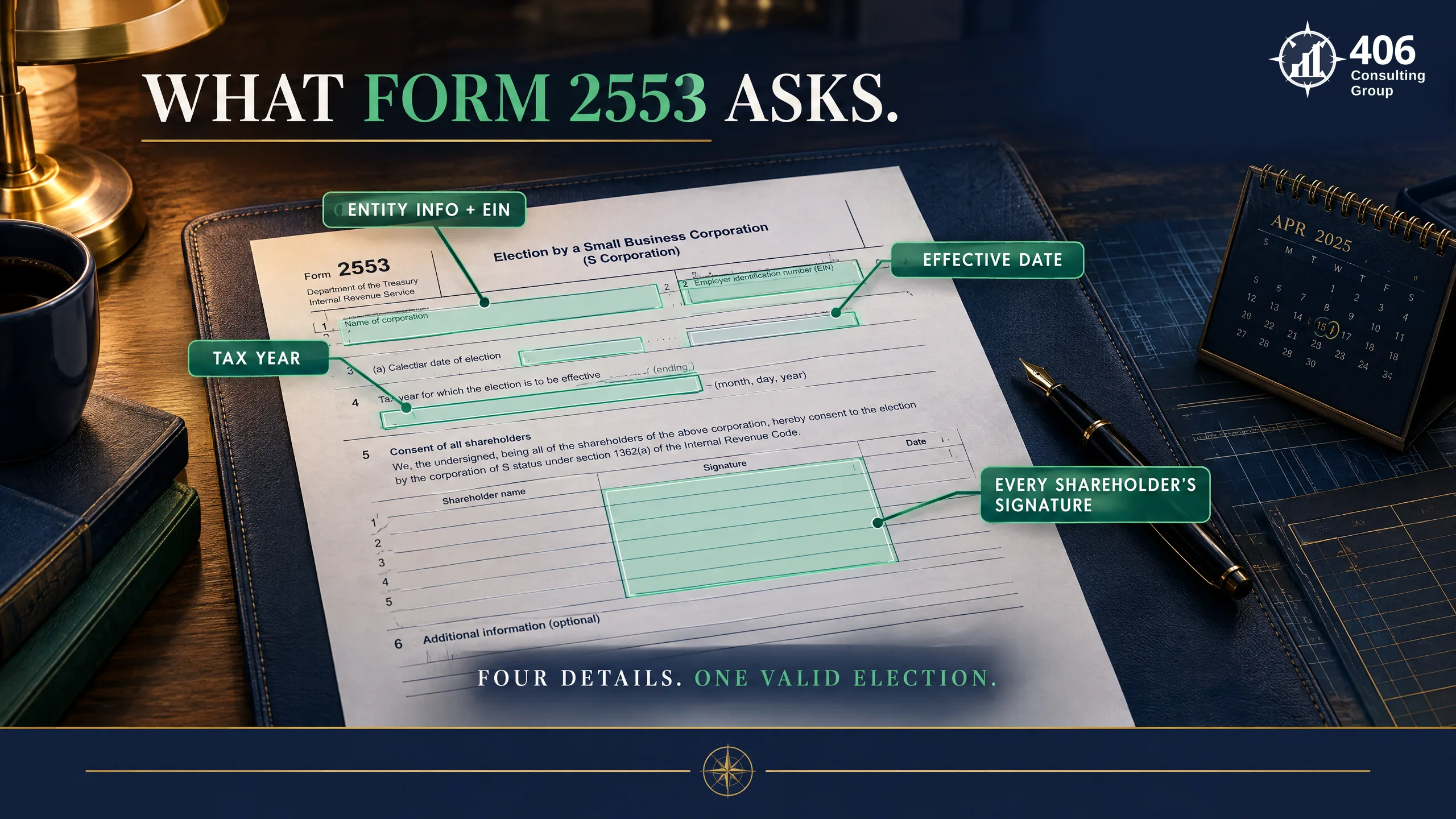
Form 2553 is short, and it's asking for a handful of specific things. Get these right and the rest is mailing or faxing it in:
Who you are
Business name, address, EIN, and the date and state you were formed. Your EIN must already exist — get it first if you don't have one.
The effective date
The date you want S-corp treatment to start. This is the field people get wrong most — more on it below.
Your tax year
Almost always a calendar year for a small business; a non-calendar year needs a business-purpose justification.
Shareholder consent + signatures
Every shareholder (and their spouse in community-property states) must consent and sign. Missing a signature can void the election.
The single field that causes the most trouble is the effective date — because it's bound to a deadline.
Timing: The Effective Date You Choose
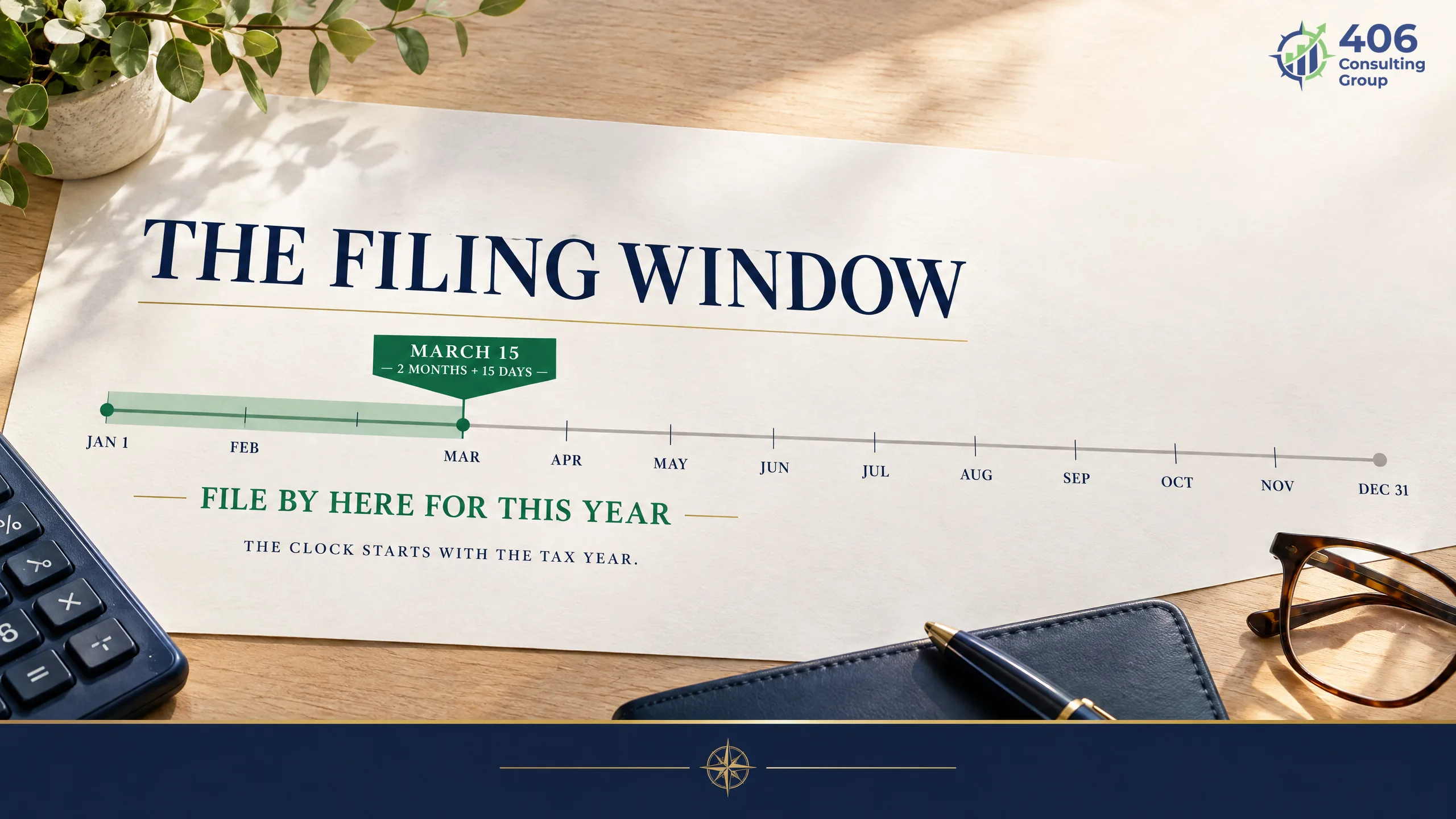
The rule: to have the election take effect for a given tax year, you generally must file Form 2553 no later than two months and fifteen days after the start of that year. For a calendar-year business, that's March 15. File by then and you're an S-corp for the whole year; file later and — absent late relief — the election slides to the next year. You can also file early: any time during the preceding tax year works too. What you can't do is quietly backdate it because you wish you'd filed sooner.
Two months and fifteen days — March 15 for most businesses. It's the line between S-corp treatment this year and waiting until next.
The one exception to "two months and fifteen days into the year" is a business that didn't exist at the start of the year.
New Business vs. Existing Business
For a brand-new business, the clock doesn't start January 1 — it starts when the business begins. A newly formed entity generally has two months and fifteen days from the date it first has shareholders, acquires assets, or begins doing business (whichever is earliest) to file and be an S-corp from day one. For an existing LLC or corporation, you're working off the calendar: file by March 15 to elect for the current year, or any time in the current year to elect for next year. Same form, different starting gun — and new-business owners often miscount their window because they assume it's always March 15.

But what if the window has already closed? This is the part almost no one explains — and where a lot of money gets saved.
Missed the Deadline? Late-Election Relief
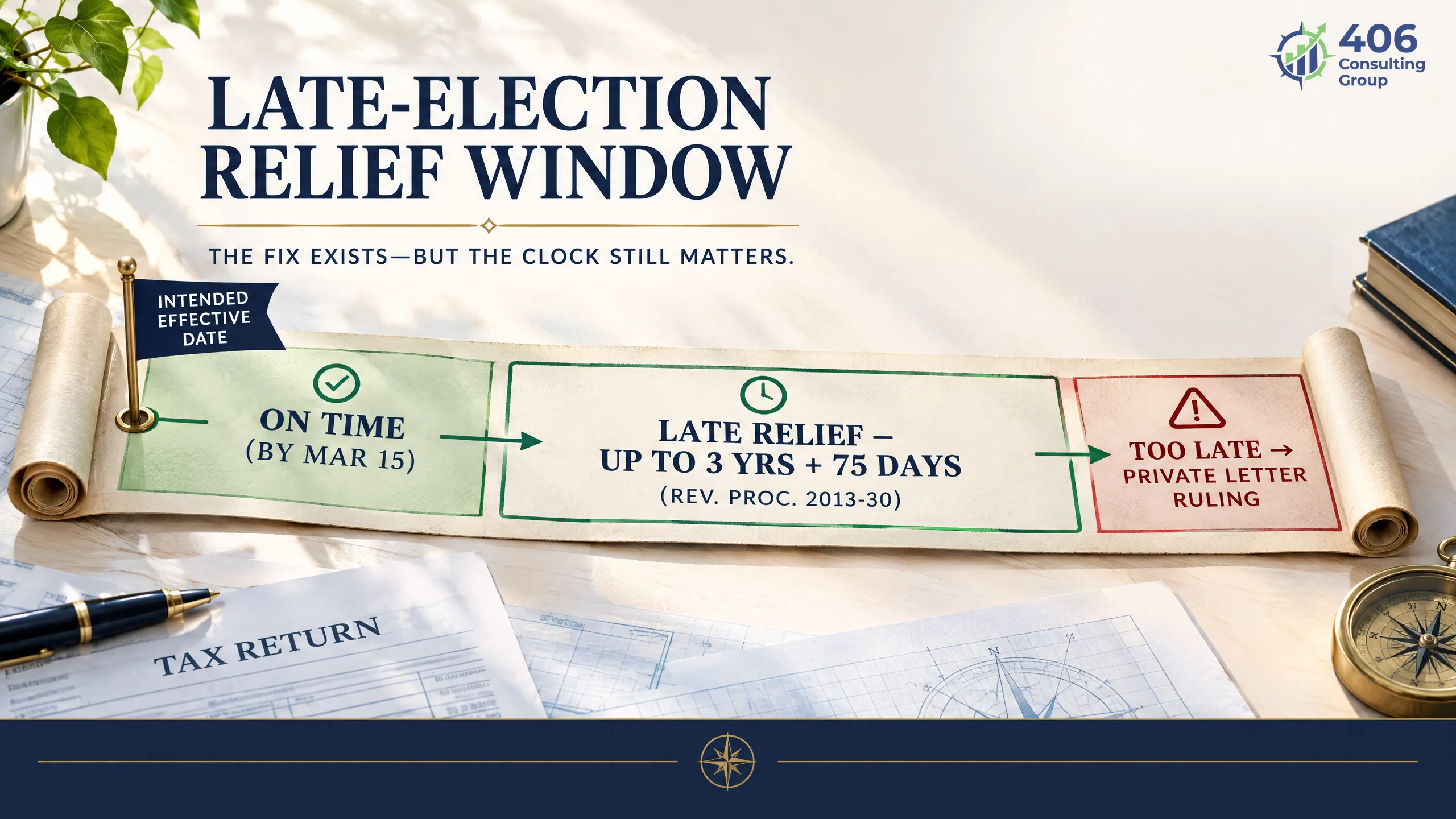
Missing March 15 is not the end of the road. The IRS has a simplified late-election relief procedure (Revenue Procedure 2013-30) that lets many businesses still get S-corp treatment for the year they wanted — without an expensive private ruling — as long as they act inside the window and meet the conditions. The timing is the part to burn into memory: you generally have up to 3 years and 75 days after the intended effective date to request relief this way.
The late-election window at a glance
On time
Filed by 2 months 15 days into the year (March 15) — routine, no relief needed.
Late, within 3 yrs 75 days
Use Rev. Proc. 2013-30 relief — file Form 2553 with a reasonable-cause statement if you qualify.
Beyond 3 yrs 75 days
Simplified relief is gone — you're generally into a private letter ruling, which is slow and costly.
To use it, you file the same Form 2553, write "FILED PURSUANT TO REV. PROC. 2013-30"across the top, and attach a statement explaining your reasonable cause. There are conditions — broadly, you intended to be an S-corp as of that date, the only thing that went wrong was the late filing, and you've reported consistently as an S-corp since. It's very doable, but the details matter, so confirm your situation before relying on it.
Relief hinges on that reasonable-cause statement — so it's worth knowing what makes one hold up.
Reasonable Cause: What Actually Counts
"Reasonable cause" means a credible, good-faith reason the form was late — not "we forgot" dressed up in nicer words. In practice, defensible explanations tend to sound like: you believed your accountant or attorney had filed it and they hadn't, you didn't know the election required a separate form, or a genuine mix-up delayed it — and you acted as an S-corp all along. The statement should be short, honest, and specific about what happened and when. The good news is that the simplified procedure is meant to be forgiving; the bar is credibility, not perfection.
Tends to hold up
- ✓"I believed my accountant filed it"
- ✓"I didn't know a separate form was required"
- ✓A specific administrative mix-up — and you acted as an S-corp all along
Doesn't hold up
- ✗"We just forgot" with no context
- ✗Vague, undated, or one-line explanations
- ✗Claiming relief while past returns don't show S-corp treatment
Once the form's in — on time or late — you wait for the IRS to weigh in.
What Happens After You File
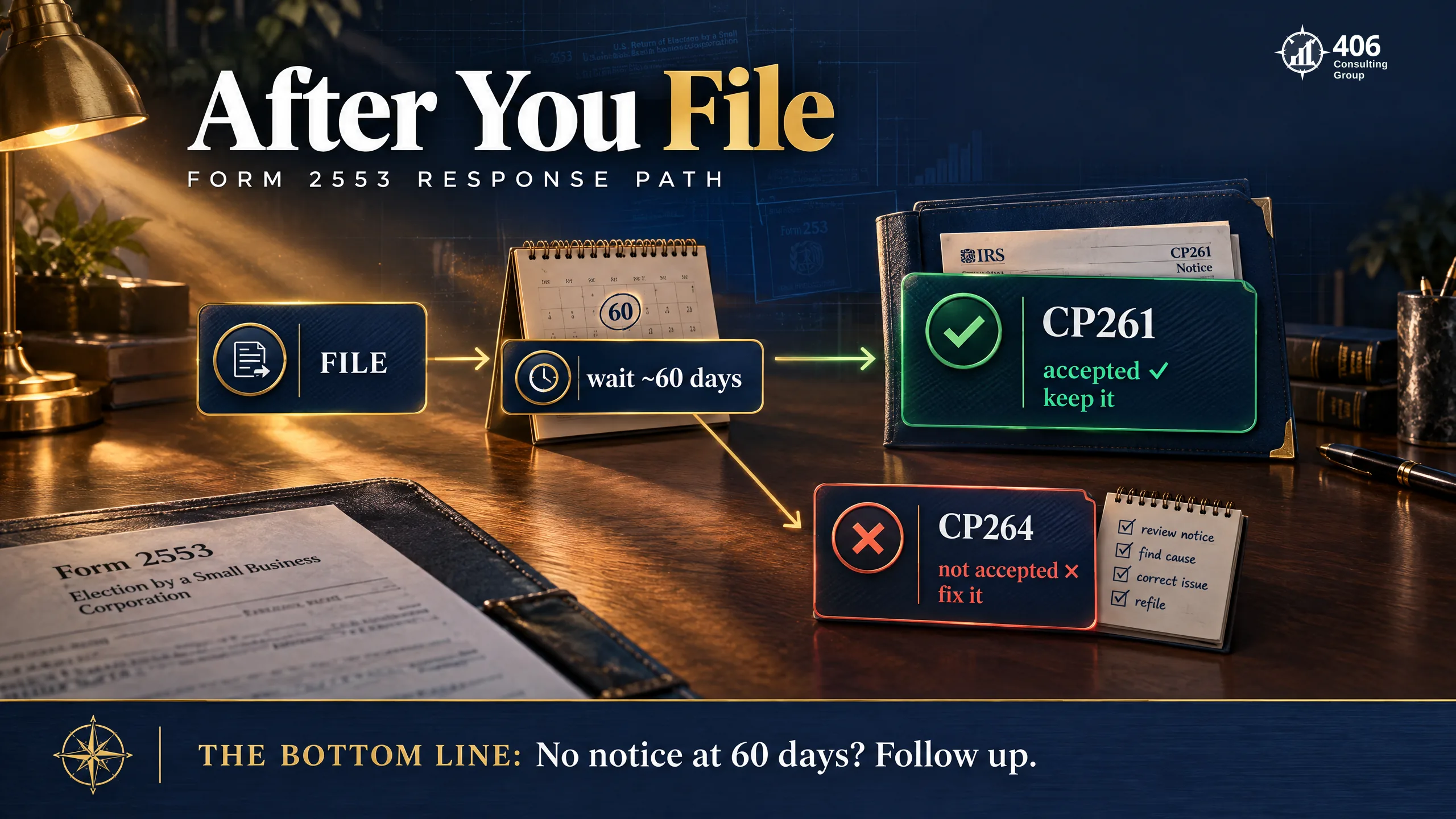
After you file, the IRS reviews the election and mails back a decision — generally allow about 60 days. If it's accepted, you'll get a CP261 notice confirming your S-corp status; keep it, because it's your proof. If something's wrong, you may get a CP264saying the election wasn't accepted, with the reason. The mistake to avoid here is going silent: if 60 days pass with no notice, don't assume it went through — follow up with the IRS, because operating as an S-corp on an election that never posted creates a mess at tax time.
Most rejections and delays trace back to a short list of avoidable errors.
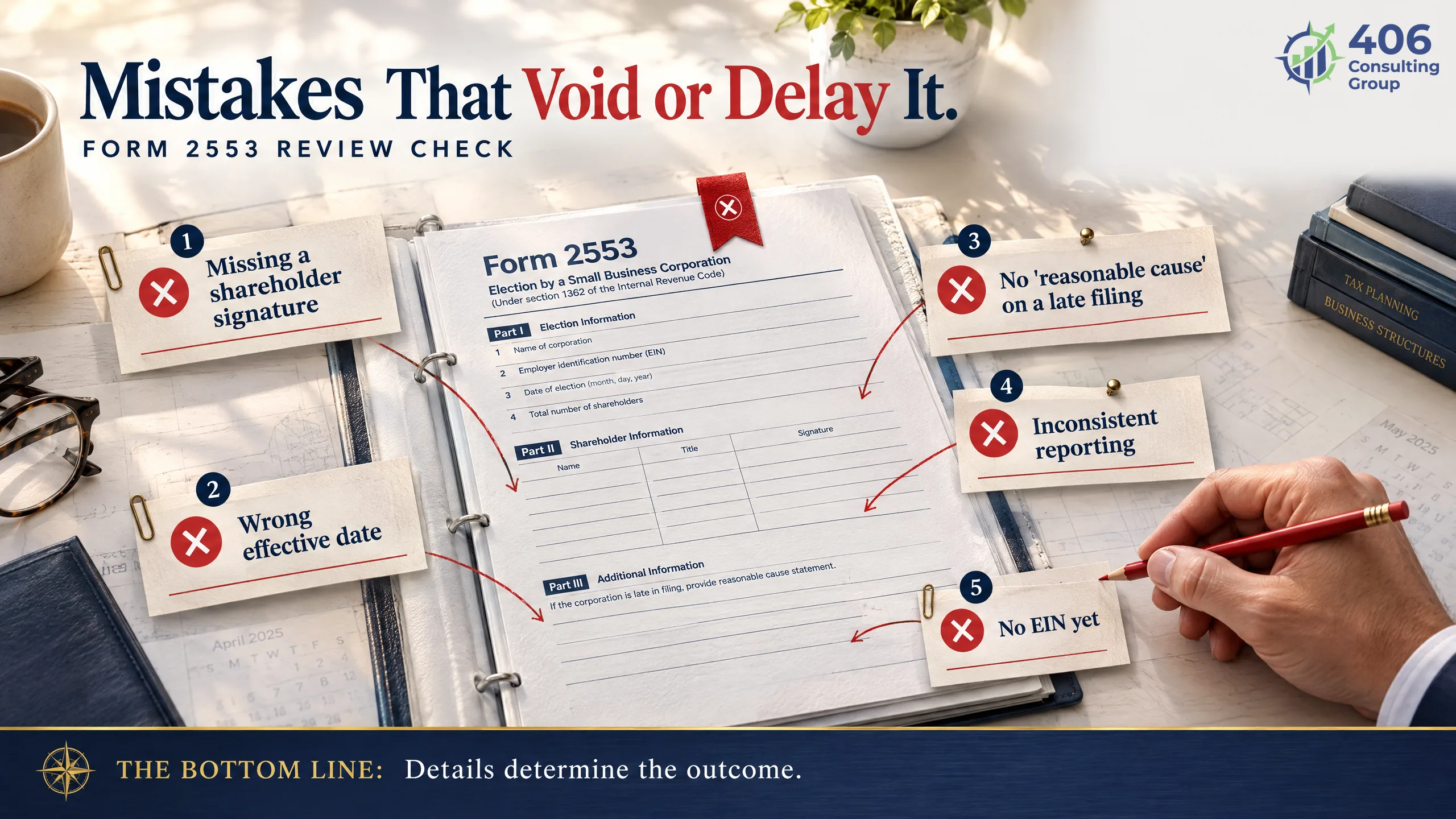
Mistakes That Void or Delay the Election
The election is unforgiving about a few specific things. Steer around these:
A missing shareholder signature
Every shareholder must consent and sign. One missing signature can invalidate the whole election.
The wrong effective date
Picking a date outside the allowed window — or backdating — gets the election bounced or shifted a year.
No 'reasonable cause' on a late filing
Filing late without the Rev. Proc. 2013-30 language and statement forfeits the simplified relief.
Inconsistent reporting
Claiming late relief while your past returns don't reflect S-corp treatment undercuts the request.
No EIN yet
You need your employer identification number on the form. No EIN, no valid election.
And then there's the part owners forget entirely — the obligations that start the moment the election is live.
The Ongoing Compliance You Can't Skip
Here's the trap that catches owners after the election is done. An S-corp owner who works in the business is now an employee on payroll — and once you're running payroll, the government expects a steady drumbeat of filings whether or not you paid yourself in a given period. The most common mistake: an owner pays himself for a couple of quarters, gets busy, and just stops — assuming that if there's no paycheck, there's nothing to file. Wrong. Once you have an open payroll account, you generally must file the return every quarter anyway, showing zero if that's the truth. (The narrow exceptions — being placed on the annual Form 944, or registering as a seasonal employer — don't apply to a typical owner drawing a steady salary.) A skipped quarter isn't "no filing" — it's a missing filing, and it generates notices and penalties.
The filings that don't stop
- →Form 941 — the federal payroll return, filed EVERY quarter you have an open account (a zero return if you paid nothing that quarter).
- →Form 940 — federal unemployment (FUTA), filed annually.
- →W-2 and W-3 — reporting your wages to the employee and the Social Security Administration each year.
- →State payroll filings — withholding and unemployment, usually quarterly, on their own schedules.
You can pause paying yourself. You cannot pause the filings. A quarter with no wages still needs its return — on time — or the penalties start.

None of this is hard when someone owns it — and getting it owned end to end is the whole point.
Get It Filed Right
The election is one form, but it's a form with a deadline, a right effective date, a reasonable-salary number behind it, and a compliance drumbeat after it. Miss any piece and the savings you decided to chase can leak away in penalties and delays. The clean path is to have one firm handle the filing, set and document the salary, and run the payroll and compliance so it never lapses.
File it right — and keep it right.
Whether you're electing on time, fixing a missed deadline, or just want the payroll and filings handled so nothing lapses, we file the election, set the salary, and run the compliance behind it — remotely, for clients across the country. Start with the calculator to see the savings you're protecting.
New to all this? Start with Should You Elect S-Corp? The Real Math and What Counts as a "Reasonable Salary"? for the decision and the salary behind the filing.
FAQ: Filing Form 2553
What is the deadline to file Form 2553?
To have the S-corp election take effect for a given tax year, you generally must file Form 2553 no later than two months and fifteen days after the start of that year — March 15 for a calendar-year business. You can also file any time during the preceding tax year to elect for the following year. A brand-new business measures its window from when it first has shareholders, acquires assets, or begins doing business, whichever is earliest — not from January 1. Confirm your exact date with a tax professional, since the effective-date field is where most errors happen.
Can I still file Form 2553 after the deadline?
Usually, yes. The IRS provides simplified late-election relief under Revenue Procedure 2013-30 that lets many businesses get S-corp treatment for the year they intended, without an expensive private letter ruling. You generally have up to 3 years and 75 days after the intended effective date to request it. You file the same Form 2553, write 'FILED PURSUANT TO REV. PROC. 2013-30' across the top, and attach a reasonable-cause statement. You have to meet the conditions — broadly, you intended to be an S-corp as of that date, the only failure was the late filing, and you've reported consistently as an S-corp — so confirm your situation before relying on it. Past that 3-year-75-day window, you're generally into a private letter ruling, which is slow and costly.
What counts as reasonable cause for a late election?
Reasonable cause is a credible, good-faith reason the form was filed late — not simply forgetting. Explanations that tend to hold up include believing your accountant or attorney had filed it when they hadn't, not realizing the election required a separate form, or a genuine administrative mix-up — combined with having acted as an S-corp all along. The statement attached to your late Form 2553 should be short, honest, and specific about what happened and when. The simplified relief procedure is designed to be forgiving, so the bar is credibility rather than a perfect excuse.
How long does it take the IRS to approve an S-corp election?
Generally allow about 60 days. If the election is accepted, the IRS mails a CP261 notice confirming your S-corp status — keep it as your proof. If there's a problem, you may receive a CP264 notice saying the election wasn't accepted, along with the reason. The important thing is not to go silent: if 60 days pass without a notice, follow up with the IRS rather than assuming it went through, because operating as an S-corp on an election that never posted creates real problems at tax time.
If I run S-corp payroll and then stop for a quarter, do I still have to file?
Yes. Once you have an open payroll account, you generally must file the payroll returns every period even if you paid no wages that quarter — you file a zero return, you don't skip it. The most common owner mistake is paying themselves for a while, getting busy, and simply stopping, assuming no paycheck means nothing to file. A skipped quarter isn't 'no filing,' it's a missing filing, and it triggers IRS notices and penalties. The ongoing drumbeat includes Form 941 each quarter, Form 940 annually, W-2 and W-3 each year, and your state's withholding and unemployment filings. If you truly won't pay wages again, there's a proper way to close the payroll account — but that's a deliberate step, not just going quiet.
Can 406 Consulting Group file my S-corp election and handle the compliance?
Yes. We prepare and file Form 2553 (including late-election relief under Rev. Proc. 2013-30 when you've missed the deadline), set and document your reasonable salary, and run the ongoing payroll and compliance — the quarterly and annual filings — so nothing lapses. Because the election, the salary, and the payroll compliance are one connected system, having a single firm own all of it is how you capture the savings without collecting penalty notices. We do it remotely for clients across the country. Start with the calculator, then talk to us.
Key Timing
Don't miss these windows
File It Right
Election + salary + payroll.
About the Author
Jason Anderson
Co-Founder, 406 Consulting Group
Big-firm-trained accountant who files S-corp elections, fixes late ones with Rev. Proc. 2013-30 relief, and runs the payroll and compliance behind them — so the election is filed right and stays right. Delivered remotely.
Read the Full Story