
Oilfield Accounting in Williston, ND:
Why Bakken Service Companies Run Out of Cash in the Boom
In the Bakken, the service companies that go under aren't the slow ones — they're the busy ones. Job costing by well, a 13-week cash forecast, North Dakota's multi-state tax, and lender-ready books, from a team that's worked oil & gas operations and underwritten the loans.
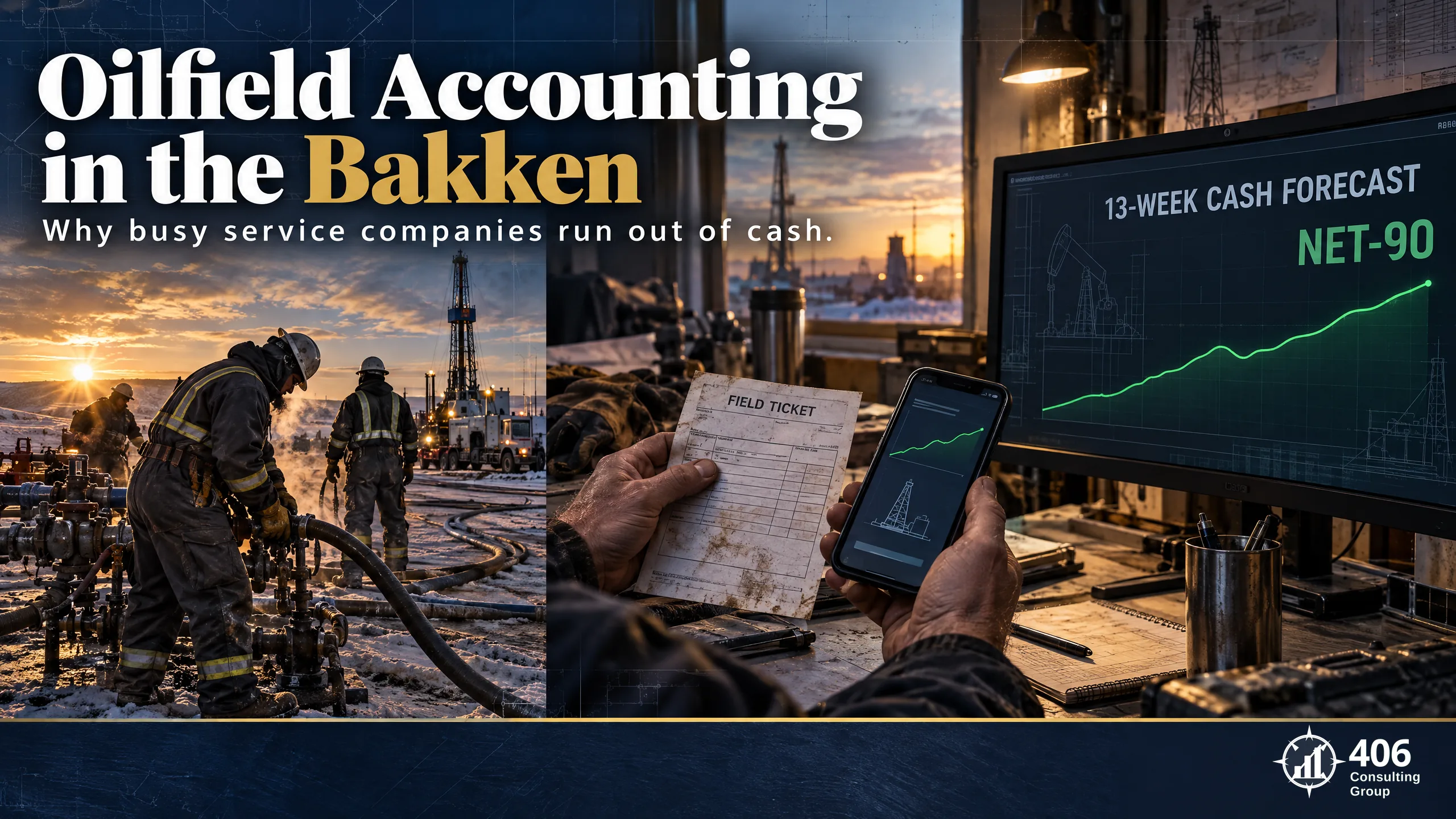
In the Bakken, the service companies that go under aren't the slow ones. They're the busyones — the outfit that doubled its crews the month activity jumped, and couldn't make payroll ninety days later. This is the money side of running an oilfield service company in Williston, written by people who have worked oil & gas operations and sat on the lender's side of the desk.
Bakken oilfield service companies run out of cash because cost and payment are out of sync: you pay crews, fuel, housing, and mobilization now, and the operator pays you in 60 to 90 days.Growth widens that gap instead of closing it — which is why the busiest quarter is the one that breaks you. The fix isn't hoping for faster payers. It's four moves you can make before the next boom: cost every job by well, run a rolling 13-week cash forecast, get North Dakota's multi-state tax and crew classification right, and walk into a lender early with numbers they trust.

By Jason Anderson
Co-Founder, 406 Consulting Group
Degreed accountant with 10+ years in tax and a decade of enterprise operations and accounting at BP — with a Six Sigma discipline for systems and job costing.
General guidance for Bakken service companies, not advice for your specific situation. Tax rules vary by state and change; confirm specifics with your advisor and the relevant agencies.
The Short Version
- Williston service companies fail in the boom, not the bust — growth eats cash faster than slow-paying operators replace it.
- The Bakken adds its own costs on top: housing, premium labor, and brutal winter downtime that most accounting ignores.
- North Dakota's production and extraction taxes are the operator's cost, not yours — your exposure is multi-state payroll, income-tax nexus, and use tax.
- The move that saves you: job costing by well, a 13-week forecast, and a lender line set up before you need it.
What We'll Cover
The Boom That Breaks Williston Companies
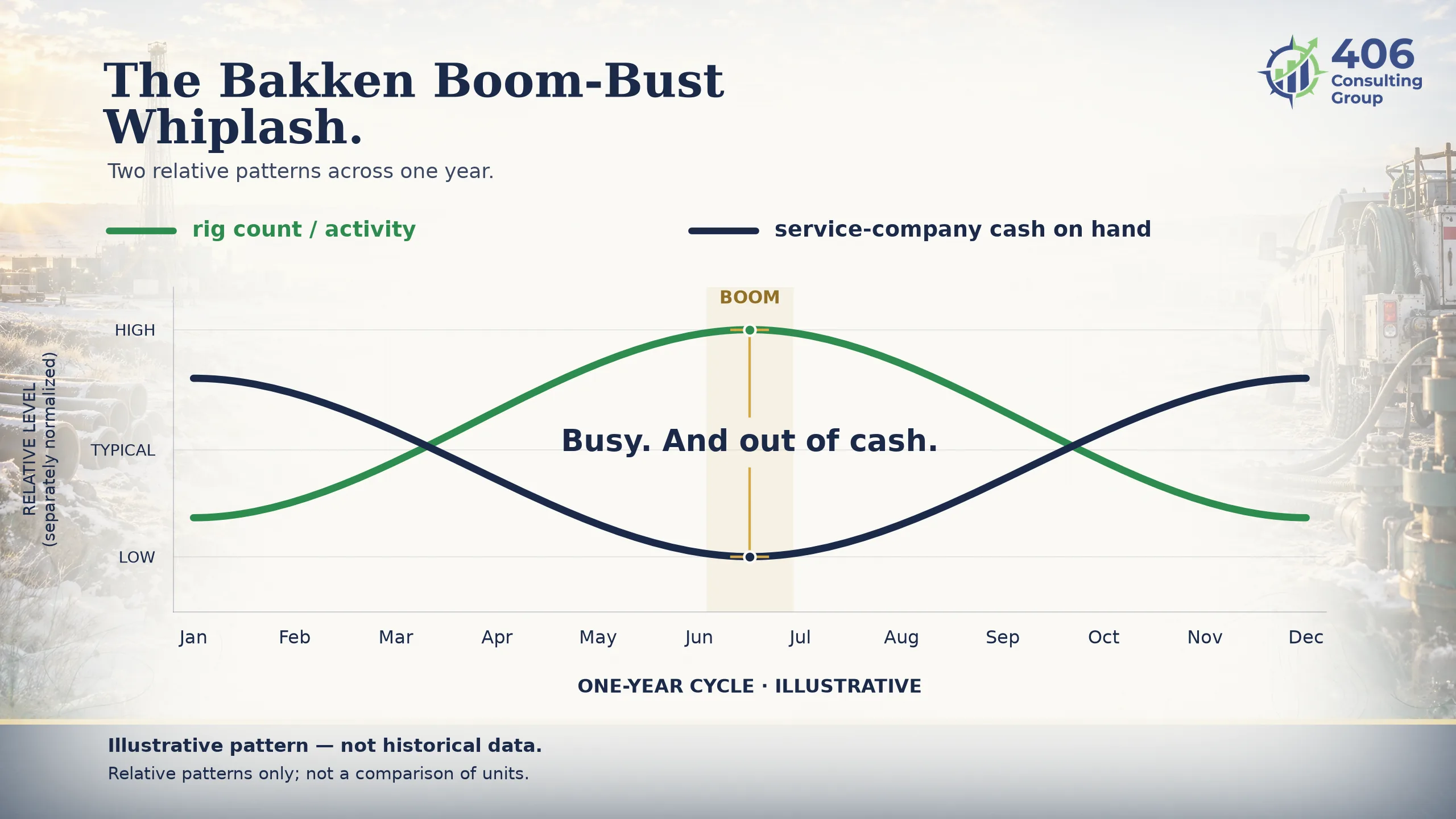
When the rig count climbs and the Bakken gets busy again, your problem flips overnight from “not enough work” to “not enough cash to do the work.” Every new job means spending first — fuel, crew wages, housing, per diem, rented equipment, mobilization out to the pad. Then you wait: for the field ticket to get signed, for the invoice to go out, for the operator's accounts-payable department to run its net-60 cycle. You're financing your operators at 0% while you cover your own costs at full price, up front, every single week.
How it plays out
Picture a Williston outfit that doubles its crews the month activity jumps. Revenue is up 80% and the P&L looks fantastic. But payroll runs weekly, housing and fuel are due now, and the operators pay in 60 to 75 days. Four weeks into the best run of its life, the company is profitable and completely out of cash — and the bank line it never set up in the quiet season is exactly what it now can't get approved fast enough. That's the statistic we keep companies off of.
Why the Bakken Is Harder Than Other Basins
Every basin has the cash cycle. Williston stacks three more costs on top that an out-of-town accountant will never put in your numbers:
Housing eats margin
Man-camps, rentals, and crew housing are a real per-head cost in Williston — and it belongs in your job cost, not buried in overhead.
Labor is scarce and priced for it
When the Bakken runs hot, you pay up to hold a crew. Underprice that into a bid and a busy job loses money.
Winter is a cash event
Cold-weather downtime, fuel burn, and slow stretches hit revenue while fixed costs keep running. It has to be forecast, not absorbed.
The move: build housing, true crew cost, and a winter revenue dip into your pricing and your forecast from day one. The outcome: you stop discovering these costs after the job is done, and you bid Bakken work at a number that actually survives a Williston winter.
The 60-to-90-Day Cash Gap
This is the number that actually runs your company, and it's not on the income statement. It's the gap between when cash goes out and when it comes back — the cash conversion cycle. You pay weekly and collect in 60 to 90 days, and the faster you grow, the bigger the hole. A company can be wildly profitable and still fail, because profit is an opinion and cash is a fact.

Cash out
Weekly
Crews, fuel, housing, rentals
Cash in
Net 60–90
After the ticket is signed & billed
The gap
You finance it
And it grows as you grow
The move: run a rolling 13-week cash forecast that reserves for payroll and growth, and tighten the field-ticket-to-invoice cycle so you bill in days, not weeks. The outcome: you see every tight week a full quarter out — and billing a week faster on net-75 terms frees up real cash you're currently lending your operator for free. Start with your weeks of cash runway, then build the full picture in the Oilfield Operator's Toolkit. The full playbook is in How Oilfield Service Companies Manage Cash Flow Through the Cycle.
Which Bakken Jobs Actually Paid?
Ask most Williston service owners which jobs make money and you'll get a gut feeling, not a number. That's dangerous, because in the Bakken the money-losers hide in the costs that never make it onto the bid: the long mobilization to a remote pad, the standby and wait time, the rented equipment that ran three weeks past plan, the windshield hours moving crews across the basin, the housing and fuel. Real job costing — actual vs. bid, by well or by job — turns “we're busy” into “we're busy on the work that pays.”
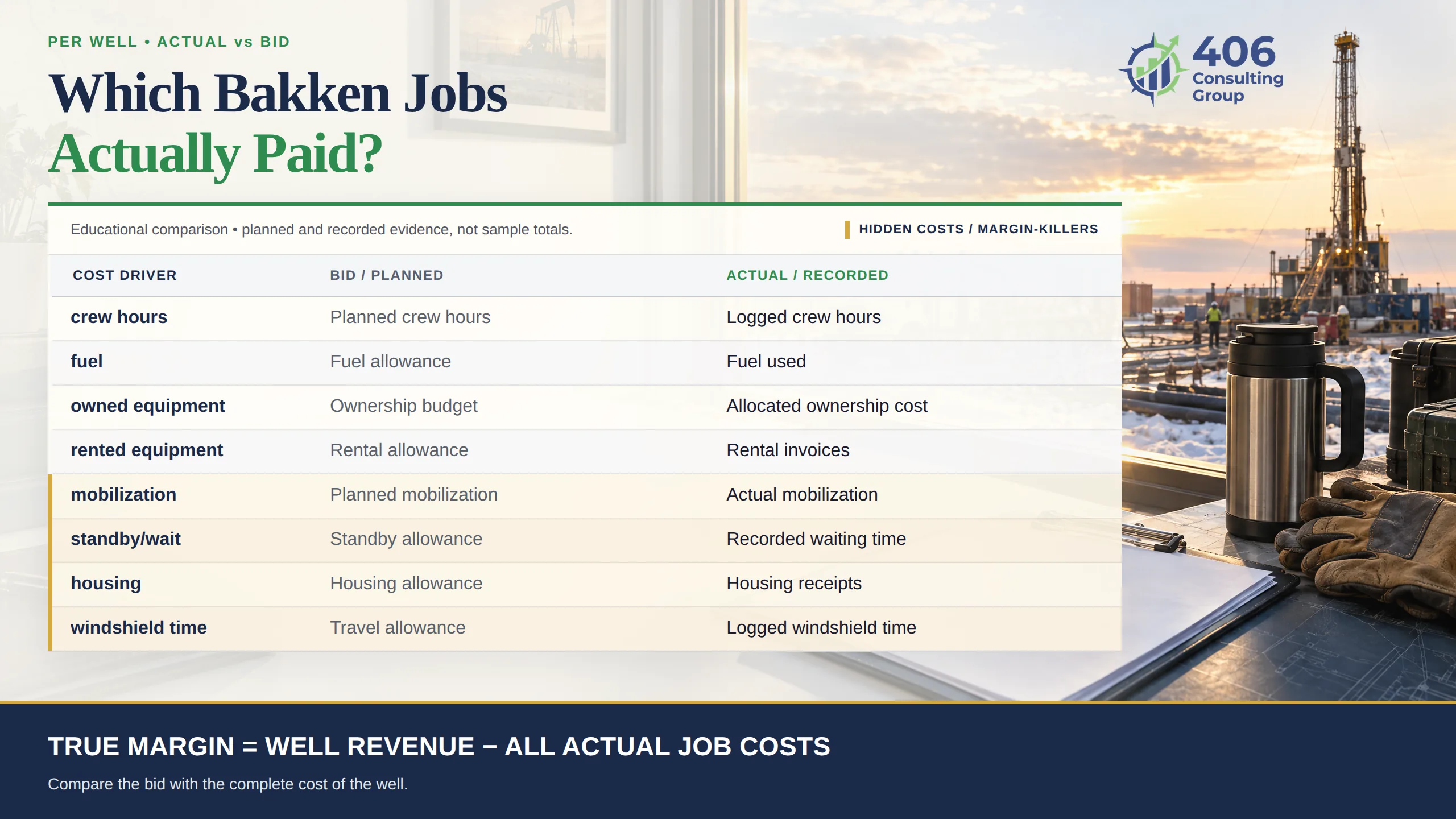
The move: cost by well and tag standby, mobilization, and housing to the job. The outcome: you learn which operators, which pads, and which kinds of work actually pay — and you can walk away from busy-but-broke work that's quietly subsidizing everyone else. Run a job through the Job Costing tool or pressure-test your numbers with the Job-Costing Health Check.
North Dakota Tax: What Service Companies Actually Owe
Here's the clarification that trips up owners: North Dakota's gross production tax and oil extraction tax fall on the operator producing the oil and gas — not on you as a service provider. Those are your customers' costs, which is exactly why their budgets, and your demand, move with the commodity price. Your exposure is different, and it's mostly about crews and iron crossing state lines:
Multi-state payroll
Crews working across North Dakota and Montana mean payroll registration and withholding in each — get it wrong and penalties stack by state.
Income-tax nexus
Working in ND creates filing obligations and apportionment — where your income gets taxed depends on where the work happens.
Sales & use tax on equipment
Equipment and materials moving between states carry use-tax questions most service companies never get right.
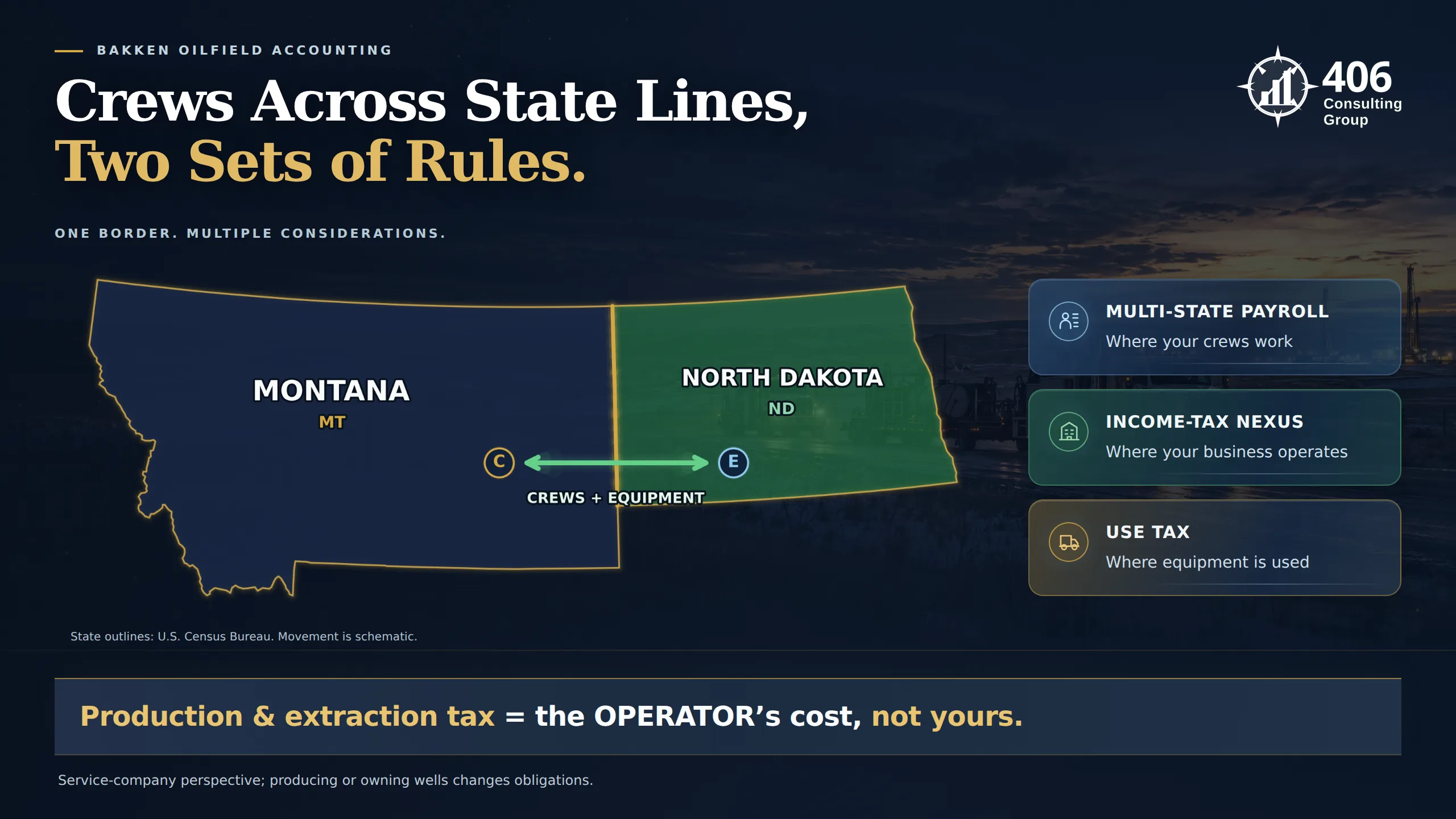
The move: map where your crews and equipment actually work and register before you have a problem. The outcome: no surprise multi-state assessment two years later — and a clean compliance record a lender and a buyer both reward. (We go deeper on crews in 1099 vs. W-2: Getting Worker Classification Right.)
1099 Crews in a Boomtown Labor Market
The Bakken runs on contract labor, and Williston's transient, churning workforce makes the temptation to pay everyone on a 1099 even stronger — and the risk even higher. If you control how, when, and where a crew works, provide the equipment, and keep them on for months, the IRS or the state can reclassify them as employees. The bill is back payroll taxes, penalties, and interest — often across North Dakota and Montana — plus workers'-comp exposure if someone gets hurt on a site and wasn't covered.
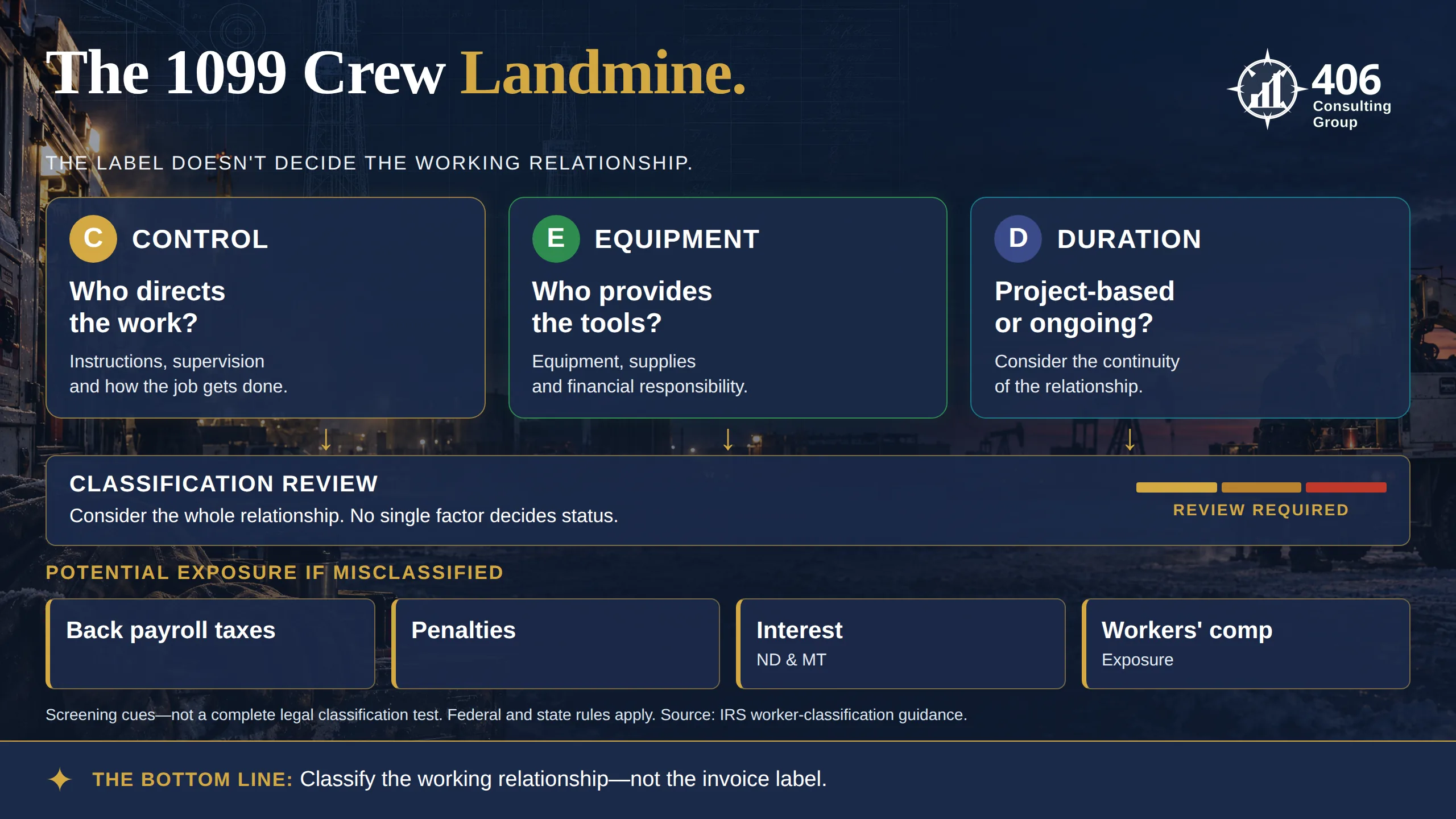
The move: get classification, documentation, and workers'-comp coverage right before an audit or an injury forces it. The outcome: you keep the flexibility contract labor gives you without carrying six figures of hidden, compounding risk on the books.
The Iron Decision
The Bakken is iron-heavy, and the iron cuts both ways. Owned equipment ties up cash and sits idle in a downturn; rented equipment protects cash but kills margin if it runs long; financed equipment is a monthly obligation that doesn't care whether the rigs are running. Get the mix right and you survive the cycle; get it wrong and you're either over-leveraged in the bust or renting away your profit in the boom. The tax side matters too — Section 179 and bonus depreciation can shelter a big-equipment year, but a deduction only helps if the cash and financing behind it make sense.
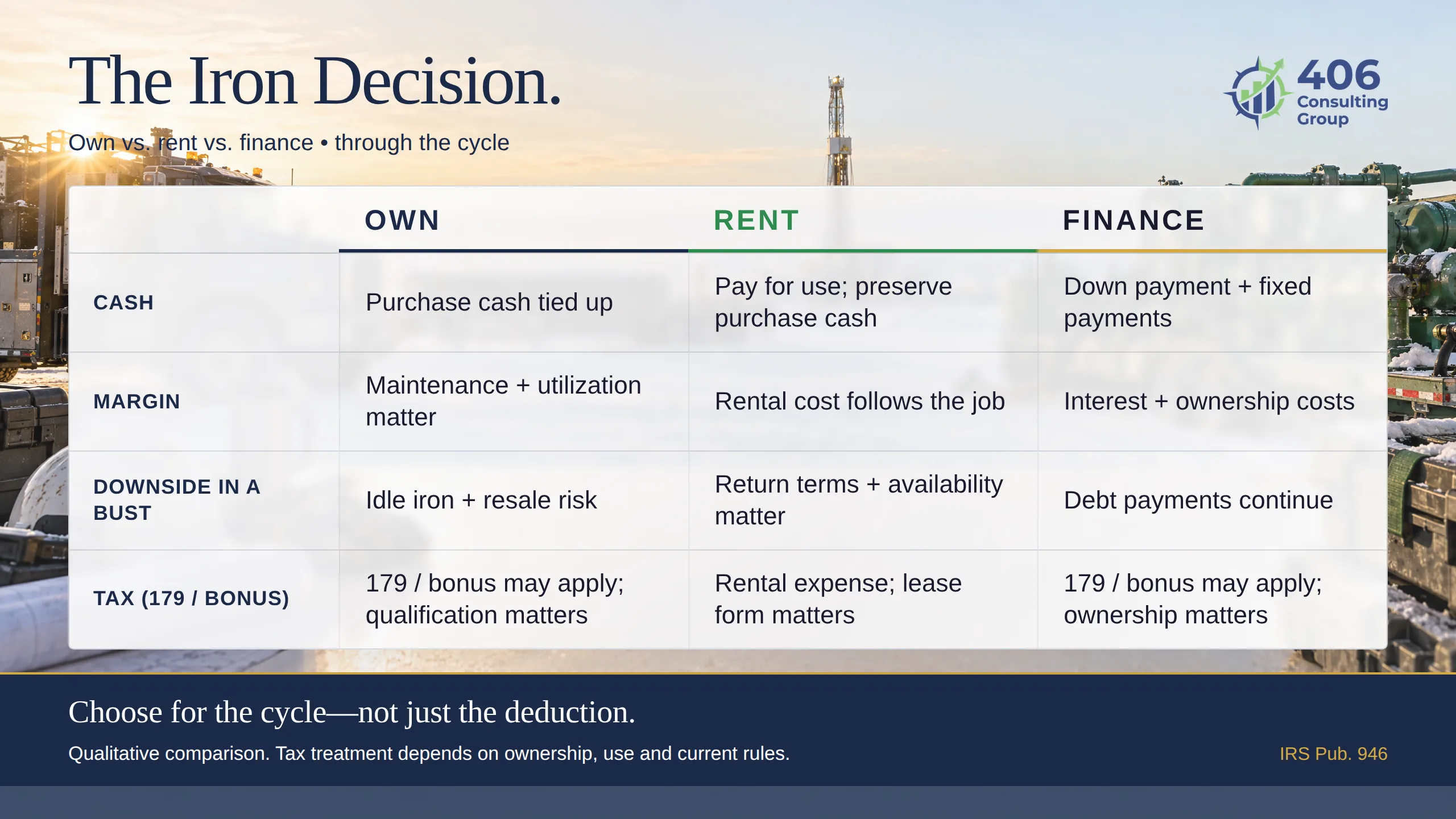
The move: decide own-vs-rent-vs-finance against your actual cash forecast, not a gut feel. The outcome: you keep iron working or off the books at the right points in the cycle. We break the math down in New Equipment vs. Used Equipment: Breaking Down the Numbers.
Getting Lender-Ready in the Bakken
When the boom hits and you need working capital now, you find out whether you built the banking relationship when you didn't. Lenders fund service companies that can show clean, current financials, a real cash-flow forecast, a receivables aging that proves the money is collectible, and an owner who can speak to the numbers. Walk in with a shoebox mid-crisis and you'll get a no; walk in six months early with a credible package and you'll get a line you can draw on when the work shows up.
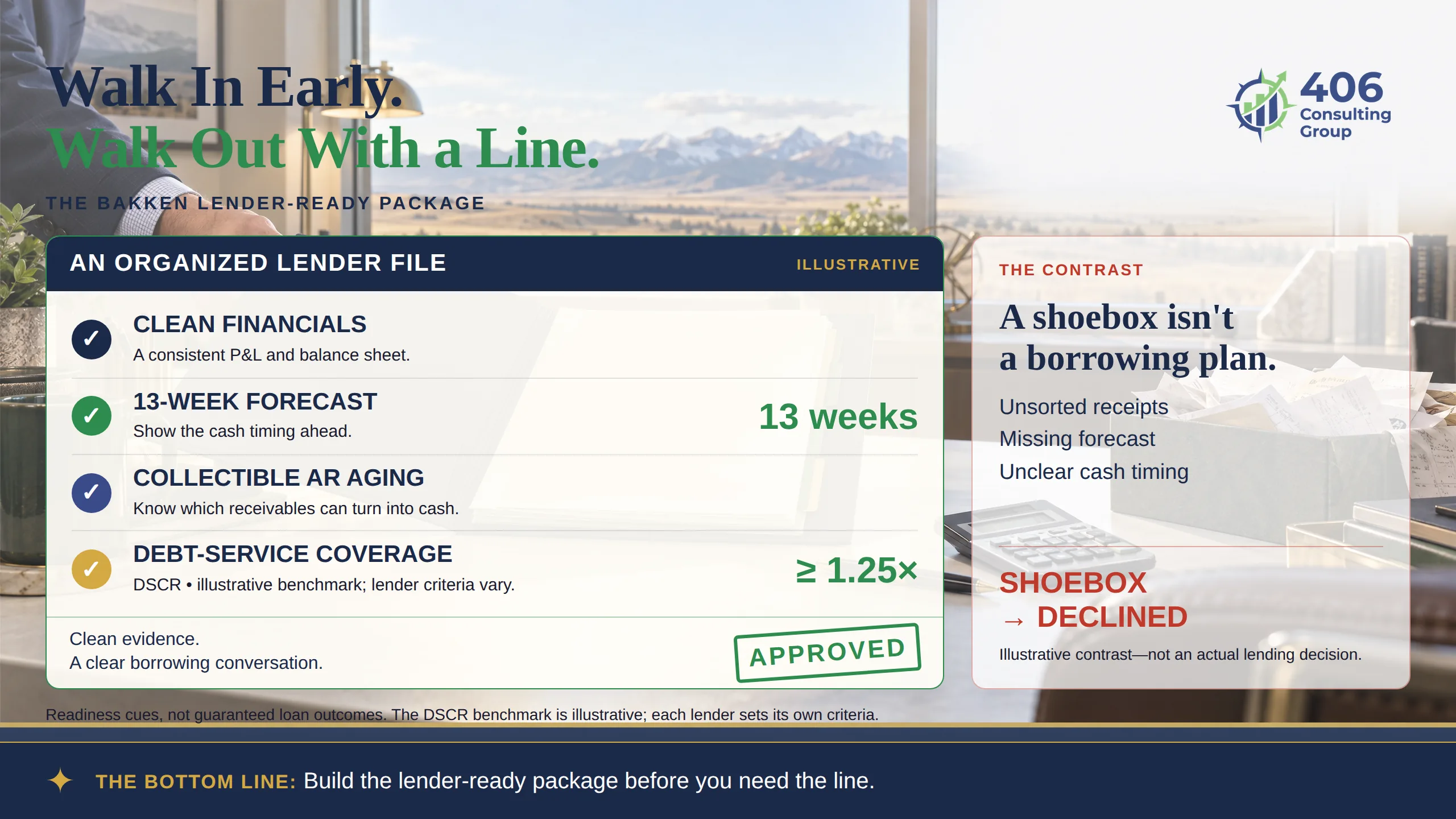
This is our home turf. Carrie spent years on the lender's side of that desk — underwriting and reviewing hundreds of commercial loans — so we build the financials the way a lender actually reads them and we know what gets a line approved versus declined. She's gotten clients approved for complex, underwriting-heavy SBA and USDA loans — the kind that live or die on how the numbers are packaged. The move: check your numbers against lender benchmarks with the Loan / DSCR tool before you apply. The outcome: you walk in from a position of strength, not desperation.
Why Remote Works in Williston
Williston has no shortage of tax preparers, and a real shortage of firms that understand an oilfield service company's cash cycle, job costing, and multi-state exposure. That's the honest case for a remote partner: a finance team that actually knows the oilfield beats an okay local generalist who files a return in April and has never seen a field ticket. Cloud accounting, shared dashboards, and a weekly cash call mean we work with a Williston yard the same way we'd work with one down the road — your numbers are current, your forecast is live, and you can reach someone who knows the difference between mobilization and standby.
What Working With Us Looks Like
We don't hand you a login and disappear. Onboarding is a deliberate journey, so from day one you know exactly what's happening and when:
Introductions & access
We introduce you to our team and connect with your key stakeholders, then get set up with access to the systems we'll run your numbers in.
First 30–60 days
We establish your priorities for the next 30 and 60 days, set a clear timeline of deliverables, and map both your near-term needs and your long-term goals.
Beyond 60 days
We move into the steady day-to-day while working toward the long-term deliverables and opportunities we identified together during onboarding.
The point: you're never left wondering what's next or whether you're being taken care of. The plan is on the table from the start — and someone who's actually run the work is executing it with you.
Why 406 for the Bakken
Most firms treat an oilfield service company like any other contractor and miss everything that makes it hard — the cash cycle, the mobile costs, the crew classification, the commodity whipsaw. We don't, because this industry is in our background. Jason spent years at BP in oil & gas operations — scheduling crude and refined-product movements across pipelines and vessels, and running marine bunker-fuel operations — while Carrie built a career in commercial lending and underwriting, reviewing hundreds of loans from the lender's side of the desk. One of the companies we worked with was a local trucking outfit we helped pull back from bankruptcy to health. We've sat in the operator's seat and the banker's seat — so when we build your books, forecast your cash, cost your jobs, and get you lender-ready, it's from experience, not a textbook.
That's what “results” means for us: not a testimonial, but a track record of walking companies through exactly this cycle and building and implementing the plan that keeps them off the casualty list. Let's not make you a statistic.
Frequently Asked Questions
Why do Bakken oilfield service companies run out of cash when they're busy?
Because growth consumes cash before it produces it. Every new job in the Bakken means paying crews, fuel, housing, and rented equipment up front, while operators pay in 60 to 90 days. The faster you grow, the larger the gap between cash out and cash in — so a Williston company can be very profitable and still unable to make payroll. A 13-week cash forecast and a working-capital line set up before the boom are what bridge it.
Do oilfield service companies pay North Dakota's oil production or extraction tax?
Generally no — North Dakota's gross production tax and oil extraction tax fall on the operator producing the oil and gas, not on service providers. As a service company your tax exposure is different: multi-state payroll and withholding (often North Dakota and Montana), income-tax nexus and apportionment where you work, sales and use tax on equipment and materials, and worker-classification compliance. Confirm specifics for your operations with your advisor.
What costs do Williston service companies most often leave out of a bid?
Housing and crew lodging, true (premium) Bakken labor cost, long mobilization to remote pads, standby and wait time, and windshield hours moving crews across the basin. These rarely make it onto the bid, so a job can look busy and profitable while quietly losing money. Costing by well — actual vs. bid, with those costs tagged to the job — is how you find them.
Can 406 Consulting Group work with a Williston company remotely?
Yes — that's how we work with oilfield service companies across the energy basins, including the Bakken. Cloud accounting, shared dashboards, and a regular cash call keep your numbers current and your forecast live. A remote team that understands oilfield operations and lending beats an okay local generalist who's never seen a field ticket. Our founders bring hands-on oil & gas operating experience and a commercial-lending background.
How much working capital does a Bakken service company need?
Enough to cover the gap between paying for a job and getting paid for it, with room for growth — which in the Bakken can be 60 to 90+ days of operating costs, plus a reserve for winter. The exact figure depends on your payment terms, growth rate, and cost structure, which is exactly what a 13-week forecast is built to show. The key move is arranging the line in the slow season, before a boom forces the question.
General guidance for oilfield service companies, not advice for your specific situation. Tax rules change and vary by state; confirm specifics with your advisor and the relevant agencies.
The bottom line
In the Bakken, cash — not profit — decides who survives. Cost every job by well, run a 13-week forecast, get North Dakota's multi-state tax right, and set up a lender line before the boom. That's how you run the cycle instead of it running you.
Keep Reading