
Why Oilfield Service Companies Go Broke
During a Boom
The oilfield companies that fail are usually the busy ones. Growth eats cash faster than slow-paying operators replace it. Here's the money side of running an oilfield service company — job costing, cash flow, crews, equipment, and the lender relationship — from people who've worked oil & gas and sat on the lending side.

Here's the part of the oil business nobody warns you about: the companies that go under are rarely the ones that are slow. They're the ones that are busy. A service company lands more work than it's ever had — crews running in the Bakken, equipment booked solid, invoices stacking up — and four months into the best run of its life, it can't make payroll. It fronted the fuel, the crews, the rented equipment, and the mobilization, and it's still waiting net-60 (or net-90) on the operator to pay. The work was real. The profit was real. The cashwas somewhere in a trailer in North Dakota, unbilled. If you've ever had the best run of your life and still felt a knot in your stomach before you opened the bank app, this is written for you.
Oilfield is one of the hardest industries in America to run the books for, and one of the least understood by the accountants who serve it. The cash cycle is brutal, the costs are mobile, the crews are a classification minefield, and the whole thing rides a commodity price nobody controls. This is the guide to the money side of an oilfield service company — written by people who have worked in oil & gas operations and sat on the lending side of the desk, not people reading about it.

By Jason Anderson
Co-Founder, 406 Consulting Group
Big-firm tax background with a Six Sigma discipline for systems and job costing.
Tax rules and rates change and vary by state and situation; confirm specifics with your advisor and the relevant agencies.
The Short Version
- Oilfield service companies most often fail in a boom, not a bust — growth eats cash faster than slow-paying operators replace it.
- You need job costing by well or job — actual vs. bid, including mobilization, rented equipment, and travel — or you can't tell which work makes money.
- 1099 crews and multi-state operations are two of the biggest audit and tax exposures in the industry.
- The thing that actually saves a service company through the cycle is a working-capital line and a lender who trusts your numbers — built before you need it.
What We'll Cover
The Boom That Breaks You
When the rigs come back, an oilfield service company's problem flips overnight from “not enough work” to “not enough cash to do the work.” Every new job you take requires you to spend first: fuel, crew wages, per diem, rented equipment, mobilization to the site. Then you wait — for the field ticket to get signed, for the invoice to go out, for the operator's accounts-payable department to run its net-60 cycle. You are, in effect, lending your operators money at 0% while you cover your own costs at full price, up front, every week.

How it plays out
Picture a Sidney, Montana outfit that doubles its crews when activity jumps. Revenue is up 80% and the P&L looks fantastic. But payroll runs weekly, fuel and rentals are due on receipt, and the operators pay in 60–75 days. Four weeks of growth later, the company is profitable and completely out of cash — and the bank line it never set up in the slow season is exactly what it now can't get approved fast enough.
Why the Oilfield Isn't Like Other Industries
Most businesses can smooth their demand. Oilfield can't. Your activity is pinned to two things you don't control: rig counts and the commodity price. When oil runs, everyone wants crews yesterday; when it drops, work evaporates in weeks. On top of that, your costs are mobile (crews and iron move between basins), your customers are a handful of large operators with real leverage over payment terms, and the whole thing turns on a dime. You can't control the cycle. You can only control how ready your business is for it — and readiness is a financial discipline, not a hope. The companies that survive set up the credit line and the cash forecast in the quiet months, so they win the boom before it starts; the ones that don't are negotiating with a banker mid-crisis, from the weakest position there is. Handing all of this to an accountant who files a return in April and has never seen a field ticket — and then betting payroll on it — is a wager most owners don't realize they're making.
You don't set demand
Rig counts and oil price drive your work — not your sales effort.
Your costs move
Crews, per diem, and equipment travel across state lines by the week.
A few customers hold the terms
Large operators dictate net-60/90 — and you finance the gap.
Profitable on the Rig, Broke at the Bank
This is the number that actually runs an oilfield service company, and it is not on the income statement. It's the gap between when cash goes out and when it comes back — the cash conversion cycle. You pay crews weekly and suppliers on receipt, but you collect in 60 to 90 days, and the faster you grow, the bigger that hole gets. A company can be wildly profitable and still fail, because profit is an opinion and cash is a fact. And the real cost of flying blind isn't one tight month — it's selling your iron at the bottom of the cycle to make payroll, losing the operator relationship you spent years earning, and not being around for the next boom.

The fix isn't hoping for faster payers. It's building a 13-week cash-flow forecast that reserves for payroll and growth, tightening the field-ticket-to-invoice cycle so you bill in days instead of weeks, and lining up working capital before the boom — which is the one time a lender will actually give it to you cheaply.
Which Jobs Actually Made Money?
Ask most oilfield service owners which of their jobs are the most profitable and you'll get a gut feeling, not a number. That's dangerous, because in this business the difference between a good job and a money-loser hides in the costs that never make it onto the bid: the mobilization and demobilization, the rented equipment that ran longer than planned, the standby time, the windshield hours getting crews between sites, the fuel. Real job costing — actual vs. bid, by well or by job — is what turns “we're busy” into “we're busy on the right work.”
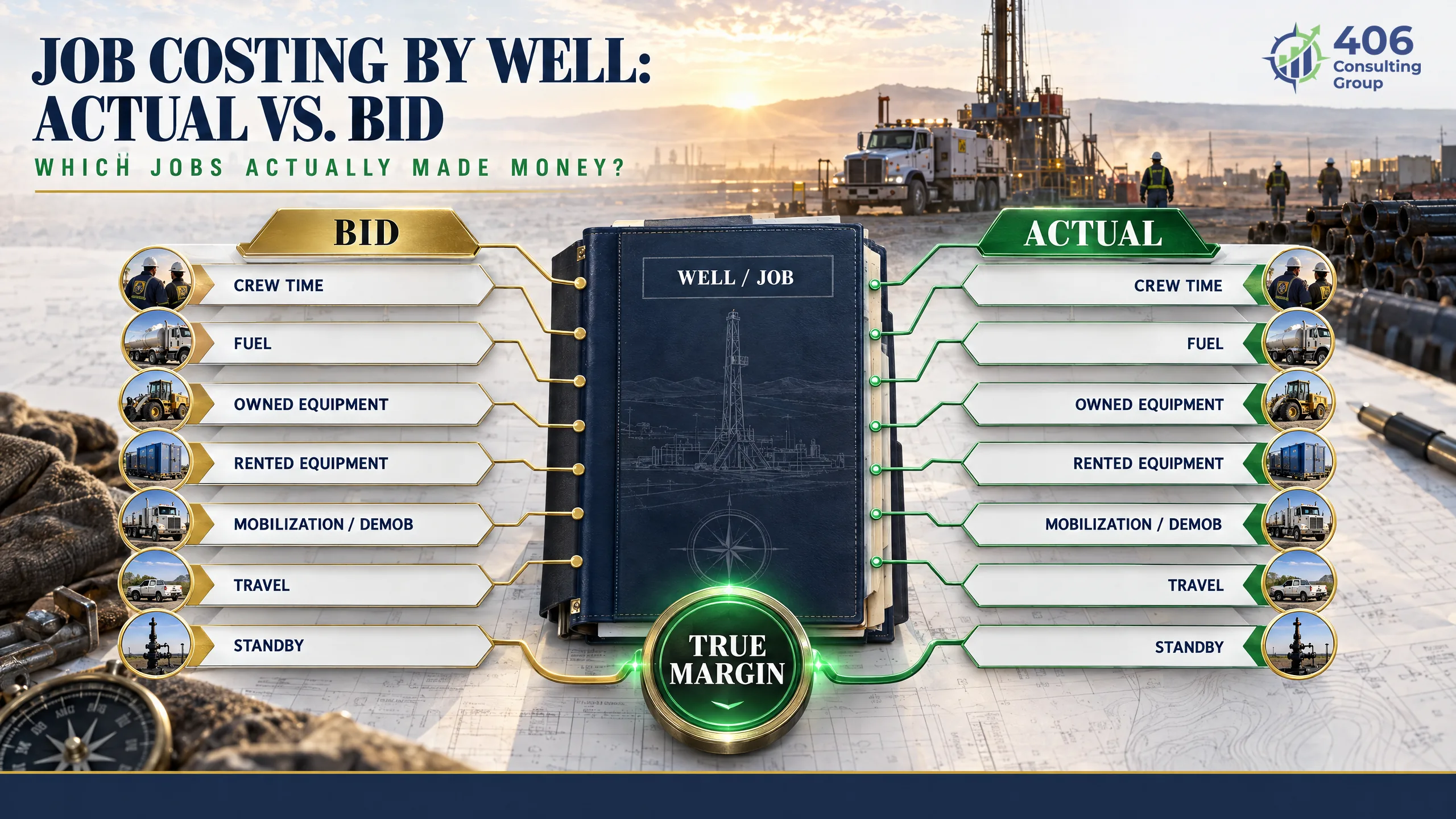
When you can see true margin by job, you learn which operators, which basins, and which kinds of work actually pay — and you can walk away from the busy-but-broke work that's quietly subsidizing everyone else.
The 1099 Crew Landmine
Oilfield runs on contract labor, and that is exactly where a lot of service companies are quietly carrying six-figure risk. If you pay a crew on a 1099 but you control how, when, and where they work, provide the equipment, and keep them on for months, the IRS (and the state) may call them employees — and reclassify them. The bill is back payroll taxes, penalties, and interest, often across multiple years and multiple states, plus workers'-comp exposure if one of them gets hurt on a site and wasn't covered.

This isn't a reason to never use contractors — it's a reason to get the classification, the paperwork, and the workers'-comp coverage right before an audit or an injury forces the question. We go deeper on the test in 1099 vs. W-2: Getting Worker Classification Right.
The Equipment That Eats Your Cash
Oilfield is iron-heavy, and the iron cuts both ways. Owned equipment ties up cash and sits idle in a downturn; rented equipment protects cash but kills margin if it runs long; financed equipment is a monthly obligation that doesn't care whether the rigs are running. Get the mix right and you survive the cycle; get it wrong and you're either over-leveraged in the bust or renting away your profit in the boom. The tax side matters too — Section 179 and bonus depreciation can shelter a big-equipment year, but a deduction only helps if the cash and the financing behind it make sense.

Crews in Five States, Five Sets of Rules
Run crews across Montana, North Dakota, Wyoming, Texas, and Oklahoma and you've just taken on five states' worth of payroll registration, income-tax nexus, and sales-and-use-tax rules — plus the equipment moving between them. One clarification that trips owners up: severance and production taxes fall on the operator producing the oil and gas, not on you as a service provider. (Montana's oil & gas production tax, North Dakota's gross production and extraction taxes, and Wyoming's severance tax are your customers' cost — which is exactly why their budgets, and your demand, move with the commodity price.) Your exposure is different: multi-state payroll and withholding, apportioned income tax, and use tax on equipment and materials moved across lines.

The Lender Relationship That Saves You
When the boom hits and you need working capital now, you find out whether you built the relationship when you didn't. Lenders fund oilfield service companies that can show clean, current financials, a real cash-flow forecast, an aging that proves the receivables are collectible, and an owner who can speak to the numbers. Walk in with a shoebox during a cash crisis and you'll get a no; walk in six months early with a credible package and you'll get a line you can draw on when the work shows up.
This is our home turf. Carrie spent her career on the other side of that desk — underwriting and reviewing hundreds of commercial loans — so we build the financials the way a lender actually reads them, and we know what gets a line approved versus declined. You're not guessing what the bank wants; you're working with someone who used to be the bank.
Why 406 for the Oilfield
Most accounting firms treat an oilfield service company like any other contractor and miss everything that makes it hard — the cash cycle, the mobile costs, the crew classification, the commodity-driven whipsaw. We don't, because this industry is in our background. Jason spent years at BP in oil & gas operations — scheduling crude and refined-product movements across pipelines and vessels, and running marine bunker-fuel operations — while Carrie built a career in commercial banking and underwriting, reviewing hundreds of loans from the lender's side of the desk. One of the first companies we ever worked with was a construction and trucking outfit we helped pull out of bankruptcy and back to health. We've sat in the operator's seat and the banker's seat — which means when we build your books, forecast your cash, cost your jobs, and get you lender-ready, we're doing it from experience, not a textbook. And we do it remotely, across the basins, so it doesn't matter whether your yard is in Sidney, Williston, or the Permian.
Frequently Asked Questions
Why do oilfield service companies run out of cash when they're busy?
Because growth consumes cash before it produces it. Every new job requires you to pay crews, fuel, per diem, and rented equipment up front, while operators typically pay in 60 to 90 days. The faster you grow, the larger the gap between cash out and cash in — so a company can be very profitable on paper and still unable to make payroll. A 13-week cash-flow forecast and a working-capital line set up before the boom are what bridge it.
Do oilfield service companies pay severance or production tax?
Generally no — severance and production taxes (like Montana's oil & gas production tax, North Dakota's gross production and extraction taxes, and Wyoming's severance tax) fall on the operator producing the oil and gas, not on service providers. As a service company your tax exposure is different: multi-state payroll and withholding, apportioned state income tax where you have nexus, sales and use tax on equipment and materials, and worker-classification compliance. Confirm specifics for your operations with your advisor.
What's the risk of paying oilfield crews on a 1099?
If you control how, when, and where a crew works, supply the equipment, and keep them on for an extended period, the IRS or a state can reclassify them from contractors to employees. That means back payroll taxes, penalties, and interest — often across several years and states — plus workers'-comp exposure if someone is injured and wasn't covered. Oilfield uses a lot of contract labor, so getting the classification, documentation, and coverage right is one of the highest-value things to fix before an audit or an injury forces it.
How should an oilfield service company handle equipment — own, rent, or finance?
It depends on the cycle and your cash position. Owned equipment ties up cash and can sit idle in a downturn; rented equipment protects cash but erodes margin if it runs long; financed equipment is a fixed monthly obligation regardless of activity. The right mix balances cash, margin, and tax (Section 179 and bonus depreciation can help in a big-equipment year, but only if the cash and financing make sense). We model the tradeoff against your actual cash forecast.
Does 406 Consulting Group work with oilfield and energy companies?
Yes. 406 Consulting Group provides bookkeeping, job costing, cash-flow forecasting, controller and fractional CFO services, payroll, and tax to oilfield service companies and energy-adjacent businesses across Montana, North Dakota, Wyoming, and the broader energy markets — delivered remotely. Our founders bring hands-on oil & gas operating experience and a commercial-lending and underwriting background, so we build your numbers the way an operator and a lender actually use them, not the way a generic firm would.
The bottom line
Oilfield service companies fail in the boom, not the bust — growth eats cash. Job costing, a real cash forecast, clean crew classification, and a lender who trusts your numbers are what keep you alive through the cycle.
Keep Reading