
The Benefits of Professional Accounting
in Boise, ID
Boise businesses lose thousands annually to bad bookkeeping. Here's what professional accounting actually delivers — clean books, tax savings, and growth-ready financials.

Professional accounting in Boise, ID is not a back-office cost — it is the financial infrastructure that determines whether a growing business keeps what it earns. Boise is one of the fastest-growing metros in the Mountain West, and that growth brings financial complexity that basic bookkeeping and DIY spreadsheets are not built to handle.
Most Boise small businesses start with the same setup: the owner manages day-to-day finances, a part-time bookkeeper enters transactions, and the CPA sees the books once a year. That setup costs thousands annually in missed deductions, undetected cash leaks, and preventable tax liabilities — and it creates the financial management ceiling that stops a business from qualifying for capital, winning larger contracts, or scaling with confidence.
This guide covers exactly what professional accounting delivers for Boise businesses: what changes, what it costs, what Idaho compliance requires, and how the right engagement looks from day one.
Table of Contents
What Professional Accounting Actually Delivers
The short answer: Professional accounting turns financial data into a decision-making tool — not just a compliance record. The difference between basic bookkeeping and professional accounting is the difference between knowing what happened last month and knowing what your business needs to do next.
Tax Liability Management
Basic Setup
CPA files what happened at year-end
Professional Accounting
Quarterly coordination minimizes the bill before April arrives
Financial Reporting
Basic Setup
P&L and balance sheet produced monthly
Professional Accounting
Budget vs. actual, KPI scorecard, and variance analysis that shows where money is leaking
Cash Flow Visibility
Basic Setup
Bank balance reviewed when needed
Professional Accounting
Rolling forecast updated weekly — no surprises, no emergencies
Lender Readiness
Basic Setup
Financial statements scrambled when a bank asks
Professional Accounting
Lender-ready package always current and ready to submit
Idaho Compliance
Basic Setup
Filings happen reactively — often late
Professional Accounting
Withholding, sales tax, and annual filings scheduled and never missed
Business Decisions
Basic Setup
Major decisions made from gut instinct and bank balance
Professional Accounting
Hire vs. contract, buy vs. lease, expand vs. hold — all modeled before the commitment
What most Boise owners discover in the first 60 days: The problem was never revenue. A Boise retailer running $1.2M annually found $87K in deductions their bookkeeper had never captured — because no one was doing a mid-year tax strategy review. The books were accurate. The tax strategy was missing entirely.
Why Boise's Growth Economy Demands Better Financial Infrastructure
Boise is one of the fastest-growing metros in the United States. Ada County grew by more than 30% between 2010 and 2020, and growth has continued through the mid-2020s. More employees, more vendors, more tax obligations, and more lender scrutiny — and a local market where competition for capital, contracts, and talent is more intense than it was five years ago.
30%+
Ada County population growth from 2010–2020 per US Census
$2B+
Micron Technology Boise campus expansion investment announced 2022
Top 5
Idaho consistently ranked among fastest-growing states for small business formation
Hiring faster than your financial systems can support
A Boise business that grew from 4 to 14 employees in 18 months has payroll, benefits, and Idaho UI filing complexity that exceeds what a part-time bookkeeper can manage. The cost of payroll errors — underpayment, missed deposits, late filings with the Idaho Department of Labor — exceeds the cost of professional accounting within the first compliance failure.
Capital needs outpacing what your books can support
Boise's construction and commercial real estate market requires capital. Whether you are a GC financing materials, a retailer opening a second location, or a service business funding a team expansion, commercial lenders require financial statements that a bookkeeper-only setup often cannot produce at the quality level underwriters require.
Idaho compliance complexity scaling with revenue
Idaho sales and use tax, quarterly withholding deposits, Idaho State Tax Commission reporting requirements, and Secretary of State annual filings all become more complex as revenue grows. A business that misses a quarterly withholding deposit faces penalties that compound — and Idaho is not known for administrative flexibility on these obligations.
The Financial Clarity Stack: 5 Layers Every Boise Business Should Know
The Financial Clarity Stack maps the five layers of accounting infrastructure a Boise business needs as it grows. Most businesses stall between Layer 2 and Layer 3 — they have accurate books but no reporting, no strategy, and no visibility into what is coming. The cost of staying at Layer 2 when your business needs Layer 3 is measurable in missed deductions, denied loans, and decisions made without adequate data.
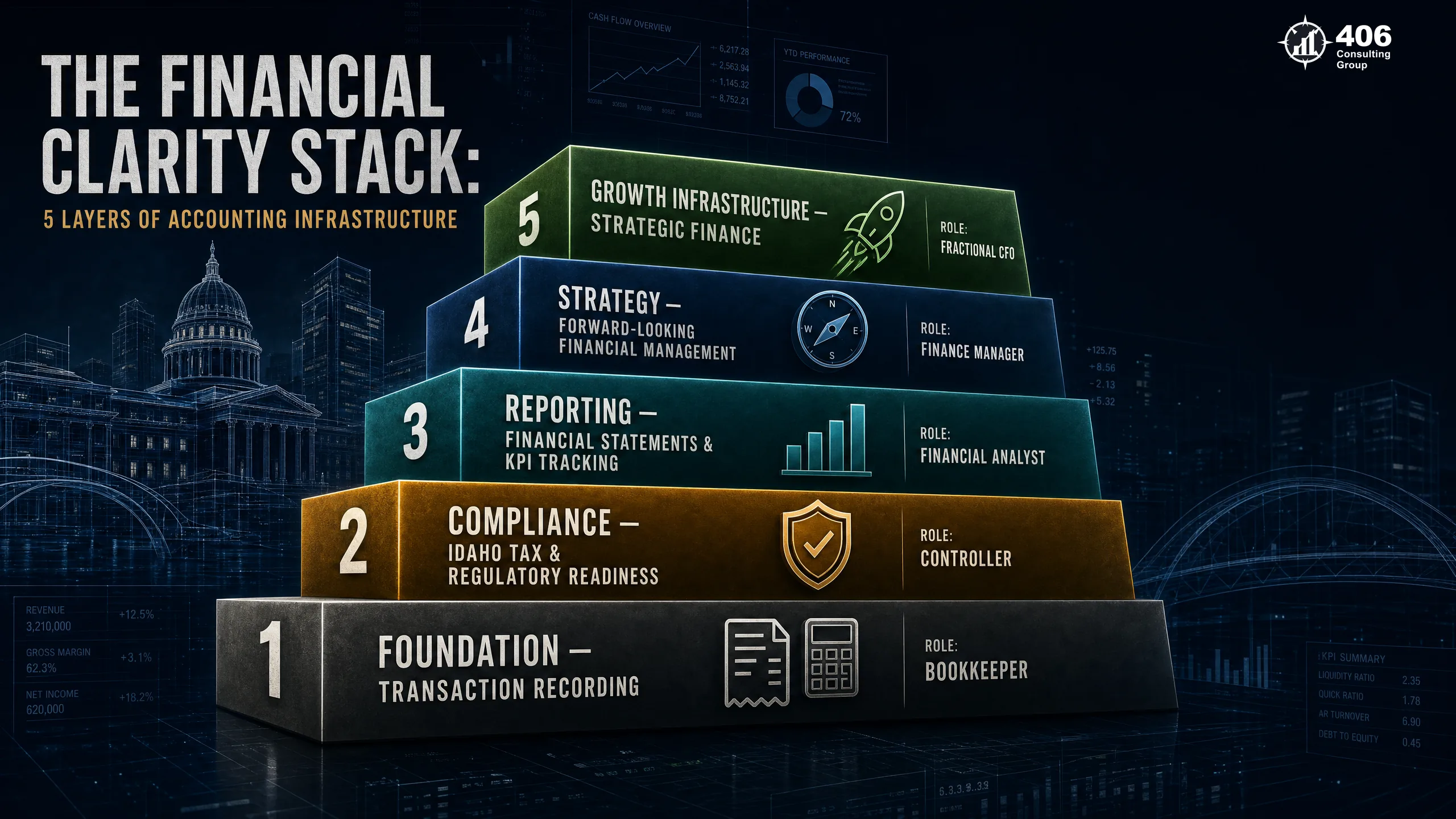
Foundation — Transaction Recording
Chart of accounts, bank reconciliation, expense categorization, accounts receivable and payable tracking.
When you need it
From day one. Every business needs this layer.
How to get it
Part-time bookkeeper or outsourced bookkeeping service. QuickBooks or equivalent.
The gap: A business that only has Layer 1 knows what happened — not what it means or what is coming.
Compliance — Idaho Tax & Regulatory Readiness
Idaho withholding deposits, quarterly sales and use tax filings, Idaho State Tax Commission reporting, Secretary of State annual report, Idaho unemployment insurance contributions.
When you need it
From the first employee or first taxable sale. Compliance failures compound quickly.
How to get it
Professional bookkeeper or accounting service with Idaho compliance expertise.
The gap: Many Boise businesses handle Layer 1 but miss Layer 2 deadlines — especially quarterly withholding deposits and sales tax remittances.
Reporting — Financial Statements & KPI Tracking
Monthly P&L, balance sheet, budget vs. actual analysis, cash flow statement, and a KPI dashboard specific to the business model.
When you need it
By $500K in revenue. Definitely by $750K.
How to get it
This is where professional accounting begins. A bookkeeper produces data; a professional accountant builds the reporting structure that makes it useful.
The gap: Without Layer 3, a business cannot identify margin leakage, produce the financials a bank requires, or make informed hiring and expansion decisions.
Strategy — Forward-Looking Financial Management
Cash flow forecasting, annual budget by department or job, tax strategy coordination with CPA, lender relationship management, scenario modeling for major decisions.
When you need it
By $1M in revenue or at a trigger event: bank loan needed, hiring decision unclear, tax bill a surprise.
How to get it
Controller or fractional CFO engagement. Scope exceeds what most standard accounting engagements deliver.
The gap: Most growth-stage Boise businesses are missing this layer. They have clean books and some reporting, but no one is building a forward-looking financial picture.
Growth Infrastructure — Strategic Finance
M&A readiness, investor-grade reporting, exit planning, capital structure optimization, multi-entity strategy, advanced tax planning.
When you need it
$3M+ in revenue, or when growth is active and capital-intensive.
How to get it
Fractional or in-house CFO. Built on the systems established in Layers 3 and 4.
The gap: Businesses that skip Layers 3 and 4 and try to jump to Layer 5 almost always have to rebuild foundational systems first — at significant cost and delay.
Most Boise businesses we work with are at Layer 2 when they need Layer 3. The move from compliance-only to reporting and strategy is where professional accounting pays for itself — typically within the first year, often within the first quarter.
The Real Cost of DIY and Basic Bookkeeping in Boise
The cost of DIY accounting is not the software subscription. It is the deductions never captured, the tax penalty paid because a quarterly filing was late, the loan denied because financials were not in order, and the hiring decision made without modeling the actual cost. These costs do not appear as a line item on a P&L — but they are real, and they compound annually.
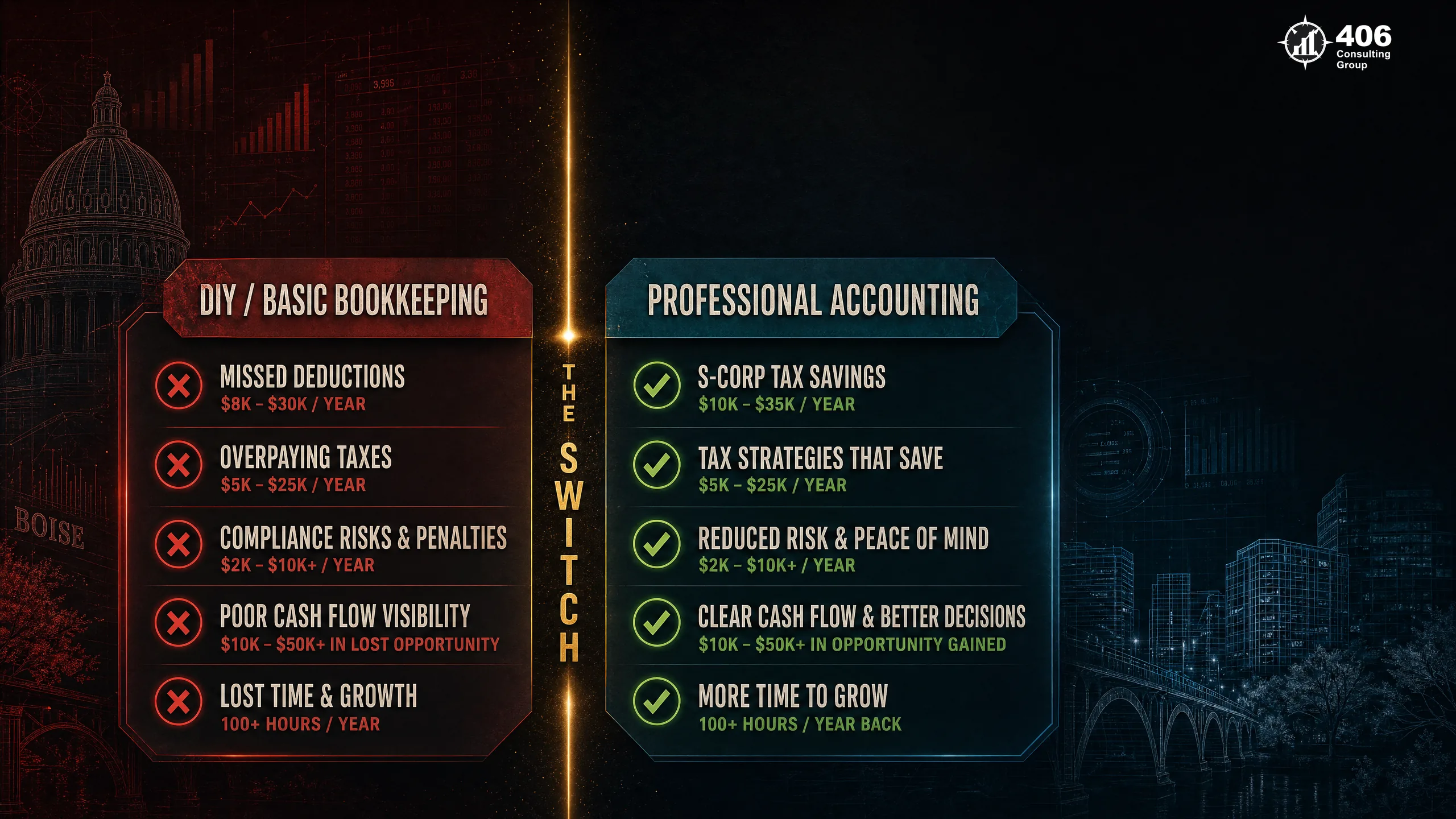
Missed deductions
$8,000–$30,000/yearHome office, vehicle use, equipment depreciation, software subscriptions, health insurance premiums, retirement plan contributions — all legitimate deductions that business owners routinely under-capture when no one is actively looking for them. A professional accountant running a year-end deduction review typically finds $8,000–$30,000 in items a basic bookkeeping setup missed.
Idaho compliance penalties
$500–$5,000+ per incidentIdaho withholding deposits are due on specific schedules that vary by employer size. A missed or late deposit triggers penalties and interest from the due date. Idaho sales and use tax remittances have similar consequences. The Idaho State Tax Commission does not offer significant grace periods — and business owners are personally liable for these obligations.
Wrong entity structure
$10,000–$40,000/year in excess taxesA Boise service business running $400K in net income as a sole proprietorship or single-member LLC pays full self-employment tax on every dollar of that income. An S-Corp election reduces that exposure substantially. Most basic bookkeeping setups never raise this question. A professional accountant identifies the election opportunity and models the savings — typically in the first engagement.
Loan denial or unfavorable terms
Delayed growth and missed opportunityLenders at Banner Bank, Idaho Central Credit Union, D.L. Evans Bank, and SBA lenders serving the Treasure Valley require financial statements prepared to at least CPA-compiled standards for loans above $250K. Self-prepared or bookkeeper-only statements signal financial management immaturity to underwriters. The loan may be approved — at a higher rate, with more collateral, for less than requested.
Undetected cash leaks and margin erosion
$2,000–$20,000/yearWithout a budget and monthly variance analysis, a Boise business can run 6–10% below gross margin expectations for months before anyone notices. By then, year-end correction options are gone. A professional accountant tracks budget vs. actual monthly and flags variance while there is still time to act.
Tax Strategy Advantages Professional Accounting Unlocks in Idaho
Idaho's tax environment has specific planning levers that most Boise small businesses never pull — because no one is looking for them. Professional accounting is not just tax compliance. It is active tax strategy: modeling liability before December, timing deductions, structuring the entity to minimize what you owe, and coordinating with your CPA so that nothing is left on the table.
S-Corp Election Timing
$10K–$35K/year in FICA savings
Idaho recognizes S-Corp elections and the associated reduction in self-employment tax exposure. For a Boise service business with $300K–$600K in net income, the FICA savings from an S-Corp election — with a reasonable owner salary set relative to market compensation — can range from $10,000 to $35,000 annually. Professional accounting identifies the opportunity and models the savings before filing.
Equipment & Asset Timing
Deductions moved to optimal year
Idaho follows federal bonus depreciation and Section 179 rules. A Boise contractor or retailer purchasing equipment in Q4 can time that purchase to maximize the current-year deduction — or defer it to the following year if income is lower. Without a professional accountant modeling the year-end income picture, these timing decisions are guesses with real tax consequences.
Idaho Investment Tax Credit
Credit on qualifying Idaho business property
Idaho offers an investment tax credit on qualifying new business property placed in service in Idaho. A Boise manufacturing or construction business purchasing qualifying equipment may be eligible — but only if someone knows to claim it. This credit is frequently missed on returns prepared without professional guidance.
Retirement Plan Contributions
Up to $69K/year excluded from taxable income
A SEP-IRA or Solo 401(k) contribution for a self-employed Boise owner can exclude a substantial amount of income from both Idaho and federal tax. Defined benefit plans can shelter even more. These contributions must be timed against income projections — which requires an accountant who knows the Q4 income picture well in advance.
Idaho Opportunity Zone Investments
Capital gains deferral on qualifying investments
Idaho has designated Opportunity Zones that allow capital gains deferral and potential exclusion for qualifying investments held long-term. Most Boise business owners are unaware of this unless an advisor raises it specifically in the context of their liquidity events or business sale planning.
Quarterly CPA Coordination
Zero surprise tax bills at filing
A basic bookkeeping setup sends data to the CPA at year-end. By then, the options for tax management are largely exhausted. Professional accounting includes quarterly CPA coordination — reviewing estimated payments, adjusting Q4 strategy before December 31, and ensuring April contains no surprises. A surprise tax bill is a cash flow event that a forecast should prevent.
Idaho Compliance Requirements Every Boise Business Must Meet
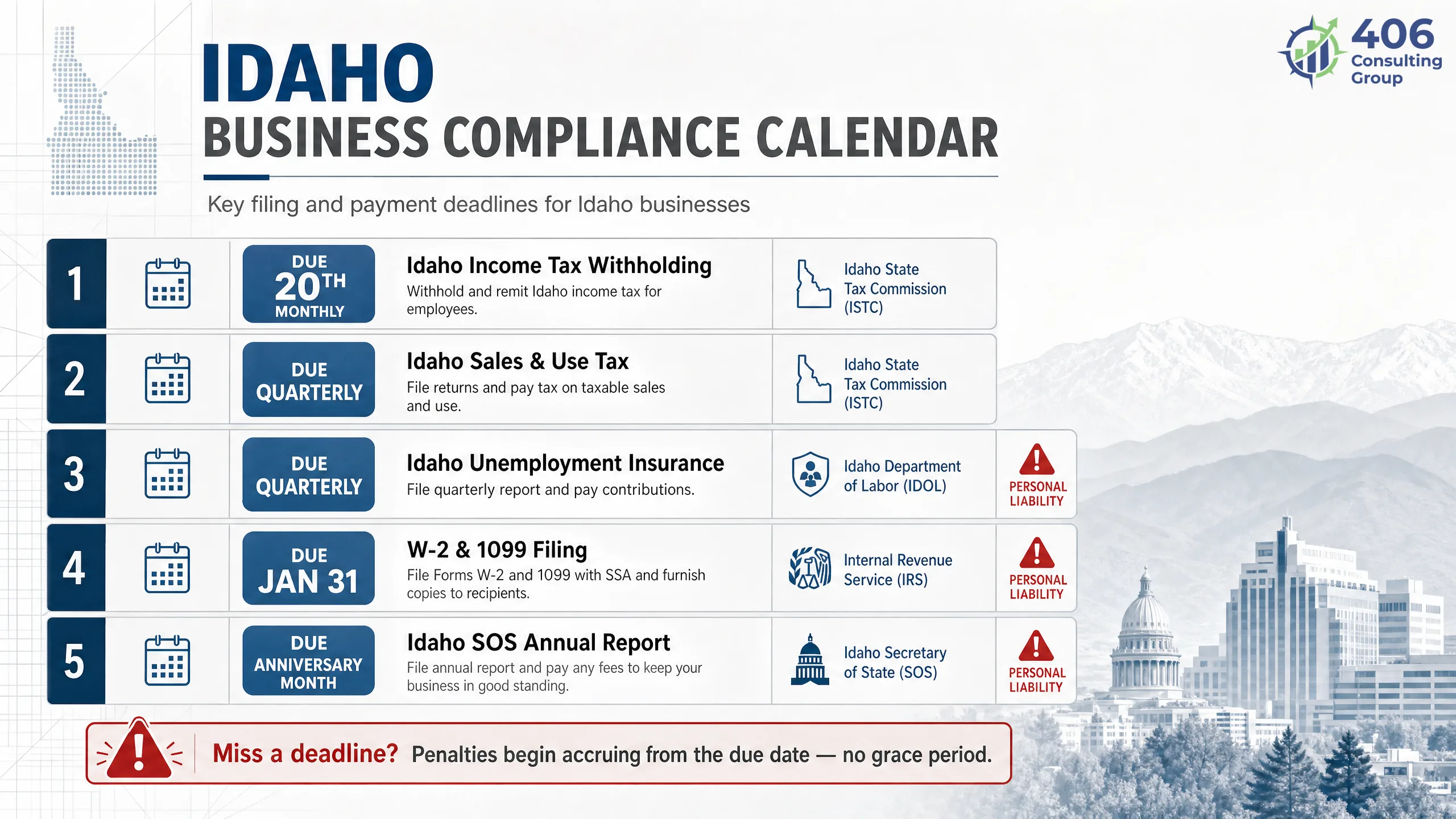
Idaho compliance is not optional and it is not forgiving. The Idaho State Tax Commission and the Idaho Department of Labor operate on fixed schedules with specific penalties for late filings and deposits. A professional accountant manages this calendar proactively — so a missed quarterly deposit does not become a $2,000 penalty discovered at year-end.
Idaho Income Tax Withholding
Idaho employers must withhold state income tax from employee wages and remit to the Idaho State Tax Commission on a schedule based on withholding volume. Monthly deposits are due by the 20th of the following month. Large employers may face more frequent requirements. Failure to deposit timely triggers penalties and interest that accumulate from the due date — and owners are personally liable.
Risk if missed: Penalties + interest from due date; personal liability
Idaho Sales and Use Tax
Idaho's base sales tax rate is 6%. Businesses selling taxable goods or certain services must register, collect from customers, and remit on the required schedule. Use tax applies to business purchases made without Idaho sales tax. Both are frequently missed by businesses that are not actively managing compliance. Idaho audits routinely recover 2–4 years of unpaid use tax from businesses with no professional oversight.
Risk if missed: Back taxes, penalties, and audit exposure
Idaho Unemployment Insurance Contributions
Idaho employers with W-2 employees must register with the Idaho Department of Labor and pay UI contributions quarterly. The rate is based on the employer's experience rating; new employers receive a standard rate. Quarterly reports are due the last day of the month following the quarter-end. Late filings result in penalties. Worker misclassification — paying contractors who should be employees — creates retroactive UI liability.
Risk if missed: Penalties for late filing; retroactive liability for misclassified workers
Idaho Secretary of State Annual Report
Idaho LLCs and corporations must file an annual report with the Idaho Secretary of State to maintain good standing. The report is due by the end of the anniversary month of formation. Failure to file results in administrative dissolution — which can trigger complications with bank accounts, professional licenses, and contracts that require an entity in good standing.
Risk if missed: Administrative dissolution; bank and contract complications
W-2 and 1099 Filing
Idaho employers must issue W-2s to employees and 1099-NECs to qualifying contractors by January 31, and file copies with both the IRS and the Idaho State Tax Commission. Errors — incorrect EIN, wrong Social Security numbers, worker misclassification — trigger IRS notices and Idaho scrutiny. A professional accountant reconciles payroll data and contractor payments before the deadline, not at it.
Risk if missed: IRS penalties; Idaho ISTC penalties; contractor disputes
Professional accounting manages this calendar for you. Withholding deposits, quarterly sales tax, UI reports, annual filings — all scheduled proactively. You do not miss a deadline because someone is watching each one. This alone eliminates a category of penalty exposure that bookkeeping-only setups routinely trigger.
Clean Books and What They Unlock for Boise Businesses
Clean books are not just a compliance requirement — they are a business asset. For a Boise business with growth ambitions, professionally maintained financial statements open doors that messy books close: bank loans, vendor credit, business partnerships, M&A, and in some cases commercial contracts that require reviewed or audited financials.
Commercial Lending
Lenders at Banner Bank, Idaho Central Credit Union, D.L. Evans Bank, and SBA lenders serving the Treasure Valley require financial statements at minimum to CPA-compiled standards for loans above $250K. Reviewed statements are required for most loans above $500K. Professionally maintained books shorten underwriting timelines, improve approval odds, and often secure better terms.
Vendor Credit and Trade Terms
A Boise contractor or retailer seeking net-30 or net-60 terms from suppliers may be asked for financial statements as part of a credit application. Professionally maintained financials demonstrate stability — translating to better payment terms and higher credit limits from key vendors.
Business Acquisition or Sale
If you are buying a Boise business — or positioning yours for sale — clean books are non-negotiable. A buyer's due diligence process examines 3 years of financial statements. Bookkeeper-only books frequently have categorization errors, commingled personal expenses, and inconsistent accounting that raise red flags and reduce the offer.
Partner and Investor Conversations
A Boise business taking on a partner or investor needs financials a sophisticated party can evaluate. Professionally maintained books — consistent categorization, accurate balance sheets, a clean chart of accounts — convey financial credibility. Messy books convey operational risk and kill deals before they start.
The direct link: A Boise HVAC contractor had been denied a $300K equipment line twice — once by their primary bank and once through the SBA. Both denials cited insufficient cash flow documentation and inconsistent statement preparation. We rebuilt 18 months of books to CPA-compiled standards, prepared a lending package with a 13-week cash flow model, and resubmitted. Approved in 22 days at the full amount. See what commercial lenders actually evaluate for the full picture.
Cash Flow Management in Boise's High-Growth Market
Boise's growth economy creates a specific cash flow pattern: revenue is increasing, but the cash required to fund growth — payroll, inventory, subcontractor deposits, equipment — often arrives before the income does. A business growing from $800K to $1.5M in 18 months can face cash shortfalls even when it is profitable on paper. Professional accounting identifies and manages those shortfalls before they become emergencies.
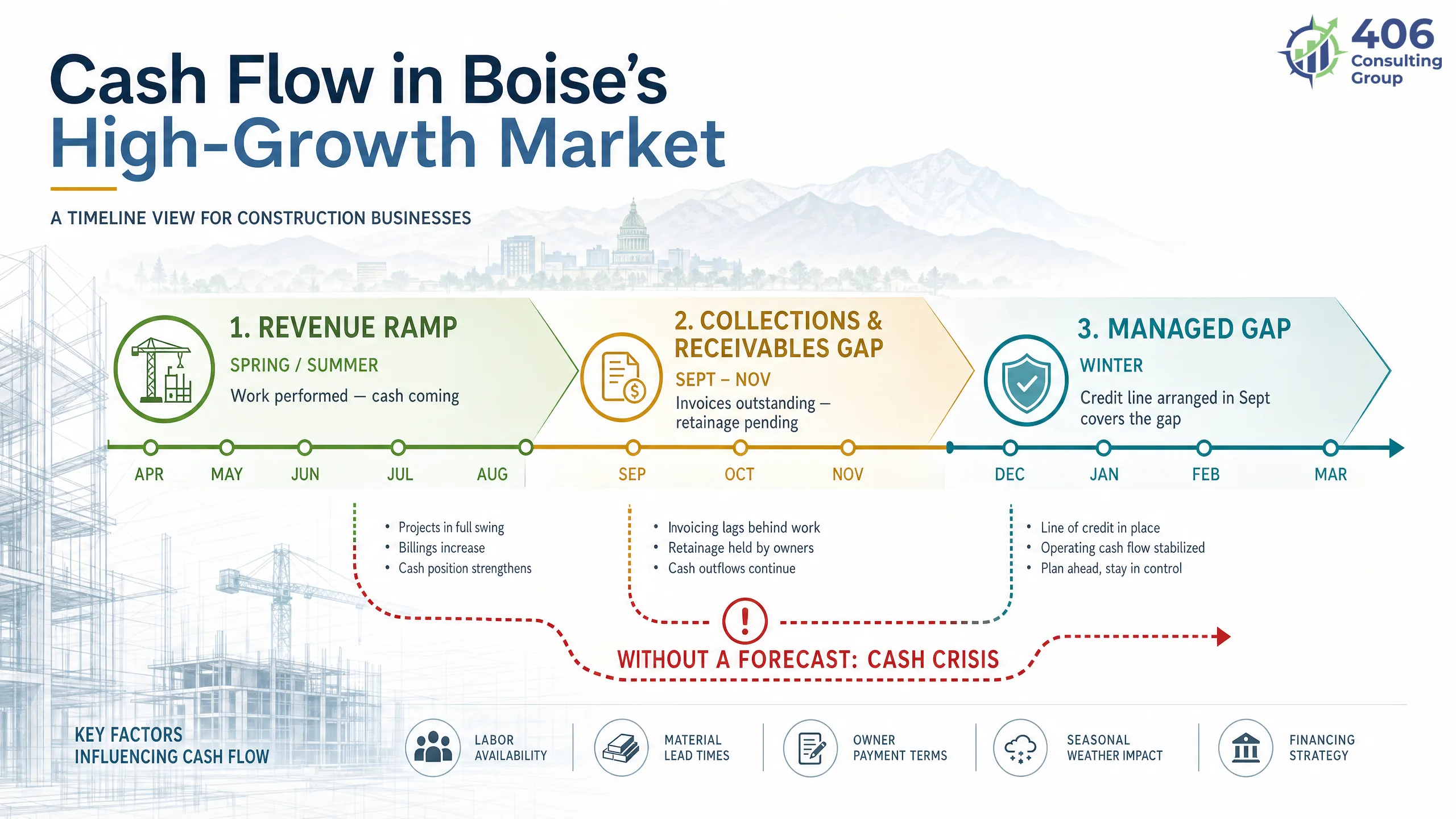
Construction and contracting: the receivables gap
A Boise residential contractor doing $2M annually typically carries 45–60 days of outstanding receivables. Materials are purchased and labor paid before billing occurs. Retainage — 5–10% held by the GC or owner — is collected months later. Without a cash flow forecast, the contractor hits a liquidity gap mid-month because three large invoices are outstanding and payroll is due. A professional accountant builds the forecast that makes this gap visible 6–8 weeks ahead — when a credit line can be arranged without urgency.
Retail: inventory financing and seasonal concentration
A Boise retailer with peak sales in Q4 and Q1 carries inventory purchased on credit in Q3. The cash to pay for that inventory comes in October through January — but supplier payments may be due in September. Without a cash flow model accounting for supplier payment terms, inventory cycles, and seasonal revenue patterns, a profitable retailer faces a cash crisis in September despite a strong annual outlook.
Service businesses: the growth investment lag
A Boise technology services firm adding its 8th employee may not see that employee's full revenue contribution for 3–6 months. Meanwhile, the cost of that hire — salary, benefits, equipment, Idaho UI contributions — begins immediately. Professional accounting models the growth investment period: how long before the hire is margin-positive, what cash reserve is required, and whether a line of credit is needed to bridge the gap.
The tool that solves this: A rolling 13-week cash flow forecast, updated weekly, mapping every inflow and outflow. It is one of the first deliverables a professional accounting engagement builds — and consistently one of the highest-value. See our professional bookkeeping services for how the foundation that makes forecasting reliable gets built.
Professional Accounting for Boise's Key Industries
Every industry in Boise has different accounting levers. A professional accountant who knows the Treasure Valley market knows which metrics matter most for each sector — and where to focus in the first 90 days to generate the fastest result.
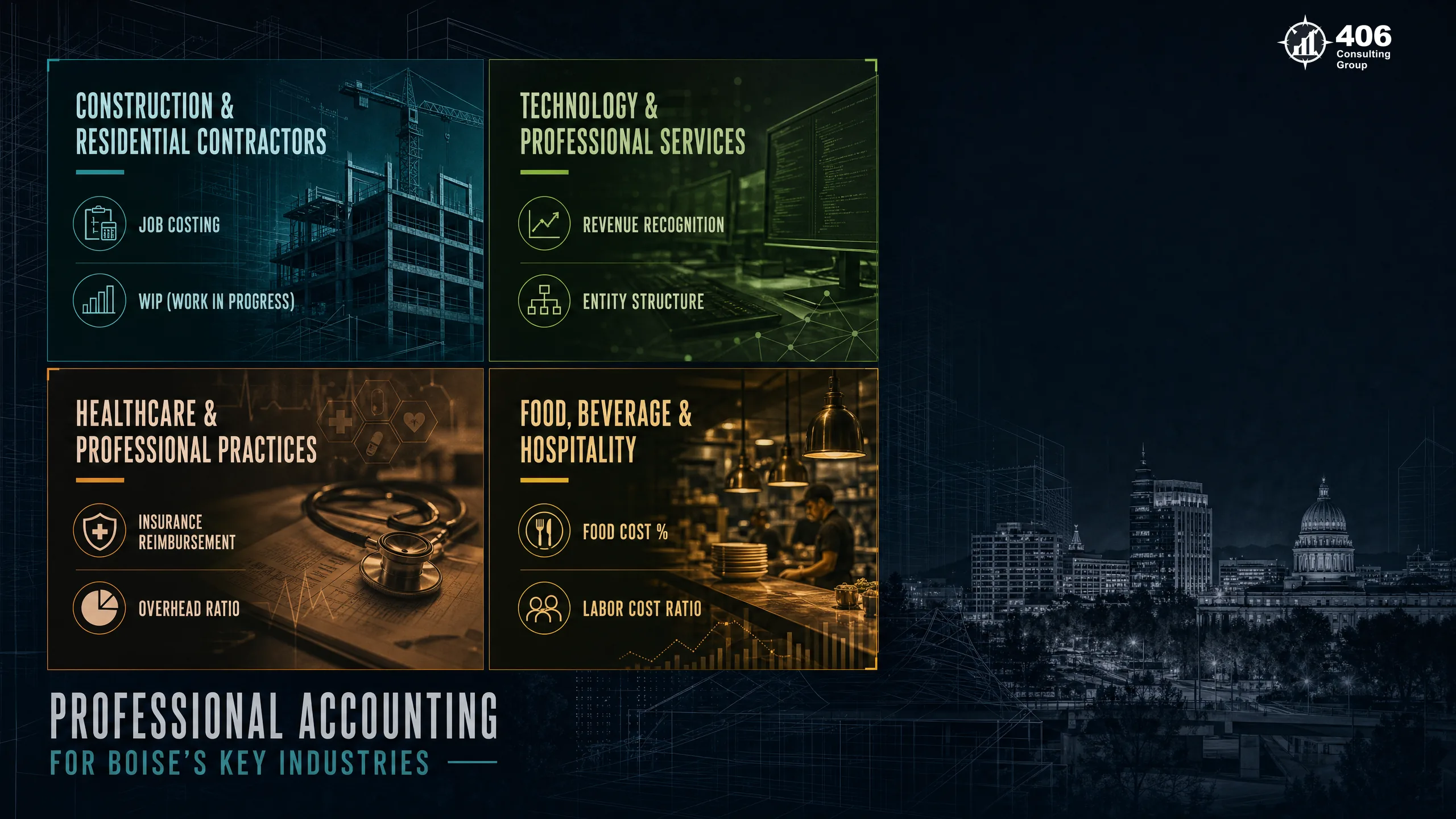
Construction & Residential Contractors
Job costing + WIP scheduleBoise's residential construction market has expanded dramatically with Ada County growth. A GC or specialty contractor without job costing cannot identify which projects are profitable and which are eroding margin. WIP schedule management is required for bonding — and Boise contractors pursuing larger commercial or public projects need bonding capacity built through systematic financial ratio management.
Technology & Professional Services
Revenue recognition + entity structureBoise's tech sector — anchored by Micron Technology, HP Inc., and a growing startup ecosystem — creates specific complexity around SaaS revenue recognition, contractor classification, and equity compensation. Worker misclassification risk is high. An entity structure review frequently identifies $15,000–$40,000 in annual tax savings for founder-operated businesses at $500K+ in revenue.
Healthcare & Professional Practices
Insurance reimbursement reconciliation + overhead ratioMedical, dental, and allied health practices in Boise face insurance reimbursement timing, write-off management, and overhead ratio benchmarking against specialty norms. A dental practice with 65% overhead when the specialty norm is 55–60% has a structural profitability problem that only appears clearly when books are prepared to industry-specific standards and reviewed against benchmarks.
Food, Beverage & Hospitality
Food cost percentage + labor cost ratioBoise's restaurant scene and growing food manufacturing presence require food cost and labor cost tracking at the concept or department level. A restaurant running 38% food cost against a 30% target is losing $80,000 annually on $1M in revenue — but only if someone is tracking the metric monthly and flagging variance before it becomes an annual P&L problem.
How to Choose the Right Accounting Partner in Boise, ID
Not all accounting services in Boise deliver the same result. The difference between a bookkeeper, a CPA firm, and a professional accounting service is the engagement level, scope, and who is actually responsible for the financial outcomes. Here is how to evaluate your options — and the questions that reveal whether a firm is the right fit.
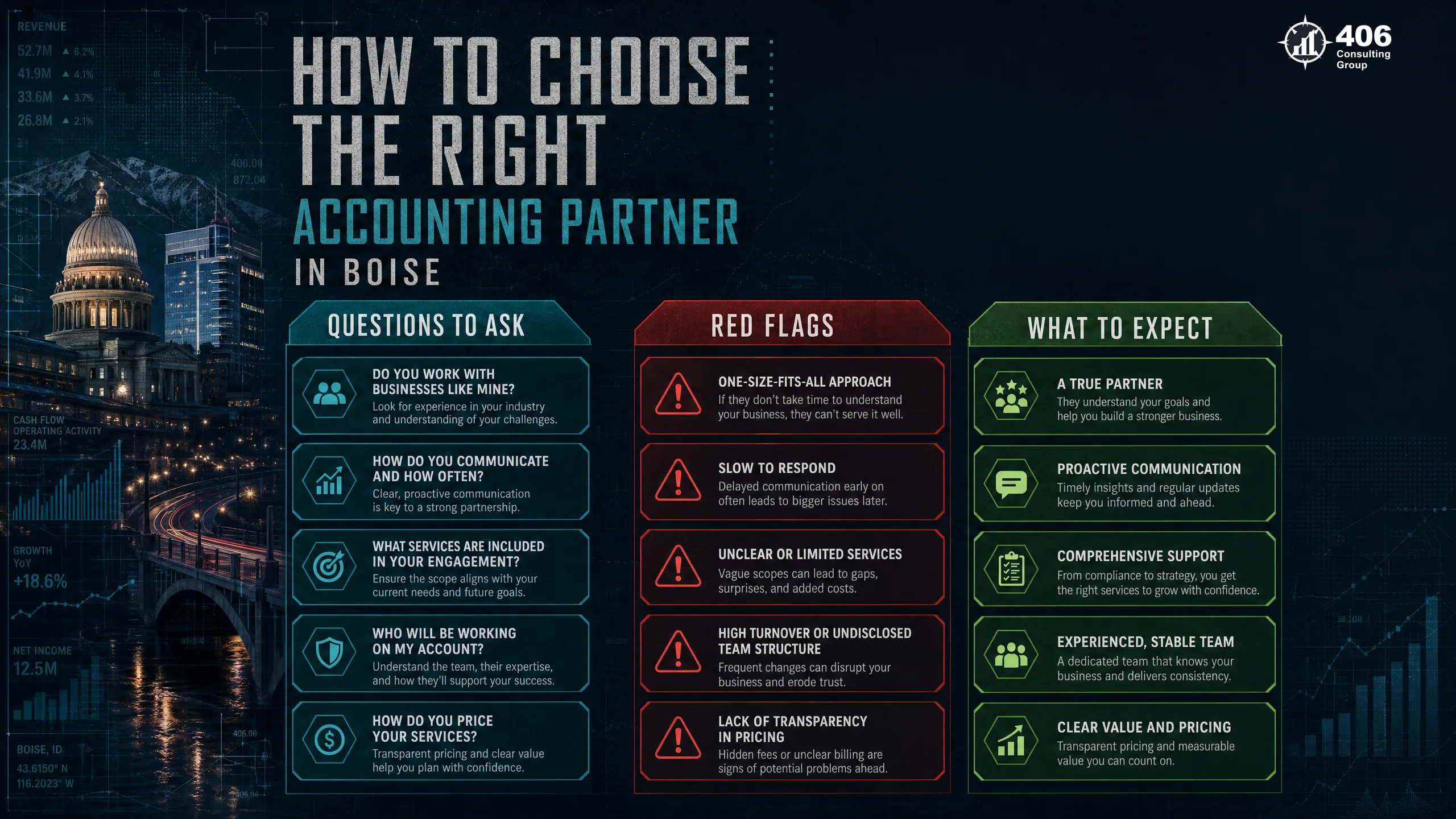
Questions to ask any accounting firm
- Do you specialize in businesses at my revenue level and in my industry?
- How do you handle Idaho withholding, sales tax, and annual filing deadlines — do you manage the calendar or do I?
- What is the monthly cadence? How often do we meet and what gets reviewed?
- What does transition from my current bookkeeper look like, and how long before books are current?
- Do you coordinate with my CPA, or do you also handle tax filings?
- Can you give me a reference from a Boise business at a similar revenue stage?
Red flags that signal a poor fit
- They quote a monthly fee before asking about your business in detail
- No structured onboarding process — they just take over the QuickBooks login
- No monthly meeting cadence — reports delivered but never discussed
- Idaho compliance is handled reactively rather than proactively
- No tax strategy review or CPA coordination offered — bookkeeping only
- They cannot name 2–3 Boise businesses they have served in your industry
What a professional accounting engagement should deliver
- Monthly financial review — P&L, balance sheet, budget vs. actual, cash position
- Quarterly tax coordination with your CPA — estimated payments reviewed and adjusted
- Idaho compliance calendar managed proactively — no missed deadlines
- Cash flow forecast maintained — visibility 8–13 weeks ahead
- Annual deduction review — looking for opportunities the current setup missed
- Access to the accountant for questions between monthly meetings — not just annually
The right accounting partner grows with you. At Layer 2, a bookkeeping service may be sufficient. At Layer 3, you need professional accounting. At Layer 4, you need a controller or fractional CFO. The best firms build toward the next layer without requiring you to switch partners every time you grow. See what a fractional CFO engagement costs for when you are approaching Layer 4.
Case Study: Boise Contractor Recovered $220K in Year One with Professional Accounting
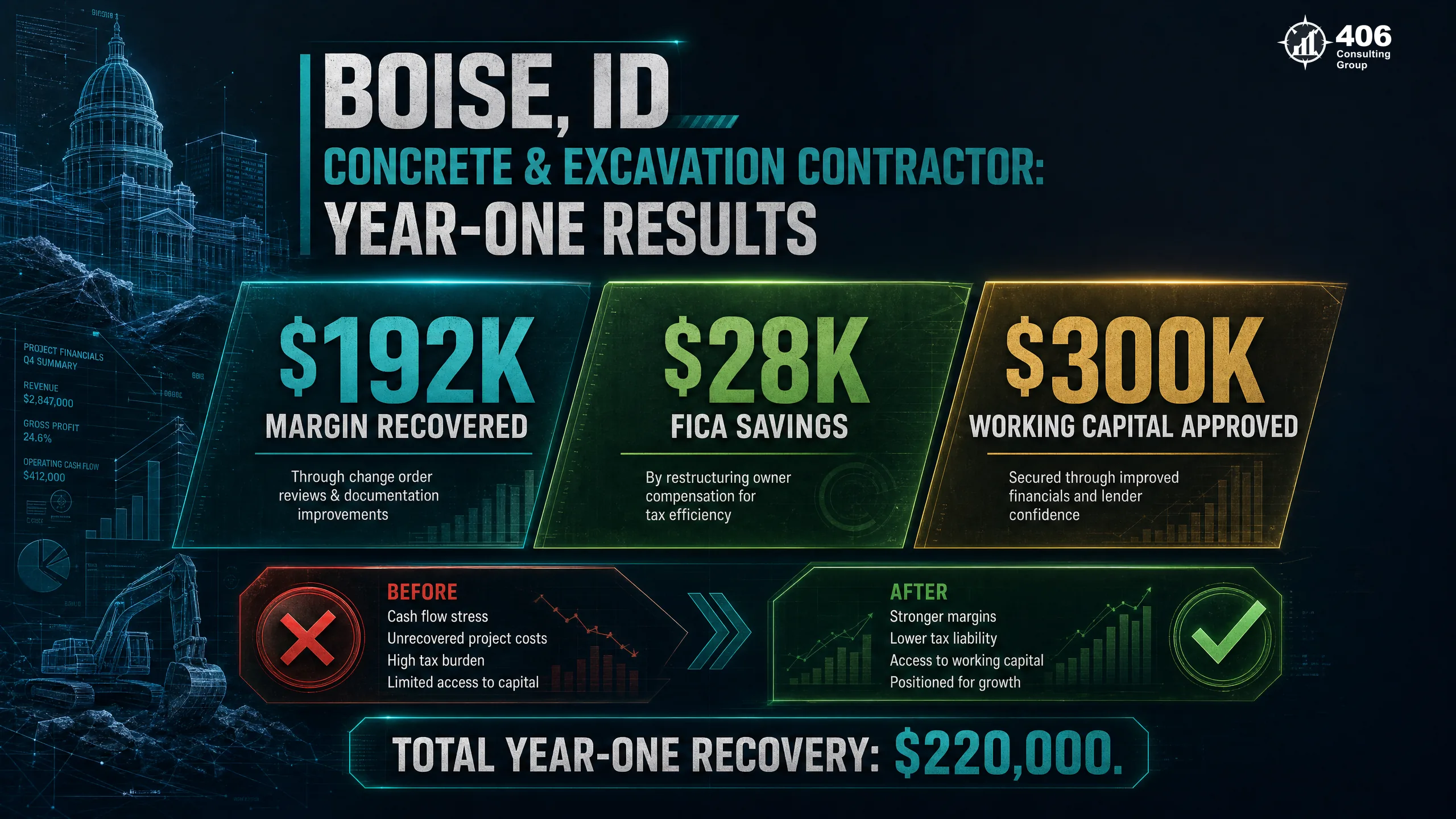
Anonymized — Boise, ID
Concrete & Excavation Contractor — Year-One Professional Accounting Engagement
When We Started
- $1.8M in annual revenue — profitable but bleeding margin on select projects
- No job costing — owner knew total revenue, not profitability by project type
- LLC taxed as sole proprietorship — paying full SE tax on $340K net income
- Idaho withholding deposit missed in Q2 — $1,100 penalty outstanding
- Bank line application stalled for 6 weeks with no update from underwriting
- Owner spending 25% of time managing bookkeeper and answering financial questions
After 12 Months
- Job costing system live — two unprofitable project types identified and repriced within 90 days
- S-Corp election completed — $28,000 in FICA savings in year one
- $192K in margin recovered by correcting job cost capture across 14 months of projects
- $300K working capital line approved — full amount, 19 days after package submitted
- Idaho compliance calendar managed proactively — zero missed deadlines since engagement
- Owner out of financial management — one 45-minute monthly meeting
$192K
Margin recovered from job cost analysis
$28K
Year-one FICA savings from S-Corp election
$300K
Working capital line approved
The critical finding: Job costing analysis revealed the excavation division was running at 12% gross margin against a company-wide average of 24%. Every excavation contract was underpriced relative to actual labor hours — and the owner had no visibility because revenue and costs were tracked at the company level, not by project type. Repricing the excavation line recovered $192,000 in margin over the following 14 months. Combined with the S-Corp FICA savings, year-one recovery totaled $220,000 against an accounting engagement cost of approximately $24,000.
Frequently Asked Questions: Professional Accounting in Boise, ID
What is the difference between bookkeeping and professional accounting in Boise?
Bookkeeping is transaction recording — categorizing expenses, reconciling bank accounts, and producing a basic P&L. Professional accounting adds reporting, strategy, and Idaho compliance management on top: budget vs. actual analysis, cash flow forecasting, tax strategy coordination, quarterly withholding and sales tax management, KPI tracking, and forward-looking financial guidance. Most Boise businesses need both — clean books as the foundation, and professional accounting to turn that data into decisions.
How much does professional accounting cost for a small business in Boise, ID?
Professional accounting engagements for Boise small businesses typically range from $500 to $2,500 per month depending on revenue, transaction volume, complexity, and scope. A business at $500K–$1M in revenue with standard needs typically falls in the $800–$1,500 range. The ROI calculation is direct: if the accountant recovers $15,000 in missed deductions and eliminates $2,000 in compliance penalties in year one, a $1,000/month engagement pays for itself within the first quarter.
Does my Boise business need a CPA, a bookkeeper, or a professional accountant?
Most Boise businesses benefit from all three — at different stages and for different purposes. A bookkeeper handles day-to-day transaction recording. A professional accountant (who may or may not hold a CPA license) handles reporting, strategy, compliance management, and financial analysis on a monthly basis. A CPA handles tax return preparation, IRS representation, and CPA-quality financial statement preparation. The most effective setup is a professional accounting service that coordinates actively with your CPA — so nothing falls between the two.
What Idaho-specific tax and compliance requirements should Boise businesses know?
Idaho businesses must manage: Idaho income tax withholding deposits (monthly or quarterly based on volume, due to the Idaho State Tax Commission), Idaho sales and use tax remittances, Idaho unemployment insurance contributions to the Department of Labor (quarterly), annual report filings with the Idaho Secretary of State, and W-2/1099 filing by January 31. Idaho also recognizes S-Corp elections and offers an investment tax credit on qualifying business property. The Idaho State Tax Commission at tax.idaho.gov is the primary authority. Missing deadlines results in penalties from the due date — there is no grace period.
How does professional accounting help a Boise business qualify for a bank loan?
Professional accounting prepares the complete financial package lenders require: CPA-compiled or reviewed financial statements, a 13-week cash flow model, working capital analysis, DSCR calculation, and a business narrative explaining what the loan is for and how it will be repaid. Lenders at Banner Bank, Idaho Central Credit Union, D.L. Evans Bank, and SBA lenders in the Treasure Valley evaluate these materials as a package — and the quality signals financial management maturity. A business with professionally prepared financials typically has a materially shorter underwriting timeline and better approval odds.
When should a Boise small business switch from DIY to professional accounting?
Five reliable trigger points: revenue has crossed $500K (complexity outpaces DIY), a bank loan is needed or has been denied, a hiring decision feels unclear because you do not know the true cost, a tax bill arrived as a surprise, or you are spending more than 15% of your time managing finances and supervising a bookkeeper. Any one of these is worth a conversation. Two or more together means the cost of staying DIY almost certainly exceeds the cost of professional accounting.
Does 406 Consulting Group provide accounting services in Boise, ID?
Yes. 406 Consulting Group provides professional accounting, bookkeeping, controller services, and fractional CFO engagements for businesses in Boise, the Treasure Valley, and across Idaho, Montana, and the Intermountain West. Jason Anderson's background in operational finance and strategic planning and Carrie Anderson's experience in commercial banking and underwriting are particularly relevant for Boise businesses pursuing lending, bonding, or growth capital. Contact us to discuss what a professional accounting engagement looks like for your business.
External Resources
It's worth being direct about the geography question, because Boise owners ask it: no, your accountant doesn't need a Boise address. About 70 to 80 percent of our own local clients never set foot in the office — the entire relationship runs on secure cloud accounting, shared screens, and a set cadence of calls. Distance simply isn't a variable in modern accounting anymore, so being in Boise, elsewhere in Idaho, or across a state line makes no difference to the depth of service you receive.
Boise, ID
Professional Accounting Services for Boise Businesses Ready to Grow
406 Consulting Group provides professional accounting, bookkeeping, controller services, and fractional CFO engagements for Boise and Treasure Valley businesses. Whether you are moving past DIY or scaling through the Financial Clarity Stack, we build the infrastructure that supports what comes next.
The Financial Clarity Stack
Which layer is your business on?
Foundation
Transaction recording — bookkeeper
Compliance
Idaho tax & regulatory readiness
Reporting
Financial statements & KPI tracking
Strategy
Forecasting, tax planning & lending
Growth Infrastructure
CFO-level strategic finance
Idaho Compliance Quick Reference
Related Reading
Ready to move up the Financial Clarity Stack?
Talk to 406 Consulting Group about what professional accounting looks like for your Boise business.
Schedule a Consultation