
Tax Planning in Cheyenne, WY:
No State Income Tax — So Make the Federal Plan Count
Wyoming takes nothing out of your profit — no state income tax, no B&O. That means all your tax planning is federal, plus the Wyoming entity advantage. Here are the levers a Cheyenne business should be pulling.

Here's the thing about tax planning in Wyoming: the state barely enters the conversation. No state income tax, no gross-receipts or B&O tax — Wyoming takes nothing out of your profit. So for a Cheyenne business, there's essentially nothing to minimize on the state side. That's the opposite of Oregon or Idaho, where cutting the state bill is half the game.
But that doesn't mean planning stops mattering — it means it moves entirely to two places most owners underuse. First, the federal return, where the IRS still taxes every dollar of profit and where all the real levers now live. Second, the Wyoming entity advantage — the same low-tax, business-friendly structure that draws LLCs here from all over the country, which you can use deliberately rather than by accident. Get those two right and a Cheyenne business keeps more of what it earns than almost anyone else in the country.
This guide walks through the federal levers, the S-corp question, the Wyoming entity advantage, the one state tax you do have to nail (sales/use), multi-state traps, and a year-round rhythm — all delivered remotely.
By Jason Anderson — Co-Founder, 406 Consulting Group. Big-firm-trained accountant and advisor to small businesses across the Rocky Mountain West, where getting entity choice and federal planning right is where the money is made.
Quick Answer: Tax Planning for a Cheyenne Business
- →Nothing to minimize on the state side — Wyoming has no income tax and no B&O, so all income-tax planning is federal.
- →The federal levers — entity choice, equipment timing, retirement, and clean deductions — carry the whole load.
- →The Wyoming entity advantage — privacy, low fees, no state income tax — is a real, usable edge.
- →Sales/use tax is the one state tax to get right; and out-of-state sales can trigger other states' rules.
- →Delivered remotely — most of our local clients never come into the office.
Table of Contents
Why Tax Planning Here Is Different
In most states, a good chunk of tax planning is about the state bill — cutting Oregon's steep income tax, managing Washington's B&O, timing income against Idaho's rate. In Wyoming, that entire half of the conversation disappears. There's no state income tax to reduce and no gross-receipts tax to manage. On profit, the state simply isn't a factor.
That has one liberating consequence and one trap. The liberating part: your planning gets simpler and points in a single direction — the federal return. The trap: because "Wyoming is a low-tax state" feels like the work is done, a lot of owners stop planning altogether — and hand the IRS thousands they didn't owe. The federal bill is exactly the same in Cheyenne as it is in a high-tax state; Wyoming's advantage sits on top of federal planning, not instead of it.

So the plan for a Cheyenne business is: run the federal levers hard, use the Wyoming entity structure on purpose, and keep the one state tax (sales/use) clean. The rest of this guide is exactly that.
The Federal Levers
With the state out of the picture, four federal levers do essentially all the work. None is exotic — they're just underused when nobody's watching the calendar.
| Lever | What it does |
|---|---|
| Entity choice | The right structure (often an S-corp at a certain profit) cuts self-employment/payroll tax on the federal side |
| Equipment & timing | Section 179 and bonus depreciation pull deductions forward against federal income |
| Retirement plans | SEP-IRA, Solo 401(k), or a defined-benefit plan shelter large amounts from federal tax |
| Clean, complete deductions | Accountable plans, home office, vehicle, and every legitimate expense — captured only if the books are clean |

Notice every lever is federal. In a high-income-tax state each of these saves twice (state + federal); in Wyoming each saves once, at the federal level — but that federal saving is identical to anywhere, and it's the entire game here.
Entity Choice & the S-Corp Question
The biggest federal lever for a profitable Cheyenne business is usually entity choice. As a sole proprietor or partnership, every dollar of profit is hit with self-employment tax (roughly 15.3% up to the Social Security wage base). Elect S-corp treatment and you split income into a reasonable salary (subject to payroll tax) plus distributions (not subject to self-employment tax) — often saving thousands a year once profit is high enough to justify it.
The catch is "reasonable" — the IRS requires a defensible market salary for the work you do, and lowballing it is a classic audit trigger. There's also real cost and paperwork to running an S-corp (payroll, a separate return), so it's a math question, not a default. In Wyoming, the S-corp play is purely a federal one — there's no state income tax layered on either side — which actually makes the calculation cleaner than in most states.
Run your own numbers
Our S-Corp Calculator estimates the payroll-tax savings at your profit level, and LLC vs. S-Corp compares the structures. When it's a close call, we model it before electing.

For the timing rules on electing, see the S-corp election deadline, and if you're weighing a structure change, when to change your entity.
The Wyoming Entity Advantage
Wyoming didn't become a favorite state for LLCs by accident. It offers a genuinely business-friendly structure: no state income tax on the entity, strong owner privacy, solid liability and asset-protection statutes, and low ongoing cost — an annual report with a small license fee based on Wyoming assets, rather than an income-based franchise tax like some states charge. For a Cheyenne business already operating here, that advantage is simply built in.
The key is to use it deliberately and correctly. A Wyoming LLC is a powerful base, but it doesn't erase federal tax, and it doesn't erase obligations in other states where you actually do business (see the multi-state section below). Used well — as your operating home with clean books and the right federal election on top — it's one of the most favorable setups in the country. Used carelessly (formed for "privacy" but ignored at tax time), it just adds a filing.

This is the piece most out-of-state advisors miss for a Wyoming business — and the one a firm that knows the state builds around.
Equipment & Timing
For Cheyenne and Wyoming's equipment-heavy sectors — oil & gas and energy services, trucking and logistics, agriculture, contractors — the timing of big purchases is a major federal lever. Section 179 and bonus depreciation let you deduct much or all of a qualifying asset in the year you place it in service, instead of spreading it over years, which can sharply cut a high-profit year's federal bill. It's a lever we know especially well for energy companies — both of our founders spent years in the oil field, so we understand the capital cycles behind those purchases.
The discipline is buying for the business, not the deduction: accelerate a purchase you were going to make anyway into a strong year, or push it to a leaner one, based on where the profit lands. That requires knowing your numbers before December — which is exactly why year-round books and a mid-year check-in matter more than a March scramble.
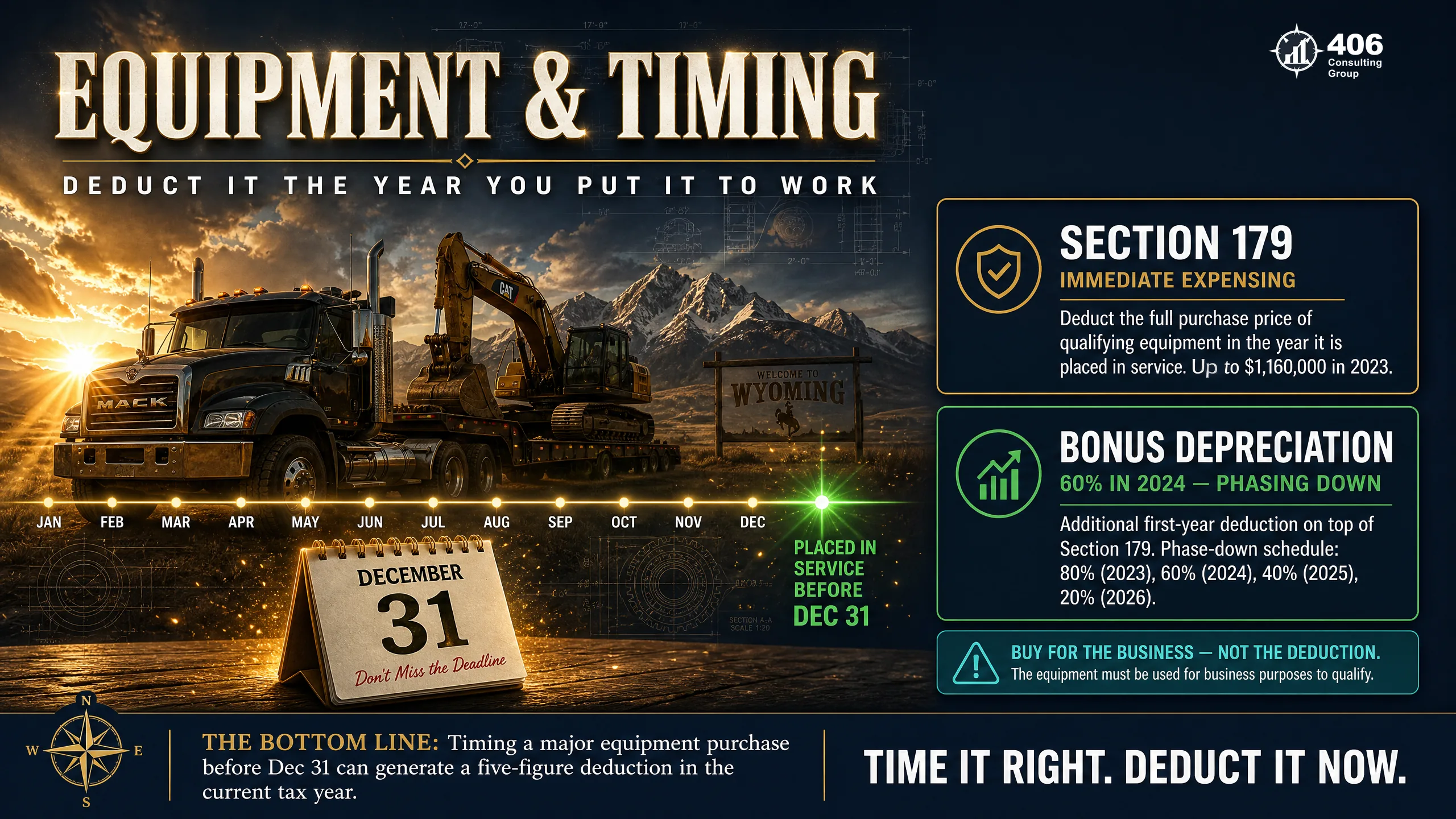
Bonus depreciation rules shift over time, so confirm the current-year percentage before counting on it — another reason to plan with an advisor rather than assume last year's rules.
Retirement & Owner Benefits
Retirement plans are the most underused big lever for profitable owners. A SEP-IRA or Solo 401(k) can shelter tens of thousands from federal tax each year, and a defined-benefit or cash-balance plan can shelter far more for an older, high-income owner — all while building the owner's own wealth rather than just cutting a check to the IRS.
Paired with an S-corp, the plan choice interacts with your salary level, so it's worth coordinating the two. Add clean fringe benefits — an accountable plan for reimbursements, the right health-coverage treatment — and a profitable Cheyenne owner can move a large slice of income out of the federal tax base entirely, legitimately.
Because none of this is reduced or complicated by a state income tax in Wyoming, the modeling is unusually clean here — federal numbers, full stop.
The One State Tax to Get Right
Wyoming's one meaningful state tax is sales and use tax — around 6% combined in Cheyenne. It isn't an income-planning lever, but it's a compliance obligation that punishes sloppiness: you collect it, hold it as the state's money, and remit it on schedule, and you owe use tax on equipment and supplies bought without sales tax (often out-of-state or online).
The classic failure isn't a planning miss — it's cash-flow drift: spending collected sales tax as if it were revenue, then coming up short at remittance. In a state with so few taxes, this is the one that bites. Clean books keep it visible as a liability and capture use tax as you go. Confirm current rates and rules with the Wyoming Department of Revenue.
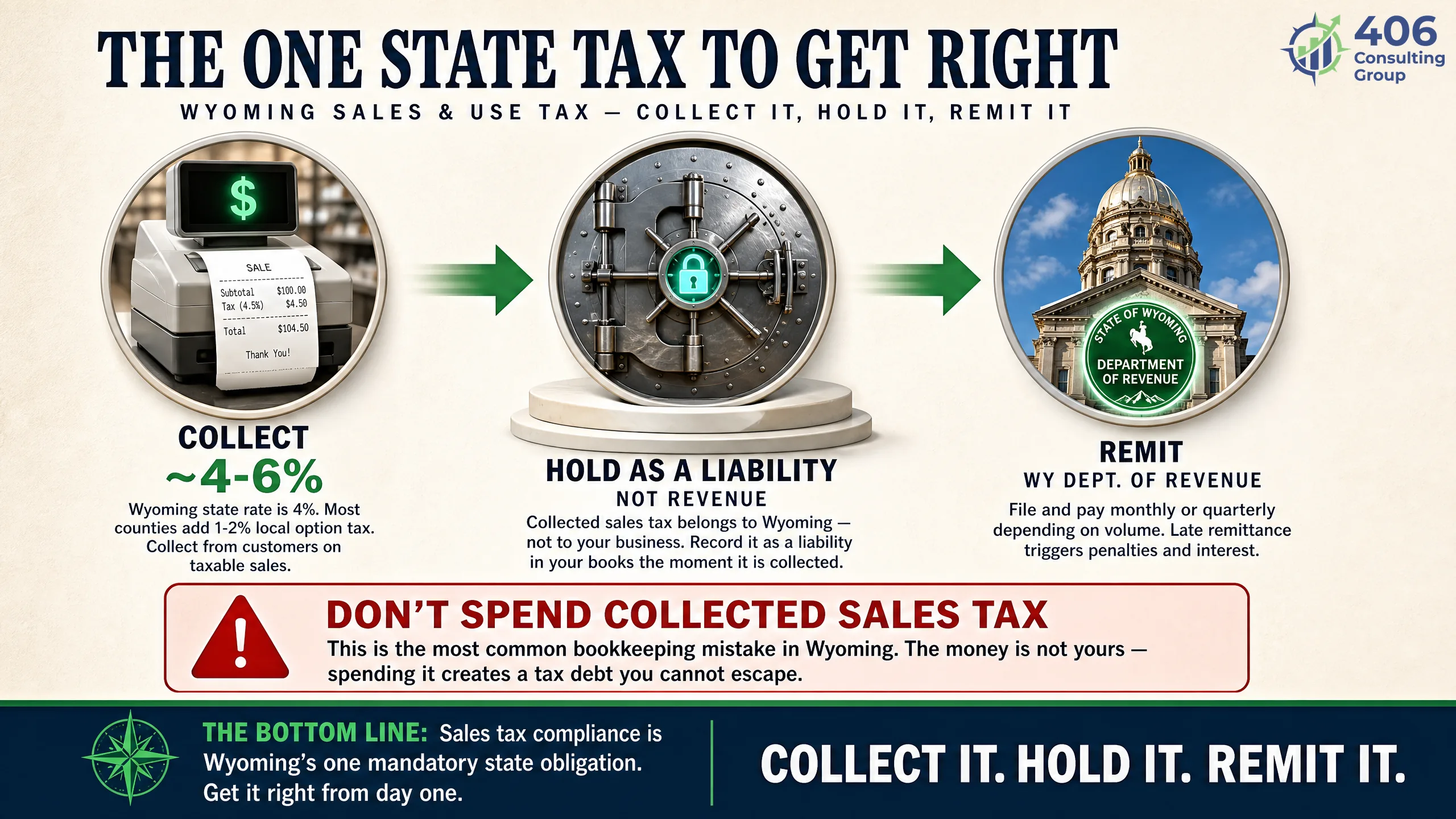
We cover the bookkeeping mechanics in the Cheyenne bookkeeping guide; here, just know it's the one state tax that can't be ignored.
Wyoming LLCs & Selling Across State Lines
Wyoming's low-tax reputation draws two situations that need care. First, plenty of businesses form a Wyoming LLC but operate from — or have real presence in — another state; that other state can still tax the income earned there and require registration, so the Wyoming shell doesn't make those obligations disappear. Second, a Cheyenne business selling online or across the Colorado, Nebraska, or Utah line can trip other states' economic-nexus thresholds and owe sales tax collection there.
Neither is a reason to avoid Wyoming's advantages — they're a reason to map where you actually have nexus and file accordingly. This is where a firm with multi-state experience earns its keep: keeping the Wyoming benefit real while staying clean everywhere you genuinely do business.
If you sell across state lines, get this mapped early — retroactive nexus cleanups are far more expensive than doing it right from the start.
A Cheyenne Tax Plan Across the Year
Because the levers here are almost all federal and timing-driven, tax planning is a year-round rhythm, not an April event. Roughly:
| When | Focus |
|---|---|
| Q1 | File; confirm/plan S-corp election (deadline mid-March); set the year's estimates |
| Q2 | Review Q1 profit vs. plan; fund/adjust retirement contributions |
| Q3 | Mid-year check: profit trajectory, equipment timing, salary vs. distribution |
| Q4 | The big one — finalize equipment, retirement funding, and any timing moves before Dec 31 |

Note there are no state estimated-income-tax payments to juggle — Wyoming has none — so the calendar is genuinely simpler than in a state like Idaho or Oregon. But the federal moves still have to happen before year-end to count.
Local vs. a Great Remote Partner
Tax planning is knowledge work — modeling an S-corp election, timing equipment, structuring retirement, keeping the Wyoming entity advantage real, and mapping multi-state exposure. What matters is whether your advisor knows Wyoming's setup and federal planning cold, not whether they're across the street. A great remote partner beats an okay local generalist every time.
It's also simply how this work happens now — even for clients down the road. Roughly 70–80% of our own local clients never set foot in our office; planning sessions run on shared screens and secure document exchange, and the numbers live in cloud accounting. So whether you're in Cheyenne, elsewhere in Laramie County, or anywhere in Wyoming, you get the same proactive planning our in-town clients do — and because Wyoming is such a common home for LLCs run from elsewhere, our multi-state experience is a real advantage.
The goal is the same wherever you sit: pay the IRS what you owe and not a dollar more.
How to Get Started
A Cheyenne tax plan comes together in three steps.
Get the entity right
Model sole prop vs. S-corp at your profit level, and confirm your Wyoming entity is set up and used correctly.
Build the federal plan
Equipment timing, retirement funding, and clean deductions mapped to your actual numbers — before year-end.
Stay clean on state & multi-state
Sales/use tax handled, and any out-of-state nexus mapped so the Wyoming advantage stays real.
Not sure where you stand? Start with the S-Corp Calculator or our Financial Maturity Assessment, then let's talk.
FAQ: Cheyenne Tax Questions
Does a Cheyenne business owe Wyoming state income tax?
No. Wyoming has no state individual income tax and no state corporate income tax, and no gross-receipts or B&O tax either. Your business income isn't taxed at the state level at all. You still owe federal income tax on your profit, and you handle Wyoming sales/use tax and payroll obligations — but there's no state income return on your earnings. It's one of the lightest state tax loads in the country.
If Wyoming has no income tax, is there any point in tax planning?
Yes — arguably more, because the savings are concentrated at the federal level where they're easy to leave on the table. The levers (entity choice/S-corp, equipment timing via Section 179, retirement plans, clean deductions) all work against your federal bill, which Wyoming's low taxes don't touch. Owners who assume 'low-tax state means nothing to do' routinely overpay the IRS. The federal savings in Cheyenne are identical to anywhere else.
Is a Wyoming LLC really a tax advantage?
It's a genuine structural advantage — no state income tax on the entity, strong privacy and asset protection, and low ongoing fees (an annual report license fee rather than an income-based franchise tax). But it doesn't erase federal tax, and if you operate in or sell into other states, those states can still tax that activity and require registration. Used deliberately as your operating home with the right federal election on top, it's one of the most favorable setups available; treated as a magic 'no-tax' box, it just adds a filing.
Should my Cheyenne business elect S-corp status?
Often yes once profit is high enough — an S-corp splits income into a reasonable salary (payroll-taxed) and distributions (not subject to self-employment tax), which can save thousands in federal payroll tax. But it adds payroll and a separate return, and the salary must be defensibly 'reasonable.' In Wyoming it's a purely federal calculation with no state layer, which makes it cleaner to model. Run our S-Corp Calculator, and when it's close we'll model it before electing.
Can 406 Consulting Group handle my Cheyenne taxes remotely?
Yes. Tax planning and preparation are knowledge work that runs well remotely — planning sessions over shared screens, secure document exchange, and numbers in cloud accounting. What matters is deep Wyoming and federal expertise, plus multi-state know-how for Wyoming LLCs operated elsewhere, not office proximity. Roughly 70–80% of our own local clients never come into the office either, so you get the same proactive, year-round planning wherever you are in Wyoming.
Keep Reading
Tax Planning — Cheyenne, WY
No State Income Tax. Make the Federal Plan Count.
406 Consulting Group builds year-round tax plans for Cheyenne businesses — entity strategy, the Wyoming advantage, equipment and retirement timing, and multi-state clarity — delivered remotely, by a firm that knows Wyoming and the Rocky Mountain West.
Cheyenne Tax Quick Reference
Cheyenne, WY — Laramie County
Overpaying the IRS in Cheyenne?
Low-tax state, federal plan that counts.
About the Author
Jason Anderson
Co-Founder, 406 Consulting Group
Big-firm-trained accountant, with extensive oil-field experience, advising small businesses across the Rocky Mountain West. Jason helps Cheyenne and Wyoming owners — including oil & gas and energy-services companies — turn a low-tax state into real savings: the right entity, a smart federal plan, and the Wyoming advantage used on purpose.
Read the Full Story