
Bookkeeping Services in Cheyenne, WY:
One of the Lowest-Tax States, Done Right
Wyoming has no state income tax and no gross-receipts tax — just a sales tax and little else, making bookkeeping simpler than almost anywhere. Here's what a Cheyenne business still needs from its books: clean sales/use tax, Wyoming payroll, and reliable numbers for federal planning.

Wyoming is about as tax-friendly as it gets for a business, and Cheyenne owners feel it in what they don'thave to deal with: no state income tax at all — personal or corporate — and no gross-receipts or business & occupation tax. The state leans on a sales tax and little else. That makes bookkeeping here genuinely simpler than in almost any other state, but "simpler" isn't "nothing" — the sales tax you collect still has to be handled cleanly, Wyoming payroll has one real quirk, and clean books matter as much as ever for the federal return and for running the business.
The low-tax reality also shapes strategy in a way most owners don't think about: with no state income tax to plan around, essentially all of your tax planning is federal, and Wyoming's famous business-friendliness (the same reason people form LLCs here) means the state mostly stays out of your way. So the bookkeeping job shifts to keeping the books clean and reliable, handling sales and use tax, running Wyoming payroll correctly, and giving you numbers you can actually run a growing Cheyenne business on.
This guide covers how Wyoming's low-tax setup shapes your books, the sales-tax and payroll specifics, what a growing business needs, and how a remote firm delivers all of it. If you're weighing whether you've outgrown DIY books, start here.
By Carrie Anderson — Co-Founder, 406 Consulting Group. Commercial banking and underwriting background — 300+ loan reviews — plus advisory work with small businesses across the Rocky Mountain West, where clean books, sales tax, and payroll compliance are everyday work.
Quick Answer: Bookkeeping for a Cheyenne Business
- →No state income tax (personal or corporate) and no gross-receipts/B&O tax — one of the lowest-tax states in the country.
- →Sales tax is the main state tax — around 6% combined in Cheyenne, collected and remitted; use tax is its companion.
- →Payroll is simpler — no state income-tax withholding — but workers' comp runs through a state-administered fund.
- →Planning is federal — with no state income tax, the tax levers all point at the federal return.
- →Delivered remotely — even most of our local clients never come to the office.
Table of Contents
Why Wyoming Bookkeeping Is Different
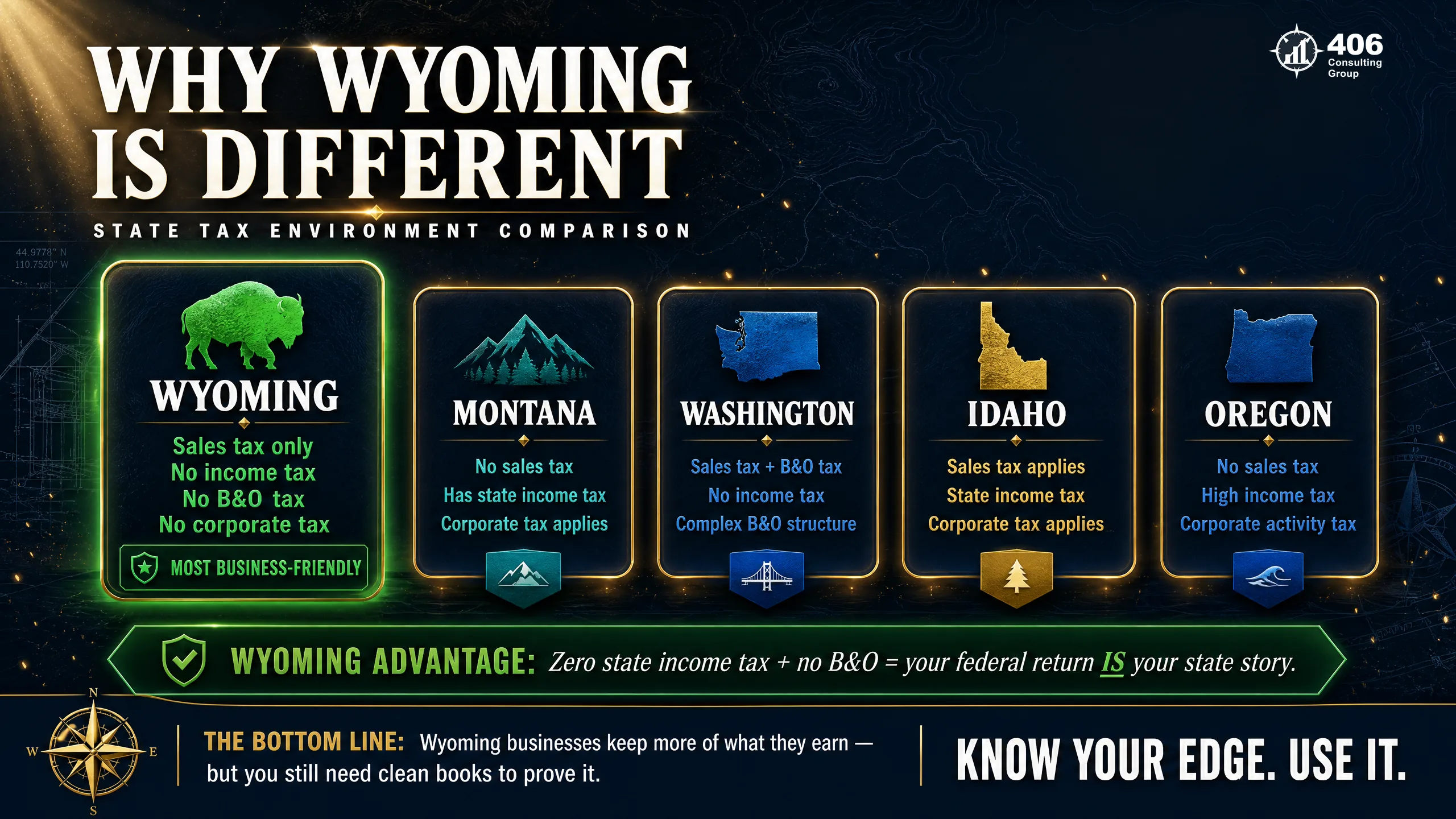
The short answer: Wyoming taxes less than almost anywhere, so there's simply less state machinery for your books to feed. No state income tax means no state income return on your profit; no gross-receipts or B&O tax means nothing like Washington's layer to track. What's left, on the state side, is mostly the sales tax you collect and remit.
It's a genuinely different setup from the neighbors: Montana has no sales tax but does tax income; Washington has sales tax plus the B&O and no income tax; Idaho taxes both; Oregon has no sales tax but a steep income tax. Wyoming is the low-tax end of the spectrum — a sales tax and little else. For a Cheyenne business, that means the books don't wrestle with a state income bill or a gross-receipts tax; they focus on clean, reliable financials, correct sales and use tax, and Wyoming's specific payroll rules. Simpler — but only if it's actually set up right.
The rest of this guide walks through each piece. Build your books around Wyoming's low-tax shape and running a Cheyenne business gets about as calm at tax time as it gets anywhere.
The Lowest-Tax-State Upside
The short answer: Wyoming consistently ranks among the most tax-friendly states for business, and the practical upside for your books is real — no state income tax to compute, estimate, or file; no gross-receipts tax to track by classification; and no state-level income planning to juggle. The layers that consume bookkeeping effort in other states just aren't here.
That's a genuine advantage, but two things keep it honest. First, "low state tax" doesn't touch your federal bill — the IRS still taxes your profit, so federal planning matters as much as ever (more on that below). Second, if you sell into other states — online, or across the Colorado, Nebraska, or Utah line — those states' sales-tax and economic-nexus rules can still reach you, Wyoming's simplicity notwithstanding. Clean books let you enjoy the simplicity while catching the exceptions.
Put simply: Wyoming removes a lot of state-tax friction, which is exactly why so many businesses form and operate here — but it makes clean books and smart federal planning the whole game rather than an afterthought.
Sales & Use Tax
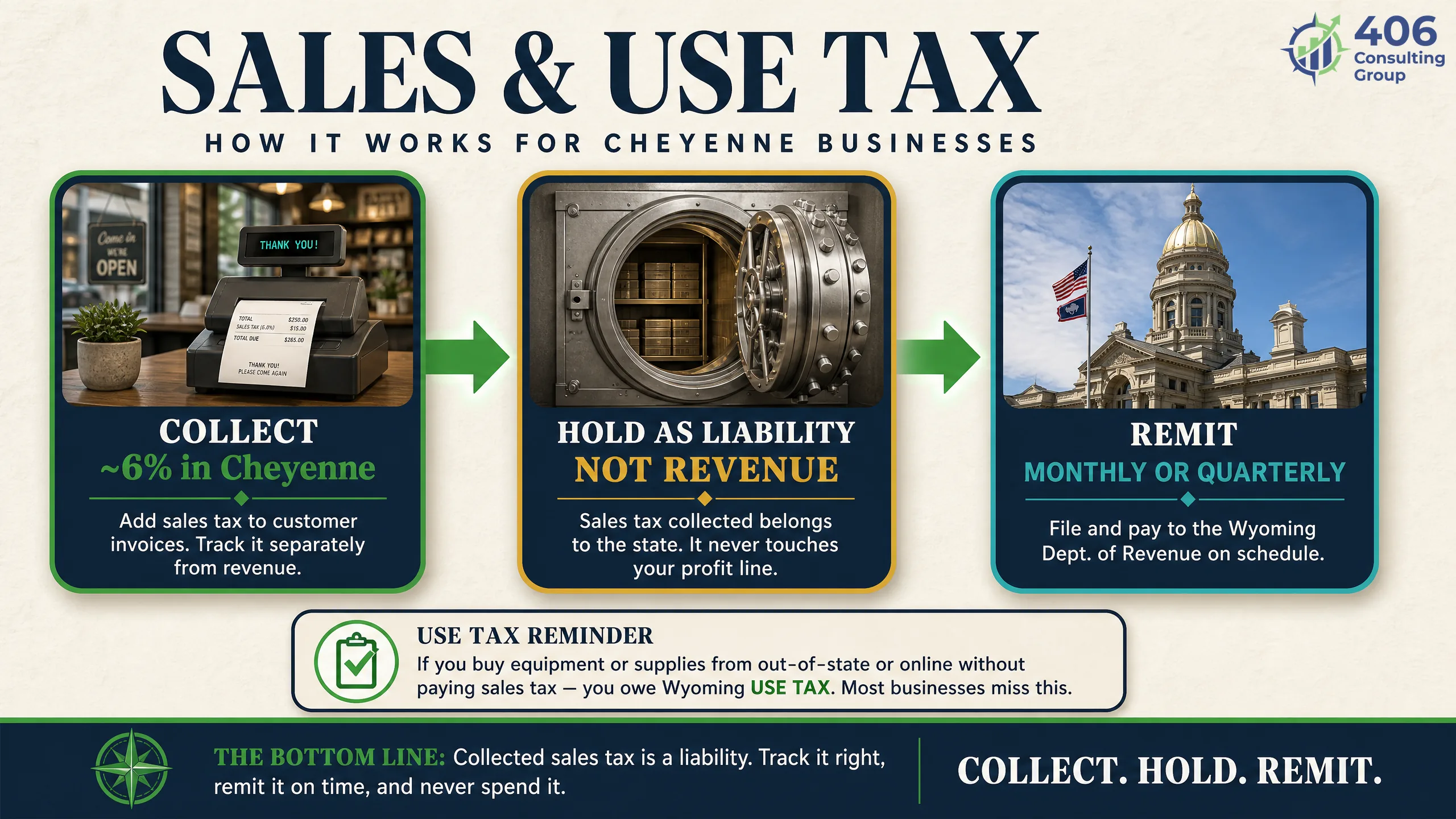
The short answer: sales tax is Wyoming's main state tax, and if you sell taxable goods or certain services you collect it and remit it — around 6% combined in Cheyenne (a state rate plus a Laramie County portion). Before you collect, you register for a sales/use tax license with the Wyoming Department of Revenue.
Use tax is the companion most owners forget: buy equipment or supplies without paying sales tax — often from an out-of-state or online seller — and you generally owe Wyoming use tax on them at the same rate. For an equipment- or inventory-heavy Cheyenne business, that adds up. Clean books record sales tax collected as a liability (never as revenue — it's the state's money) and flag untaxed purchases so use tax is captured as you go, not discovered in an audit.
The one trap in a simple system
In a state with so few taxes, the sales tax is the one that bites if mishandled — spending collected sales tax as if it were revenue is the classic Wyoming small-business hole. Keep it visible as a liability and remit on schedule. Confirm current rates, the license, and use-tax rules with the Wyoming Department of Revenue.
Wyoming Payroll: Simpler, With a Twist
The short answer: Wyoming payroll is simpler than most states in one big way — because there's no state income tax, there's no state income-tax withholding to calculate, remit, or reconcile. But there's one real twist: workers' compensation is administered by the state, not bought from a private carrier, so it works differently than it does in most of the country.
| Item | What it is | Bookkeeping note |
|---|---|---|
| State income withholding | None — Wyoming has no state income tax | One fewer withholding to compute and remit |
| State workers' comp | Administered by the State of Wyoming (not a private carrier) | Reported and paid to the state by class and payroll |
| Unemployment (SUI) | Employer-paid, via WY Dept. of Workforce Services | Experience-rated; quarterly filing |
| Federal payroll | Social Security, Medicare, federal withholding, FUTA | Deposits and quarterly 941s as usual |
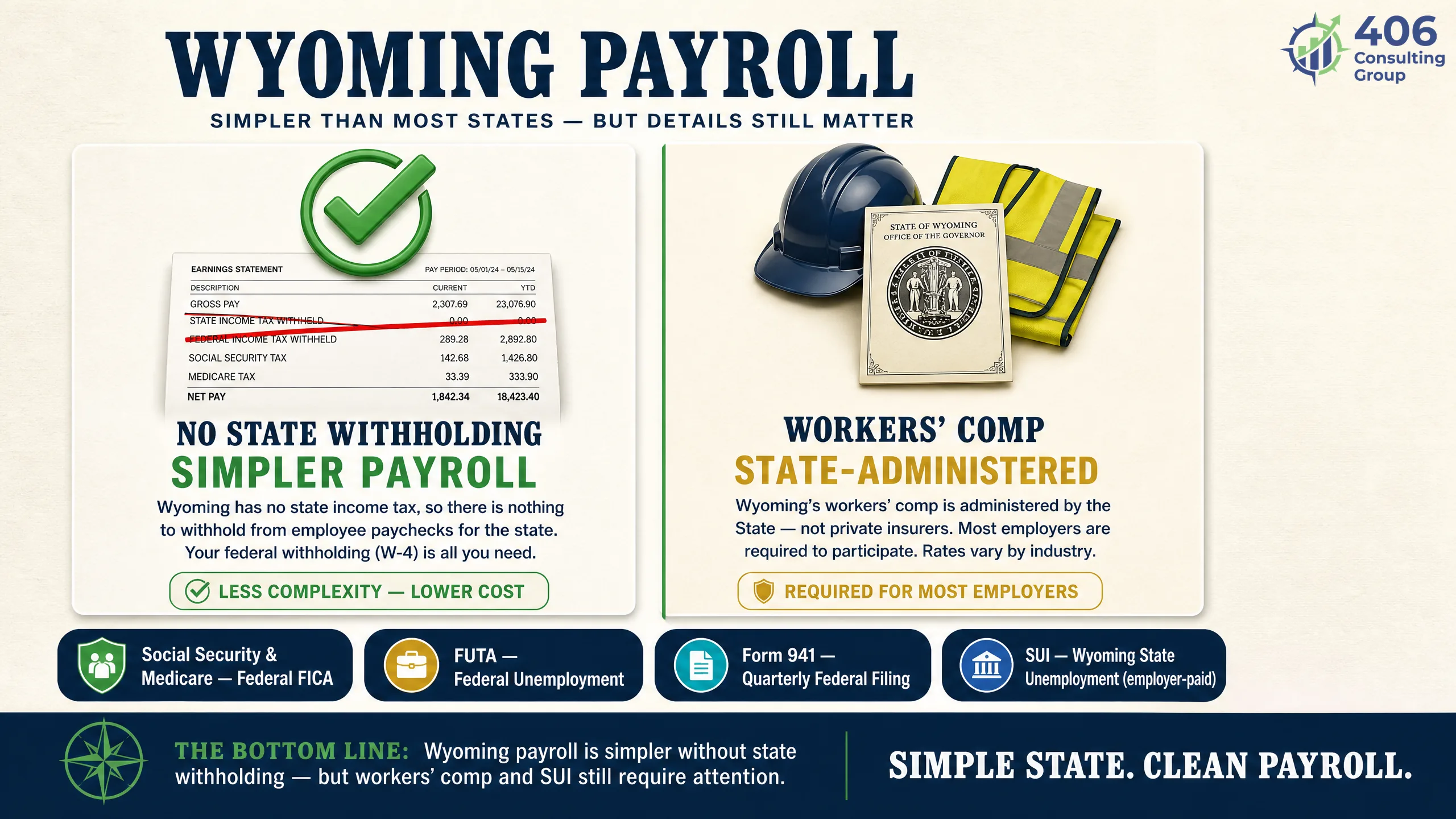
The state-run workers' comp system means you report payroll and pay premiums to the state rather than shopping a private policy — get the class codes right and it's routine. Verify current rules with the Wyoming Department of Workforce Services. Handled properly, Wyoming payroll is genuinely low-friction — which is what our payroll work keeps that way.
Federal Focus & the Wyoming Entity
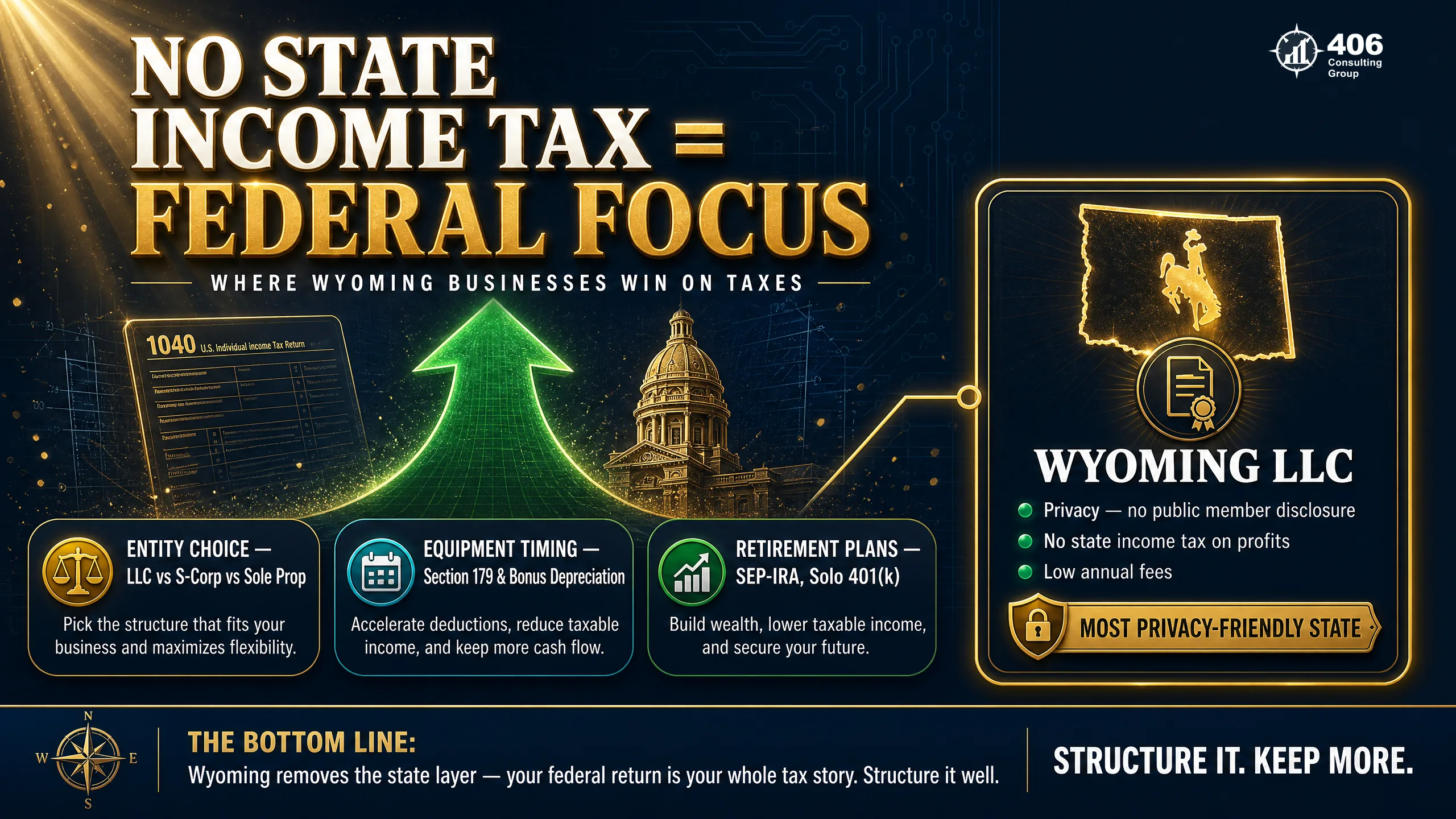
The short answer: because Wyoming takes no bite out of your income, your income-tax planning is entirely federal — the moves that save you money (entity choice, equipment timing, retirement) all work against the IRS bill, with no state layer on top. That's the flip side of a low-tax state: the savings live at the federal level, so clean books that support federal planning are where the money is.
Wyoming's business-friendliness is also why it's a popular place to form entities: strong privacy, no state income tax on the business, and low ongoing requirements (an annual report with a small license fee rather than an income-based franchise tax). If you operate in Cheyenne — or formed a Wyoming LLC and run it from elsewhere — your books still need to support a correct federal return and any multi-state obligations. Good bookkeeping is what makes the Wyoming advantage real rather than theoretical.
We go deep on the federal levers — and how a low-tax state changes the math — in the Cheyenne tax guide (part of this series). The bookkeeping job is to keep the numbers clean enough to plan from.
A Chart of Accounts Built for Wyoming
The short answer: your chart of accounts is the skeleton of your books, and a Wyoming-ready one is refreshingly lean — no state income-tax scaffolding and no gross-receipts classifications to maintain — but it still needs the sales-tax liability and payroll liabilities cleanly separated, plus a structure that makes your federal picture easy to read.
Set up right, a Wyoming chart of accounts keeps sales tax collected as a liability (never mixed into revenue), breaks out payroll liabilities for federal taxes, unemployment, and state workers' comp, and keeps profit clean and readableso your federal return and any planning are straightforward. You skip the income-tax-state and B&O complexity entirely — which is exactly why Wyoming books, done right, are so low-maintenance month to month.
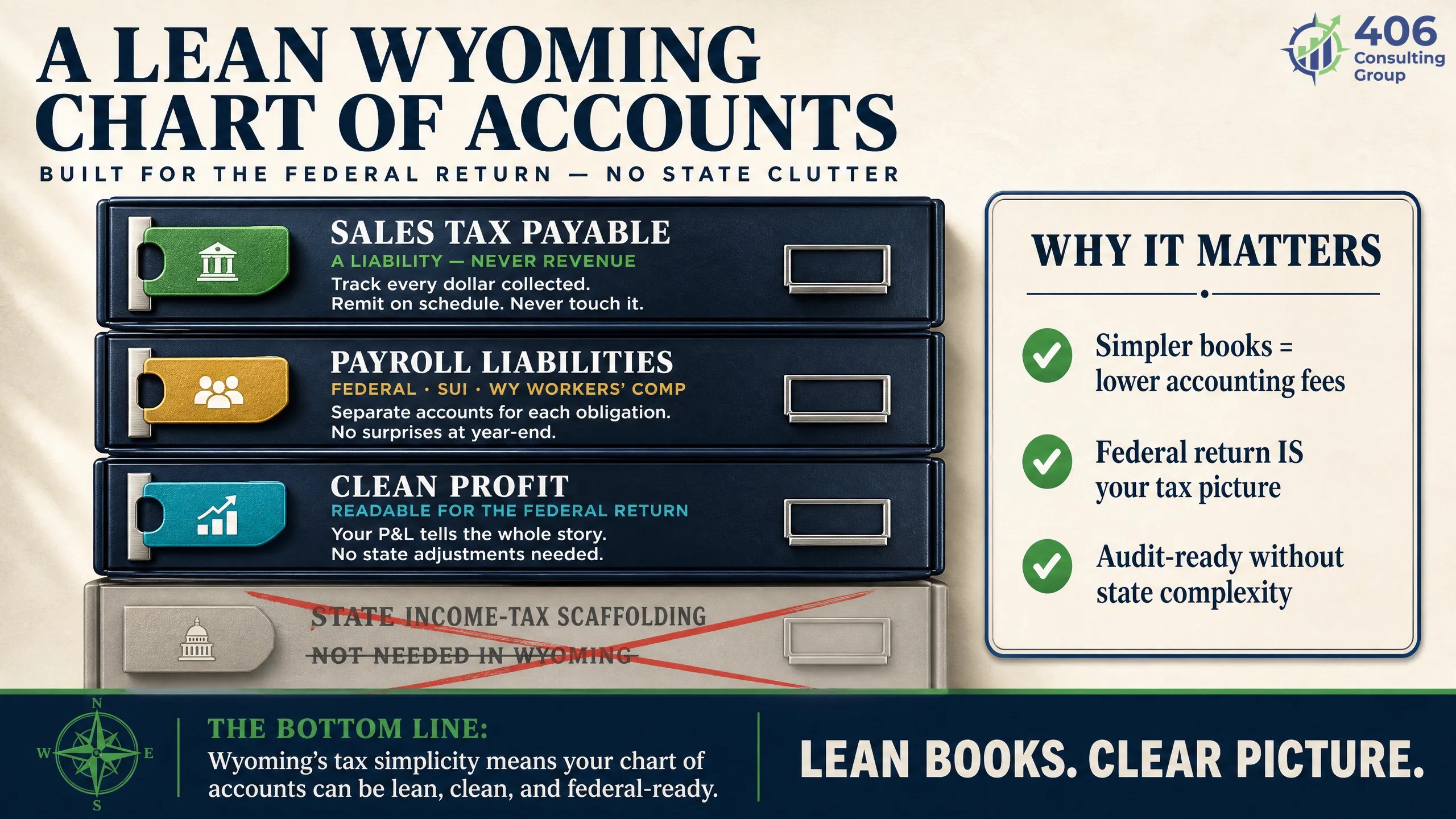
It's the kind of setup that pays off every month — and the first thing we streamline when we take on a Cheyenne business whose books were built on a generic, income-tax-state template.
What a Growing Cheyenne Business Needs
The short answer: beyond compliance, a growing Cheyenne business needs books that inform decisions — accurate monthly financials, a read on what actually makes money, and a cash-flow picture that (thanks to Wyoming's low taxes) is refreshingly free of a big state-tax drain but still has to fund payroll, growth, and the federal bill.
Cheyenne is growing — logistics, data centers, and distribution are drawing investment and jobs — and businesses riding that need more than compliant books. Clean monthly financials are the baseline; from there the value climbs: margin visibility so you know what to lean into, payroll handled correctly as you hire, and a cash-flow forecast so growth doesn't outrun the bank account. Wyoming's light tax load actually makes the numbers clearer — fewer distortions — so good books translate quickly into good decisions.
When reliable numbers become the basis for real decisions, many businesses step up from bookkeeping to controller-level support — a path we cover in upgrading from bookkeeping to a controller.
Bookkeeping by Cheyenne Industry
Cheyenne and the wider Wyoming economy lean toward energy, transportation, agriculture, government, and a fast-growing data-center and distribution sector — and each corner asks something a little different of the books.
| Industry | What the books need to track |
|---|---|
| Oil & gas / energy services | Field equipment and assets, per-well/per-job costing, fuel, subcontractor payments, use tax on gear |
| Transportation & logistics | Fuel and fleet, per-mile costs, driver payroll, receivables |
| Agriculture & ranching | Livestock and equipment, seasonal income, input costs, use tax on gear |
| Data centers & tech | Capital assets and depreciation, multi-state nexus, payroll, contracts |
| Government & defense contracting | Contract/job costing, compliance documentation, receivables timing |
| Retail, healthcare & services | Sales tax (retail), receivables, inventory or utilization, payroll |

Energy work we know first-hand: both of our founders, Jason and Carrie, spent years in the oil field, so oil & gas and energy-services companies get books built by people who understand how the work — and the money — actually moves in that industry. Different details, same backbone: keep sales and use tax clean, handle Wyoming payroll correctly, and keep profit readable for the federal return. Because our background is in running whole businesses, we set books up around the entire operation — not just tax-time tidiness.
Common Wyoming Bookkeeping Mistakes
Even in a low-tax state, a handful of avoidable mistakes cause most of the trouble. Here's what we see most.
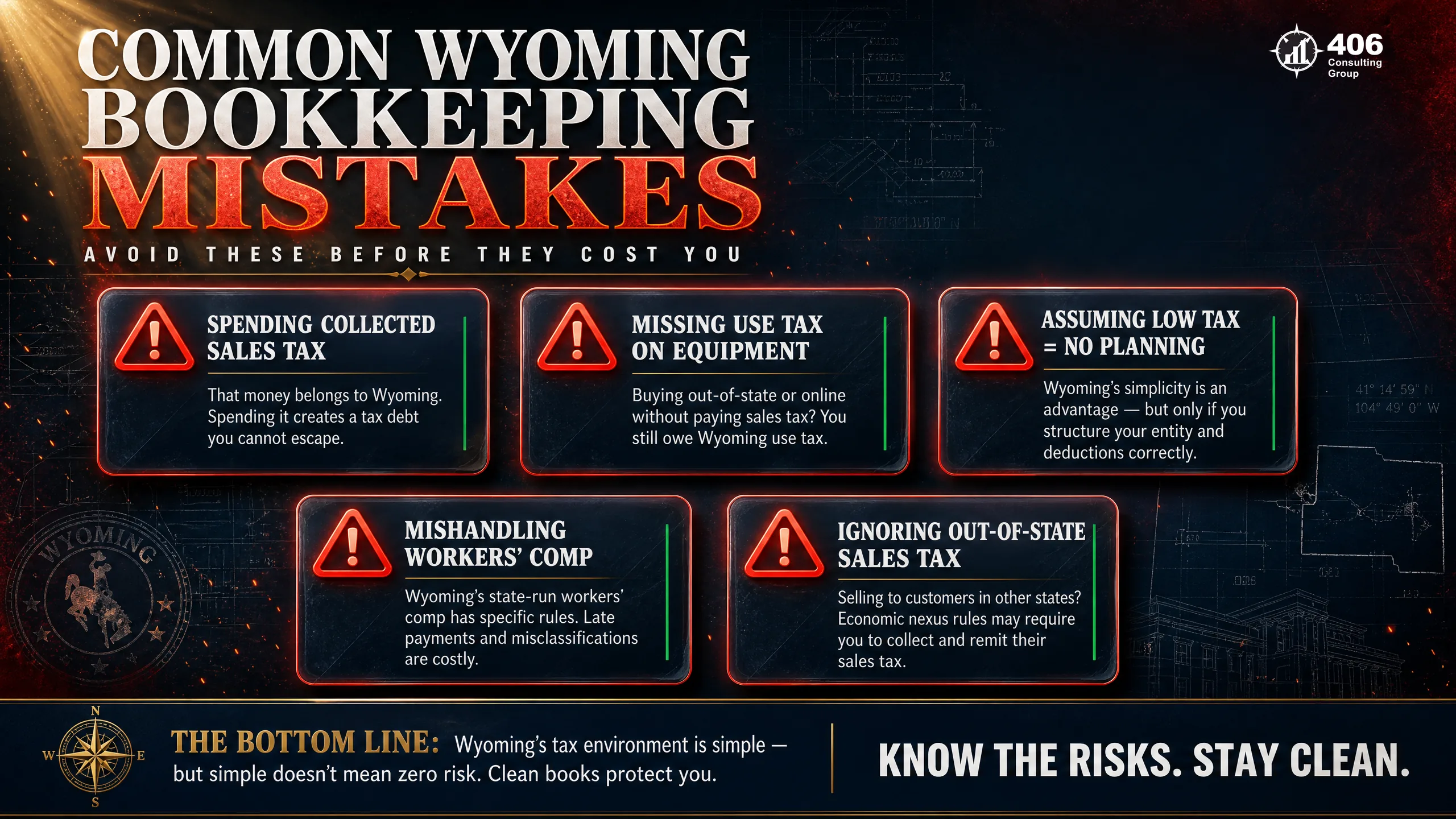
Spending collected sales tax
It's the state's money in your account. In a state with few other taxes, this is the one that creates a shortfall if you treat it as cash flow.
Missing use tax on equipment
Out-of-state gear and supplies bought without sales tax usually owe Wyoming use tax — commonly overlooked.
Assuming 'low tax' means no planning
The federal bill is untouched by Wyoming's low taxes — skipping federal planning leaves real money on the table.
Mishandling state workers' comp
Wyoming's state-run comp system works differently than a private policy; wrong class codes or filings cause problems.
Ignoring out-of-state sales tax
Selling online or across the CO/NE/UT line can trigger other states' economic nexus rules despite Wyoming's simplicity.
Every one is a setup-and-habit problem, not a character flaw — and every one disappears once the books are built for Wyoming and maintained on a monthly rhythm.
Local vs. a Great Remote Partner
The short answer: what matters in a bookkeeper is whether they know Wyoming's setup — sales and use tax, the no-withholding payroll, the state workers' comp system — and how to run clean books for federal planning, not whether their office is in Cheyenne. A great remote partner who understands Wyoming beats an okay local generalist, and the work is a natural fit for remote delivery.
And honestly, remote is how modern bookkeeping already works — even for the clients right down the road. Roughly 70–80% of our own local clients never set foot in our office; the whole relationship runs on secure cloud accounting, connected bank feeds, shared screens, and a steady monthly rhythm. Distance simply isn't the variable it used to be. So whether you're in Cheyenne, elsewhere in Laramie County, or anywhere in Wyoming, you get the same responsive, Wyoming-savvy service our in-town clients do.
And because Wyoming is such a common home for LLCs run from elsewhere, multi-state experience is especially valuable here — exactly what a specialized remote firm brings.
How to Get Started
Getting your Wyoming books in order is three steps.
Clean up and set the baseline
Reconcile the accounts and build a lean Wyoming-ready chart of accounts — sales tax as a liability, payroll liabilities, clean profit.
Get sales tax and payroll right
Set up sales/use-tax tracking and remittance, and Wyoming payroll (no state withholding, state workers' comp) correctly from the start.
Run it monthly
Monthly reconciliation and clean financials keep compliance routine and give you numbers you can run the business on.
Not sure whether you need bookkeeping, tax help, or something more? Our Financial Maturity Assessment maps it out in about eight minutes.
FAQ: Cheyenne Bookkeeping Questions
What taxes does a Cheyenne, Wyoming business have to deal with?
Fewer than almost anywhere. Wyoming has no state income tax (personal or corporate) and no gross-receipts or B&O tax. The main state tax is sales tax — around 6% combined in Cheyenne — which you collect from customers and remit, along with use tax on untaxed purchases. You still owe federal income tax and handle federal payroll, plus Wyoming unemployment insurance and state-administered workers' compensation. It's one of the lightest state tax loads in the country.
Is bookkeeping really simpler in Wyoming?
On the state side, genuinely yes — no state income tax to compute or file, no gross-receipts tax to classify, and no state income-tax withholding on payroll. What remains is sales and use tax, Wyoming payroll (including the state-run workers' comp system), and clean books for your federal return. So the work shifts toward getting sales tax right, running payroll correctly, and keeping reliable financials for federal planning — meaningfully less state complexity than Idaho, Washington, or Oregon.
If Wyoming has no income tax, does tax planning still matter?
Yes — it just all happens at the federal level. Wyoming takes no bite out of your income, so the tax levers (entity choice, equipment timing, retirement plans) work against your federal bill, which is untouched by the state's low taxes. Skipping planning because 'Wyoming is a low-tax state' is a common and costly mistake — the federal savings are exactly the same as they'd be anywhere. Clean books are what make that federal planning possible.
How does workers' comp work in Wyoming?
Differently than most states. Wyoming administers workers' compensation through a state fund rather than having employers buy policies from private insurers, so you report payroll and pay premiums to the state by classification. It's not hard once it's set up, but it works differently than a private policy and the class codes matter. Your books should track it as a payroll liability, and it's worth confirming current rules with the Wyoming Department of Workforce Services.
Can 406 Consulting Group do my Cheyenne bookkeeping remotely?
Yes. We work with Cheyenne and Laramie County businesses through secure cloud accounting — connected bank feeds, shared screens, and a steady monthly rhythm. What matters for a Wyoming business is expertise in sales and use tax, the no-withholding payroll and state workers' comp, and clean books for federal planning, not office proximity. In fact, roughly 70–80% of our own local clients never come into the office either. And because Wyoming is such a common home for LLCs operated from elsewhere, our multi-state experience is a real plus.
Keep Reading
Bookkeeping — Cheyenne, WY
Low-Tax State. Clean Books. Real Decisions.
406 Consulting Group keeps Cheyenne businesses clean and compliant — sales and use tax, Wyoming payroll, and reliable financials for federal planning — delivered remotely, by a firm that knows Wyoming and the Rocky Mountain West.
Cheyenne Bookkeeping Quick Reference
Cheyenne, WY — Laramie County
Behind on the Books in Cheyenne?
Sales tax, payroll & clean financials, handled.
About the Author
Carrie Anderson
Co-Founder, 406 Consulting Group
Commercial banking and underwriting background — 300+ loan reviews — plus extensive oil-field experience and advisory work with small businesses across the Rocky Mountain West. Carrie helps Cheyenne and Wyoming owners — including oil & gas and energy-services companies — keep the books clean, handle sales tax and payroll, and make the most of a low-tax state through smart federal planning.
Read the Full Story