
Tax Planning in Coeur d'Alene, ID:
In a Two-Tax State, Planning Pays Twice
Idaho has a state income tax, so every smart move cuts both your federal and 5.3% state bill. Add construction timing, short-term-rental strategy, the Idaho pass-through election, and cross-border ID/WA planning — here's the playbook.

Tax planning in Coeur d'Alene has a feature Wyoming and Washington businesses don't get to enjoy: because Idaho has a state income tax, every smart move you make usually saves you money twice — once on your federal bill and again on the Idaho one. A deduction that cuts your federal taxable income cuts your Idaho 5.3% too. That makes proactive planning worth more here than in a no-income-tax state, not less.
And Coeur d'Alene has its own high-value angles a generalist misses: the construction boom brings equipment timing and income-timing methods that can defer real money; the short-term-rental market opens up depreciation strategies most owners never hear about; Idaho has a pass-through election that can sidestep the federal SALT cap; and the Washington line thirty minutes west means multi-state planning is often on the table. Handled together, these turn a good year into a much better after-tax one.
This guide covers the levers that cut both bills, the construction and short-term-rental strategies, the Idaho pass-through election, and cross-border planning — all delivered remotely.
By Carrie Anderson — Co-Founder, 406 Consulting Group. Commercial banking and underwriting background — 300+ loan reviews — advising construction, real-estate, and small businesses across the Inland Northwest.
Quick Answer: Tax Planning for a Coeur d'Alene Business
- →Deductions save twice — Idaho's flat 5.3% income tax plus your federal bill.
- →Builders: equipment timing (§179/bonus) and construction income-timing methods can defer real money.
- →Short-term rentals: depreciation, cost segregation, and material-participation rules open real strategy.
- →Idaho pass-through election can work around the federal SALT cap for pass-through owners.
- →Cross-border ID/WA planning matters if you work both sides of the line.
Table of Contents
Why Planning Here Saves Twice
In a no-income-tax state, tax planning only works against the federal return. In Idaho, it works against two: the federal bill and the state's flat 5.3%. Every legitimate deduction, every dollar of income deferred or sheltered, cuts both. That doesn't double your savings exactly, but it does mean a move worth $10,000 federally is often worth another $500-plus in Idaho tax on top — and those add up fast across a profitable year.
The flip side is the trap: skip planning and you overpay twice, too. Plenty of Coeur d'Alene owners — especially in the boom, when everyone's just trying to keep up with the work — leave real money on both tables because no one's looking ahead. Proactive planning is the whole point, and in a two-tax state it pays for itself even faster.

The rest of this guide is the specific moves — general levers first, then the construction, rental, and cross-border strategies unique to this market.
The Levers That Cut Both Bills
Start with the core levers every profitable business should be pulling. In Idaho, each one works against the federal and the state 5.3%.
| Lever | What it does |
|---|---|
| Entity choice (S-corp) | Cuts self-employment/payroll tax once profit is high enough |
| Equipment & timing | Section 179 / bonus depreciation pull deductions forward — big for builders |
| Retirement plans | SEP, Solo 401(k), or defined-benefit shelter large amounts from both bills |
| Clean, complete deductions | Vehicle, home office, tools, accountable plans — captured only with clean books |
None of these are exotic — they're just underused when everyone's busy. The next sections go deeper on the ones that matter most for a Coeur d'Alene business.
Entity & the S-Corp Question
For a profitable contractor or owner, entity choice is often the biggest single lever. As a sole proprietor or partnership, every dollar of profit gets hit with self-employment tax (roughly 15.3% up to the Social Security wage base). Elect S-corp treatment and you split income into a reasonable salary (payroll-taxed) plus distributions (not subject to self-employment tax) — frequently saving thousands a year once profit justifies it.
The catch is "reasonable" — the IRS wants a defensible market wage for the work you do, and in the trades that means paying yourself in line with what a foreman or lead would earn. There's cost and paperwork too, so it's a math question, not a default.
Run your own numbers
Our S-Corp Calculator estimates the payroll-tax savings at your profit level, and LLC vs. S-Corp compares the structures. See also the election deadline.
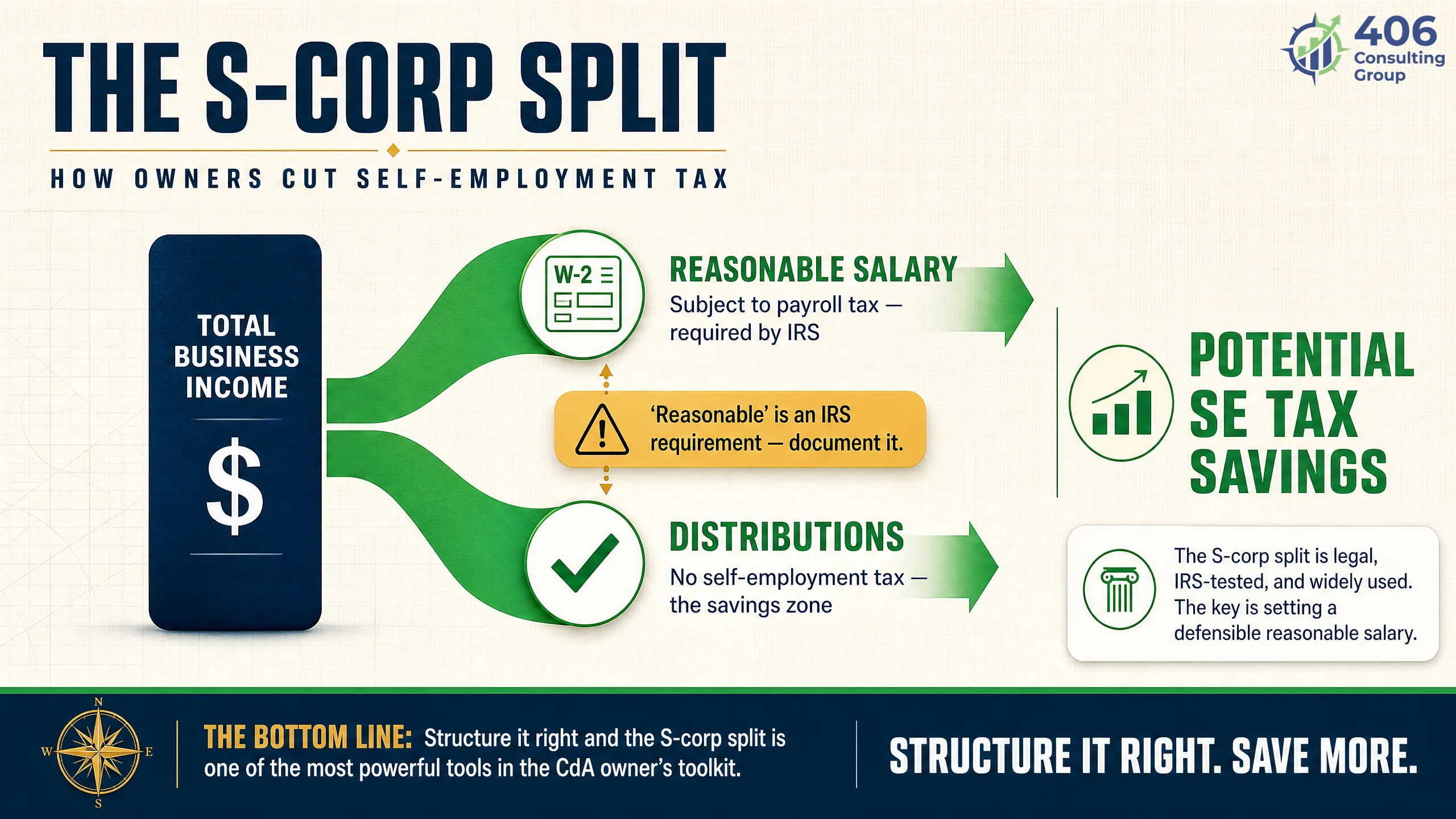
In Idaho the S-corp math is a little sweeter than in a no-income-tax state, because the structure can help on the state side too — one more reason to run the numbers rather than guess.
Equipment Timing for Builders
Construction and trades are equipment-heavy, and the timing of big purchases is a major lever. Section 179 and bonus depreciation let you deduct much or all of a qualifying truck, trailer, or machine in the year it's placed in service — cutting both your federal and Idaho bill in a strong year. In a boom, when you're buying gear to keep up with the work anyway, timing those purchases deliberately is close to free money.
The discipline is buying for the business first and letting tax refine the timing: accelerate a purchase into a high-profit year, or push it to a leaner one, based on where your numbers land. That takes knowing your profit before December — which is why a fall check-in beats a March surprise. Bonus depreciation percentages shift over time, so confirm the current-year rules before counting on them.

Pair equipment timing with the income-timing methods below and a contractor has real control over which year the tax lands in.
Construction Income-Timing Methods
Here's a lever most contractors don't know they have. For long-term construction contracts, the accounting method you use — how you recognize income across a job that spans months or year-ends — affects when you pay tax. The default for many long-term contracts is percentage-of-completion, but smaller contractors and certain home-construction contracts can qualify for methods like completed-contract that defer income until the job wraps, which can push a big tax bill into a later year.
Which methods you qualify for depends on your size, your contract types, and current rules, so this is squarely a work-with-a-pro area — but for a builder with jobs straddling year-end, choosing the right method (and handling retainage correctly) can be one of the biggest timing levers available. It's the kind of thing a generalist who doesn't know construction simply never raises.
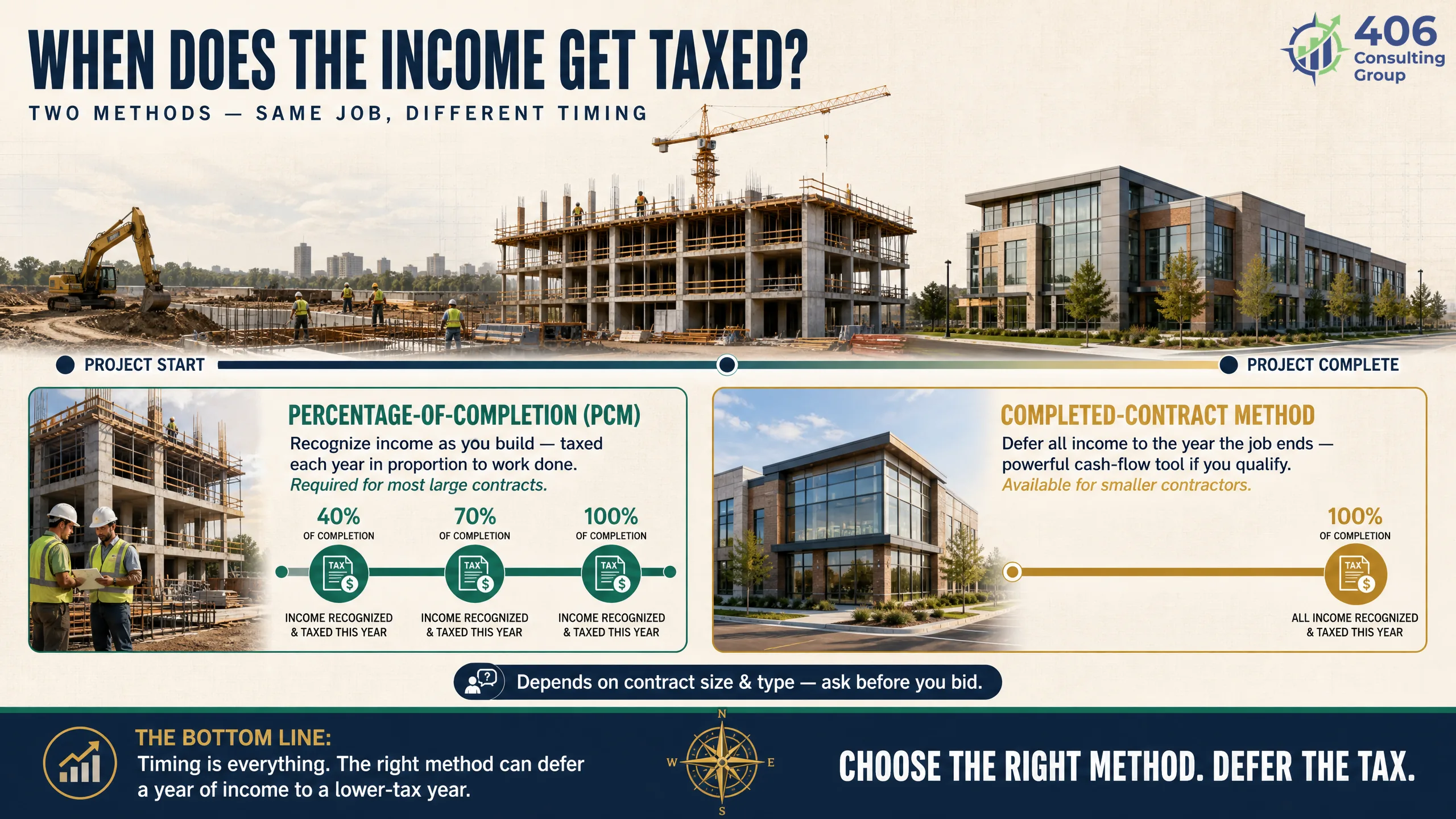
The bookkeeping foundation for all of this — WIP, retainage, job costing — is covered in the Coeur d'Alene bookkeeping guide.
Short-Term Rental Tax Strategy
Coeur d'Alene's lake draws visitors, and short-term rentals are everywhere — which opens up tax strategy most owners never hear about. Rental real estate can be depreciated, and a cost-segregation study can accelerate a chunk of that depreciation into the early years, creating large deductions. On top of that, short-term rentals sit under special rules: if the average guest stay is short and you materially participate, the activity may not be treated as passive — which can change whether those deductions offset your other income.
These rules are powerful and genuinely technical — material participation, passive-activity limits, and depreciation recapture all interact, and a 1031 exchange may come into play when you sell. This is not a DIY area; done right it's a major strategy, done wrong it's an audit headache. The point is that a CdA rental owner has real tools available, and should be working with someone who knows them.
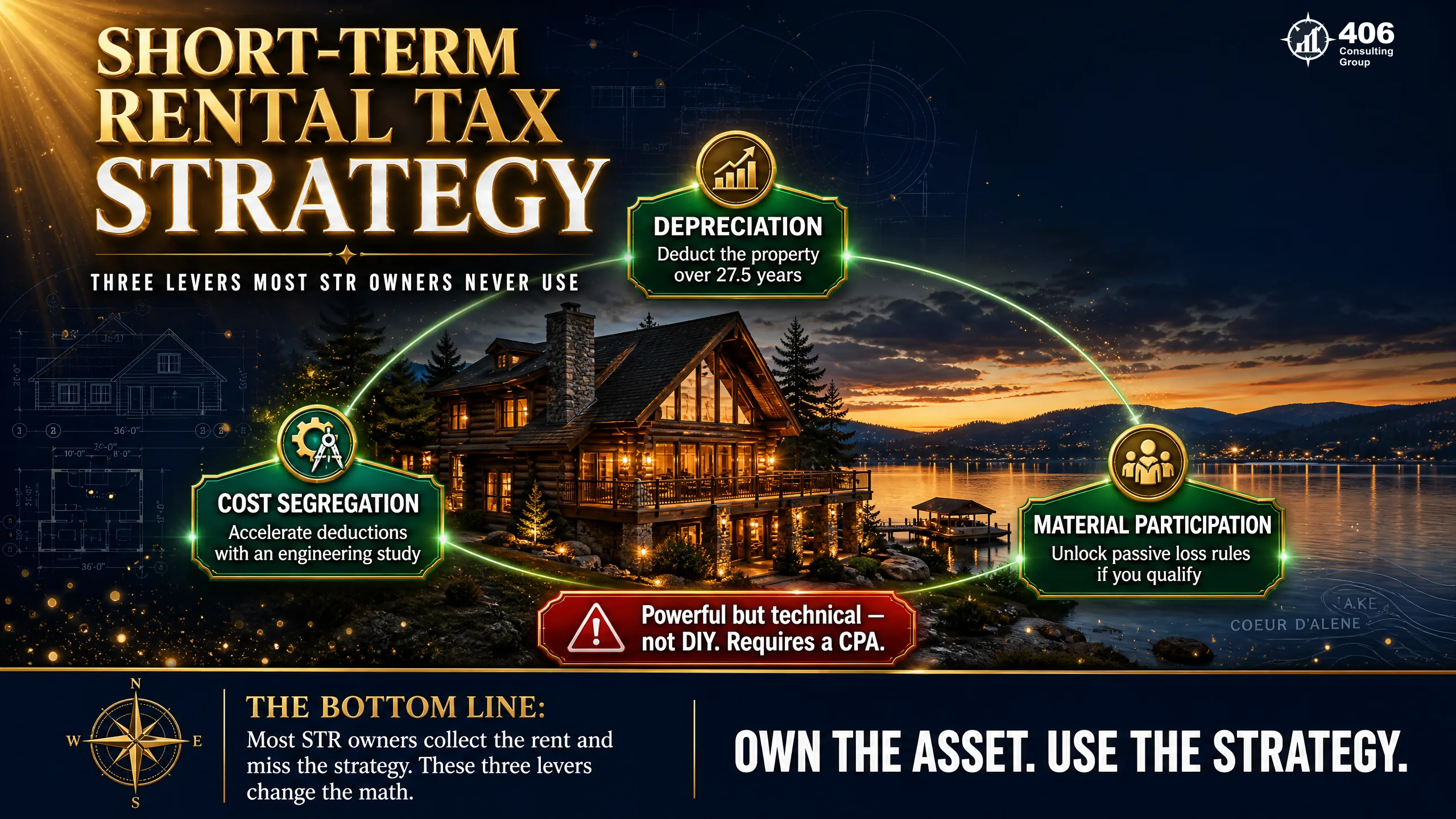
And none of the strategy works without clean records — lodging revenue, expenses, and the participation log all have to be there when it counts.
The Idaho Pass-Through Election
If your business is a pass-through — an S-corp or partnership — Idaho offers an election that can work around the federal cap on deducting state and local taxes (the "SALT cap"). In broad strokes, the business elects to pay Idaho income tax at the entity level, where it's a deductible business expense, instead of that tax flowing to your personal return where the deduction is capped. For a profitable pass-through owner, it can recover a federal deduction you'd otherwise lose.
The election has specific rules and deadlines and doesn't help every owner equally, so it's worth modeling before you elect. But it's a real, Idaho-specific lever that a lot of Coeur d'Alene pass-through owners either don't know about or aren't using — and for the right business, it's found money.
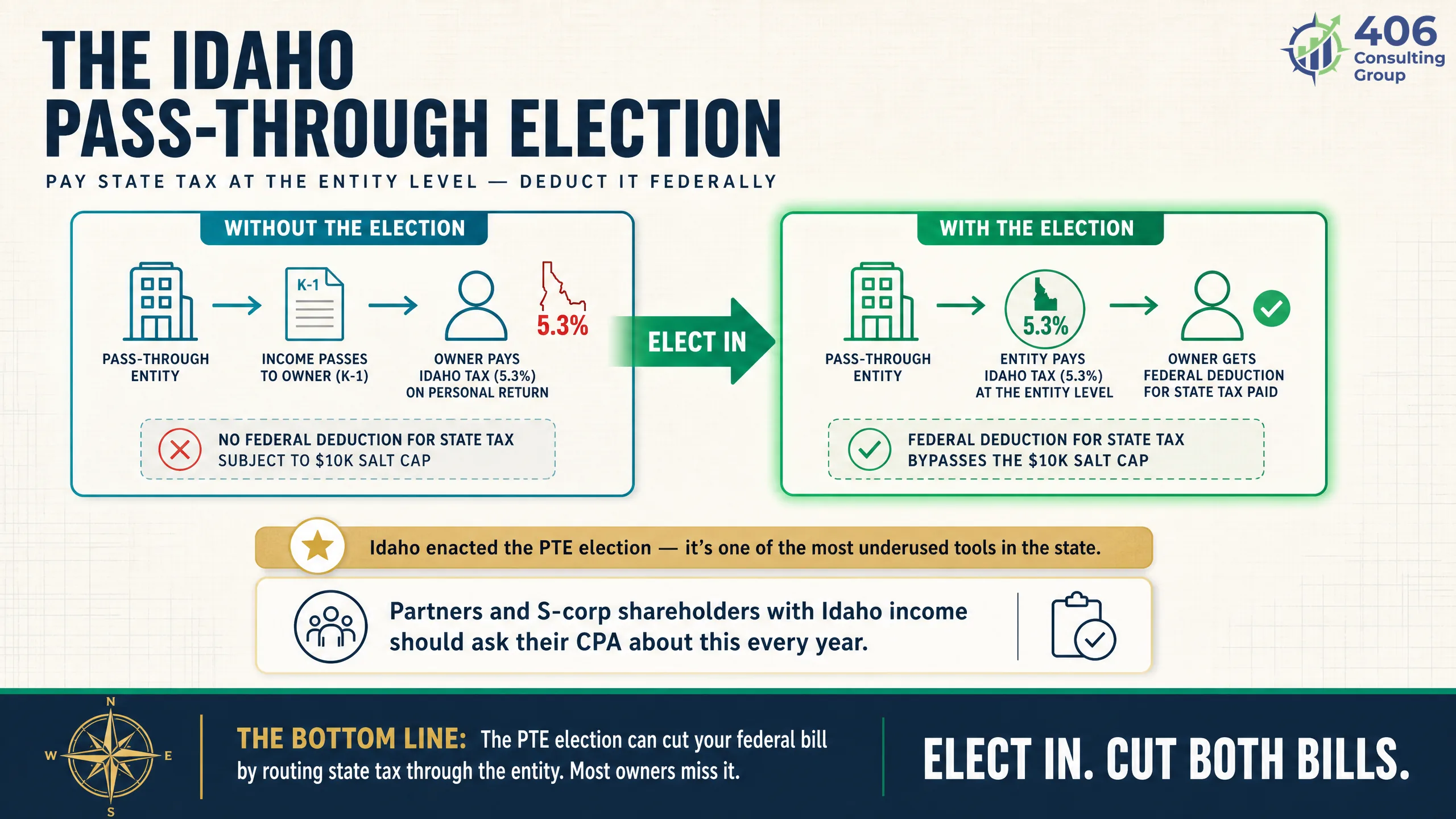
We model whether the election helps as part of planning — it's exactly the kind of thing that separates proactive tax work from once-a-year filing.
Cross-Border ID/WA Planning
Working across the Washington line changes your tax picture. Washington has no personal income tax, but it does charge a business & occupation (B&O) tax on gross receipts from work done there, plus sales tax — obligations that don't exist on the Idaho side. So a Coeur d'Alene business with Washington work needs to register and pay Washington's B&O and sales tax on that activity, while still reporting its income in Idaho.
The planning is about getting the split right, not avoiding the work: cleanly sourcing revenue between the states, paying the Washington B&O that applies (it's a real cost to price into WA jobs), and — if your crews also work in states that do have an income tax — handling apportionment and any credit for taxes paid elsewhere. A CdA business that maps this early avoids the nasty surprise of a state catching up with it later.

The bookkeeping side of the border — splitting the books by state — is in the bookkeeping guide; here, the point is to plan for it, not just clean it up afterward.
Estimates & a Year-Round Rhythm
A note on estimates, since it's widely misunderstood: Idaho does not run a federal-style mandatory quarterly-estimate-and-penalty system for individuals the way the IRS does — the state generally charges interest on tax not paid by the April deadline rather than penalizing missed quarterly installments (C-corporations and certain electing entities are treated differently). That is not a license to ignore what you owe; it means the discipline is setting aside for both the federal quarterlies and the Idaho balance as you go, so April isn't a shock.
Because so many of these levers are timing-driven, planning is a year-round rhythm: confirm entity and method choices early, watch the year's profit build, and make the equipment, retirement, and election moves before December 31, when most of them have to happen to count.
Always confirm current Idaho rules with the Idaho State Tax Commission or your advisor — the details move.
Local vs. a Great Remote Partner
Tax planning is knowledge work — modeling an S-corp, choosing a construction method, running a cost-seg analysis, weighing the pass-through election, mapping cross-border exposure. What matters is whether your advisor knows Idaho, construction, and multi-state work, not whether they're on Sherman Avenue. A great remote partner who knows this market beats a local generalist who files your return and calls it planning.
It's also how the work runs now. Roughly 70–80% of our own local clients never come into the office; planning sessions happen over shared screens and secure document exchange, with the numbers in the cloud. So whether you're in Coeur d'Alene, around the lake, or working jobs on both sides of the state line, you get proactive, market-specific planning — and our multi-state experience is a genuine edge in a border market.
The goal is the same wherever you sit: pay Idaho and the IRS what you owe, and not a dollar more.
How to Get Started
A Coeur d'Alene tax plan comes together in three steps.
Get the structure right
Model sole prop vs. S-corp, and whether the Idaho pass-through election helps your situation.
Build the plan around your work
Equipment timing, construction methods, and any short-term-rental strategy mapped to your numbers before year-end.
Handle state & cross-border
Idaho set-asides, and Washington B&O/sales plus apportionment if you work across the line.
Start with the S-Corp Calculator or our Financial Maturity Assessment, then let's talk.
FAQ: Coeur d'Alene Tax Questions
How much is Idaho's income tax, and does planning really help?
Idaho has a flat 5.3% state income tax on business and personal income, on top of federal income tax. Because there are two income taxes, proactive planning is worth more here than in a no-income-tax state — most legitimate deductions and deferrals cut both bills. Owners who skip planning overpay twice; those who plan (entity choice, equipment and income timing, retirement, the pass-through election) keep meaningfully more. It's not about loopholes; it's about using the normal levers deliberately and before year-end.
What tax strategies are specific to construction businesses?
Two big ones. First, equipment timing: Section 179 and bonus depreciation let you deduct trucks and machines in the year placed in service, cutting both bills in a strong year. Second, income-timing methods: for long-term contracts, the accounting method you use affects when income is taxed, and smaller contractors or certain home-construction contracts may qualify for methods like completed-contract that defer income into a later year. Both depend on your size and current rules, so they're work-with-a-pro areas — but for a builder with jobs crossing year-end, they're among the biggest levers available.
Can I really get big tax benefits from a Coeur d'Alene short-term rental?
Potentially, yes — and it's genuinely technical. Rental real estate can be depreciated, and a cost-segregation study can accelerate much of that depreciation into the early years for large deductions. Short-term rentals also sit under special rules: if the average guest stay is short and you materially participate, the activity may not be treated as passive, which affects whether the deductions offset your other income. Material participation, passive-activity limits, depreciation recapture, and 1031 exchanges all interact, so this is not a DIY area — done right it's a major strategy, done wrong it's an audit risk.
What is the Idaho pass-through election?
It's an Idaho election that lets a pass-through business (S-corp or partnership) pay Idaho income tax at the entity level, where it's a deductible business expense, rather than having that tax flow to the owner's personal return where the federal SALT deduction is capped. For a profitable pass-through owner, it can recover a federal deduction that would otherwise be lost. It has specific rules and deadlines and doesn't help everyone equally, so it's worth modeling before electing — but for the right Coeur d'Alene business it can be real money.
Can 406 Consulting Group handle my Coeur d'Alene taxes remotely?
Yes. Tax planning and preparation run well remotely — planning over shared screens, secure document exchange, and numbers in the cloud. What matters is deep knowledge of Idaho, construction, short-term rentals, and multi-state work, not office proximity. Roughly 70–80% of our own local clients never come into the office either, and in a border market our multi-state experience is a real advantage. You get proactive, year-round planning wherever you are.
Keep Reading
Tax Planning — Coeur d'Alene, ID
In a Two-Tax State, Planning Pays Twice.
406 Consulting Group builds year-round tax plans for Coeur d'Alene businesses — entity strategy, equipment and construction timing, short-term-rental strategy, the Idaho pass-through election, and cross-border clarity — delivered remotely.
CdA Tax Quick Reference
Coeur d'Alene, ID — Kootenai County
Overpaying in Coeur d'Alene?
In a two-tax state, planning pays twice.
About the Author
Carrie Anderson
Co-Founder, 406 Consulting Group
Commercial banking and underwriting background — 300+ loan reviews — advising construction, real-estate, and small businesses across the Inland Northwest. Carrie helps Coeur d'Alene owners plan for both the Idaho and federal bill, and use the construction and rental levers a generalist misses.
Read the Full Story