
CFO & Controller Services in Coeur d'Alene, ID:
Grow Profit, Not Just Revenue
The busier a builder gets, the tighter cash feels. Here's how fractional controller and CFO leadership — job-level margin, the WIP schedule, cash forecasting, and bonding readiness — helps a Coeur d'Alene construction business grow profit, not just revenue.

Here's a paradox every growing Coeur d'Alene builder eventually hits: the busier and more profitable you get, the tighter cash feels. You're winning bigger jobs, buying more materials up front, carrying more payroll and more subs, and floating retainage — and somehow the bank account is scarier at $4M in revenue than it was at $1.5M. That's not bad luck. It's what happens when a construction business outgrows the owner's ability to run it by feel, and it's exactly the point where real financial leadership starts to pay for itself.
Construction is one of the hardest industries to manage financially: job-level margins that a company-wide P&L hides, work-in-progress that has to be tracked or your numbers lie to you, cash that lags the work by months, and bonding requirements that gate the jobs you can even bid. A controller keeps the job numbers reliable; a CFO turns them into decisions — which work to chase, how to fund the growth, and how to build the financial strength that unlocks bigger projects. And you don't need a full-time hire to get it.
This guide covers what controllers and CFOs do for a builder, what each costs, the WIP and cash realities of construction, bonding readiness, and how to know which you need.
By Jason Anderson — Co-Founder, 406 Consulting Group. Big-firm-trained accountant specializing in construction — job costing, WIP, and bonding-ready financials — for builders across the Inland Northwest.
Quick Answer: CFO & Controller Help for a Coeur d'Alene Builder
- →A controller makes the job numbers reliable; a CFO turns them into decisions.
- →The WIP schedule — over/under-billing — is the number that tells you if you're really making money.
- →Growth eats cash: profitable builders go broke in booms without cash forecasting.
- →Bonding capacity is built on clean financials and a strong WIP — the gate to bigger jobs.
- →Fractional delivers both roles for ~$4,000–$8,000/month — a fraction of full-time — remotely.
Table of Contents
Why a Growing Builder Needs Financial Leadership
Most construction businesses hit a financial ceiling when growth outpaces the owner's ability to run the numbers in his head. The jobs get bigger, the crews multiply, the subs stack up, and the decisions get too expensive to get wrong — which bid to chase, whether that big project is actually profitable, how to cover payroll while you wait on a draw. In Coeur d'Alene's boom, that wall arrives fast, because the work is there to grow into faster than the systems can keep up.
Financial leadership is what turns clean books into decisions: the true margin on each job, a cash forecast that survives the gaps between draws, and the financial strength that unlocks bonding and bigger work. It's the difference between a builder who grows revenue and one who grows profit — and they are very different outcomes.

The question is which kind of help you need, and how to get it without overpaying. That starts with the roles.
Bookkeeper vs. Controller vs. CFO
These three roles get blurred constantly, but they're distinct — and hiring the wrong one for your problem is a common, expensive mistake.
| Role | Core question they answer |
|---|---|
| Bookkeeper | "Are the job costs and transactions recorded and reconciled?" |
| Controller | "Are the financials and the WIP right, on time, and controlled?" |
| CFO | "What do the numbers tell us — which jobs, how to fund them, how to grow?" |
A quick rule: if your job numbers are late or wrong, you need a controller. If they're clean but you can't see which work to chase or how to fund it, you need a CFO. Many growing CdA builders need some of both — which a coordinated fractional engagement delivers. We cover the first step up in upgrading from bookkeeping to a controller.
The Cost Math: Fractional vs. Full-Time
Full-time financial leadership is expensive, and at most growing builders it isn't a 40-hour-a-week job yet. Fractional gives you the expertise scaled to what you actually need.
| Role | Fractional (per month) | Full-time (annual) |
|---|---|---|
| Controller | ~$2,500–$6,000 | $85K–$120K + ~25% benefits |
| Fractional CFO | ~$2,500–$5,000 | $150K–$300K+ + benefits |
| Both, coordinated | ~$4,000–$8,000 | $235K–$420K+ |
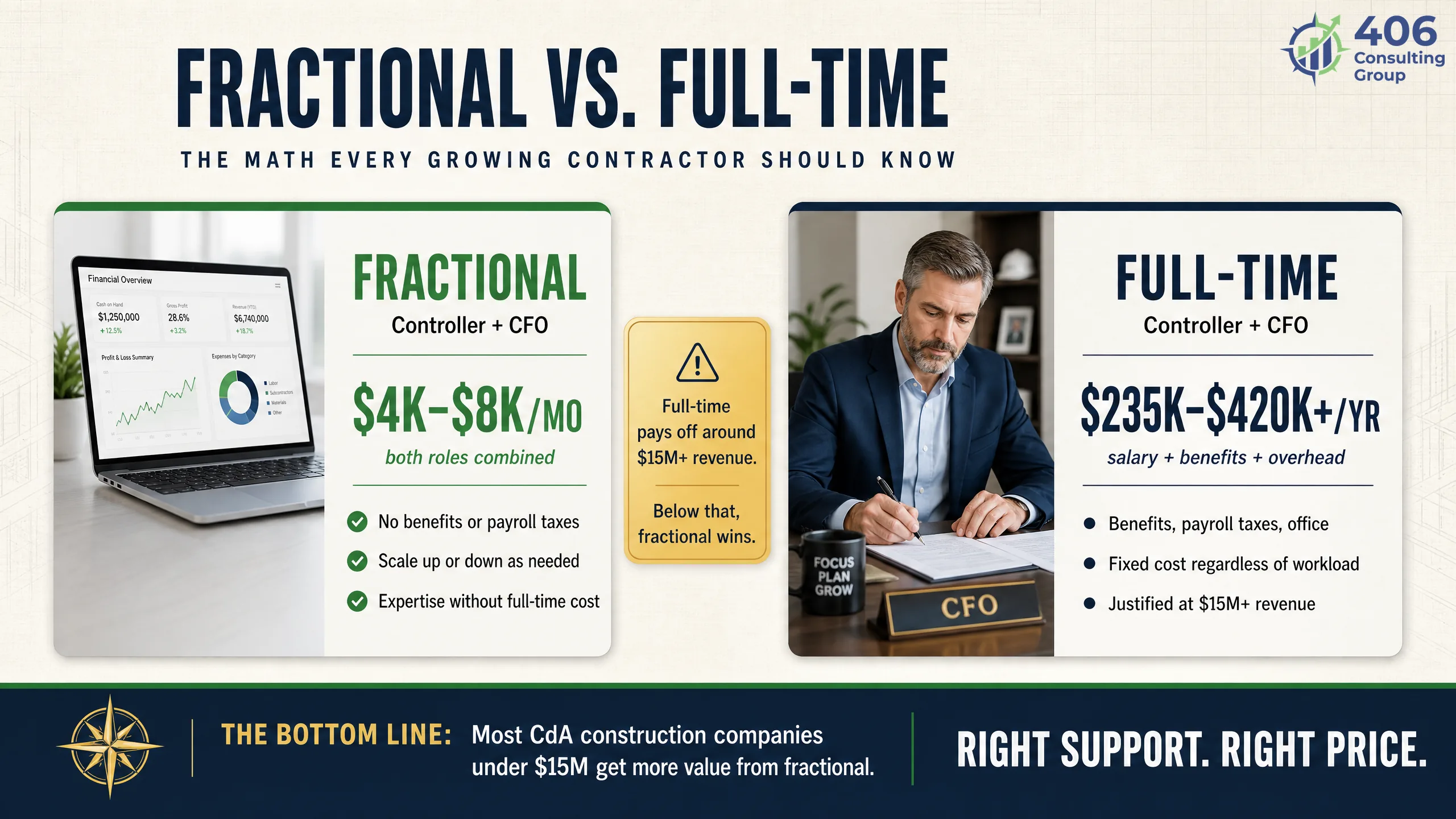
Fractional is dramatically more cost-effective until a business reaches the scale — generally $15M+ — that keeps a full-time hire busy year-round. Estimate the controller piece with our Controller Estimator.
What a Controller Delivers
A controller owns the integrity of your financials — and for a builder, that centers on the job. A reliable monthly close, accurate statements you can trust, clean job costing so every project is tracked, and — critically — a correct work-in-progress (WIP) schedule, the report that reconciles what you've billed against what you've actually earned. Add clean handling of subs, 1099s, retainage, and change orders, and you have books that tell the truth.
This matters more in construction than almost anywhere, because without job costing and WIP, a company-wide P&L can show a profit while individual jobs quietly bleed. Because we build books around how construction actually runs — jobs, phases, draws, retainage — the numbers stay useful for decisions, not just compliant for the return.
Once the job numbers are reliable, most owners want to use them — which is the CFO's job.
What a CFO Delivers
A CFO turns reliable job numbers into forward strategy: cash-flow forecasting across draws and retainage, job-level margin and bid analysis, budgeting and scenario planning, financing strategy for growth and equipment, and the financial packaging that builds bonding capacity. For a growing CdA builder, the CFO's highest-value work is usually making sure the growth is funded and bondable — that you can take the bigger job without running out of cash or getting turned down by the surety.
It's also the seat at the table for the big calls: which bids to chase and which to walk away from, whether to buy or lease equipment, when to add a crew, and how to price work so the margin survives contact with reality. That forward view is what separates builders who scale profitably from those who grow themselves into a cash crisis.
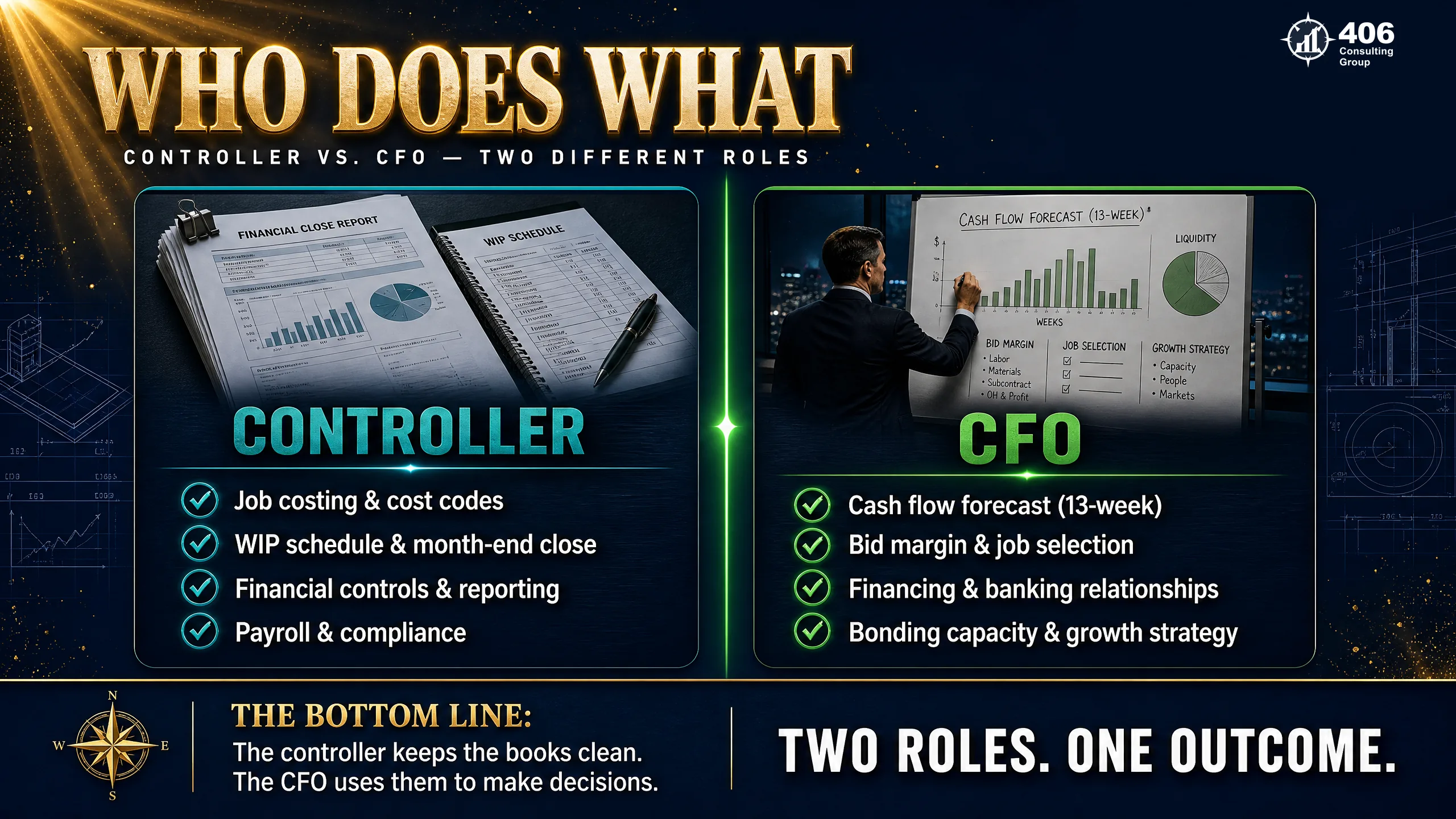
You rarely need both at full strength at once — which is why a coordinated fractional engagement, dialed to your stage, is usually the right answer.
Job Margin & the WIP Schedule
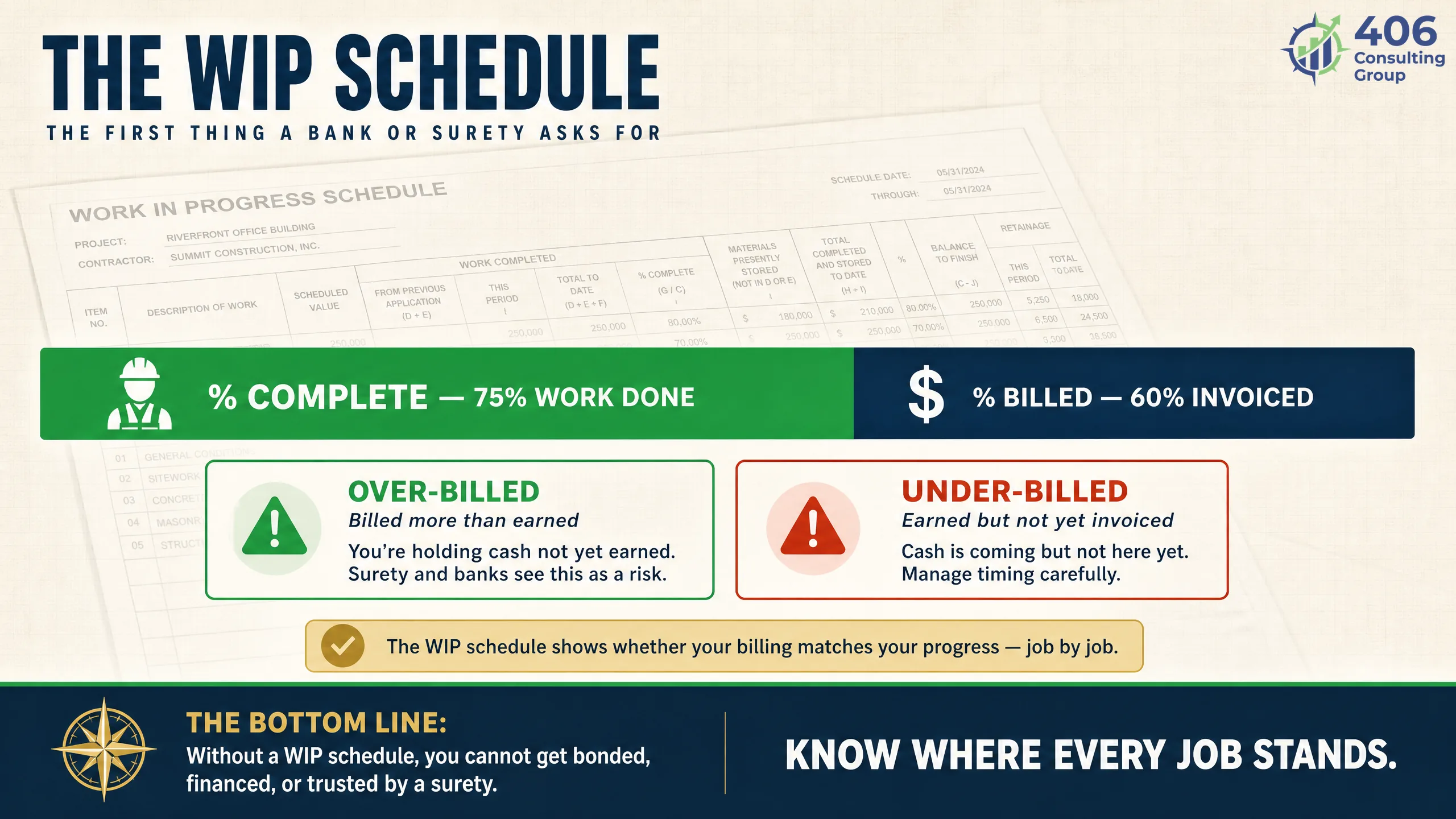
If there's one report that separates builders who know their numbers from those who don't, it's the work-in-progress schedule. WIP compares how much you've billed on each job against how much of the work you've actually completed. Bill ahead of the work (over-billing) and you're sitting on cash that isn't really yours yet; bill behind it (under-billing) and you've done work you haven't been paid for — a hidden asset that feels like a loss. Either way, if you're not tracking it, your financials are telling you a story that isn't true.
A good WIP schedule catches jobs going sideways while there's still time to act, keeps your reported profit honest, and is the first thing a bank or surety asks to see. Pair it with real job-level margin analysis and you can finally answer the question that runs a construction business: which jobs, and which kinds of work, actually make money.
Digging into which crews and job types actually pay is exactly what our flagship on contractor unit economics is about — and a clean WIP schedule is what makes the answer trustworthy.
Cash Flow in a Boom
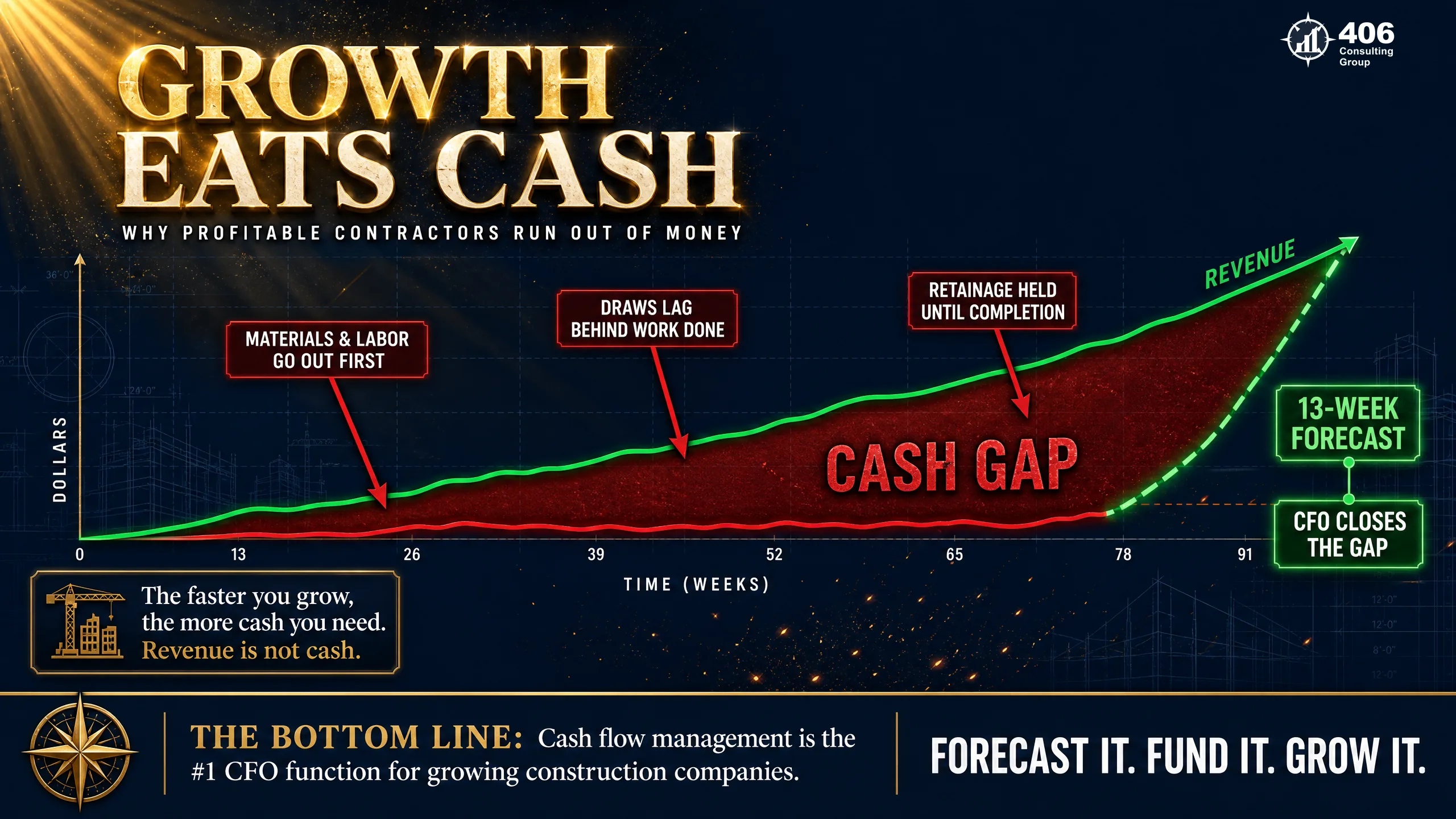
This is the one that catches good builders off guard: growth eats cash. Every new job means materials and labor going out weeks or months before the draw comes in, retainage held back until the end, and the next bigger project demanding even more up front. A profitable, growing construction business can absolutely run out of cash — and in a boom, when you're saying yes to everything, the risk is highest exactly when things feel best.
The fix is a real cash-flow forecast — a rolling 13-week view plus a look further out — that maps draws, retainage, payroll, and material buys so you can see a squeeze before it arrives and line up financing before you need it, not during a panic. It's the single most valuable habit a growing builder can adopt, and the one most skip until it's almost too late.
Want a quick read on your runway? Try our Cash Flow Runway tool, and see why profit and cash aren't the same.
Bonding & Surety Readiness
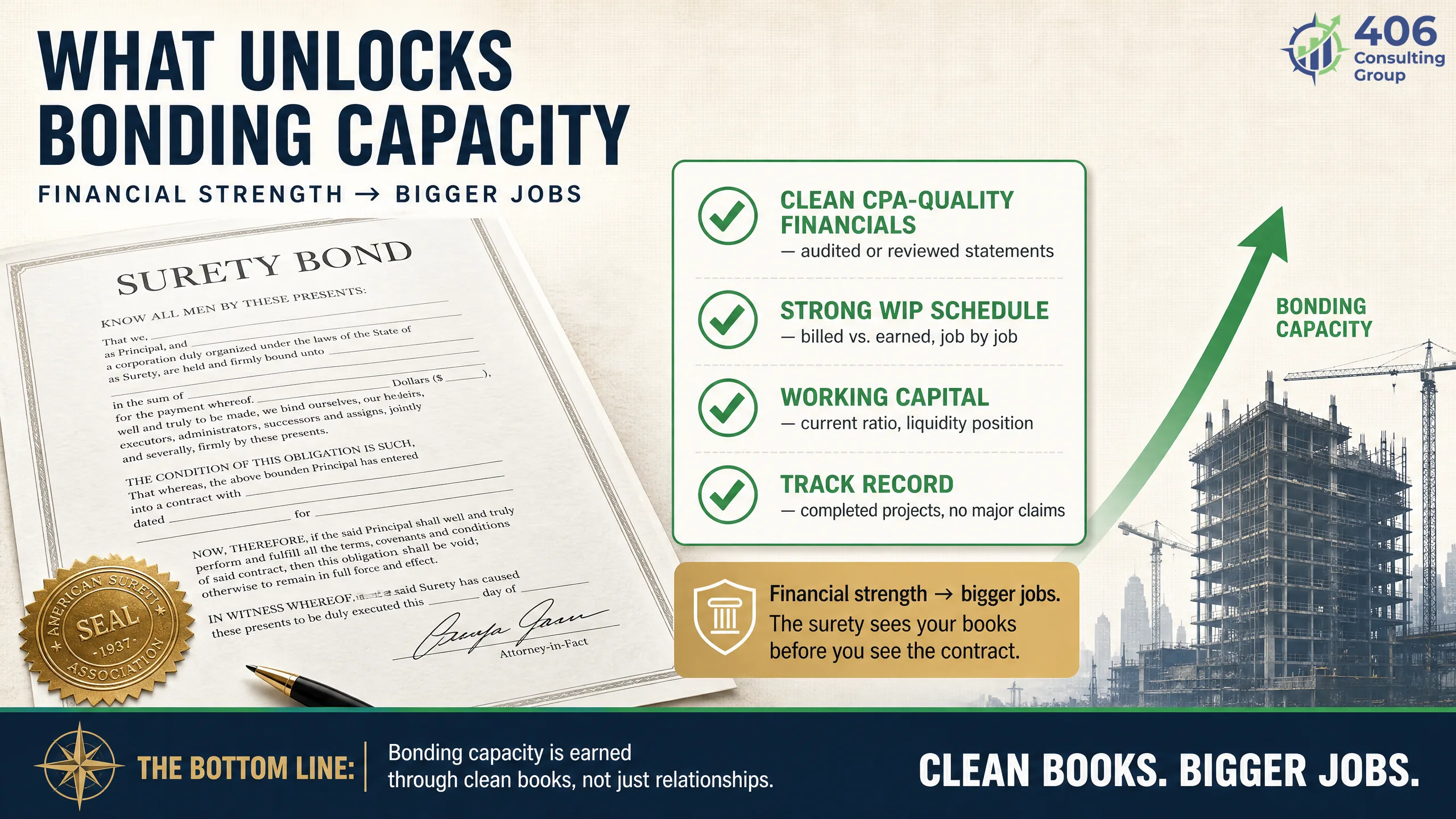
For builders chasing larger commercial or public work, bonding is the gate — and it's a financial question as much as a construction one. Sureties extend bonding capacity based on your financial strength: clean, CPA-quality financial statements, a solid work-in-progress schedule, working capital, and a track record they can trust. Weak or messy financials cap the size of the jobs you can bid; strong ones open the door to bigger work.
This is where good financial leadership directly grows the business. Preparing bonding-ready financials and WIP schedules, managing working capital, and presenting the company the way a surety underwrites it can meaningfully increase your bonding capacity — and our commercial-banking background means we prepare a builder the way lenders and sureties actually evaluate one. The same financial strength also makes financing growth and equipment far easier.
See our loan & financing readiness work for how we get a builder bank- and bond-ready.
When to Hire — and the Fractional Path
A few clear signals mean it's time for financial leadership:
You don't have a real WIP schedule
If you can't say which jobs are over- or under-billed, your financials aren't telling you the truth.
Cash is tight despite good profit
Growth is eating cash faster than draws come in — a classic, dangerous construction squeeze.
Bonding is capping your growth
If your bonding capacity is limiting the jobs you can bid, your financials are the lever.
You're bidding and buying on gut
Big bids and equipment decisions made without job-level margin and a forecast get expensive fast.

The fractional path lets you start with exactly what you need — often a controller to get job costing and WIP right, then CFO strategy for cash, bidding, and bonding — and scale up as you grow, without the risk of a six-figure hire.
Local vs. a Great Remote Partner
Financial leadership for a builder is analysis and judgment — building the WIP schedule and cash forecast, analyzing bids, preparing bonding packages, talking through the big calls. None of it depends on being on the jobsite; what matters is whether your partner understands construction finance, not their zip code. A great remote CFO who knows WIP and bonding beats a local generalist who doesn't, every time.
It's also how we already work. Roughly 70–80% of our own local clients never come into the office; forecasts, WIP reviews, and bid analysis run on shared screens and live dashboards, with regular calls. So whether you're building in Coeur d'Alene, around the lake, or across the line in Washington, you get the same construction-savvy financial leadership our in-town clients do.
Distance isn't the variable. Knowing construction finance is.
How to Get Started
Getting financial leadership in place is three steps.
Diagnose what you actually need
Late/wrong job numbers and no WIP point to a controller; clean-but-unused numbers point to a CFO. We pinpoint the real gap.
Get the job foundation right
Reliable job costing, a correct WIP schedule, and a trustworthy monthly close — the CFO work is only as good as the numbers under it.
Layer on growth strategy
Cash forecasting, bid and margin analysis, and bonding readiness, scaled to your stage.
Not sure which layer you need? Our Financial Maturity Assessment maps it out in about eight minutes.
FAQ: Coeur d'Alene CFO & Controller Questions
How much do CFO and controller services cost in Coeur d'Alene, ID?
Fractional pricing typically runs about $2,500–$6,000 per month for a controller and about $2,500–$5,000 per month for a fractional CFO, depending on complexity and scope. A coordinated engagement covering both often runs roughly $4,000–$8,000 per month. Compare that to full-time salaries — $85K–$120K for a controller and $150K–$300K+ for a CFO, plus roughly 25% in benefits — and fractional is dramatically more cost-effective until a business reaches the scale (generally $15M+) that keeps a full-time hire busy year-round.
What is a WIP schedule and why does it matter so much for builders?
A work-in-progress (WIP) schedule compares how much you've billed on each job against how much of the work you've actually completed. If you've billed ahead of the work (over-billing), you're holding cash that isn't truly earned yet; if you've billed behind it (under-billing), you've done work you haven't been paid for. Without a WIP schedule, a company-wide P&L can show a profit while individual jobs bleed, and your financial statements can be materially wrong. It's also the first thing a bank or surety asks to see, which makes it central to both running the business and growing it.
Why does a profitable construction business run out of cash?
Because growth consumes cash. Every new job requires materials and labor to go out before the draw comes in, retainage is held back until the end, and each bigger project demands more up front than the last. So a builder can be genuinely profitable on paper and still hit a cash crunch — especially in a boom, when you're taking on everything. The solution is a rolling cash-flow forecast that maps draws, retainage, payroll, and material buys so you can see a squeeze coming and arrange financing before you need it rather than during a crisis.
How does financial leadership help with bonding?
Bonding capacity is built on financial strength. Sureties look at clean, CPA-quality financial statements, a solid WIP schedule, working capital, and your track record to decide how much bonding to extend — which caps or unlocks the size of jobs you can bid. A controller and CFO who produce bonding-ready financials, manage working capital, and present the company the way a surety underwrites it can meaningfully increase your bonding capacity. In that sense, good financial leadership directly grows the business by opening the door to bigger work.
Can 406 Consulting Group provide CFO and controller services remotely?
Yes — it's how the work is done now. WIP reviews, cash forecasting, bid analysis, and bonding prep all happen over shared screens, live dashboards, and regular calls; none of it requires being on the jobsite. Roughly 70–80% of our own local clients never come into the office either. What matters is deep construction-finance expertise — job costing, WIP, bonding, and multi-state work in a border market — plus a commercial-banking background that means we prepare you the way lenders and sureties actually evaluate a builder.
Keep Reading
CFO & Controller — Coeur d'Alene, ID
Grow Profit, Not Just Revenue.
406 Consulting Group gives Coeur d'Alene builders fractional controller and CFO leadership — job costing, WIP, cash forecasting, and bonding readiness — delivered remotely, built for construction.
Fractional vs. Full-Time
Coeur d'Alene, ID — typical ranges
Growing Faster Than Your Cash?
WIP, cash & bonding, handled.
About the Author
Jason Anderson
Co-Founder, 406 Consulting Group
Big-firm-trained accountant specializing in construction — job costing, WIP schedules, and bonding-ready financials. Jason helps Coeur d'Alene builders grow profit, not just revenue, and build the financial strength that unlocks bigger work.
Read the Full Story