
Tax Services in Las Vegas, NV:
Turn the No-Income-Tax Advantage Into Kept Dollars
Nevada has no state income tax — so the planning shifts to federal levers, the MBT and Commerce Tax, and a clean domicile if you're relocating. The tax moves that actually move the needle, delivered proactively and remotely.

Nevada's no-income-tax reputation is well earned — there's no personal or corporate state income tax, and that's a genuine advantage. But it changes where the tax planning happens rather than removing the need for it. With no state income tax to optimize, the biggest levers for a Las Vegas business move to the federal side — entity choice and self-employment tax, depreciation timing, retirement planning — plus a handful of Nevada-specific business taxes to manage and, for the flood of businesses arriving from California, getting the domicile right so the savings are real.
This guide walks the planning that actually moves the needle for a Nevada business — the federal moves the no-income-tax states make most valuable, managing the MBT and Commerce Tax, and relocating cleanly from a high-tax state — delivered proactively and remotely, not once a year at filing.
By Carrie Anderson — Co-Founder, 406 Consulting Group. Commercial banking and advisory background; she helps Nevada owners structure entities, time decisions, and relocate cleanly so the state's no-income-tax advantage turns into real, kept dollars.
Quick Answer: Tax Planning for a Las Vegas Business
- →No state income tax is real — so the planning shifts to federal levers and Nevada's business taxes.
- →The S-corp election is still a top move — but here it's purely a federal self-employment-tax play, with no state angle.
- →Plan around the MBT (payroll tax) and the Commerce Tax ($4M gross) rather than a state income tax.
- →Relocating from California or another high-tax state? Get domicile and nexus right or the savings can slip away.
- →Delivered remotely and proactively — planning all year, not a return in April.
Table of Contents
Las Vegas Tax Planning Is Federal-First
In most states, a big part of tax planning is managing the state income tax — brackets, credits, the SALT cap, pass-through workarounds. In Nevada, that entire layer simply doesn't exist, which is a real gift and also a trap: owners assume that with no state income tax, there's nothing to plan. There's plenty — it just lives on the federal return and in Nevada's business taxes. The businesses that keep the most treat tax as a year-round federal planning function and manage the state pieces deliberately, rather than filing a simple return in April and calling it strategy.
No state income tax doesn't mean no tax planning — it means the planning moves to the federal return and Nevada's business taxes. The owners who assume there's nothing to do are the ones overpaying federally.
Start by being clear-eyed about exactly what the no-income-tax advantage does and doesn't do.
The No-Income-Tax Advantage — and Its Limits
The advantage is genuine: Nevada takes no cut of your business profit or your personal income the way California, Colorado, or most states do, which for a profitable owner is real money kept every year. But it has limits worth naming. You still owe federal income and self-employment tax — often the larger bill anyway. Nevada still collects through the MBT, Commerce Tax, sales tax, and licensing. And the advantage only fully applies if you're genuinely a Nevada business — a company that's really operating in California doesn't escape California tax by putting an address in Las Vegas.

With the state income tax off the table, the single biggest lever left is federal — and it starts with your entity.
Entity Choice: The S-Corp Play Is Federal Here
Entity structure is the highest-return tax question for most profitable Las Vegas businesses — and in Nevada it's a purely federal decision, because there's no state income tax in the equation. A default LLC pays self-employment tax (about 15.3%) on all its profit. Elect S-corptreatment and you split profit into a reasonable salary (which carries payroll tax) and distributions (which don't) — often saving real money once profit consistently clears roughly the $80,000–$100,000 range. In an income-tax state you'd also weigh state effects; in Nevada the math is clean, which makes the S-corp decision especially worth running.

Run the S-corp math for your own numbers with our S-Corp calculator. With the entity set, the Nevada-specific taxes are the next thing to plan around.
Planning Around the MBT & Commerce Tax
Nevada's business taxes are lighter than an income tax, but they still reward planning. The Modified Business Tax is an employer payroll tax on wages above a quarterly threshold, so how you structure compensation — including reasonable S-corp salary — has an MBT dimension, not just a federal one. The Commerce Tax only applies above $4 million in Nevada gross revenue, at industry-specific rates, so a growing business wants to know which industry category it falls in and see the threshold coming. Neither is huge on its own, but managed together with your federal plan they keep the total burden as low as the rules allow.

Those are ongoing levers. Equipment purchases are a timing lever you control year to year.
Depreciation & Equipment Timing
When you buy equipment — a vehicle, a machine, a build-out — Section 179 and bonus depreciationcan let you deduct a large share of the cost in the year you place it in service rather than spreading it over years. Because Nevada has no state income tax, this is a clean federal decision with no state add-back to reconcile — simpler than in a state like Colorado. It's still a timing decision, not a reflex: a big deduction is worth more in a high-income year than a low one, so the goal is matching the deduction to the year you need it most.
A deduction taken in the right year is worth far more than the same deduction taken in the wrong one — and with no Nevada income tax, that's a purely federal call you can make cleanly.
One more planning area matters enormously in Las Vegas specifically, because of where so many businesses are coming from.
The California Exodus: Nevada Domicile Done Right
A huge share of Las Vegas's growth is businesses and owners leaving California and other high-tax states for Nevada's no-income-tax environment. The savings can be enormous — but only if the move is done right. A high-tax state doesn't just wave goodbye: if you still have employees, offices, or customers there, you can retain nexus and keep owing tax, and states like California scrutinize whether a "move" is real. Genuinely establishing Nevada domicile and residency, cleanly de-registering where you've truly left, and handling any lingering multi-state obligations is what turns the relocation from a hopeful address change into real, defensible savings.

Our commercial and multi-state background is built for exactly this kind of move. Beyond it, some industries carry their own tax quirks.
Industry-Specific Tax Nuances
Las Vegas's signature industries each bend the tax picture. Hospitality and food & beverage carry tip reporting, the FICA tip credit, and service-charge treatment that affect the federal return. Construction deals with equipment-heavy depreciation and use tax on materials. Gaming-adjacent businesses face specialized reporting. And tech, logistics, and multi-state sellers — a growing Nevada segment — face income and sales-tax nexus questions across state lines that dwarf anything happening inside Nevada.

Knowing your industry's quirks is half of good planning; the other half is staying ahead of the calendar.
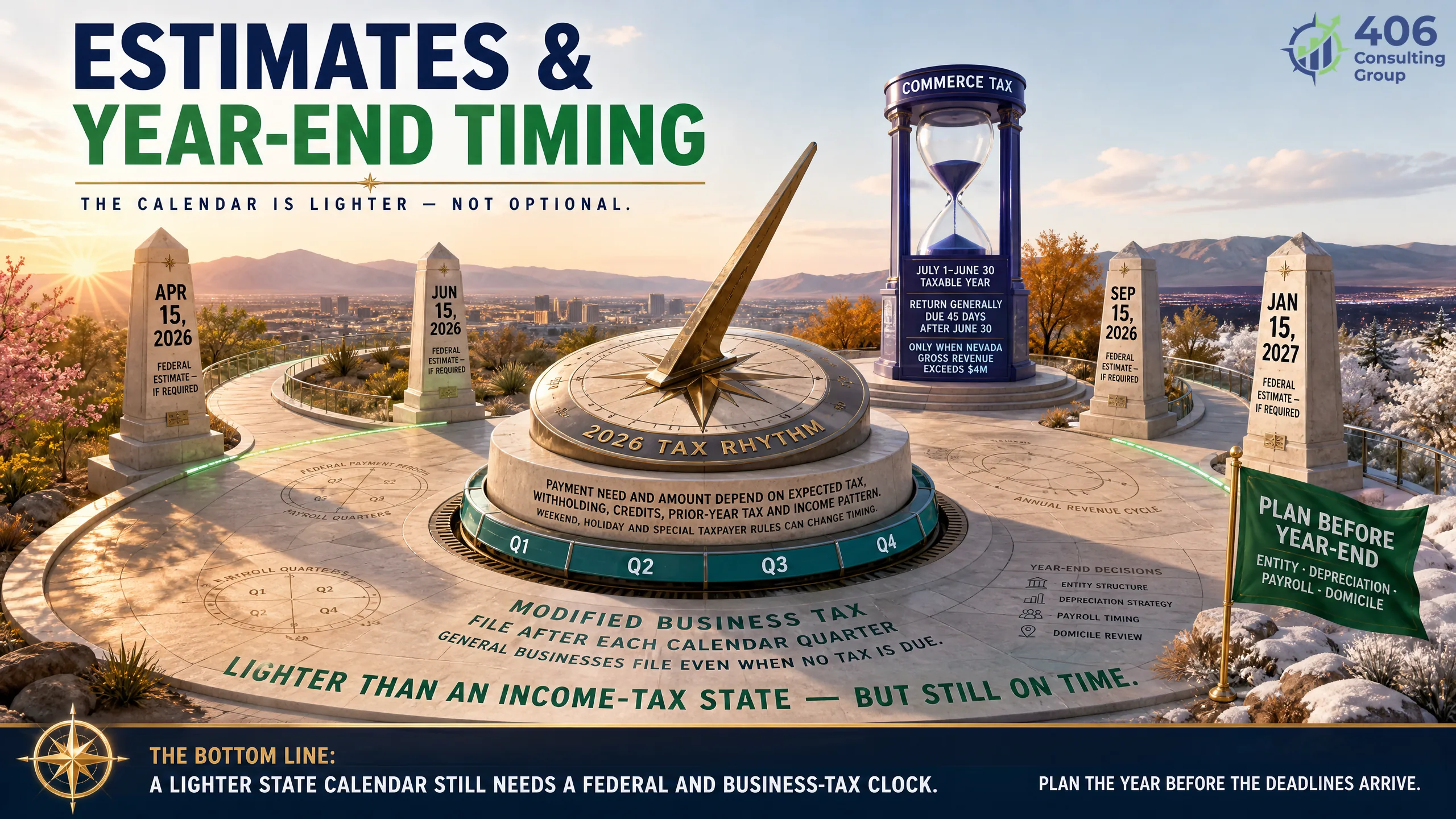
Estimates & Year-End Timing
With no state income tax, your estimated payments are mostly a federalmatter — quarterly estimates to the IRS on business income and self-employment tax. Miss or underpay them and you get penalties on top of the tax. Good planning keeps a running estimate of the year's federal liability so the quarterly payments are right, times income and deductions around year-end, and sets aside for the bill — plus keeps the MBT and any Commerce Tax filings on schedule. It's a lighter compliance calendar than an income-tax state, but the pieces still have to be handled on time.
Handling all of this well takes a partner who's in the numbers all year — which raises the question of whether that partner has to be down the street.
Local vs. a Great Remote Tax Partner
Tax planning is the last place a Las Vegas address matters and the first place expertise does. What a Nevada business needs is a partner who understands the federal levers, the MBT and Commerce Tax, and — critically for the many relocating owners — multi-state domicile and nexus, not one who happens to be nearby. A generalist who treats "no income tax" as "nothing to plan" is where the overpayment comes from. Modern tax work runs on secure document exchange, screen-shares, and regular planning calls, so a great remote partner who lives in these rules serves you better than a local generalist.
We work with Las Vegas and Southern Nevada businesses entirely remotely, and our commercial-banking and multi-state background means we plan your taxes with the whole picture in view — including a clean relocation if you're coming from a high-tax state.
How to Get Started
Good tax planning starts with a review: your entity and whether an S-corp election makes sense, how compensation is set, your depreciation position, your MBT and Commerce Tax exposure, and — if you've relocated — whether your Nevada domicile is genuinely clean. From there it becomes a year-round rhythm: planning conversations before decisions, not explanations after them.
Turn Nevada's tax advantage into kept dollars.
Let's check the entity, the federal moves, the MBT, and — if you're relocating — a clean Nevada domicile, so the no-income-tax advantage actually shows up in your bank account. Start with where your business stands today.

As you grow, the tax strategy connects to the bigger financial picture — the controller and CFO work in our Las Vegas CFO guide.
FAQ: Las Vegas Tax Planning
If Nevada has no income tax, is there anything to plan?
Plenty — the planning just moves to the federal return and Nevada's business taxes. There's no state income tax to optimize, so the biggest levers become federal: entity choice and self-employment tax (the S-corp decision), depreciation timing, and retirement planning. On the Nevada side you manage the Modified Business Tax on payroll and the Commerce Tax if you're over $4 million in revenue. And if you've relocated from a high-tax state, establishing clean domicile is its own planning project. Owners who assume 'no income tax' means 'nothing to do' are usually the ones overpaying on their federal return.
Should my Las Vegas business be an LLC or an S-Corp?
It depends on your profit, and in Nevada it's a purely federal decision because there's no state income tax involved. A default LLC pays self-employment tax of about 15.3% on all its profit. An S-corp lets you split profit into a reasonable salary and distributions, with only the salary carrying payroll tax — which often saves money once profit consistently clears roughly $80,000–$100,000, though the savings must beat the added payroll and compliance cost. Because there's no state tax layer to complicate it, the Nevada S-corp math is clean and well worth running for your specific numbers.
I'm moving my business from California to Nevada — what do I need to know?
That the savings are real but only if the move is genuine. A high-tax state like California doesn't simply release you when you change your address — if you keep employees, offices, or significant customers there, you can retain nexus and keep owing tax, and California actively scrutinizes whether a relocation is real. Doing it right means genuinely establishing Nevada domicile and residency, cleanly winding down or de-registering where you've truly left, and handling any lingering multi-state obligations. Handled properly the no-income-tax advantage is substantial; handled sloppily, the old state can still come calling. This is worth planning with a multi-state-aware advisor.
What Nevada taxes does my business still pay with no income tax?
Several, though they're lighter than an income tax: the Modified Business Tax (an employer payroll tax on wages above a quarterly threshold, roughly 1.378% for general businesses), the Commerce Tax (a gross-receipts tax that applies only above $4 million in Nevada revenue, at industry-specific rates), sales and use tax around 8.375% in Clark County, and an annual state business license plus local licenses. You also still owe all federal income and self-employment taxes. Planning manages these together with your federal strategy. Confirm current rates with the Nevada Department of Taxation.
Can 406 Consulting Group handle my Las Vegas taxes remotely?
Yes — we provide proactive tax planning and preparation for Las Vegas and Southern Nevada businesses entirely remotely, through secure document exchange and regular planning conversations. What matters for a Nevada business is expertise in the federal levers, the MBT and Commerce Tax, and multi-state domicile and nexus for relocating owners — not office proximity. Our commercial-banking and multi-state background means we plan taxes with the whole picture in view, including a clean move if you're coming from a high-tax state. Most of our own local clients never come into an office either.
Las Vegas Tax Levers
Where the savings live
Las Vegas Tax Planning
Proactive, remote, Nevada-savvy.
About the Author
Carrie Anderson
Co-Founder, 406 Consulting Group
With a commercial banking and multi-state advisory background, Carrie helps Nevada owners structure entities, time federal decisions, and relocate cleanly so the state's no-income-tax advantage turns into real, kept dollars.
Read the Full Story