
Bookkeeping Services in Las Vegas, NV:
No Income Tax Isn't the Same as Simple
Nevada has no state income tax — but it collects through the Modified Business Tax on payroll, the Commerce Tax, sales tax, and licensing. The bookkeeping a Las Vegas business actually needs, delivered remotely.

Nevada's pitch is famous: no state income tax — none on individuals, none on corporations. It's a real advantage and a big reason businesses pour into Las Vegas from higher-tax states. But "no income tax" quietly convinces a lot of owners that Nevada bookkeeping is simple, and it isn't. The state collects a different way — through the Modified Business Tax on payroll, a Commerce Tax on larger businesses, one of the higher sales-tax rates in the region, and an annual state business license — and Las Vegas layers on hospitality-industry payroll quirks that catch newcomers off guard.
This guide walks the mechanics a Las Vegas business actually has to get right — the MBT payroll tax, tips and service charges, sales and Commerce Tax, and job costing in an event-driven economy — and how we handle all of it remotely, with the same depth as a firm on the Strip.
By Jason Anderson — Co-Founder, 406 Consulting Group. Big-firm-trained accountant who builds clean, decision-ready books and the systems behind them — including the payroll-tax and job-costing setups a Las Vegas business lives on.
Quick Answer: Bookkeeping for a Las Vegas Business
- →No state income tax — but Nevada collects through payroll and gross-receipts taxes instead, so bookkeeping is far from "simple."
- →The Modified Business Tax (MBT) is a payroll tax on wages above a quarterly threshold — the piece owners most often miss.
- →Tips and service charges carry real payroll and tax rules — a Vegas hospitality reality.
- →Watch the Commerce Tax threshold ($4M gross), the ~8.375% sales tax, and the annual state business license.
- →Delivered remotely across Las Vegas and Southern Nevada — Nevada expertise over office proximity.
Table of Contents
Why Las Vegas Bookkeeping Is Its Own Discipline
The "no income tax" headline does Nevada businesses a quiet disservice, because it makes the bookkeeping sound like an afterthought. In reality, the state simply collects elsewhere, and the places it collects — payroll, gross receipts, sales, licensing — are exactly the ones a generic, out-of-state bookkeeping setup mishandles. Is your MBT set up and filed? Are tips and service charges handled correctly? Did anyone renew the state business license? A tidy-looking set of books can be hiding penalties in every one of those.
"No income tax" is true — and it's only half the story. Nevada moved the complexity from your income to your payroll, your sales, and your license, which is exactly where a generic setup goes wrong.
So the right starting point isn't your chart of accounts — it's understanding the Nevada tax frame your books have to sit inside.
The Nevada Tax Backdrop
Nevada trades an income tax for a mix of business and consumption taxes. Here's the frame a Las Vegas business keeps books inside:
| Item | What it means for your books |
|---|---|
| Income tax | None — no personal or corporate state income tax, and no state income-tax withholding on payroll |
| Modified Business Tax | A payroll tax (around 1.378% for general business) on wages above a quarterly threshold, filed quarterly |
| Commerce Tax | A gross-receipts tax on businesses over $4M in Nevada revenue; most small businesses are below it but should track toward it |
| Sales & use tax | ~8.375% in Clark County (Las Vegas); collected on taxable sales and owed as use tax on untaxed purchases |
| State business license | An annual license through the Secretary of State, plus local (city/county) business licenses |
| Payroll insurance | Workers' comp required for employees, plus Nevada unemployment insurance |
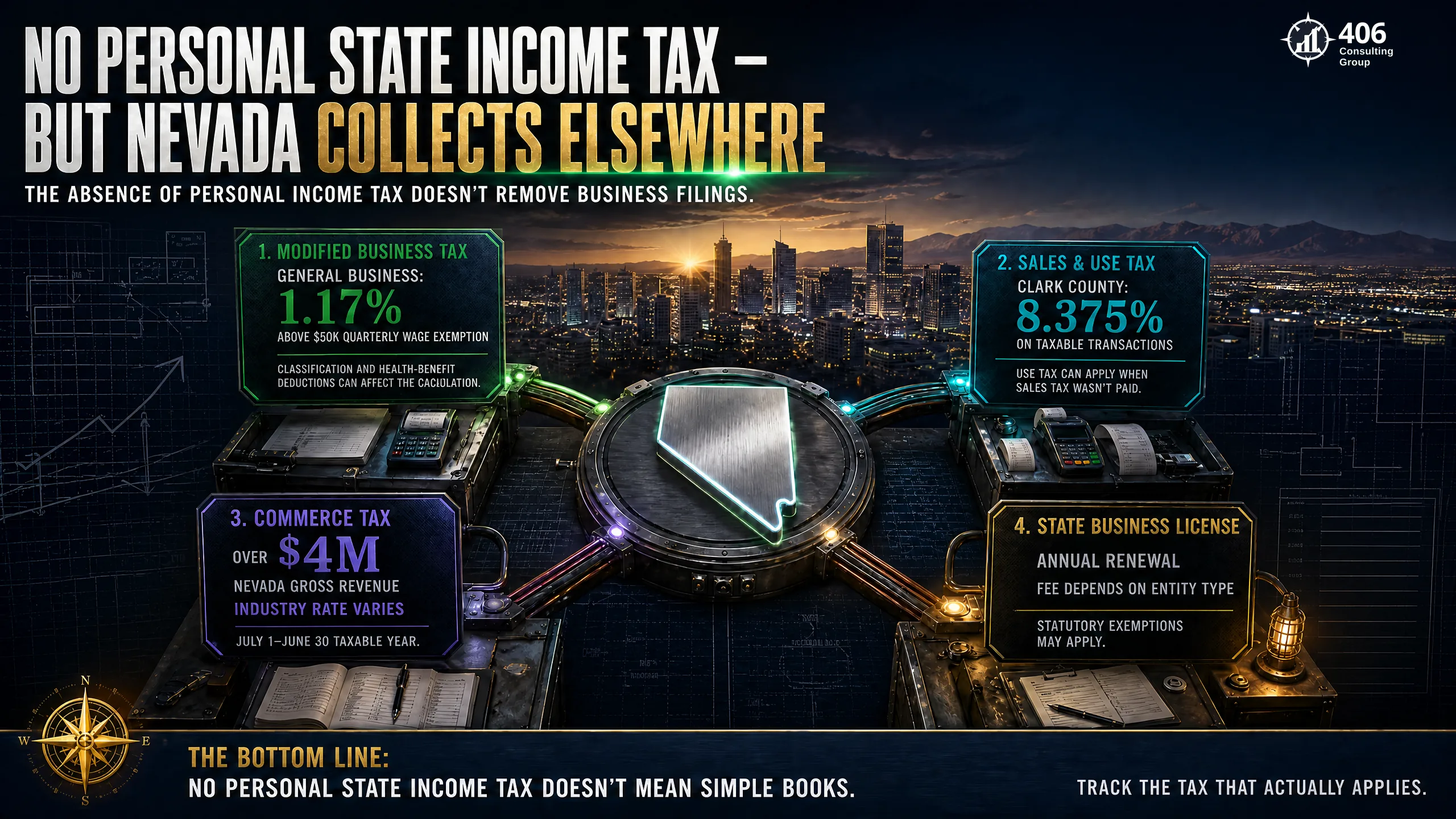
Verify current rates and thresholds with the Nevada Department of Taxation. The one that surprises new employers most is sitting right near the top of that table.
Modified Business Tax: The Payroll Tax People Miss
Because Nevada has no income tax, owners assume payroll is simple — and then meet the Modified Business Tax (MBT). The MBT is a state payroll tax on gross wages, at roughly 1.378% for general businesses (financial institutions and mining pay a higher rate), charged on wages above a quarterly thresholdand filed each quarter. Below the threshold you may owe little or nothing; above it, it adds up fast as you hire. It's not withheld from employees — it's an employer tax on your payroll — so it has to be tracked and accrued in your books, not discovered at filing time.
What owners assume
No income tax means no state payroll tax — payroll is just federal, done in a few minutes.
The Nevada reality
The MBT is an employer payroll tax on wages over a quarterly threshold — real money as you grow, filed every quarter.

The MBT catches every employer. In Las Vegas, the payroll picture gets one more layer from the industry that runs the city.
Tips, Service Charges & Hospitality Payroll
Las Vegas runs on hospitality, and hospitality payroll has rules a generic setup skips. Tips are taxable wages that have to be reported and run through payroll correctly, which affects withholding, the employer's share of payroll taxes, and tip-credit treatment. Service charges— the automatic gratuity on a banquet or large party — are treated differently from voluntary tips: the IRS generally counts them as regular wages, not tips, which changes how they're taxed and reported. Get the two confused and you create payroll-tax and compliance problems that surface at exactly the wrong time.
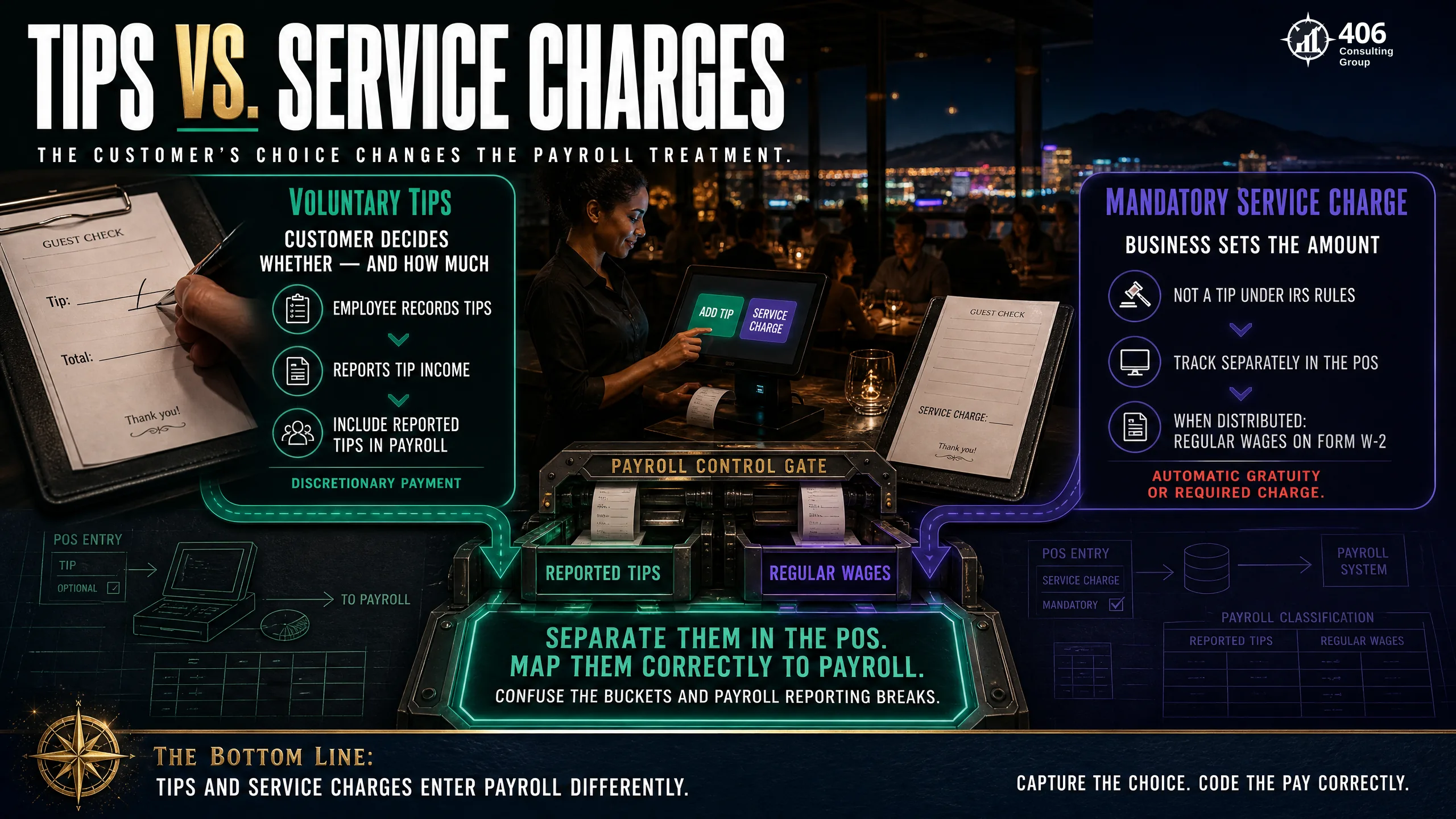
Handled cleanly, hospitality payroll is just data flowing correctly into your books. Sales tax is the next place Nevada quietly collects.
Sales Tax & the Commerce Tax Threshold
Two more Nevada taxes belong in your books. Sales and use tax runs about 8.375% in Clark County — you collect and remit it on taxable sales, and you owe use tax on items you bought without Nevada tax (out-of-state or online), a commonly missed liability. And the Commerce Tax is a gross-receipts tax that kicks in only once your Nevada revenue tops $4 million a year, at industry-specific rates from about 0.051% to 0.331%. Most small businesses sit below it — but you still may have a filing obligation, and a growing business needs to see the threshold coming rather than get surprised by it.
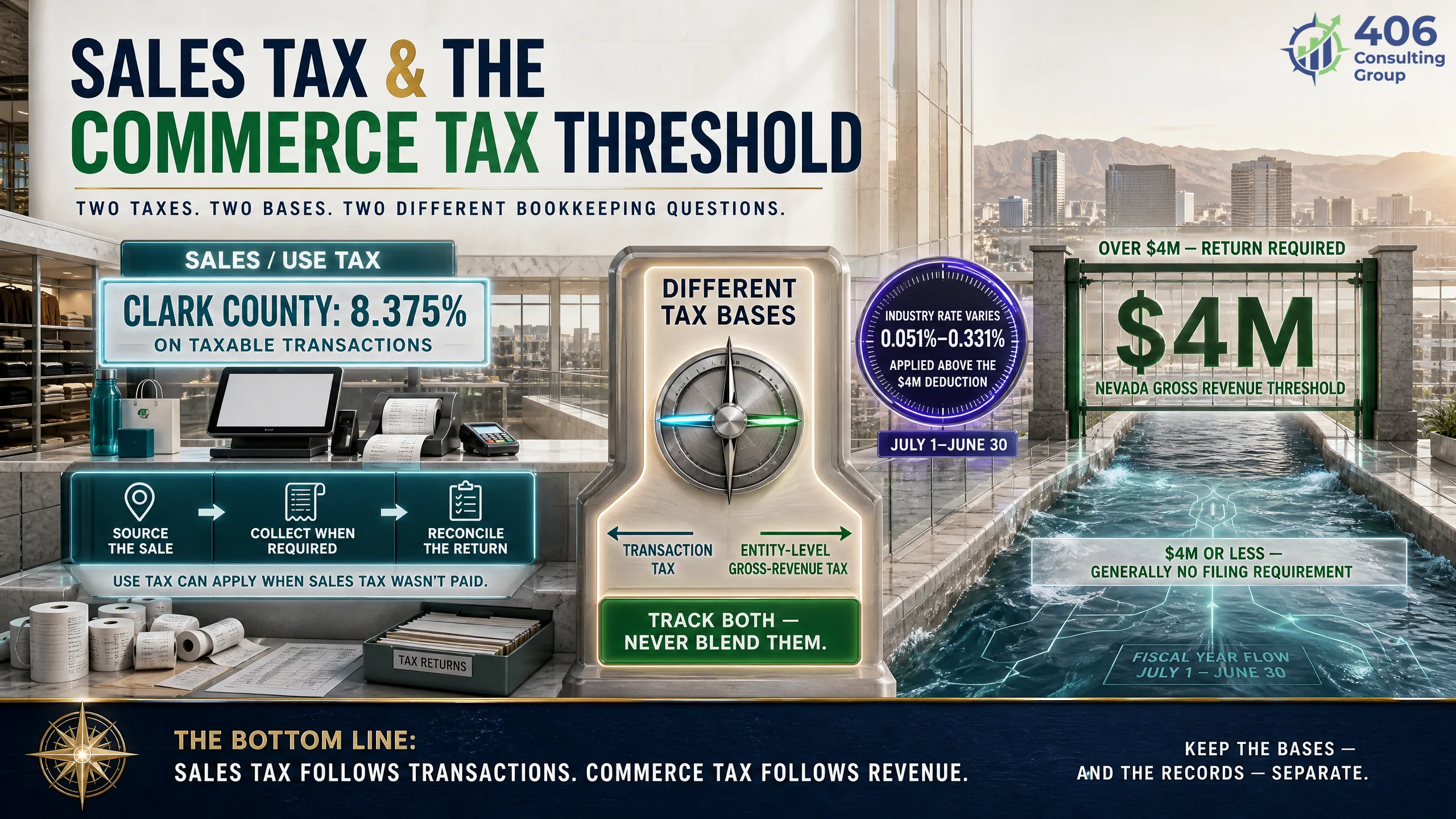
Which of these matter most depends on what kind of business you run — and Vegas has a distinctive mix.
Vegas Industries and How They Shape the Books
Las Vegas's economy has a character worth building your books around. Hospitality, food & beverage, and entertainment live on tips, service charges, daily sales reconciliation, and event-driven revenue. Construction and the trades — booming across Henderson and North Las Vegas — need job costing, use tax on materials, and prevailing-wage tracking on public work. Logistics, distribution, and data centers bring inventory and asset-heavy books. And professional services and real estate lean on clean margin by client and project.

Whatever the industry, one Vegas trait shapes the books more than most: the money doesn't arrive evenly.
Job Costing & Event-Driven Seasonality
Las Vegas revenue is famously lumpy — conventions, events, tourism peaks, and shoulder-season gaps mean cash arrives in bursts. That makes two things essential. First, job or segment costing, so you know which events, projects, clients, or locations actually make money instead of guessing from a company-wide average. Second, books current enough to feed a cash-flow viewthat gets you across the slow weeks between the busy ones. In a lumpy-revenue market, "we had a great month" and "we can cover next month" are two very different questions.
In an event-driven city, a big month can hide a cash problem in the slow one that follows. Segment costing and current books are how a Vegas business sees the difference before it bites.

Which projects and clients make money is the heart of our unit-economics work — and segment reporting is how a Las Vegas business sees it. Avoiding the common mistakes keeps all of this on track.
Common Las Vegas Bookkeeping Mistakes
Ignoring the MBT
Assuming 'no income tax' means no state payroll tax — and missing the Modified Business Tax on wages over the threshold.
Confusing tips and service charges
Treating an automatic service charge like a voluntary tip, creating payroll-tax and reporting problems.
Missing use tax
Collecting sales tax on sales but never accruing use tax on out-of-state and online purchases.
Letting the business license lapse
Forgetting the annual state business license or a local city/county license renewal.
No segment costing in a lumpy market
Busy books that can't say which events, jobs, or clients are profitable when revenue arrives in bursts.

Every one of these is avoidable with the right setup — which raises the question of whether that setup has to come from someone with a Las Vegas office.
Local vs. a Great Remote Partner
It's reasonable to ask whether Las Vegas bookkeeping needs a Las Vegas bookkeeper. It needs a Nevadaone. The things a generic setup gets wrong — the MBT, tips versus service charges, the Commerce Tax threshold, the business license — are about knowing Nevada and your industry, not knowing the neighborhood. A generalist with a Strip-adjacent address who doesn't know the MBT is the real risk; a great remote partner who lives in these rules serves you better than a nearby generalist. The whole relationship runs on secure cloud accounting, live bank feeds, and screen-shares.
We work with Las Vegas and Southern Nevada businesses entirely remotely — being across a state line changes nothing about the depth of the service you get.
How to Get Started
Getting clean starts with a look at where your books stand: whether the MBT is set up and filed, how tips and service charges are handled, whether sales and use tax are right, whether the business license is current, and whether you can see profit by segment. From there it's a straightforward path — fix the payroll-tax setup, get sales and use tax dialed in, and build a reliable monthly close that keeps up with a lumpy-revenue business.
Clean books, built for Nevada.
Let's get your MBT, hospitality payroll, sales tax, and job costing set up right — and give you books you can actually make decisions from. Start with where your business stands today.
Bookkeeping is the foundation; the tax planning, controller function, and industry-specific work build on top of it — starting with the Nevada tax strategy in our Las Vegas tax guide.
FAQ: Las Vegas Bookkeeping
If Nevada has no income tax, why is bookkeeping still complicated?
Because Nevada collects through other taxes that a generic setup mishandles. There's no state income tax or income-tax withholding, but there is the Modified Business Tax (a payroll tax on wages above a quarterly threshold), a Commerce Tax on businesses over $4 million in Nevada revenue, sales and use tax around 8.375% in Clark County, and an annual state business license — plus, for Las Vegas, hospitality payroll rules around tips and service charges. 'No income tax' is a real advantage, but it moves the complexity to payroll, sales, and licensing, which is exactly where clean, Nevada-aware bookkeeping earns its keep.
What is the Modified Business Tax and does my Las Vegas business owe it?
The Modified Business Tax (MBT) is Nevada's employer payroll tax on gross wages — roughly 1.378% for general businesses (financial institutions and mining pay a higher rate) — charged on wages above a quarterly threshold and filed each quarter. It isn't withheld from employees; it's a tax on the employer's payroll, so it needs to be tracked and accrued in your books. Below the threshold you may owe little or nothing, but it adds up as you hire, so it should be set up correctly from your first employees. Confirm the current rate and threshold with the Nevada Department of Taxation.
How are tips and service charges handled in Las Vegas payroll?
They're treated differently, and confusing them creates compliance problems. Tips are voluntary amounts left by customers; they're taxable wages that must be reported and run through payroll, affecting withholding and payroll taxes. Service charges — like an automatic gratuity added to a banquet or large party — are generally treated by the IRS as regular wages paid by the business, not tips, which changes how they're taxed and reported. In a hospitality-heavy city like Las Vegas, getting the two right is a core part of clean payroll and clean books. Confirm specifics with a payroll professional and the IRS.
What is the Nevada Commerce Tax and do I need to worry about it?
The Commerce Tax is a Nevada gross-receipts tax that applies to businesses with more than $4 million in Nevada gross revenue in a year, at industry-specific rates ranging from about 0.051% to 0.331%. Most small businesses are below the $4 million threshold and don't owe it, though depending on the year you may still have a filing obligation. The practical point for bookkeeping is to track your gross revenue so you see the threshold coming and can plan for it rather than get surprised. Confirm your specific obligation with the Nevada Department of Taxation.
Can 406 Consulting Group do my Las Vegas bookkeeping remotely?
Yes — we work with Las Vegas and Southern Nevada businesses entirely remotely, on secure cloud accounting with live bank feeds and a reliable monthly close. What matters for a Nevada business is expertise in the things a generic setup gets wrong — the MBT, tips versus service charges, the Commerce Tax threshold, sales and use tax, and the state business license — not whether your bookkeeper has an office on the Strip. A great remote partner who knows Nevada cold beats a nearby generalist, and distance simply isn't the variable it used to be.
Las Vegas Quick Facts
What shapes your books
Las Vegas Bookkeeping Help
Remote, Nevada-savvy.
About the Author
Jason Anderson
Co-Founder, 406 Consulting Group
Jason is a big-firm-trained accountant who builds clean books and the systems behind them — the payroll-tax, sales-tax, and job-costing setups a Las Vegas business depends on, delivered remotely.
Read the Full Story