
Accounting for Las Vegas Small Business:
The No-Income-Tax Playbook
The overview that ties it together — Nevada's 'no income tax, but here's the catch' reality and the books-to-tax-to-CFO stack for a Las Vegas small business, delivered remotely.
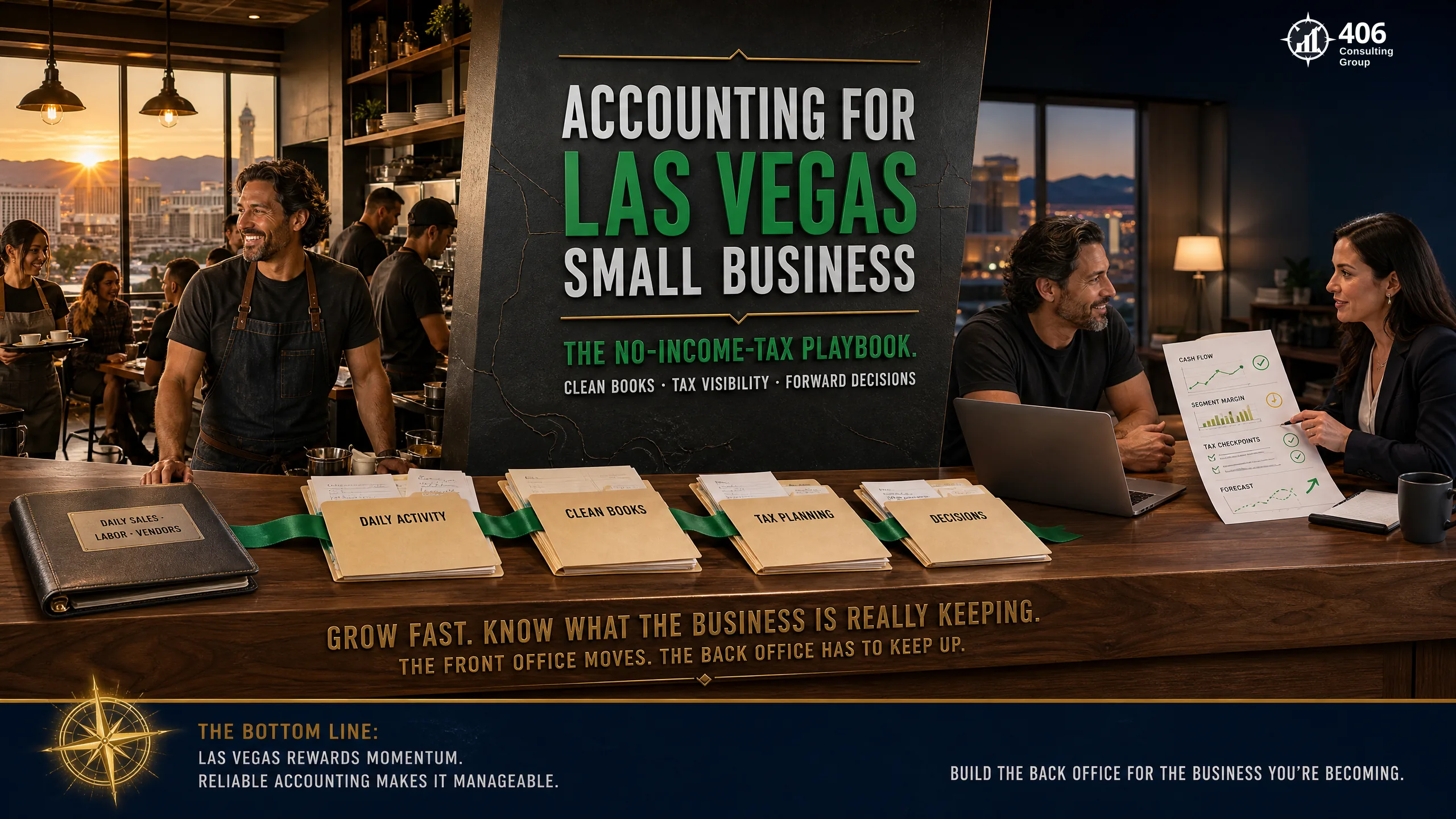
Las Vegas is one of the country's great places to build a company — a no-income-tax state, a booming Southern Nevada economy, and a steady flood of businesses and talent arriving from higher-tax states. It's also a place where the accounting quietly trips owners up — not despite the no-income-tax reputation but because of it. Believing there's no tax to manage, owners skip the pieces Nevada actually runs on: an employer payroll tax, a gross-receipts tax once you're big enough, a steep sales tax, licensing, and — in Las Vegas — hospitality quirks stacked on famously uneven, event-driven cash flow.
This is the overview — the playbook for getting your accounting right in a no-income-tax state, from first clean books to a CFO-level view of a business built to scale through the swings. It ties together our deeper Las Vegas guides on bookkeeping, tax planning, and CFO & controller services — delivered remotely, by a firm that knows Nevada cold.
By Carrie Anderson — Co-Founder, 406 Consulting Group. Commercial banking and multi-state advisory background — she helps Nevada owners build financial systems that keep compliance clean, turn the no-income-tax advantage into real savings, and fund growth.
Quick Answer: Accounting for a Las Vegas Business
- →No state income tax is a real advantage — but Nevada collects through payroll, gross-receipts, sales, and licensing instead.
- →The MBT payroll tax, the Commerce Tax, and hospitality payroll rules are where a generic, out-of-state setup goes wrong.
- →Las Vegas's event-driven cash flow makes forecasting and segment costing matter earlier than in a steady market.
- →Build the stack in order: clean books → federal-first tax planning → controller & CFO as you grow.
- →Delivered remotely across Las Vegas & Southern Nevada — Nevada expertise over office proximity.
Table of Contents
Running a Business in Las Vegas
Southern Nevada's economy is deep and fast-moving. Hospitality, gaming, and entertainment anchor it; construction races to keep up with relentless growth across Henderson and North Las Vegas; logistics, distribution, and data centers have turned the valley into a Western hub; and professional services, tech, and healthcare fill in around them. Add a steady stream of companies relocating from California for the tax environment, and you get tremendous opportunity paired with the reality of operating in a market that grows fast and earns unevenly.
The businesses that thrive here treat accounting as infrastructure: clean books that speak Nevada's tax language, planning that captures what the federal and state codes allow, and a financial view that can steer through seasonal swings instead of getting whipsawed by them. The ones that struggle usually have strong demand and a back office that never scaled — or assumed "no income tax" meant no complexity. This playbook is about being the first kind.
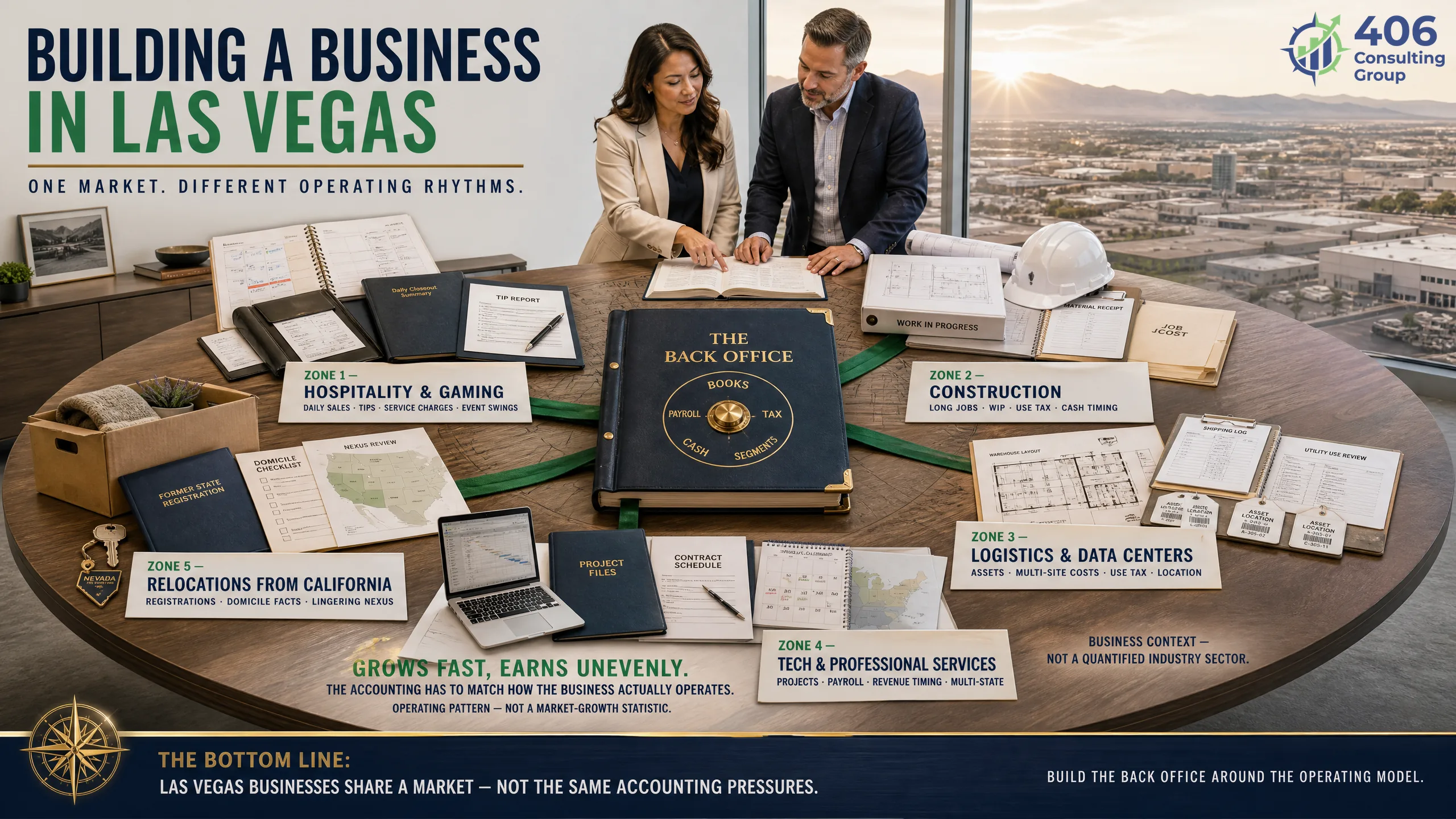
It starts with understanding what makes Nevada different — and that's mostly how it taxes.
The Nevada Tax Reality
Here's the shape of it, because it surprises nearly every owner who moves a business to Nevada expecting "tax-free." There's genuinely no state income tax — personal or corporate. But underneath that headline sit four things that decide your real tax life, and each is where a generic, out-of-state setup goes wrong.
Modified Business Tax
An employer payroll tax on wages above a quarterly threshold — the piece 'no income tax' owners most often miss.
Commerce Tax
A gross-receipts tax that only bites above $4M in Nevada revenue — a milestone to plan for as you scale, not a startup worry.
Sales & licensing
~8.375% sales/use tax in Clark County, plus an annual state business license and local licenses.
Real domicile
The no-income-tax break only fully applies if you're genuinely a Nevada business — an address isn't a move.

Confirm current rates with the Nevada Department of Taxation. The takeaway to internalize is that "no income tax" describes one line on your return — not the whole system.
"No Income Tax" Is Half the Story
The no-income-tax headline is real and valuable — but Nevada collects around it, and the pieces that surround it are exactly what an out-of-state accountant mishandles. A business can celebrate paying no state income tax while quietly bleeding money to a mismanaged MBT, an un-planned relocation that left California nexus behind, or a payroll setup that fumbled tips and service charges. The advantage is real; capturing it takes books and planning built for how Nevada actually works, not a generic template that assumes "no income tax" means "nothing to manage."
Nevada's no-income-tax advantage is one of the best in the country. Whether it actually lands in your bank account depends on the payroll tax, the relocation, and the planning around it — the half of the story nobody puts on a billboard.
Get those right and Nevada genuinely is a favorable place to operate. The other half of the picture is your industry.
Las Vegas's Signature Industries
Two forces define the Las Vegas economy, and each bends a company's finances a different way. Hospitality, gaming, and entertainment is the anchor — a world of tips and service charges, daily sales reconciliation, event-driven revenue, and razor-thin operating margins where knowing your true cost per event or cover is everything. Construction and the trades ride the growth boom on the opposite rhythm: long jobs, job costing and WIP, use tax on materials, prevailing wage on public work, and cash that lags the work by months. Getting either right takes books designed around how the business actually earns, not a generic setup.

Those two anchor the economy, but Southern Nevada's real momentum is its widening base.
Tech, Logistics & Beyond
Beyond hospitality and construction, Southern Nevada's base is widening fast, and the newer arrivals each shift the financial center of gravity. The logistics, distribution, and data-center wave — drawn by cheap land and a central Western location — is asset-heavy and multi-state by nature. The tech and remote-first companies relocating from California bring runway math and cross-border nexus questions that dwarf anything happening inside Nevada. And a thickening layer of professional services, real estate, and healthcarerounds out an economy that's no longer a one-industry town. Each rides the valley's growth on its own terms.
The common thread across every Las Vegas segment: Nevada's tax structure is the same backbone underneath, and the businesses that manage it well are the ones whose books are built for it and whose owners can see their numbers clearly — which is what the accounting stack is for.
The Books-to-Tax-to-CFO Stack
The businesses that get this right build the financial function in the right order, like a stack. First, clean books that handle Nevada's MBT, hospitality payroll, and sales tax correctly — the foundation. Then federal-first tax planning — entity choice, the S-corp decision, a clean domicile if you relocated — layered on once the books are reliable. Then, as you grow, a controller to make the numbers trustworthy and a CFO to forecast through the swings and turn numbers into strategy. Skip a layer and the ones above it wobble; build them in order and each makes the next more valuable.
Build the stack in order
1.Clean books — MBT, hospitality payroll, sales tax, job costing. Las Vegas bookkeeping →
2.Tax planning — entity, federal moves, clean domicile. Las Vegas tax planning →
3.Controller & CFO — reliable numbers, forecasting, strategy. Las Vegas CFO & controller →

One thread runs through the whole stack, and it matters more in a lumpy market: actually seeing where the money is made.
Seeing Profit by Segment
Which events, service lines, locations, or clients are quietly carrying the company — and which are just noise? A company-wide profit number can't tell you; only segment-level reporting can. In an event-driven Las Vegas business with revenue arriving in bursts, seeing true margin by segment is what turns "we had a big month" into "we made money on these jobs and lost it on those." It changes what you chase, what you price up, and what you walk away from.
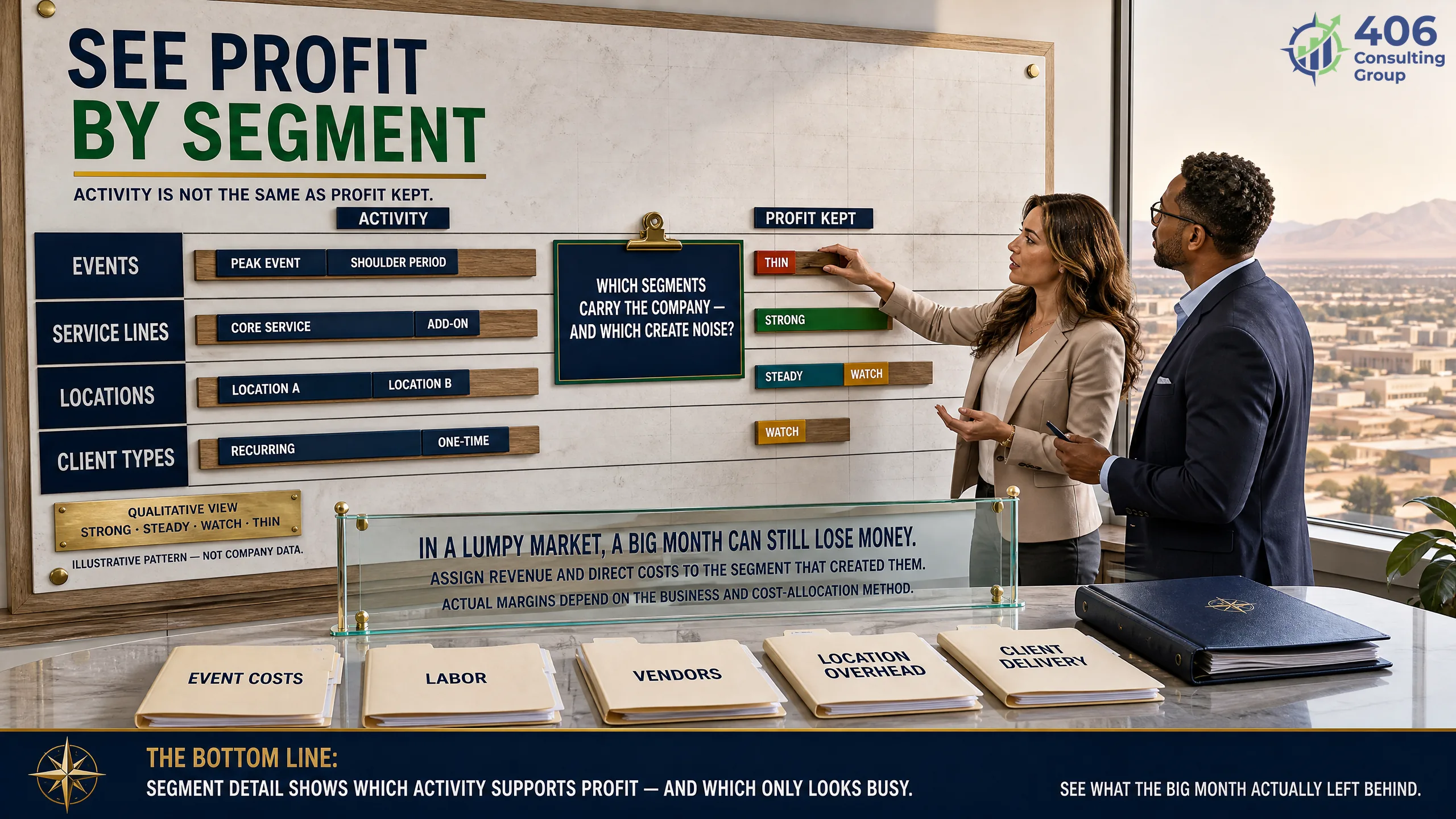
Surfacing that answer is the whole point of our unit-economics work. And once you can see the profit, the next question is funding the growth through the swings.
Financing & Growth in a Boom Town
Growth in a boom town usually means capital — a bank line, an SBA loan, equipment financing, bonding, or investment. Every one depends on financials a lender or investor can read and trust, and a seasonal business has to show it manages the swings rather than gets tossed by them. This is where our background matters most: with commercial-banking experience behind us, we present your numbers — plus a forecast that shows a lender you can weather the quiet months — the way the people who hold the money actually evaluate them. Financials that read clean and prepared are what turn a hesitant lender into a funded deal.

None of this requires an accountant with a Las Vegas office — which is worth addressing directly.
Do You Need a Local Las Vegas Accountant?
What you need is an accountant who knows Nevadaand your industry — the MBT, the Commerce Tax, hospitality payroll, multi-state domicile, and how a hospitality, construction, logistics, or tech business runs — far more than one with a Las Vegas address. A generalist who treats "no income tax" as "nothing to manage" is the real liability, because those are the areas a generic setup gets wrong. Since the work happens over cloud software and screen-shares anyway, the real question isn't where your accountant sits — it's whether they actually know Nevada.
We work with Las Vegas and Southern Nevada businesses entirely remotely — and for the many owners who've just relocated here, our multi-state experience is a real advantage.
How It Fits Together
Put it together and the Las Vegas playbook is simple to state: get clean, Nevada-correct books; layer in federal-first tax planning and a clean domicile; add controller and CFO firepower to forecast through the swings as you grow; and keep your financials lender-ready the whole way. Do that and you get to enjoy the upside of building in a no-income-tax boom town without the payroll-tax, relocation, and cash-flow surprises that catch everyone else.
Build your Las Vegas business on numbers you trust.
Bookkeeping, tax planning, and CFO/controller work — all delivered remotely to Las Vegas and Southern Nevada, built around Nevada's real tax picture and lumpy cash flow. Start with where your business stands today.

Building in the Las Vegas boom? The contractor-specific picture — the state contractor license, prevailing wage, and use tax on materials — is in our Las Vegas construction accounting guide.
FAQ: Las Vegas Small Business Accounting
What makes accounting in Las Vegas different from other cities?
Mostly Nevada's tax structure and Las Vegas's industry mix. There's no state income tax — a genuine advantage — but Nevada collects through the Modified Business Tax on payroll, a Commerce Tax on businesses over $4 million in revenue, one of the region's higher sales-tax rates, and licensing, and Las Vegas adds hospitality payroll rules and famously uneven, event-driven cash flow. So the accounting turns on the payroll tax, a clean relocation if you moved from a high-tax state, and forecasting through the swings — not on a state income tax. 'No income tax' describes one line, not the whole system.
Think of Nevada's business taxes as a few buckets — what are they?
Since there's no income tax, the buckets are different from most states. First, the Modified Business Tax: an employer payroll tax on wages above a quarterly threshold. Second, the Commerce Tax: a gross-receipts tax that only applies above $4 million in Nevada revenue, so most small businesses are below it. Third, sales and use tax around 8.375% in Clark County, plus an annual state business license and local licenses. And you still owe all federal income and self-employment taxes — often the larger bill. Confirm current specifics with the Nevada Department of Taxation.
Do I need a local Las Vegas accountant?
What you need is an accountant who knows Nevada and your industry — the MBT, the Commerce Tax, hospitality payroll, and multi-state domicile for relocating owners — far more than one with a Las Vegas office. A generalist who treats 'no income tax' as 'nothing to manage' is the real liability, since those are the areas a generic setup gets wrong. Modern accounting runs on secure cloud software, bank feeds, and screen-shares, so a great remote partner who knows the state cold serves you better than a nearby generalist — and for the many owners relocating to Nevada, multi-state experience matters more than a local address.
When should a growing Las Vegas business get bookkeeping, tax, or CFO help?
Roughly by stage, built like a stack: get bookkeeping and Nevada's payroll and sales taxes right from the start; layer in federal-first tax planning (entity/S-corp, clean domicile) once you're established; add segment costing and cash-flow forecasting as you grow — which the city's lumpy revenue makes valuable early; and bring in a fractional controller or CFO as the monthly close slips, growth outruns the books, or you seek financing. Our Financial Maturity Assessment helps you place yourself and prioritize the next rung.
Can 406 Consulting Group handle all of this remotely?
Yes — bookkeeping, tax planning, and CFO/controller work, all delivered remotely to Las Vegas and Southern Nevada businesses through secure cloud accounting and regular strategy conversations. What matters for a Nevada business is expertise in the MBT and Commerce Tax, hospitality payroll, multi-state domicile, and forecasting through seasonal swings — not office proximity — and our commercial-banking background means we prepare your financials the way lenders and investors read them. Most of our own local clients never come into an office either.
The Las Vegas Stack
Build it in order
Las Vegas Accounting Help
Remote, Nevada-savvy.
About the Author
Carrie Anderson
Co-Founder, 406 Consulting Group
With a commercial banking and multi-state advisory background, Carrie helps Nevada owners build financial systems that keep compliance clean, turn the no-income-tax advantage into real savings, and fund growth — preparing financials the way lenders and investors read them.
Read the Full Story