
Tax Services in Nashville, TN:
No Income Tax, Real Planning Still Pays
Proactive Tennessee tax planning for Nashville businesses — the entity/F&E decision, managing the 6.5% excise base, sales-tax exemptions, and the federal QBI, depreciation, and retirement moves.

No personal income tax should make Tennessee tax planning simple — and in one way it does: the bracket-and-timing game that businesses in California or New York obsess over just doesn't exist here, and there's no state pass-through election to chase. But that's exactly why the planning that does matter gets skipped. The real levers in Tennessee are the Franchise & Excise tax — where your entity choice and your net-earnings figure directly change what you owe — the sales-tax exemptions Nashville businesses leave unclaimed, and the federalmoves that no-income-tax owners under-use because they assume "Tennessee is easy."
This is the planning companion to our Nashville bookkeeping guide. Where that one covers recording F&E, sales tax, and the business-tax and property filings, this one is about the decisions that lower the bill: the entity-versus-F&E trade-off, managing the excise base, capturing sales-tax exemptions, and the federal depreciation, QBI, and retirement moves that carry almost all the weight in a no-income-tax state. All delivered remotely.
By Carrie Anderson — Co-Founder, 406 Consulting Group. Commercial banking and underwriting background — 300+ loan reviews — plus advisory work with small businesses across the country, where entity strategy, entity-level taxes like Tennessee's F&E, and federal planning are everyday work.
Quick Answer: Tax Planning for a Nashville Business
- →No income tax — so no PTE/SALT workaround to chase; the leverage is on F&E, sales tax, and federal.
- →Entity choice is the big decision: a sole prop pays no F&E; an LLC or S-corp does — weighed against the federal S-corp savings and liability protection.
- →The excise works twice: deductions that lower net earnings cut your federal bill and the 6.5% Tennessee excise.
- →Federal is where the dollars are: QBI, depreciation (§179/bonus), retirement plans, and estimates.
- →Delivered remotely — Tennessee expertise matters far more than a local office.
Table of Contents
Why Nashville Tax Planning Is Different
In a high-income-tax state, planning is mostly about the income tax — brackets, timing, entity elections, SALT-cap workarounds. Tennessee erases that whole layer for individuals, which is genuinely valuable but also lulls owners into thinking there's nothing to plan. There is; it just sits in different places. The Franchise & Excise tax has real decisions baked into it, starting with which entity you operate through. Sales tax carries exemptions most businesses never claim. And with no state income return to fuss over, the federal return becomes the main event — where a Nashville small business has some of the biggest levers available anywhere.
A generic preparer files the F&E return and moves on — leaving the entity decision unexamined, the excise base un-managed, the sales-tax exemptions unclaimed, and federal QBI and depreciation under-planned. In Tennessee, that's where the money hides.
That's what a "Tennessee is easy" mindset costs you. The state income tax isn't there to force the planning conversation, so it never happens — and a profitable Nashville business quietly overpays on the taxes it doesowe. Start with what "no income tax" actually changes about the plan.
No Income Tax Changes the Whole Game
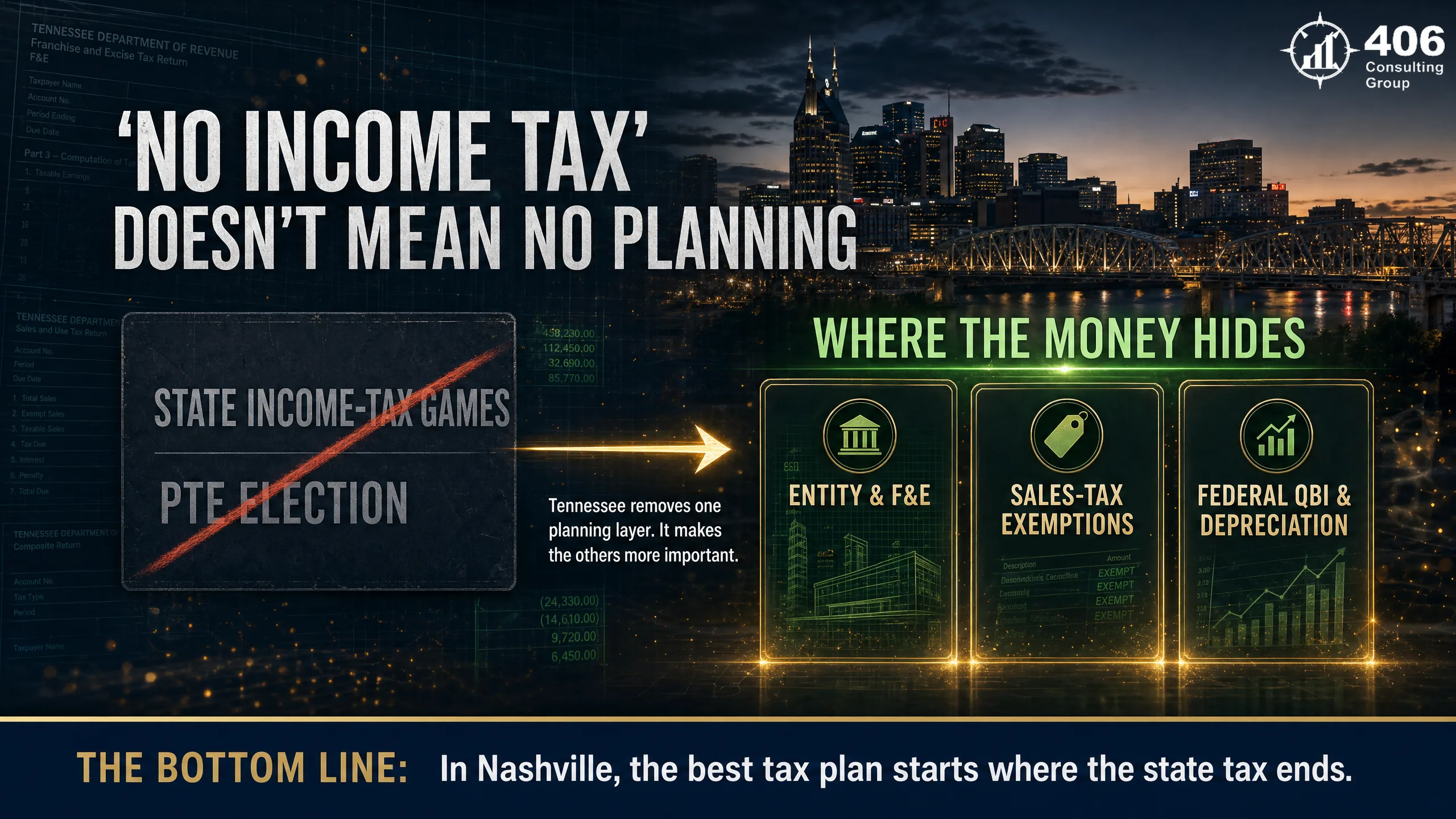
The absence of a personal income tax has real, positive planning consequences beyond the obvious. There's no state pass-through (PTE) election to make, because there's no state personal income tax to work around the federal SALT cap on — a whole exercise businesses in Illinois, Utah, and dozens of other states must run simply doesn't apply. There's no state bracket management, no state timing of personal income, and no personal state return at all.
What that means in practice: your planning energy should shift to the two places Tennessee actually reaches — the Franchise & Excise tax on your entity and sales tax — plus the federalreturn, which for a profitable Tennessee business carries essentially all of the income-tax weight. Owners arriving from income-tax states sometimes keep planning as if the state matters most; in Tennessee, the F&E decisions and the federal side are where the real dollars move.
It's a genuinely lighter picture — but lighter isn't the same as "nothing to do."
The Defining Decision: Entity Choice & F&E
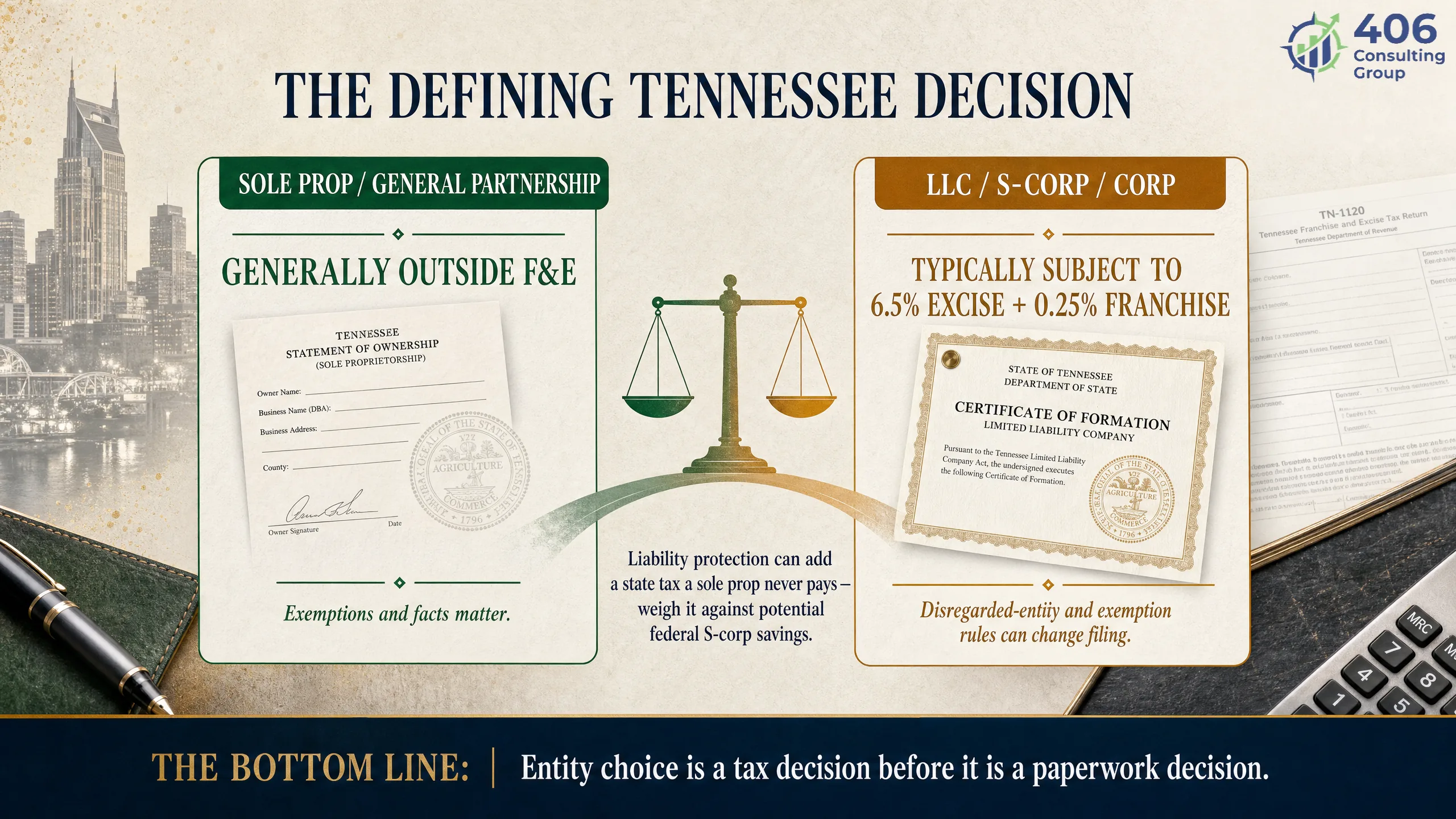
In most states, entity choice is driven by income-tax and liability considerations. In Tennessee it's driven by something more distinctive: whether you're in the Franchise & Excise system at all. Sole proprietorships and general partnerships are generally exempt from F&E. The moment you form an LLC, S-corp, LP, or corporation, the entity owes 6.5% excise on its net earnings plus 0.25% franchise on net worth. So in Tennessee, the liability protection of an LLC comes with a state tax a sole proprietor never pays — a real, quantifiable trade-off rather than a formality.
That doesn't mean stay a sole proprietor — liability exposure is usually the bigger risk, and the classic S-corp move still works here, cutting federal self-employment tax by splitting profit into a reasonable salary and distributions. But that S-corp benefit is entirely federal; Tennessee adds no state-income advantage on top, and it does add the F&E bill. The right answer weighs federal self-employment savings and liability protection against the F&E cost — a calculation a generic S-corp calculator misses because it ignores Tennessee entirely.
Get a first-pass federal read with our S-Corp Calculator, then let's layer the Tennessee F&E reality on top before you decide.
Managing the Excise Base
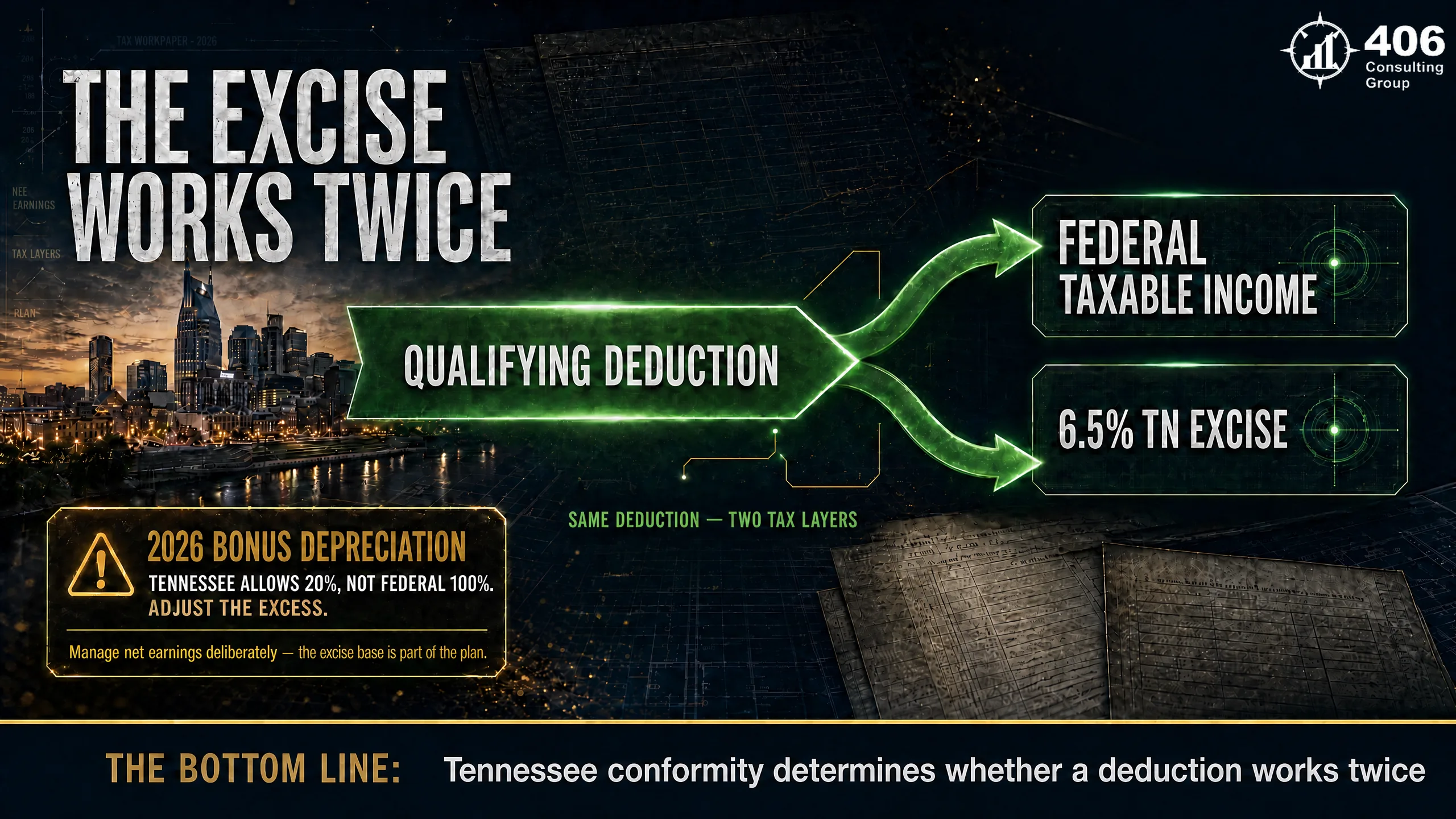
The excise tax is 6.5% of your Tennessee net earnings, which starts from your federal taxable income with state-specific adjustments — and that creates a quiet planning upside most owners miss. Because the excise base tracks federal income, most deductions that lower your federal bill also lower the 6.5% excise. In effect, a legitimate deduction works twice for a Tennessee entity: once federally, once against the excise. That's the closest thing Tennessee has to the "deductions work twice" dynamic of an income-tax state — except it lands on the business, not your personal return.
One important caveat: Tennessee doesn't follow every federal deduction dollar-for-dollar. Notably, it generally requires adding back federal bonus depreciation for excise purposes, so a big bonus write-off cuts your federal bill immediately but is spread over time for Tennessee. Section 179 generally flows through, and ordinary operating deductions do too. The planning move is to manage net earnings deliberately — timing deductible purchases, funding an entity retirement plan, cleaning up what's actually deductible — with the Tennessee add-backs in view, not discovered at filing.
Confirm the current add-backs and conformity rules with the Tennessee Department of Revenue before relying on a specific deduction.
The Franchise Tax & the $100 Floor
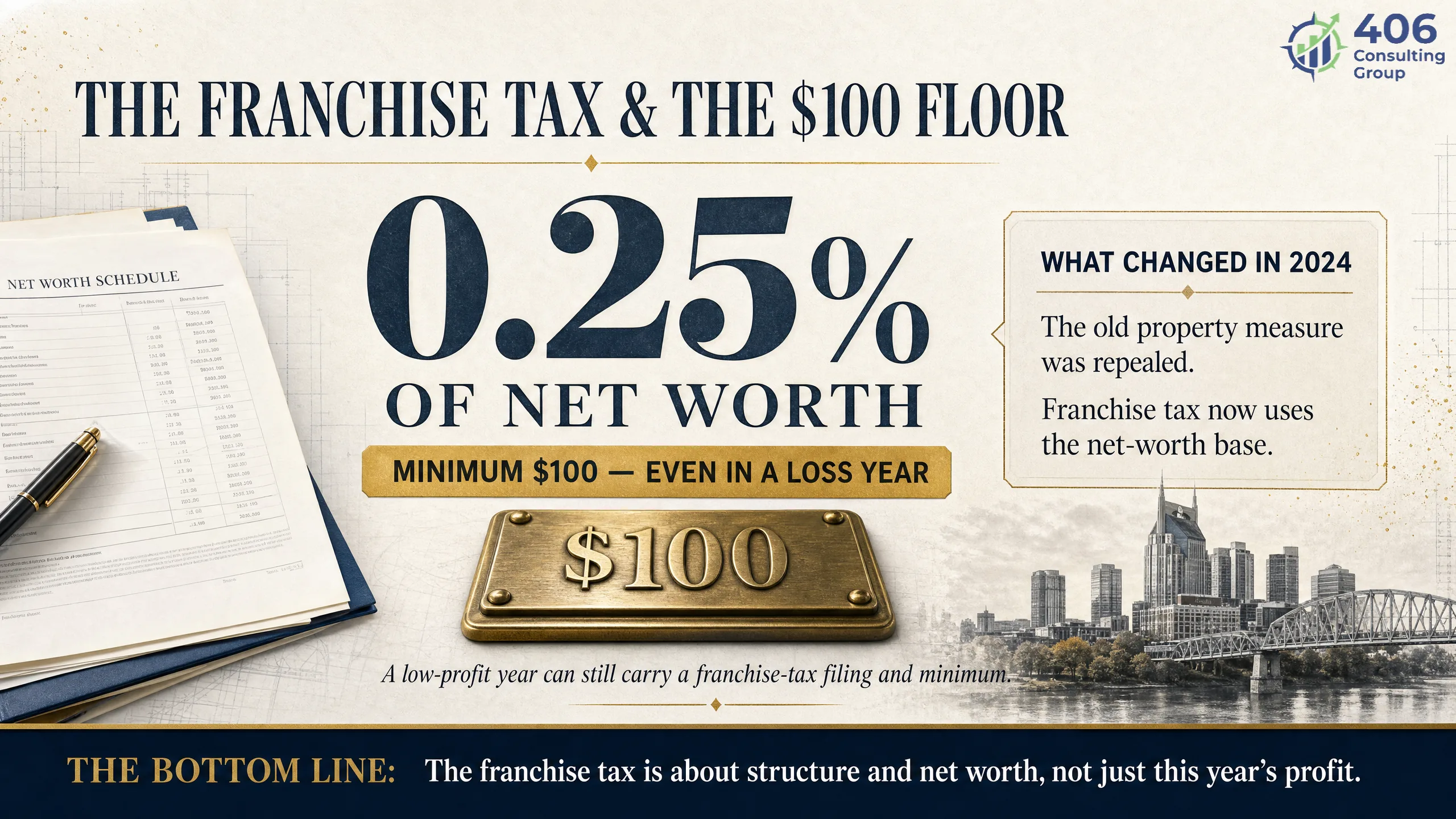
The franchise half of F&E is smaller but has its own quirks worth planning around. It's 0.25% of net worth (broadly, your apportioned equity in Tennessee), with a $100 minimumthat applies even in a lean or loss year — so an F&E entity is never truly at zero. For most small businesses the franchise dollars are modest, but the base is your net worth, so how the balance sheet is structured and how equity accumulates can move it.
Tennessee also reworked the franchise tax recently— 2024 legislation repealed the old alternative property-based measure and moved to a net-worth-only base, with a refund window for prior years. If your business paid franchise tax under the old property measure, there may have been money to recover, and the base you're planning against today is the net-worth one. It's a good example of why "set it and forget it" doesn't work even for the small taxes: the rules move.
Confirm the current franchise base and any refund eligibility with the Tennessee Department of Revenue.
Sales-Tax Exemptions & the Services Trap
At roughly 9.25% in Nashville, sales tax is big enough that getting it right is real money — in both directions. On the savings side, Tennessee offers exemptions worth claiming: an industrial machinery exemption for qualifying manufacturing equipment, resale exemptions where goods pass through rather than being consumed, and others that businesses routinely under-use for lack of the right certificates. Capturing them means keeping valid exemption and resale certificates on file and classifying purchases correctly.
On the exposure side is the services trap: Tennessee taxes a range of services and digital products that owners assume are exempt because they would be elsewhere. For Nashville's software, entertainment, and creative businesses, whether a given offering is taxable can be genuinely nuanced — and guessing wrong means either under-collecting (an audit exposure) or over-charging customers. And use tax is owed on taxable goods you buy without Tennessee tax. Planning here is about deciding the treatment deliberately, up front, rather than at audit.
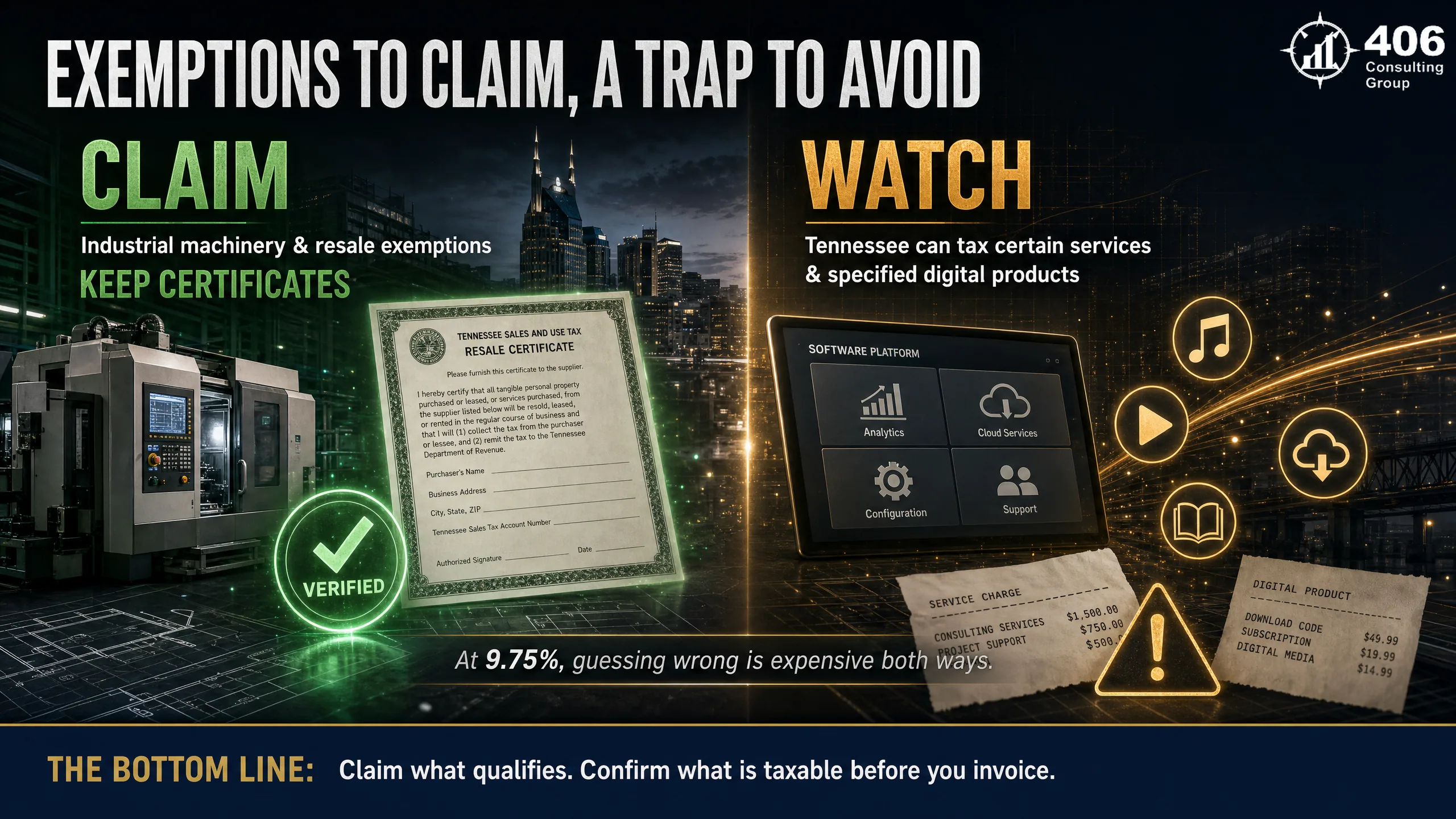
The mechanics of tracking taxable-versus-exempt live in the bookkeeping guide; the decisions that capture the savings and avoid the exposure live here.
Federal Levers: QBI, Depreciation & Retirement
With no state income tax, the federal return carries the load — so the federal levers matter more, not less. The Qualified Business Income (QBI) deduction — up to 20% of qualified pass-through income, subject to thresholds and limits — is one of the biggest for a Nashville small business, and it interacts with your salary, entity choice, and depreciation, so it rewards planning them together. Depreciation (Section 179 and bonus) is the next big one, remembering the Tennessee bonus add-back means the federal and excise timing differ.
Retirement plans are the quietly powerful lever for a profitable owner: a SEP-IRA or Solo 401(k) can shelter tens of thousands, cutting your federal bill now — and an employer plan funded at the entity level also reduces the net earnings the 6.5% excise is based on, so it can work on both fronts. And because profitable owners owe federal quarterly estimates — essentially the whole estimated-tax picture in Tennessee for the individual — those should track real results rather than a stale prior-year number, especially in project- or royalty-driven Nashville businesses where income swings.
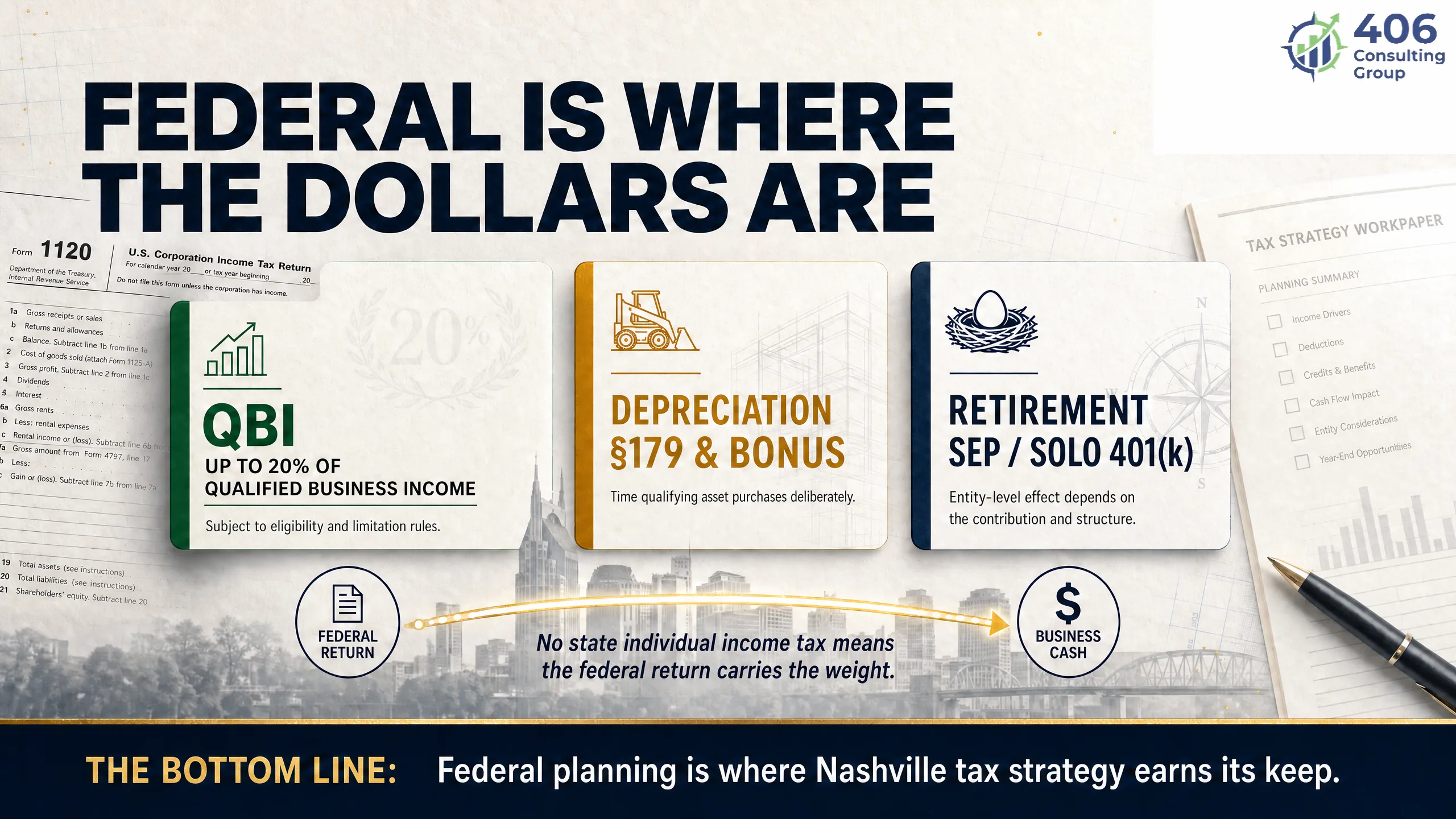
It's the throughline of Tennessee planning: the state is light on the individual, so make the federal moves — and the excise-base moves — count.
The Nashville Tax Calendar
Tennessee swaps personal income-tax dates for its own rhythm — the F&E return and its estimates are the ones that catch newcomers.
| Obligation | Rough cadence |
|---|---|
| Franchise & Excise return | Annually, generally due the 15th day of the 4th month after year-end (verify) |
| F&E estimated payments | Quarterly, once your F&E liability is large enough to require them (verify threshold) |
| Sales & use tax | Monthly, quarterly, or annually per your assigned frequency |
| Business tax | Annually to the Department of Revenue, with a county/city business license |
| Federal income & estimates | Return in spring; quarterly estimates mid-Apr, Jun, Sep, Jan (no state personal return) |
Confirm your specific due dates with the Tennessee Department of Revenue— the F&E return and its quarterly estimates are the two that most often surprise businesses new to Tennessee.
Common Tennessee Tax Mistakes
The costly mistakes here cluster around assuming "no income tax" means "no planning."
Choosing an entity without pricing F&E
Forming an LLC or S-corp for liability protection without accounting for the 6.5% excise and 0.25% franchise it switches on.
Ignoring the excise 'works twice' effect
Not managing net earnings — timing deductions and funding plans — when they cut both federal tax and the 6.5% excise.
Forgetting the bonus-depreciation add-back
Assuming a big federal bonus write-off cuts the excise the same year, when Tennessee spreads it out.
Under-claiming sales-tax exemptions or misreading services
Missing the industrial-machinery or resale exemptions, or guessing wrong on taxable services at 9.25%.
Under-using federal levers
Assuming Tennessee is 'easy' leads owners to under-plan QBI, depreciation, and retirement — where the real dollars are.
Every one is avoidable with planning that starts before year-end — not at the filing deadline.
Local vs. a Great Remote Partner
Tax planning is even less about geography than bookkeeping is. What lowers a Nashville business's bill is expertise — knowing the entity/F&E trade-off, how to manage the excise base, the sales-tax exemptions and services rules, and the federal depreciation, QBI, and retirement interactions — not whether your accountant's office is off Music Row. A remote partner who plans Tennessee taxes beats a nearby generalist who files the F&E return and stops there.
And planning is naturally a remote, year-round conversation: a mid-year check over a screen share, a quick call before you incorporate or make a big purchase, a clean hand-off to filing. We do this with businesses across Nashville and Middle Tennessee the same way we do nationwide — grounded in how your business actually runs, not just the tax code.
The bill is set by the decisions, and the decisions are set by expertise — not by a zip code.
How to Get Started
Getting ahead of your Nashville taxes is three steps.
Get the entity decision right
Weigh the federal S-corp self-employment savings and liability protection against the F&E cost an entity triggers — deliberately, with Tennessee in the math.
Manage the excise base and exemptions
Time deductions and fund plans to lower net earnings (cutting federal and the 6.5% excise), and claim the sales-tax exemptions you're owed.
Make the federal moves count
Plan QBI, depreciation, and retirement, and set federal estimates that track real income — that's where the dollars are.
Want a first read on whether an S-corp election pays off for you? Start with our S-Corp Calculator, then let's pressure-test it against the Tennessee F&E reality together.
FAQ: Nashville Tax Questions
If Tennessee has no income tax, is there anything to plan?
Yes — quite a lot, it just lives in different places than in an income-tax state. The Franchise & Excise tax has real decisions in it, starting with which entity you operate through, and the excise base can be managed because it tracks federal income. Sales tax has exemptions most businesses never claim, and a services trap that catches the unwary. And because there's no state income tax, the federal return carries all the income-tax weight, making federal moves like QBI, depreciation, and retirement more important, not less. 'No income tax' removes one layer; it doesn't remove planning.
How does entity choice affect my Tennessee taxes?
It's the defining Tennessee decision. Sole proprietorships and general partnerships are generally exempt from the Franchise & Excise tax, while LLCs, S-corps, LPs, and corporations owe it — 6.5% excise on net earnings plus 0.25% franchise on net worth. So forming an entity for liability protection also switches on a state tax a sole proprietor never pays. The classic S-corp move (cutting federal self-employment tax via salary and distributions) still works, but it's entirely federal — Tennessee adds no state-income benefit and does add the F&E cost. The right call weighs federal savings and liability protection against F&E, which a generic S-corp calculator ignores.
Do deductions lower my Tennessee taxes if there's no income tax?
For an F&E entity, yes — through the excise tax. The 6.5% excise is based on your Tennessee net earnings, which starts from federal taxable income, so most deductions that lower your federal bill also lower the excise. In that sense a deduction works twice for a Tennessee business — federally and against the excise — though it lands on the entity rather than a personal return. One caveat: Tennessee generally requires adding back federal bonus depreciation for the excise, so that particular deduction's state benefit is spread over time. Confirm current conformity with the Tennessee Department of Revenue.
What sales-tax exemptions can a Nashville business claim?
Tennessee offers several worth capturing, including an industrial machinery exemption for qualifying manufacturing equipment and resale exemptions where goods pass through rather than being consumed. These require valid exemption and resale certificates on file and correct classification. Just as important is the other direction: Tennessee taxes a number of services and digital products that owners assume are exempt, so software, entertainment, and creative businesses should confirm the taxability of their specific offering rather than guess — at roughly 9.25%, a wrong assumption is expensive either way. Confirm specifics with the Tennessee Department of Revenue.
Can 406 Consulting Group handle my Nashville tax planning remotely?
Yes. Tax planning is a year-round, naturally remote conversation — a mid-year review over a screen share, a call before you incorporate or make a big purchase, and a clean hand-off to filing. We work with Nashville and Middle Tennessee businesses the same way we do nationwide. What lowers your bill is Tennessee expertise — the entity/F&E trade-off, managing the excise base, the sales-tax exemptions and services rules, and the federal levers — not whether we share a zip code.
Keep Reading
Tax Planning — Nashville, TN
No Income Tax. Real Planning Still Pays.
406 Consulting Group plans Nashville taxes around what actually moves the number — the entity/F&E decision, managing the excise base, sales-tax exemptions, and the federal QBI, depreciation, and retirement moves — delivered remotely, by a firm that knows Tennessee.
Nashville Tax Quick Reference
Nashville, TN — Davidson County
Overpaying Despite "No Income Tax"?
Entity, the excise base & federal moves.
About the Author
Carrie Anderson
Co-Founder, 406 Consulting Group
Commercial banking and underwriting background — 300+ loan reviews — plus advisory work with small businesses across the country. Carrie helps Nashville owners get the entity/F&E decision right, manage the excise base, and make the federal moves that matter most in a no-income-tax state.
Read the Full Story