
Bookkeeping Services in Nashville, TN:
No Income Tax, Still Plenty to Get Right
Tennessee has no personal income tax — but the Franchise & Excise tax hits your entity, Nashville sales tax runs ~9.25%, and services get taxed. The bookkeeping a Nashville business really needs.

"Tennessee has no income tax" is the line every Nashville founder leads with — and it's true for your personal return. It's also where a lot of owners stop thinking about state tax, which is exactly the trap. Tennessee doesn't skip taxing business; it just does it somewhere you're not looking. The Franchise & Excise tax lands squarely on your entity, the sales tax is one of the highest in the country and reaches services most owners assume are exempt, and there's a separate business tax and license on top. For a Music City company, "no income tax" can quietly come with a bigger state-tax bill than you'd expect.
Clean books in Nashville mean getting the Franchise & Excise tax right, handling a ~9.25% sales tax and its taxable-services wrinkles correctly, and keeping the business-tax and personal-property filings current — on top of the job costing or revenue tracking your particular industry lives on. This guide walks all of it, delivered remotely, so "no income tax" becomes a real advantage instead of a false sense of security.
By Jason Anderson — Co-Founder, 406 Consulting Group. Big-firm-trained accountant building financial infrastructure for small businesses across the country, where entity-level taxes like Tennessee's F&E, high sales-tax compliance, and clean job costing are everyday work.
Quick Answer: Bookkeeping for a Nashville Business
- →No personal income tax — but Tennessee taxes your business through the Franchise & Excise tax, sales tax, and a business tax.
- →Franchise & Excise: 6.5% excise on net earnings + 0.25% franchise on net worth (min $100) — at the entity level; sole props & general partnerships are exempt.
- →Sales tax ~9.25% in Nashville — among the nation's highest — and Tennessee taxes some services people assume are exempt.
- →Payroll is lighter (no state withholding) but workers' comp is generally required here, unlike some no-income-tax states.
- →Delivered remotely — even most of our local clients never come into the office.
Table of Contents
Why Nashville Bookkeeping Is Different
The no-income-tax headline hides how Tennessee actually collects. There's no personal income tax — the old Hall tax on investment income is gone too — so your personalreturn is genuinely simpler. But the state funds itself through business and consumption taxes instead: the Franchise & Excise tax on your entity's earnings and net worth, one of the highest sales-tax rates in the country with a real reach into services, a separate gross-receipts business tax with its own license, and a county tax on the tangible property your business owns. Treat "no income tax" as "no state tax" and those turn into surprise bills and penalties.
The moment you form an LLC or a corporation in Tennessee, the Franchise & Excise tax switches on. A sole proprietor never sees it — which makes entity choice a real, dollars-and-cents decision here.
Nashville stacks its own economy on top: a healthcare-management industry that anchors the region, the music and entertainment business, a fast-growing tech and startup scene, tourism and hospitality, logistics, and the construction racing to keep up with all of it. Each asks something specific of the books — from revenue recognition and royalties to job costing — so bookkeeping built for a Nashville business has to speak Tennessee tax and Music City industry at once.
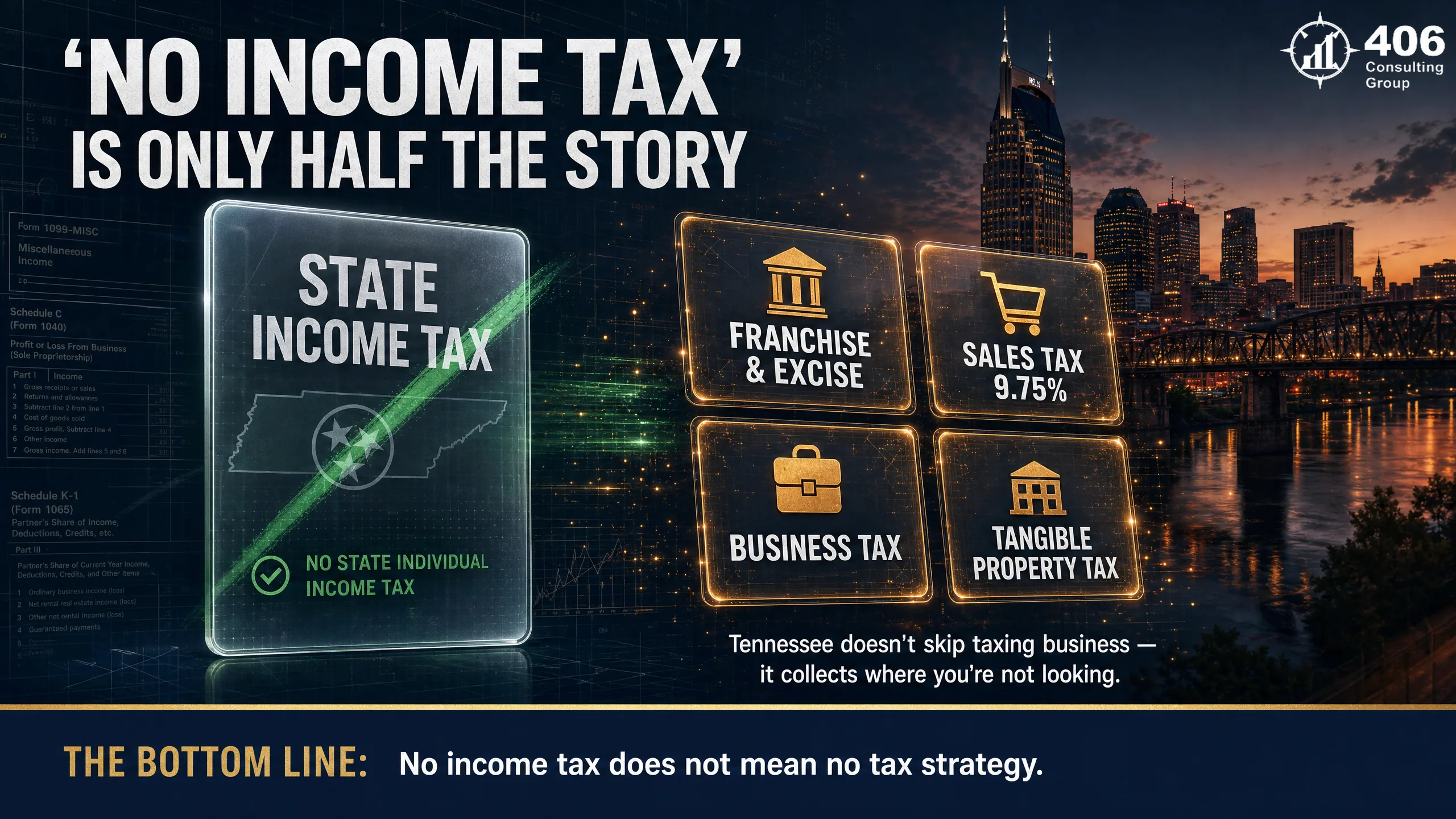
Start with the tax backdrop — because it's not what the "no income tax" line suggests.
The Tennessee Tax Backdrop
Tennessee trades a personal income tax for a heavier mix on business and consumption. Here's the picture for a Nashville business:
| Tax | Tennessee reality |
|---|---|
| Personal income tax | None — no tax on wages, and the Hall tax on investment income is repealed |
| Excise tax | 6.5% of net earnings (income) from business in Tennessee — at the entity level |
| Franchise tax | 0.25% of net worth, minimum $100 — paid alongside the excise tax |
| Sales & use tax | State 7% + local (~2.25% in Davidson) ≈ 9.25% in Nashville; some services taxed |
| Business tax + property | A separate gross-receipts business tax with a license, plus county tangible-property tax |
| Payroll / workers' comp | No state income-tax withholding; workers' comp generally required (5+ employees; any in construction) |
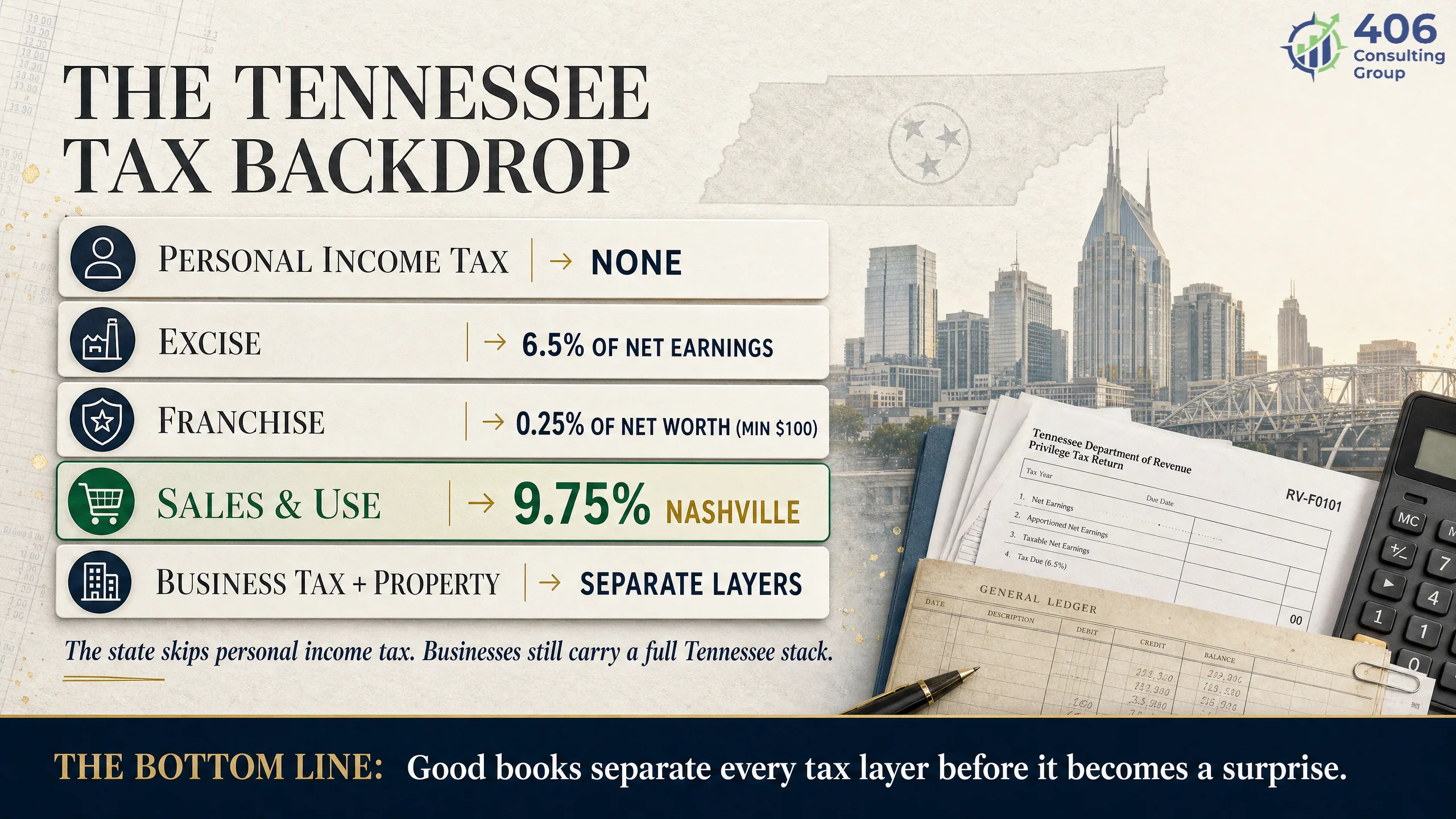
Verify current rates, thresholds, and rules with the Tennessee Department of Revenue and your county assessor. We cover planning in the Nashville tax guide.
The Franchise & Excise Tax
Tennessee's real business tax is the Franchise & Excise (F&E) tax, and it's two taxes filed together. The excise tax is 6.5% of your net earnings — essentially your Tennessee business income — which functions a lot like a corporate income tax under a different name. The franchise tax is 0.25% of net worth(with a $100 minimum), a small levy on the capital base that most businesses pay regardless of a lean year. Together they're the reason "no income tax" is only half the story for anyone operating through an entity.
The piece that catches owners: who pays. Sole proprietors and general partnerships are generally exemptfrom F&E — but the moment you form an LLC, an S-corp, an LP, or a corporation, the entity owes it. That makes entity choice a genuine trade-off in Tennessee rather than a formality: the liability protection of an LLC comes with an F&E bill a sole prop avoids. Clean books make the excise calculation (your net earnings) and the franchise base (your net worth) straightforward to compute and defend, and the filing a non-event.
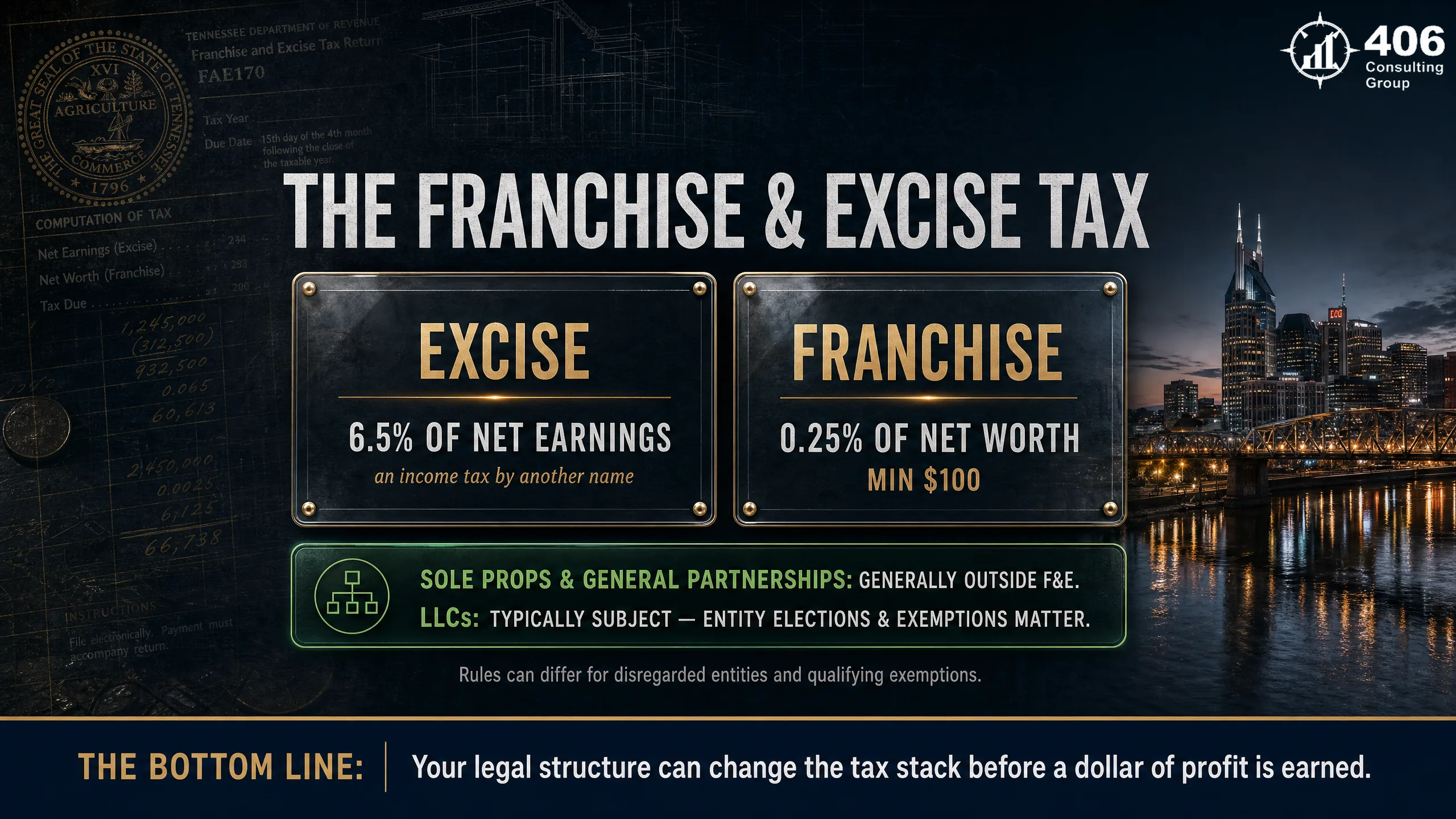
The "no income tax so I'm fine" trap
The excise tax is an income tax on your business in all but name, and it applies the moment you operate through an entity. Transplants from a truly no-tax state are the ones it surprises most. Confirm current F&E rules and any exemptions with the Tennessee Department of Revenue before you assume you owe nothing.
The High Sales Tax & Taxable Services
Tennessee leans hard on sales tax, and the rate shows it: 7% at the state level — one of the highest state rates in the country — plus local option tax that brings Nashville/Davidson County to roughly 9.25%. On taxable sales, that near-tenth of every dollar was never your money; it's collected for the state and remitted, and at 9.25% it adds up on the books fast.
What trips people up is what's taxable. Tennessee taxes a number of services and digital products that owners assume are exempt because they would be in other states — and for Nashville's software, entertainment, and creative businesses, the taxability of a given offering can be genuinely nuanced. On the other side, use tax is owed on taxable goods you buy without Tennessee tax, commonly online or out of state. Clean books track taxable versus exempt sales carefully, keep resale and exemption certificates on file, and flag use-tax situations so nothing sneaks up on you.
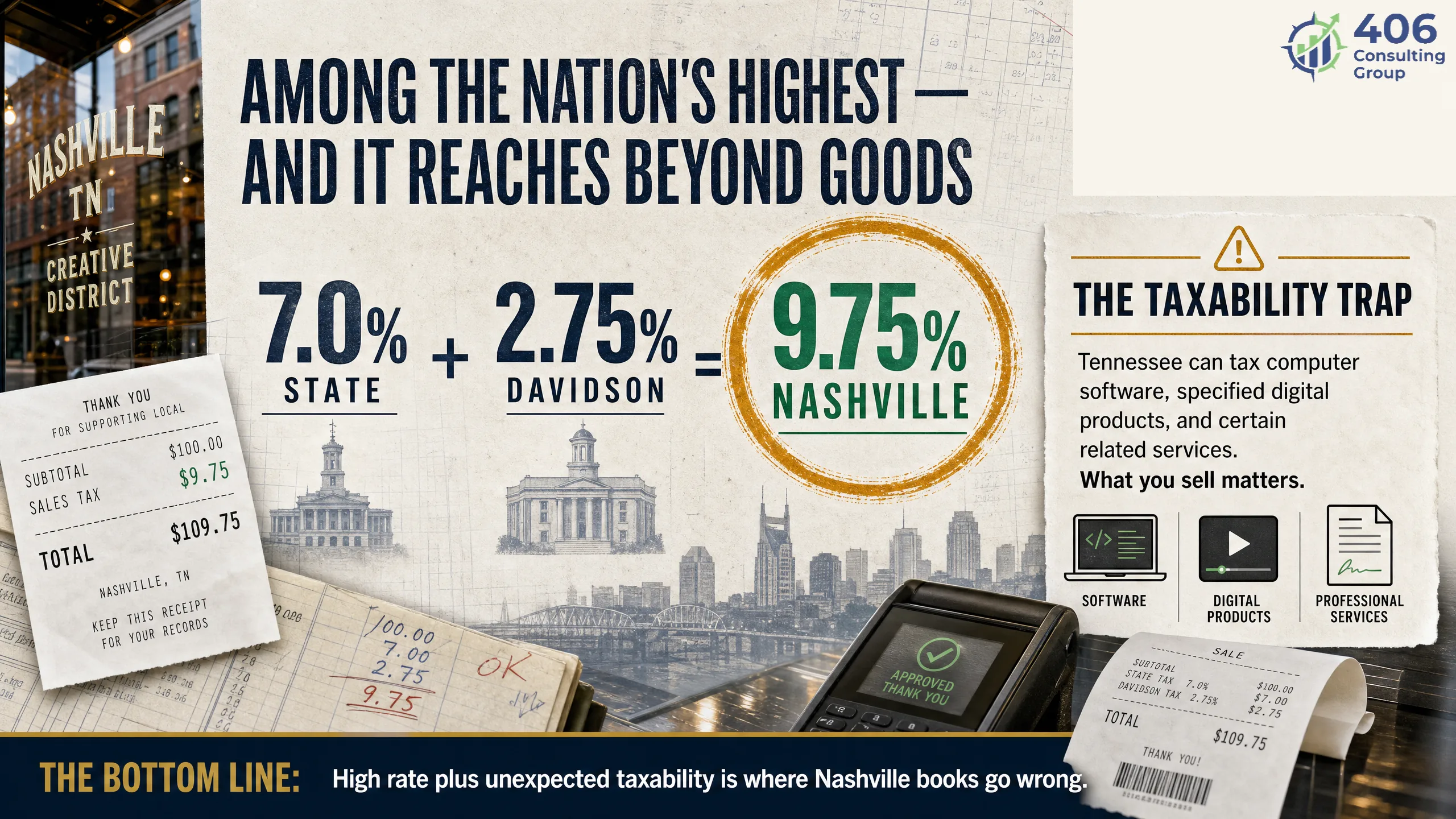
The trap: spending sales tax you collected
At ~9.25%, the sales tax sitting in your account is real money — and it belongs to the state, not you. Treating it as cash flow is one of the fastest ways to dig a hole. Clean books keep it visible as a liability. Confirm what's taxable for your specific offering with the Tennessee Department of Revenue.
The Other Layers: Business Tax & Property
Two more layers round out the picture, and both are easy to overlook. Tennessee's business tax is a separate gross-receipts tax — distinct from F&E — that most businesses over a receipts threshold owe, along with a business licenseregistered with the county and city. Rates are low and vary by classification (retail, wholesale, services), but it's a real filing with its own calendar, and it catches owners who thought F&E was the whole story.
Then there's the county tangible personal property tax: the equipment, furniture, and fixtures your business owns are assessed annually, and you generally file a personal-property schedule with the county assessor. It's modest for a laptop-and-desk service firm and meaningful for an equipment-heavy shop or a restaurant with a full kitchen. A clean, current fixed-asset schedule is exactly what that filing needs — and what keeps you from paying on gear you've long since retired.
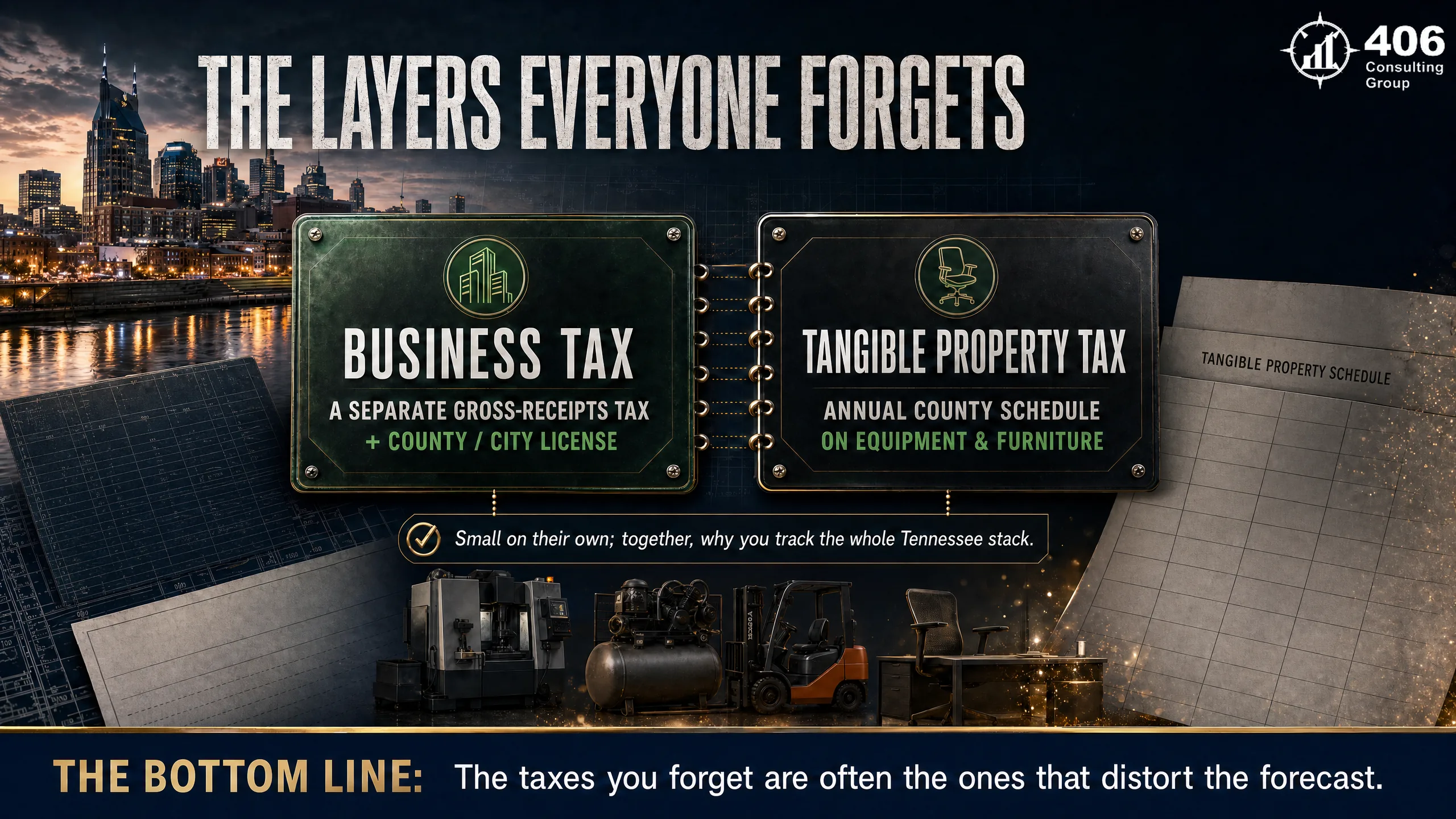
None of these are large on their own; together they're why a Nashville business needs books that track the whole Tennessee stack, not just the one tax everyone talks about.
Nashville Industry Bookkeeping
Nashville isn't a one-industry town, and its signature sectors each bend the books their own way. Healthcare and healthcare management — the region's anchor — run on insurance receivables, multi-entity structures, and payroll-heavy costs. The music and entertainment business brings royalties, project-based income, 1099-heavy rosters, and revenue that arrives in irregular bursts. Tech and startups need revenue recognition, multi-state sales tax on software, and burn-and-runway visibility. And hospitality and tourism live on daily sales reconciliation, tip handling, and that steep sales tax.
Each of those shapes the chart of accounts and the monthly close differently, and each has its own Tennessee-tax quirk — a taxable-services question for tech, sales-tax handling for hospitality, entity structure for a multi-location healthcare group. Because our background is in running whole businesses, we set the books up around how the company actually operates, not a generic template forced onto an industry it doesn't fit.

Want to know which projects, clients, or locations actually make money? That's the heart of our unit-economics work — and segment-level reporting is how a Nashville business sees it.
Tennessee Payroll (No Withholding, Comp Required)
Here's where Tennessee genuinely lightens the load: no state income tax means no state income-tax withholding, so payroll is simpler than in an income-tax state. You still handle federal payroll taxes and Tennessee unemployment insurance (employer-paid), but there's one fewer moving part on every check.
One important difference from some other no-income-tax states: workers' compensation is generally required in Tennessee. Most employers with five or more employees must carry it, and in construction any employer with employeesmust — so a Nashville contractor doesn't get the "optional comp" treatment a Texas one might. Class codes and coverage matter for field-heavy businesses, so it's worth handling deliberately rather than assuming you're exempt.
Handled properly, Tennessee payroll is low-friction — which is what our payroll work keeps it.
A Chart of Accounts Built for Tennessee
Your chart of accounts is the skeleton of your books, and a Tennessee one needs structure a generic template lacks. It has to make net earnings easy to read (because that drives the excise tax) and net worth easy to pull (because that drives the franchise tax), keep sales tax collected as a liability with taxable-versus-exempt tracking, maintain a fixed-asset schedule for the personal-property filing, and separate revenue cleanly for the business-tax classification.
Built right, that structure turns the F&E return, the sales-tax filing, the business-tax report, and the property schedule into near-mechanical exercises pulled straight from numbers you already track. Built as a generic out-of-state template, it blends together exactly the figures Tennessee needs separated — and every filing becomes a reconstruction project. Getting the structure right once is what makes every filing afterward fast and defensible.
It's the kind of setup work that pays off every month after — and it's the first thing we fix when we take on a Tennessee business whose books grew up without it.
Bookkeeping by Nashville Segment
Nashville's economy is broad, and each corner asks something different of the books.
| Segment | What the books need to track |
|---|---|
| Healthcare & practices | Insurance receivables, multi-entity structures, payroll-heavy costs, F&E net earnings |
| Music & entertainment | Royalties, project income, heavy 1099s, irregular revenue timing, taxable-services questions |
| Tech & startups | Revenue recognition, multi-state sales tax on software, burn & runway, F&E on the entity |
| Hospitality & tourism | Daily sales reconciliation, ~9.25% sales tax, tips, inventory, seasonality |
| Construction & trades | Job costing, use tax on materials, required workers' comp, equipment on the property schedule |
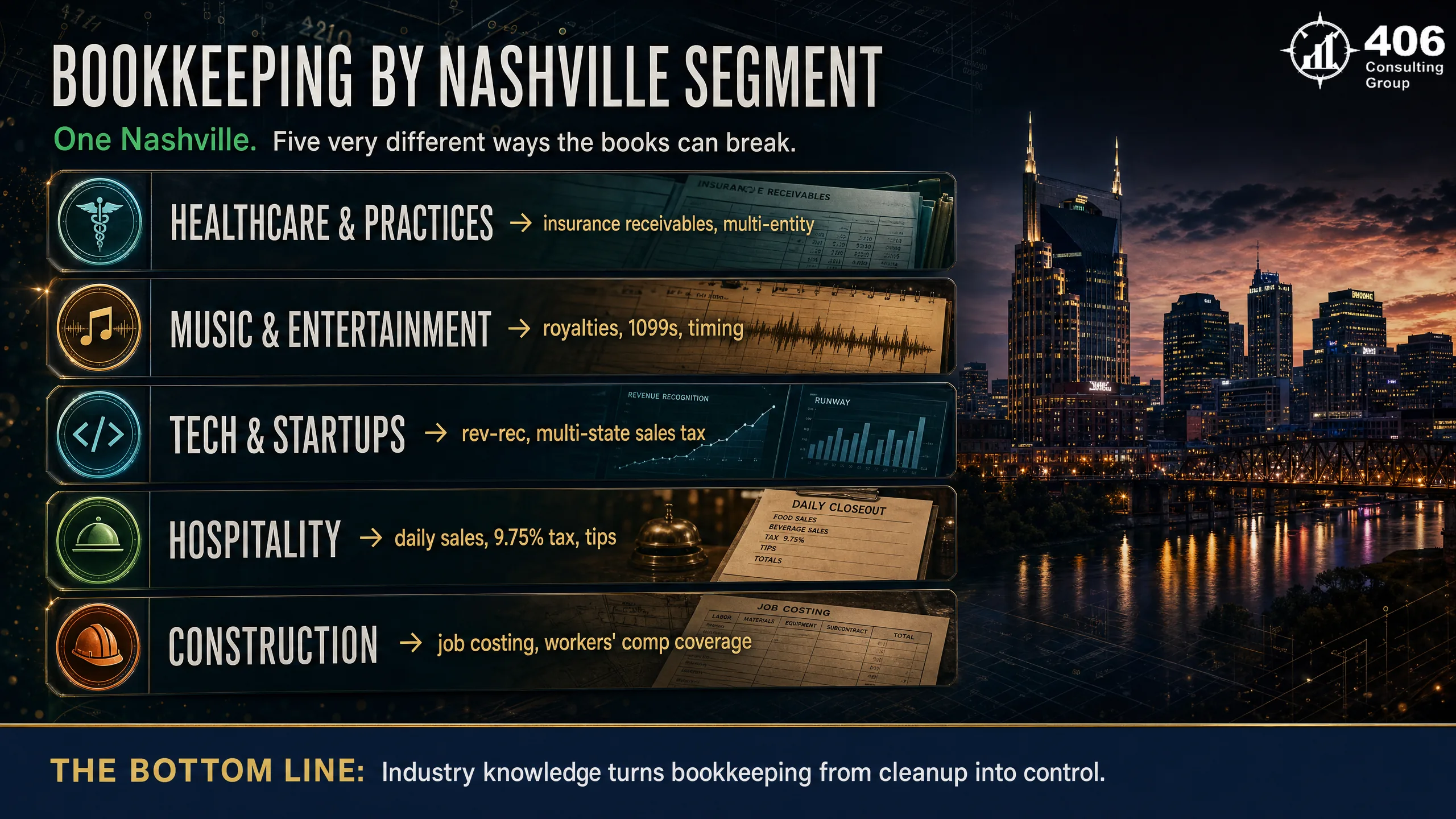
Different details, same backbone: net earnings and net worth readable for F&E, sales tax classified right, property tracked for the schedule, payroll handled, and profit clear.
Common Tennessee Bookkeeping Mistakes
A handful of avoidable mistakes cause most of the trouble for Nashville businesses. Here's what we see most.
Assuming 'no income tax' means no tax work
F&E, sales tax, the business tax, and property tax all still apply — ignoring them invites penalties.
Forgetting F&E after forming an LLC
Owners who ran as a sole prop don't realize incorporating switched on the 6.5% excise and 0.25% franchise tax.
Mishandling taxable services
Assuming a service or digital product is exempt because it would be elsewhere — at 9.25%, that's a costly guess.
Spending collected sales tax
At ~9.25% it's real money and it's the state's — treating it as cash flow leaves you short at filing.
Missing the business tax or property schedule
The gross-receipts business tax, its license, and the county property filing each have their own deadlines.
Every one is a setup-and-habit problem — and every one disappears once the books are built for Tennessee and maintained on a monthly rhythm.
Local vs. a Great Remote Partner
For a Nashville business, what matters in a bookkeeper isn't whether their office is off Broadway — it's whether they understand Tennessee tax and Nashville industry: the Franchise & Excise tax, the taxable-services rules, the business tax and property filings, and how a healthcare, music, tech, or hospitality company actually runs. A bookkeeper who doesn't know Tennessee is a real liability, because those are exactly the things a generic setup gets wrong.
And remote is how modern bookkeeping already works — even for clients across town. The large majority of our own local clients never set foot in our office; everything runs on secure cloud accounting, connected bank feeds, and a steady monthly rhythm. So whether you're in Nashville, out in Williamson County, or anywhere across Middle Tennessee, you get the same responsive, Tennessee-savvy service. What we bring is knowing Tennessee tax cold — which matters far more than a zip code.
Distance isn't the variable. Knowing Tennessee is.
How to Get Started
Getting your Nashville books in order is three steps.
Set up for Tennessee correctly
Build a chart of accounts that keeps net earnings and net worth readable for F&E, sales tax as a liability with taxable-vs-exempt tracking, and a fixed-asset schedule for the property filing.
Get the filings and payroll right
Map the F&E, sales-tax, business-tax, and property calendars, and set up Tennessee payroll (no state withholding) with workers' comp handled deliberately.
Run it monthly
Monthly reconciliation, sales-tax filing, and clean financials — so compliance is routine and you have numbers you can run the business on.
Not sure whether you need bookkeeping, tax help, or something more? Our Financial Maturity Assessment maps it out in about eight minutes.
FAQ: Nashville Bookkeeping Questions
Does Tennessee really have no business tax?
Tennessee has no personal income tax — including no tax on wages or, since the Hall tax was repealed, on investment income. But it very much taxes business. The Franchise & Excise (F&E) tax applies to most entities: 6.5% excise on net earnings plus 0.25% franchise on net worth (minimum $100). There's also a separate gross-receipts business tax with a license, sales tax around 9.25% in Nashville, and a county tangible-personal-property tax. So 'no income tax' is true for your personal return, but it doesn't mean no state tax or no filings for your business.
Who has to pay the Franchise & Excise tax?
Generally any entity that provides liability protection or is taxed as a corporation or partnership — LLCs, S-corps, C-corps, and LPs — owes Tennessee F&E on business done in the state. Sole proprietorships and general partnerships are generally exempt. That makes entity choice a real financial decision in Tennessee: forming an LLC for liability protection also switches on the 6.5% excise and 0.25% franchise tax that a sole proprietor never pays. Confirm your entity's specific obligations with the Tennessee Department of Revenue.
What taxes does a Nashville, Tennessee business deal with?
No personal income tax, but the Franchise & Excise tax on your entity (6.5% of net earnings + 0.25% of net worth), sales and use tax around 9.25% in Nashville with a real reach into services and digital products, a separate gross-receipts business tax with a license, and a county tangible-personal-property tax on equipment and furniture. Payroll is lighter because there's no state income-tax withholding, though you still handle federal payroll taxes and Tennessee unemployment — and workers' comp is generally required (5+ employees, or any employee in construction). Confirm specifics with the Tennessee Department of Revenue and your county.
Are services taxable in Tennessee?
Some are — and that's a common trap. Tennessee taxes a number of services and digital products that are exempt in many other states, so an owner who assumes their offering is non-taxable can under-collect and build an audit exposure, especially in Nashville's software, entertainment, and creative sectors where taxability can be nuanced. The safe approach is to confirm the treatment of your specific service or product with the Tennessee Department of Revenue and set the books up to track taxable versus exempt sales from the start.
Can 406 Consulting Group do my Nashville bookkeeping remotely?
Yes. We work with Nashville and Middle Tennessee businesses through secure cloud accounting — connected bank feeds, shared screens, and a steady monthly rhythm. What matters for a Tennessee business is expertise in the Franchise & Excise tax, the sales-tax and taxable-services rules, the business-tax and property filings, and your industry — not office proximity. The large majority of our own local clients never come into the office either, so you get the same responsive, Tennessee-savvy service whether you're in Nashville or anywhere across the metro.
Keep Reading
Bookkeeping — Nashville, TN
No Income Tax. Still Plenty to Get Right.
406 Consulting Group keeps Nashville businesses clean and compliant — the Franchise & Excise tax, the ~9.25% sales tax and taxable-services rules, the business-tax and property filings, and reliable financials — delivered remotely, by a firm that knows Tennessee.
Nashville Bookkeeping Quick Reference
Nashville, TN — Davidson County
F&E & Sales Tax Got You Guessing?
Tennessee tax, services & filings, handled.
About the Author
Jason Anderson
Co-Founder, 406 Consulting Group
Big-firm-trained accountant building financial infrastructure for small businesses across the country. Jason helps Nashville owners get the Franchise & Excise tax right, handle the high sales tax and taxable-services rules, and keep clean books that fit how their industry really runs.
Read the Full Story