
Trades & Construction Accounting in Bend, OR:
Build the Boom on Books You Can Trust
No Oregon sales tax means one headache other states pile on contractors simply doesn't exist — but the CAT, CCB licensing, prevailing wage, and a high income tax do. The accounting a Bend contractor really needs.
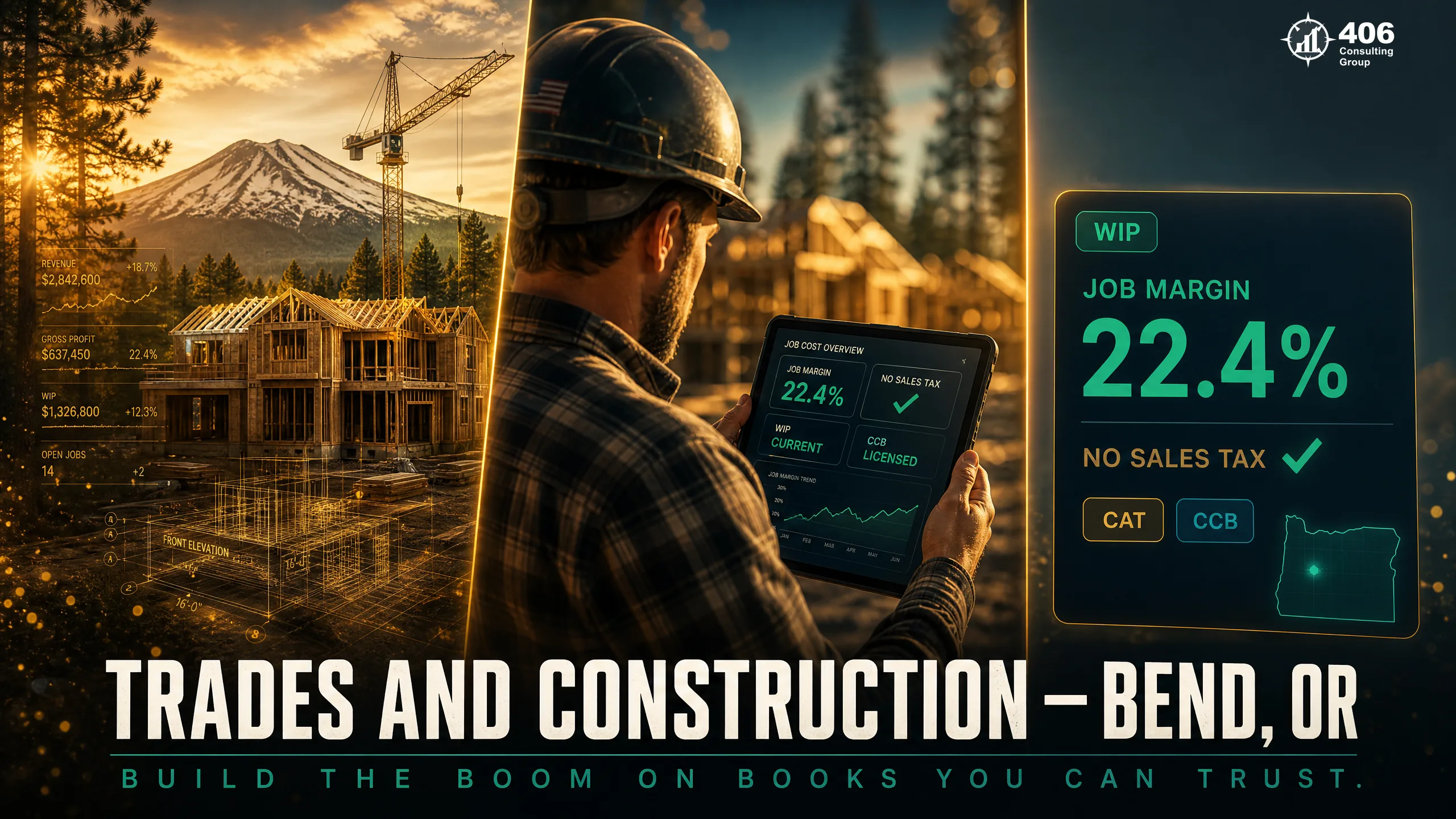
Bend has boomed, and the building has boomed with it — custom homes on the west side, resort and short-term-rental construction, remodels for the wave of new arrivals, and the framers, electricians, plumbers, HVAC techs, concrete crews, and general contractors keeping pace. For a Central Oregon contractor the demand is there. What makes the accounting distinctive isn't a heavy sales-tax regime — Oregon famously has none — it's a different mix of rules most builders never get walked through: the Corporate Activity Tax, CCB licensing and bonding, Oregon's own prevailing-wage law, and a high state income tax on whatever profit the business throws off.
The headline surprise cuts the other way from most states: with no Oregon sales tax, you're not collecting or remitting tax on materials at all — a real simplification — but that doesn't mean tax-free, because buying materials or equipment across the border in Washington can pull in that state's tax, the CAT applies once you're past a revenue threshold, and Oregon's income tax is among the highest in the country. Add job costing, WIP, retainage, certified payroll, and equipment, and clean books here are their own discipline. This guide covers all of it, delivered remotely.
By Carrie Anderson — Co-Founder, 406 Consulting Group. Commercial banking and underwriting background — 300+ loan reviews — serving contractors and trades across the Mountain West, from job costing and WIP to the state-specific rules that decide whether a bid actually holds its margin.
Quick Answer: Accounting for a Bend Contractor
- →No Oregon sales tax — you don't collect tax on materials, a genuine simplification versus most states (but out-of-state purchases can still be taxed).
- →The Corporate Activity Tax (CAT) is a gross-receipts-style tax that kicks in past a revenue threshold — it can catch a growing contractor off guard.
- →CCB licensing & a surety bond are required to contract in Oregon — a real state licensing regime.
- →Oregon prevailing wage (BOLI) and a high state income tax shape payroll and planning; job costing & WIP protect your margin.
- →Delivered remotely — the norm for a contractor whose office is the truck.
Table of Contents
Why Construction Accounting Is Its Own Discipline
A contractor's books behave unlike any ordinary business. Money shows up as progress draws across jobs that run for months; costs spread across labor, materials, subs, and equipment that each have to be pinned to the right project; you bill partway through and the owner holds retainage; change orders keep moving the finish line; and one badly estimated job can swallow the profit from several good ones. Standard bookkeeping — sort the bank feed, reconcile at tax time — can't answer what a builder actually needs to know: is this job hitting its estimate, and is the company as a whole ahead or just busy?
In Oregon that discipline meets a distinctive set of rules. There's no sales tax to administer, which removes a headache other states pile on contractors — but the Corporate Activity Tax, CCB licensing and bonding, a real state prevailing-wage law, and a high income tax all run through your books instead. For a Bend contractor riding one of the West's hottest building markets, getting these right is the difference between growth that builds real equity and growth that just moves cash around.
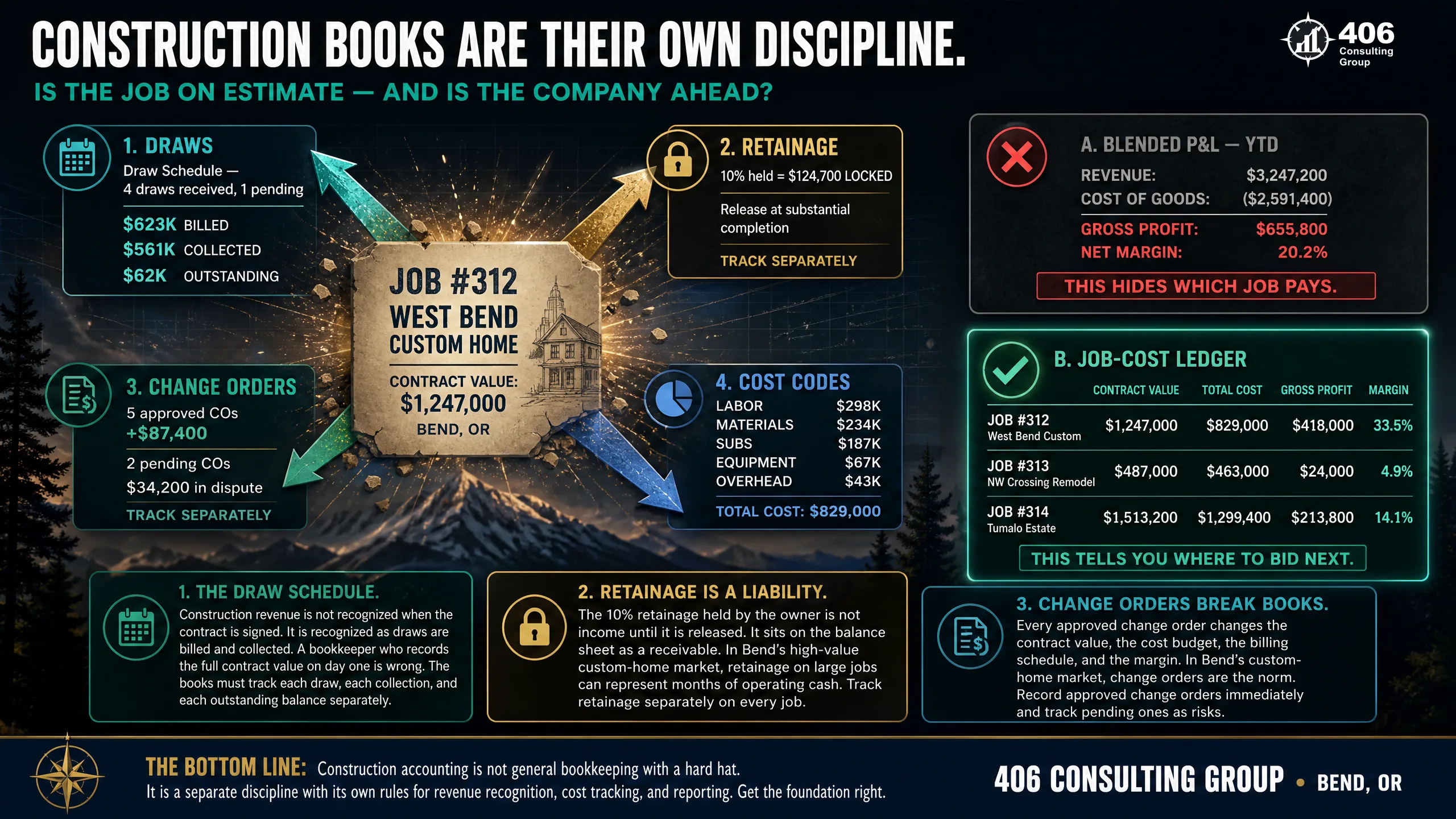
Start with the Oregon-specific picture — it looks nothing like a sales-tax state's.
The Oregon Contractor Tax & Licensing Picture
Oregon flips the usual script — nothing on sales, plenty everywhere else. Here's the frame for a contractor:
| Item | What it means for a contractor |
|---|---|
| Sales & use tax | None in Oregon — you don't collect tax on materials (but out-of-state purchases can be taxed) |
| State income tax | Among the nation's highest (up to ~9.9%, verify) — it lands on pass-through profit |
| Corporate Activity Tax (CAT) | A gross-receipts-style tax above a revenue threshold (~$1M) — catches growing contractors |
| CCB licensing | Construction Contractors Board license, bond & insurance generally required to contract |
| Prevailing wage | Oregon's own BOLI prevailing-wage law on public works, plus federal Davis-Bacon |
| Equipment | Business personal property is assessed by the county — track it |
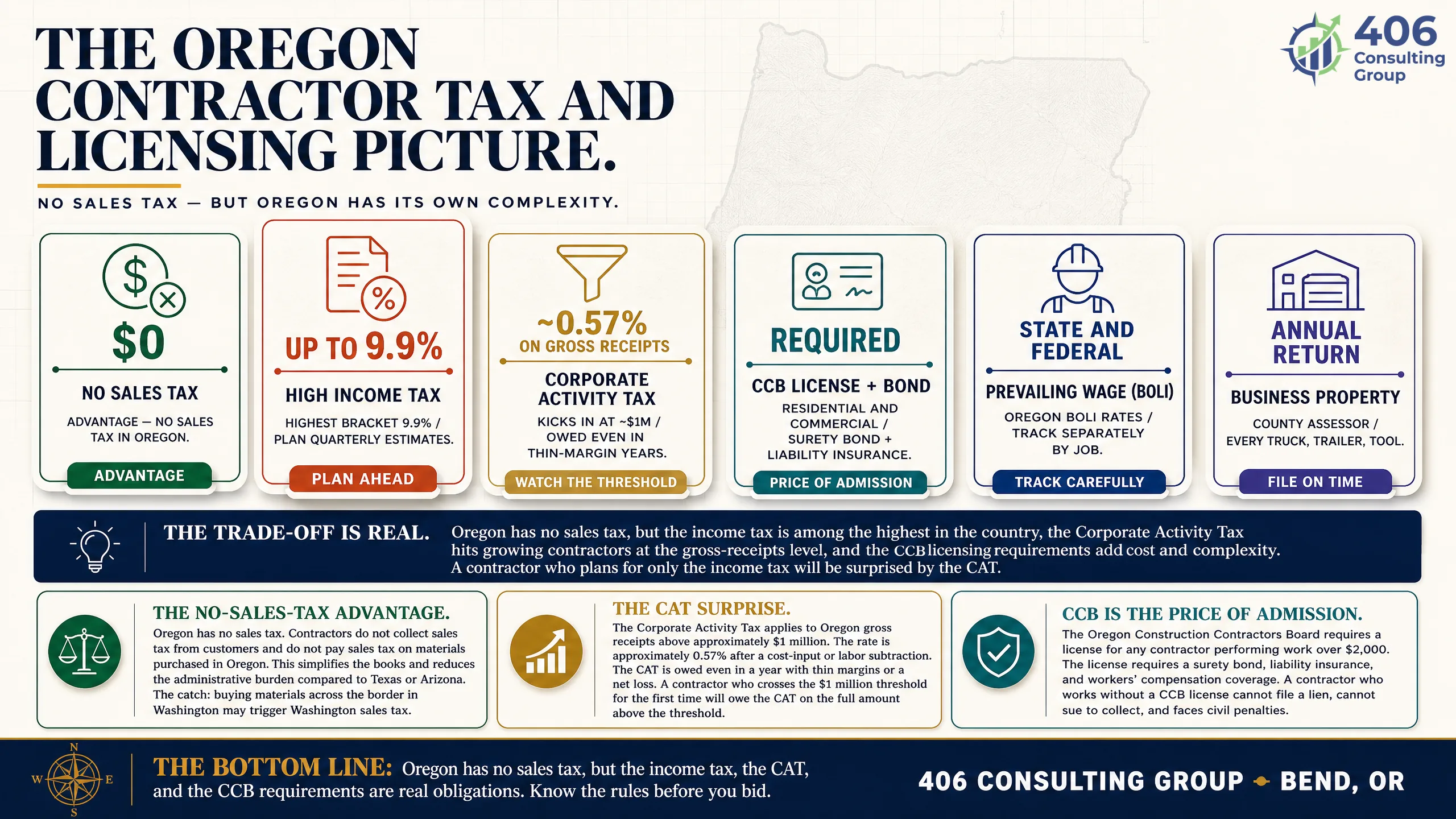
Confirm current rules with the Oregon Department of Revenue and the CCB. Start with the piece that surprises builders coming from — or comparing against — a sales-tax state.
The Tax That Isn't: No Sales Tax (and the Catch)
In most states, the thorniest question for a contractor is who owes sales tax on the materials — how the contract is written, whether it's new work or a repair, and so on. In Oregon, that entire tangle simply doesn't exist: there's no state sales or use tax, so you don't charge customers tax on materials, you don't wrestle with resale certificates on in-state buys, and there's no monthly sales-tax return to file. For a contractor moving a lot of material, that's a genuine, everyday simplification.
The catch is the border and the supplier. Central Oregon builders often buy materials or equipment out of state or through out-of-state vendors, and a purchase made in a sales-tax state — California, Idaho, or Nevada, say — can be taxed at the point of sale under that state's rules, so "Oregon has no sales tax" doesn't automatically mean a given purchase was tax-free. The books should capture where material and equipment are bought so you're not surprised, and so job costs reflect the true landed cost. It's a smaller issue than a full sales-tax regime, but it's the one that trips up contractors who assume "no sales tax" is the whole story.
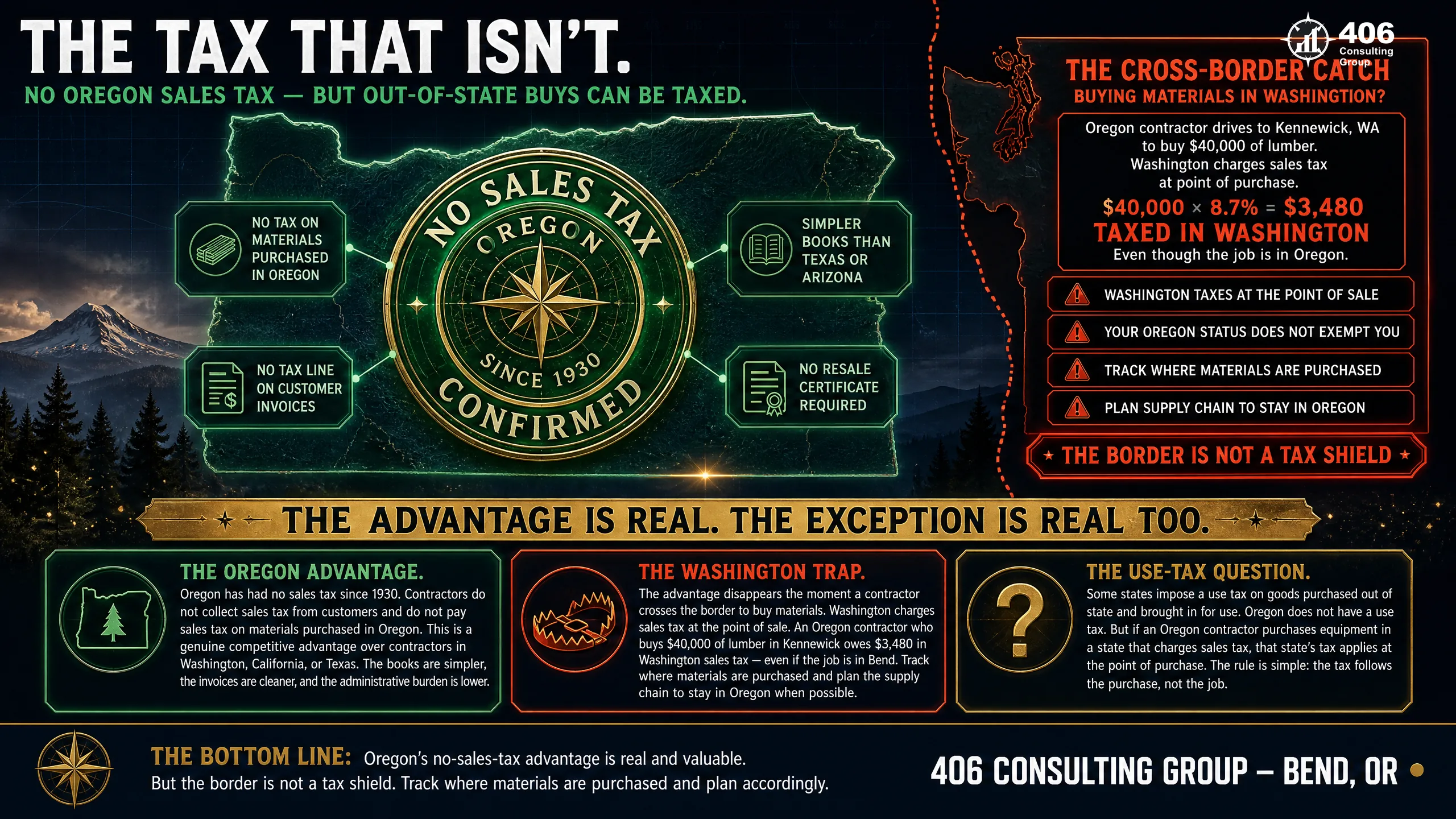
So the Oregon contractor's tax attention goes where the money actually is — the CAT, income tax, and payroll — not to a sales-tax return that doesn't exist.
The Oregon Corporate Activity Tax (CAT)
Here's the one that quietly catches growing Bend contractors. Oregon's Corporate Activity Tax is a gross-receipts-style tax on a business's Oregon commercial activity above a revenue threshold (commonly cited around $1 million). Above that threshold it applies a modest rate to your receipts — with a partial subtraction for a share of your cost inputs or labor — on top of, and separate from, the regular income tax. Because it's tied to gross receipts rather than profit, a high-revenue, thin-margin contractor can owe CAT even in a lean year, which surprises owners who only think about income tax.
For the books, that means watching your Oregon commercial activity as it approaches and crosses the threshold, tracking the cost inputs and labor that feed the subtraction, and planning for CAT as a real line item once you're over it. It's not huge as a rate, but for a contractor whose revenue can run well ahead of margin, it's exactly the kind of tax that shouldn't be a year-end surprise. Confirm the current threshold, rate, and rules with the Oregon Department of Revenue or a pro, since the details matter.
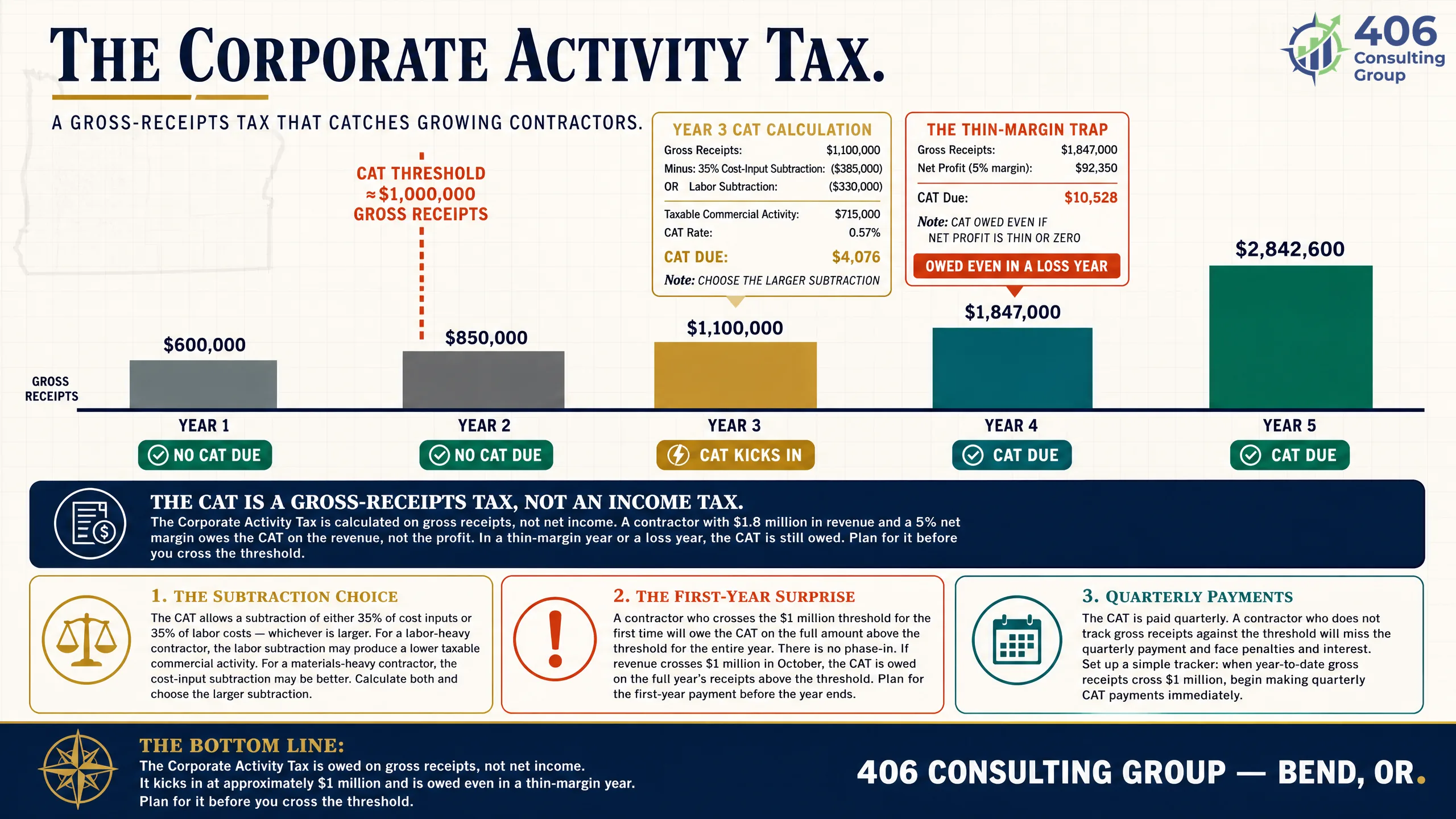
It's the Oregon equivalent of a surprise that other states deliver through sales tax — different mechanism, same lesson: know it before it hits.
CCB Licensing, Bonds & Getting Legal to Build
Oregon takes contractor licensing seriously through the Construction Contractors Board (CCB). Most construction work generally requires an active CCB license, and getting one typically means carrying a surety bond and liability insurance, completing required training, and registering the business — with different requirements for residential versus commercial work. The CCB bond protects customers and is separate from any performance or payment bonds you post on individual jobs.
This matters for the books because licensing, the bond, and insurance are real recurring costs and obligations that belong in your financial picture — and because contracting without an active license can jeopardize your ability to get paid or enforce a contract in Oregon. As you grow, add trades, or move between residential and commercial work, your CCB standing and bonding have to keep pace, and your financial statements are part of what supports larger bonding. Confirm your specific license class and bond requirements with the Oregon CCB.
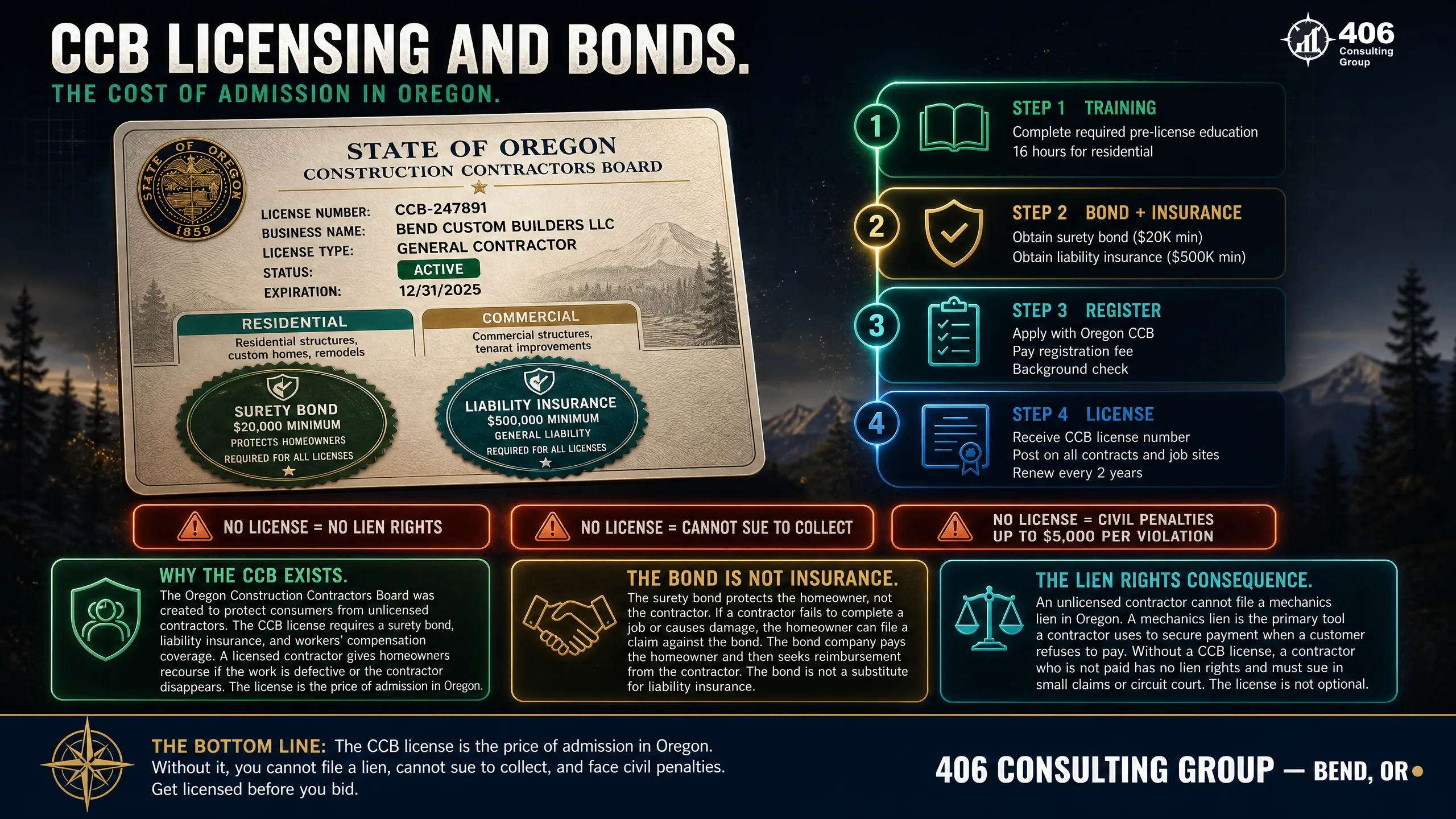
Licensing is the cost of doing business in Oregon; keeping it and your bonding healthy rests on clean financials underneath.
Job Costing: Which Job Actually Makes Money
Ask a busy Bend builder which project is their most profitable and you'll often get a pause. Job costing removes the guesswork by attaching every labor hour, material receipt, subcontractor bill, and piece of equipment time to the specific job it belongs to — so you see the true margin on each one instead of a single blended company number. On custom-home and resort work especially, where scope and finishes vary wildly job to job, that per-job clarity is what lets you bid the profitable work more aggressively and stop repeating the jobs that quietly lose money.
It's also the layer everything else depends on: you can't build an honest WIP schedule, bill progress accurately, or judge whether a change order is worth taking without job-level costs beneath it. For a Bend contractor scaling into a hot market, disciplined job costing is what keeps growth profitable instead of just bigger.
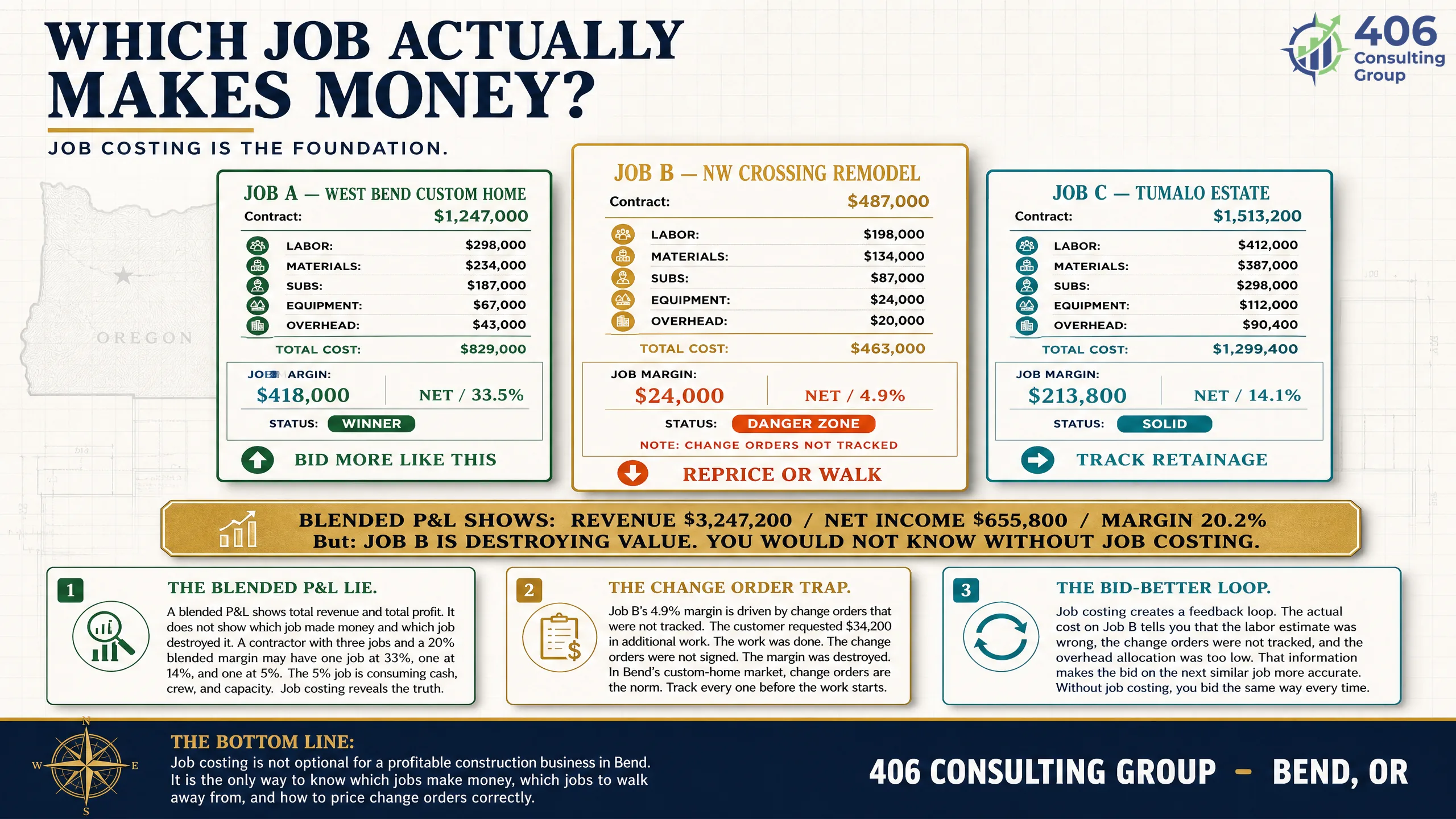
That's the question our contractor unit economics work exists to answer — on custom and resort work, the profit hides in which jobs and crews you actually make money on.
WIP, Percentage-of-Completion, Retainage & Change Orders
Jobs that run for months need construction-specific accounting a generic ledger can't produce. A work-in-progress (WIP) schedule sets each open job's costs, billings, and estimated cost-to-complete side by side, revealing whether you're over- or under-billed — bill ahead of the work and the extra cash can look like profit you've already spent, while billing behind it means you're quietly funding the owner's project. Percentage-of-completion accounting books revenue as the job earns it rather than in a lump at the end, so each month's numbers reflect reality.
Add retainage — the slice of each payment held until completion, which ties up cash and needs its own receivable — and change orders, which shift a job's scope and margin and have to be captured before they're built and forgotten. Handled together, these convert a tangle of open-job activity into statements your lender and bonding agent can actually stand behind.
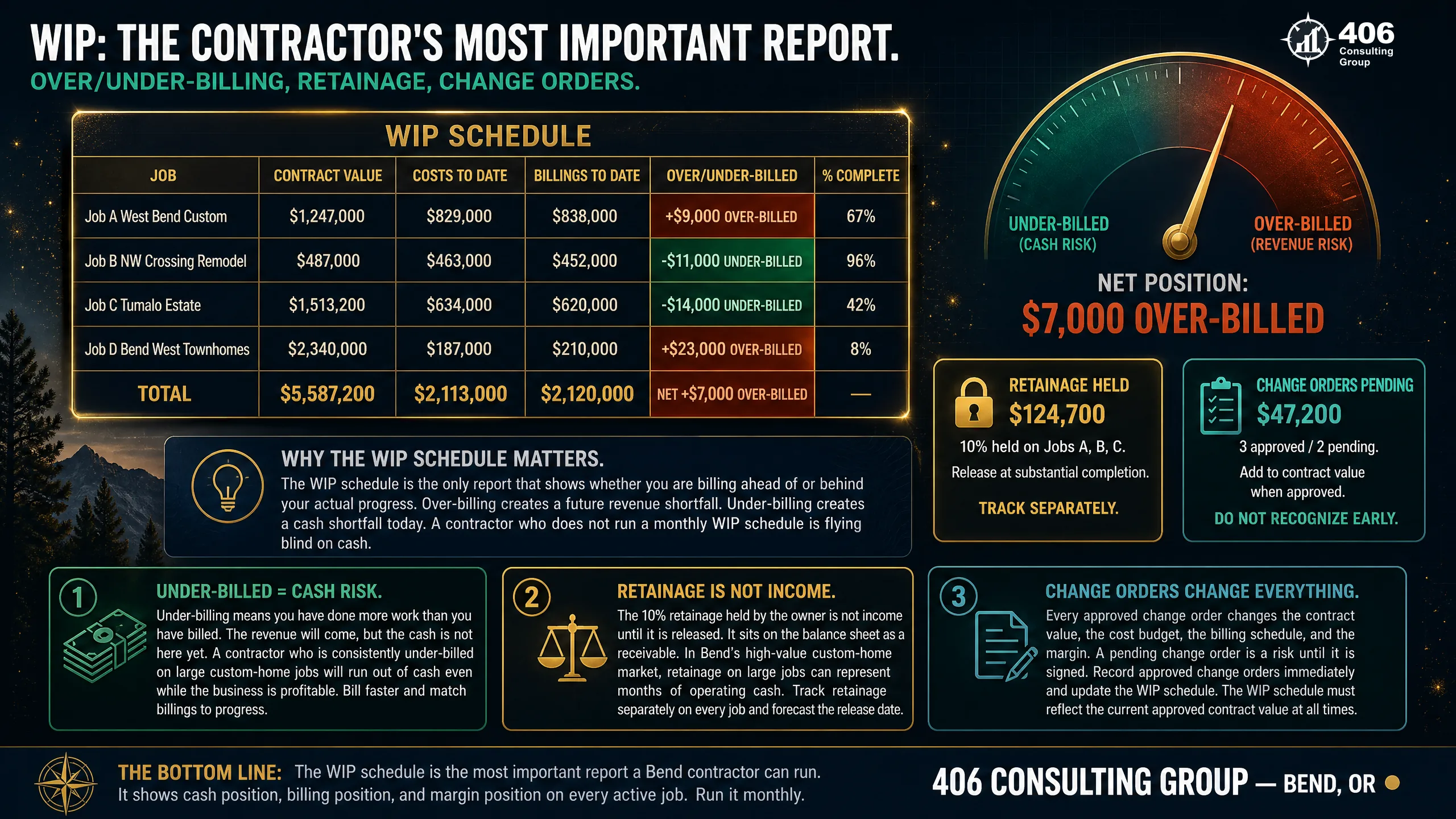
As the jobs grow, this is where a controller or CFO function earns its keep — few reports tell a builder more about the health of the business than a current WIP.
Prevailing Wage & Certified Payroll
Oregon payroll carries more than the average state. Because Oregon has a high state income tax, payroll includes meaningful state withholding on top of federal — and Oregon runs its own prevailing-wage law (administered by the Bureau of Labor and Industries, BOLI) on public-works projects, in addition to the federal Davis-Bacon Act on federally funded work. Either regime requires paying set wage rates and filing certified payroll reports documenting exactly what each worker was paid, and getting it wrong on a public job can stall your payments — so it's not a place to improvise.
Beyond that, construction payroll means tracking labor to jobs (which feeds job costing), handling a heavy mix of subcontractors and 1099s with correct worker classification, and carrying workers' compensation, which Oregon requires for employees. Set up well, payroll becomes a clean input to your job costs rather than a monthly scramble.
Our payroll work — certified payroll on public jobs included — keeps this running quietly in the background.
Equipment, Depreciation & Personal Property
Contractors run on equipment, and that gear shapes the books two ways. On the federal side, Section 179 and bonus depreciation can let you deduct a large share of a truck, excavator, or trailer in the year you buy it — powerful when you're building a fleet, though worth timing against your multi-year income (and Oregon's high income tax) rather than deducting on reflex. On the state side, Oregon assesses business personal property — your machinery, tools, and equipment — through the county, so a clean, current fixed-asset schedule keeps you from paying on gear you've sold or worn out.
That same fixed-asset detail should feed job costing, because equipment time belongs on the jobs that used it, and an idle machine is one of the quietest drains on a contractor's margin. Track what you own, what it costs to run, and where it's earning, and the equipment stops being a blind spot.
The depreciation-and-income-tax planning lives in the Bend tax guide; the tracking that makes it work starts in the books.
Common Construction Bookkeeping Mistakes
A handful of avoidable mistakes cause most of the financial pain for Bend contractors.
Assuming 'no sales tax' means no tax planning
Oregon's CAT, high income tax, and payroll obligations all still apply — and out-of-state purchases can carry another state's tax.
Getting caught by the CAT
A high-revenue, thin-margin contractor can owe the gross-receipts-based CAT even in a lean year if it isn't planned for.
Running without job costing
Without costs tied to each job, you can't tell which custom homes or remodels made money — so you keep bidding the ones that don't.
Ignoring the WIP schedule
Over- and under-billing hide the true state of every open job, and no surety will extend bonding without a clean WIP.
Letting CCB licensing or bonding lapse
An inactive license can jeopardize getting paid, and bonding has to keep pace with the work you take on.
Each is a setup-and-habit problem — and each disappears once the books are built for Oregon construction and run on a monthly rhythm.
Local vs. a Great Remote Partner
A Bend contractor's day is on the job site and in the truck, not sitting in an accountant's office — so remote bookkeeping fits how you already work rather than fighting it. What actually decides the outcome is expertise, not a downtown address: does your accountant understand construction and Oregon — job costing and WIP, the CAT, CCB licensing and bonding, prevailing wage, and the high-income-tax planning that follows? A great remote partner who knows all of that beats a nearby generalist who's never built a WIP schedule, every time — and honestly, a specialist who lives in these rules is worth far more than proximity.
Our whole setup is built for that: cloud accounting and job-costing software, field-captured receipts and time, live bank feeds, and a close you can count on each month — Oregon-literate construction books you never have to drive into an office for. West side of Bend, out in Redmond or Sisters, or anywhere across Central Oregon, the service is the same: responsive and construction-fluent.
What moves the needle is fluency in construction and Oregon's rules — the mileage between you and your accountant doesn't.
How to Get Started
Getting a Bend contractor's books in order is three steps.
Get the Oregon pieces right
Stay current with CCB licensing and bonding, watch your revenue against the CAT threshold, and plan for the state income tax on your profit.
Build construction-grade books
Job costing by phase, a WIP schedule, retainage and change-order tracking, a fixed-asset schedule, and certified payroll where public work requires it.
Run it monthly
Monthly close, WIP review, CAT and payroll tracking, and job reporting — so you always know which jobs pay and whether the business is ahead.
Not sure where your books stand? Our Financial Maturity Assessment maps it out in about eight minutes.
FAQ: Bend Construction Accounting
Does a Bend contractor deal with sales tax?
Not within Oregon — the state has no sales or use tax, so you don't charge customers tax on materials, you don't manage resale certificates on in-state purchases, and there's no sales-tax return to file. That's a real, everyday simplification compared with most states. The catch is cross-border buying: if you purchase materials or equipment in a sales-tax state — California, Idaho, or Nevada, say — or through an out-of-state vendor, that state's tax can apply at the point of sale, so 'no Oregon sales tax' doesn't automatically mean every purchase was tax-free. It's worth tracking where you buy so your job costs reflect the true landed cost.
What is the Oregon Corporate Activity Tax and does it hit contractors?
The Corporate Activity Tax (CAT) is a gross-receipts-style tax on a business's Oregon commercial activity above a revenue threshold (commonly cited around $1 million). Above that, it applies a modest rate to receipts with a partial subtraction for a share of cost inputs or labor, separate from the regular income tax. Because it's based on gross receipts rather than profit, a high-revenue, thin-margin contractor can owe CAT even in a lean year — which surprises owners who only plan for income tax. If your revenue is approaching or past the threshold, it's worth tracking and planning for; confirm the current threshold and rate with the Oregon Department of Revenue.
Do I need a contractor's license in Oregon?
Generally, yes. Oregon licenses contractors through the Construction Contractors Board (CCB), and most construction work requires an active CCB license, which typically means carrying a surety bond and liability insurance, completing required training, and registering — with different requirements for residential versus commercial work. The CCB bond protects customers and is separate from any performance or payment bonds on individual jobs. Contracting without an active license can jeopardize your ability to get paid or enforce a contract, so it's important to keep your CCB standing and bonding current as you grow. Confirm your license class and bond requirements with the Oregon CCB.
Is there prevailing wage and certified payroll in Oregon?
Yes — Oregon has its own prevailing-wage law, administered by the Bureau of Labor and Industries (BOLI), that applies to public-works projects, in addition to the federal Davis-Bacon Act on federally funded work. Both require paying set wage rates and filing certified payroll reports documenting what each worker was paid, and errors on a public job can hold up your payments. If you take public work, it's important to have payroll set up to produce accurate certified reports. Separately, Oregon requires workers' compensation for employees, and the state's high income tax means meaningful state withholding on every check.
Can 406 Consulting Group do my Bend construction bookkeeping remotely?
Yes — when the job site is your office, remote bookkeeping is the natural fit. It all runs on cloud accounting and job-costing software, with receipts and time captured from the field, live bank feeds, and a reliable monthly close. What lowers a construction business's risk is expertise — job costing, WIP, the Oregon CAT, CCB licensing and bonding, prevailing wage, and bonding-ready statements — not office proximity. We serve Bend and Central Oregon contractors the same way whether you're on the west side, out in Redmond or Sisters, or anywhere across the region.
Keep Reading
Trades & Construction — Bend, OR
Build the Boom on Books You Can Trust.
406 Consulting Group keeps Bend contractors clean, licensed, and bondable — the CAT, CCB licensing, prevailing wage, job costing, WIP, and equipment handled — delivered remotely, by a firm that knows Oregon construction.
Bend Construction Quick Reference
Bend, OR — Deschutes County
CAT or CCB Catching You Off Guard?
Job costing, WIP & licensing, handled.
About the Author
Carrie Anderson
Co-Founder, 406 Consulting Group
Commercial banking and underwriting background — 300+ loan reviews — serving contractors and trades across the Mountain West. Carrie helps Bend builders handle the CAT and CCB rules, run real job costing and WIP, keep certified payroll clean, and build books strong enough to grow their bonding.
Read the Full Story