
Trades & Construction Accounting in Meridian, ID:
Build Meridian on Books You Can Trust
In Idaho you're the consumer of your materials — pay sales tax at purchase, don't bill the customer — with DOPL registration and no state prevailing wage. The accounting a Meridian contractor really needs.

Meridian has gone from a bedroom community to Idaho's second-largest city in a single generation — and it's still one of the fastest-growing cities in the country. The work reflects it: master-planned subdivisions marching west toward Ten Mile, medical campuses and physician offices around St. Luke's, corporate and tech buildings along the Silverstone and Eagle Road corridors, and the retail, restaurant, and tenant-improvement build-out that follows the rooftops. For the framers, electricians, plumbers, HVAC and mechanical crews, and general contractors riding that curve, the schedule is full. The catch is that Idaho's accounting rules don't work the way a newcomer expects — a real registration regime, a sales/use tax that lands on your materials, a flat income tax, and workers' comp — and they invert the moment a crew crosses into Washington.
The single fact that reshapes an Idaho contractor's books is this: on real-property work, you are the consumer of your materials. You pay sales or use tax when you buy the lumber, wire, conduit, and fixtures — you don't add sales tax to the owner's invoice for the construction. Layer on DOPL registration, no state prevailing wage, and the job costing and WIP that an affluent, high-volume market demands, and you can see why construction books are a discipline of their own. This guide covers the whole picture for a Meridian builder, delivered remotely.
By Jason Anderson — Co-Founder, 406 Consulting Group. Big-firm-trained accountant serving contractors and trades across the Mountain West — job costing, WIP, and the state rules, Idaho's included, that decide whether a Treasure Valley bid actually holds its margin.
Quick Answer: Accounting for a Meridian Contractor
- →You're the consumer of your materials: pay Idaho sales/use tax (~6%) when you buy, and don't add sales tax to the owner's bill on real-property work.
- →Register with DOPL as a contractor and carry the required insurance; electricians, plumbers, and HVAC hold separate state licenses.
- →No Idaho prevailing wage — certified payroll only comes into play on federal Davis-Bacon work.
- →Flat income tax (5.3%, verify), competitive workers' comp, and a business personal-property tax with an exemption complete the frame.
- →Take a job into Washington and the rule flips — WA calls your work a retail sale. All handled remotely.
Table of Contents
Why Construction Accounting Is Its Own Discipline
Standard small-business bookkeeping was built for companies that sell something today and collect for it soon after. A contractor's economics look nothing like that. Revenue arrives as progress draws on jobs that run for months; costs land in four different buckets — labor, materials, subcontractors, equipment — that each have to be pinned to the right project; the owner sits on retainage until the end; change orders rewrite the scope midstream; and one underpriced job can eat the profit from three good ones. Books that only sort the bank feed and tidy up for tax season can't answer the two questions a builder actually lives on: is this job beating its estimate, and is the company making money?
A margin blind spot you can absorb on fifteen jobs a year becomes a real threat at fifty — and Meridian's contractors are living on the steep part of that curve.
Meridian sharpens the challenge two ways: the sheer pace of the build-out, and an Idaho tax code that treats your materials as your own purchase rather than a resale. Getting the books, the registration, and the tax treatment right is what lets a contractor here scale with the growth instead of drowning in it — and it's what keeps a competitive bid from going underwater the instant the materials tax is forgotten.
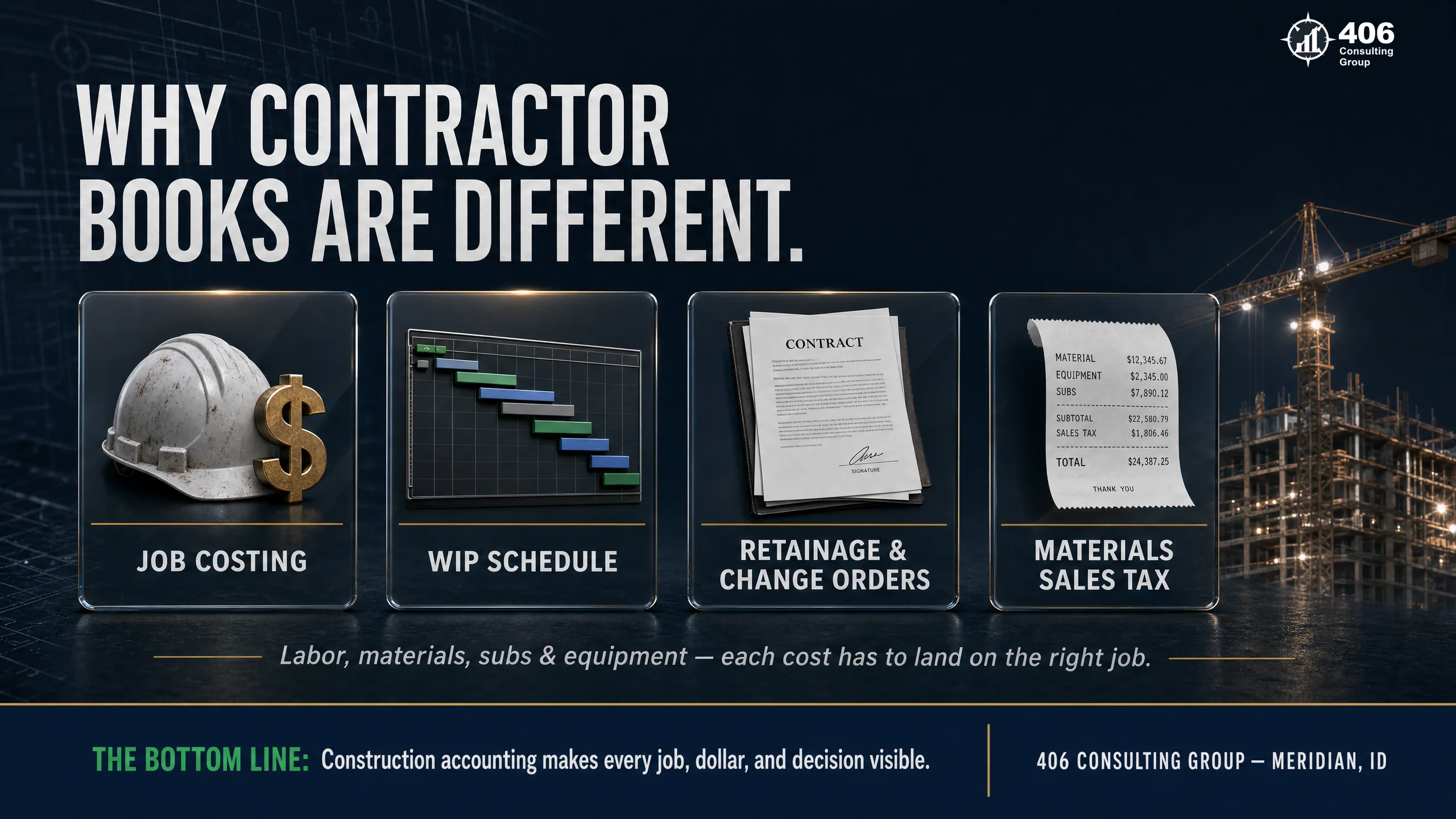
Begin with Idaho's tax and registration frame — and keep one eye on how completely it flips just across the Washington line.
The Idaho Contractor Tax & Registration Picture
Idaho keeps taxes moderate and runs a registration system rather than a licensing exam for general contractors. Here's the frame a Meridian builder works inside:
| Item | What it means for a contractor |
|---|---|
| Sales & use tax | ~6% (verify). You're the consumer on real-property work — the tax hits when you buy materials, and you never add it to the owner's invoice |
| State income tax | A single flat rate of 5.3% (verify current) on your pass-through profit |
| Contractor registration | No GC exam, but you must register with DOPL and hold the required liability insurance |
| Trade licensing | Electrical, plumbing, and HVAC each carry their own state license and exam |
| Prevailing wage | None at the state level — certified payroll only on federal Davis-Bacon projects |
| Workers' comp | Mandatory, bought competitively — private carriers bid against the State Insurance Fund |
| Equipment | Personal-property tax on machinery, with a per-taxpayer exemption — worth tracking |
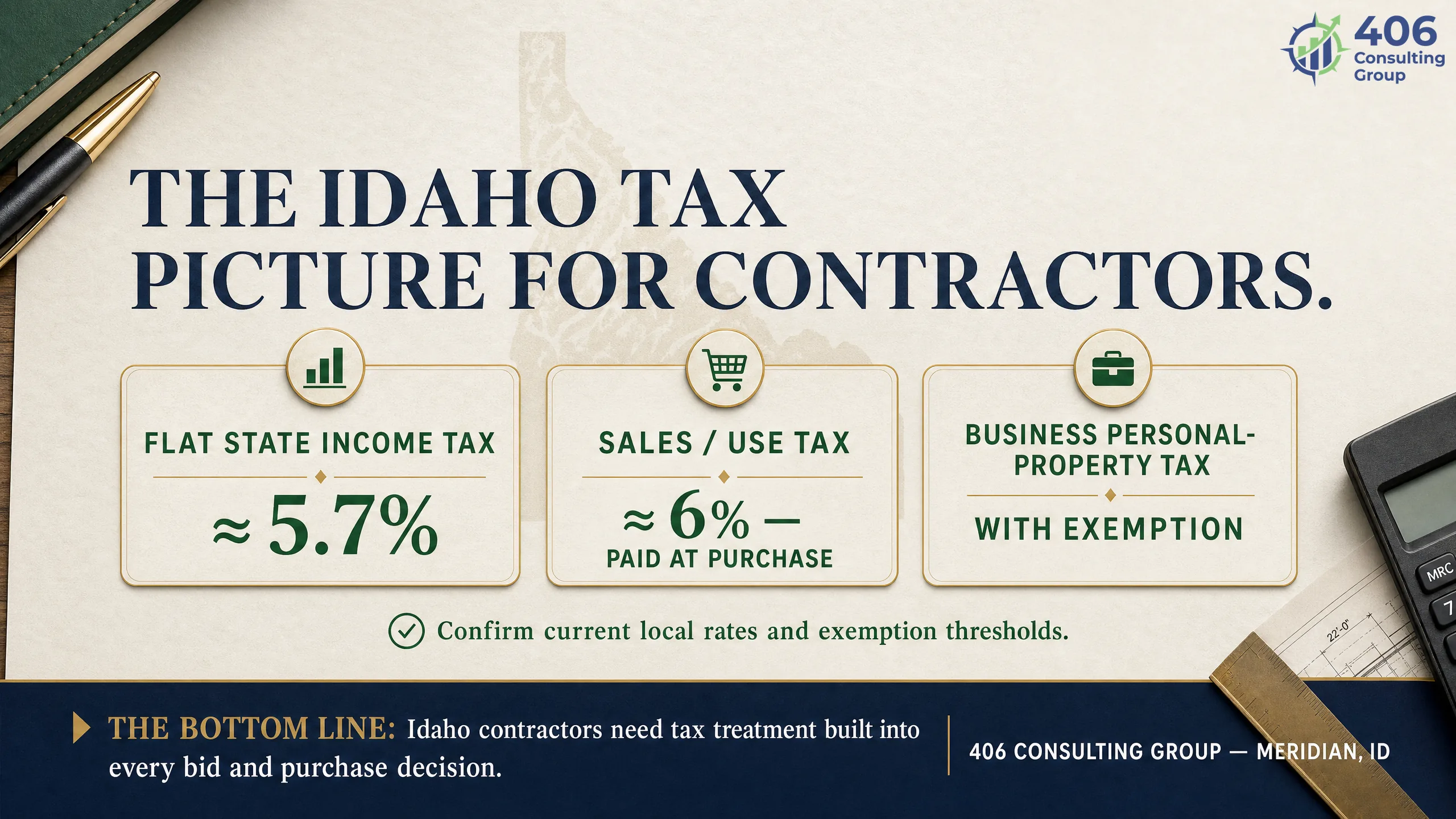
Verify current rates and rules with the Idaho State Tax Commission and registration and licensing with the Idaho Division of Occupational & Professional Licenses (DOPL). The consumer-of-materials rule is the line item that makes or breaks your bids, so we'll take it next.
Registration & Licensing: DOPL, Insurance & the Trades
There's no general-contractor exam in Idaho, but there is a hard requirement to register. Construction contractors file with the Division of Occupational & Professional Licenses (DOPL) and have to keep the required general liability insurance in force to register and work legally. Let that lapse — or work unregistered — and you can lose the right to enforce a contract and collect, on top of penalties. It's a standing obligation, renewed on a cycle, not a one-and-done piece of paperwork.
The specialty trades sit under a separate regime: electricians, plumbers, and HVAC contractors carry their own state licenses, exams, and continuing requirements, and the City of Meridian and Ada County add their own permits and inspections on top. In the books, registration, insurance, and trade licenses are recurring costs and live compliance items — and your financial statements are exactly what a surety leans on when a larger commercial or public job needs bonding. Confirm what applies to your trade with Idaho DOPL, because the requirements aren't the same across trades.
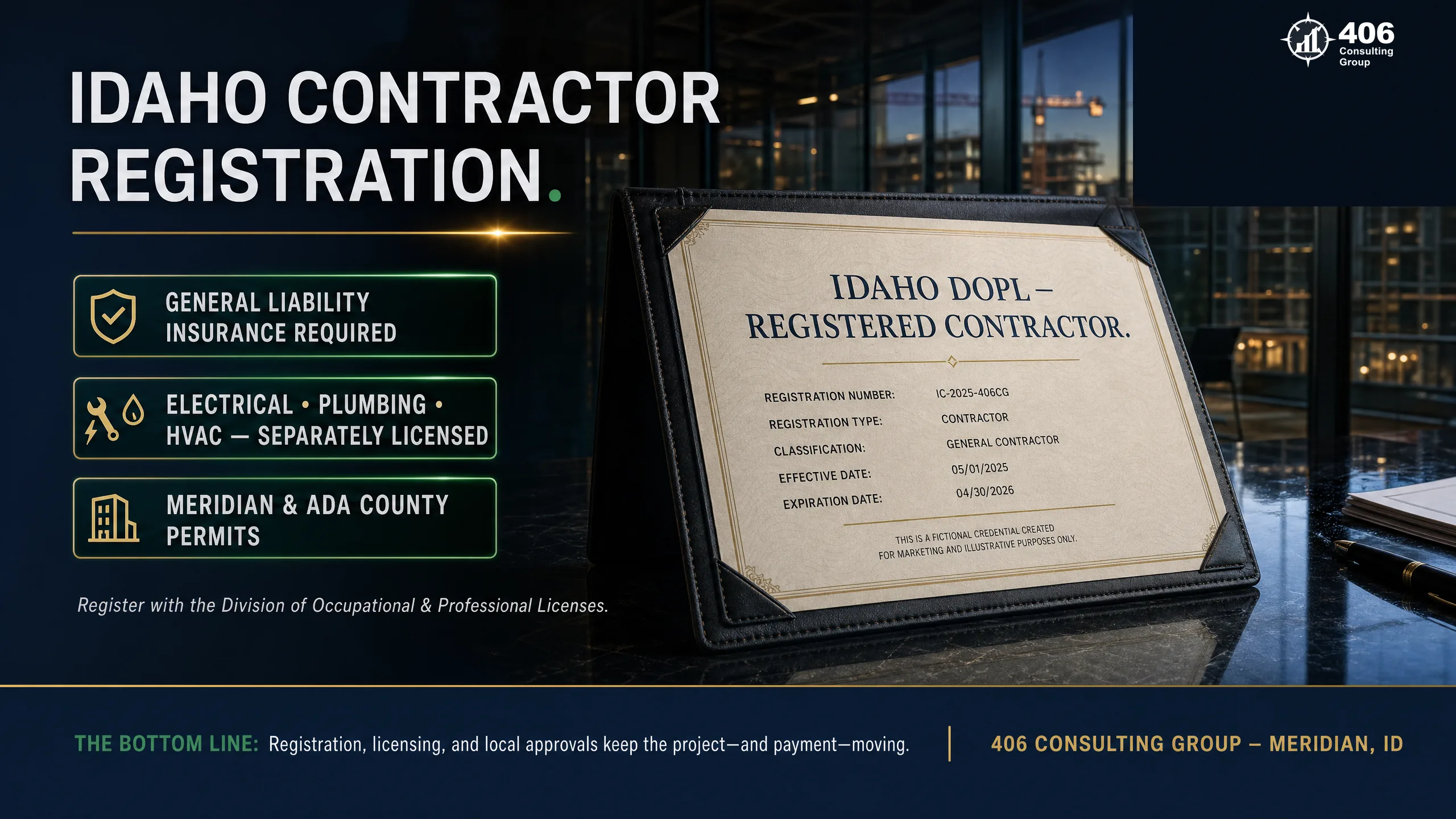
Registration clears you to work. The rule that touches every single invoice is how Idaho taxes your materials.
You're the Consumer: Idaho Sales Tax on Your Materials
For a contractor, Idaho's sales tax runs backward from how a retailer experiences it — and directly opposite to Washington's system next door. Install materials into real property and Idaho treats you as the end consumer of those materials. You pay the sales or use tax at the moment you purchase them, and you never add sales tax to the owner's contract for the construction. Put plainly: the tax on your lumber, wire, pipe, and fixtures is a cost of doing the job — not a line you collect from the customer and forward to the state like a store would.
The entire trick: price your materials into the estimate at what you actually paid — tax included — because that tax is never coming back as a separate charge.
Two edge cases deserve attention. Use tax picks up anything you bought without Idaho tax on it — an out-of-state online order, or stock pulled from your own shelf onto a job — which is easy to overlook when a Meridian project is moving fast. And if part of your business sells goods over the counter without installing them, that side may be taxed as ordinary retail, so a mixed operation needs the two streams cleanly separated in the books. Set up correctly, the tax becomes predictable and your pricing stays truthful.

Check how the rule and use tax apply to your particular mix of work with the Idaho State Tax Commission — especially if you both install and sell.
Building Meridian: Master-Planned Growth, Medical & Commercial
Meridian's construction market has a distinct shape, and it's not Nampa's industrial-and-ag base or a North Idaho resort town's. The engine here is master-planned residential — large subdivisions, senior and multifamily living, and the schools and parks that anchor them — pushing steadily toward Ten Mile and the western edge of Ada County. On top of that sits a deep bench of healthcare and medical-office work around the St. Luke's campus, a growing cluster of corporate, tech, and flex buildings along Silverstone and Eagle Road, and the retail, restaurant, and tenant-improvement volume that trails new rooftops — The Village and the Ten Mile interchange being the obvious examples. It's a high-value, design-forward market that rewards contractors who can bid and cost finish-heavy commercial and upscale residential with equal precision.
Booms carry a counterintuitive risk: they're where contractors most often lose money, because a full schedule hides thin or negative margins until cash gets tight. More work only compounds into a stronger business if you can see the margin on each job and finance the growth behind it — which is a matter of job costing, a live WIP schedule, and a cash forecast, not simply a busier calendar.
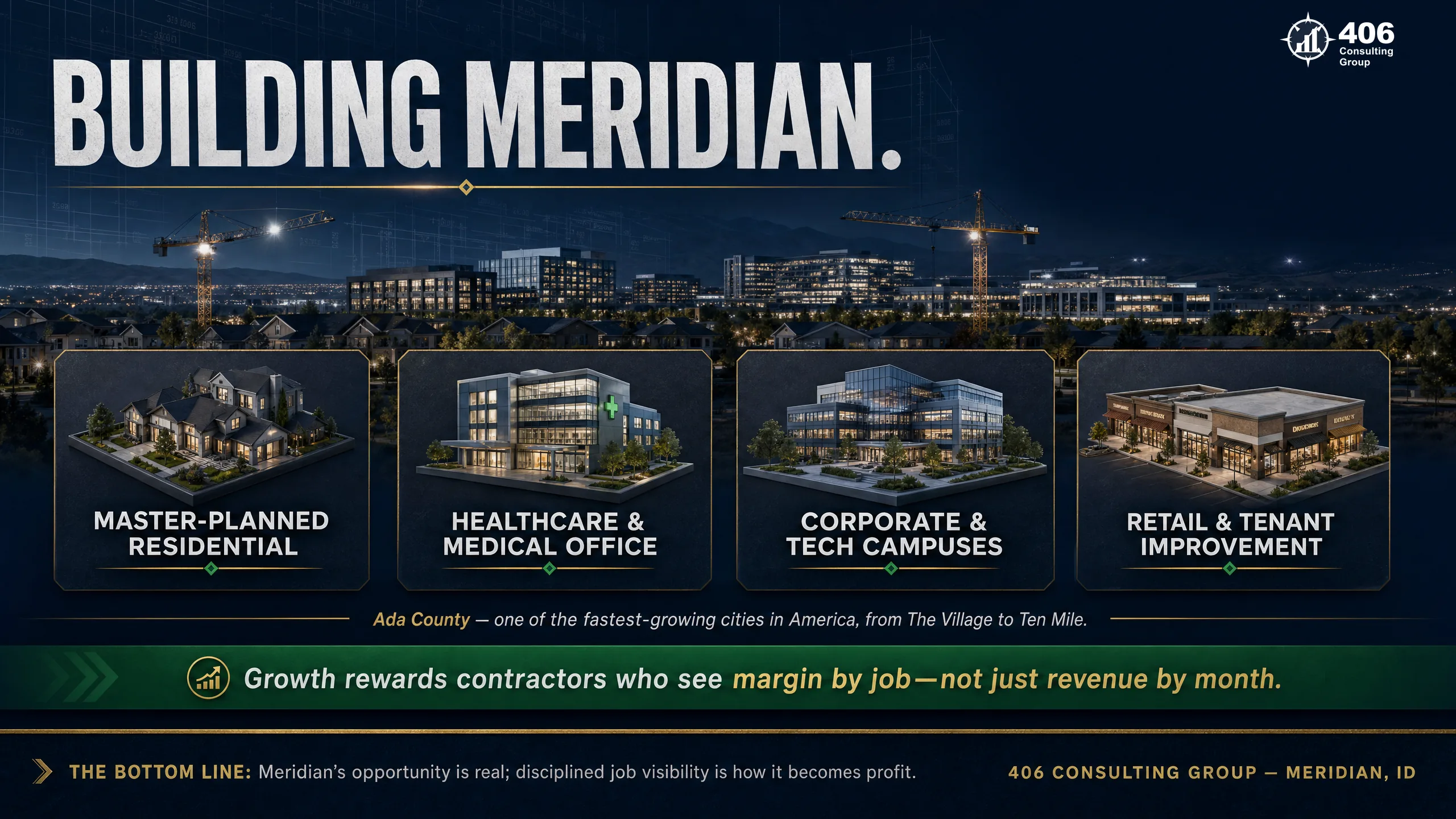
Growth only counts if it's profitable growth — and that's a question your books answer long before your sales pipeline does.
Job Costing: Which Job Actually Makes Money
When the phone won't stop ringing, the reflex is to keep saying yes — and without job costing you have no way to separate the jobs building your company from the ones bleeding it. Job costing pins every labor hour, every material invoice (at its taxed cost), every subcontractor payment, and every hour of equipment use to a specific project, so each job's real margin shows on its own instead of vanishing into a blended company average. The moment you can see that a medical-office tenant improvement is running thin while your production-home work is carrying the quarter, you bid and pursue the two very differently.
It's also the foundation everything else rests on — an honest WIP schedule, accurate progress billing, and sound change-order pricing all depend on real job-level costs underneath them. For a Meridian contractor scaling into a high-value market, disciplined job costing is the single habit that keeps growth profitable instead of merely impressive.
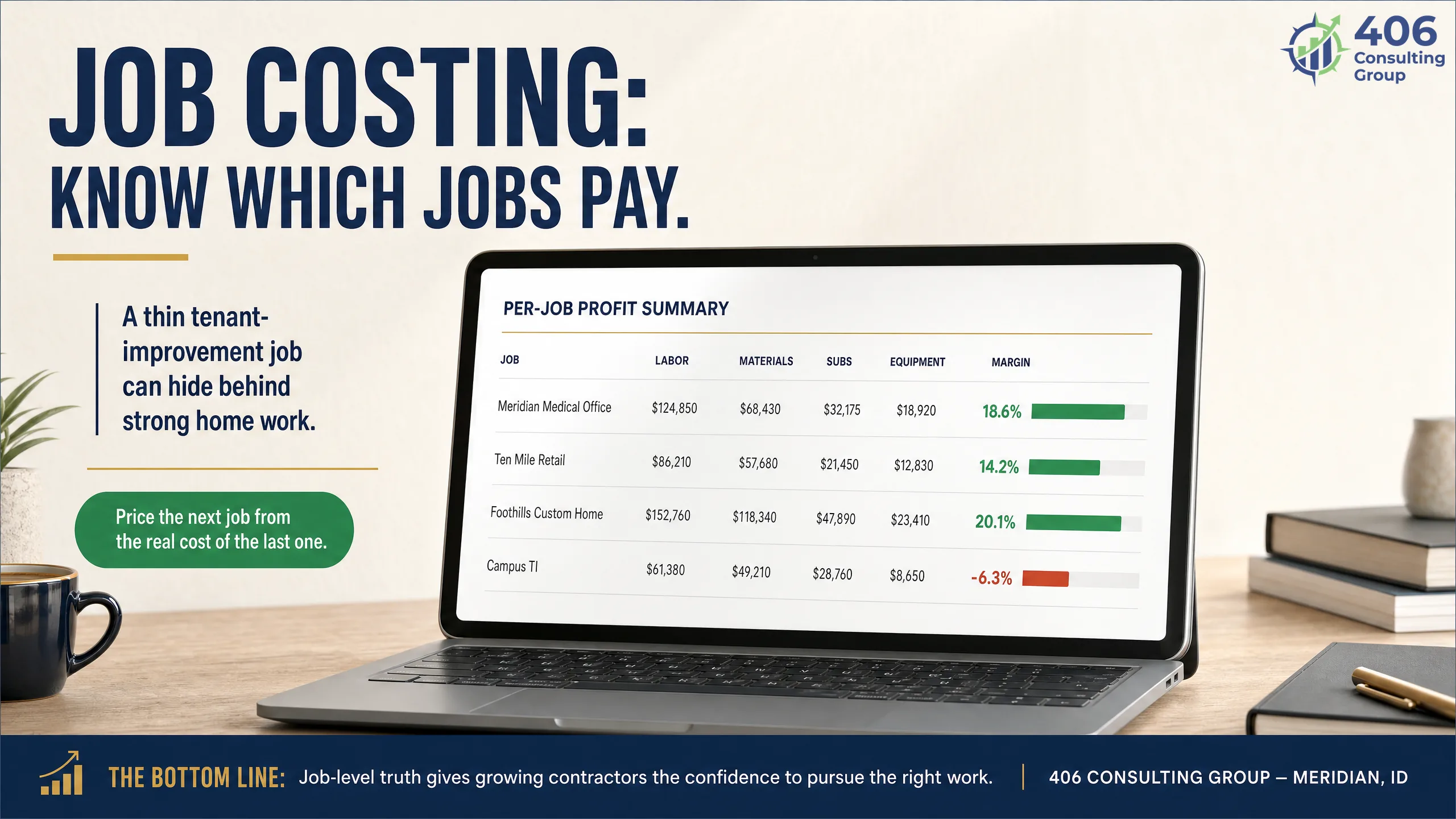
Knowing which jobs and crews truly carry the business is exactly what our contractor unit economics work is built around — and job costing is what puts the answer in front of you.
WIP, Percentage-of-Completion, Retainage & Change Orders
Long-running jobs need reporting a simple ledger just can't produce. A work-in-progress (WIP) schedule lines up each open job's costs, billings, and estimated cost-to-complete side by side, and the gaps between them tell you whether you're over- or under-billed. Bill ahead of the work and the extra cash can make a struggling job look healthy while costs are still landing; bill behind it and you're effectively financing the owner's project out of your own pocket. Percentage-of-completion matches revenue to how far a job has actually progressed, so the monthly numbers stay honest instead of piling up at the end.
Then there's retainage — the portion held back until closeout, which ties up cash and belongs in its own receivable — and change orders, which move scope and margin and have to be captured and priced before the crew absorbs the work for free. With more open jobs than you've ever run at once, that WIP discipline is what stops a packed schedule from passing itself off as a profitable one — and it's the first statement a banker or bonding agent will open.
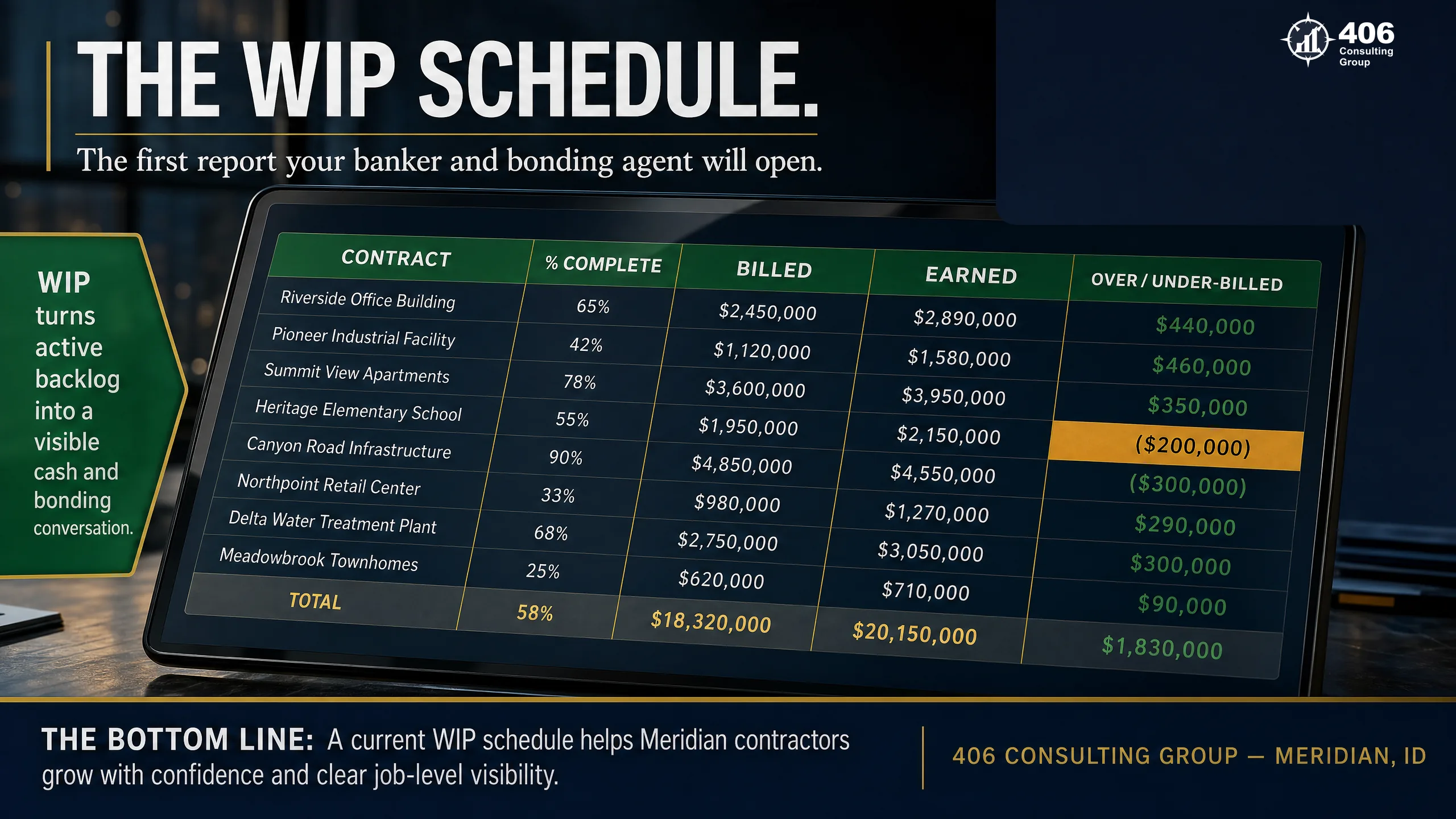
As the job list grows, this is the point where a controller or CFO function starts paying for itself — the WIP is the report that tells you where the company really stands.
Payroll, Prevailing Wage & Idaho Workers' Comp
Idaho construction payroll is relatively clean, with a handful of pieces that need to flow into job costing. With a flat state income tax, payroll carries Idaho withholding next to federal. Workers' compensation is mandatory for employees and purchased on a competitive market — private carriers and the State Insurance Fund bid against each other — with construction class-code rates that belong inside your burdened labor cost. And on prevailing wage, Idaho is unusual: there's no state prevailing-wage law at all, so those requirements surface only through the federal Davis-Bacon Act on federally funded projects.
No state prevailing wage
Federal Davis-Bacon work is the only place certified payroll shows up — city, county, and state jobs don't trigger it.
Competitive workers' comp
Coverage is quoted on an open market; fold the construction class-code rate into your burdened labor.
Flat-rate withholding
One flat Idaho rate withheld next to federal — nothing to recompute paycheck to paycheck.
The rest of construction payroll is about discipline: tie every labor hour to a job so it feeds costing, and classify a heavy roster of subcontractors and 1099s correctly — worker classification draws real scrutiny in a fast trades market. Built cleanly, payroll stops being a month-end scramble and becomes reliable data flowing straight into your job costs.
Our payroll work — certified payroll on any federal job included — keeps all of it running in the background so it never eats your week.
Equipment, Depreciation & Idaho Personal-Property Tax
Equipment hits the books from two angles. On the federal side, Section 179 and bonus depreciation let you write off much of a truck, lift, or machine in its purchase year — useful fuel for scaling, but a call to make against your multi-year income picture rather than by reflex. On the Idaho side, the county levies a business personal-property tax on machinery and equipment, tempered by an exemption up to a per-taxpayer threshold — so a lean shop may owe next to nothing, while an equipment-heavy operation should track it and confirm exactly where it lands with the assessor.
A tidy, current fixed-asset schedule pulls double duty: it keeps depreciation and any personal-property reporting correct, and — since equipment hours belong on the jobs that burned them — it feeds job costing so an idle machine reads as the cost it truly is instead of disappearing into overhead. Know what you own, what it costs to run, and which jobs it's actually working.
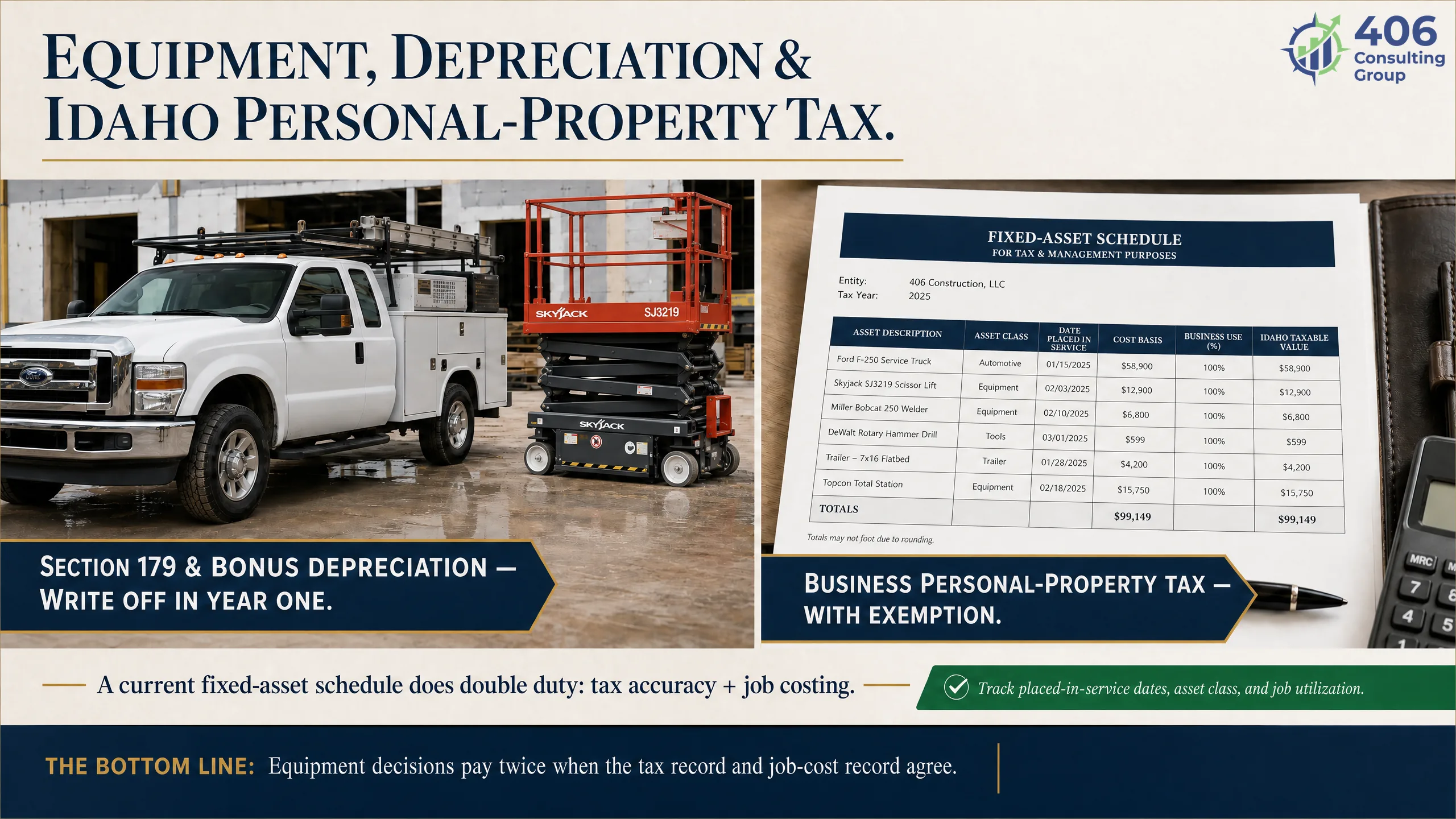
The depreciation timing and Idaho income-tax planning live in the Meridian tax guide; the tracking that makes it possible starts in the books.
Common Construction Bookkeeping Mistakes
A short list of avoidable errors accounts for most of the financial pain we see in Meridian contractors — and a high-speed market makes every one of them cost more.
Bidding materials at the pre-tax price
Materials tax is yours to absorb as the consumer, so it belongs in the bid — forget it, or miss use tax on an out-of-state order, and you're underwater before the first day.
Letting DOPL registration or insurance slip
Working unregistered or with lapsed coverage can cost you the right to collect and trigger penalties — this has to be tracked and renewed on schedule.
Scaling without job costing
In a boom a full schedule masks thin margins; with no per-job numbers you can grow straight into a loss and not notice until the account runs dry.
Skipping the WIP schedule
Over- and under-billing hide where each job really stands — and no surety grows your bonding on Ada County-scale work without a clean WIP.
Loose sub and 1099 classification
A deep subcontractor bench in a hot market invites scrutiny; misclassified workers are a costly mess to untangle after the fact.
Every one of these is a setup problem, not a talent problem. Build the books for Idaho construction, run a real monthly close, and they quietly go away.
Local vs. a Great Remote Partner
A Meridian contractor spends the day between the site and the truck, not sitting in an accountant's lobby — so a remote partner already fits the way the business actually runs. The real question isn't proximity, it's competence: can your accountant handle Idaho construction — the consumer-of-materials sales-tax rule, DOPL registration, job costing across medical, commercial, and high-end residential work, and a bonding-grade WIP — plus the border twist when a crew takes a job into Washington?
An accountant who lives inside Idaho's rules, wherever their desk is, beats a down-the-street generalist who's never built a WIP or priced the consumer-of-materials rule into a bid.
The way we work matches a builder's day: cloud accounting and job-costing software, receipts and hours captured from the field, connected bank feeds, and a monthly close you can count on — Idaho-fluent construction books without a drive across the valley. And when the work spills across the line into Washington, where the tax treatment inverts, our Coeur d'Alene guide and our Spokane Valley, WA guide keep both sides straight.
The thing that matters is whether your accountant knows Idaho construction cold — the address on the door is beside the point.
How to Get Started
Getting a Meridian contractor's books in shape comes down to three moves.
Nail the Idaho pieces
Keep DOPL registration and insurance renewed on schedule, bake materials sales/use tax into every estimate, and get workers' comp set up right.
Build construction-grade books
Put phase-level job costing, a lender-ready WIP schedule, retainage and change-order tracking, and a fixed-asset schedule in place — plus certified payroll if you touch federal work.
Run it every month
A close you can trust each month, a WIP review, clean sales/use-tax handling, and per-job reporting — so you always know which jobs pay and can bankroll and bond the next one.
Not sure where your books stand today? Our Financial Maturity Assessment gives you a straight read in about eight minutes.
FAQ: Meridian Construction Accounting
Do I need a contractor's license in Idaho?
There's no general-contractor exam in Idaho, but registration is mandatory. You file as a construction contractor with the Division of Occupational & Professional Licenses (DOPL) and keep general liability insurance in force to work legally. Skip it and you can forfeit the right to enforce a contract, on top of penalties — so it's a standing, renewable obligation, not a one-time filing. Electricians, plumbers, and HVAC contractors are licensed separately with their own exams, and Meridian and Ada County layer on permits and inspections. Check your trade's requirements with Idaho DOPL.
Do Idaho contractors charge customers sales tax on a job?
Usually not on real-property work. Idaho counts a contractor who installs materials into real property as the end user of those materials, so the sales or use tax lands when you purchase them — you don't tack sales tax onto the owner's construction contract. That makes materials tax a job cost, one that has to be priced into your estimates at the taxed amount. Use tax picks up anything bought without Idaho tax on it — out-of-state orders, or stock pulled from your shelf — and if you also sell goods over the counter without installing them, that revenue can be taxed as ordinary retail. It's the mirror image of Washington, where the entire job is a retail sale. Verify the specifics with the Idaho State Tax Commission.
Is there prevailing wage or certified payroll in Idaho?
No. Idaho has no prevailing-wage statute, so ordinary private work along with city, county, and state jobs carry no certified-payroll requirement at all. It surfaces only on federally funded projects, where the federal Davis-Bacon Act fixes the wage rates and requires certified payroll for every worker on site. Accuracy matters — a botched rate or classification can freeze a draw — so if you chase federal work, build payroll to generate those filings cleanly. Because the trigger is the funding source, verify it on each contract. Workers' comp stands apart: every Idaho employer must carry it, purchased competitively from private insurers or the State Insurance Fund.
What makes Meridian's construction market different to account for?
Meridian's build is weighted toward master-planned residential, healthcare and medical office, corporate and tech buildings, and the retail and tenant-improvement work that follows new rooftops — a higher-finish, higher-value mix than an industrial or ag base. That makes accurate job costing and bidding especially important, because finish-heavy commercial and upscale residential carry very different cost structures, and it's easy for a thin tenant-improvement job to hide behind strong production-home work. A live WIP schedule and real per-job margins are what let a contractor here keep pace with one of the country's fastest-growing cities without outrunning their own cash.
Can 406 Consulting Group do my Meridian construction bookkeeping remotely?
Yes — for a builder the real office is the truck and the trailer, so working remotely already matches your day. It all runs on cloud accounting and job-costing software, with receipts and hours captured on site, live bank feeds, and a monthly close you can lean on. For an Idaho contractor the deciding factor is know-how — pricing the consumer-of-materials rule, keeping DOPL registration current, running job costing and WIP, and handling the flip when work crosses into Washington — not the distance to our desk. We serve Meridian and Treasure Valley builders identically, whether you're near The Village, out toward Ten Mile, or along the Eagle Road corridor.
Keep Reading
Trades & Construction — Meridian, ID
Build Meridian on Books You Can Trust.
406 Consulting Group gives Meridian builders books that hold up — the consumer sales-tax rule, DOPL registration, job costing, WIP, and equipment all handled — worked remotely by a team fluent in Idaho construction.
Meridian Construction Quick Reference
Meridian, ID — Ada County
Building across the Treasure Valley?
Consumer sales tax, job costing & WIP, handled.
About the Author
Jason Anderson
Co-Founder, 406 Consulting Group
Big-firm-trained accountant serving contractors and trades across the Mountain West. Jason helps Meridian builders handle Idaho's consumer sales-tax rule, keep DOPL registration current, run real job costing and WIP, and build books strong enough to grow through one of the country's fastest-growing markets.
Read the Full Story