
Trades & Construction Accounting in Coeur d'Alene, ID:
Build the Lake Country on Books You Can Trust
In Idaho you're the consumer of your materials — you pay the sales tax, you don't bill it — and Spokane's right across the line with a whole different rulebook. The accounting a Coeur d'Alene contractor really needs.
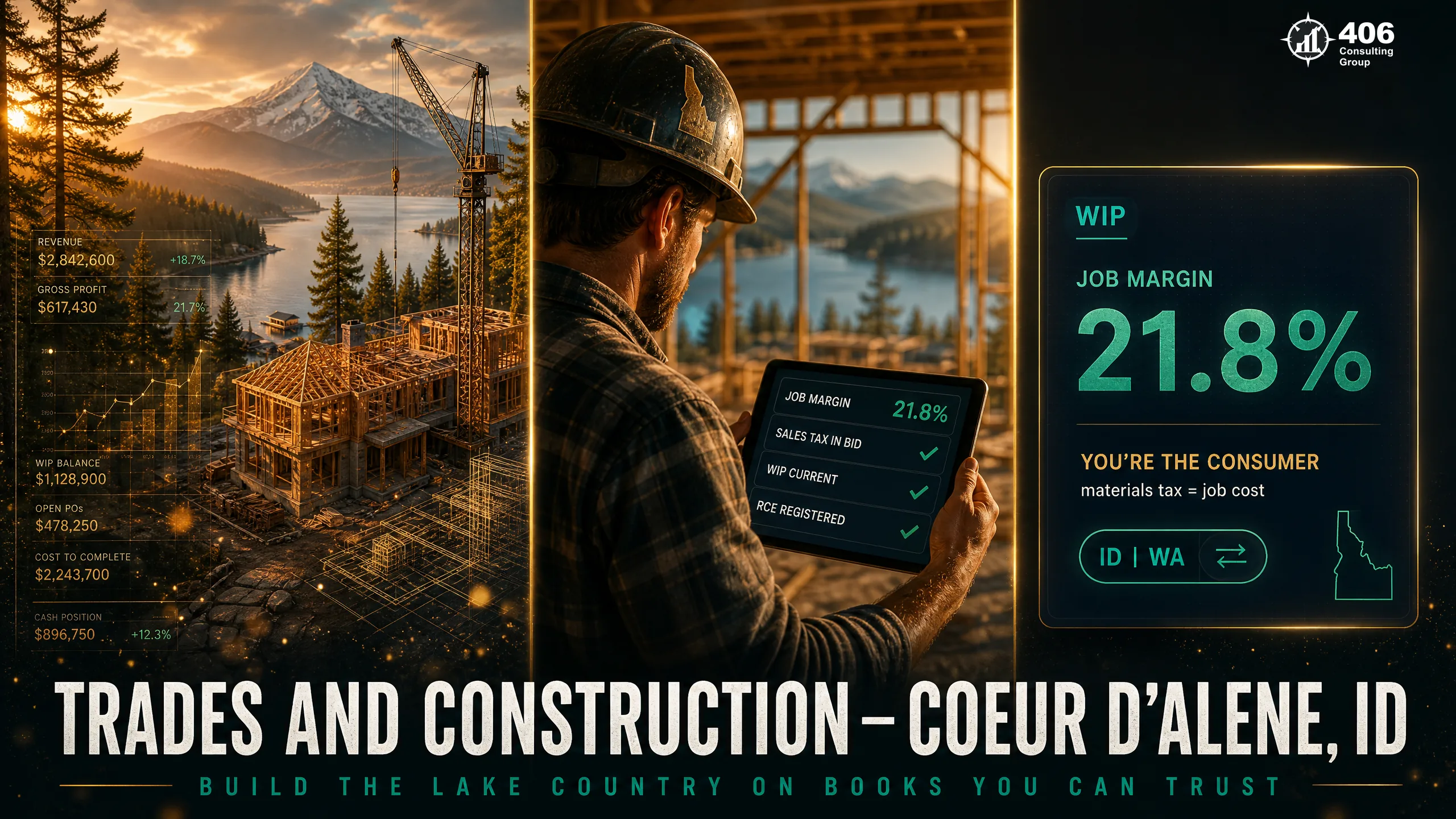
North Idaho is booming, and Coeur d'Alene sits at the center of it — lakefront custom homes, resort and short-term-rental builds, and a steady wave of new arrivals from Washington, California, and beyond driving residential and commercial construction. For the framers, electricians, plumbers, HVAC techs, excavators, and general contractors keeping up, the work is there. What makes the accounting distinctive is Idaho's own set of rules — how sales tax lands on a contractor, Idaho's contractor registration, and, because Spokane is a half-hour west, the very real question of what happens when you buy materials or take a job across the line in Washington.
The rule most Idaho contractors only half-understand: on a typical real-property job you're treated as the consumer of your materials — you pay sales tax when you buy them and don't charge the customer tax on the work — which is very different from a state that makes you collect it, and different again the moment you cross into Washington's system. Add contractor registration, job costing, WIP, certified payroll on public jobs, and equipment, and clean books here are their own discipline. This guide walks all of it, delivered remotely.
By Jason Anderson — Co-Founder, 406 Consulting Group. Big-firm-trained accountant serving contractors and trades across the Mountain West — job costing, WIP, and the state-line questions that decide whether a North Idaho bid actually holds its margin.
Quick Answer: Accounting for a Coeur d'Alene Contractor
- →You're the consumer: on Idaho real-property work you pay sales tax on materials at purchase and don't charge the customer tax on the job.
- →The Washington line matters: buying materials or working across in WA pulls in a whole different regime (B&O tax, WA sales tax, WA rules).
- →Idaho contractor registration (RCE) is required for most work; public works carry a separate license.
- →Flat state income tax, no state prevailing wage (federal Davis-Bacon only), workers' comp required; job costing & WIP protect margin.
- →Delivered remotely — the norm for a contractor whose office is the truck.
Table of Contents
Why Construction Accounting Is Its Own Discipline
Construction doesn't fit the rhythm ordinary bookkeeping assumes. Cash arrives in draws spread over long jobs; costs scatter across labor, materials, subs, and equipment that each have to land on the right project; you bill in stages while the owner holds retainage; change orders keep moving the scope; and one job bid a little short can eat the profit from the last three. A back office that just categorizes the bank feed and reconciles at tax time can't answer the questions a contractor actually lives by: is this job coming in on its estimate, and across everything, is the company genuinely making money?
In North Idaho that discipline runs into a specific tax and licensing setup — the way Idaho taxes a contractor's materials, the state's registration requirements, and the Washington border sitting right there tempting cross-line work and cross-line purchasing. All of it flows through the books. For a Coeur d'Alene contractor riding one of the West's hottest markets, handling it well is what separates growth that builds a durable business from growth that just churns bigger numbers through the same thin margins.
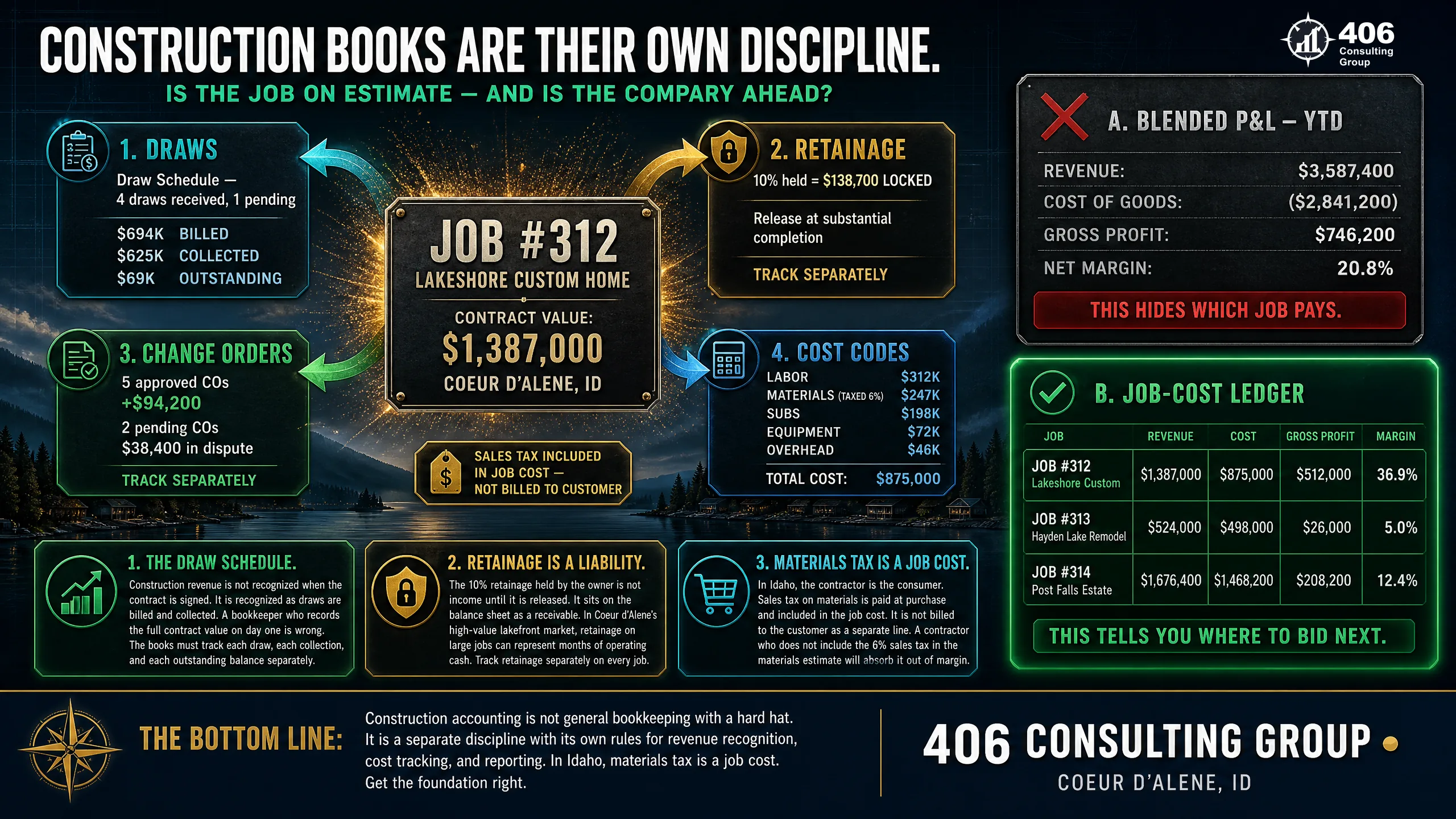
Start with how Idaho actually taxes a contractor — it surprises people coming from a state that makes builders collect sales tax.
The Idaho Contractor Tax & Registration Picture
Idaho's setup is middle-of-the-road on rates but specific in how it treats contractors. Here's the frame:
| Item | What it means for a contractor |
|---|---|
| Sales & use tax | 6% state rate; on real-property work the contractor is the consumer — pays tax on materials, doesn't bill the customer tax |
| State income tax | A flat rate (5.3%, verify) on pass-through profit |
| Contractor registration | Idaho contractor registration (RCE) generally required; public works carry a separate license |
| Prevailing wage | No Idaho state prevailing wage — only federal Davis-Bacon on federally funded jobs |
| Workers' comp | Required in Idaho for employees |
| The Washington line | Cross-border purchases and jobs bring WA's B&O tax, sales tax, and rules into play |
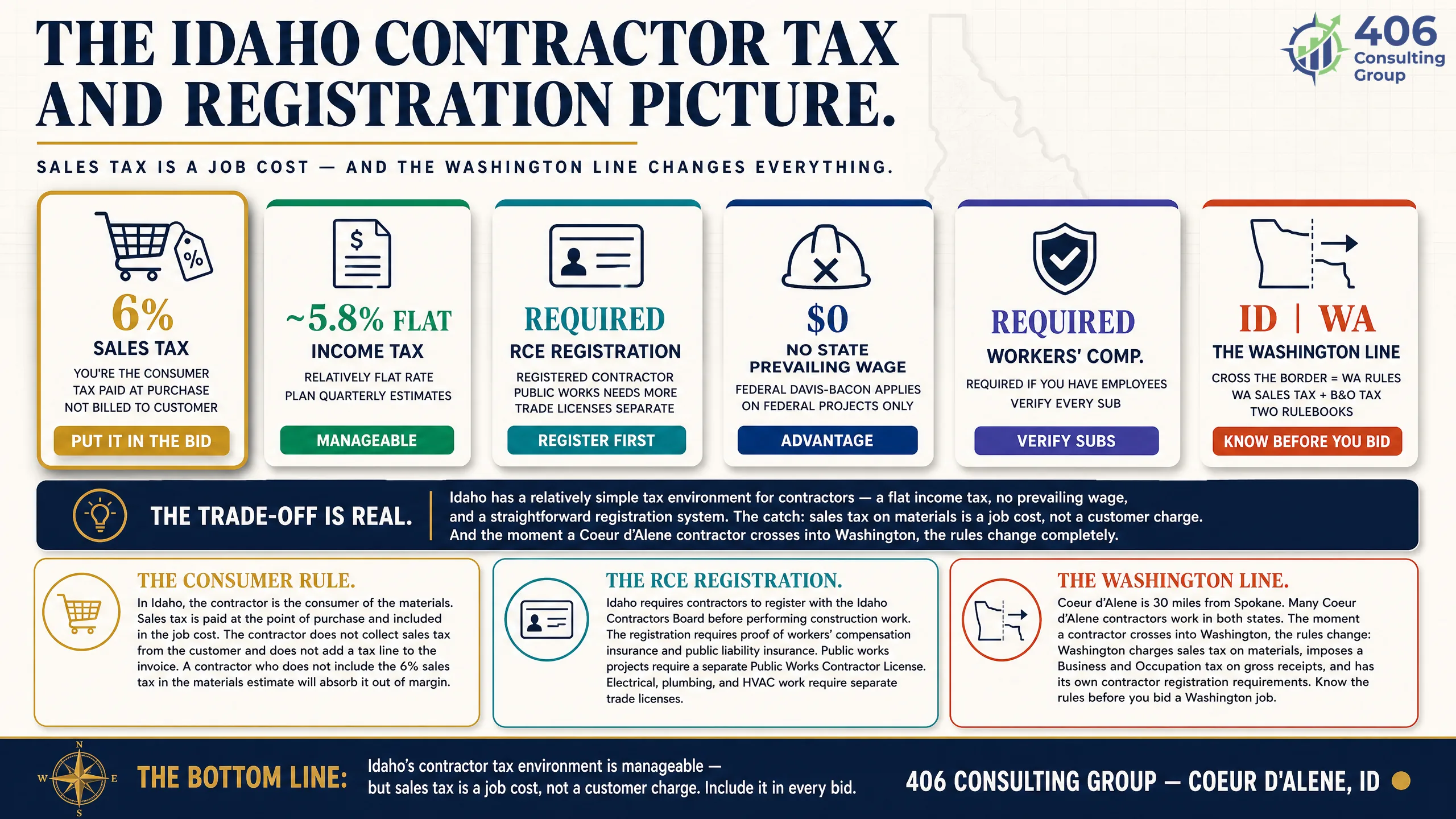
Confirm current rules with the Idaho State Tax Commission. Two pieces deserve a closer look — the consumer rule, and the Washington border.
Idaho Sales Tax: You're the Consumer
Idaho answers the "who pays the sales tax on materials?" question differently than a lot of states. For a contractor improving real property, Idaho generally treats you as the consumer of the materials — meaning you pay sales or use tax when you buy the materials, and you do not charge your customer sales tax on the construction job itself. You're not a retailer collecting tax from the homeowner; you're the end user of the lumber, wire, pipe, and fixtures, and the tax is baked into your cost.
For the books, that has two consequences. First, materials tax is a job cost, not a pass-through — it belongs in your estimates and your job costing at the taxed price, or you'll quietly under-price every bid. Second, if you also sell tangible goodsat retail (say, over-the-counter parts or appliances you don't install), that side can be taxable differently, so mixed operations need care. There are also use-tax obligations when you pull materials from inventory or bring in items on which no Idaho tax was paid. It's a different mental model than a "collect-from-the-customer" state, and getting it into the books correctly keeps both your pricing and your compliance clean.
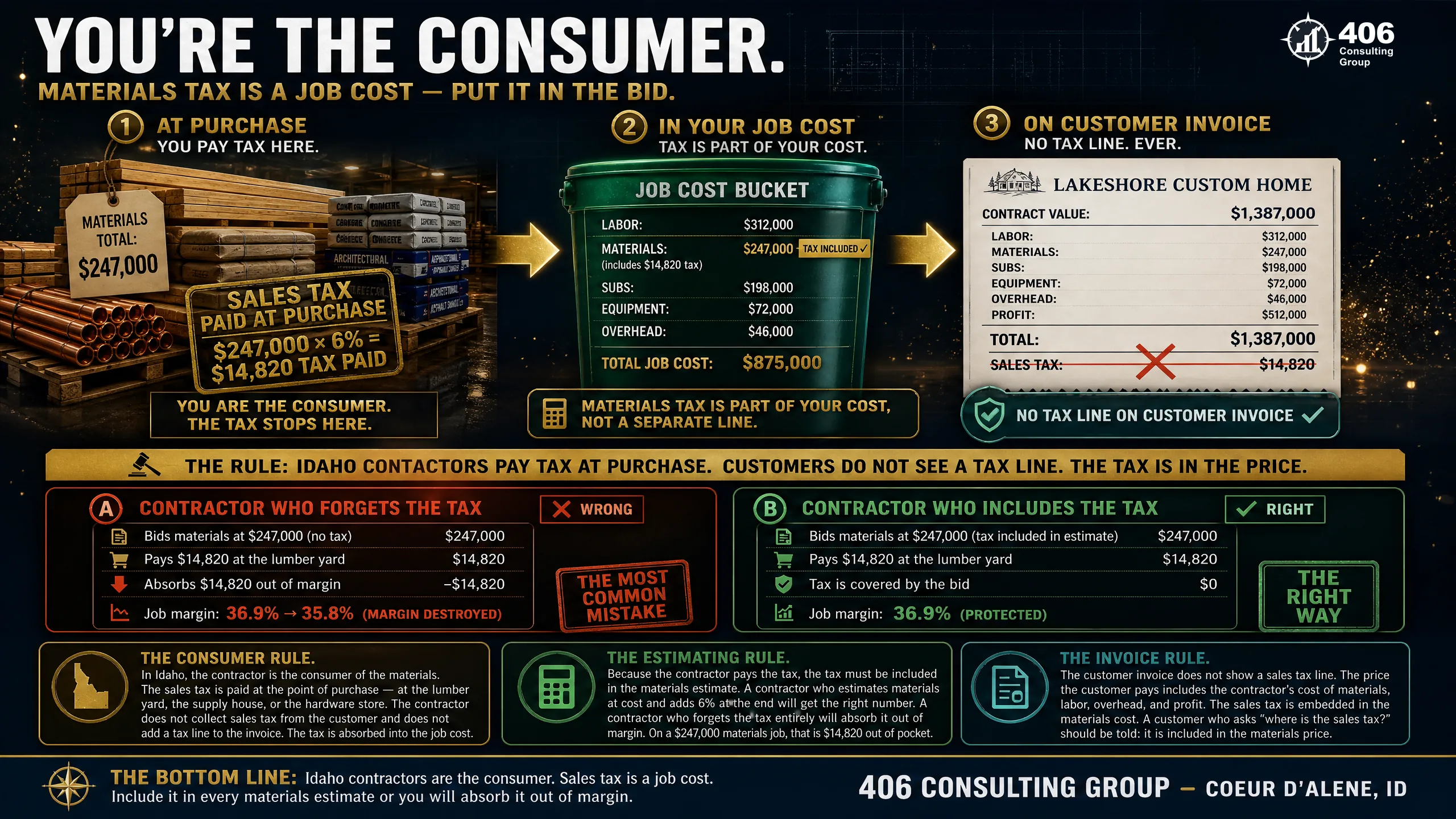
Confirm how the rule applies to your specific work with the Idaho State Tax Commission — especially if you both install and sell.
Working Across the Line: Idaho vs. Washington
Here's the piece unique to the Coeur d'Alene market: Spokane and the Washington line are right next door, and the moment materials or jobs cross it, you're in a different tax world. Buy materials in Washington and you may pay Washington sales tax at purchase; take a construction job on the Washington side and you can land in Washington's system entirely — including the Business & Occupation (B&O) tax (a gross-receipts tax with no Idaho equivalent) and Washington's own contractor sales-tax rules, which treat construction differently than Idaho does. Two neighboring states, two genuinely different rulebooks.
For a CdA contractor who routinely buys in Spokane or bids work across the border, this isn't a footnote — it's a real compliance and pricing issue. Your books need to know which state each purchase and each job belongs to, so materials carry the right tax, so any Washington B&O and registration obligations are handled, and so a job priced on Idaho assumptions doesn't lose money under Washington rules. If you work both sides of the line, this is exactly where a construction-literate accountant earns their fee.
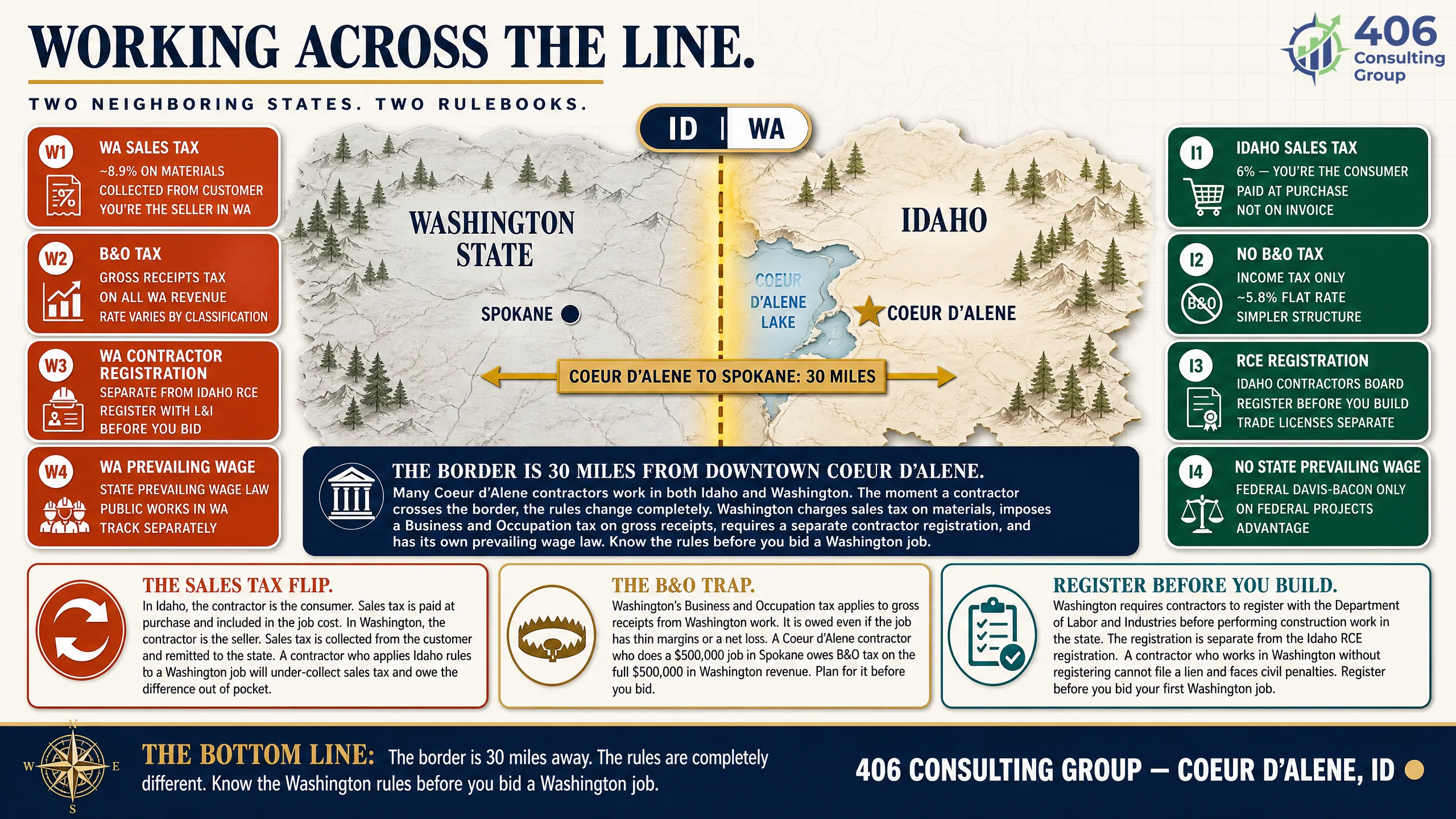
Verify any Washington obligations with the Washington Department of Revenuebefore you bid across the line — the B&O tax in particular surprises Idaho contractors.
Idaho Contractor Registration & Public Works
Idaho requires most construction contractors to hold an active Idaho Contractor Registration (RCE) — it's lighter than a full trade-exam license in some states, but it's mandatory to legally offer or perform many kinds of construction work, and it comes with insurance requirements. Public-works projects go further, requiring a separate Public Works Contractor License tied to the size of work you take on. Certain trades — electrical, plumbing, HVAC — carry their own state licensing on top.
For the books, registration, licensing, and the insurance behind them are recurring costs and obligations that belong in your financial picture — and letting registration lapse can jeopardize your ability to contract and get paid. As you grow, take on public work, or move into new trades, your registration and any public-works licensing have to keep pace, and your financials help support the bonding that larger public jobs require. Confirm your specific requirements with the Idaho Division of Occupational and Professional Licenses (DOPL) and the public-works licensing board.
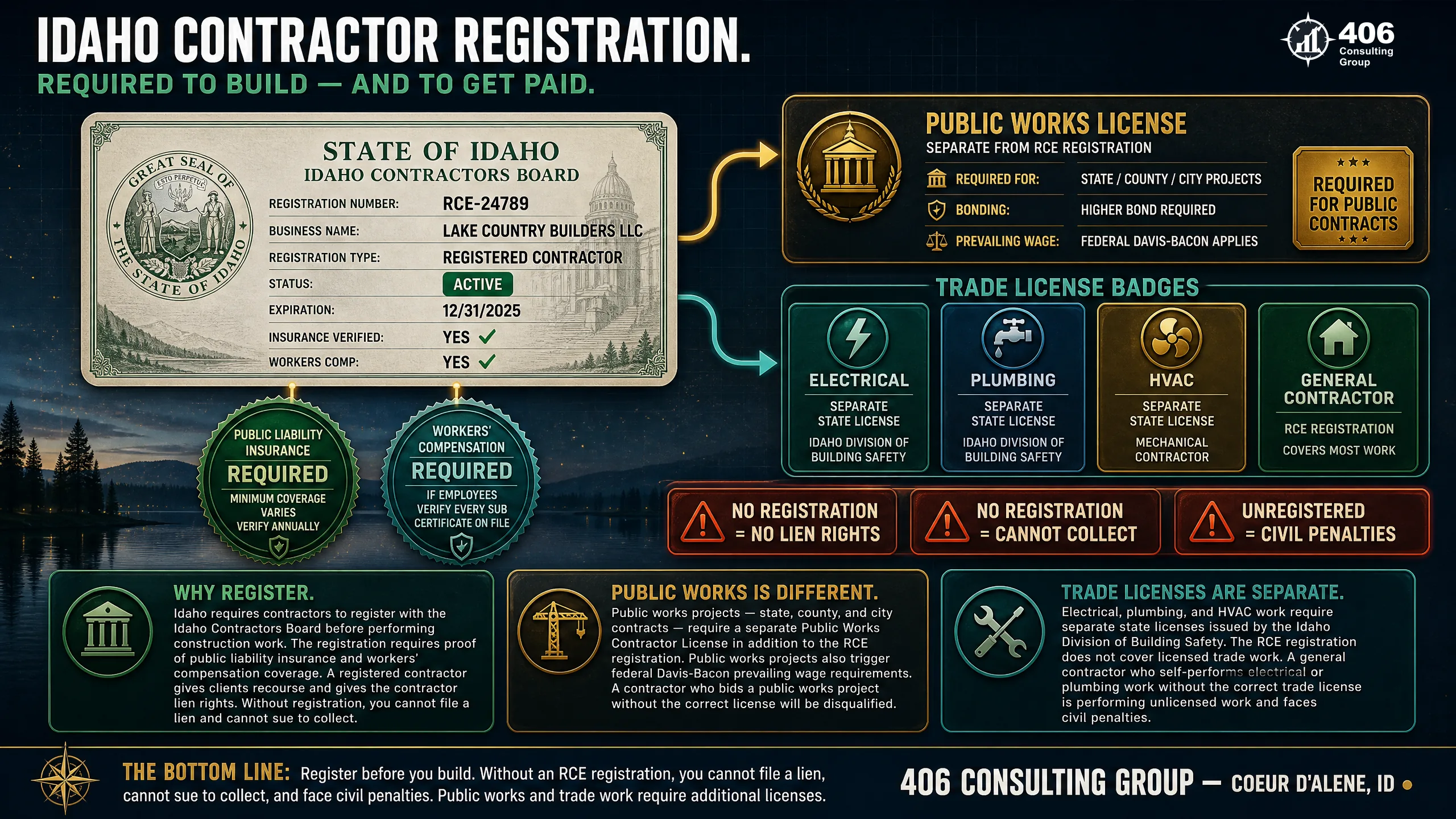
Registration is the baseline for building legally in Idaho; keeping it and your insurance current rests on organized books underneath.
Job Costing: Which Job Actually Makes Money
Ask a North Idaho builder which of their projects earned the best margin last year and you'll often get a guess, not an answer. Job costing replaces the guess with a number by tagging every labor hour, material invoice (at its taxed cost, remember), subcontractor bill, and equipment charge to the specific job it belongs to. On the custom-home and lakefront work that defines this market — where two projects can look similar and perform completely differently — per-job margin is the only way to see which work is worth chasing and which quietly drains the bank.
It's also the base every other construction report is built on: an accurate WIP schedule, correct progress billing, and a real read on whether a change order pays all depend on job-level costs underneath them. For a Coeur d'Alene contractor scaling into a hot market, job costing is what keeps the growth profitable instead of merely larger.
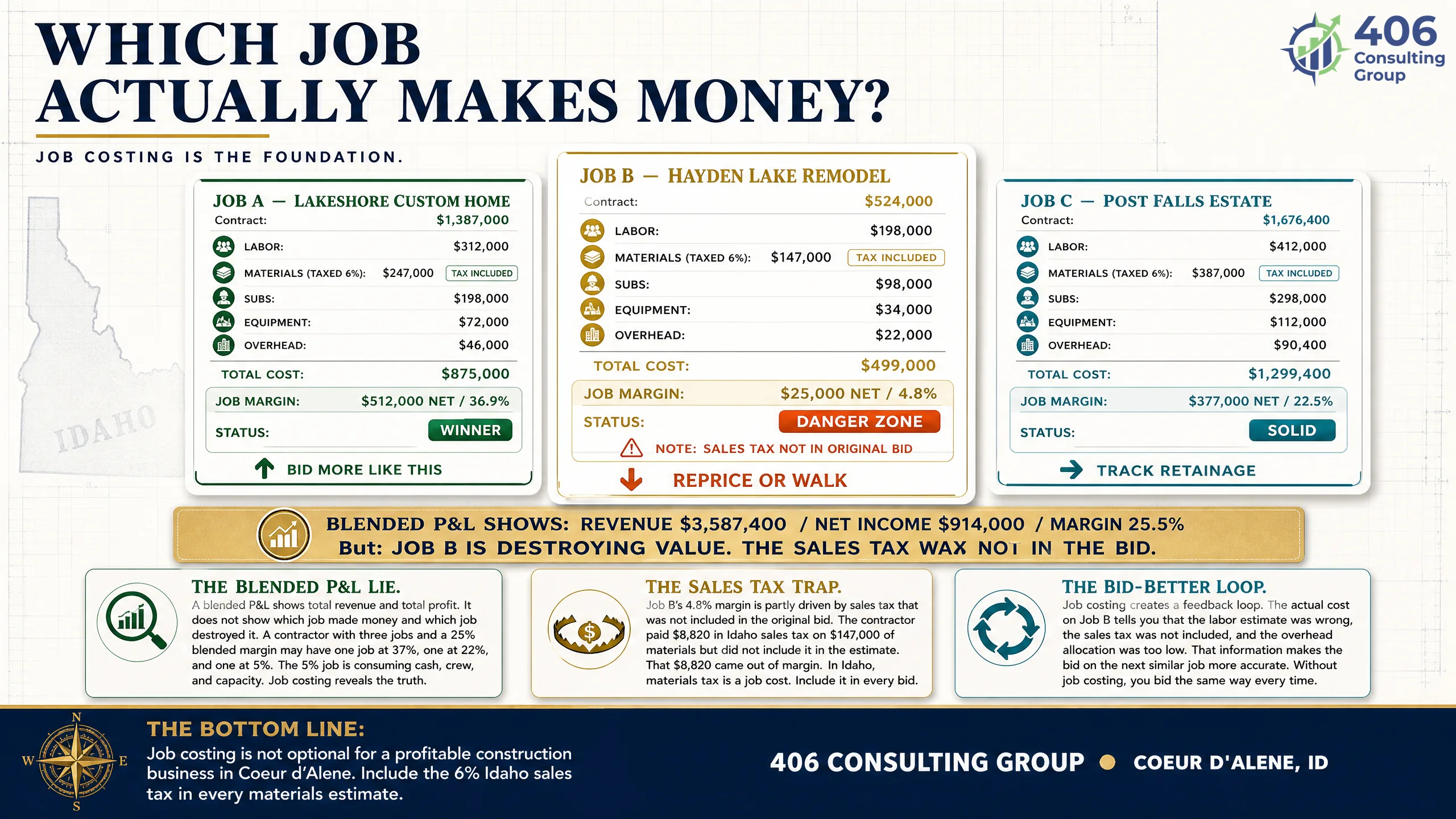
Digging into which jobs and crews truly carry the business is the whole thrust of our contractor unit economics work — job costing is how you finally see it.
WIP, Percentage-of-Completion, Retainage & Change Orders
Jobs that run for months call for accounting a plain ledger can't deliver. A work-in-progress (WIP) schedule puts each open job's costs, billings, and estimated cost-to-complete in one view, exposing whether you're over- or under-billed — running ahead of the work can make spent cash look like profit, while running behind means your own capital is floating the project. Percentage-of-completion books revenue as the job earns it instead of in one lump at closeout, so each month's numbers reflect where the work truly stands.
Then there's retainage — the portion held back until completion, which parks real cash and has to live as its own receivable — and change orders, which reshape scope and margin and must be logged and billed before they blur into the job. Kept together, these give you month-to-month numbers that hold up when a lender or bonding agent looks hard at them — which, in a fast-growing market, they will.
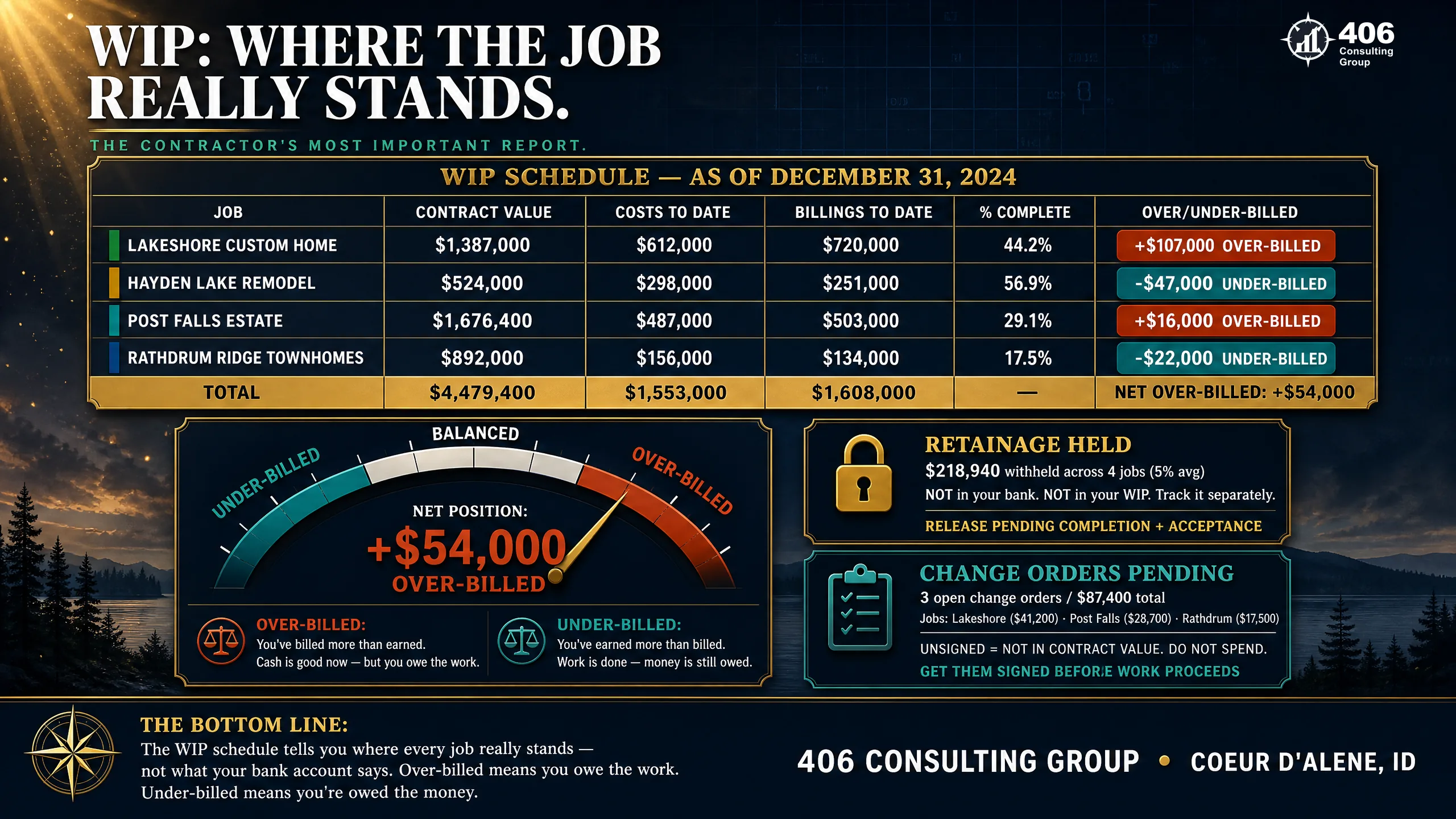
Once the jobs get sizeable, this is the terrain a controller or CFO function takes over — a live WIP is the report that tells you where the business really stands.
Payroll, Prevailing Wage & the Idaho Labor Picture
Idaho construction payroll has its own shape. Because Idaho has a flat state income tax, payroll includes state withholding alongside federal. On public works, Idaho is notable for what it lacks: the state has no prevailing-wage law, so unlike many states, prevailing-wage and certified payroll obligations generally arise only from the federal Davis-Bacon Act on federally funded projects — worth confirming project by project, since the requirement follows the funding. Workers' compensation is required in Idaho, and the class codes on construction trades aren't trivial.
Beyond that, construction payroll means tracking labor to jobs so it feeds job costing, handling a heavy mix of subcontractors and 1099s with correct worker classification, and — if you have crews working across the Washington line — being aware that WA payroll rules and its workers' comp system differ from Idaho's. Set up well, payroll becomes clean data flowing into your job costs instead of a monthly headache.
Our payroll work — certified payroll on federal jobs included — keeps this quietly handled in the background.
Equipment, Depreciation & Personal Property
Equipment shapes a contractor's books two ways. On the federal side, Section 179 and bonus depreciation can let you write off a large share of a truck, excavator, or trailer in the year of purchase — valuable as you build out a fleet, though worth timing against your multi-year income rather than deducting on reflex. On the Idaho side, the state taxes business personal property, but with an exemption that covers a meaningful amount of equipment per taxpayer per county — so many smaller contractors owe little or nothing, while larger equipment-heavy outfits should track it and confirm where they land.
Either way, a clean, current fixed-asset schedule earns its keep: it keeps depreciation right, keeps any personal-property reporting accurate, and — because equipment time belongs on the jobs that used it — feeds job costing so idle iron shows up as the margin drain it is. Confirm the current personal-property exemption and any filing with your county assessor.
The depreciation-and-income-tax planning lives in the Coeur d'Alene tax guide; the tracking that powers it starts in the books.
Common Construction Bookkeeping Mistakes
A handful of avoidable errors cause most of the financial pain for Coeur d'Alene contractors.
Not treating materials tax as a job cost
Because you pay the sales tax as the consumer, it belongs in every estimate and job cost — leave it out and you under-price the work.
Ignoring the Washington line
Buying in Spokane or bidding across the border without accounting for WA sales tax and the B&O tax can quietly erase a job's margin.
Running without job costing
Without costs tied to each job, you can't tell which lakefront builds or remodels actually made money — so you keep repeating the losers.
Ignoring the WIP schedule
Over- and under-billing hide the real state of every open job, and lenders and sureties want a clean WIP before they extend you.
Letting registration lapse
An inactive Idaho contractor registration can jeopardize your ability to contract and get paid.
Each is a setup-and-habit problem — and each clears up once the books are built for Idaho construction and run on a monthly rhythm.
Local vs. a Great Remote Partner
A Coeur d'Alene contractor spends the day on the site and in the truck, not in an accountant's waiting room — so working with a remote partner matches how you already operate. The thing that decides whether it works is knowledge, not a local address: can your accountant handle Idaho construction — the consumer sales-tax rule, contractor registration, the Washington-border questions, job costing, and WIP? A specialist who knows all of that, wherever they sit, is far more valuable than a nearby generalist who's never touched a WIP schedule or a cross-border job.
The way we work suits a builder's life: cloud accounting and job-costing software, receipts and hours captured from the field, connected bank feeds, and a monthly close you can rely on — Idaho-literate construction books without a single trip to an office. On the lake, up in Hayden or Post Falls, or out across Kootenai County, the service and the expertise are exactly the same.
The deciding factor is whether your accountant truly knows Idaho construction — proximity has nothing to do with it.
How to Get Started
Getting a Coeur d'Alene contractor's books in order is three steps.
Get the Idaho pieces right
Build materials sales tax into your estimates as a job cost, keep your contractor registration current, and set up how any Washington-side work and purchasing get handled.
Build construction-grade books
Job costing by phase, a WIP schedule, retainage and change-order tracking, a fixed-asset schedule, and certified payroll where federal work requires it.
Run it monthly
Monthly close, WIP review, sales/use-tax handling, and job reporting — so you always know which jobs pay and whether the business is ahead.
Not sure where your books stand? Our Financial Maturity Assessment maps it out in about eight minutes.
FAQ: Coeur d'Alene Construction Accounting
Do Idaho contractors charge customers sales tax?
Generally not on real-property construction work. Idaho treats a contractor improving real property as the consumer of the materials, which means you pay sales or use tax when you buy the materials and you don't charge the customer sales tax on the job itself. The tax is part of your cost, so it has to go into your estimates and job costing at the taxed price — otherwise you under-price the work. If you also sell tangible goods at retail (parts or appliances you don't install), that side can be taxed differently, and use tax can apply to items pulled from inventory or bought without Idaho tax. Confirm how it applies to your specific mix with the Idaho State Tax Commission.
What happens if I buy materials or take a job in Washington?
You step into a different system. Buying materials in Washington can mean paying Washington sales tax at the point of purchase, and taking a construction job on the Washington side can put you under Washington's rules entirely — including its Business & Occupation (B&O) tax, a gross-receipts tax with no Idaho equivalent, plus Washington's own contractor sales-tax treatment, which differs from Idaho's. For a Coeur d'Alene contractor who buys in Spokane or bids across the line, your books need to track which state each purchase and job belongs to so nothing is misapplied and no job is priced on Idaho assumptions but performed under Washington rules. Verify Washington obligations with the Washington Department of Revenue.
Do I need to be a registered contractor in Idaho?
Generally, yes. Idaho requires most construction contractors to hold an active Idaho Contractor Registration (RCE), which is mandatory to legally offer or perform many types of construction work and comes with insurance requirements. Public-works projects require a separate Public Works Contractor License tied to the size of the work, and trades like electrical, plumbing, and HVAC carry their own state licensing. Letting your registration lapse can jeopardize your ability to contract and get paid, so it's worth keeping current as you grow or move into new trades. Confirm your specific requirements with the Idaho Division of Occupational and Professional Licenses (DOPL) and the public-works licensing board.
Is there prevailing wage or certified payroll in Idaho?
Idaho has no state prevailing-wage law, so unlike many states, prevailing-wage and certified-payroll obligations generally arise only from the federal Davis-Bacon Act on federally funded projects — not from a state mandate. If you take federal work, you'll typically need to pay the required wage rates and file certified payroll reports for each worker, and errors can hold up your payments, so it's worth having payroll set up to produce accurate reports. Because the requirement follows the funding source, confirm it project by project. Separately, workers' compensation is required for employees in Idaho.
Can 406 Consulting Group do my Coeur d'Alene construction bookkeeping remotely?
Yes — remote is how a jobsite-based contractor is best served, not a fallback. It all runs on cloud accounting and job-costing software, field-captured receipts and hours, live bank feeds, and a monthly close you can count on. For a construction business the deciding factor is know-how — job costing, WIP, Idaho's consumer sales-tax rule, contractor registration, the Washington-border questions, and bonding-ready financials — rather than how near the office is. We back Coeur d'Alene and Kootenai County contractors the same way whether you're on the lake, in Hayden or Post Falls, or anywhere across North Idaho.
Keep Reading
Trades & Construction — Coeur d'Alene, ID
Build the Lake Country on Books You Can Trust.
406 Consulting Group keeps Coeur d'Alene contractors clean and compliant — Idaho's consumer sales-tax rule, the Washington-border questions, registration, job costing, WIP, and equipment handled — delivered remotely, by a firm that knows North Idaho construction.
Coeur d'Alene Construction Quick Reference
Coeur d'Alene, ID — Kootenai County
Working Both Sides of the Line?
Idaho tax, the WA border & job costing, handled.
About the Author
Jason Anderson
Co-Founder, 406 Consulting Group
Big-firm-trained accountant serving contractors and trades across the Mountain West. Jason helps Coeur d'Alene builders handle Idaho's consumer sales-tax rule and the Washington-border questions, run real job costing and WIP, keep registration current, and build books strong enough to grow.
Read the Full Story