
Accounting for Charlotte Small Business:
Which Help You Need, and When
Accounting is really four functions — bookkeeping, tax, controller, and CFO. This is the map: which one your Charlotte business needs, in what order, and how to choose a partner who connects them and reads your numbers like a lender.

Running a small business in Charlotte means competing in one of the fastest-growing metros in the country — and doing it in the shadow of the second-largest banking center in the United States, where lenders, investors, and sophisticated finance are unusually close at hand. That's an opportunity and a bar. The businesses that make the most of it treat their accounting not as a once-a-year tax chore but as the system that tells them what's working, funds their growth, and earns them capital when they need it.
This is the overview — the map. Rather than repeat our deep-dive articles, it answers the question owners actually ask first: which kind of accounting help do I need, in what order, and how do I choose the right partner? The detailed guides on bookkeeping, tax, CFO & controller work, and construction accounting go a level deeper on each.
By Carrie Anderson — Co-Founder, 406 Consulting Group. Former commercial banker and underwriter who has reviewed hundreds of businesses' financials from the lender's side of the table — now helping Charlotte owners build the accounting that earns a yes.
Quick Answer: Accounting for a Charlotte Small Business
- →There are four functions: bookkeeping, tax, controller, and CFO/advisory — most owners only buy the first two and stall.
- →Buy them in sequence: reliable books first, proactive tax next, then control and strategy as you grow.
- →North Carolina adds its own rules — the franchise tax, sales/use tax, and a declining income tax — that reward planning.
- →Choose a partner who connects the functions and reads financials the way a lender does — not four disconnected vendors.
- →The right partner can be remote: expertise and integration beat office proximity, even in a banking city.
Table of Contents
The Charlotte Small-Business Landscape
Charlotte's economy runs on finance, energy, healthcare, logistics, and a construction boom feeding all of it — and money moves fast here. That means two things for a small business. First, the competition is real and often well-capitalized, so thin margins and sloppy numbers get punished. Second, because capital is close, a business with clean, credible financials can reach for growth financing that owners in other cities can only dream about. Your accounting is what decides which side of that line you're on.
In a banking city, your books aren't just a record — they're the application. Someone with lending authority will eventually read them, and what they see decides what you can build next.
So what does "good accounting" actually consist of? It breaks into four distinct functions.
The Four Functions Every Business Needs
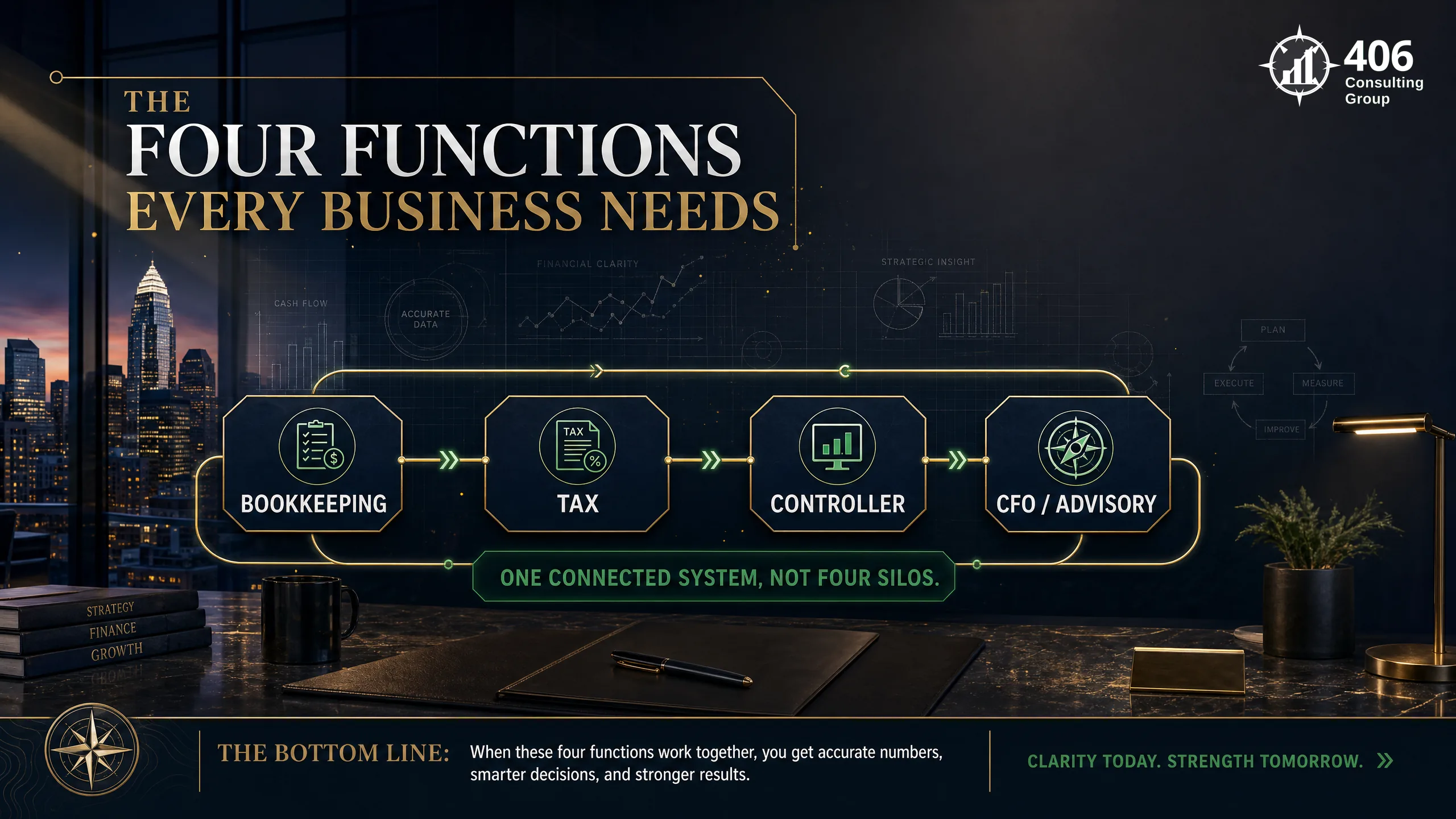
"Accounting" is really four jobs, and most owners only buy the first two — which is exactly why they plateau. Knowing the full set tells you what you're missing.
Bookkeeping
Records and reconciles every transaction — the clean foundation everything else stands on.
Tax
Proactive planning and preparation — the PTET election, S-corp math, and NC's declining rate.
Controller
Makes the numbers reliable and on time — a real monthly close and true job-level profit.
CFO / Advisory
Turns numbers into strategy — forecasting, pricing, and lender-ready capital planning.
You don't need all four on day one. You need them in the right order.
What You Need, and When
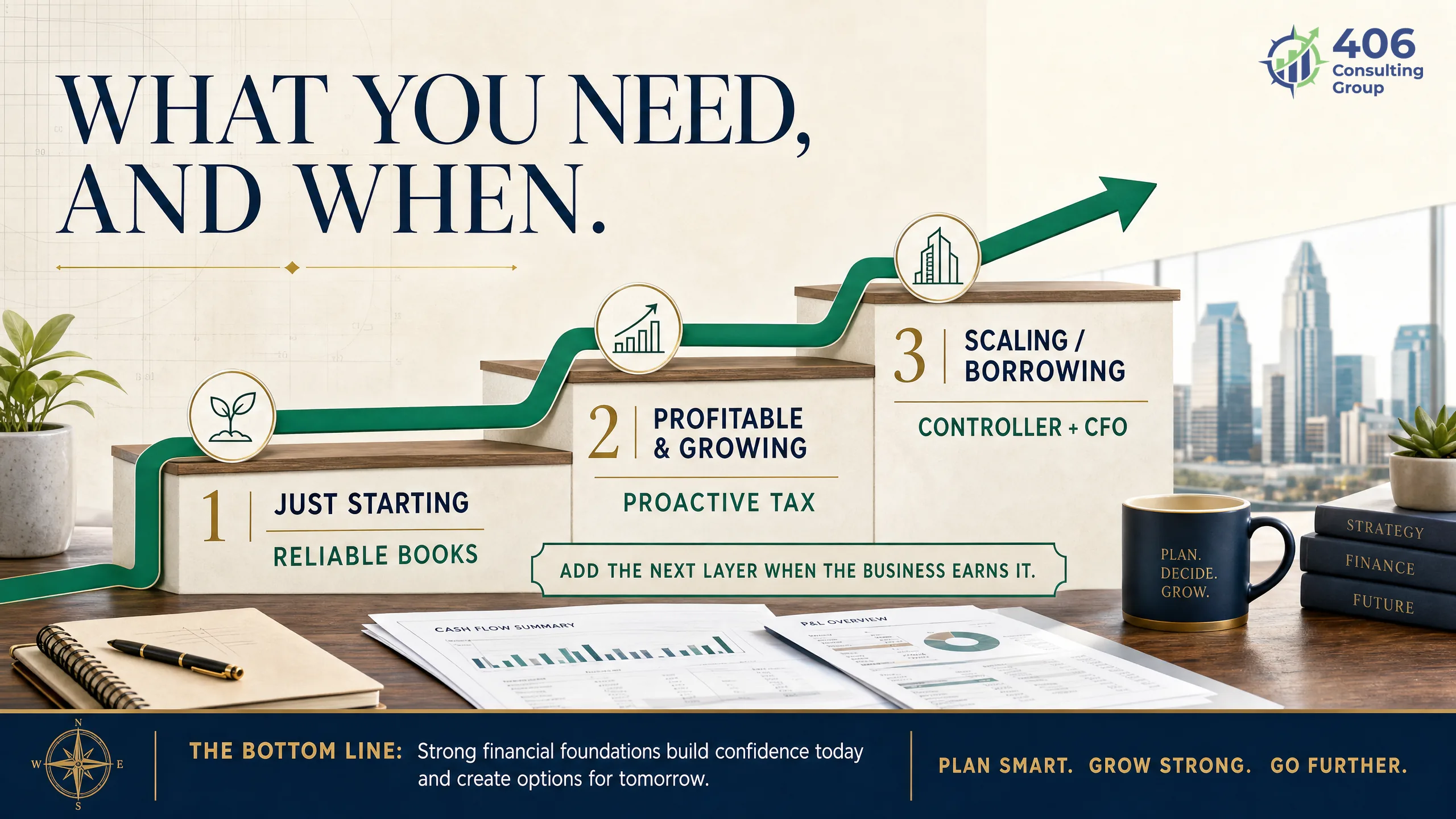
The mistake we see most is buying out of order — an owner hiring a "CFO" while the books are still a mess, or chasing tax strategies on numbers no one trusts. Strategy built on unreliable numbers is just expensive guessing. The sequence that works: get the bookkeeping reliable, layer in proactive tax planning so you stop overpaying, bring in controller discipline once decisions depend on timely numbers, and add CFOstrategy when you're forecasting, pricing, and reaching for capital.
Just starting / small
Reliable bookkeeping + a tax filer who won't miss deadlines.
Profitable & growing
Proactive tax planning (S-corp, PTET) + a real monthly close.
Scaling / borrowing
Controller discipline + fractional CFO forecasting and capital work.
Wherever you are on that path, North Carolina adds a few rules worth planning around.
The North Carolina Realities to Plan For
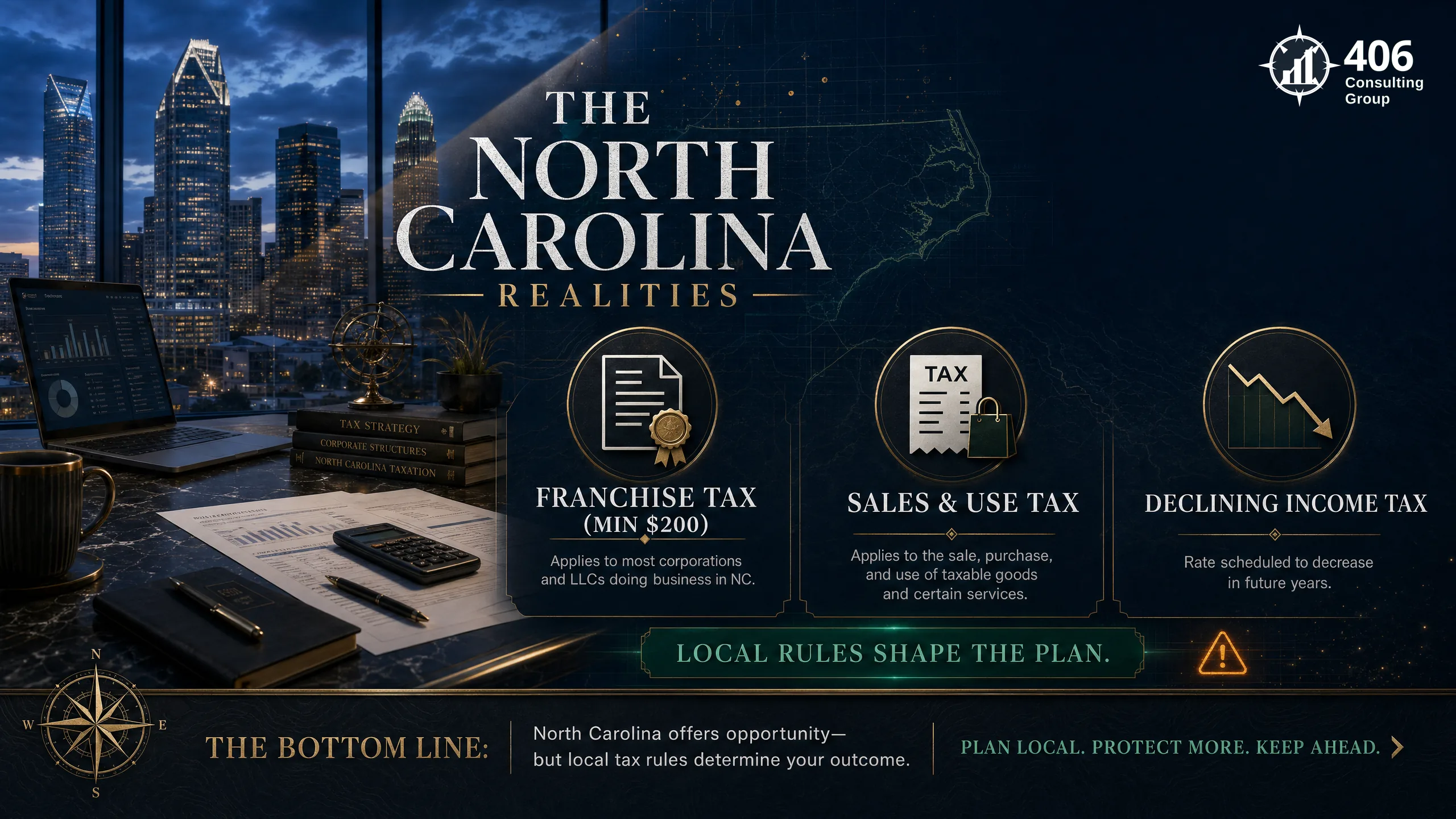
North Carolina is a relatively business-friendly state with a falling income tax, but it has its own wrinkles. The franchise tax (a tax on net worth, minimum $200) applies to corporations and S-corps and quietly changes the LLC-versus-S-corp math. Sales and use tax catches businesses that owe use tax on out-of-state purchases they never charged tax on. And the steadily declining income taxmakes the timing of income and deductions a real lever. None of these are reasons to panic — they're reasons to have someone who plans around them rather than reacting each April.
Always confirm the current-year specifics with the North Carolina Department of Revenue — and, more usefully, with an advisor who plans ahead. Which raises the real question: how do you pick that advisor?
How to Choose an Accounting Partner
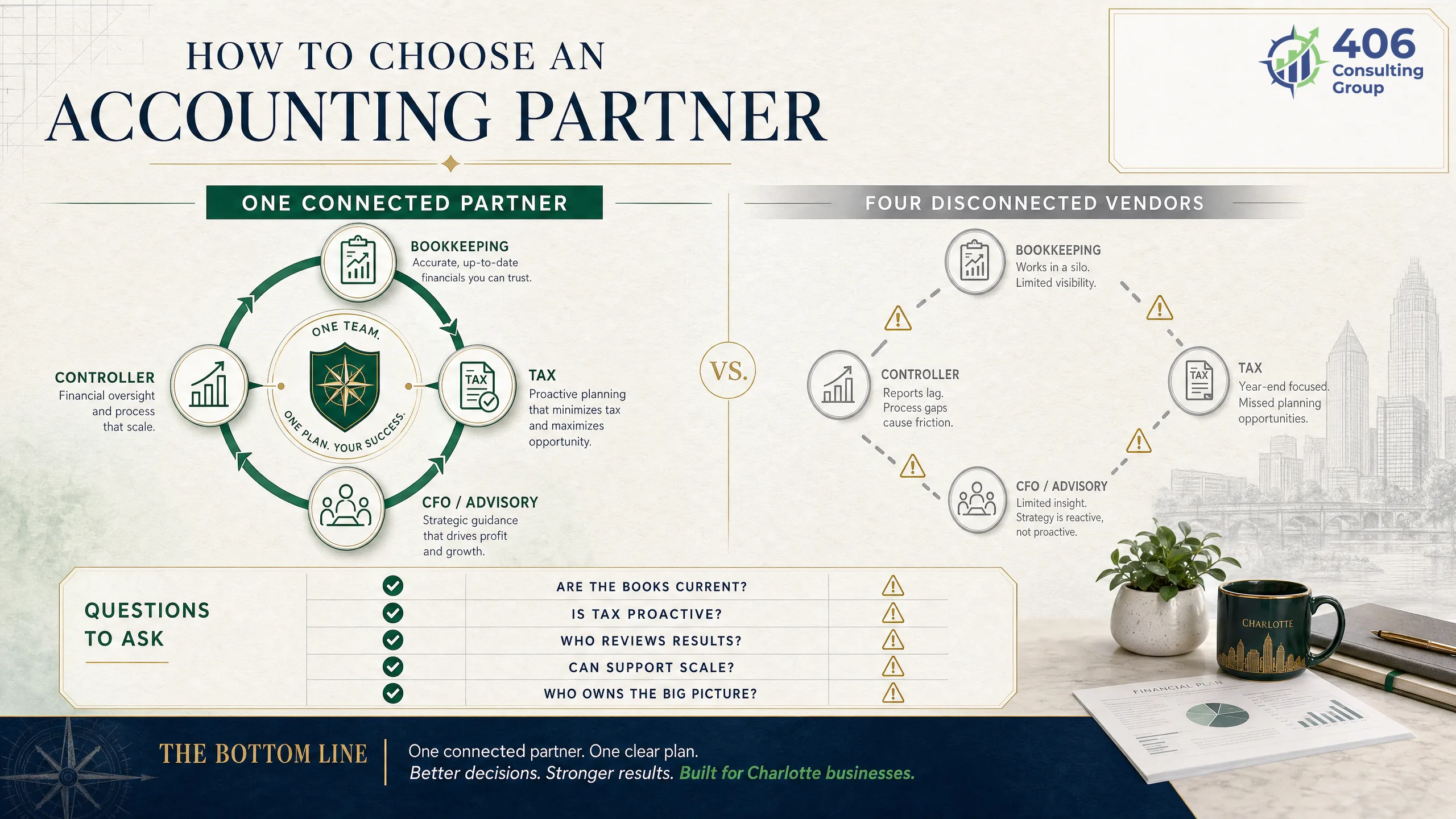
The most common failure isn't hiring a bad bookkeeper or a bad tax preparer — it's hiring four disconnected ones. When your bookkeeper, tax preparer, and whoever gives you advice don't talk to each other, the gaps between them are where money leaks and opportunities die. The best partner treats the four functions as one connected system, so a tax decision reflects your real books and a growth plan reflects your real tax picture. In a banking city, add one more test: does this partner understand how a lender reads your numbers?
Five questions to ask a prospective partner
- 1.Do you connect bookkeeping, tax, and advisory — or just do one piece?
- 2.Can you give me a real monthly close, not just a year-end scramble?
- 3.Do you plan taxes proactively (PTET, S-corp) or only file them?
- 4.Have you prepared financials that lenders and bonding companies actually read?
- 5.Will you design around how my whole business runs, not just the accounting?
That standard also tells you when it's time to stop doing it yourself.
When to Graduate From DIY
Doing your own books in the earliest days is normal and fine. The signs it's costing you more than it saves are consistent: you're doing the books at 11 p.m. instead of selling or serving, you can't confidently say whether last month made money, tax time is a panic, and you suspect you're overpaying but don't know where. When the hours you pour into the books are worth more spent running the business — and when a mistake in them could cost you real money or a loan — you've outgrown DIY. The goal was never to save the bookkeeping fee; it was to make more than the fee with the time and clarity you get back.
What separates a great partner from an adequate one is how far past the numbers they think.
The Whole-Company Systems Advantage
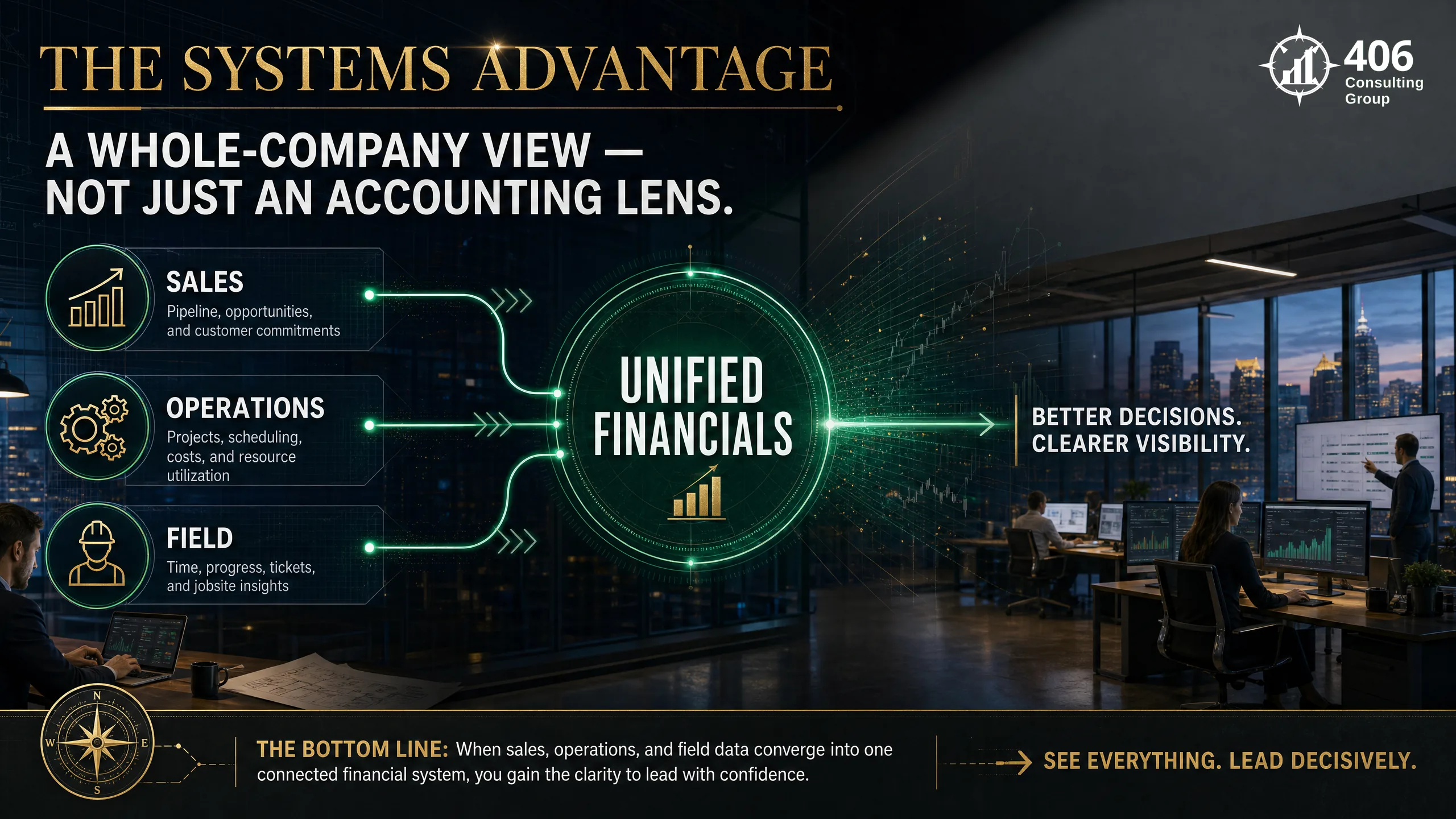
Most accounting help looks at your business through an accounting-only lens. We design financial systems from a whole-company, cross-departmental view— how sales, operations, and the field actually create and spend money — so the numbers connect to how the business really runs, and the reports answer questions an owner actually has. It's the difference between an accountant who hands you statements and a partner who helps you build a company that runs on clean information. That systems mindset is what turns accounting from overhead into an advantage.
And none of it requires the partner to be down the street.
Remote vs. Local in a Banking City
It's natural to assume a Charlotte business needs a Charlotte accountant down the road. But modern accounting is cloud-based and collaborative — shared books, screen-share reviews, and regular planning calls — so what actually matters is the expertise and how connected the work is, not the drive time. A great remote partner who plans your taxes, runs a real close, and prepares lender-ready financials beats an okay local one who just files a return. And because our background is commercial banking and underwriting, we prepare your numbers the way Charlotte's lenders read them — proximity to the bank isn't the point; understanding it is.
Here's how the full Charlotte series fits together.
The Charlotte Accounting Series
Each guide below goes a level deeper on one function. Start wherever your biggest gap is.
Bookkeeping Services in Charlotte, NC
Lender-grade books, NC franchise and sales/use tax, and the foundation everything stands on.
Tax Services in Charlotte, NC
The PTET election, S-corp-vs-franchise-tax math, a declining rate, and multi-state timing.
CFO & Controller Services in Charlotte, NC
Reliable numbers, forecasting, and turning performance into access to capital.
Construction Accounting in Charlotte, NC
Job costing, WIP, licensing tied to financials, and the numbers bonding companies need.
Not sure where to start?
Take the Financial Maturity Assessment and we'll show you which rung you're on — and the one function that will move your Charlotte business furthest right now.
FAQ: Accounting for Charlotte Small Business
How much does accounting cost for a small business in Charlotte?
It depends on which of the four functions you need and how complex your business is. Basic monthly bookkeeping for a straightforward small business is modest; layering in proactive tax planning, a real monthly close, and fractional CFO strategy costs more because it does far more. The better way to think about it isn't price but return: good bookkeeping and tax planning routinely pay for themselves in taxes saved and mistakes avoided, and CFO-level work is judged by the decisions and financing it unlocks. Beware the cheapest option that only files a year-end return — it's usually the most expensive once you count what it misses.
Do I need a CPA, a bookkeeper, or a full accounting firm?
Most small businesses need more than one of those, which is exactly the problem with hiring them separately. A bookkeeper keeps the records; a CPA or tax professional handles planning and returns; a controller and CFO make the numbers reliable and strategic. Hiring them as disconnected vendors leaves gaps between them where money leaks. A firm that connects all four functions — and reads your numbers the way a lender does — gives you one coherent financial picture instead of three partial ones. That integration, more than any single credential, is what actually moves the needle.
When should a Charlotte business hire an accountant instead of doing it themselves?
When the time you spend on the books is worth more spent running the business, or when a mistake could cost you real money or a loan. Concretely: you're doing books late at night instead of selling, you can't confidently say whether last month was profitable, tax season is a panic, or you're about to approach a lender. In a banking city especially, the moment you're reaching for capital is the moment amateur books start costing you — a lender's read of your financials directly affects what you can borrow and on what terms.
What makes accounting different in Charlotte specifically?
Two things. First, North Carolina's own rules — a franchise tax on net worth that changes the S-corp decision, sales and use tax exposure, and a steadily declining income tax that makes timing matter. Second, Charlotte's identity as the second-largest banking center in the country: capital is unusually close, but only to businesses whose financials can earn it. That combination rewards accounting that both plans around NC's tax code and prepares your numbers to pass a sophisticated lender's review — which is precisely where our commercial-banking background applies.
Can a Charlotte business use a remote accounting firm?
Yes — and increasingly it's the norm. Modern accounting runs on cloud software, shared books, and video planning calls, so the work happens the same whether your accountant is uptown or across the country. What matters is expertise, responsiveness, and how well the functions connect — a great remote partner who plans your taxes and prepares lender-ready financials beats an okay local one who only files a return. We serve Charlotte and the Carolinas entirely remotely, and most of our own local clients never come into an office either.
The Four Functions
Which are you missing?
Charlotte Accounting
One connected system, remote.
About the Author
Carrie Anderson
Co-Founder, 406 Consulting Group
A former commercial banker and underwriter, Carrie reviewed hundreds of businesses' financials from the lender's side of the table. She helps Charlotte owners build accounting that both saves tax and earns a confident yes when it's time to borrow.
Read the Full Story