
Bookkeeping Services in Charlotte, NC:
Lender-Grade Books in a Banking City
In the country's second-largest banking center, clean books are table stakes. North Carolina's declining flat tax, the franchise tax owners forget, and the bookkeeping a Charlotte business actually needs — delivered remotely.
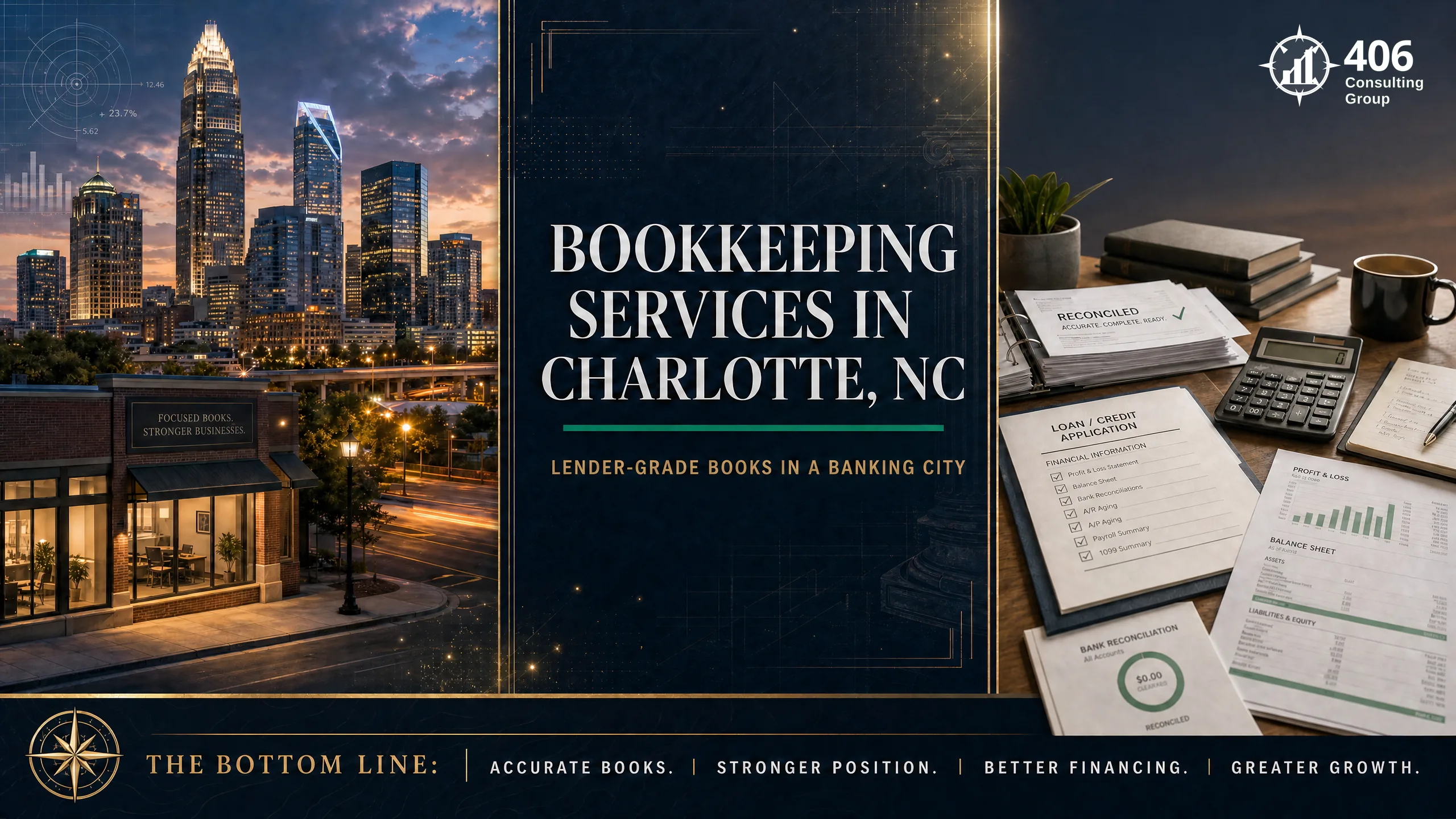
Charlotte is the second-largest banking center in the country, and that shapes how a business here should keep its books. In a city where lenders, investors, and sophisticated finance are part of the air, clean, lender-grade books aren't a nicety — they're table stakes. North Carolina makes that its own discipline: a flat income tax that's declining but layered over a corporate franchise tax most owners forget, a sales tax around 7.25% in Mecklenburg County, and payroll rules with their own thresholds. Simple on the surface, with details that catch a generic setup.
This guide walks the mechanics a Charlotte business actually has to get right — the franchise tax, sales and use tax, NC payroll, and the job costing and clean separation that make your books fundable — and how we handle all of it remotely, with the same depth as a firm uptown.
By Jason Anderson — Co-Founder, 406 Consulting Group. Big-firm-trained accountant who builds clean, decision-ready, lender-grade books — the franchise-tax, sales-tax, and job-costing setups a Charlotte business depends on.
Quick Answer: Bookkeeping for a Charlotte Business
- →Banking city, banking standards — in Charlotte your books should be lender-grade from day one, not cleaned up at loan time.
- →Flat income tax (~4.5%, declining) keeps that side simple — the complexity is the franchise tax, sales tax, and payroll.
- →The NC franchise tax on corporations and S-corps (minimum $200) is the piece owners most often miss.
- →Sales/use tax ~7.25% in Mecklenburg, and workers' comp is required at three or more employees.
- →Delivered remotely across Charlotte and the Carolinas — Carolina expertise over office proximity.
Table of Contents
Why Charlotte Bookkeeping Is Its Own Discipline
Plenty of businesses treat bookkeeping as data entry — categorize the bank feed, reconcile, done. In Charlotte that approach costs you twice. First, because North Carolina's real compliance lives in the places a generic setup ignores: the franchise tax, the sales-and-use rules, the payroll thresholds. And second, because in a banking town, the day you go to a lender — for an equipment line, an SBA loan, an acquisition — messy books turn a fundable business into a "no." The bar here is simply higher.
In the second-largest banking center in the country, your books are read by people who lend for a living. Keep them lender-grade all year, and you're never scrambling to clean up the month a bank asks.
So the right starting point isn't your chart of accounts — it's understanding the North Carolina tax frame your books have to sit inside.
The North Carolina Tax Backdrop
North Carolina has been cutting its income tax for years, but it collects through a few other channels that land on your books. Here's the frame a Charlotte business keeps books inside:
| Item | What it means for your books |
|---|---|
| Income tax | A flat individual rate around 4.5% that's scheduled to keep declining — simple to compute, easy to plan around |
| Franchise tax | A tax on corporations and S-corps based on net worth (minimum $200) — LLCs/partnerships taxed as such generally don't owe it |
| Sales & use tax | About 7.25% in Mecklenburg County (Charlotte); collected on taxable sales and owed as use tax on untaxed purchases |
| PTET election | North Carolina's taxed pass-through entity election lets S-corps/partnerships work around the federal SALT cap |
| Payroll | State income-tax withholding, unemployment insurance, and workers' comp required at three or more employees |
| County | Mecklenburg County (Charlotte); business personal property is reported to the county |
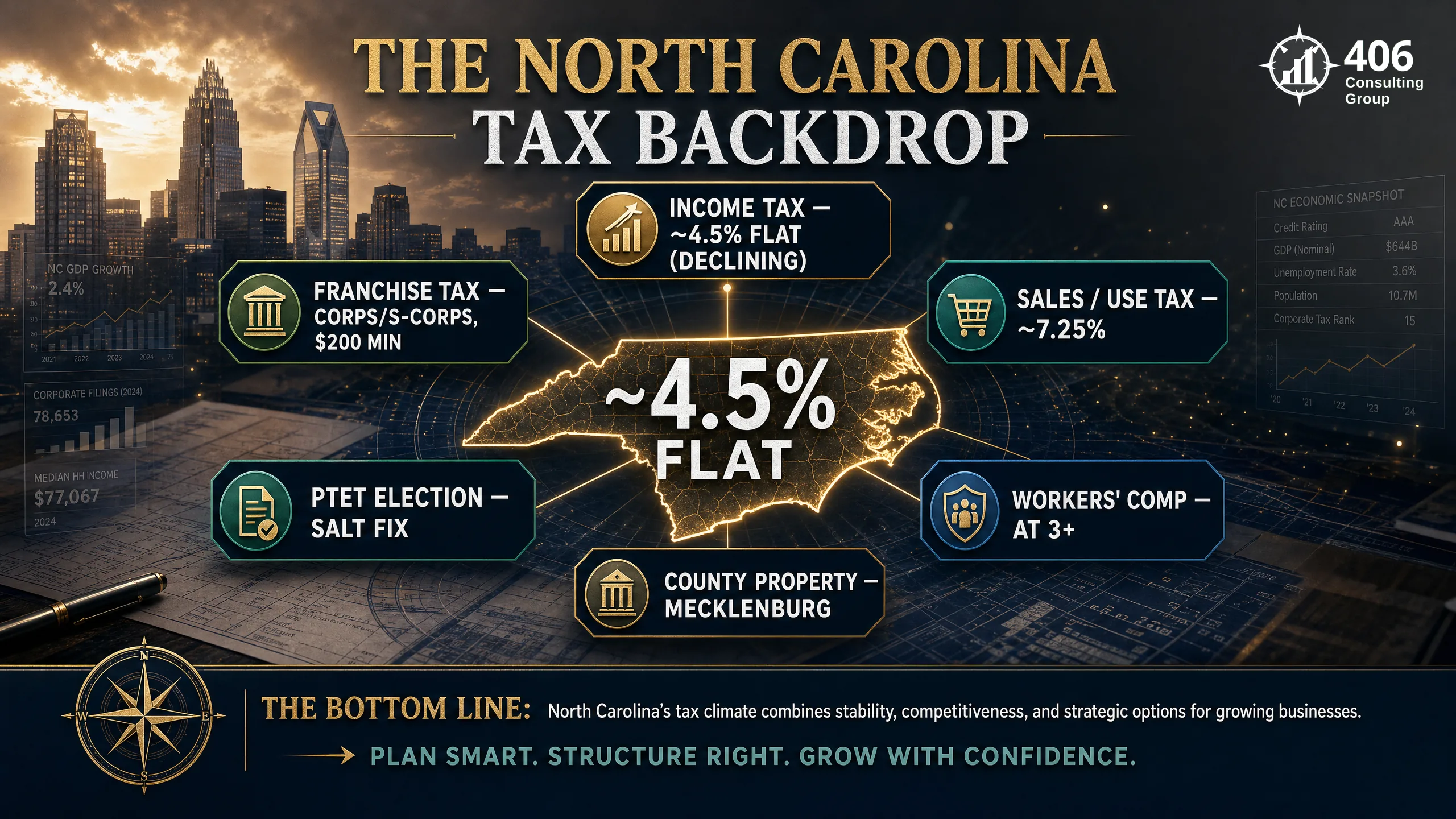
Verify current rates with the North Carolina Department of Revenue. The one that quietly catches business owners most is the second row.
The NC Franchise Tax: The One People Forget
Here's the North Carolina wrinkle owners moving from other states rarely see coming. On top of income tax, North Carolina levies a franchise tax on corporations — including S-corps — calculated on the company's net worth (its capital, essentially), with a minimum of $200. It isn't huge for most small businesses, but it's real, it's annual, and it has to be accrued and filed. Crucially, it usually does not apply to LLCs and partnerships taxed as pass-throughs — which means the franchise tax is one more factor in the entity decision, not just a line to remember.
Owes the franchise tax
C-corporations and S-corporations — on net worth, minimum $200, filed annually with the NC return.
Generally doesn't
LLCs and partnerships taxed as pass-throughs — a real factor when you weigh an S-corp election.
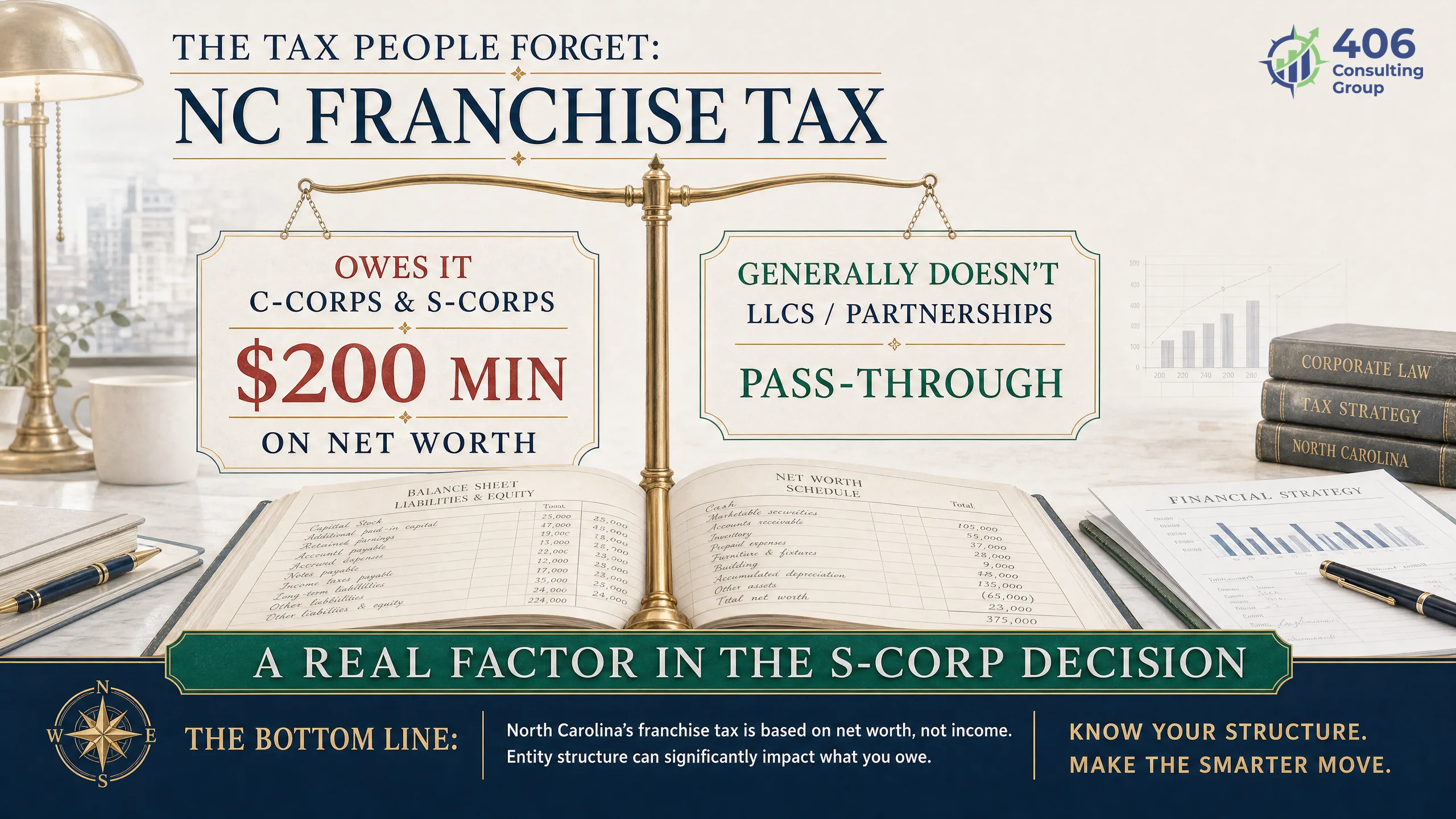
Because it ties to your entity, it's worth coordinating with your tax planning — more on that in the Charlotte tax guide. Next, the tax you touch most often.
Sales & Use Tax Mechanics
North Carolina sales and use tax runs about 7.25% in Mecklenburg County — the state rate plus the county's local rate. If you sell taxable goods or certain services, you collect and remit it; the catch most businesses miss is use tax, which you owe on items you buy without North Carolina tax, such as out-of-state or online purchases used in the business. North Carolina also taxes some services and has specific rules for things like repair, maintenance, and installation, so the "is this taxable?" question deserves a real answer rather than a guess.
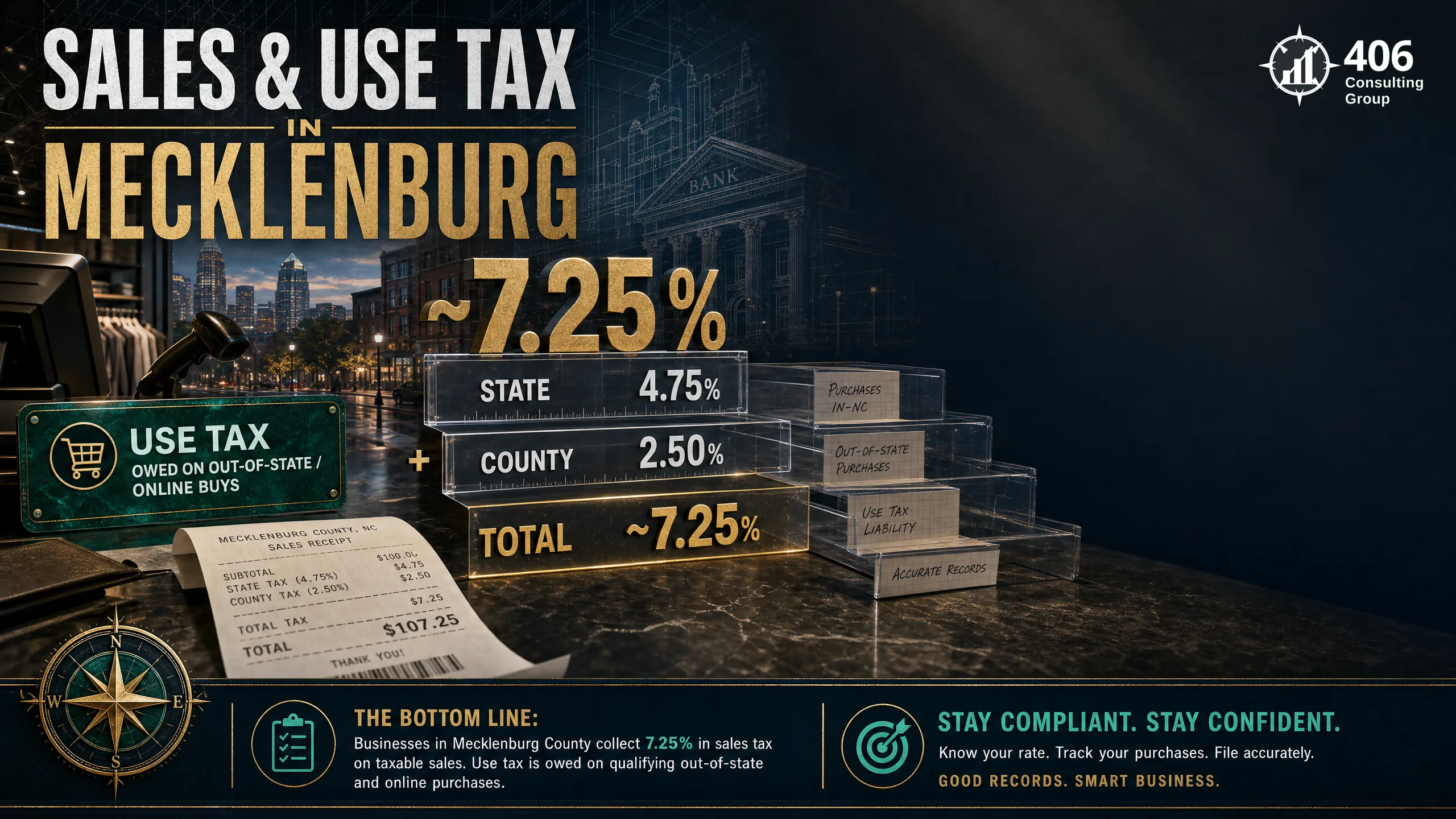
Sales tax is transactional; payroll is where a different set of North Carolina thresholds comes in.
North Carolina Payroll & Workers' Comp
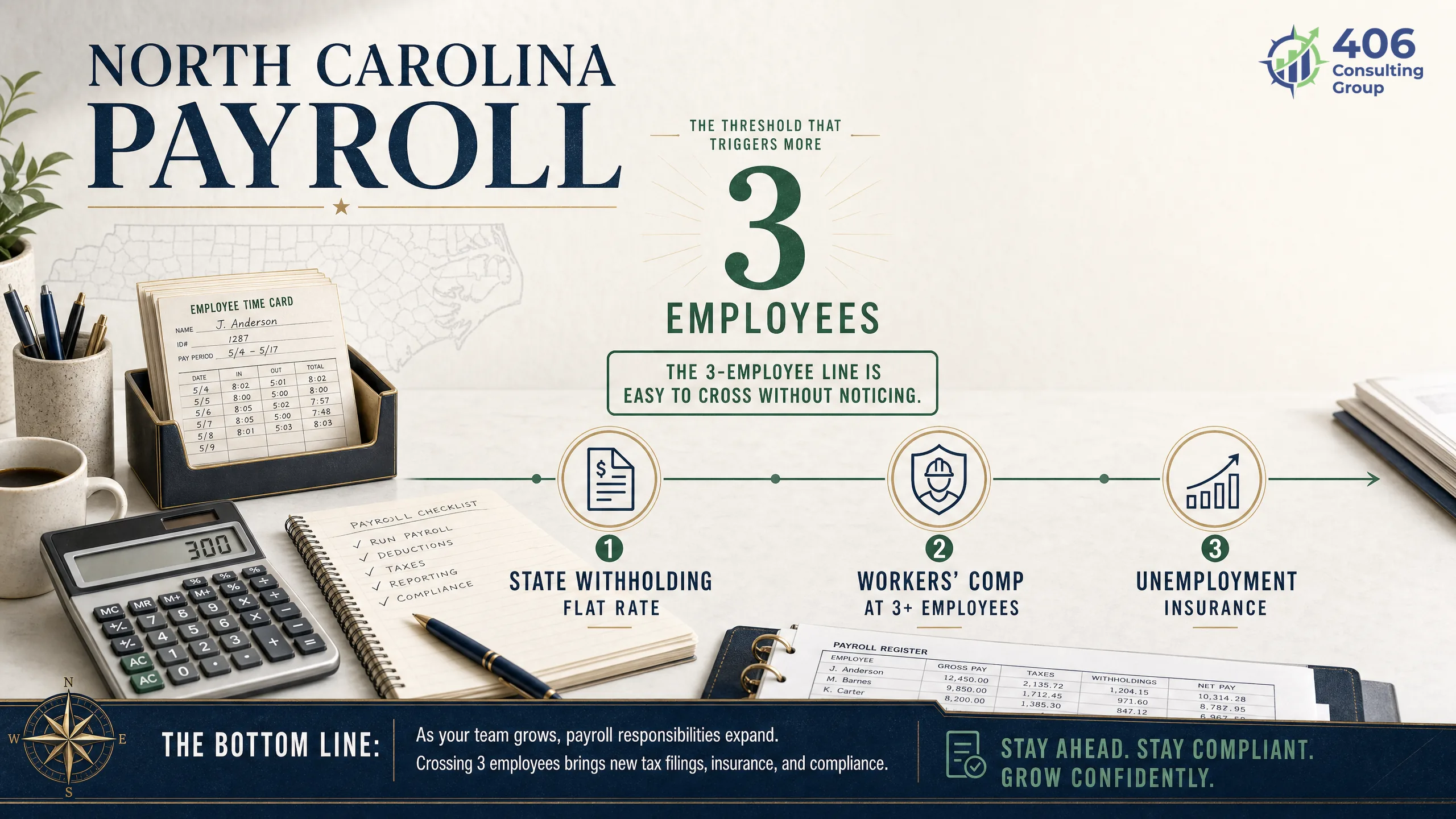
North Carolina payroll is relatively straightforward but has its own pieces. You withhold state income tax from wages (at the flat rate) and remit it on a schedule set by your size, and you pay state unemployment insurance. The threshold that surprises people is workers' compensation: North Carolina generally requires coverage once you have three or more employees — a lower bar than many owners assume, and one with serious penalties for getting it wrong.
State withholding
Withhold NC income tax at the flat rate; remit on a schedule based on your payroll size.
Workers' comp at 3+
Coverage generally required once you have three or more employees — lower than most expect.
Unemployment insurance
State UI on top of federal payroll taxes; register and file on schedule.
Which industry you're in shapes how the rest of the books come together — and Charlotte's mix is distinctive.
Charlotte's Industries and How They Shape the Books
Charlotte's economy has a character worth building your books around. Banking, fintech, and financial services anchor it — a sophisticated owner base with equity compensation and multi-entity structures. Energy runs deep (Charlotte is a major energy hub). Construction and the trades ride a relentless growth boom across the metro and need job costing and WIP. And healthcare, logistics and distribution, manufacturing, and professional services round out a broad, fast-growing base.

Whatever the industry, one Charlotte reality raises the bar on your books above almost anywhere else.
Lender-Grade Books in a Banking City
In Charlotte, capital is close and lenders are sophisticated — which is an opportunity if your books can meet the moment. A bank, an SBA lender, or an investor reads your financials to decide whether to back you, and they read them a particular way: clean separation of business and personal, a readable P&L that shows true profit by job or segment, and a balance sheet that holds up to scrutiny. Books kept to that standard all year mean you're ready the day an opportunity or a need for capital arrives — instead of spending a frantic month cleaning up before you can even apply.
A busy business with messy books isn't a fundable business — no matter how much cash is coming in. In a banking town, lender-grade books are the difference between a yes and a slow no.

This is exactly where our commercial-banking background pays off — we keep books the way lenders read them. Avoiding the common mistakes is how you keep them there.
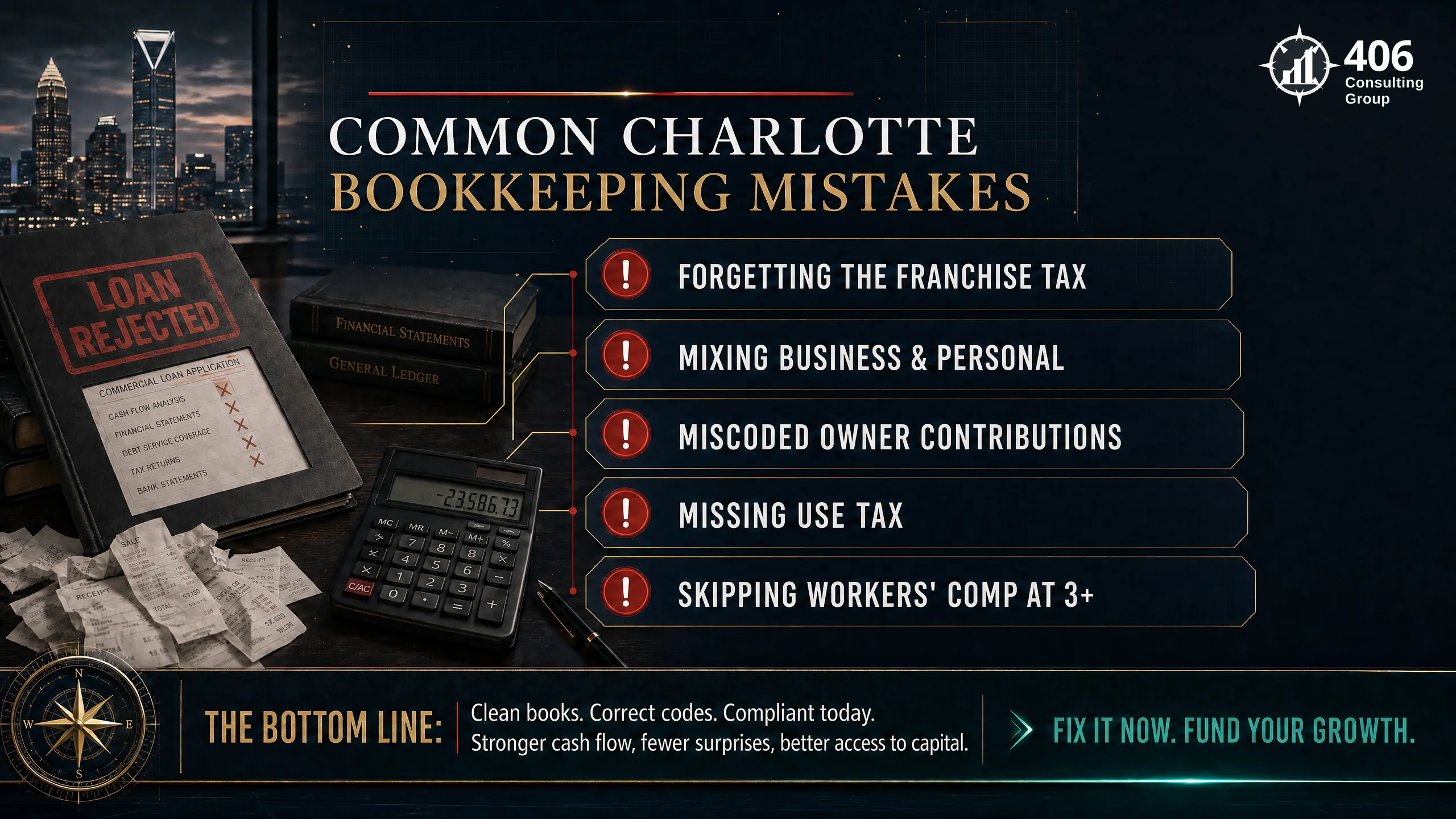
Common Charlotte Bookkeeping Mistakes
Forgetting the franchise tax
Filing as a corporation or S-corp and missing the annual NC franchise tax on net worth — a real, recurring liability.
Mixing business and personal
The fastest way to make a profitable business un-fundable in a banking city — and to inflate taxable income.
Miscoding owner contributions
Coding capital you put in to cover slow months as revenue — quietly inflating taxable income year after year.
Missing use tax
Owing use tax on out-of-state and online purchases and never accruing it.
Skipping workers' comp at 3+
Not carrying required coverage once you hit three employees — a penalty waiting to happen.
Every one of these is avoidable with the right setup — which raises the question of whether that setup has to come from someone with a Charlotte office.
Local vs. a Great Remote Partner
It's fair to ask whether Charlotte bookkeeping needs a Charlotte bookkeeper. It needs a North Carolinaone — and, given the city, one who understands how lenders read financials. The things a generic setup gets wrong (the franchise tax, use tax, workers' comp thresholds, clean separation) are about knowing the state and how capital works, not the neighborhood. Our commercial-banking background means we prepare books the way Charlotte's lenders actually read them, and the whole relationship runs on secure cloud accounting, live bank feeds, and screen-shares.
We work with Charlotte and Carolinas businesses entirely remotely — being across a state line changes nothing about the depth of the service you get.
How to Get Started
Getting clean starts with a look at where your books stand: whether the franchise tax is handled, how sales and use tax are filed, whether payroll and workers' comp are set up for North Carolina, whether business and personal are cleanly separated, and whether you can see profit by job or segment. From there it's a straightforward path to books a lender would happily read.
Clean, lender-grade books, built for the Carolinas.
Let's get your franchise tax, sales tax, payroll, and job costing set up right — and give you books that hold up to any underwriter. Start with where your business stands today.
Bookkeeping is the foundation; the tax planning, controller function, and industry-specific work build on top of it — starting with the North Carolina tax strategy in our Charlotte tax guide.
FAQ: Charlotte Bookkeeping
What taxes does a Charlotte, NC business deal with?
A flat state income tax (around 4.5% and scheduled to keep declining); the NC franchise tax on corporations and S-corps, based on net worth with a $200 minimum; sales and use tax around 7.25% in Mecklenburg County; and, for pass-through entities, the option to use North Carolina's PTET election to work around the federal SALT cap. On payroll you withhold state income tax and pay unemployment insurance, and workers' compensation is generally required at three or more employees. Confirm current rates with the North Carolina Department of Revenue and Mecklenburg County.
What is the North Carolina franchise tax and does my business owe it?
The NC franchise tax is a tax on corporations — including S-corporations — calculated on the company's net worth, with a minimum of $200, filed annually with the state return. It generally does not apply to LLCs and partnerships taxed as pass-throughs. For most small businesses it isn't large, but it's real, recurring, and easy to forget, and because it depends on your entity it's worth factoring into any S-corp decision rather than treating it as an afterthought. Confirm your specific liability with the North Carolina Department of Revenue.
When does a North Carolina business need workers' compensation?
North Carolina generally requires workers' compensation coverage once a business has three or more employees — a lower threshold than many owners assume, and one that carries serious penalties if you get it wrong. Certain businesses (for example those with employees who handle radiation, or those in specific trades) can face requirements sooner. Because the three-employee line is easy to cross without noticing during a growth spurt, it's worth setting up coverage as you approach it. Confirm your specific requirement with the North Carolina Industrial Commission.
How much does bookkeeping matter for getting a loan in Charlotte?
In the second-largest banking center in the country, it matters enormously. Lenders, SBA programs, and investors read your financials to decide whether to back you, and they look for clean separation of business and personal spending, a readable P&L that shows true profitability, and a balance sheet that supports the request. A busy, profitable business with messy books routinely gets turned down — not because it isn't making money, but because the books don't prove it. Keeping lender-grade books all year means you're ready the day you need capital, instead of scrambling to clean up first.
Can 406 Consulting Group do my Charlotte bookkeeping remotely?
Yes — we work with Charlotte and Carolinas businesses entirely remotely, on secure cloud accounting with live bank feeds and a reliable monthly close. What matters for a North Carolina business is expertise in the things a generic setup gets wrong — the franchise tax, sales and use tax, payroll and workers' comp thresholds, and clean, lender-grade separation — not whether your bookkeeper has an uptown office. Our commercial-banking background means we keep your books the way Charlotte's lenders actually read them, and distance simply isn't the variable it used to be.
Charlotte Quick Facts
What shapes your books
Charlotte Bookkeeping Help
Remote, lender-grade, Carolina-savvy.
About the Author
Jason Anderson
Co-Founder, 406 Consulting Group
Jason is a big-firm-trained accountant who builds clean, lender-grade books and the systems behind them — the franchise-tax, sales-tax, and job-costing setups a Charlotte business depends on, delivered remotely.
Read the Full Story