
Construction Accounting in Charlotte, NC:
Where Your Books Set Your License Limit
In North Carolina, your financial statements set the size of job you're legally allowed to bid. Job costing, WIP, retainage, and bonding for Charlotte contractors — the numbers that raise your license tier and grow your business, delivered remotely.
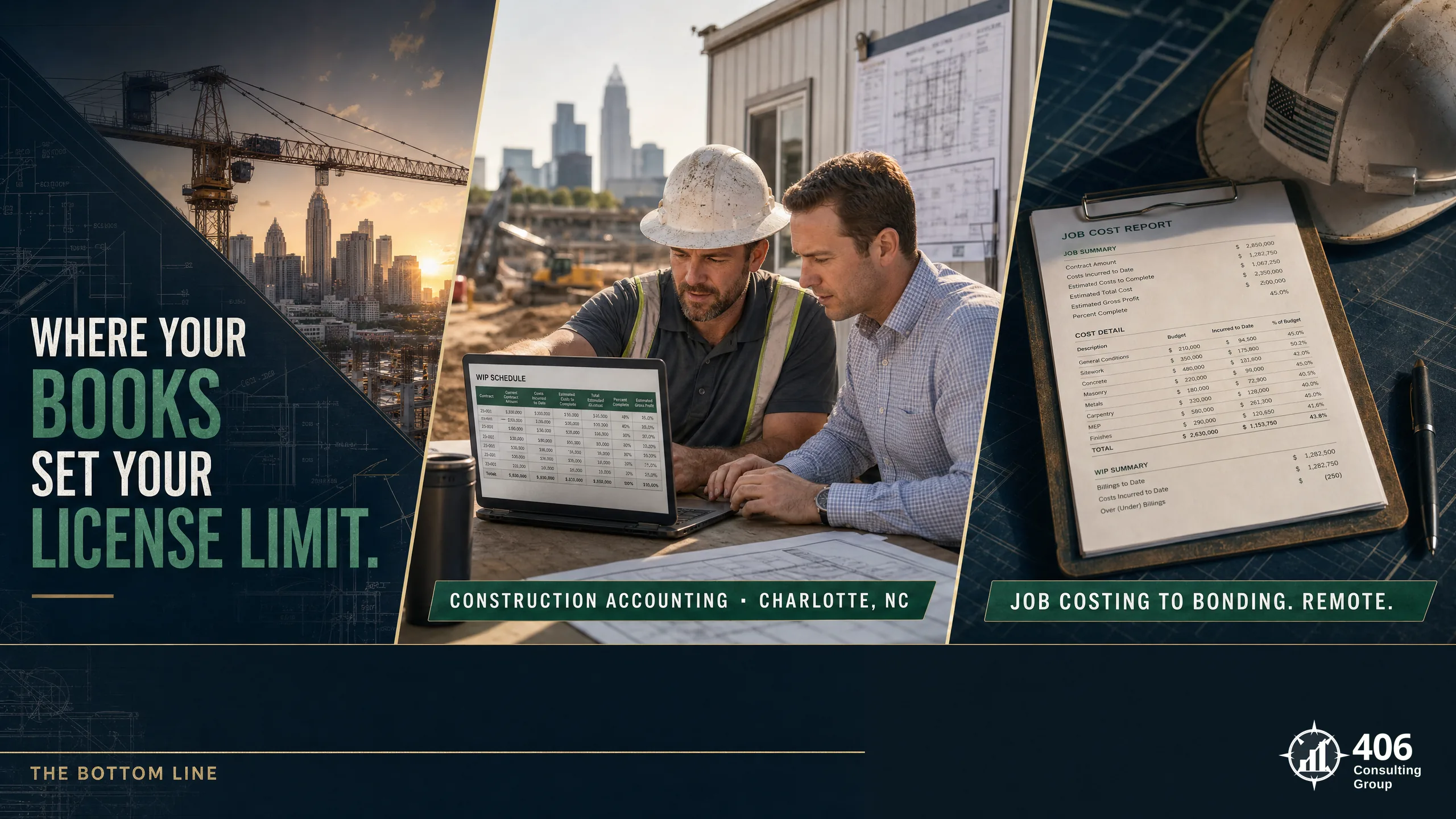
Charlotte is being built and rebuilt at once — towers uptown, subdivisions spreading south and east, and the trades keeping pace with all of it. It's a great time to be a contractor here, and a dangerous one, because construction is the industry where a company can be slammed with work and still go broke. The difference between the builders who scale and the ones who stall is almost never the quality of the work. It's the quality of the numbers behind it — and in North Carolina, those numbers do something they don't do in most states: they set the size of the job you're legally allowed to bid.
This guide covers what makes construction accounting its own discipline, the North Carolina rules that catch contractors off guard, and how a Charlotte builder gets books that grow the business instead of just recording it — all delivered remotely.
By Jason Anderson — Co-Founder, 406 Consulting Group. Big-firm-trained accountant with deep trades and oilfield experience who builds job-costing, WIP, and license- and bond-ready financials for construction companies — designed from a whole-company view.
Quick Answer: Construction Accounting in Charlotte
- →Construction needs job costing and WIP — you must know true profit per project, not just company-wide.
- →North Carolina requires a general contractor license for projects $30,000+, and your license limit is tied to your financial statements.
- →Contractors are the consumer of materials — you generally pay sales/use tax on materials, not the customer.
- →Workers' comp is required at 3+ employees; NC has no state prevailing-wage law (only federal Davis-Bacon on federal jobs).
- →Retainage and bonding make cash flow and credibility everything — in a banking city, lender-ready books pay twice.
Table of Contents
Building in the Queen City Boom
A hot construction market hides a hard lesson every seasoned builder eventually learns: growth is where contractors most often go broke. More work means more materials bought before you're paid, more crews to make payroll for, and more jobs whose real profit you won't know until it's too late to fix. Volume feels like winning right up until the week the cash isn't there. The contractors who come through a boom stronger are the ones who could see, job by job, which work was actually making money — and who had the financials to keep bidding bigger.
In construction, revenue lies and cash tells the truth. A busy year with no job-level numbers is just a fast way to find out — too late — which jobs were bleeding you.
Seeing that clearly requires accounting built for how construction actually works.
Why Construction Accounting Is Different
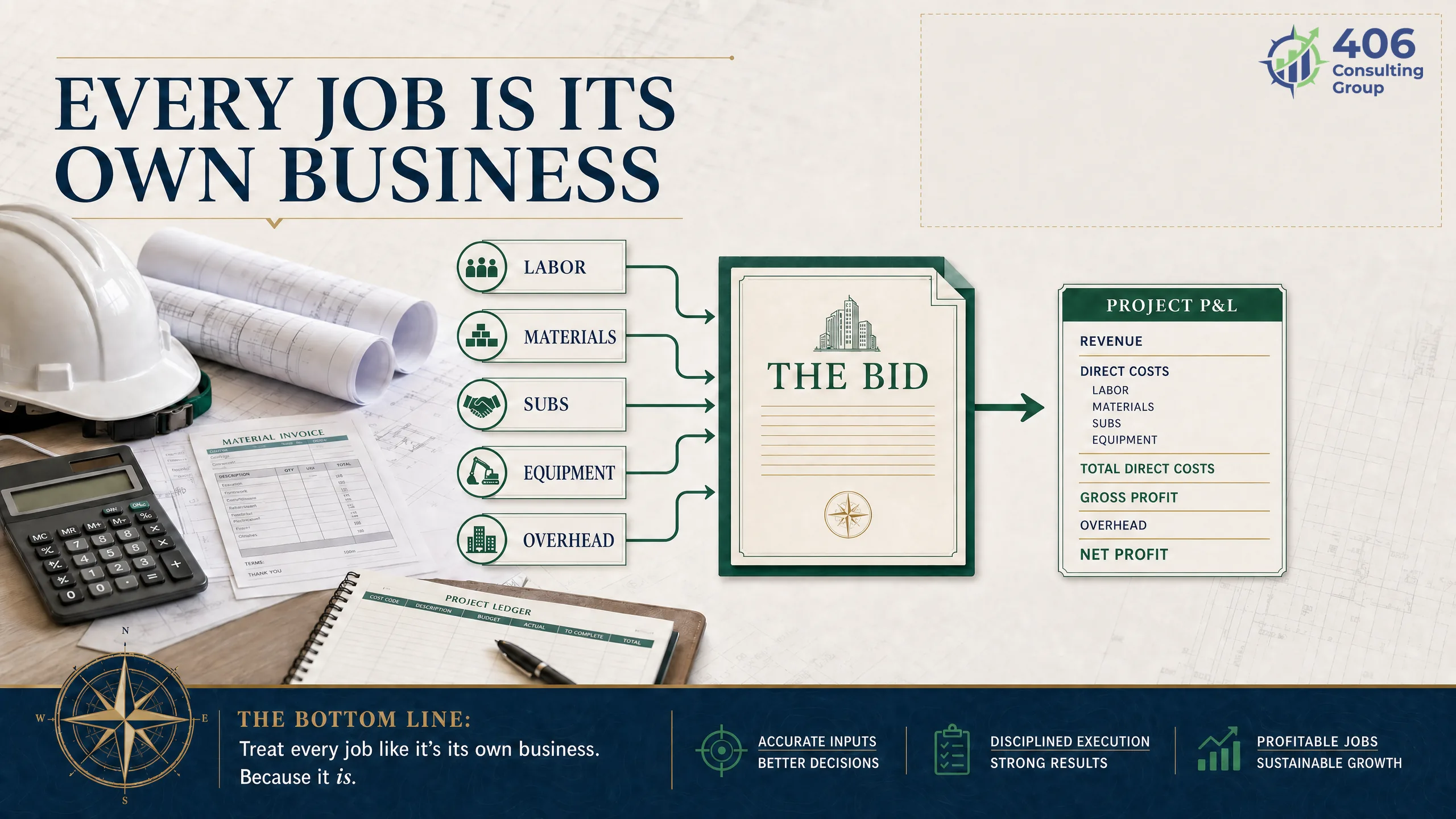
Most businesses can run on a single company-wide profit-and-loss. Construction can't. Every project is its own little business, with its own budget, timeline, materials, labor, and margin — and your company's overall numbers can look fine while individual jobs quietly lose money. The core of construction accounting is job costing: tracking the true cost of each project — labor, materials, subs, equipment, and a fair slice of overhead — against what you bid, so you know real margin per job while there's still time to act on it.
Get job costing right and everything else — bidding, licensing, bonding — gets easier. In North Carolina, that starts with something most contractors don't expect.
The NCLBGC License Limit Is Set by Your Books
In North Carolina, any general construction project of $30,000 or more requires a license from the North Carolina Licensing Board for General Contractors (NCLBGC). Here's the part that surprises people: the board issues licenses in limitation tiers — limited, intermediate, and unlimited — and which tier you qualify for is determined by your working capital and financial statements. In plain terms, your books literally set the ceiling on the size of project you're legally allowed to bid. Weak or messy financials don't just cost you a loan; they cap your business by law.
Most states let bad books cost you quietly. North Carolina makes it official: your working capital sets your license tier, and your license tier sets how big you're allowed to build.

That makes clean, strong financial statements a growth tool, not just a compliance chore — and it makes how you recognize revenue matter enormously.
WIP and Percentage-of-Completion
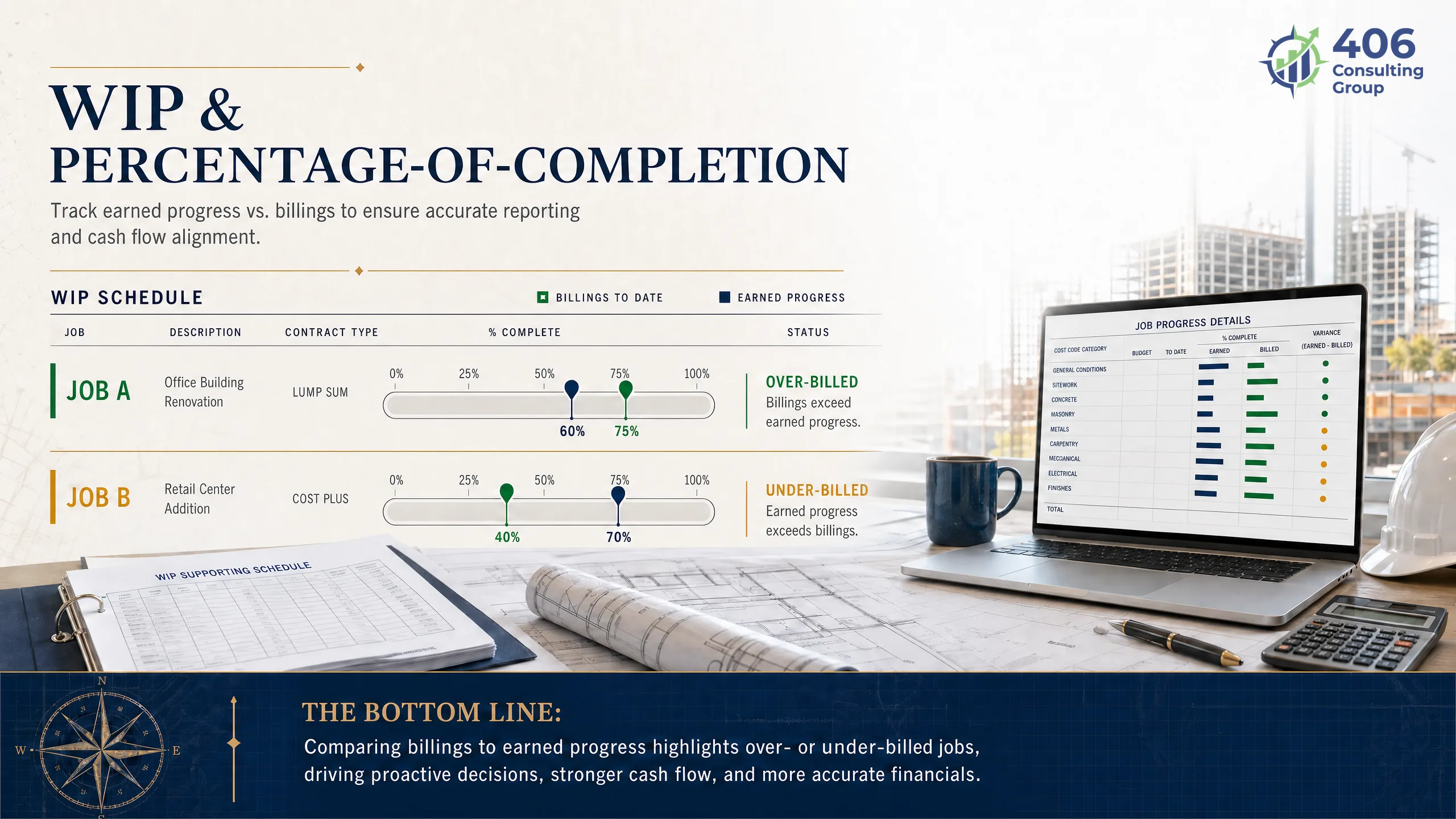
On multi-month jobs, when you count the revenue matters as much as how much. The percentage-of-completion method recognizes revenue as a job progresses, and a work-in-progress (WIP) scheduleis the report that tracks it — showing whether each job is over- or under-billed relative to the work actually done. WIP is the single most important report in construction: it tells you if you've billed ahead of your costs (borrowing from the job's future) or fallen behind (financing the customer out of your own pocket). It's also the report the NCLBGC, bonding companies, and lenders all want to see — the same document earns you a bigger license tier, a bigger bond, and a bigger line of credit.
Accurate WIP depends on capturing every real cost — including a tax cost most contractors handle wrong.
NC Sales & Use Tax: You Are the Consumer
For real-property improvement contracts, North Carolina generally treats the contractor as the consumer of the materials — meaning you pay sales or use tax when you buy the materials, and you don't charge your customer sales tax on the finished improvement. That sounds simple, and it trips people up in two ways: contractors forget to build the material tax into their bids as a real cost, and they owe use tax on materials bought out of state or online where no NC tax was collected. Some repair, maintenance, and installation services follow different rules, so the line between a taxed service and an untaxed real-property contract matters. Get it wrong and it shows up as either eroded margins or a use-tax bill later.

Confirm your specific contracts with the North Carolina Department of Revenue. The other cost contractors underestimate is labor.
Workers' Comp at 3 and True Labor Burden
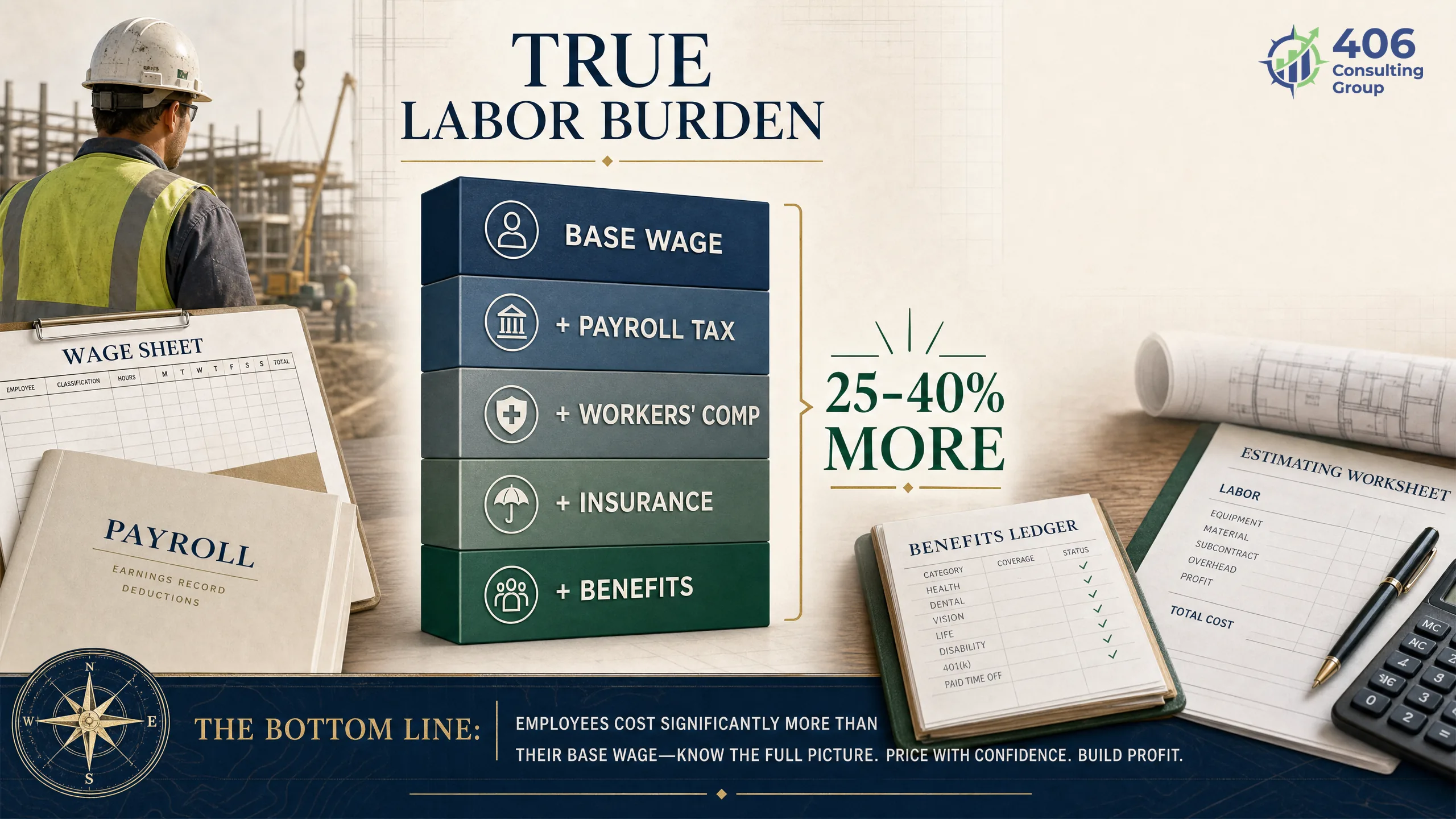
North Carolina requires workers' compensation insurance once a business has three or more employees — and in construction, where premiums run high, that's a major cost that has to be captured against each job. It's part of the bigger truth about labor burden: a field employee's real cost isn't their wage, it's the wage plus payroll taxes, workers' comp, insurance, and benefits — often 25% to 40% more than the base rate. Contractors who bid off the raw hourly wage lose money on labor and never understand why. Good construction accounting loads the fully burdened labor cost into every estimate and every job-cost report.
One labor cost North Carolina does not add is a state prevailing wage — but there's a nuance worth knowing.
Prevailing Wage: What NC Does and Doesn't Require
Unlike many states, North Carolina has no state prevailing-wage law — there's no "little Davis-Bacon" act forcing set wage rates on state or local public works. For most private and state/local jobs, you pay market wages. The exception is federal work: projects funded with federal dollars still trigger the federal Davis-Bacon Act, which requires prevailing wages and the certified payroll reporting that comes with it. So a Charlotte contractor's payroll compliance depends on the funding source of the job — straightforward on most work, but demanding on federally funded projects, where certified payroll is its own discipline.
Between material tax, labor burden, and the rest, the thread tying it all together is cash — and construction has a built-in cash trap.
Retainage and the Cash-Flow Trap
Retainage— the portion of each payment (often 5% to 10%) the customer holds back until the job is complete — is where profitable contractors run dry. You've paid for the labor and materials, but a slice of what you're owed sits unpaid for months, sometimes long after the work is done. Multiply that across several active jobs and a busy, profitable contractor can be genuinely short of cash. Managing it means tracking retainage receivable as the real asset it is, forecasting when it releases, and financing the gap on purpose rather than discovering it on payroll Friday. This is exactly the kind of construction-specific cash reality that generic accounting misses.

Handle cash and job costing well, and you unlock the two things that let a Charlotte contractor scale: bonding and capital.
Bonding and Capital in a Banking City
Bigger and public projects require surety bonds, and a surety underwrites your bonding capacity almost entirely on your financial statements — your WIP schedule, working capital, and profit history. Weak books mean a small bonding line and small jobs; strong, credible books mean the capacity to bid the work that actually grows a company. In Charlotte, that stacks on top of the license-tier rule and the city's deep pool of capital: the same clean financials raise your NCLBGC limit, expand your bond, and open the line of credit that funds materials and retainage. Because our background is commercial banking and underwriting, we prepare contractor financials the way sureties and lenders actually read them — so your numbers open doors instead of closing them.

All of it — job costing, WIP, licensing, bonding — can be built and run without anyone setting foot on your site.
Getting Started — Remotely
Construction accounting is done from the numbers, not the jobsite — job-cost data, payroll, and WIP live in the cloud, and reviews happen over screen-share and calls. What a Charlotte contractor needs is an accountant who genuinely understands construction — job costing, WIP, the NCLBGC license math, retainage, and bonding — not one who happens to have a local office. We build these systems from a whole-company view, tying the field, the office, and the financials together, and we serve contractors across Charlotte and the Carolinas remotely. Start with an honest look at your numbers and what they're currently costing you in license tier, bond capacity, and margin.
Build books that let you bid bigger.
Let's get your job costing, WIP, and financials to where they raise your license tier, grow your bond, and fund your growth — remotely, for Charlotte and Carolinas contractors.
For the rest of the Charlotte picture, see our Charlotte accounting overview and the CFO & controller guide.
FAQ: Charlotte Construction Accounting
Do I need a contractor's license in North Carolina, and how does my accounting affect it?
Yes — a general contractor license from the North Carolina Licensing Board for General Contractors (NCLBGC) is required for construction projects of $30,000 or more. What surprises most contractors is that the board issues licenses in limitation tiers — limited, intermediate, and unlimited — and which tier you qualify for is based on your working capital and financial statements. That means your books directly determine the maximum project size you're legally allowed to bid. Clean, strong financials aren't just good practice in North Carolina; they're what raises the ceiling on your business. Always confirm current requirements with the NCLBGC.
How does sales and use tax work for Charlotte contractors?
For real-property improvement contracts, North Carolina generally treats the contractor as the consumer of the materials — you pay sales or use tax when you buy materials, and you don't charge your customer sales tax on the finished improvement. Two things trip contractors up: forgetting to build that material tax into bids as a real cost, and owing use tax on materials bought out of state or online where no NC tax was collected. Certain repair, maintenance, and installation services follow different rules, so the classification of a given job matters. Confirm your specific contracts with the North Carolina Department of Revenue.
What is a WIP schedule and why does it matter so much in construction?
A work-in-progress (WIP) schedule tracks each active job's costs and billings against the work actually completed, using the percentage-of-completion method. It tells you whether you've over-billed (collected ahead of your costs, borrowing from the job's future) or under-billed (financing the customer out of your own pocket). It's the most important report in construction because it reveals both true job profitability and hidden cash risk — and it's the exact document the NCLBGC, surety bonding companies, and lenders all want to see. One accurate WIP schedule earns you a bigger license tier, a bigger bond, and a bigger line of credit.
Does North Carolina have a prevailing wage law for contractors?
No — North Carolina has no state prevailing-wage (or 'little Davis-Bacon') law, so on private and most state and local projects you pay market wages. The exception is federally funded work, which still triggers the federal Davis-Bacon Act and its prevailing-wage and certified-payroll requirements. So your payroll compliance depends on the funding source: straightforward on most jobs, but demanding on federal projects, where certified payroll reporting is its own discipline that has to be handled correctly to stay compliant and get paid.
Can 406 Consulting Group handle construction accounting remotely for a Charlotte contractor?
Yes. Construction accounting is done from the numbers — job-cost data, payroll, and WIP schedules that live in the cloud — with reviews over screen-share and calls, so it works the same whether we're across town or across the country. What matters is genuine construction expertise: job costing, WIP, the NCLBGC license math, retainage, workers' comp burden, and bonding. With our commercial-banking background, we also prepare your financials the way sureties and lenders read them — a real edge in a banking city. We serve contractors across Charlotte and the Carolinas entirely remotely.
NC Contractor Facts
Charlotte construction at a glance
Charlotte Construction
Job costing to bonding, remote.
About the Author
Jason Anderson
Co-Founder, 406 Consulting Group
Jason pairs big-firm accounting training with hands-on trades and oilfield experience, building job-costing, WIP, and license- and bond-ready financials that let contractors bid bigger — designed from a whole-company view and delivered remotely.
Read the Full Story