
Tax Services in Charlotte, NC:
Turn a Falling Rate Into Kept Dollars
North Carolina is cutting its taxes — but the savings live in the PTET election, an S-corp decision uniquely complicated by the franchise tax, and multi-state timing. The planning that actually moves the needle, delivered remotely.

North Carolina is one of the few states actively cutting its taxes — the flat income tax has been stepping down for years, and the corporate income tax is scheduled to phase out entirely. That's a genuine tailwind for a Charlotte business, but it doesn't mean the planning gets easier. The savings now live in the PTET election that beats the federal SALT cap, in an entity decision uniquely complicated by North Carolina's franchise tax, and in depreciation and multi-state timing — the moves that turn a falling headline rate into dollars you actually keep.
This guide walks the planning that matters most for a North Carolina business — the PTET workaround, the S-corp-versus-franchise-tax math, depreciation, and the multi-state exposure a Charlotte owner base tends to carry — delivered proactively and remotely, not once a year at filing.
By Carrie Anderson — Co-Founder, 406 Consulting Group. Commercial banking and advisory background; she helps Charlotte owners structure entities, use the PTET election, and time decisions so a falling tax rate turns into real, kept dollars.
Quick Answer: Tax Planning for a Charlotte Business
- →Rates are falling — NC's flat income tax keeps declining and its corporate tax is phasing out — but the planning is in the details.
- →The PTET election lets your S-corp or partnership pay NC tax at the entity level, beating the federal SALT cap.
- →The S-corp decision is uniquely NC: weigh federal self-employment-tax savings against the state franchise tax an S-corp triggers.
- →Depreciation timing and multi-state exposure (common for Charlotte's finance-heavy base) are real levers.
- →Delivered remotely and proactively — planning all year, not a return in April.
Table of Contents
Planning in a Falling-Rate State
Most states are holding rates steady or raising them. North Carolina is doing the opposite: the individual income tax has been ratcheting down year after year, and the corporate income tax is on a legislated path toward zero. For a Charlotte business that's real money over time — but a falling rate is a reason to plan more, not less, because timing suddenly matters. Income you can shift into a lower-rate year, deductions you accelerate into a higher-rate one, and elections you make before deadlines all compound when the rate itself is a moving target.
When the rate is falling every year, when you recognize income and deductions is worth real money. A falling-rate state rewards the owner who plans the timing — and quietly overtaxes the one who doesn't.
The starting point is being clear-eyed about what the flat rate does and doesn't solve.
The Declining Flat Tax — Still Worth Planning
North Carolina's individual income tax is a single flat rate — around 4.5% and scheduled to keep declining — with no brackets to work. That simplicity is a gift, but it also means the state-rate math won't save you much on its own; the savings come from structure and federal coordination. The largest lever is the SALT cap, because for a profitable owner, the state income tax you pay can be non-deductible on your federal return — and North Carolina built a way around that.

That workaround is the single most valuable move for most profitable Charlotte pass-throughs.
The PTET Election: NC's SALT Cap Workaround
The federal SALT deduction — the state and local taxes you can write off on your federal return — is capped (the cap was $10,000 per return under the 2017 law, then raised to $40,000 starting in 2025, with a phase-down for higher earners). Above that cap, a profitable owner can strand the North Carolina income tax they pay — you owe it, but you can't deduct it federally. North Carolina's answer is the taxed pass-through entity (PTET) election: your S-corp or partnership elects to pay the NC income tax at the entity level, where it's a fully deductible business expense on the federal return, and you take a credit for it. The cap is sidestepped, and for a profitable pass-through it's often the highest-value election on the board.
Without PTET
You pay NC tax personally; once you're over the SALT cap, it earns no federal deduction — real dollars lost.
With PTET
The entity pays the NC tax, deducts it federally, and you take a credit — the cap is bypassed.

The election has timing and mechanics to handle, so confirm your situation with a tax pro and the North Carolina Department of Revenue. And whether PTET even applies runs straight into North Carolina's most distinctive entity question.
Entity Choice: S-Corp Savings vs. the Franchise Tax
Here's the North Carolina wrinkle that changes the usual entity math. In most states the S-corp decision is simple: once profit clears roughly $80,000–$100,000, electing S-corp treatment splits profit into a reasonable salary and distributions, and the distributions escape the ~15.3% self-employment tax — real federal savings. But in North Carolina there's a wrinkle tied to how you're organized, not just how you're taxed: the franchise tax on net worth (minimum $200) applies if your business is a corporation — including one that elects S-corp status — while an LLC that elects S-corp taxation but stays an LLC generally avoids it. So the decision isn't just "does the SE-tax saving beat the added payroll cost" — if you're organized as a corporation, it's that saving minus the franchise tax you now owe.
In North Carolina the S-corp election is a three-way trade: federal SE-tax savings, versus added payroll and compliance cost, versus the state franchise tax an S-corp triggers. For most profitable businesses the savings still win — but you have to run it, not assume it.

Run the S-corp math for your own numbers with our S-Corp calculator, then layer in the franchise tax. With the structure set, timing is the next lever.
Depreciation & Equipment Timing
When you buy equipment — a vehicle, a machine, a build-out — Section 179 and bonus depreciationcan let you deduct a large share of the cost in the year you place it in service. It's a powerful tool, but a timing decision rather than a reflex, and in a falling-rate state it's doubly so: a deduction is worth more against this year's higher rate than next year's lower one, which can argue for accelerating. North Carolina doesn't always conform to the federal bonus rules dollar-for-dollar, so the state add-back is worth modeling rather than assuming.
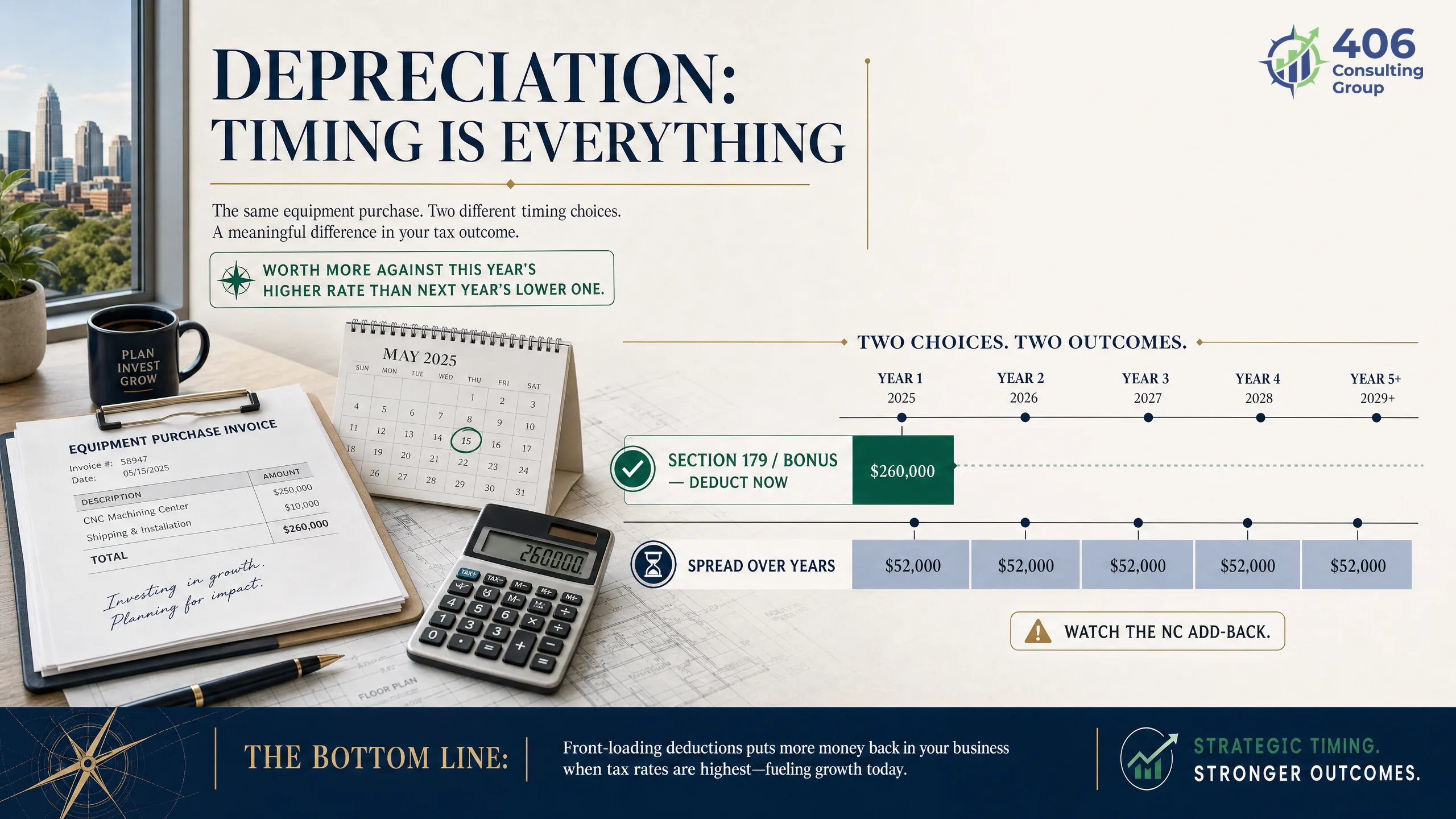
Equipment timing shifts dollars between years. For Charlotte's finance-heavy base, another exposure crosses state lines.
Equity Comp & Multi-State Exposure
Charlotte's banking and financial-services base produces a sophisticated owner class — equity compensation, multi-entity structures, and business that reaches across state lines. Two things follow. Equity compensation (options, RSUs, carried interest, ownership stakes) carries timing and character decisions that dwarf the state rate. And multi-state nexus— the moment you have employees, offices, or enough sales in another state — can create income and sales-tax filing obligations most owners don't see coming. For a Charlotte business, planning across state lines is often where the biggest dollars and the biggest risks sit.

Beyond those, some industries carry tax quirks of their own.
Industry-Specific Tax Nuances
Charlotte's signature industries each bend the tax picture. Financial and professional services face equity-comp and multi-state questions. Construction deals with equipment-heavy depreciation and use tax on materials. Energy carries capital-intensive assets and specialized rules. And real estate and property businesses lean on depreciation, cost segregation, and entity structuring more than most. Matching the plan to the industry is half of getting it right.
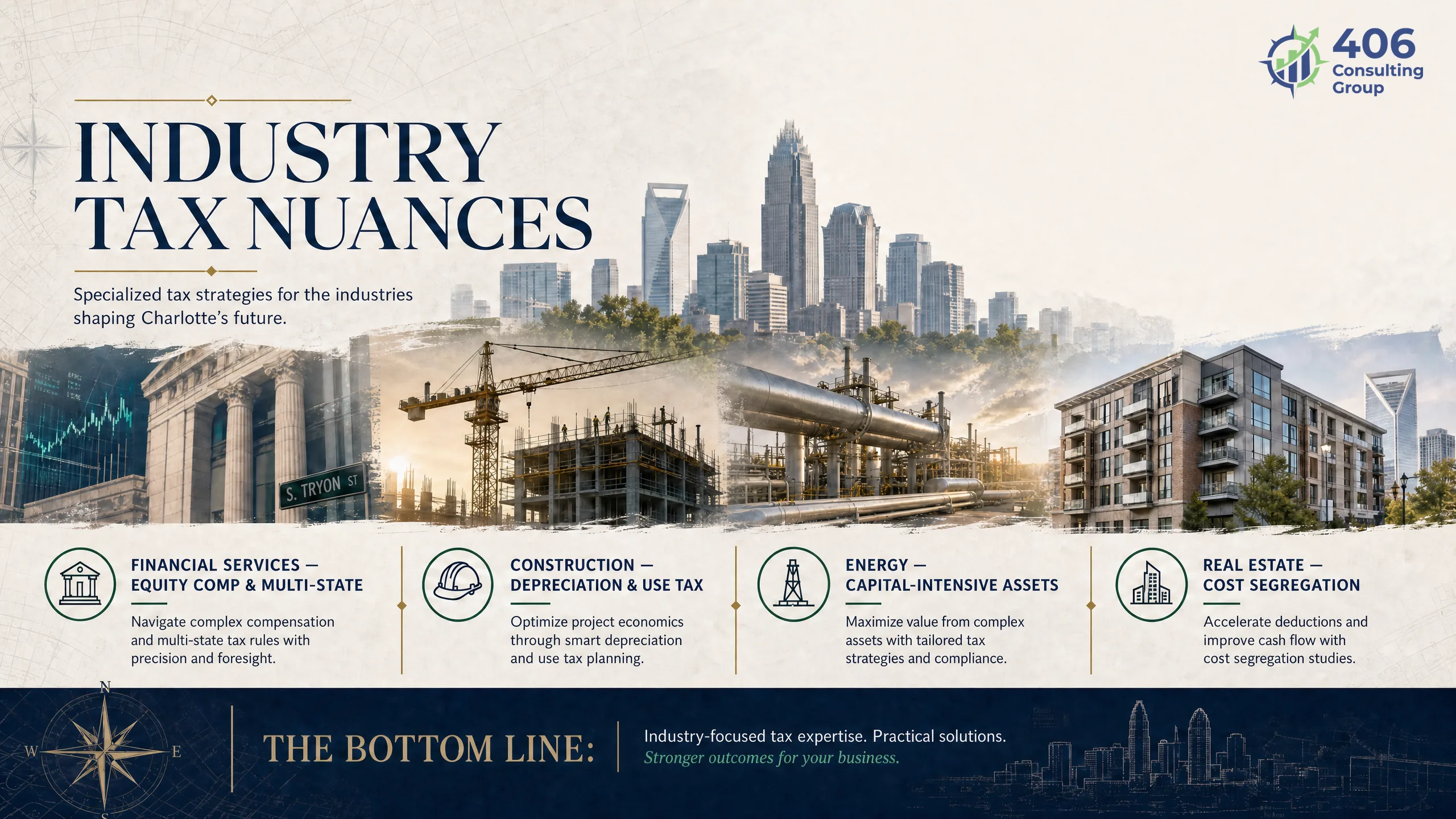
Knowing your industry's quirks is half of good planning; the other half is staying ahead of the calendar.
Estimates & Year-End Timing
Business owners generally owe tax as they earn it, through quarterly estimated payments to both the IRS and North Carolina. Miss or underpay them and you get penalties on top of the tax. Good planning keeps a running estimate of the year's liability so the quarterly payments are right, coordinates the PTET payment(which has its own timing), and times income and deductions around year-end — which, in a falling-rate state, is a genuine lever rather than a formality. It's the difference between a return that confirms good decisions and an April surprise.

Handling all of this well takes a partner who's in the numbers all year — which raises the question of whether that partner has to be uptown.
Local vs. a Great Remote Tax Partner
Tax planning is the last place a Charlotte address matters and the first place expertise does. What a North Carolina business needs is a partner who knows the PTET election and the franchise-tax interplay, understands equity comp and multi-state nexus, and is proactive all year — not one who happens to be uptown. A generalist who treats the falling flat rate as "nothing to plan" is where the overpayment comes from. Modern tax work runs on secure document exchange, screen-shares, and regular planning calls, so a great remote partner who lives in these rules serves you better than a local generalist.
We work with Charlotte and Carolinas businesses entirely remotely, and our commercial-banking and multi-state background means we plan your taxes with the whole financial picture in view.
How to Get Started
Good tax planning starts with a review: your entity and whether an S-corp election makes sense once the franchise tax is in the math, whether the PTET election fits, your depreciation position, any multi-state exposure, and your estimated payments. From there it becomes a year-round rhythm — planning conversations before decisions, not explanations after them.
Turn a falling rate into kept dollars.
Let's check the entity and franchise-tax math, the PTET election, and the timing moves that keep your combined federal-and-state bill as low as the law allows. Start with where your business stands today.
As you grow, the tax strategy connects to the bigger financial picture — the controller and CFO work in our Charlotte CFO guide.
FAQ: Charlotte Tax Planning
Should my Charlotte business be an LLC or an S-Corp?
It depends on your profit — and North Carolina adds a twist most states don't. A default LLC pays self-employment tax of about 15.3% on all its profit; electing S-corp treatment lets you split profit into a reasonable salary and distributions, and the distributions escape that tax, which often saves money once profit consistently clears roughly $80,000–$100,000. But North Carolina adds a franchise-tax wrinkle tied to how you're organized: the tax on net worth (minimum $200) applies if your business is a corporation electing S-corp status, while an LLC that elects S-corp taxation but stays an LLC generally avoids it. So the decision is a three-way trade: SE-tax savings, versus added payroll and compliance cost, versus the franchise tax if you're organized as a corporation. For most profitable businesses the savings still win, but you should run the numbers — including any franchise tax — rather than assume.
What is the North Carolina PTET election?
North Carolina's taxed pass-through entity (PTET) election lets an S-corp or partnership pay North Carolina income tax at the entity level instead of passing it to owners' personal returns. Because the entity pays it, the tax becomes a deductible business expense on the federal return, which sidesteps the federal SALT cap (that cap was $10,000 under the 2017 law and was raised to $40,000 starting in 2025, with a phase-down for higher earners); the owners then take a credit for the tax the entity paid. For a profitable pass-through whose owners are hitting the SALT cap, it's often the single most valuable election available — though whether it pays off depends on where your SALT sits against the current limit. It has timing and mechanics that must be handled correctly, so confirm your situation with a tax professional and the North Carolina Department of Revenue.
Is North Carolina really lowering its taxes?
Yes. North Carolina's flat individual income tax has been stepping down for several years (it's around 4.5% and scheduled to keep declining), and the state's corporate income tax is on a legislated path to phase out entirely over the coming years. That's a real advantage for businesses over time. Counterintuitively, a falling rate is a reason to plan more carefully, not less: when the rate drops each year, the timing of income and deductions — shifting income into lower-rate years, accelerating deductions into higher-rate ones — becomes a genuine lever. Confirm the current year's rate with the North Carolina Department of Revenue.
Does my Charlotte business have multi-state tax exposure?
Often, yes — especially given Charlotte's finance-heavy, fast-growing economy. The moment you have employees, offices, or enough sales in another state, you can create 'nexus' there and pick up income and sales-tax filing obligations, and equity compensation earned across state lines adds its own complexity. Many owners don't realize they've crossed a threshold until a state comes calling. For a Charlotte business, multi-state planning is frequently where the biggest tax dollars and the biggest risks sit, so it's worth reviewing with a multi-state-aware advisor as you grow.
Can 406 Consulting Group handle my Charlotte taxes remotely?
Yes — we provide proactive tax planning and preparation for Charlotte and Carolinas businesses entirely remotely, through secure document exchange and regular planning conversations. What matters for a North Carolina business is expertise in the PTET election, the S-corp-versus-franchise-tax math, depreciation, and multi-state nexus — not office proximity — and our commercial-banking and multi-state background means we plan taxes with your whole financial picture in view. Even our nearby clients tend to run the entire relationship over screen-share and secure document exchange.
Charlotte Tax Levers
Where the savings live
Charlotte Tax Planning
Proactive, remote, Carolina-savvy.
About the Author
Carrie Anderson
Co-Founder, 406 Consulting Group
With a commercial banking and multi-state advisory background, Carrie helps Charlotte owners structure entities, use the PTET election, and time decisions so North Carolina's falling rate turns into real, kept dollars.
Read the Full Story