
Accounting for Coeur d'Alene Businesses:
The North Idaho Playbook
A construction boom, a lake-resort economy, the Washington line, and Idaho's two-tax setup — Coeur d'Alene accounting has four demands a generic approach can't meet. Here's the whole playbook: bookkeeping, tax, and financial leadership.
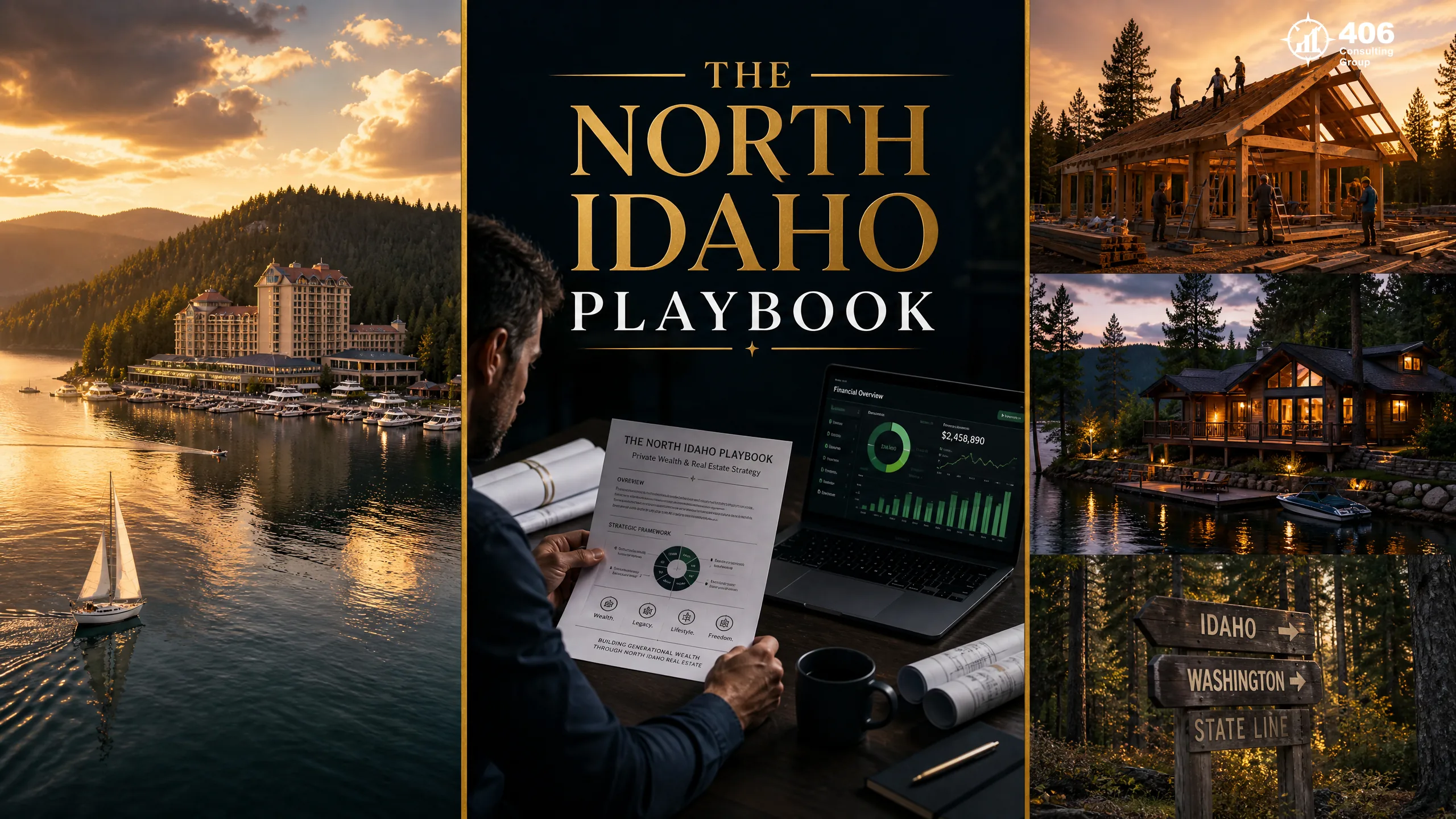
Coeur d'Alene is booming, and the boom has a particular shape: a construction and second-home surge, a lake-resort economy full of short-term rentals and hospitality, and the Washington line thirty minutes west that a lot of businesses work across. Layer Idaho's two-tax setup — a state income tax plus sales tax — over all of it, and you get an accounting picture that a generic, one-size-fits-all approach simply doesn't handle.
This is the whole playbook — the one-page map of how accounting works for a Coeur d'Alene business, and where to go deeper on each piece. Bookkeeping, tax, and financial leadership each get their own detailed guide; this ties them together for an owner who wants to see how the construction, rental, cross-border, and tax pieces fit into one clear picture.
By Carrie Anderson — Co-Founder, 406 Consulting Group. Commercial banking and underwriting background — 300+ loan reviews — advising construction, real-estate, hospitality, and small businesses across the Inland Northwest.
Quick Answer: Accounting for a Coeur d'Alene Business
- →Two booms: construction (job costing, WIP, bonding) and short-term rentals (lodging tax, depreciation).
- →Idaho's two taxes: a flat 5.3% income tax plus 6% sales tax — so planning cuts both bills.
- →The Washington line means multi-state sales tax and B&O for businesses working both sides.
- →Financial leadership — WIP, cash forecasting, bonding — turns clean books into growth.
- →All of it remote — most of our local clients never come into the office.
Table of Contents
Why North Idaho Accounting Is Different
Most accounting advice assumes a simple business in one place, in one state, doing one thing. Coeur d'Alene rarely fits. The building boom means construction accounting — job costing, work-in-progress, bonding. The lake means hospitality and short-term rentals with their own lodging taxes. The border means multi-state obligations. And Idaho's income tax means planning pays off on two returns, not one. Four different demands, and a generic setup meets none of them well.
The four pillars are the same as any business — bookkeeping, tax, financial leadership, and the system underneath — but in Coeur d'Alene each takes a specific shape. This guide maps all four and points to the deep dives, so you can see how the pieces fit before diving into any one of them.
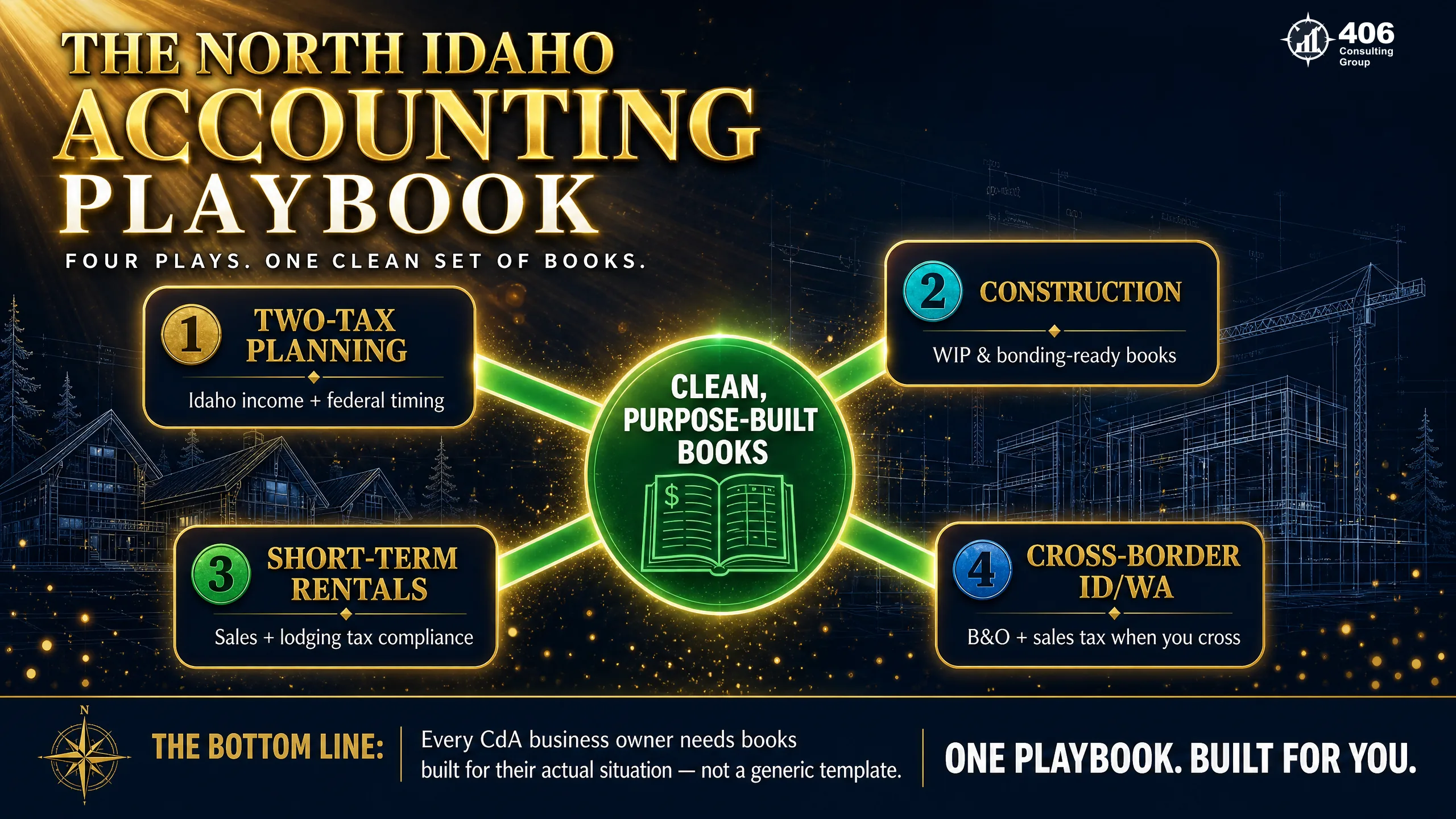
Start anywhere below — the big idea is that a booming, border, two-tax market rewards accounting built for exactly that, and punishes the generic kind.
The Idaho Tax Picture
Here's the whole state tax picture for a typical Coeur d'Alene business, at a glance:
| Tax | Idaho reality |
|---|---|
| State income tax | Flat 5.3% — so planning cuts both the Idaho and federal bill |
| Sales & use tax | 6% state rate; use tax on untaxed purchases |
| Gross-receipts / B&O | None (unlike Washington across the line) |
| Lodging (short-term rental) | Sales tax + state travel & convention tax on short stays |
| County | Kootenai County |
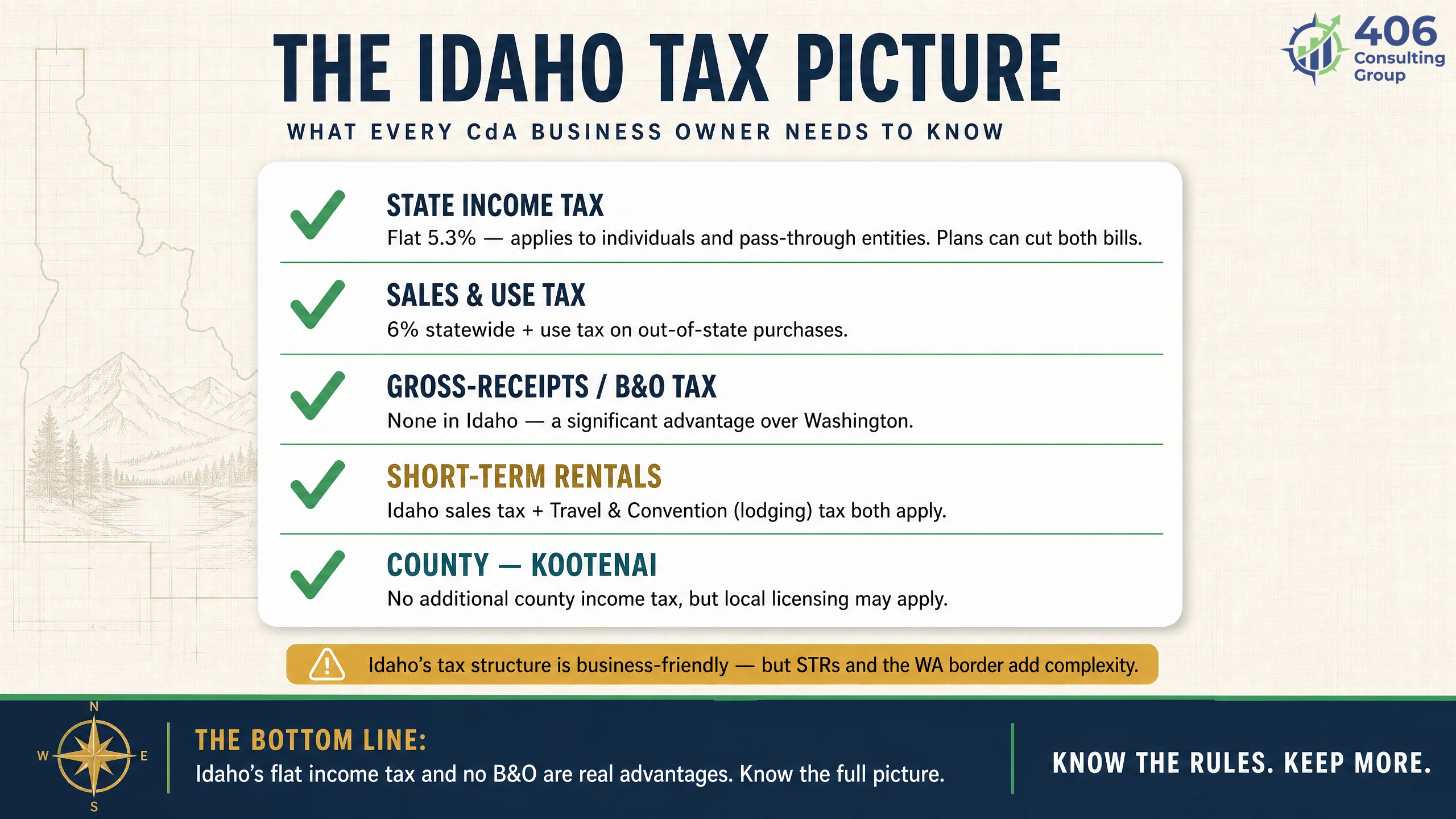
Because Idaho has an income tax, proactive planning is worth more here than in a no-income-tax state. The full planning playbook is in the Coeur d'Alene tax guide.
Construction: Job Costing, WIP & Bonding
The building side of Coeur d'Alene needs construction-grade accounting. Job costing ties labor, materials, subs, and equipment to each build so you can see the real margin. A work-in-progress (WIP) schedule reconciles what you've billed against what you've actually earned — the report that keeps your financials honest and is the first thing a bank or surety asks to see. And bonding capacity, built on clean financials and a strong WIP, gates the size of jobs you can bid.
Miss these and a company-wide P&L can show a profit while jobs quietly bleed, cash tightens in the boom, and your growth hits a bonding ceiling. Get them right and construction becomes a business you can actually steer.
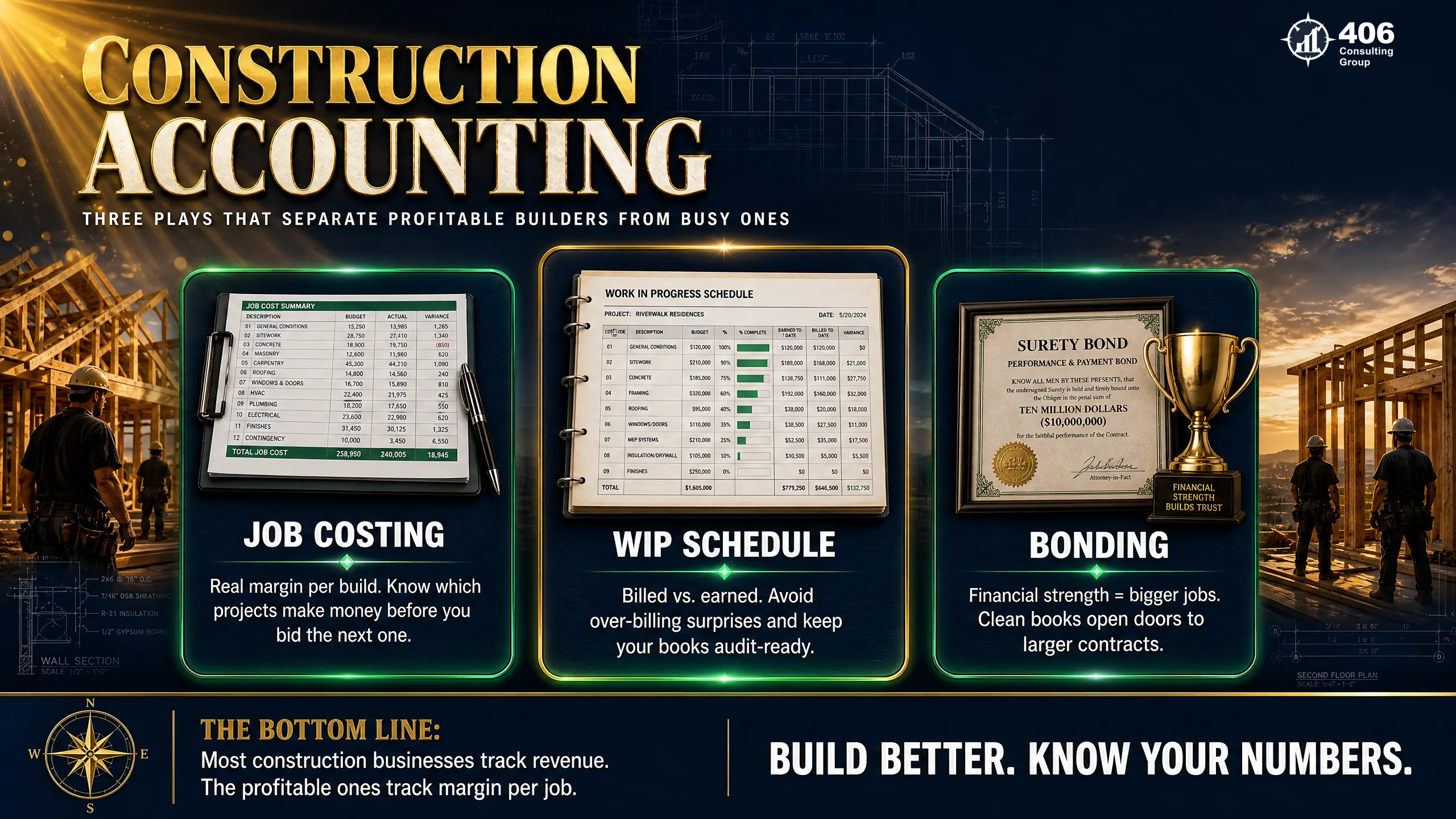
The bookkeeping mechanics are in the bookkeeping guide; the WIP, cash, and bonding strategy is in the CFO & controller guide.
Short-Term Rentals & Hospitality
The lake draws visitors, and short-term rentals are a big part of the CdA economy — with their own accounting demands. On the compliance side, a rental generally owes Idaho sales tax plus the state travel & convention (lodging) tax, and platforms don't always collect every tax that applies, leaving the owner on the hook. On the strategy side, rental real estate can be depreciated, and cost segregation plus the short-term-rental material-participation rules can open real tax benefits for owners who qualify.
The combination — lodging-tax compliance you can't ignore and depreciation strategy most owners never hear about — is exactly why a rental-heavy business needs books and planning built for it.
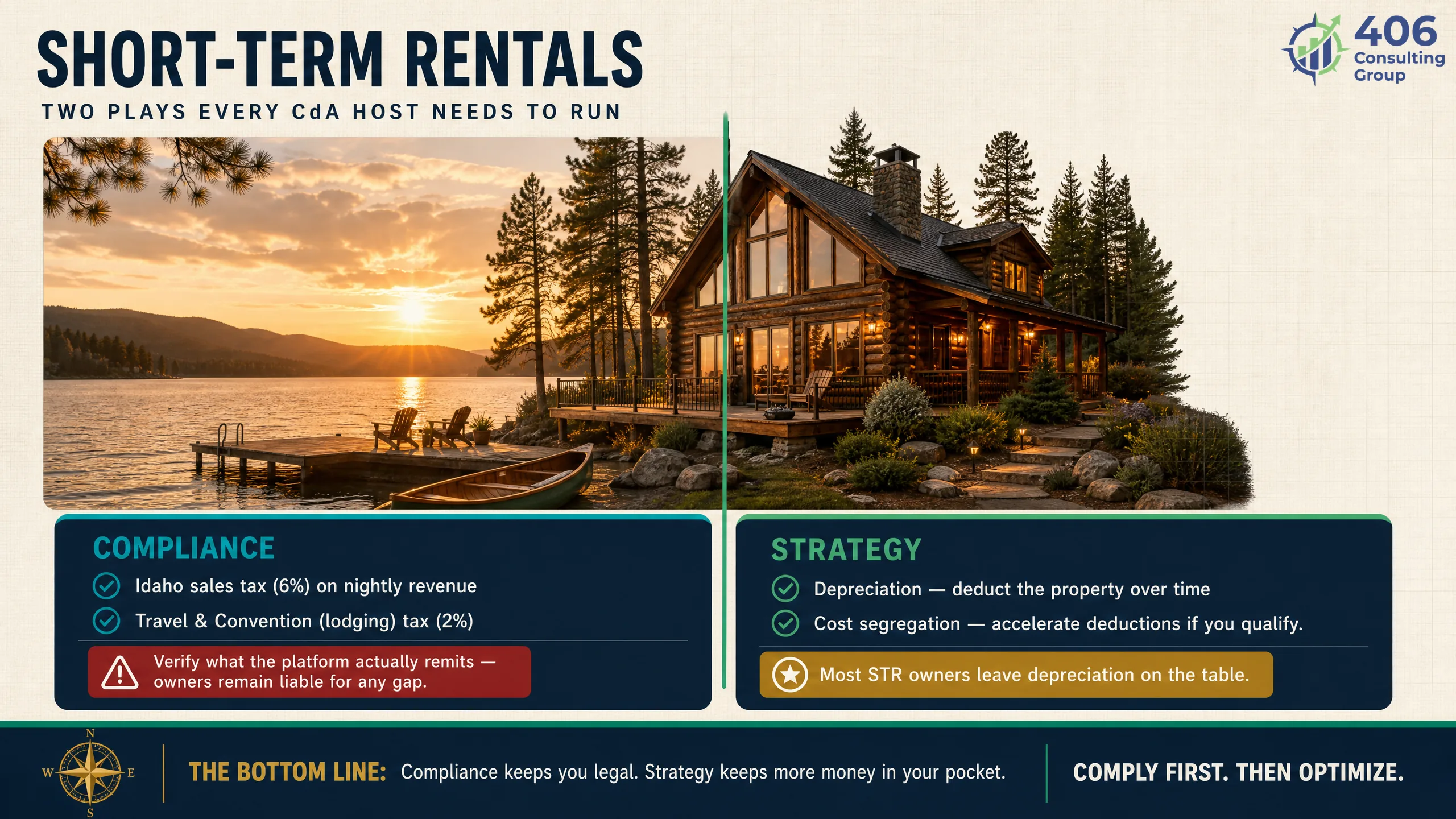
Compliance mechanics are in the bookkeeping guide; the depreciation strategy is in the tax guide.
The Cross-Border ID/WA Reality
Spokane is thirty minutes west, and plenty of Coeur d'Alene businesses work or sell across the Washington line. The moment they do, Washington's rules can apply: Washington charges sales tax and a business & occupation (B&O) tax on gross receipts from work done there — a gross-receipts tax that has no Idaho equivalent. So a CdA business working both sides reports its income in Idaho and pays Washington's B&O and sales tax on its Washington activity.
It's very manageable with books that cleanly split the two states and planning that prices the Washington B&O into that work — but it's exactly the kind of thing a single-state generic approach misses until a state comes asking. In a border market, multi-state fluency isn't a nice-to-have.
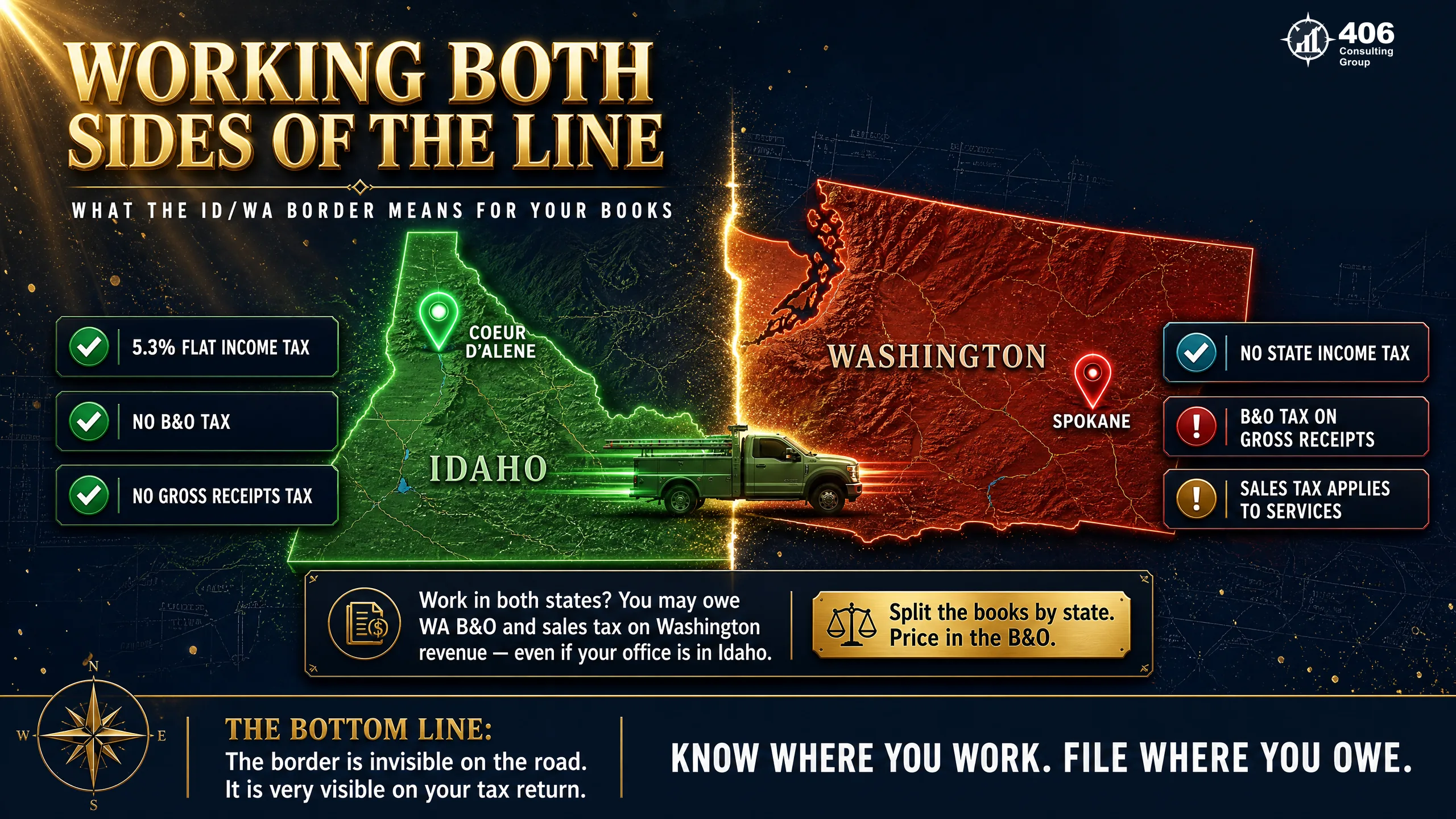
We cover the bookkeeping split and the tax planning for it in the bookkeeping and tax guides.
Planning in a Two-Tax State
Because Idaho has a state income tax on top of the federal one, tax planning here saves money twice — most legitimate deductions and deferrals cut both bills. For a CdA business that means real value in the usual levers (entity choice and the S-corp question, equipment timing, retirement) plus construction-specific income-timing methods, short-term-rental depreciation, and the Idaho pass-through election that can work around the federal SALT cap for pass-through owners.
The trap is skipping planning because you're busy — in a boom, that's easy to do, and it means overpaying on two returns instead of one. Proactive, year-round planning is where a profitable CdA business keeps meaningfully more of what it earns.
The full playbook — every lever, plus the construction, rental, and cross-border strategies — is in the Coeur d'Alene tax guide. Run your own S-corp numbers with our S-Corp Calculator.
When You Need More Than a Bookkeeper
As a Coeur d'Alene business grows — especially a builder — clean books stop being enough. You start needing the numbers to tell you which jobs to chase, how to fund the growth, and how to build the strength that unlocks bigger work. That's the step up to financial leadership: a controller who keeps job costing and the WIP schedule reliable, and a CFO who turns them into cash forecasting, bid analysis, and bonding readiness.
The classic trigger is the boom itself: growing revenue, tightening cash, and a bonding ceiling on the next tier of jobs. You don't need a six-figure hire to solve it — fractional leadership scales the controller-and-CFO thinking to your stage.
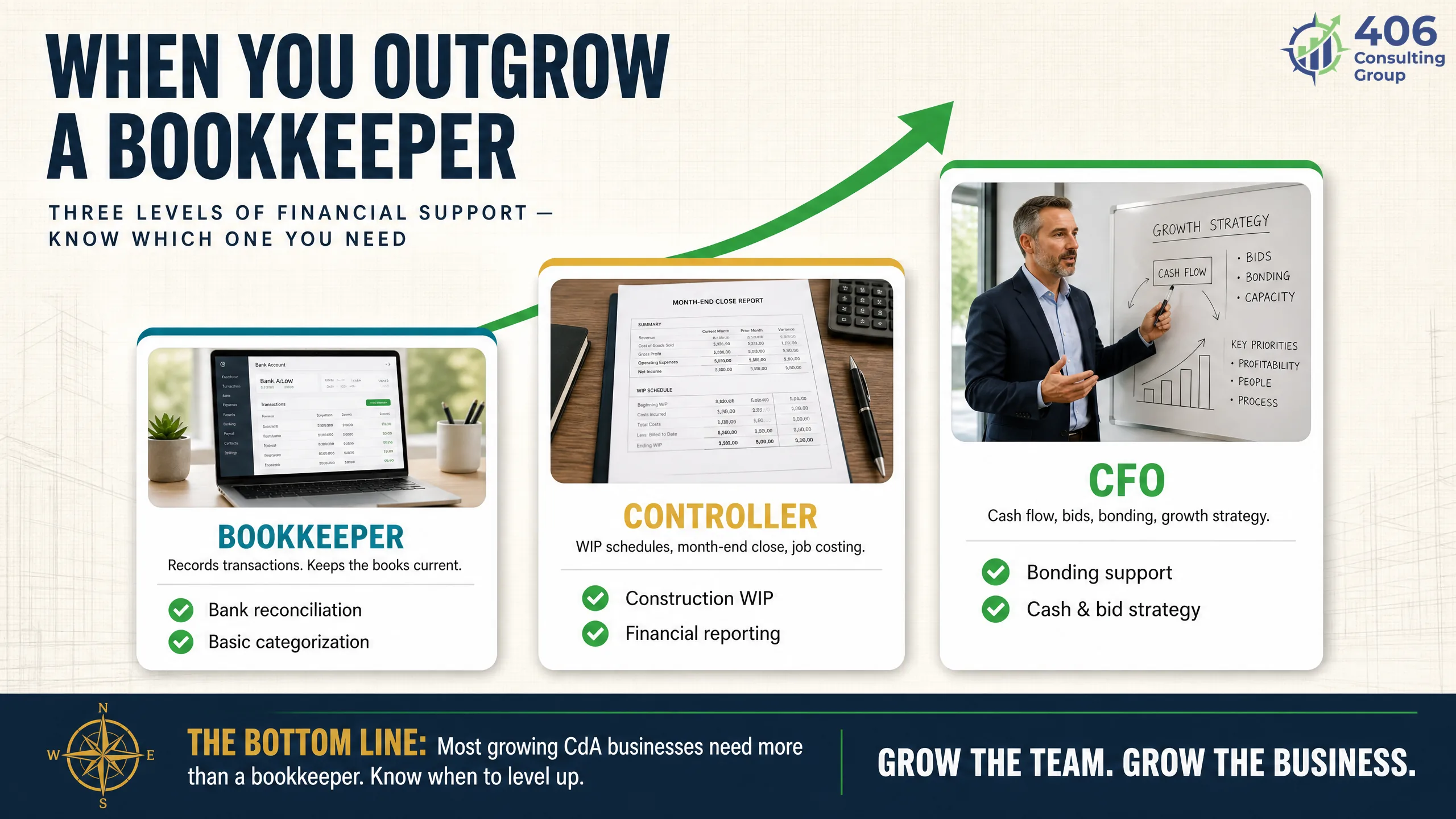
What each role delivers and what it costs is in the Coeur d'Alene CFO & controller guide. And for a deep look at which jobs actually make money, see our flagship on contractor unit economics.
Accounting by Coeur d'Alene Segment
Coeur d'Alene's economy is led by building and tourism, with the usual businesses around them — and each asks something different of the books.
| Segment | Accounting priorities |
|---|---|
| Construction & trades | Job costing, WIP, bonding, subs/1099s, retainage, cash forecasting |
| Short-term rentals & hospitality | Lodging taxes, depreciation strategy, seasonality, platform reconciliation |
| Real estate & services | Commissions, 1099s, cross-border sales, receivables |
| Healthcare & professional | Receivables/insurance, payroll, utilization, clean reporting |
| Retail & restaurants | Sales tax, inventory or food cost, tips/payroll, seasonality |
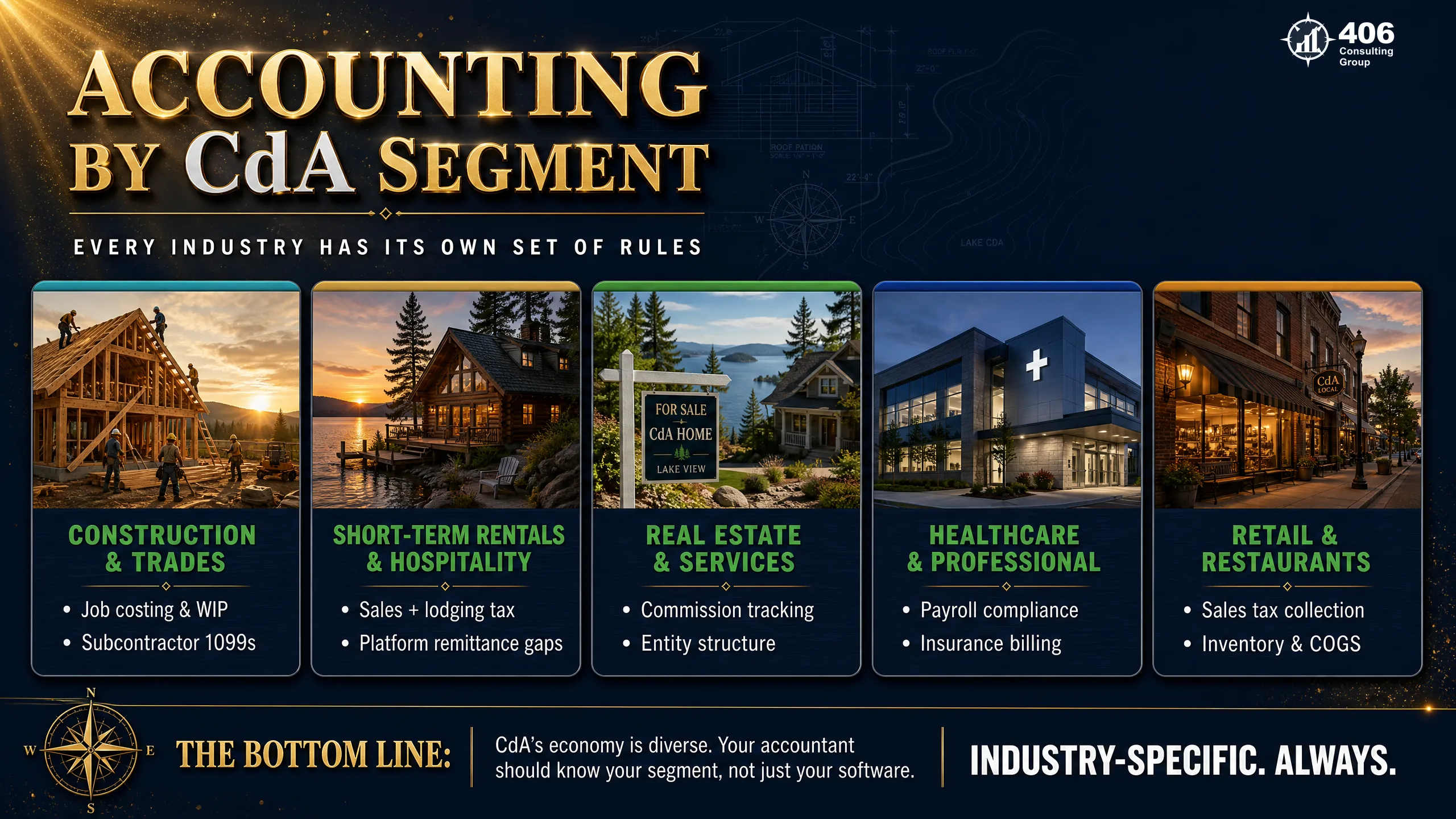
Different details, same backbone: clean job or lodging tracking, taxes handled on both sides of the line, and profit readable for the Idaho and federal returns.
Building the Right Accounting System
What separates accounting that just keeps you compliant from accounting that helps you run the business is the system underneath it. A booming, border, two-tax market especially rewards a system designed around the whole operation — how a job is bid, built, drawn, and closed; how a rental books and reconciles; how work splits across the state line — because the numbers are only useful if they mirror how the business actually runs.
Built right, one system carries job costing, WIP, lodging tracking, the ID/WA split, and clean Idaho and federal reporting — and every month afterward is fast and clear. Built as a generic template, it blends everything into one number and hides the very things a CdA business needs to see.
That whole-company perspective is our core differentiator — the difference between books that are merely compliant and books that are genuinely useful.
Local vs. a Great Remote Partner
Accounting for a Coeur d'Alene business is knowledge work — construction job costing, lodging taxes, cross-border planning, WIP and bonding. What matters is whether your partner knows Idaho, construction, and multi-state work, not whether they're on Sherman Avenue. A great remote firm that understands this market beats a local generalist who doesn't, every time.
It's also how the work already happens. Roughly 70–80% of our own local clients never come into the office; everything runs on secure cloud accounting, shared screens, and regular calls. So whether you're in Coeur d'Alene, around the lake, or working jobs across the line, you get the same full-service support — and in a border market, our multi-state experience is a real advantage.
Distance isn't the variable. Knowing this market is.
How to Get Started
Getting your Coeur d'Alene accounting right is three steps.
Build the books for your work
Job costing and WIP for construction, lodging tracking for rentals, and an ID/WA split if you work across the line.
Build the two-tax plan
Entity, equipment and construction timing, rental depreciation, and the pass-through election — mapped to your numbers.
Add leadership as you grow
Controller and CFO support for WIP, cash forecasting, and bonding readiness.
Not sure which layer you need? Our Financial Maturity Assessment maps it out in about eight minutes.
FAQ: Coeur d'Alene Accounting
What makes accounting for a Coeur d'Alene business different?
Four things at once: a construction boom that needs job costing, WIP, and bonding; a lake-resort economy with short-term rentals and their lodging taxes; the Washington border thirty minutes west that creates multi-state obligations; and Idaho's income tax, which means planning pays off on both the state and federal return. A generic, single-state, one-industry approach handles none of these well, which is why CdA businesses benefit from accounting built specifically for this market.
What taxes does a Coeur d'Alene, Idaho business pay?
Idaho has a flat 5.3% state income tax on business and personal income, a 6% state sales tax with a companion use tax, and no gross-receipts or B&O tax. Short-term rentals also owe the state travel & convention (lodging) tax on top of sales tax. You handle federal income tax and payroll, plus Idaho unemployment insurance and workers' compensation. And if you work across the line in Washington, that state's sales tax and B&O can apply to the Washington portion of your business.
Do I need construction-specific accounting for my building business?
Yes. Construction accounting centers on job costing (tying labor, materials, subs, and equipment to each build), a work-in-progress schedule (reconciling what you've billed against what you've earned), and bonding-ready financials. Without these, a company-wide P&L can show a profit while individual jobs bleed, cash tightens as you grow, and your bonding capacity caps the jobs you can bid. It's a genuinely different discipline from generic small-business bookkeeping.
How does the Idaho/Washington border affect my accounting?
If you work or sell across the line, you likely have obligations in both states. Idaho taxes your income; Washington charges sales tax and a business & occupation (B&O) tax on gross receipts from work done there — a tax Idaho doesn't have. Your books need to cleanly separate Idaho and Washington activity, and your planning should price the Washington B&O into that work. It's very manageable with the right setup, but it's exactly what a single-state approach overlooks until a state comes asking.
Can 406 Consulting Group handle everything remotely for a Coeur d'Alene business?
Yes — bookkeeping, tax, and CFO/controller work all run well remotely through secure cloud accounting, shared screens, and regular calls. What matters is deep knowledge of Idaho, construction, short-term rentals, and multi-state work, not office proximity. Roughly 70–80% of our own local clients never come into the office either, and in a border market our multi-state experience is a real advantage. You get the same full-service support whether you're in Coeur d'Alene or anywhere in the region.
The Coeur d'Alene Series
Accounting — Coeur d'Alene, ID
The Whole North Idaho Playbook, Handled.
406 Consulting Group gives Coeur d'Alene construction, hospitality, and small businesses full-service accounting — job costing, lodging taxes, two-tax planning, cross-border clarity, and financial leadership — delivered remotely.
The Coeur d'Alene Series
Hub & the three deep-dive guides
CdA Business Accounting
The whole playbook, handled remotely.
About the Author
Carrie Anderson
Co-Founder, 406 Consulting Group
Commercial banking and underwriting background — 300+ loan reviews — advising construction, real-estate, hospitality, and small businesses across the Inland Northwest. Carrie helps Coeur d'Alene owners turn a booming, border, two-tax market into a durable advantage.
Read the Full Story