
Accounting for Denver Small Business:
The Front Range Playbook
The overview that ties it together — Colorado's 'flat but not simple' tax reality and the books-to-tax-to-CFO stack for a Denver small business, delivered remotely.

Denver is one of the country's great places to build a company — a booming Front Range economy spanning technology, healthcare, energy, construction, and the outdoor industry, drawing talent and capital in from everywhere. It's also a place where the accounting quietly trips owners up, because Colorado taxes in a way that lookssimple and isn't: a clean flat income tax sitting on top of one of the most complicated local sales-tax systems anywhere, plus a payroll layer and a federal deduction problem most owners never see coming.
This is the overview — the Front Range playbook for getting your accounting right, from first clean books to a CFO-level view of a business built to scale. It ties together our deeper Denver guides on bookkeeping, tax planning, and CFO & controller services — delivered remotely, by a firm that knows Colorado cold.
By Carrie Anderson — Co-Founder, 406 Consulting Group. Commercial banking and advisory background — she helps Colorado owners build financial systems that keep compliance clean, minimize tax, and fund growth on the Front Range.
Quick Answer: Accounting for a Denver Business
- →Flat 4.4% income tax is simple — but it sits on a genuinely complex layer of local taxes and payroll rules.
- →Home-rule sales tax and the SALT cap (with its PTE fix) are where a generic, out-of-state setup goes wrong.
- →Denver's tech, energy, healthcare, and construction sectors each shape the books differently.
- →Get the stack right in order: clean books → real tax planning → controller & CFO as you grow.
- →Delivered remotely across Denver & the Front Range — Colorado expertise over office proximity.
Table of Contents
Running a Business in Denver
The Front Range economy is deep and fast-moving. Technology and startups cluster along the corridor from Denver to Boulder; energy and oil & gas anchor the region; healthcare, aerospace, and defense run strong; construction races to keep up with the people arriving; and an entire outdoor-and-tourism economy rides Colorado's brand. For an owner, that's tremendous opportunity paired with the reality of operating in a market growing faster than most back offices can keep up with.
The businesses that thrive here treat accounting as infrastructure: clean books that speak Colorado's tax language, planning that captures what the state and federal codes allow, and a financial view that scales with rapid growth instead of buckling under it. The ones that struggle usually have strong demand and a back office that never scaled — or never adjusted for how differently Colorado taxes. This playbook is about being the first kind.

It starts with understanding what makes Colorado different — and that's mostly how it taxes.
The Colorado Tax Reality
Here's the shape of it, because it surprises nearly every owner who moves a business to Colorado. The income tax is genuinely easy — a flat 4.4%. But underneath that simple headline sit four things that decide your real tax life, and each one is where a generic setup goes wrong.
Home-rule sales tax
Denver collects its own, so you can file with the city separately from the state — and with other self-collecting cities you sell into.
The SALT cap & PTE
The federal $10K cap can strand your state tax — the PTE election is the legal way pass-throughs get the deduction back.
Payroll layer
FAMLI paid-leave premiums, HFWA sick leave, state withholding, and the SecureSavings retirement mandate.
Property & fees
A county business personal-property declaration on equipment, plus Colorado's assorted business fees.

Confirm current rates with the Colorado Department of Revenueand your county. The takeaway to internalize is that "flat and simple" describes only the rate — not the system.
"Flat and Simple" Is Half the Story
The flat-rate headline is real and worth having — but Colorado collects around it, and the pieces that surround it are exactly what an out-of-state accountant mishandles. A business can run a clean 4.4% return and still be quietly bleeding money to a missed home-rule sales-tax filing, an un-taken PTE election, or a payroll setup that skipped FAMLI. The rate is the easy part; the system is where a Colorado-savvy partner earns their keep.
Colorado's 4.4% flat tax is one of the simplest rates in the country. Everything around it — home-rule sales tax, the SALT cap, the payroll layer — is where the money and the mistakes actually live.
Get those right and Colorado genuinely is a favorable place to operate. The other half of the picture is your industry.
Denver's Signature Industries
Two forces define the Denver economy, and each bends a company's finances a different way. Energy and oil & gas is a regional anchor — capital-intensive, equipment-heavy, and often structured across related entities, where depletion, project accounting, and multi-entity tax planning all matter more than in a typical business. Technology and startups run on the opposite metabolism: revenue recognition questions, a runway number the founders watch weekly, and multi-state income and sales-tax exposure the moment they sell across state lines. Getting either one right takes books designed around how the business actually earns, not a generic template.

Those two anchor the economy, but the Front Range's real strength is its breadth.
Tech, Energy & Beyond
Beyond energy and tech, Denver's economy has genuine range, and every corner keeps books a little differently. Construction and the trades live on job costing, use tax on materials, and Colorado's prevailing-wage and licensing rules. Healthcare and aerospace/defense carry insurance receivables, contract accounting, and payroll-heavy structures. Cannabis — a real Denver industry — operates under federal 280E, which makes cost accounting and entity structure unusually high-stakes. And hospitality and the outdoor-recreation economy run on daily sales reconciliation, seasonality, and that home-rule sales tax at the register.
The common thread across every Denver segment: the Colorado tax structure is the same backbone underneath, and the businesses that manage it well are the ones whose books are built for it and whose owners can see their numbers clearly — which is what the accounting stack is for.
The Books-to-Tax-to-CFO Stack
The businesses that get this right build the financial function in the right order, like a stack. First, clean books that handle Colorado's home-rule sales tax and payroll correctly — the foundation everything else stands on. Then real tax planning — entity choice, the PTE election, depreciation timing — layered on top once the books are reliable. Then, as you grow, a controller to make the numbers trustworthy and a CFO to turn them into forecasting and strategy. Skip a layer and the ones above it wobble; build them in order and each makes the next more valuable.
Build the stack in order
1.Clean books — home-rule sales tax, FAMLI payroll, job costing. Denver bookkeeping →
2.Tax planning — entity, PTE election, timing. Denver tax planning →
3.Controller & CFO — reliable numbers, forecasting, strategy. Denver CFO & controller →

One thread runs through the whole stack: actually seeing where the money is made.
Seeing Profit by Segment
Which service lines, locations, or clients are quietly carrying the company — and which are just noise on the P&L? A company-wide profit number can't tell you; only segment-level reportingcan. For a Denver business with several revenue streams or job types, seeing true margin by segment is what turns "we're busy" into "we're profitable, and here's exactly where." It changes what you chase, what you price up, and what you walk away from.
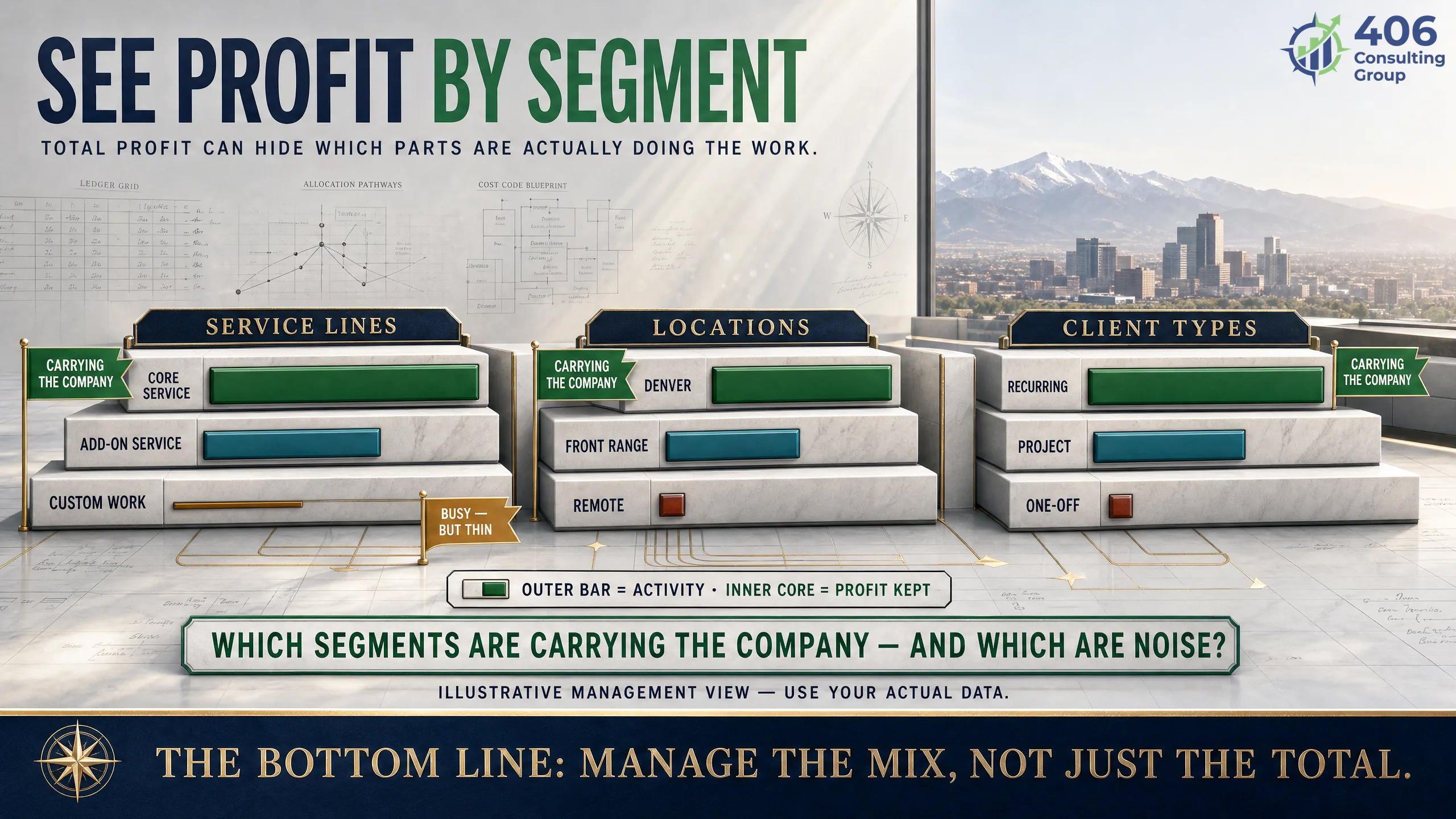
Surfacing that answer is the whole point of our unit-economics work. And once you can see the profit, the next question is funding the growth.
Financing & Growth on the Front Range
Growth on the Front Range usually means capital — a bank line, an SBA loan, equipment financing, bonding, or investment. Every one of those depends on financials a lender or investor can read and trust, and this is where our background matters most: with commercial-banking experience behind us, we prepare your numbers the way the people with the money actually read them. Clean, credible, lender-ready financials are the difference between a confident yes and a slow no — and they're a natural output of getting the stack right.

None of this requires an accountant with a Denver office — which is worth addressing directly.
Do You Need a Local Denver Accountant?
What you need is an accountant who knows Coloradoand your industry — home-rule sales tax, the PTE election, FAMLI, and how a tech, energy, construction, or healthcare business runs — far more than one with a Denver address. A generalist who doesn't know the home-rule trap is actually the liability, since those are the areas a generic setup gets wrong. Modern accounting runs on secure cloud software, bank feeds, and screen-shares, so a great remote partner who knows the state cold serves you better than a nearby generalist.
We work with Denver and Front Range businesses entirely remotely — most of our own local clients never come into an office either.
How It Fits Together
Put it together and the Denver playbook is simple to state: get clean, Colorado-correct books; layer in real tax planning; add controller and CFO firepower as you grow; and keep your financials lender-ready the whole way. Do that and you get to enjoy the upside of building in one of the country's best business economies without the tax and cash-flow surprises that catch everyone else.
Build your Denver business on numbers you trust.
Bookkeeping, tax planning, and CFO/controller work — all delivered remotely to Denver and the Front Range, built around Colorado's real tax picture. Start with where your business stands today.

Building or renovating in Denver? The contractor-specific picture — licensing, prevailing wage, and use tax at the building permit — is in our Denver construction accounting guide.
FAQ: Denver Small Business Accounting
What makes accounting in Denver different from other cities?
Mostly Colorado's tax structure and Denver's industry mix. The state income tax is a simple flat 4.4%, but it sits on top of one of the most complicated local sales-tax systems in the country — Denver is a home-rule city that collects its own tax — plus a payroll layer (FAMLI, HFWA), a business personal-property tax, and the federal SALT cap that makes the PTE election valuable. Layer on Denver's tech, energy, healthcare, and construction economy, and you get accounting where home-rule filings, the PTE election, and segment costing matter more than in a typical market. 'Flat and simple' describes the rate, not the system.
What taxes does a Denver small business pay?
Think of it in layers. The income tax is the easy one — a flat 4.4%. The complexity is local: sales and use tax near 8.81% in Denver, which the city self-collects as a home-rule jurisdiction, so your filings can run separately from the state's. Payroll adds FAMLI paid-leave premiums, HFWA sick leave, and Colorado withholding. Your county taxes business equipment above an exemption threshold through an annual personal-property declaration. And if you're a pass-through, the PTE election is how you claw back the state-tax deduction the federal SALT cap would otherwise strip away. The City and County of Denver, your county assessor, and the Colorado Department of Revenue hold the current specifics.
Do I need a local Denver accountant?
What you need is an accountant who knows Colorado and your industry — the home-rule sales tax, the PTE election, FAMLI, and how a tech, energy, construction, or healthcare business runs — far more than one with a Denver office. A generalist who doesn't know the home-rule trap is the real liability, since those are the areas a generic setup gets wrong. Modern accounting runs on secure cloud software, bank feeds, and screen-shares, so a great remote partner who knows the state cold serves you better than a nearby generalist. We work with Denver and Front Range businesses entirely remotely.
When should a growing Denver business get bookkeeping, tax, or CFO help?
Roughly by stage, built like a stack: get bookkeeping and Colorado tax structure right from the start; layer in real tax planning (entity/PTE, depreciation timing) once you're established; add segment costing and cash-flow forecasting as you grow; and bring in a fractional controller or CFO as the monthly close slips, growth outruns the books, or you seek financing — usually well before the revenue point where a full-time hire makes sense. Our Financial Maturity Assessment helps you place yourself and prioritize the next rung.
Can 406 Consulting Group handle all of this remotely?
Yes — bookkeeping, tax planning, and CFO/controller work, all delivered remotely to Denver and Front Range businesses through secure cloud accounting and regular strategy conversations. What matters for a Colorado business is expertise in the home-rule sales tax, the SALT cap and PTE election, and your industry, not office proximity — and our commercial-banking background means we prepare your financials the way lenders and investors read them. Most of our own local clients never come into an office either.
The Denver Stack
Build it in order
Denver Accounting Help
Remote, Colorado-savvy.
About the Author
Carrie Anderson
Co-Founder, 406 Consulting Group
With a commercial banking and advisory background, Carrie helps Colorado owners build financial systems that keep compliance clean, minimize tax, and fund growth — preparing financials the way lenders and investors actually read them.
Read the Full Story