
Bookkeeping Services in Denver, CO:
Clean Books Built for Colorado's Home-Rule Maze
Colorado's flat 4.4% income tax is simple — its home-rule sales tax is one of the most complicated in the country. The bookkeeping a Denver business actually needs, delivered remotely.

Denver looks like an easy place to keep books until you meet its sales tax. Colorado runs a flat 4.4% income tax that feels refreshingly simple — and then hands you one of the most complicated sales-tax systems in the country, because Denver is a home-rule city that collects its own tax separately from the state. Layer on Colorado's FAMLI paid-leave premiums, a business personal-property tax, and a Front Range economy running hot across construction, tech, healthcare, and energy, and clean bookkeeping in Denver becomes a real discipline rather than a monthly chore.
This guide walks the mechanics a Denver business actually has to get right — the home-rule sales-tax trap, Colorado payroll, job costing, and the personal-property filing most owners forget — and how we handle all of it remotely, with the same depth as a firm down the street.
By Jason Anderson — Co-Founder, 406 Consulting Group. Big-firm-trained accountant who builds clean, decision-ready books and the systems behind them — including the multi-jurisdiction sales-tax and job-costing setups a Denver business lives or dies on.
Quick Answer: Bookkeeping for a Denver Business
- →Home-rule sales tax is the big one: Denver self-collects its own tax, so you often file with the city separately from the state.
- →Flat 4.4% income tax keeps that side simple — the complexity is in sales tax, payroll, and property.
- →Colorado payroll means FAMLI paid-leave premiums, HFWA sick leave, state withholding, and the SecureSavings retirement mandate.
- →Denver's mix — construction, tech, healthcare, energy — rewards real job and segment costing.
- →Delivered remotely across Denver and the Front Range — Colorado expertise over office proximity.
Table of Contents
Why Denver Bookkeeping Is Its Own Discipline
Plenty of businesses treat bookkeeping as data entry — categorize the bank feed, reconcile, done. In Denver that approach quietly builds a liability, because the hard part of Colorado compliance doesn't live in the income tax; it lives in the places generic bookkeeping ignores. Which city do you owe sales tax to, and did you file it with the state or directly with Denver? Are your FAMLI premiums set up right? Did anyone file the business personal-property declaration? Get those wrong and the tidy-looking books are hiding penalties.
Colorado's income tax is one of the simplest in the country. Its sales tax is one of the most complicated. A Denver bookkeeper who only knows the easy half is exactly where the expensive surprises come from.
So the right starting point isn't your chart of accounts — it's understanding the Colorado tax frame your books have to sit inside.
The Colorado Tax Backdrop
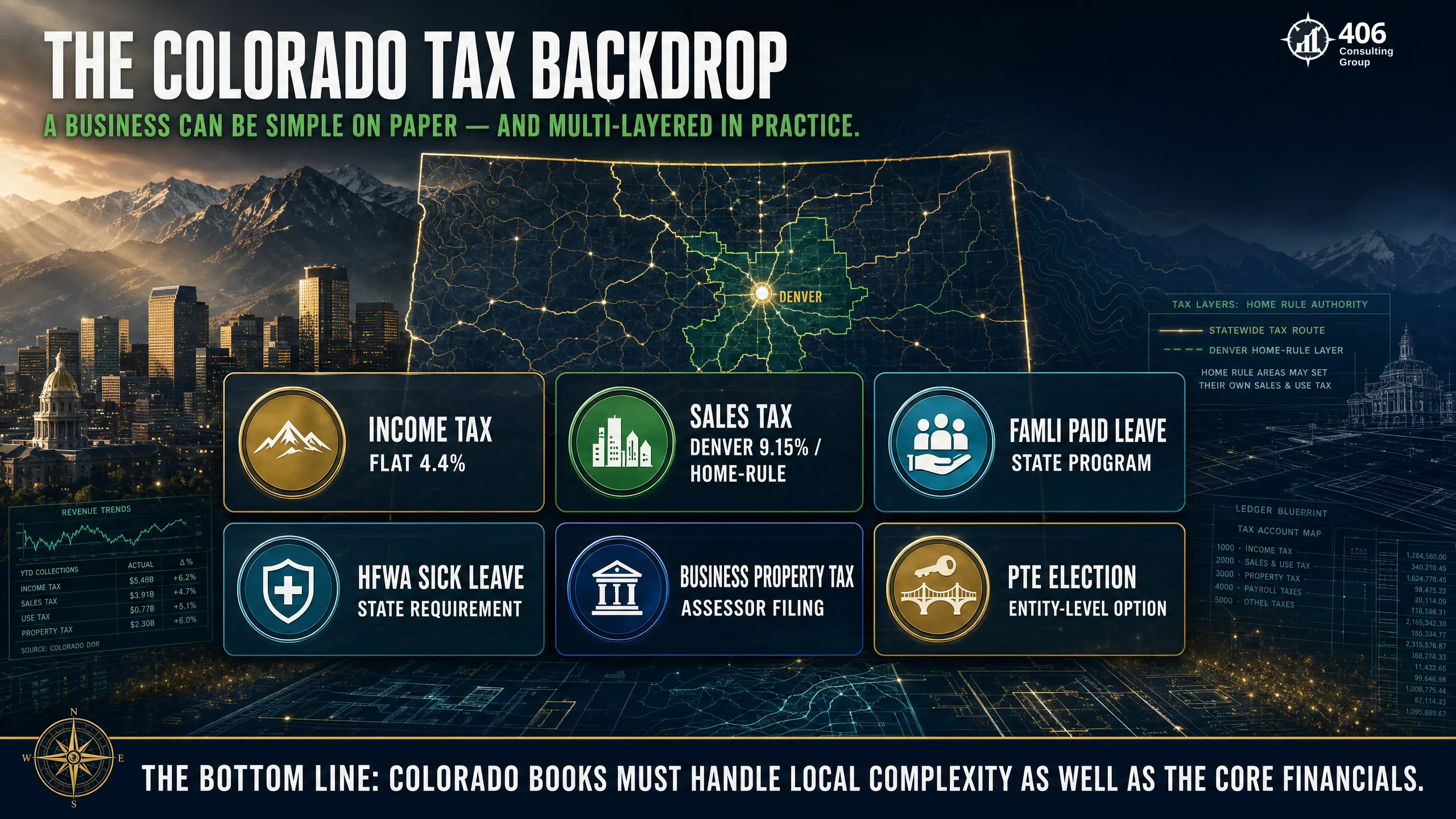
Colorado pairs a simple income tax with a genuinely complex layer of local taxes. Here's the frame a Denver business keeps books inside:
| Item | What it means for your books |
|---|---|
| State income tax | Flat 4.4% on business and personal income — simple to compute, but the SALT cap makes planning matter |
| Sales & use tax | ~8.81% in Denver; the city is home-rule and self-collecting, so filings can be separate from the state |
| FAMLI | Paid Family & Medical Leave Insurance premiums, split employer/employee, run through payroll |
| HFWA sick leave | Healthy Families and Workplaces Act paid sick leave to track and accrue |
| Business personal property | County tax on business equipment/furniture above an exemption threshold — an annual declaration |
| PTE election | Colorado's pass-through entity tax lets S-corps/partnerships work around the federal SALT cap |
Verify current rates and rules with the Colorado Department of Revenue and the City and County of Denver. The one that trips up newcomers most is sitting right in the middle of that table.
Home-Rule Sales Tax: The Denver Headache
Here's the thing nobody warns a new Denver business about. Colorado lets certain cities be home-rule — meaning they write and collect their own sales tax rather than letting the state do it for them. Denver is one of them. So a Denver business can end up filing sales tax in two places: a state return through the Colorado Department of Revenue, and a separate city return directly with Denver. Add nearby jurisdictions where you deliver or work, and a growing company can owe returns to several self-collecting cities at once, each with its own rules, forms, and login.
What owners assume
One state sales-tax return covers everything, filed with Colorado, done in a few minutes a month.
The Denver reality
Denver self-collects, so you may file a separate city return — plus more if you sell or work across other home-rule cities.
The state's SUTS system (Sales & Use Tax System) helps by letting you remit to many jurisdictions in one place, but it doesn't cover every home-rule city, and it doesn't decide whereyou owe. Getting that right — where each sale is taxed, which cities you're registered in, and filing each one on time — is the single biggest bookkeeping job for a Denver business, and the one a generic setup gets wrong.

Sales tax is the headache that gets attention. Payroll is the one that quietly grew more complicated over the last few years.
Colorado Payroll: FAMLI, HFWA & Withholding
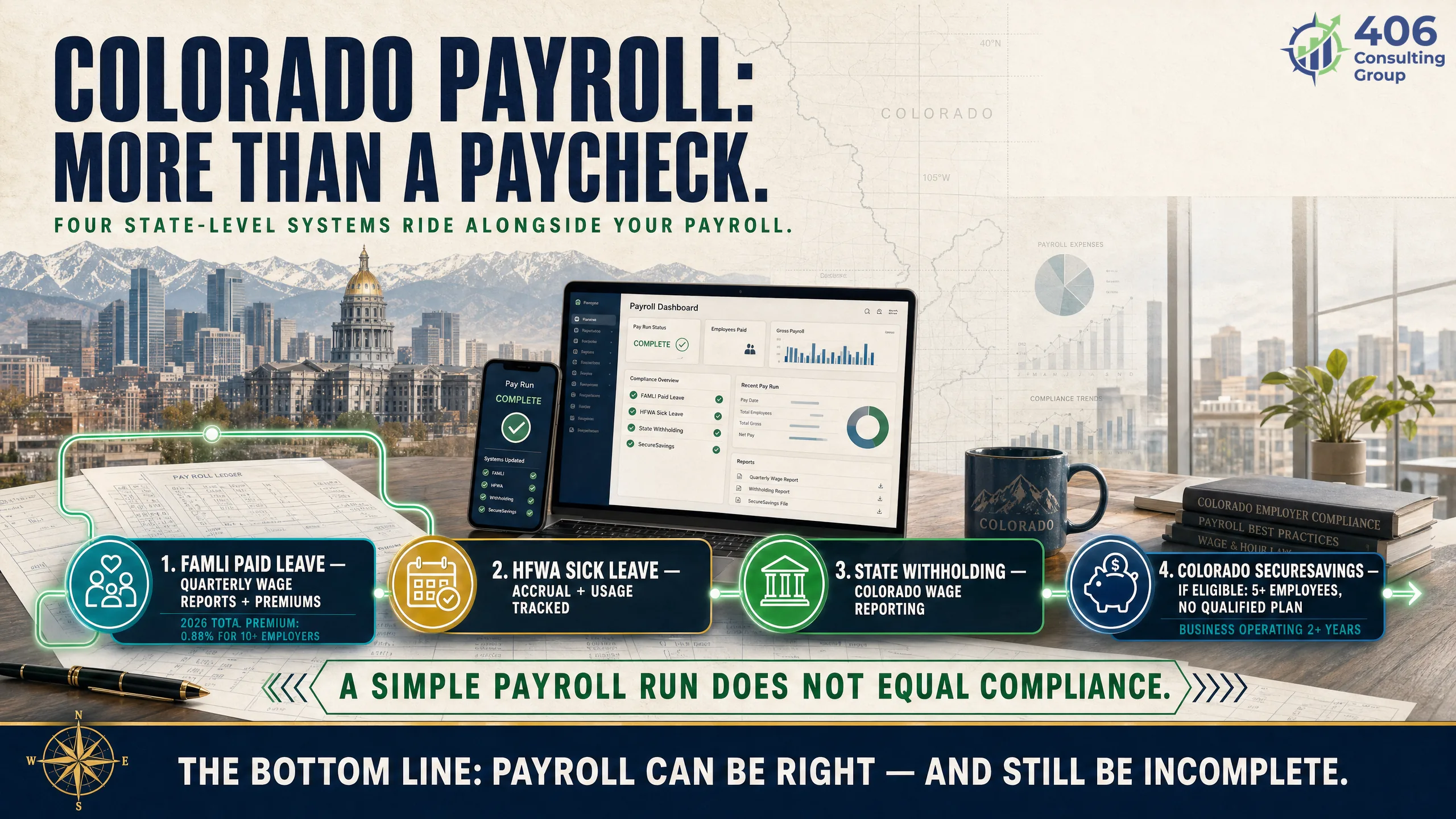
Colorado payroll carries a few state-specific pieces a national template misses. FAMLI — the state's Paid Family and Medical Leave Insurance program — collects a premium split between employer and employee and remitted each quarter. HFWA, the Healthy Families and Workplaces Act, requires paid sick leave that has to accrue and track correctly. Colorado also has state income-tax withholding (unlike no-income-tax states), and the Colorado SecureSavings program requires many employers to offer retirement access or enroll.
FAMLI premiums
Paid-leave insurance split employer/employee, filed and paid quarterly.
HFWA sick leave
Accrued paid sick time that must be tracked correctly per employee.
State withholding
Colorado income-tax withholding on every check — one more line than a no-tax state.
SecureSavings
State retirement mandate — offer a plan or facilitate the state program.
Set up cleanly at the start, these run quietly in the background. Bolted on late, they turn into penalties and back-premiums. Which industry you're in shapes how the rest of the books come together.
Denver's Industries and How They Shape the Books
Denver's Front Range economy is broad, and each corner keeps books a little differently. Construction and the trades need job costing, WIP, and use tax handled on materials. Technology and startups live on revenue recognition, multi-state sales tax on software, and runway visibility. Healthcare runs on insurance receivables and payroll-heavy costs. Energy and oil & gas — strong across the DJ Basin and Front Range — bring project accounting and equipment tracking. And cannabis, hospitality, and outdoor-recreation businesses each carry their own sales-tax and inventory quirks.

Whatever the industry, the same question decides whether your books are useful: can you see which work actually makes money?
Job Costing & Segment Reporting
Company-wide totals tell you the business made money; they don't tell you which jobs, clients, or locations made it and which quietly lost it. Job costing (for contractors and project businesses) and segment reporting(by location, service line, or customer) assign revenue and cost to the right slice, so the true margin of each stands on its own. In a market as varied as Denver's, that's the difference between chasing more of the wrong work and doubling down on the work that carries the company.
"We're busy" and "we're profitable" are not the same sentence. Job and segment costing is how a Denver business finally sees the difference.

Want to know which projects, clients, or locations actually make money? That's the heart of our unit-economics work — and segment-level reporting is how a Denver business sees it.
Business Personal Property Tax
One filing quietly catches Denver businesses every year: the business personal property tax. Colorado counties tax the equipment, furniture, and machinery a business owns, and you're required to file an annual declarationwith the county assessor listing those assets. There's an exemption threshold for smaller amounts of property, but if you're over it and never file, you can face penalties — and if you never track fixed assets cleanly, you can't file it correctly anyway. A current fixed-asset schedule in your books does double duty: it feeds depreciation and it makes this declaration a non-event.
Confirm the current exemption and filing deadline with your county assessor. Handled inside clean books, it's a quick annual task rather than a scramble — which is the theme of avoiding the mistakes that catch most Denver businesses.

Common Denver Bookkeeping Mistakes
Treating sales tax as one return
Filing only with the state and missing Denver's separate home-rule city return — a common and penalty-prone error.
Ignoring where sales are taxed
Selling or delivering into other home-rule cities without registering or filing there.
Missing FAMLI or HFWA setup
Running payroll on a generic template that skips Colorado's paid-leave premiums and sick-leave accrual.
Forgetting the property declaration
Never filing the county business personal-property declaration — or filing it off a shoebox of receipts.
No job or segment costing
Busy books that can't say which work is profitable — flying blind in a varied market.

Every one of these is avoidable with the right setup — which raises the question of whether that setup has to come from someone with a Denver office.
Local vs. a Great Remote Partner
It's fair to ask whether Denver bookkeeping needs a Denver bookkeeper. It needs a Colorado one. The things a generic setup botches — home-rule filings, FAMLI, the PTE election, the property declaration — are about knowing the state, not the neighborhood. Your books live in the cloud now, on connected bank feeds and shared screens, so where your bookkeeper sits stopped mattering years ago; whether they actually know Colorado never did.
We work with Denver and Front Range businesses entirely remotely — the whole relationship runs on cloud accounting and a steady monthly rhythm, and being across a state line changes nothing about the depth of the service you get.
How to Get Started
Getting clean starts with a look at where your books stand today: how sales tax is being filed and to whom, whether payroll is set up for Colorado's requirements, whether the property declaration is handled, and whether you can see profit by job or segment. From there it's a straightforward path — right-size the sales-tax registrations, fix the payroll setup, build a real fixed-asset schedule, and get a reliable monthly close running.
Clean books, built for Colorado.
Let's get your Denver sales tax, payroll, and job costing set up right — and give you books you can actually make decisions from. Start with where your business stands today.
Bookkeeping is the foundation; the tax planning, controller function, and industry-specific work all build on top of it — starting with the Colorado tax strategy in our Denver tax guide.
FAQ: Denver Bookkeeping
Why is sales tax so complicated for a Denver business?
Because Colorado allows home-rule cities to write and collect their own sales tax, and Denver is one of them. That means a Denver business can file a state sales-tax return with the Colorado Department of Revenue and a separate city return directly with Denver — and if you sell or work in other self-collecting home-rule cities, you may owe returns to several of them, each with its own rules and forms. The state's SUTS system helps remit to many jurisdictions in one place, but it doesn't cover every home-rule city and doesn't decide where you owe. Getting the registrations and filings right is the single biggest bookkeeping job for most Denver businesses.
What taxes does a Denver small business deal with?
A flat 4.4% Colorado income tax; state and local sales/use tax around 8.81% in Denver (with Denver self-collecting as a home-rule city); FAMLI paid-leave premiums and HFWA sick leave through payroll; Colorado income-tax withholding; a county business personal-property tax on equipment above an exemption threshold; and, for pass-through entities, the option to use Colorado's PTE election to work around the federal SALT cap. Confirm current rates with the Colorado Department of Revenue, the City and County of Denver, and your county assessor.
What is FAMLI and does my Colorado business have to pay it?
FAMLI is Colorado's Paid Family and Medical Leave Insurance program. Most Colorado employers participate, collecting a premium that's split between the employer and the employee and remitted to the state each quarter (very small employers may have reduced obligations, and employers with an approved private plan can opt out). It runs through payroll, so it needs to be set up correctly from the start — bolting it on late tends to create back-premiums and penalties. Confirm your specific obligation with the Colorado FAMLI Division.
Do I need to file a business personal property declaration in Colorado?
If your business owns taxable personal property — equipment, furniture, machinery — above the state exemption threshold, yes: Colorado counties require an annual declaration filed with the county assessor listing those assets, and they tax them. Smaller amounts of property fall under an exemption and may not owe, but the cleanest approach is to keep a current fixed-asset schedule in your books so the declaration is accurate and quick. Confirm the current exemption amount and deadline with your county assessor.
Can 406 Consulting Group do my Denver bookkeeping remotely?
Yes — we work with Denver and Front Range businesses entirely remotely, on secure cloud accounting with live bank feeds and a reliable monthly close. What matters for a Colorado business is expertise in the things a generic setup gets wrong — home-rule sales tax, FAMLI and HFWA payroll, the PTE election, and the property declaration — not whether your bookkeeper has a downtown office. Distance simply isn't the variable it used to be, and a great remote partner who knows Colorado cold beats a nearby generalist.
Denver Quick Facts
What shapes your books
Denver Bookkeeping Help
Remote, Colorado-savvy.
About the Author
Jason Anderson
Co-Founder, 406 Consulting Group
Jason is a big-firm-trained accountant who builds clean books and the systems behind them — the multi-jurisdiction sales-tax, payroll, and job-costing setups a Denver business depends on, delivered remotely.
Read the Full Story