
Trades & Construction Accounting in Denver, CO:
Build the Front Range on Books You Can Trust
In Colorado you're the consumer of your materials — with use tax often collected at the building permit — your GC license is local, and there's a state prevailing wage on public work. The accounting a Denver contractor really needs.
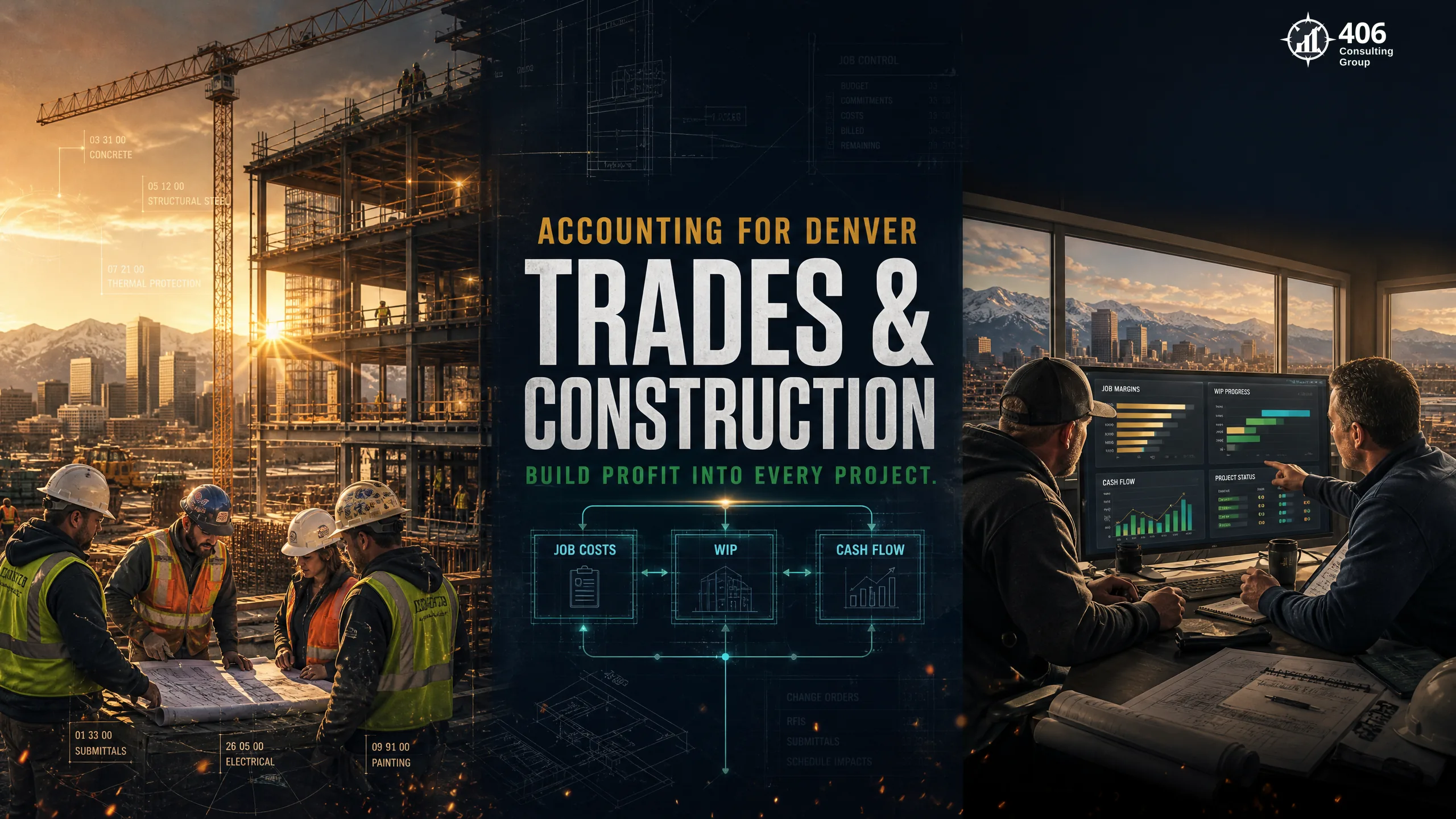
Few regions are building the way the Front Range is — high-rises and mixed-use downtown, healthcare and tech campuses, and residential racing to house relentless in-migration from Denver to Fort Collins. For the framers, electricians, plumbers, HVAC and concrete crews, and general contractors chasing it, the backlog is deep. What makes the accounting its own discipline is Colorado's particular setup: a flat income tax that hides a home-rule sales-and-use-tax maze, local contractor licensing instead of a single state license, use tax often collected right at the building permit, and a prevailing-wage rule on public work that caught many contractors off guard.
Three things shape a Colorado contractor's books most: you're the consumer of your materials (you pay the use tax, often at the permit), your license is local rather than statewide, and Colorado now has a prevailing wage on state public projects. Wrap job costing, WIP, and equipment around a market moving this fast, and clean construction books become their own discipline. This guide walks all of it, delivered remotely.
By Jason Anderson — Co-Founder, 406 Consulting Group. Big-firm-trained accountant serving contractors and trades — job costing, WIP, and the state rules, Colorado's included, that decide whether a bid holds its margin.
Quick Answer: Accounting for a Denver Contractor
- →You're the consumer of your materials: you pay Colorado use tax on them — often collected up front at the building permit.
- →Licensing is local — cities like Denver license general contractors; electricians and plumbers are licensed by the state.
- →Colorado has a prevailing wage on state public works (plus federal Davis-Bacon on federal jobs) — newer than many contractors realize.
- →Workers' comp is required for essentially any employee, and FAMLI applies to construction payroll too.
- →Delivered remotely — Colorado construction expertise over office proximity.
Table of Contents
Why Construction Accounting Is Its Own Discipline
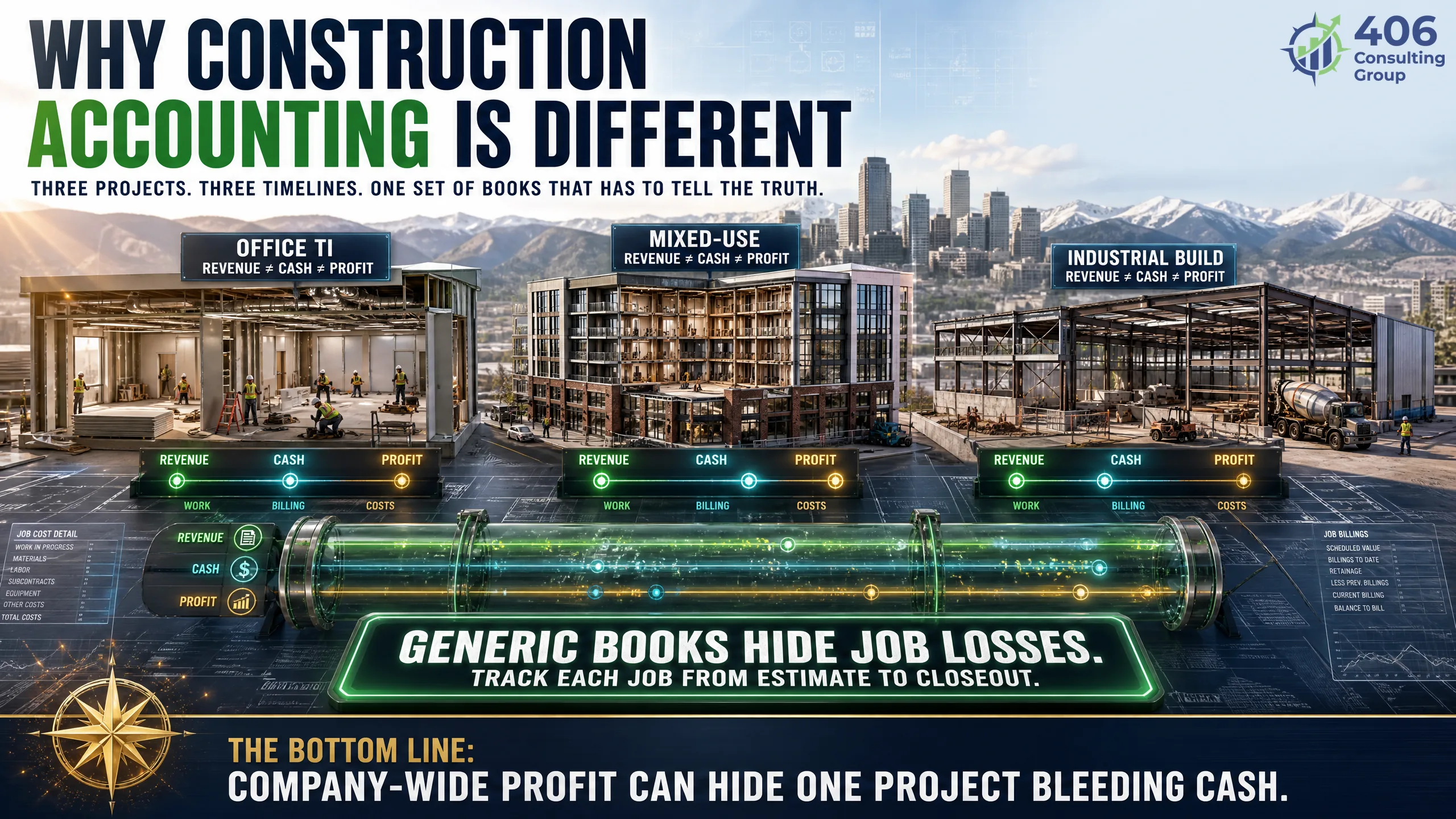
A contracting company hides its real numbers from ordinary bookkeeping. Revenue arrives as progress draws on jobs that run for months; costs scatter across labor, materials, subs, and equipment that each have to land on the right project; the owner holds retainage; change orders keep moving the target; and one underpriced bid can quietly swallow the profit from several good ones. Books that just categorize the bank feed and reconcile at tax time leave a builder guessing on the two questions that matter: is this job beating its estimate, and is the company as a whole making money?
In a market growing as fast as the Front Range, a costing blind spot you could shrug off at a dozen jobs a year turns expensive at forty — and if you forget to build the material use tax into a bid, it comes straight out of your margin.
Start with Colorado's tax and licensing frame — it's not what the "flat 4.4%" line suggests.
The Colorado Contractor Tax Picture
Colorado pairs a simple income tax with a complex local tax layer that lands hard on contractors. Here's the frame a Front Range builder works inside:
| Item | What it means for a contractor |
|---|---|
| Income tax | Flat 4.4% — simple; the PTE election can help pass-through owners beat the federal SALT cap |
| Sales & use tax | Home-rule and ~8.81% in Denver; you're the consumer of materials and pay use tax on them |
| Use tax at permit | Many jurisdictions collect a use-tax deposit at building-permit issuance, based on project valuation |
| Licensing | General-contractor licensing is local (city/county); electrical and plumbing are state-licensed |
| Prevailing wage | Colorado prevailing wage on state public works, plus federal Davis-Bacon on federal jobs |
| Workers' comp | Required for essentially any employee; FAMLI premiums apply to construction payroll too |

Verify current rates and rules with the Colorado Department of Revenue and your city. Two pieces catch contractors most — licensing and the use tax — so start there.
Colorado's Contractor Licensing
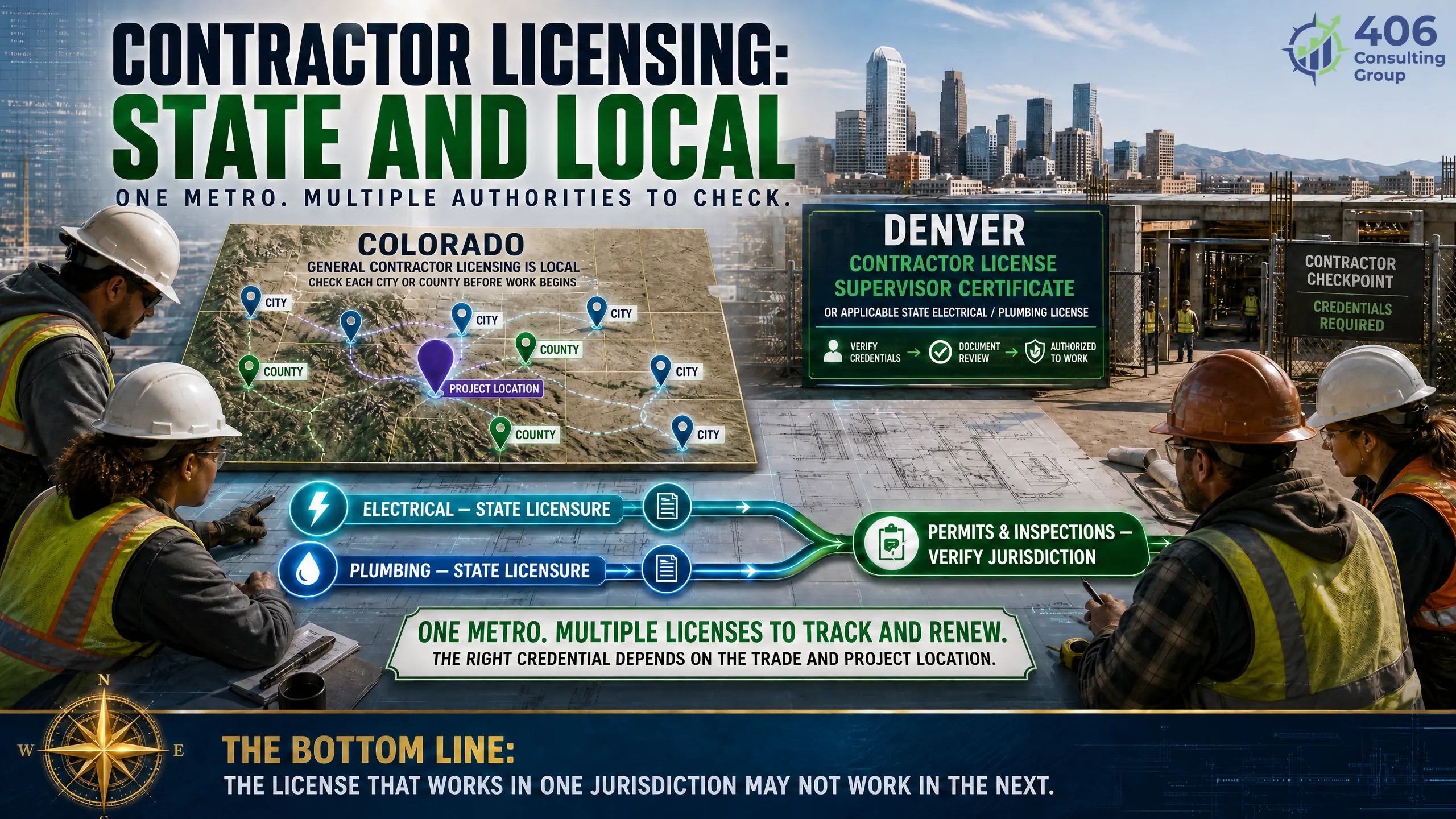
Unlike states that run a single statewide contractor license, Colorado leaves general-contractor licensing to cities and counties. Denver licenses contractors directly, and neighboring jurisdictions each have their own rules, classes, and exams — so a builder working across the metro can need multiple local licenses. The trades are different: electricians and plumbers are licensed by the statethrough Colorado's licensing boards. For your books, that means license fees, renewals, and any bonding or insurance tied to them are recurring obligations that vary by jurisdiction — and bidding work in a city you're not licensed in is a costly mistake.
There's no single Colorado contractor license to get. A GC working the metro may hold licenses in several cities at once — track them like the recurring obligations they are.
Licensing gets you allowed to work. The rule that shapes every invoice is how Colorado taxes your materials.
Use Tax on Materials — and at the Building Permit
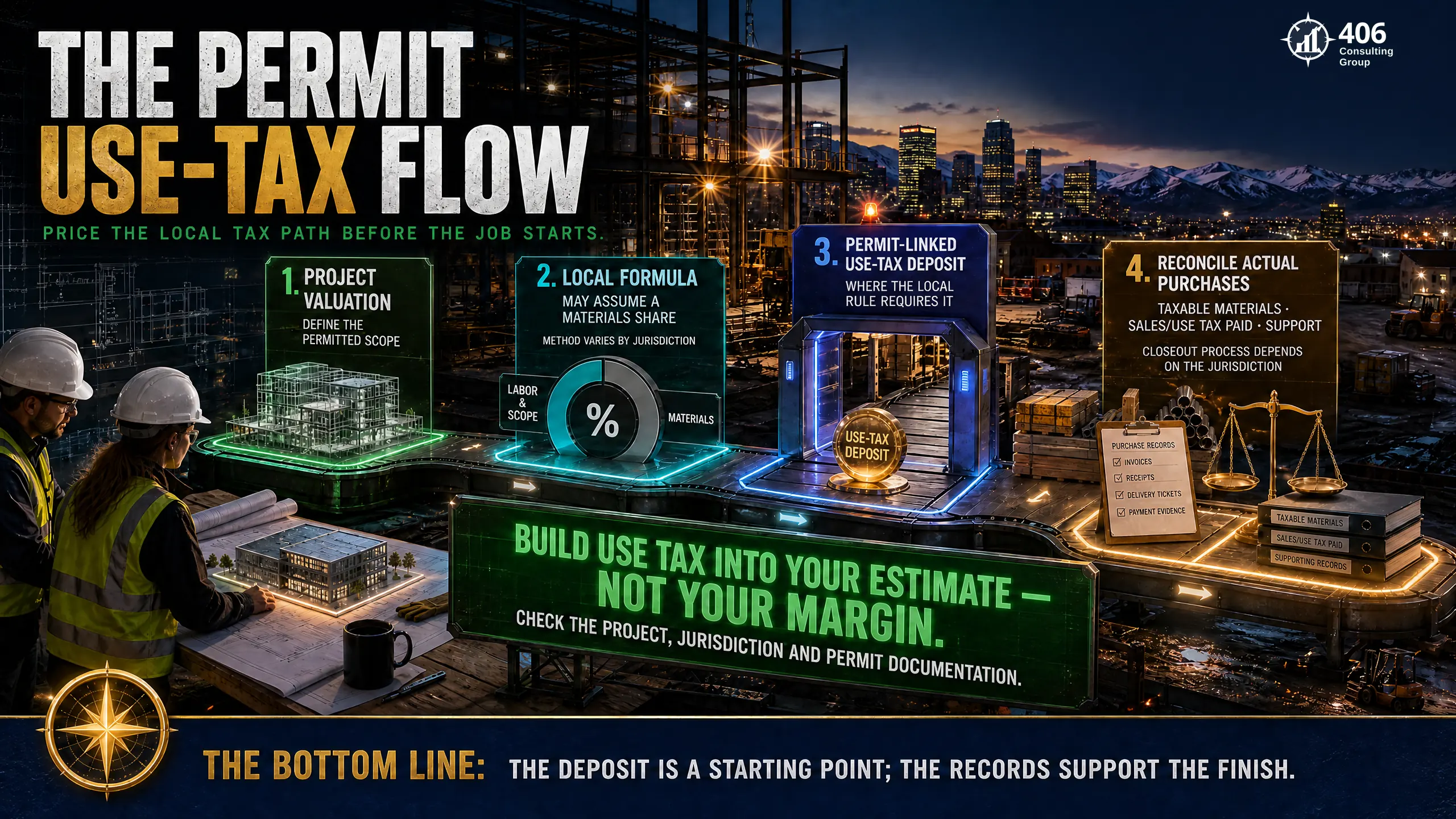
Colorado generally treats a construction contractor as the consumer of the materials permanently installed into real property. That means you owe sales or use tax on the lumber, wire, pipe, and fixtures you buy for a job — it's a cost of the work, not a tax you collect from the owner. The Colorado twist most contractors don't see coming: many jurisdictions, Denver included, collect a use-tax deposit right at building-permit issuance, estimated as a percentage of the project's valuation. You effectively prepay the material use tax when you pull the permit, then reconcile against what you actually bought.
What owners assume
You pay sales tax at the register when you buy materials, and that's the end of it.
The Colorado reality
You're the consumer — and a use-tax deposit is often collected at the permit, based on project valuation, then reconciled.
The whole game is building that material tax into your bid at the price you'll actually pay — and tracking the permit deposits so you don't double-pay or miss a reconciliation. Handle it right and it's predictable; ignore it and it erases margin before you break ground.
Confirm how use tax and permit deposits apply to your work with the Colorado Department of Revenueand your city. Now the market you're building into.
Building the Front Range: The Construction Boom
The Front Range construction market has a character worth building your books around. Commercial and high-rise work fills the Denver core; healthcare and tech campuses keep rising; industrial and energy construction follows the region's base; and residential and mixed-usestretch north to Fort Collins and south through the suburbs to house the in-migration. It's a deep, mixed runway that rewards contractors who can price and cost very different job types accurately.
Here's the counterintuitive part of a boom: the busiest years are when contractors most often go broke. When bids are easy to win, it's tempting to load the schedule and sort the numbers out later — but one underpriced high-rise, or a job you forgot to price the permit use tax into, can quietly erase the profit from three good ones, and you won't see it until the cash is gone. More work makes you stronger only if you can see the margin on each job and fund the gap between paying crews now and collecting later — which takes job costing, a live WIP schedule, and a cash forecast.
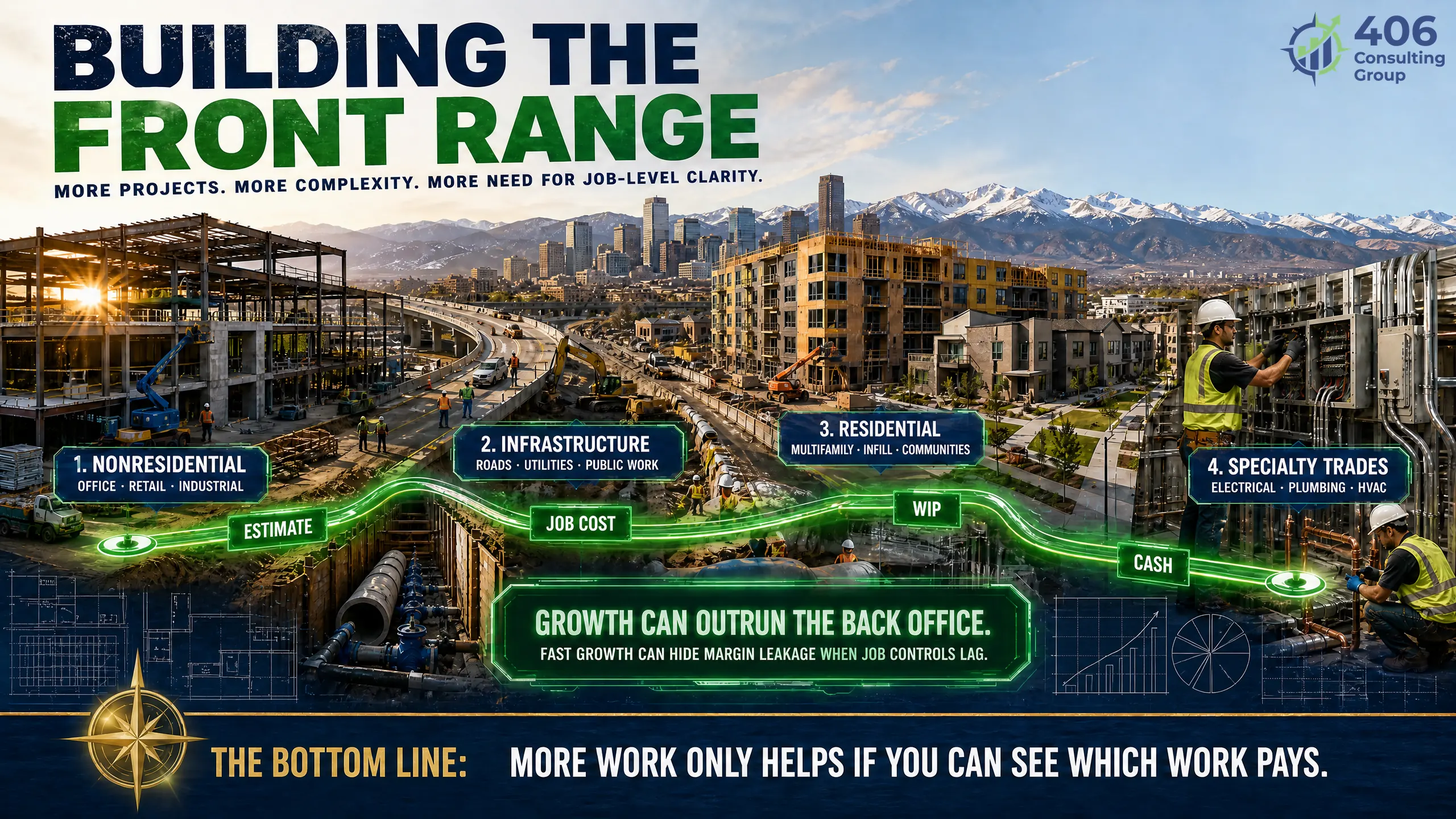
Growth is only good growth if it's profitable — and that's a bookkeeping question before it's a sales one.
Job Costing: Which Job Actually Makes Money
In a market this busy, the temptation is to keep saying yes — but without job costing, you can't tell the jobs that build your business from the ones quietly draining it. Job costing assigns every labor hour, every material invoice (at its taxed cost), every subcontractor bill, and every hour of equipment time to the specific project, so each job's true margin stands on its own instead of disappearing into a company-wide average. When you can see that a downtown high-rise runs thin while your healthcare tenant-improvement work carries the company, you bid and chase very differently.
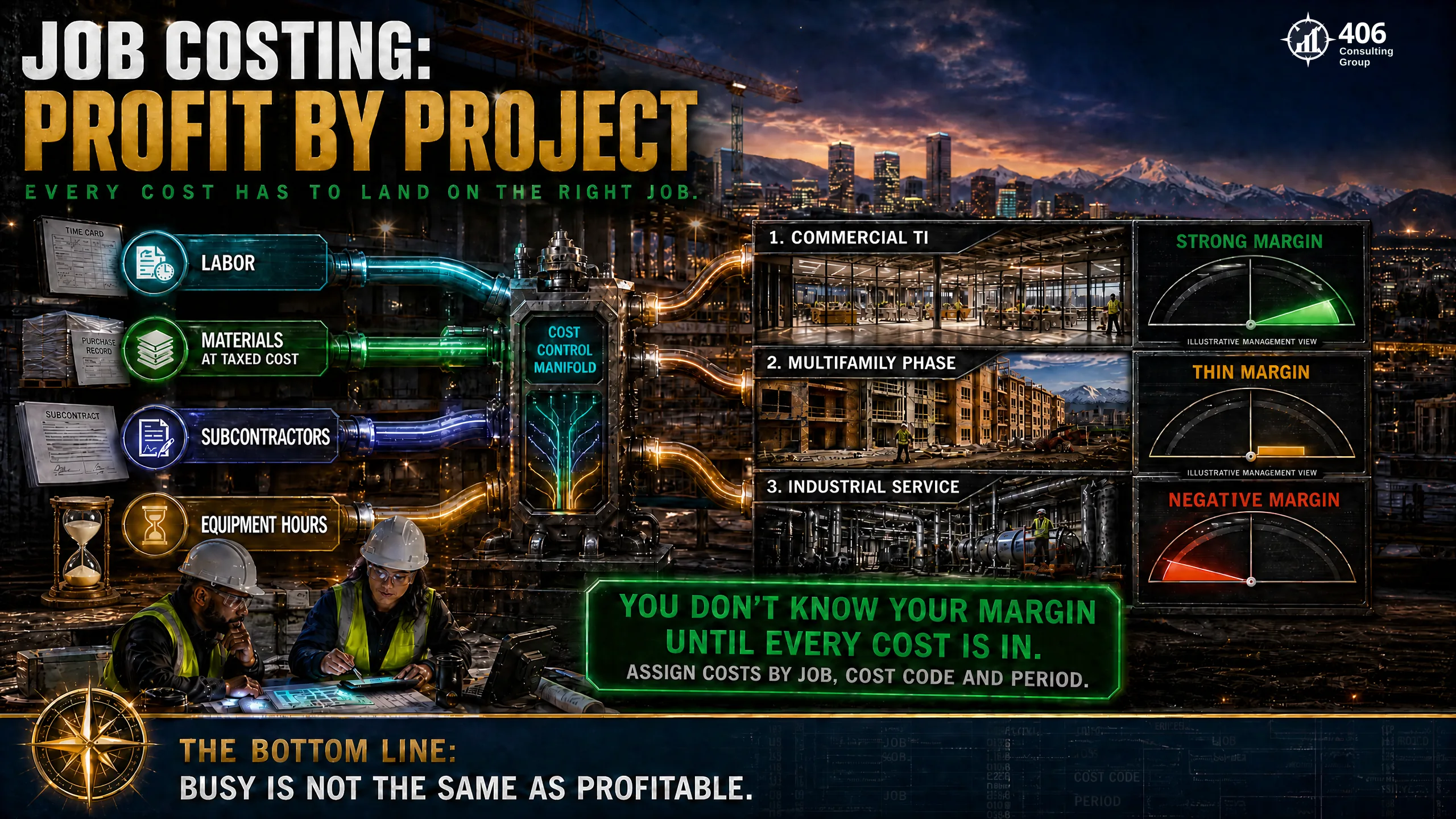
Figuring out which jobs and crews genuinely carry the business is the whole point of our contractor unit economics work — and job costing is what makes the answer visible.
WIP, Percentage-of-Completion, Retainage & Change Orders
Jobs that span months need reporting a plain ledger can't give you. A work-in-progress (WIP) schedule holds each open job's costs, billings, and estimated cost-to-complete together, so the relationship among them reveals whether you're over- or under-billed. Bill out ahead of the work and the surplus can flatter your cash while the costs are still coming; bill behind it and you're quietly lending the owner your working capital. Percentage-of-completion ties revenue to how far the job has actually gotten, keeping the monthly picture honest.
Add retainage — the slice held back to the end, which parks cash and belongs in its own receivable — and change orders, which shift scope and margin and must be logged and priced before the work gets absorbed into the job. In a growth market where you may be running more open jobs than ever, WIP discipline keeps a busy schedule from masquerading as a profitable one — and a clean WIP is exactly what a bank, a bonding agent, and a surety all want to see.
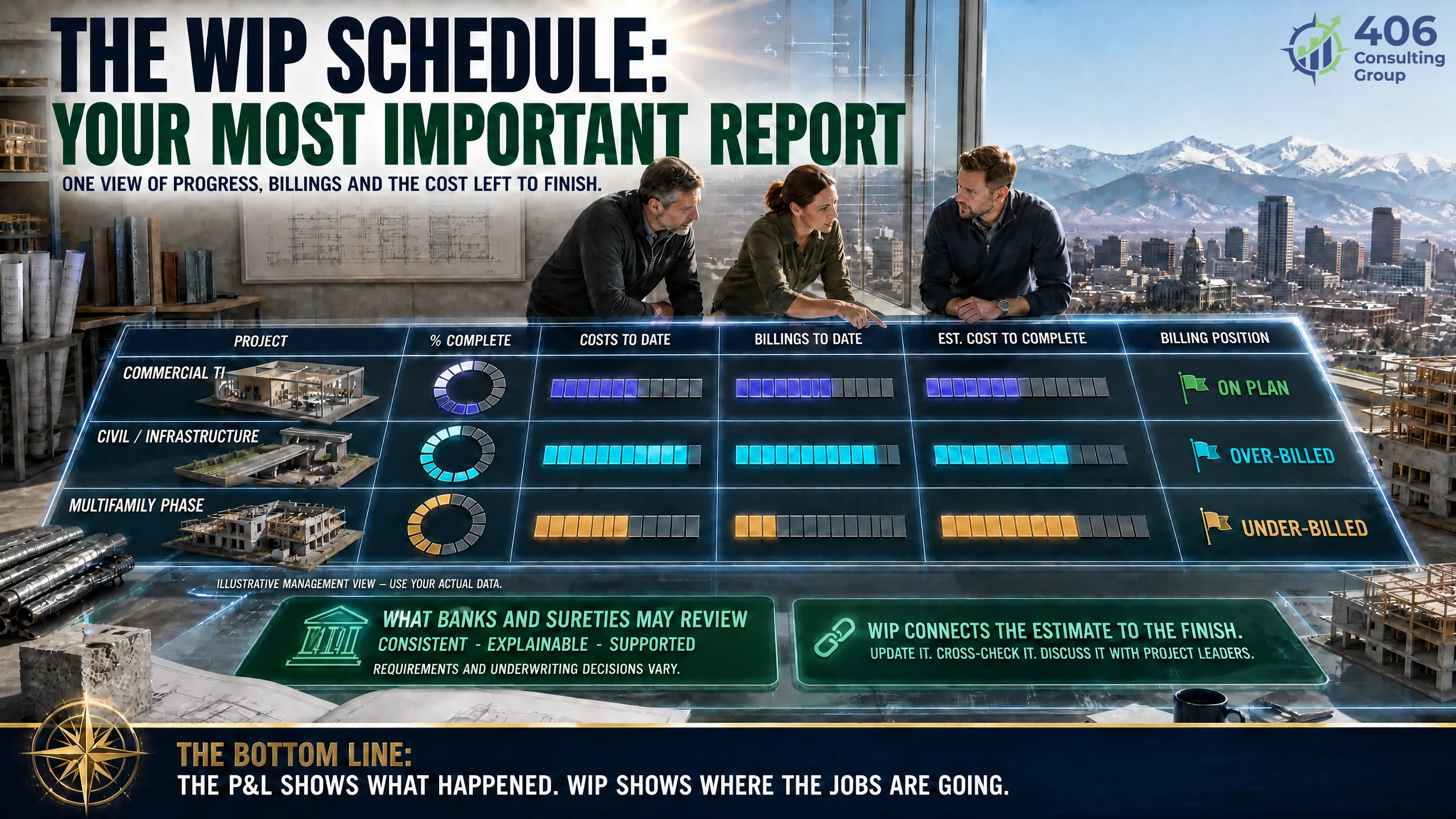
As you scale, this is where a controller or CFO function becomes worth it — the WIP is the report that tells you where the business truly stands.
Payroll, Workers' Comp & Prevailing Wage
Colorado construction payroll carries real weight. Workers' compensation is required for essentially any employee, and construction is a high-rate class, so it has to be tracked and coded correctly by job. Colorado also runs the FAMLI paid-leave program and state income-tax withholding, both of which flow through construction payroll. And on public work, Colorado now has a prevailing wage: recent state law requires prevailing wages and certified payroll on qualifying state-funded public projects, on top of the federal Davis-Bacon Act that already applies to federally funded jobs.
Workers' comp
Required for essentially any employee — construction is a high-rate class; code it by job.
Colorado prevailing wage
Certified payroll on qualifying state public works (newer than many contractors realize).
FAMLI + withholding
Paid-leave premiums and state income-tax withholding run through construction payroll.
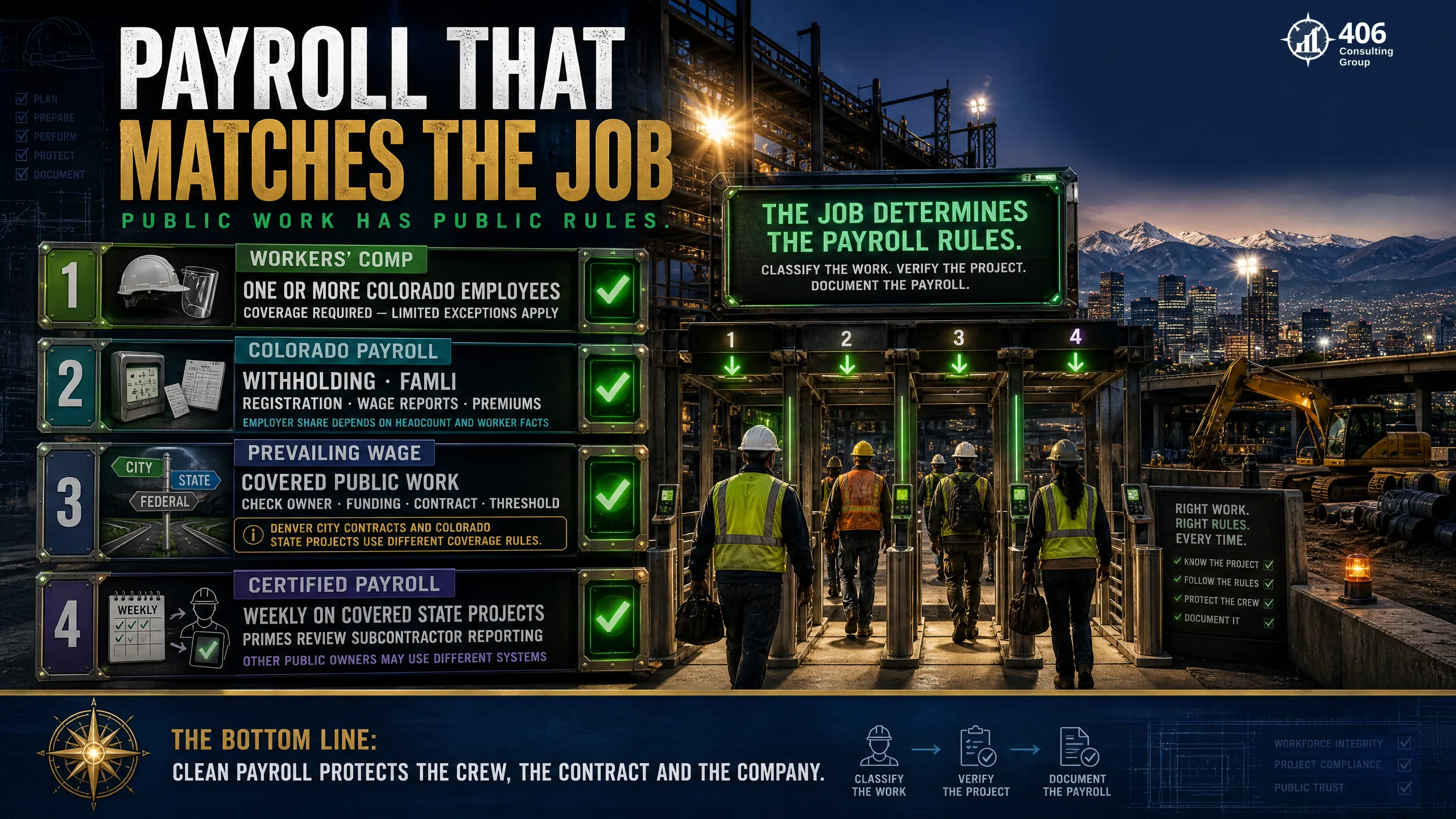
Beyond that, construction payroll means tracking labor to jobs so it feeds job costing, and handling a heavy mix of subcontractors and 1099s with correct worker classification. Our payroll work — certified payroll on prevailing-wage jobs included — keeps it running quietly in the background.
Equipment, Depreciation & Property Tax
Equipment reaches the books from a few directions. Federally, Section 179 and bonus depreciation can pull a large share of a truck, lift, or machine into the deduction for its purchase year — helpful as you scale, but a decision to weigh against your multi-year income rather than a reflex, and Colorado generally follows the federal §179 treatment. Colorado counties also assess a business personal-property tax on machinery and tools above an exemption threshold, filed on an annual declaration — so what you own has to be tracked, not just deducted.
A clean, current fixed-asset scheduledoes triple duty: it keeps depreciation and the property declaration accurate, and — because equipment hours belong on the jobs that used them — it feeds job costing so an idle machine shows up as the cost it is rather than hiding in overhead. Track what you own, what it costs to run, and where it's working.
Common Construction Bookkeeping Mistakes
Not pricing the material use tax
Bidding materials at shelf price and eating the use tax — a margin leak on every job.
Missing permit use-tax reconciliation
Prepaying a use-tax deposit at the permit and never reconciling it against actual purchases.
Bidding unlicensed
Taking work in a metro city you don't hold a contractor license in — a costly, avoidable mistake.
No WIP schedule
Running long jobs with no over/under-billing view, so a busy schedule hides a cash problem.
Prevailing-wage surprises
Bidding public work without pricing certified payroll and prevailing wages into the job.
Every one of these is avoidable with the right setup — which raises the question of whether that setup has to come from someone with a Denver office.
Local vs. a Great Remote Partner
A builder's office is the truck and the trailer, so working with a remote accountant matches how you already operate. Everything runs on cloud accounting and job-costing software, with field-captured receipts and hours, live bank feeds, and a monthly close you can rely on. For a Colorado construction business the deciding factor is expertise — the consumer-of-materials and permit use-tax rules, local licensing, prevailing wage, job costing, and WIP — not how close the office is.
We serve Denver and Front Range contractors the same whether you're downtown, up in Fort Collins, or out in the suburbs — the whole relationship runs remotely.
How to Get Started
Getting clean starts with a look at how your jobs are costed, whether your WIP is real, how you're handling material use tax and permit deposits, and whether your licensing and payroll are set up for Colorado. From there it's a clear path to books that tell you the truth about every job.
Build the Front Range on books you can trust.
Let's get your job costing, WIP, use tax, and prevailing-wage payroll set up right — so every bid holds its margin. Start with where your business stands today.
For the full Denver picture — bookkeeping, tax, and the CFO layer — see the rest of our Denver accounting series.
FAQ: Denver Construction Accounting
Do I need a contractor's license in Colorado?
Usually yes, and it's local. Colorado doesn't issue a single statewide general-contractor license — cities and counties license GCs individually, so Denver licenses contractors directly and neighboring jurisdictions each have their own requirements, meaning a builder working across the metro may need multiple local licenses. The trades are handled differently: electricians and plumbers are licensed by the state of Colorado. Confirm the specific license, class, bond, and insurance requirements with each city or county you plan to work in — bidding work where you're not licensed is a costly mistake.
Do Colorado contractors charge customers sales tax on a job?
Generally not on real-property construction. Colorado treats a contractor who permanently installs materials into real property as the consumer of those materials, so you pay sales or use tax when you buy them and don't charge the property owner sales tax on the construction itself. The Colorado wrinkle: many jurisdictions, including Denver, collect a use-tax deposit at building-permit issuance, estimated as a percentage of the project's valuation, which you then reconcile against actual purchases. Build the material use tax into your bids and track the permit deposits. Confirm the details with the Colorado Department of Revenue and your city.
Is there prevailing wage in Colorado?
Yes, on public work. Colorado enacted a state prevailing-wage law that requires prevailing wages and certified payroll on qualifying state-funded public construction projects — newer than many contractors realize, and separate from the federal Davis-Bacon Act, which requires certified payroll on federally funded jobs. On ordinary private work there's no prevailing wage, but if you bid public projects you need to price certified payroll and the prevailing wage rates into the job from the start. Confirm which projects trigger it with the Colorado Department of Labor and Employment.
What taxes and payroll rules hit a Denver construction business?
A flat 4.4% income tax (with the PTE election available to pass-throughs); home-rule sales and use tax around 8.81% in Denver, where you're the consumer of materials and use tax is often collected at the building permit; workers' compensation required for essentially any employee at construction's high rate class; FAMLI paid-leave premiums and state income-tax withholding through payroll; a county business personal-property tax on equipment; and prevailing wage plus certified payroll on qualifying public work. Confirm specifics with the Colorado Department of Revenue and your city and county.
Can 406 Consulting Group do my Denver construction bookkeeping remotely?
Yes — a builder's office is the truck and the trailer, so working with a remote accountant matches how you already operate. Everything runs on cloud accounting and job-costing software, with field-captured receipts and hours, live bank feeds, and a monthly close you can rely on. For a Colorado construction business the deciding factor is expertise — the consumer-of-materials and permit use-tax rules, local licensing, prevailing wage, job costing, and WIP — not how close the office is. We serve Denver and Front Range contractors entirely remotely.
CO Contractor Facts
What shapes the books
Denver Construction Books
Remote, contractor-savvy.
About the Author
Jason Anderson
Co-Founder, 406 Consulting Group
Jason serves contractors and trades — job costing, WIP, and the state rules, Colorado's included, that decide whether a bid holds its margin — building clean construction books delivered remotely.
Read the Full Story