
Accounting for Idaho Falls Small Businesses:
The Right Financial Help at Each Stage
Idaho Falls runs five economies at once — INL contractors, Snake River Plain ag, healthcare, the boomtown trades, and Yellowstone-Teton tourism — and each needs a different kind of financial help in a different order. This hub maps the whole landscape, places you on the Financial Maturity Ladder, and points you to the right next step, delivered remotely across Idaho.

Here is the moment this article is about. You are an Idaho Falls owner, the bank balance looks fine, and you are staring at a decision you can't make from a bank balance: do you bid the INL subcontract that needs reviewed financials, hire the controller your lender keeps hinting at, or buy the second truck before the Rexburg job starts? The money is sitting there. The answer isn't — because a checking account tells you what happened, not what you can afford to do next.
That gap is the whole reason this guide exists. Idaho Falls looks like one town, but it runs four or five different economies at once — the Idaho National Laboratory and its contractor ecosystem, the Snake River Plain's potato-barley-dairy machine, a healthcare-and-consumer-products hub anchored by EIRMC and Melaleuca, a boomtown construction surge, and the tourist flow to Yellowstone and the Tetons. Each of those businesses needs a different kind of financial help, and — just as important — needs it in a different order as it grows. This is the hub article: it maps the whole landscape, shows you where you sit on one simple ladder, and points you to the deeper guide for your exact situation.
We'll use one framework the whole way through — our Financial Maturity Ladder — so instead of a menu of services you can't rank, you get a straight answer to the only question that matters: where are you now, and what's the next rung?
By Jason Anderson — Co-Founder, 406 Consulting Group. Big-firm accounting background plus Six Sigma process and job-costing systems. Jason and co-founder Carrie Anderson have run whole businesses — trucking, construction, and oilfield operations — not just booked them, and build financial systems for Idaho Falls owners from a whole-company view, delivered remotely across Idaho.
Quick Answer: What Kind of Help Do You Need?
- →If your books are behind or you don't trust the numbers — you need bookkeeping. That's Rung 1, and nothing else works until it's solid.
- →If the books are clean but nobody's steering — you need a controller for reliable monthly reporting, then a fractional CFO for forecasting and financing.
- →If you're profitable and overpaying the IRS — you need proactive tax strategy (S-corp math, Idaho's ABE election, equipment timing).
- →If you're in the trades — your financials literally gate what you're allowed to register for and bid, so the books are a business asset, not a chore.
- →Not sure? The Financial Maturity Assessment places you on the ladder in about two minutes — all of it delivered remotely across Idaho.
Table of Contents
Idaho Falls Isn't One Economy — It's Five
Most "small business accounting" advice treats every company the same. In Idaho Falls that's a trap, because the business two doors down may live in a completely different financial world than you do. The Idaho National Laboratory alone anchors a research-and-contractor ecosystem of thousands of jobs and billions in economic impact, and roughly two spinoff jobs ride on every lab job. Around it sit the Snake River Plain's producers, a healthcare-and-consumer-products hub, a construction boom, and a steady tourist river headed to Yellowstone and the Tetons. Same zip codes, five different sets of books.
INL & federal-contractor ecosystem
Engineering, R&D, and specialty subs serving the lab. Needs job costing, indirect/overhead rates, and federal-contract (DCAA-style) rigor — the books have to survive scrutiny.
Snake River Plain agriculture
Potatoes (United Potato Growers of Idaho is headquartered here), barley for the malt operation, and dairy. Seasonality, ag-processing margins, and equipment financing dominate.
Healthcare & consumer products
EIRMC as the regional medical hub plus Melaleuca's large HQ, and the clinics, practices, and suppliers around them. Payroll scale and clean reporting matter most.
The boomtown trades
A fast-growing population in Ammon, Iona, Ucon, and Rigby is driving a construction surge — where your financials set your bid ceiling (more below).
Yellowstone & Teton tourism
Lodging, outfitters, restaurants, and retail that make their year in a few months. Cash-flow timing and seasonality are the whole game.
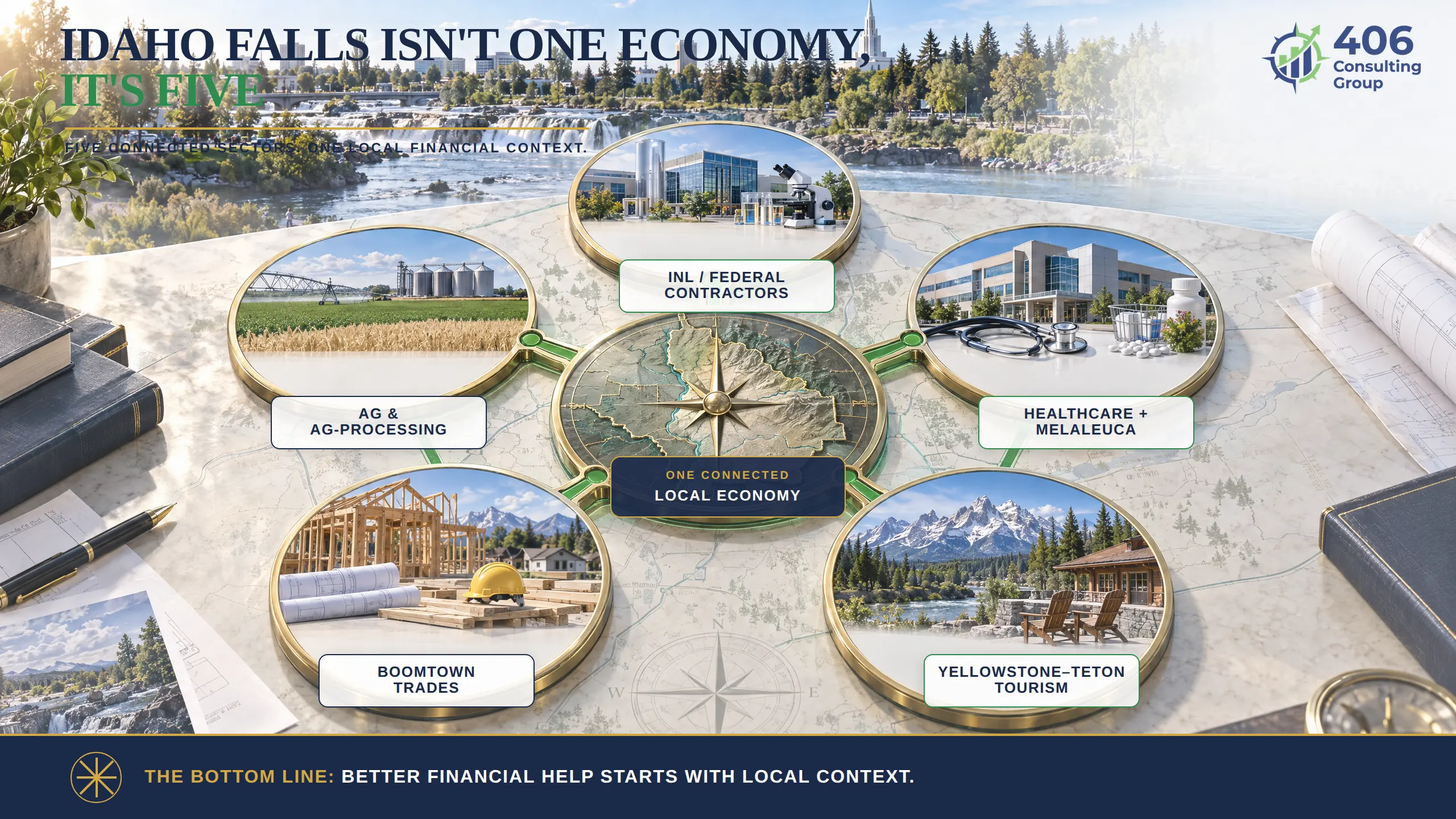
Here's why that matters for the fee you're about to pay someone: the real cost of the wrong accounting isn't the monthly bill — it's the INL bid you couldn't make because your overhead rates were a guess, or the potato-shed line that bled margin all season while the bank balance looked fine. The question isn't "who's cheapest." It's "who understands which of these five worlds I live in, and what I need next." That's what the rest of this guide answers.
The Financial Maturity Ladder: Where Are You Right Now?
Owners get stuck because "accounting" is sold as a pile of services with no order to them — bookkeeping, controller, CFO, tax — and it's impossible to buy what you can't rank. So we throw it out and use one simple picture instead. Every business sits on one of four rungs, and the only move that ever makes sense is the next one up. Figure out your rung and you've figured out your decision.
Rung 1: Chaos — needs Clean, current bookkeeping
"I don't really know what my numbers are."
Books are behind, in a shoebox, or in a spreadsheet you don't trust. Every other rung is built on this one, so nothing else works until it's fixed.
Rung 2: Compliance — needs Bookkeeping + proactive tax
"The books are done, taxes get filed on time."
You're clean and legal — but reactive. The numbers tell you the past, and you're probably overpaying tax because nobody's planning ahead.
Rung 3: Control — needs A controller
"I get reliable reports every month and I act on them."
Monthly close, real margins by job or product line, and someone making sure the numbers are right and on time. This is where you stop being surprised.
Rung 4: Strategy — needs A fractional CFO + tax strategy
"I use my numbers to decide where the business goes."
Forecasting, financing readiness, pricing, and growth decisions driven by the numbers. This is the rung lenders and buyers reward.

Two rules keep this honest. You can't skip rungs — a parachute CFO dropped onto broken books just produces confident reports built on bad data. And you shouldn't over-buy — a one-truck startup in Shelley doesn't need a CFO, it needs clean books and a smart tax election. Not sure which rung you're on? The Financial Maturity Assessmentplaces you in about two minutes. The next four sections walk the ladder rung by rung — and hand you off to the deeper Idaho Falls guide for each one.
Rung 1 → 2: Clean Books (The Base Everything Reads From)
The moment this bites: a lender at a Bonneville County bank asks for a current profit-and-loss and a balance sheet, and you realize the file you'd hand over is three months stale and doesn't tie to the bank. That pause — that little flush of "let me get back to you" — is the sound of Rung 1 not being solid. And it costs real money: the equipment loan that stalls, the sales-tax liability you spent because it looked like cash, the year-end scramble where your preparer is reconstructing instead of planning.
Clean books aren't data entry — they're the instrument panel. Done right for an Idaho Falls business, they track the state's 6% sales tax as a liability (never as spendable cash), flag use tax on equipment or materials bought out-of-state without tax, keep inventory and cost of goods honest for a producer, and leave profit readable so you can set aside for Idaho's flat 5.3% income tax as you earn. That's the difference between a shoebox and an instrument you can fly by.

If your books have fallen behind — and for most owners on Rung 1 they have — that's the whole job right now. We cover Idaho Falls bookkeeping in depth, including the seller's permit, use tax, and getting current fast, in the Idaho Falls bookkeeping guide, and you can see the service itself under bookkeeping.
Rung 3: Control — When You Need a Controller
The tell that you've outgrown Rung 2 isn't revenue — it's surprise. The job that looked profitable in your head lost money. Payroll crept up and nobody caught it. You can't say which of your three INL subcontracts actually earns its keep. Clean books record the past faithfully; a controller makes the numbers tell you the truth every month, on time, and in a form you can act on.
Say an Ammon electrical sub (illustrative) is running three jobs at once. A bookkeeper tells them the bank balance. A controller runs a monthly close, costs each job, and shows that the hospital-remodel work earns 34% while the tract-home wiring barely breaks even — so the owner stops chasing the cheap work. That's control: reliable reporting plus someone whose job is to make sure the numbers are right. Skip it and the cost isn't a fee, it's a year of chasing the wrong jobs because the bank balance never told you they were the wrong jobs.

Where to go deeper: the Idaho Falls CFO & controller guide walks through exactly when a controller pays for itself, and the controller service shows what it includes.
Rung 4: Strategy — When You Need a Fractional CFO
Rung 4 is where the numbers stop describing the business and start driving it. The questions change: Can we afford to take on the second potato-storage facility and the crew to run it? What does the cash look like six months out if we win the bigger INL contract? What has to be true for the bank to say yes? A fractional CFO answers those — forecasting, pricing, financing readiness, and the strategy that turns a good operator into a business that compounds.
Here's the unfair advantage most Idaho Falls owners never get access to: our co-founder Carrie spent her career in commercial banking and underwriting — she has reviewed more than 300 loans and sat in the exact seat that decides whether yours gets approved. So when we build a financing package or a forecast, we build the one the underwriter is actually looking for, because one of us used to bethe underwriter. Pair that with a big-firm, Six-Sigma systems background on the operations side, and you get CFO guidance from people who have run whole businesses — trucking, construction, oilfield — not just booked them. Risking a seven-figure growth decision to save a few hundred a month on advice is the kind of math that only looks smart until the decision goes wrong.
The full picture — what a fractional CFO does, and how controller and CFO work fit together — is in the Idaho Falls CFO & controller guide, with the service under fractional CFO.
The Tax Layer That Sits Over Every Rung
Tax isn't a rung — it rides alongside all of them, and it's where a profitable Idaho Falls business most often leaves money on the table. The difference between a filer and a planner is a season: a filer records what already happened in April; a planner changes what happens before year-end. On a profitable business, that gap is routinely five figures a year.
S-corp election
Splits pay into salary (payroll tax) and distribution (no 15.3% self-employment tax) on a profitable business — a reasonable salary still required.
Idaho's ABE election
Idaho lets S-corps and partnerships pay state tax at the entity level, making it federally deductible and sidestepping the federal SALT cap (now $40,000 post-OBBBA).
Equipment timing (Section 179)
Because Idaho taxes income, a well-timed equipment deduction cuts both your federal and your 5.3% Idaho bill — it works twice.
Retirement + income timing
Funding a plan and managing income across the year lowers taxable income on both returns at once.

Run your own S-corp numbers with the S-Corp calculator or compare structures with the LLC vs. S-corp tool, then go deep on the ABE election and the full planning playbook in the Idaho Falls tax guide and our tax planning service.
The Boomtown Trades Exception: Your Books Set Your Bid Ceiling
If you're a contractor riding the Idaho Falls construction surge, your financials aren't a chore — they're a license and a bid limit. Two things make the trades different from every other business on this ladder, and both are worth real money.
Registration is gated by your insurance and comp
Idaho has no general-contractor exam for private work, but construction with an aggregate contract price of $2,000 or more requires Idaho Contractor Registration (RCE) with the state Contractors Board — and registration requires proof of at least $300,000 in general liability plus workers' comp coverage (or a signed exemption). Your compliance literally gates your ability to register and work.
Public-works bids are gated by your financial statements
To bid public projects above the state threshold you need a Public Works Contractor License — and the license class, which sets how large a project you're allowed to bid, is determined by CPA-prepared financial statements. Higher classes require reviewed or audited statements; lower classes a compilation; and they must be under 12 months old. Clean, CPA-ready financials are the difference between bidding the small job and the big one.
That's the killer point for a growing Rigby or Ucon contractor: let your books slide and you don't just risk an audit — you cap the size of the jobs the state will let you bid. Idaho contractors are also the consumer of materials (you pay 6% sales tax at purchase and don't bill it to the customer), and there's no state prevailing wage. We cover all of it — registration, the bid-ceiling angle, job costing, and material tax — in the Idaho Falls trades & construction guide and for the industry under general contractors.
Which Help Your Kind of Business Actually Needs
The ladder is universal, but where you tend to get stuck — and what you should buy next — depends on which Idaho Falls economy you live in. Here's the short version for the five big ones (examples are illustrative).
| Your business | What bites first | Usually needs next |
|---|---|---|
| INL / federal contractor | Indirect & overhead rates, job costing, audit-ready books | Controller, then CFO |
| Potato / barley / dairy ag | Seasonality, equipment financing, real COGS & input costs | Bookkeeping + CFO for financing |
| Healthcare practice / clinic | Payroll scale, clean monthly reporting, entity/tax structure | Controller + tax planning |
| Trades & construction | Registration, bid-ceiling financials, material sales tax, job costing | Bookkeeping + CPA-ready statements |
| Tourism / hospitality | Seasonal cash-flow timing, sales tax, payroll swings | Bookkeeping + cash forecasting |
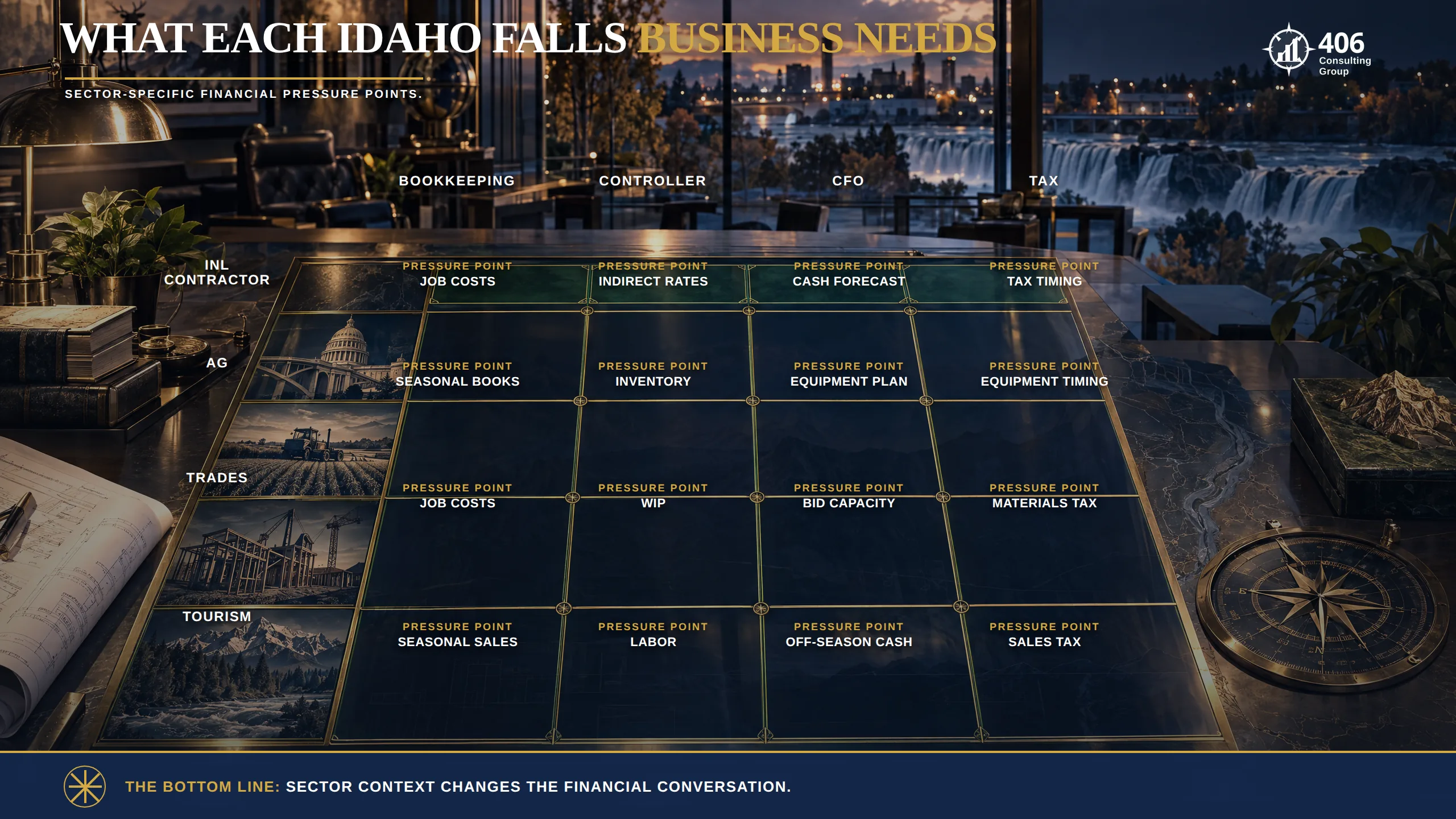
Different details, one backbone: get clean books first, layer tax planning over them, and bring in control and strategy as you grow. The reason we can read all five of these worlds is that our background is running whole businesses across operations, purchasing, and job costing — so we design the financial system around how your whole company runs, not just the ledger.
The Idaho Tax Picture, in One Place
Whatever rung you're on, the Idaho rules underneath don't change — and the good news is they're refreshingly clean compared with a home-rule state. Here's the whole picture so nothing surprises you.
| Tax | Idaho Falls reality |
|---|---|
| Income tax | 5.3% flat — individual and corporate (2025 HB 40, carries into 2026). Pass-through profit lands on the owner's return. |
| Sales & use tax | 6% state, with NO local-option tax in Idaho Falls (local option is resort-city only) — a clean flat 6%, unlike Colorado's home-rule patchwork. |
| Use tax | Equipment or materials bought out-of-state without sales tax still owe 6% — the edge an audit finds. |
| ABE election | S-corps & partnerships can pay Idaho tax at the entity level to sidestep the federal SALT cap; owners get a credit. |
| Self-employment tax | 15.3% up to the Social Security wage base, 2.9% above — the gap an S-corp election targets. |
| Payroll | Federal + Idaho 5.3% withholding, state unemployment insurance, and workers' comp once you have employees. |
A figure or two moves each year — the Social Security wage base and the exact public-works threshold, for instance — so verify the current numbers rather than treating any single figure as gospel. For the deadlines that matter, see tax deadlines, and to pick the right structure start with business entities.
The Generalist Down the Street vs. a Specialist Team
The instinct is to hire the firm with the Idaho Falls address, because "local" feels safe. But proximity isn't the thing that saves you money — fit is. A local-only generalist handling a little of everything can't go as deep on your overhead rates, your ABE election, or your public-works bid ceiling as a team that specializes. The question was never "how far away is my accountant," it was "does my accountant actually know my world — and can I reach them when it counts."
The local-only generalist
- ·One person stretched across every industry and service
- ·Often a filer, not a planner — reactive at tax time
- ·You're one of hundreds; response can mean waiting days
- ·"Local" mostly means you can drive there — which you won't
A specialist remote team (how we work)
- →A bookkeeper, controller, CFO, and tax specialist — not one generalist
- →Proactive planning built around the Idaho rules above
- →Secure cloud accounting and connected bank feeds — faster response, not slower
- →An underwriter's eye on financing and operators who've run whole businesses

And here's the part that surprises people: remote is how modern accounting already works — roughly 70–80% of even our own local clients never set foot in the office. The whole relationship runs on secure cloud accounting, shared screens, and a steady rhythm, so an Idaho Falls business gets the same responsive, Idaho-savvy service an in-town client would — with a specialist on each piece instead of one generalist stretched thin. A great remote team beats an okay local one, every time.
Where to Start
You don't have to boil the ocean. The whole point of the ladder is that there's only ever one next move — so start there.
Find your rung
Take the Financial Maturity Assessment — about two minutes — and get an honest read on where you actually sit.
Fix the base if it needs it
If the books are behind or you don't trust them, nothing else matters yet. Get current and Idaho-ready first.
Layer the next rung
Add tax planning, then a controller, then a CFO — in that order, only as the business is ready for each.
Wherever you are on the ladder, we can meet you there — and because we build from a whole-company view, the system we set up fits how your Idaho Falls business actually runs.
FAQ: Idaho Falls Small-Business Accounting
What kind of accounting help does my Idaho Falls business actually need?
It depends on where you sit on the Financial Maturity Ladder. If your books are behind or you don't trust the numbers, you need bookkeeping (Rung 1) before anything else. If the books are clean but nobody's steering, you need a controller for reliable monthly reporting (Rung 3), then a fractional CFO for forecasting and financing (Rung 4). Proactive tax planning rides over every rung. The Financial Maturity Assessment places you in about two minutes so you know the one next move to make.
What taxes does an Idaho Falls small business pay?
Idaho has a flat 5.3% income tax on both individuals and corporations (2025 HB 40, carrying into 2026), and for most small businesses that profit flows through to the owner's return. You also collect and remit a 6% sales tax — and Idaho Falls has no local-option sales tax, so it's a clean flat 6% — plus use tax on untaxed out-of-state purchases. Employers handle Idaho withholding, state unemployment insurance, and workers' comp. S-corps and partnerships can also make Idaho's ABE election to pay state tax at the entity level and sidestep the federal SALT cap.
How is accounting different for an INL contractor versus an ag or trades business?
The Financial Maturity Ladder is the same for all of them, but the pressure points differ. An INL or federal contractor needs job costing, indirect and overhead rates, and audit-ready books. A Snake River Plain ag business wrestles with seasonality, real COGS, and equipment financing. A trades company's financials literally set its registration and public-works bid ceiling. Tourism lives and dies on seasonal cash-flow timing. We read all of these because our background is in running whole businesses, not just booking them.
Why do a contractor's books matter so much in Idaho Falls?
Because in the trades your financials are a license and a bid limit. Idaho construction with an aggregate contract price of $2,000 or more requires Idaho Contractor Registration, which in turn requires proof of at least $300,000 in general liability and workers' comp (or a signed exemption). And to bid public-works projects above the state threshold you need a Public Works Contractor License whose class — and therefore the size of the job you're allowed to bid — is set by CPA-prepared financial statements less than 12 months old. Clean books don't just avoid an audit; they raise your bid ceiling.
Is a remote accounting firm really better than a local one in Idaho Falls?
For most businesses, yes — because fit beats proximity. A local-only generalist handles a little of everything; a specialist remote team gives you a bookkeeper, controller, CFO, and tax specialist who each go deep on your world. The work runs on secure cloud accounting and connected bank feeds, which means faster response, not slower. In fact roughly 70–80% of our own local clients never come into the office. A great remote team beats an okay local one.
Does 406 Consulting Group provide accounting services in Idaho Falls, ID?
Yes. We serve Idaho Falls and the surrounding communities — Ammon, Iona, Ucon, Shelley, Rigby, Rexburg, Blackfoot, and the rest of Bonneville and Bingham counties — with bookkeeping, payroll, fractional controller and CFO services, and proactive tax planning, all delivered remotely through secure cloud accounting. Because our founders have run whole businesses across operations, construction, trucking, and oilfield — and bring a commercial-underwriting lens from more than 300 loan reviews — we design the financial system around your entire operation, not just the ledger.
Serving Idaho Falls & Eastern Idaho
Keep Reading — The Idaho Falls Series
Small-Business Accounting — Idaho Falls, ID
Find Your Rung. Make the Next Move.
406 Consulting Group gives Idaho Falls owners Idaho-ready books, proactive tax strategy, and the controller and CFO leadership to grow — a specialist on every piece, delivered remotely across Idaho. Start with the one next move that fits where you are.
Idaho Falls Quick Reference
Bonneville & Bingham Counties
The Financial Maturity Ladder
Which Rung Are You On?
Find your next move in about two minutes.
About the Author
Jason Anderson
Co-Founder, 406 Consulting Group
Big-firm accounting background plus Six Sigma process and job-costing systems. Jason and co-founder Carrie Anderson have run whole businesses — trucking, construction, and oilfield operations — not just booked them, and build financial systems for Idaho Falls owners from a whole-company view.
Read the Full Story